Sweet Addiction Summary, Characters and Themes
Sweet Addiction by Bella Matthews is a contemporary romance that mixes small-town comfort with the high-pressure world of professional MMA and sudden fame. Dillan Ryan wants a quiet, self-made life—running her romance bookstore, teaching yoga, and writing under a secret pen name to protect her peace.
Rome Beneventi is a star fighter with everything on the line: a career-defining title shot and an image the public keeps trying to rewrite for him. When a scandal forces them into a fake relationship, old hurt flares up, attraction refuses to stay buried, and both of them must decide what they’re willing to risk for love, truth, and security. It’s the 2nd book in the Love & Legacy series.
Summary
Two years ago, Dillan Ryan agrees to a setup date at a bar called West End, even though she already suspects it’s a bad idea. Her date, Kevin Kosen, looks perfect on the surface—charming smile, polished clothes, brag-ready job—but he spends the night talking about himself and checking his phone.
Worse, he keeps steering the conversation toward Dillan’s sister, Lilah, who is famous and frequently in the public eye. Dillan quickly realizes she isn’t the target of Kevin’s interest; she’s a stepping stone.
Across the room, Rome Beneventi—an MMA fighter known for winning and for being hard to impress—feels restless after a fight victory that should have satisfied him. The attention around him feels empty, and he’s ready to leave when he notices Dillan trapped in a miserable date.
Kevin barely looks up at her. Dillan’s frustration shows in every stiff movement.
Rome decides he can’t just watch it happen.
He strides over and interrupts with a ridiculous “emergency,” blurting out a crude half-sentence before pivoting into a fake story about Dillan’s “cat” being hit by a car. Dillan catches on instantly and plays along, naming the imaginary pet Puss and Boots.
The excuse gives her the out she needs, and she leaves Kevin behind without a second glance.
Outside, cold air and snow snap the moment into focus. Dillan scolds Rome for his crude approach and his absurd lie, but she can’t deny he rescued her.
Rome insists she isn’t taking a ride alone and points to his motorcycle. Dillan argues—it’s dangerous, it’s cold, she’s dressed wrong for it—but curiosity and adrenaline win.
She climbs on behind him, holds on tight, and arrives home shaken, thrilled, and annoyed with herself for enjoying it.
At her door, Rome doesn’t pretend to be subtle. He asks to be invited inside.
Dillan challenges him, but instead of sending him away, she offers tequila. They end up on her living-room floor, talking long past the point when either of them can claim they’re just being polite.
Rome describes what it’s like to fight: the training, the hunger to win, the way the crowd’s noise fades once he locks into the moment. Dillan shares pieces of her life too, including why she works despite family money and what she’s saving for.
She admits she wants to open a bookstore and, more reluctantly, that she’s been writing a book in secret. They talk names, mythology, and constellations; Rome mentions his middle name, DeLaurentiis, and his fighter identity, The Titan.
Dillan brings up Theia, a figure tied to the sky, and the detail sticks.
The attraction between them stops being theoretical. Dillan decides she’s done denying herself what she wants, and she chooses him.
They spend the night together, then again in the morning, including in the shower. For a few hours, it feels simple—until Rome’s brother calls, and Rome dismisses the night as if it meant nothing.
Dillan overhears enough to hear the message: she was a convenience. The shift in her is instant.
She turns cold, tells him to leave, and locks the emotional door behind him as firmly as the real one.
In the present, Dillan has built the life she wanted. She hosts a book club at West End with her cousin Lexie, her employee Kaleigh, and Lilah—now visibly pregnant.
They’re deep into romance and romantasy talk, including a popular series credited to an author named Theia DeLaurentiis. Rome shows up with others from their circle, including Ryker and Jamie, and the old friction sparks immediately.
He needles Dillan, she snaps back, and everyone else reads it as ordinary bickering—unaware it’s built on history.
The group decides the men should join the next meeting, and Rome, clearly enjoying Dillan’s irritation, asks what they’ll be reading. Kaleigh sets the new book on the table: A Crown of Stars and Ruin by Theia DeLaurentiis.
Dillan’s face gives away just enough for Rome to sense there’s more going on.
Rome’s life is accelerating in its own direction. He’s frustrated by delays in his career progression, but his coach and uncle, Hudson, finally confirms the news: Rome has an upcoming fight against Benny “The Beast,” the opportunity he’s been waiting for.
Training camp begins, the pressure mounts, and Rome’s public profile grows louder and more intrusive.
Rome also crosses paths with Dillan at the gym, where she teaches hot yoga. Their dynamic is sharp and volatile, with Dillan acting as if Rome is the problem in every room.
Rome keeps pushing her buttons, partly because it’s easy, partly because her reactions still matter to him more than he wants to admit. When he starts participating in the book club chat, he jokes about the genre and reads along—but the author name keeps nagging at him.
At his family’s bakery, Sweet Temptations, the hardback copy becomes another clue. Lexie won’t let him damage the spine, and as Rome studies the cover, the name Theia DeLaurentiis triggers a memory: Dillan, two years ago, talking about Theia and the sky.
The “coincidence” feels too neat. He goes straight to Dillan’s bookstore, Hopeless Romantics, determined to test what he suspects.
Dillan is already under strain when he arrives. A troubling email suggests she has less than two months left for something crucial, and the deadline rattles her.
When Rome asks for the book and starts probing about the author, Dillan tries to play calm and casual, pretending Theia is just a debut writer with no connection to her. Rome doesn’t buy it.
He leaves with a copy, and Dillan is left shaken that he’s circling her secret.
Then Rome gets hit with a crisis of his own: his cousin and agent, Olivia St. James, storms in with a screenshot from a grainy sex tape rumored to feature him. Rome denies it and points out the date stamp makes the accusation impossible.
Olivia warns that truth won’t matter if the public decides otherwise. Without thinking through the consequences, Rome lies and claims he’s been quietly seeing someone who can vouch for him.
When pressed for a name, he says: Dillan Ryan.
Rome confronts Dillan at her shop, flips the sign to Closed, and calls her Theia—making it clear he knows she’s the author. He demands her help: she will pretend to be his girlfriend so the scandal loses fuel.
In return, he’ll keep her secret identity protected. Dillan calls it blackmail because that’s what it is, and she makes it clear she hates him for forcing her hand.
But she also knows exposure could blow up the writing life she’s built and the privacy she needs.
Their lie escalates fast. Dillan’s brother Asher walks in at the worst moment and misreads the situation.
Dillan realizes she has to commit immediately to keep Rome from blurting something worse, so she plays along. Rome takes it further, announcing Dillan agreed to move in with him.
The family group chat erupts, and Dillan finds herself trapped under her family’s excitement, suspicion, and relentless teasing.
Dillan moves into Rome’s secluded log cabin—beautiful, private, and inconveniently designed for one. There’s one bedroom, one bed, and nowhere to hide.
Dillan lays down rules: boundaries, no careless public posts, and a clean story. Rome insists they need to be seen together to sell the relationship, and that means public dates and public affection.
They start with a pillow wall in bed, but the tension doesn’t respect imaginary borders.
As they perform their relationship, real emotions surface. Rome grows possessive when people look at Dillan too long or make comments, and Dillan sees flashes of a protective side that confuses her.
Olivia pushes for a high-profile debut as a couple at the Kingston family’s Black & White Ball, a charity event packed with cameras. Dillan enlists Lexie and Lilah to help her prepare, realizing her private life is now being staged under bright lights.
Meeting Dillan’s family as her “boyfriend” pulls Rome into the core of Dillan’s insecurities. At dinner, Dillan’s relatives tease her in ways that shrink her down, treating her like she’s still drifting, still uncertain, still behind.
Rome notices how she goes quiet, how she tries to swallow it, and it infuriates him. Later, he confronts her in the kitchen about why she lets people talk over her accomplishments.
Dillan insists she doesn’t need validation, but the conversation cracks open deeper pain. When Rome asks who hurt her, she answers honestly: “You did.” The wound goes back to the night he made her feel disposable.
The ball forces them closer. Dillan panics under the cameras, and Rome steadies her in the limo, helping her breathe and stay present.
Inside, they play their roles, but the pretending starts to feel like an excuse neither of them needs anymore. Rome pushes Dillan to admit what she wants.
Dillan admits she wants to hate him, but she also wants him. They cross the line they’ve been denying, and afterward Dillan tries to rebuild her walls, frightened by how quickly she can fall.
Back at the cabin, they finally put words to the damage. Dillan tells Rome what she overheard two years ago and how it broke something in her.
Rome admits he uses nicknames because Dillan shows different versions of herself to the world, and he tries—awkwardly, imperfectly—to explain that his feelings aren’t a game. The fake relationship begins to tilt into something real, even as the outside pressure gets worse.
The sex tape is leaked publicly, and the fallout is brutal. Olivia sets up a press conference.
Dillan is hit by cruel online commentary, and the attention triggers years of insecurity from living in her sister’s shadow and being judged for existing in public. During the press conference, a reporter drags Dillan into the mess and implies she’s part of it.
Rome snaps, threatening the reporter, and chaos erupts. Dillan watches afterward with guilt and fear, and Lilah pushes her to understand what being connected to a fighter really means.
At the same time, Dillan’s writing life reaches a breaking point. Rome reads from her spicy fantasy manuscript at home, and their teasing turns into open desire and possessive honesty.
But Dillan can’t keep living as a secret, especially now that the scandal threatens to expose her anyway.
A turning point arrives during a familiar family tradition: dinner and The Wizard of Oz with her mom and Lilah. Dillan finally says out loud what she’s been carrying for years—how constant comparison and public commentary hurt her, how she withdrew to protect herself, and how therapy helped her rebuild.
Then she reveals the truth: she wrote A Crown of Stars and Ruin. Instead of rejection, she gets support.
Her mother offers resources—an agent, a publicist, protection—whether Dillan stays anonymous or chooses to be known.
That night, Dillan returns to Rome and finds him watching the sky for the aurora borealis. She tells him she opened up to her family and it went well, and she agrees to meet with the team her mother recommends.
More importantly, she decides she will go with Rome to his internationally broadcast fight, even though she hates the spotlight, because she refuses to let fear steer their lives. Under snow and shifting light, they confess love.
But the threat isn’t over. On the way to New York, Rome receives an extortion message: throw the fight at a specific time, or Dillan will be exposed and her private therapy records will be dragged into public view.
The blackmailer includes proof they’ve been watching her. Rome tries to handle it quietly, but the secrecy strains everything, and Dillan senses something is wrong when Rome disappears behind closed doors.
Dillan refuses to stay hidden and pushes her way into the truth. Rome finally tells her about the blackmail and the demand to sabotage his career to protect her.
Dillan is shaken, furious, and scared—then she makes a decision that changes the power dynamic completely. Instead of letting her secret be a weapon, she removes the leverage.
Dillan searches her pen name online and sees it is now public because she chose to out herself. With her new team, she sets a plan in motion to control the narrative on her terms.
Rome will not throw his fight for her, and she won’t let herself be used as a threat against him.
Olivia later brings proof they’ve identified the person behind the scheme: Elana, Benny’s baby mama, connected to the sex tape and tied to Dillan through her editor. Law enforcement moves in, and the blackmail collapses.
Rome steps into the cage and fights Benny without holding back. He wins decisively and becomes heavyweight champion.
Dillan rushes in to celebrate with him, no longer hiding, no longer shrinking. In the epilogue, they’re married and living privately by the beach.
Dillan has completed a long book series, navigated public life on her terms, and even sold movie rights. She’s pregnant with twins, and as Rome reads baby-name options, their quiet day turns into a sprint to the hospital when her water breaks—bringing them to the moment where their hard-won future becomes real.
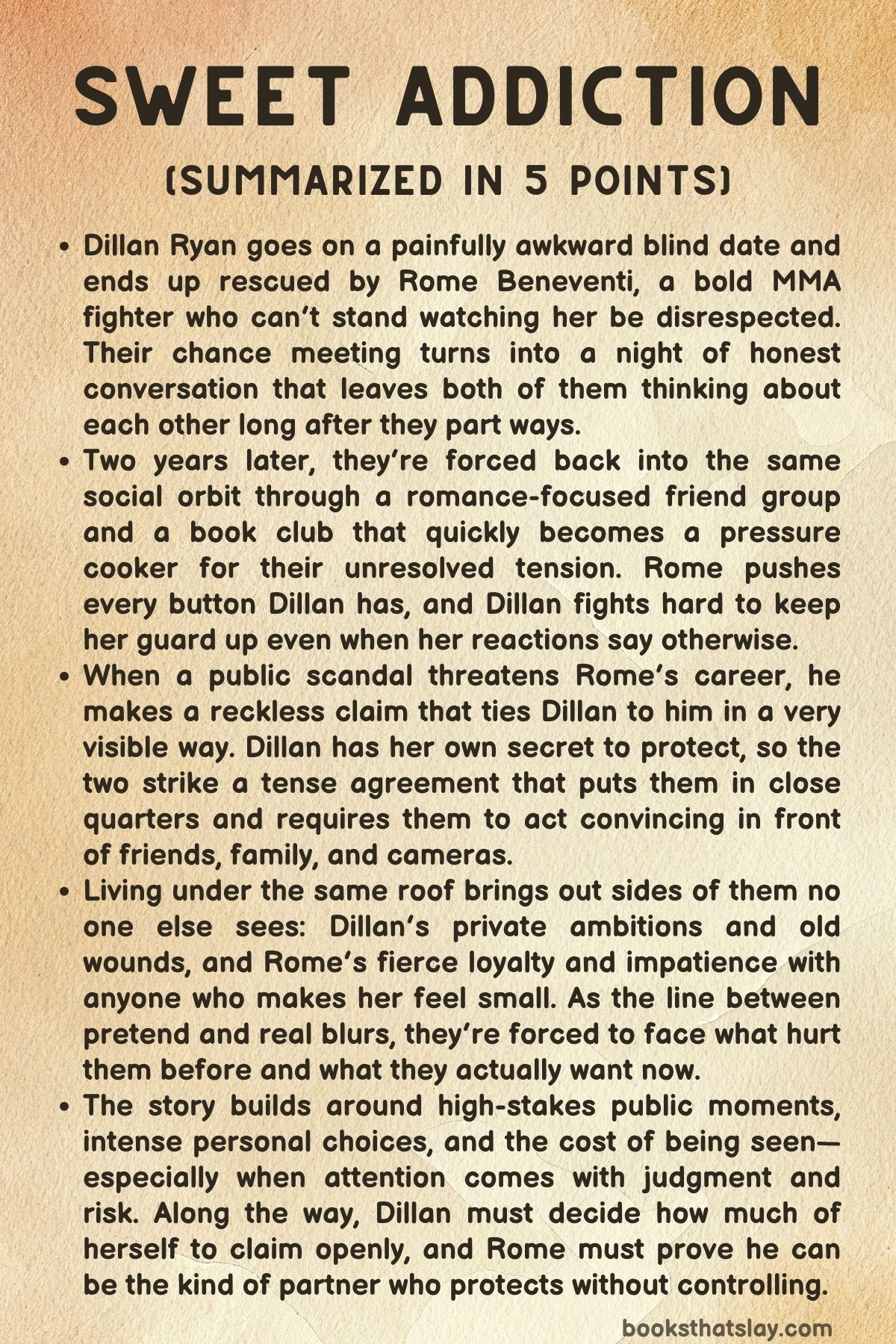
Characters
Dillan Ryan
Dillan is the emotional center of Sweet Addiction, shaped by a long-running push-pull between wanting to be seen and wanting to stay safe. From the opening disaster date, she comes across as sharp, self-aware, and quietly tired of being treated like a stand-in for her famous sister.
That protective instinct turns inward: she’s built a life that looks modest on the surface—teaching hot yoga, working hard, running her bookstore—because it gives her control and keeps the spotlight at arm’s length. Her secret authorship under the name Theia DeLaurentiis isn’t just a career move; it’s a survival strategy, a way to create without being publicly measured against her family or attacked by strangers.
Dillan’s insecurity is not shallow vanity but a learned response to years of comparisons, online cruelty, and the feeling that her own identity gets swallowed by someone else’s narrative.
Her biggest contradiction is that she craves intimacy but flinches when it’s offered carelessly. The night with Rome two years earlier shows how quickly she can open when she feels chosen and listened to, and how instantly she freezes when she senses she is being minimized.
That one overheard dismissal becomes a wound that defines her boundaries for years, making her seem cold or rigid when, underneath, she’s simply trying not to relive that humiliation. As the fake relationship forces proximity, Dillan’s arc becomes a slow reclaiming of voice: she stops letting others define what she should be, first in small ways—setting rules, demanding truth—and then in the boldest way by choosing to reveal her identity on her own terms.
By outing herself to remove the blackmailer’s leverage, she transforms from someone protecting her secret to someone protecting her future, and she does it not by becoming fearless overnight, but by deciding that fear no longer gets to drive the relationship or her career.
Rome Beneventi
Rome is introduced as a man who looks invincible—an elite MMA fighter celebrated for winning—yet the story immediately frames him as restless, dissatisfied, and starved for something real. His strength is obvious, but what defines him is his impatience with emptiness: shallow praise, surface-level attention, and people who don’t see him beyond the cage.
That hunger is why he locks onto Dillan during the terrible date; his “rescue” is crude and chaotic, but it reveals an underlying protectiveness and a need to act when something feels unjust. Rome’s persona is built around intensity—he trains hard, speaks bluntly, pushes limits—and he often uses provocation as his default language, especially with Dillan, because it keeps him in control of the emotional temperature.
At his worst, Rome weaponizes control. He lies impulsively to protect his image, then doubles down by pulling Dillan into a public fiction, and the fact that he frames it as necessity doesn’t erase the coercion.
His flaw isn’t that he doesn’t care—it’s that he cares in a way that becomes possessive, reactive, and sometimes reckless, like when he physically escalates at the gym or threatens a reporter. Yet the narrative also shows that Rome is capable of learning a softer competence: the way he steadies Dillan in the limo, tracks her emotional tells, notices how her family talks over her, and begins to ask the right questions rather than just demanding compliance.
His nicknames, which initially feel like antagonism, evolve into a kind of language for intimacy—imperfect, but personal—because he is trying to name and protect the parts of Dillan she hides. Rome’s growth lands in the moments where he chooses partnership over dominance: he tells her the truth about the blackmail, he panics at the idea of losing her trust, and ultimately he lets her take the lead in dismantling the leverage by revealing her identity.
His championship win matters, but it’s more revealing that he learns not to treat love like a conquest.
Lilah Ryan
Lilah exists in the story as both a source of Dillan’s deepest insecurity and a pathway to healing it. She is famous, visibly pregnant in the present timeline, and often surrounded by attention that Dillan has spent years trying to avoid.
Early on, Lilah’s well-meaning setup inadvertently exposes Dillan to someone who views her as a stepping stone, reinforcing Dillan’s fear of being secondary. That dynamic could have stayed purely painful, but Lilah is not written as a villain; she becomes a complicated mirror.
She can be oblivious at times to the weight Dillan carries, yet she also shows fierce familial loyalty—she calls Dillan out when Rome needs support and frames it in the language of what it means to love someone whose life is public and brutal.
Most importantly, Lilah’s role shifts when Dillan finally tells the truth. Her response in that confession scene functions as emotional restitution: instead of Dillan being the “lesser” sister, Lilah is forced to see the cost of the comparison and the courage it took for Dillan to build a private dream.
In that way, Lilah becomes part of Dillan’s reclamation, not because she changes Dillan’s past, but because she becomes someone Dillan no longer has to hide from.
Lexie
Lexie provides warmth, teasing honesty, and practical support, acting as a bridge between worlds—family business life, friend-group chaos, and Dillan’s quieter interiority. She’s the one who can needle Rome without fear and can also support Dillan without making it performative.
Her presence in book club and in the gown-selection moments highlights her role as a stabilizer: she keeps things social and light while also nudging the story toward connection, like inviting the men into the book club and normalizing the idea that this community can be shared rather than segmented. Lexie’s teasing about book spines and her refusal to let Rome damage the hardback also signals how she polices care in small ways; she insists people treat what matters—books, feelings, relationships—with respect, even when they pretend not to care.
Kaleigh
Kaleigh functions as Dillan’s trusted employee and part of her chosen family, rooted in the everyday reality Dillan has built through her bookstore. She is the one who brings structure and enthusiasm to the book club mechanics, and her presence reinforces that Dillan’s life is not just a reaction to her sister’s fame or Rome’s chaos; Dillan has created community, work, and belonging on her own terms.
Kaleigh also helps push the plot by anchoring the group’s reading choices, including the pivotal reveal when the next selection is tied to Theia DeLaurentiis, which tightens the net around Dillan’s secret. She represents the part of Dillan’s world that is steady and earned, not inherited.
Lucky Beneventi
Lucky is the brother who repeatedly intrudes at exactly the wrong time, but his function runs deeper than comic interruption. He is a reminder that Rome is not a lone wolf; he is embedded in family expectations and routines that keep him grounded.
Lucky also becomes a gatekeeper of information in the New York sequence, and his reluctance or inability to explain what’s happening shows how the men around Rome sometimes default to containment rather than transparency. That contrast matters because Dillan’s greatest trigger is being kept in the dark or treated like she can’t handle the truth.
Lucky doesn’t intend harm, but his role highlights how secrecy, even when motivated by protection, can replicate the same power imbalance Dillan has been fighting.
Ryker
Ryker is the friend who says the thing everyone else is avoiding. His blunt joke about Dillan and Rome sleeping together lands because it exposes how obvious their chemistry is, but his more meaningful role is emotional insight.
He articulates Dillan’s softness without infantilizing her, framing it as something valuable that needs care, and he warns Rome not to treat her like collateral damage. His childhood story about Dillan showing up after he lost his hearing and teaching him sign language reframes Dillan’s character through someone else’s memory: she is not only guarded and insecure; she is also instinctively nurturing, consistent, and brave in quiet ways.
Ryker’s presence pushes Rome toward accountability, making him confront the possibility that his intensity can harm what he actually wants to protect.
Jamie
Jamie appears as part of the broader circle that folds the men into the book club dynamic, reinforcing the community backdrop where private tension becomes public banter. His function is to normalize the group setting so that Rome and Dillan cannot isolate their conflict into a closed room; they are being watched, teased, and included, which raises the stakes of every interaction.
Jamie’s agreement to join book club signals that this friend group is open-hearted and participatory, making Dillan’s eventual truth-telling to them feel like a logical next step rather than an out-of-nowhere confession.
Killian
Killian is Rome’s cousin and a pressure valve: the person Rome can text when he needs to “hit something,” which translates emotional dysregulation into physical release. That detail underscores Rome’s coping style—anger and stress become movement, impact, action.
Killian’s presence shows that Rome has channels for support even if he doesn’t always use them wisely, and it reinforces the family-network theme that runs parallel to the romance. He’s part of the infrastructure that keeps Rome functional during the fight-camp grind while the personal scandal threatens to derail him.
Hudson
Hudson is the authority figure in Rome’s fighting world: coach, uncle, and the voice of discipline that Rome resists but needs. He’s the one who sets boundaries—ending sparring, demanding rest, structuring fight camp—and he also becomes the adult in the room when Rome blurts out the lie about dating Dillan.
Hudson’s role exposes the collision between professional branding and private truth; he is focused on the mechanics of winning and on managing Rome as an asset, but he also recognizes when Rome is spiraling. His warning about avoiding sex before the fight is more than a performance cliché—it underscores how Rome’s body is both weapon and commodity, and how personal entanglements can become tactical liabilities.
Hudson represents the world where emotions are acceptable only insofar as they are controlled.
Olivia St. James
Olivia is crisis management with a pulse: Rome’s cousin and agent who reacts with fury, urgency, and strategy when scandal hits. She treats reputation as something that can be shaped, contained, and sold, and her insistence that Rome needs the optics of a stable relationship reveals the brutal logic of public perception in combat sports.
Olivia can feel manipulative because she speaks in outcomes, but she is also protective in a pragmatic way—she is trying to prevent Rome from being consumed by rumor. Her biggest narrative purpose is to force the fake relationship into existence and to keep escalating the public demands: press, appearances, the Black & White Ball, controlled narratives.
At the same time, Olivia’s earlier dismissal of an extortion attempt becomes a critical failure that nearly costs Rome everything. That misjudgment adds complexity: she is competent, but not infallible, and her work is shaped by constant triage.
When the blackmail resurfaces with Dillan as leverage, Olivia becomes part of the machine that must pivot fast, coordinate proof, and bring in police—showing that in this world, love stories don’t unfold in private; they unfold under spotlights and threats.
Asher Ryan
Asher is Dillan’s brother and an accelerant for the deception spiral. By walking in mid-confrontation and seeing Rome’s physical closeness with Dillan, he forces Dillan to commit to the lie immediately, not in theory but in performance.
His presence represents the protective family instinct that Dillan both wants and fears: she wants her siblings to see her as worthy of defense, but she also fears their judgment and their tendency to treat her life as something to tease or correct. Asher’s reaction sets off the family chat chain and the social momentum that traps Dillan further, making him an unwitting participant in the pressure that turns a fake relationship into a living reality.
Brady Ryan
Brady, Dillan’s father, embodies the family authority that Dillan reflexively shrinks under. His dislike of Rome and his warning about not settling for anything that doesn’t bring happiness could be read as caring, but it lands as judgment because Dillan is already primed to feel like her choices are evaluated rather than respected.
Brady’s role is important because it illustrates the difference between love and understanding: he may love Dillan, but he doesn’t seem to truly know the scale of what she has built or what she has endured. That gap fuels Dillan’s sense that she can’t be fully honest at home, and it becomes a catalyst for Rome’s anger on her behalf, which then forces conversations about why Dillan accepts being underestimated.
Benny “The Beast”
Benny is the looming professional obstacle—Rome’s booked opponent and the embodiment of what Rome has been waiting for: a real shot at the heavyweight title. He functions as both a sports threat and a narrative countdown clock, because training camp and championship stakes heighten every personal conflict.
Even when he’s not present in scenes, Benny’s gravity keeps Rome’s life structured around risk, injury, and public scrutiny, making the extortion demand—throw the fight—feel like an attack on Rome’s identity itself. Benny is less about personality in this summary and more about the role he plays as the mountain Rome must climb, which makes Rome’s final win feel like a reclaiming of agency after weeks of being manipulated.
Elana
Elana is the hidden architect of the external conflict, weaponizing scandal and surveillance to force an outcome that benefits her. Her connection to the sex tape and to Benny through personal ties turns the story’s public humiliation into a targeted strategy, not random cruelty.
What makes her especially threatening is that she understands leverage: she doesn’t just threaten Rome, she threatens Dillan’s most fragile vulnerabilities—her anonymity, her private therapy history, the very parts of her life she has kept sealed to stay functional. Elana’s link through Dillan’s editor’s family line adds an intimate edge, suggesting that betrayal and exposure can come from near the circle, not just tabloids.
She represents predation through information, and her defeat matters because Dillan’s choice to out herself removes Elana’s power at its root.
Kevin Kosen
Kevin is an early, sharply drawn example of the story’s theme of objectification. He’s attractive and polished, but his behavior makes it clear he sees people as access points: Dillan is not a person to him, but a route to Lilah.
His self-absorption, constant phone checking, and insistence on steering the conversation toward Lilah establish him as the kind of man Dillan fears the world is full of—men who will always look past her. Kevin’s role is brief but foundational: he triggers Dillan’s anger, sets the tone for her mistrust, and creates the moment where Rome intervenes.
In that way, Kevin isn’t just a bad date; he is the spark that exposes Dillan’s boundaries and begins the chain of events that ties her to Rome.
Themes
Autonomy, Consent, and the Power to Choose
Dillan’s arc is defined by how often other people try to steer her life—sometimes casually, sometimes aggressively—and how she learns to reclaim the steering wheel. The opening setup date makes that dynamic obvious: she’s treated as a bridge to her famous sister rather than a person with her own value, and even that small humiliation carries the familiar sting of being overlooked.
When Rome steps in, it’s framed as rescue, but it also introduces a complicated pattern: Dillan is repeatedly placed in situations where choice is pressured by circumstance. The night they first sleep together is consensual and wanted, yet what follows shows how easily consent can be eroded by language and power.
Rome’s “no one important” dismissal doesn’t only insult Dillan; it strips meaning from her agency by implying her decision didn’t matter. Two years later, the fake relationship arrangement raises the stakes: the situation functions like a contract formed under coercion.
Dillan’s resistance—rules, boundaries, public limitations—reads as a way to restore control in a scenario that started with blackmail. What makes her growth feel substantial is that she doesn’t just endure or adjust; she changes the game.
When the final blackmail threat targets her identity and therapy records, Dillan refuses to become a bargaining chip. She chooses exposure on her own terms, not as surrender but as strategy.
That choice also reframes the entire story: autonomy isn’t portrayed as a fixed trait she either has or lacks, but as something she practices, loses, rebuilds, and ultimately protects—even when it costs comfort and demands courage.
Emotional Insecurity, Comparison, and the Long Shadow of Family Roles
Dillan’s pain doesn’t come from one cruel moment; it comes from years of being cast in a lesser role inside and outside her family. Even when her family loves her, their teasing and assumptions shrink her—treating her as indecisive, as someone still “figuring it out,” as the sibling who hasn’t quite become impressive in the way they can easily recognize.
That kind of environment can create a specific insecurity: not the fear of failure, but the fear that success won’t be seen or will be attributed to someone else. Dillan’s history with comparisons to Lilah is especially corrosive because it’s not only personal; it’s public.
Online cruelty isn’t an abstract backdrop here—it becomes a trigger that shapes Dillan’s choices, career decisions, and comfort with attention. The story treats that insecurity as something that can coexist with competence.
Dillan runs a bookstore, manages a community, writes commercially successful work, and still carries the reflex to hide when the gaze turns toward her. Her emotional shutdown after hearing Rome minimize her—then later her instinct to build walls right after intimacy—shows a learned survival tactic: if you detach first, you can’t be abandoned.
The turning point isn’t a single pep talk; it’s the accumulation of moments where her feelings are finally given appropriate weight. Telling her mother and sister the truth becomes a form of repair, not because it magically removes insecurity, but because it replaces silent suffering with shared reality.
The family “girls’ night” tradition matters because it gives Dillan a safe structure to speak without performing. She is allowed to be hurt without being corrected, to be honest without being framed as dramatic.
That release changes her inner calculus: she can still be sensitive, still be affected by attention, and still move forward. The book’s resolution suggests that healing doesn’t require becoming unbothered; it requires being believed, supported, and permitted to take up space.
Ambition, Creative Ownership, and Building a Life Beyond Expectations
Dillan’s dream of opening a bookstore and writing is treated as more than a hobby; it’s her attempt to craft a life that belongs to her, not to her family’s wealth or her sister’s fame. Working at a flower shop despite family money signals that she wants to earn her stability and define success on her own terms.
The bookstore becomes a physical symbol of that independence: a place she curates, a community she shapes, a business that reflects her taste rather than anyone else’s branding. Her writing adds another layer because it is both ambition and vulnerability.
Putting a story into the world means risking judgment, exposure, and failure—exactly the fears that have shaped her. The pen name protects her long enough to build confidence and credibility.
When Rome begins reading her work aloud and treats it with interest rather than dismissal, it becomes a rare kind of validation: not praise of her appearance or her family connection, but attention to what she made. Rome’s own ambition is direct and measurable—title shots, training camps, outcomes decided under bright lights.
Dillan’s ambition is quieter but no less intense—finishing a manuscript, meeting deadlines, building a career while protecting her mental health. The story shows how different ambitions can clash and support each other.
Rome’s public life forces Dillan to confront visibility; Dillan’s creative discipline forces Rome to respect a kind of strength that isn’t physical. Even when movie rights and fame arrive later, the theme remains grounded in ownership: Dillan chooses her representation, considers legal protection, decides how and when to tell her story.
The ending doesn’t suggest ambition fixes insecurity; it suggests ambition gives her a structure for self-respect. She becomes someone who can be loved publicly and still remain herself privately—because she built the foundation first.
Protection vs Possession in Love
Rome’s protectiveness is a constant, but the book repeatedly asks what that protectiveness is made of. Early on, his intervention at the bar reads like rescue, yet it’s also charged with entitlement—he decides what Dillan needs, pushes her onto his motorcycle, and then asks to be invited inside with blunt confidence.
Later, in the fake relationship, his insistence on public appearances and his physical intimidation at the gym blur the line between safeguarding and controlling. Dillan’s reactions clarify the distinction.
She wants to feel safe, but she refuses to be managed. Her rules about boundaries and social media are not just practical; they are a demand that protection must include respect.
The story makes the line sharper during the press conference. Rome’s defensive rage when a reporter targets Dillan is understandable, but it also reveals a dangerous edge: the impulse to solve everything with threat and force.
Dillan doesn’t romanticize that. She experiences the fallout, the fear, the scrutiny, and the guilt of being pulled into a public storm.
What changes over time is that Rome begins to protect in ways that center Dillan’s experience rather than his ego. Helping her breathe in the limo, encouraging her to talk to her family, listening to what publicity does to her nervous system—these are protective actions that don’t require dominance.
Dillan also grows into her own protective strength. By outing her identity intentionally, she protects Rome and herself without waiting for him to rescue her.
The love story becomes strongest when protection turns into partnership: two people choosing to stand beside each other rather than one person standing in front and calling it safety.