Taming the Heart Summary, Characters and Themes
Taming the Heart (Crimson Ridge #3) by Elliott Rose is a contemporary western romance set around a developing guest ranch in Crimson Ridge, Montana. It follows retired rodeo star Beau Heartford, a guarded man trapped in a manufactured celebrity marriage, and Sage Maloney, an ambitious marketing entrepreneur determined to build her career without surrendering her independence.
Their attraction begins with an awkward, comic encounter and grows into a relationship shaped by secrecy, age difference, professional boundaries, public scrutiny, and personal fear. Alongside its romance, the novel explores emotional recovery, ambition, reputation, trust, and the difficult work of choosing a life based on truth rather than obligation or image.
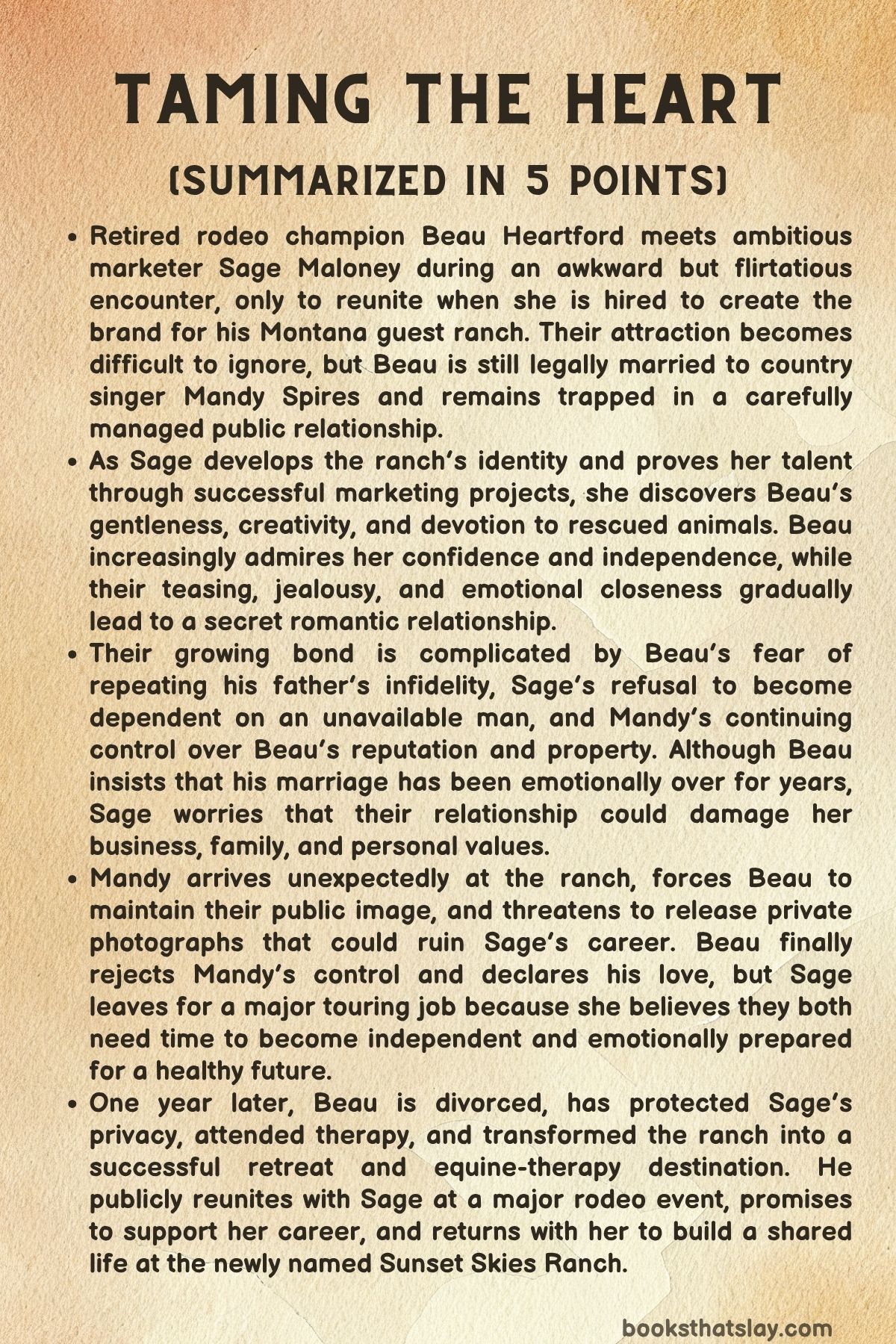
Summary
Retired rodeo champion Beau Heartford meets Sage Maloney outside an art gallery in Crimson Ridge when her handbag breaks and its contents scatter across the steps. Their immediate attraction is sharpened by bold teasing and an embarrassing discovery, but the encounter ends when Beau’s sister Tessa pretends to be his wife to discourage public attention.
A month later, Sage returns to Montana for a summer marketing contract at a new guest ranch. She is building Wild Jasmine Studio, her independent branding business, and views the job as a chance to prove herself without surrendering her freedom.
At the airport, Sage discovers that the stranger from the gallery is the person sent to collect her. She also learns that he is Beau Heartford, a famous former bull rider, and that he owns the ranch she has been hired to promote.
Beau is unsettled because he has thought about Sage since their first meeting. He is still legally married to country singer Mandy Spires, although the marriage has long been emotionally empty and is maintained largely for publicity, contracts, and a controlled divorce arrangement.
The unfinished ranch has cabins, open land, trails, a river, barns, and plans for retreats and equine therapy. Sage quickly begins shaping its identity, audience, visual style, launch strategy, and guest experience, proving that her confidence is supported by business skill.
Beau tries to remain distant because Sage is younger, works for him, and could become a target if Mandy suspects an affair. His restraint is also tied to childhood wounds, especially his fear of becoming like his unfaithful father.
Sage senses that Beau’s public marriage is false, but she refuses to accept easy excuses from an unhappy married man. When he treats a burn on her arm and admits that Mandy has had affairs while forcing him to maintain the image of a devoted husband, Sage challenges him to acknowledge his own role in preserving the lie.
As Sage develops material for the ranch, she photographs cowboys, studies local businesses, and helps rebrand the Loaded Hog. Beau watches her earn respect through competence, while Sage discovers his patience with damaged horses and his private gift for photography.
Their attraction grows through jealousy, shared gatherings, teasing, and moments of closeness. Beau becomes visibly affected when younger cowboys show interest in Sage, and she tests him because his reactions reveal feelings he refuses to state openly.
During a trip to collect horses, Beau admits to his friend Storm that Sage matters far more than he wants to accept. Storm argues that guilt is keeping him trapped in a marriage that ended emotionally years earlier, while Beau remains afraid that choosing Sage would repeat his father’s betrayal.
Distance weakens their restraint. A private video call crosses an intimate boundary and leaves both aware that their relationship can no longer be dismissed as harmless flirtation.
When Beau returns and cannot find Sage, he becomes terrified that she has been hurt somewhere on the property. He finds her swimming at the river, and his relief appears first as anger before their argument turns into the kiss they have avoided for weeks.
Sage reminds him that he is still married and refuses to pretend that private unhappiness erases moral consequences. Even so, they consciously choose intimacy, and what they call a single mistake becomes a secret relationship built on desire, trust, comfort, and a growing sense of partnership.
Beau shows Sage that surrendering control in private does not require giving up strength. Sage, who usually protects herself through independence and casual relationships, begins trusting him with needs she rarely allows anyone to see.
Their relationship develops a domestic rhythm as Sage spends nights in Beau’s home, shares meals with him, helps shape his appearance, and encourages his photography. Beau supports her ambitions rather than asking her to become smaller, while Sage helps him imagine an identity beyond rodeo fame and Mandy’s control.
Sage’s professional life also expands. Her relaunch of the Loaded Hog succeeds, the ranch campaign gains momentum, and she is offered a travelling marketing position on the professional rodeo circuit that could transform Wild Jasmine Studio.
The opportunity forces Sage to confront a central conflict: she loves Beau, but she will not sacrifice her future for a man who remains unavailable. Beau respects her ambition, yet Mandy threatens to delay the divorce and claim part of the ranch if he resists her terms.
Mandy then arrives at the ranch without warning, livestreaming her visit and presenting herself publicly as Beau’s loving wife. Her presence forces Beau and Sage apart, and Sage is humiliated when her belongings are removed from Beau’s bedroom to hide their relationship.
At a ranch event, Mandy kisses Beau for cameras while Sage watches. Beau finally understands that caution has become another form of surrender and decides that protecting the ranch or his image is no longer worth losing Sage.
He finds Sage in the barn, removes his wedding ring, and tells her that he is choosing her even if Mandy takes the property. The gesture proves his emotional decision, but it cannot solve the legal danger, public scandal, or Sage’s fear that she will always be treated as a secret.
Before leaving, Mandy reveals that she found intimate photographs of Sage on Beau’s computer. She threatens to publish them, ruin Sage’s business, involve her family, and present her as an opportunist who accepted a contract to seduce a married celebrity.
Beau declares his love when Sage tells him about the threat, but she has already decided to leave for the touring job. She believes he needs time to become legally free and discover who he is without Mandy, while she must protect her career and prove that her achievements belong to her.
Sage leaves despite Beau’s pleas, telling him that if they are meant to meet again, he can look for her beneath the sunset sky. Their separation is painful, but it prevents either person from building a future out of fear, dependence, or unfinished conflict.
Over the following year, Beau completes the divorce, protects Sage’s photographs, secures the ranch, and begins therapy. Mandy’s own affair becomes public, weakening her influence, while the ranch grows into a successful destination offering retreats, rodeo experiences, and equine-therapy programs.
Sage’s touring work expands her business and confirms that she can succeed independently, but professional achievement does not erase her love for Beau. She keeps her distance because she believes the year apart is necessary, although part of her still hopes he will come for her.
Beau eventually stops waiting passively. During a major rodeo event, he enters the arena before a sold-out crowd, admits that letting Sage leave was the greatest mistake of his life, and asks the audience to help him find the woman who owns his heart.
When they meet in the arena, Beau tells Sage that he has come to find his sunset sky. He is legally free, emotionally stronger, willing to support her career, and prepared to stand beside her publicly rather than hide her.
Sage tells him that she loves him, and Beau joins her for the remainder of the tour. They later return to Crimson Ridge, where the ranch is named Sunset Skies Ranch and their shared life allows both love and independent work to continue.
The ending returns to the comic energy of their first meeting while showing how much both have changed. Beau chooses truth over fear, Sage chooses partnership without abandoning ambition, and together they create a home defined by freedom, respect, work, humour, and deliberate commitment.
Characters
Beau Heartford
Beau Heartford is the central male character and one of the most psychologically burdened figures in Taming the Heart. A former rodeo champion, he has spent years being admired as a public symbol while privately living with shame, panic, loneliness, and a marriage built around image rather than affection.
His guarded manner comes from several sources at once. Fame taught him to distrust attention, Mandy’s manipulation taught him that intimacy can become a tool of control, and his father’s infidelity convinced him that desire outside marriage would make him morally corrupt even after the marriage had ceased to function as a real partnership.
Beau’s strongest qualities are patience, loyalty, attentiveness, and practical care. These appear in the way he treats Sage’s injury, supports her work, protects the rescue horses, develops Teddy’s trust, and repeatedly checks Sage’s comfort and consent during private moments.
His major weakness is passivity disguised as endurance. He tells himself that waiting, obeying contracts, and protecting the ranch are responsible choices, but the book gradually shows that avoidance allows Mandy to continue controlling the story of his life.
Sage challenges him because she refuses to confuse suffering with innocence. Through her, Beau learns that being harmed does not remove his responsibility to act, speak clearly, and accept consequences.
His final development is not simply the decision to pursue love. It is the decision to become visible as his real self, seek therapy, end the false performance, protect Sage openly, and build a future in which loyalty is chosen freely rather than enforced through fear.
Beau’s Father
Beau’s father never becomes an active present-day character, but his betrayal shapes many of Beau’s most damaging beliefs. By abandoning the family and becoming publicly associated with infidelity, he leaves Beau determined to prove that he is morally different.
That determination becomes unhealthy because Beau treats any attraction outside his legal marriage as evidence that he is repeating the same failure. He overlooks the difference between betrayal and a relationship that has already ended emotionally, allowing fear of resemblance to control him more effectively than principle.
The father’s influence helps explain why Beau confuses suffering with loyalty. Beau’s eventual growth requires him to understand that morality is not measured by how long he accepts manipulation, but by whether he acts honestly, accepts responsibility, and refuses to harm others through continued silence.
Sage Maloney
Sage Maloney is the central female character and the driving professional force of Taming the Heart. She is energetic, humorous, sexually confident, imaginative, and fiercely committed to creating a career that belongs to her.
Her independence is both a strength and a defense. Growing up with parents whose marriage set a high standard has made her unwilling to accept a weak relationship, but it has also encouraged her to avoid emotional dependence whenever closeness threatens her control.
Sage’s work reveals that her confidence is not superficial. She studies audiences, understands branding, notices how spaces make people feel, manages demanding events, and turns broad ideas into practical results that help both the ranch and the Loaded Hog.
Her relationship with Beau tests her self-image because she cannot dismiss him as a temporary attraction. He respects her ambition and gives her room to be bold, yet his marriage places her in a position that conflicts with her ethics, reputation, family loyalty, and professional goals.
Sage’s most important decision is leaving after Beau declares his love. The choice is painful rather than cold, because she understands that love cannot repair unresolved legal conflict or substitute for the personal growth both of them still need.
By accepting the touring job, Sage proves that she will not build her future around waiting. Her return to Beau carries weight because she meets him after establishing her career, examining her fears, and seeing that he has become capable of offering a public, equal partnership.
Mandy Spires
Mandy Spires functions as the principal antagonist, but her power comes less from physical presence than from her control over publicity, contracts, reputation, and narrative. She understands how celebrity culture rewards appearances and uses that knowledge to keep Beau tied to a marriage that benefits her career.
Mandy treats intimacy as branding. Photographs, livestreams, staged affection, and carefully managed stories matter to her because they allow her to define reality for an audience that cannot see what happens privately.
Her cruelty becomes most visible when she threatens Sage with stolen photographs and attacks her family, business, and emotional insecurities. She does not merely want Beau’s compliance; she wants to prove that she can determine who is protected, who is believed, and who is publicly shamed.
At the same time, Mandy exposes Beau’s long habit of surrendering authority over his own life. Her eventual loss of power occurs when her own affair becomes public and Beau stops cooperating with fear.
She remains a warning about the damage created when image becomes more valuable than truth. Her downfall comes from the same public machinery she used against others, showing that a manufactured identity becomes unstable when it depends on secrecy, manipulation, and constant control.
Tessa Diaz
Tessa Diaz is Beau’s sister, business manager, defender, and one of the people most responsible for keeping his life functioning. She knows both the public version of Beau and the frightened private man beneath it, which allows her to speak to him with unusual directness.
Her early decision to pose as his wife is comic, but it also shows how accustomed she has become to protecting him from fans and unwanted attention. Later, she supports Sage’s hiring because she recognizes professional talent and refuses to let Beau use discomfort as an excuse to dismiss a qualified woman.
Tessa is practical during crises, especially when Beau experiences panic. She understands the damage Mandy has caused, yet she also pushes Beau toward action instead of endless self-protection.
Her role in the ending is especially important because she refuses to let him wait passively for Sage. Tessa represents loyal family support at its best: protective without being controlling, honest without being cruel, and determined to help Beau build a life rather than merely survive one.
Storm
Storm is Beau’s friend, fellow rancher, and moral sounding board. He recognizes Beau’s attraction to Sage before Beau is willing to name it and challenges the idea that guilt is automatically proof of virtue.
His advice is not reckless because he understands the risks surrounding the marriage, Sage’s reputation, and Mandy’s influence. What he opposes is Beau’s habit of treating all desire as evidence that he has become his father.
Storm also helps connect the ranch to the wider community of cowboys, friends, and rodeo families. His presence reminds Beau that he is not as isolated as he believes and that trusted people can help him distinguish responsibility from self-punishment.
When he later tells Beau that Sage needs visible action rather than private promises, he identifies the central failure in Beau’s behavior. Storm’s honesty helps move Beau from emotional confession toward public commitment.
Layla
Layla is Sage’s closest friend and one of the strongest links between Sage’s independent career and the community around Crimson Ridge. Her connections help Sage secure the ranch contract, but Sage’s success afterward comes from her own ability.
Layla is affectionate, observant, and unwilling to accept obvious evasions. She notices that Sage is emotionally involved with Beau and understands that the secrecy is affecting her before Sage fully admits it.
Her concern never becomes judgment. Even when she fears Sage is entering a dangerous relationship, Layla remains present, drives her to the airport, and respects the decision to leave.
Layla’s friendship gives Sage a model of love that does not demand possession. She supports, questions, protects, and allows Sage to choose, which makes her an important contrast to the controlling relationships elsewhere in the story.
Briar
Briar is part of Sage and Beau’s trusted social circle and contributes warmth, community, and emotional perspective. She appreciates Beau’s work with Teddy and openly praises his photography, drawing attention to a creative ability he tends to hide.
Her response matters because Beau is uncomfortable receiving recognition for something unrelated to rodeo fame. Briar’s admiration helps Sage see that his private identity contains patience and artistry, not only celebrity history and masculine reserve.
Briar also joins the group of women who challenge Sage’s secrecy. She is supportive rather than intrusive, helping create a setting in which Sage can eventually admit that her connection with Beau is more serious than she has claimed.
Sky
Sky appears as part of the close group of women surrounding Sage. Her role is less individually developed than Layla’s, but she helps establish the friendship network that gives Sage emotional support outside the romance.
Through conversations at the river and later gatherings, Sky contributes to moments when Sage compares her uncertain secret relationship with the more stable lives of her friends. This comparison increases Sage’s awareness that desire alone cannot provide security, honesty, or a workable future.
Sky also helps show that Sage is not socially isolated. Her presence reinforces the idea that healthy independence includes community, friendship, and people who notice when someone is hiding pain.
Kayce
Kayce is a younger cowboy whose easy friendliness toward Sage exposes Beau’s jealousy. He does not act as a true romantic rival so much as a pressure point that reveals how emotionally invested Beau has become.
Kayce also represents the relaxed social world Beau keeps at a distance. He jokes, participates in gatherings, helps with ranch work, and treats Sage openly, while Beau often watches from the edge of the group.
His role shows that Beau’s possessiveness cannot be justified as professional concern. Kayce’s harmless interest forces Beau to confront the difference between wanting to protect Sage and wanting an exclusive place in her life.
Colt
Colt belongs to the wider ranch and rodeo community that welcomes Sage into Crimson Ridge. Although he receives limited individual development, his presence helps create the social environment in which Beau and Sage’s private tension becomes visible.
He represents the stable network of friendships and partnerships surrounding the central couple. This community offers both support and accountability, making it harder for Beau and Sage to pretend their choices affect only themselves.
Oscar Diaz
Oscar is Tessa’s husband, and his rodeo accident introduces a serious reminder of the physical danger connected to the sport. His injuries also explain why Tessa cannot manage the ranch in person and why Sage receives greater independence during the contract.
Although Oscar remains mostly outside the central action while recovering, his relationship with Tessa provides a contrast to Beau’s marriage. Their bond appears genuine, practical, and rooted in care rather than publicity.
Oscar later helps with Beau’s public reunion with Sage by taking control of her camera during the arena surprise. This small action places him among the people who help Beau finally turn private love into a visible commitment.
Teddy
Teddy is a rescue horse, but he functions as more than background detail. Mistreated, distrustful, and unwilling to be ridden, he reflects Beau’s own difficulty with trust and his instinct to retreat when closeness feels dangerous.
Beau never forces Teddy into progress. He builds safety through patience, movement, routine, and respect, revealing the kind of care Beau is capable of giving when he is not governed by panic.
Teddy also creates an emotional meeting point for Beau and Sage. Through the horse, Sage sees Beau’s gentleness, while Beau begins imagining a ranch that can help damaged people and animals recover without being pressured to perform.
Mist
Mist, the blue roan Beau has long wanted, represents the future he is slowly allowing himself to claim. His affection for the horse reveals a quieter form of desire based on care, patience, and belonging rather than public achievement.
When Beau introduces Sage to Mist and the other horses, he is also inviting her into the life he hopes to build. The scene matters because his feelings are expressed through shared plans and trust rather than through spectacle.
Mist therefore supports the ranch’s larger symbolic role. The horse belongs to a world in which Beau can create something lasting, useful, and personally meaningful after years of living according to other people’s expectations.
Zeb
Zeb is Mandy’s assistant and an extension of her public-relations machinery. His presence reinforces how thoroughly Mandy’s life is organized around image, logistics, and control.
He helps carry her influence into Beau’s private space, especially when she arrives at the ranch with luggage, cameras, and demands. Zeb is not developed as independently malicious, but his cooperation allows Mandy’s performance to continue smoothly.
His limited characterization is purposeful. He represents the professional system that can make manipulation appear ordinary when everyone involved treats publicity goals as more important than personal boundaries.
Chaos Hayes and Knox
Chaos Hayes and Knox are the owners connected to the Loaded Hog rebranding project. Their willingness to trust Sage’s ideas gives her an important opportunity to demonstrate that she can produce commercial results beyond the ranch contract.
They listen to her proposals, approve broad creative authority, and support a gradual transformation of the business. Their confidence helps validate Sage’s professional identity at a point when her private choices could easily overshadow her work.
Through them, the novel shows that Sage’s success is not a gift from Beau or a benefit of romantic proximity. She earns responsibility by understanding the business, presenting a clear strategy, and delivering a relaunch that attracts attention and customers.
Sage’s Parents and Sisters
Sage’s parents and younger sisters shape her values even though they remain mostly outside the main setting. Her parents’ loving marriage gives her a demanding standard for partnership, while her sisters reinforce her identity as the responsible eldest child.
This family background explains both her confidence and her caution. Sage knows what mutual devotion can look like, so she resists relationships that offer only partial commitment or require secrecy.
Her concern about Mandy targeting her family also influences her decision to leave. Protecting them is not an excuse; it reflects Sage’s understanding that public scandal can injure people who never consented to become part of it.
Zeke “Raine” Rainer
Zeke “Raine” Rainer appears near the end as a new ranch employee. His arrival shows that the ranch has moved beyond Beau’s private dream and become a growing organization with new staff, programs, and responsibilities.
He also creates a deliberate echo of the airport scene that once reunited Beau and Sage. This time, Beau is not waiting for romance to appear by accident; he is preparing to act and go after the person he loves.
Raine therefore functions as a small transitional character. His presence marks the movement from waiting to pursuit and confirms that Beau’s life has continued developing during the year of separation.
Themes
Freedom, Control, and Self-Definition
Freedom in Taming the Heart is not presented as the absence of commitment. It is the ability to choose relationships, work, identity, and responsibility without being ruled by fear, coercion, or a false public image.
Beau appears powerful because he is famous, wealthy, physically capable, and the owner of a large ranch, yet Mandy controls his schedule, reputation, marriage narrative, and emotional decisions. His development shows that external success means little when a person cannot speak honestly or accept the cost of choosing a different life.
Sage has more practical freedom, but she also uses independence as protection. She fears that commitment may require sacrifice of ambition, so she keeps emotional distance until Beau demonstrates that love can support her work rather than replace it.
Their separation is necessary because neither should move directly from one form of dependence into another. Beau needs to become free before asking Sage to share his future, and Sage needs to prove that partnership will be a choice rather than a rescue.
The ranch becomes the clearest symbol of healthy freedom. It changes from a private refuge into a working community where damaged animals, guests, athletes, and the central couple can build new patterns based on care, purpose, and voluntary trust.
Public Image and Private Truth
Celebrity culture gives Mandy the power to create a believable marriage through photographs, livestreams, staged affection, and repeated stories. The public does not need access to the truth because a polished image can become more persuasive than private reality.
Beau participates in the deception even when he hates it. His silence protects property and delays conflict, but it also strengthens Mandy’s version of events and makes Sage appear guilty when the relationship becomes visible.
Sage’s profession makes this conflict especially sharp because she understands how branding shapes perception. She can build campaigns ethically for businesses and experiences, yet she sees how the same tools can be used to manipulate emotion, hide abuse, and destroy a reputation.
The stolen photographs show the danger of losing control over personal images. What Beau sees as private affection can be reframed as evidence against Sage, proving that context is often weaker than the story told by the person with the largest audience.
The arena reunion reverses this pattern. Beau finally uses a public stage to tell the truth instead of sustaining a lie, and the act matters because he accepts exposure rather than demanding that Sage trust another private promise.
Trust, Vulnerability, and Emotional Recovery
Both central characters protect themselves through control, although they express it differently. Beau withdraws, obeys rigid moral rules, and tolerates unhappiness, while Sage relies on humour, competence, sexual confidence, and the ability to leave before anyone can limit her.
Their relationship develops when care becomes more important than performance. Beau treats Sage’s injury, Sage helps him through panic, and both learn that vulnerability can be offered without becoming weakness.
The rescue horses deepen this idea. Teddy cannot be forced into trust, and Beau’s patient treatment of him suggests that recovery depends on safety, consistency, and respect for boundaries.
Beau’s therapy after the separation is essential because love alone cannot resolve the fear created by his father, Mandy, and years of public pressure. He must understand why he surrendered control before he can become a reliable partner.
Sage also needs emotional growth. Leaving protects her career, but the year apart teaches her that refusing dependence can become another form of fear when it prevents her from accepting a relationship that respects her identity.
Their reunion succeeds because trust is supported by evidence. Beau is divorced, has protected her privacy, has sought help, and is ready to stand beside her openly, while Sage returns as someone who has strengthened rather than abandoned her own life.
Ambition, Partnership, and the Refusal to Shrink
Sage’s career is not a decorative subplot; it is one of the main measures of whether the romance can become healthy. She wants love, but she refuses any future that treats her ambition as selfish, temporary, or less important than a man’s needs.
Her work repeatedly proves her ability. She creates the ranch identity, plans guest experiences, manages publicity, transforms the Loaded Hog, and expands her business through the rodeo circuit.
Beau’s respect for this ambition distinguishes him from the kind of partner Sage fears. He does not ask her to remain at the ranch, abandon the touring job, or make his recovery the center of her life.
Their temporary separation protects this balance. Had Sage stayed while Beau was still legally trapped, her career could have become dependent on secrecy, and his emotional stability could have become dependent on her presence.
The final partnership works because both people bring an established purpose into it. Beau has built the ranch into a place of service and recovery, while Sage has built a business with reach beyond Crimson Ridge.
Their shared future therefore rejects the idea that commitment requires one person to become smaller. Love becomes sustainable when it makes room for work, travel, friendship, healing, privacy, and mutual pride in what the other person creates.