Tart: Misadventures of an Anonymous Chef Summary and Analysis
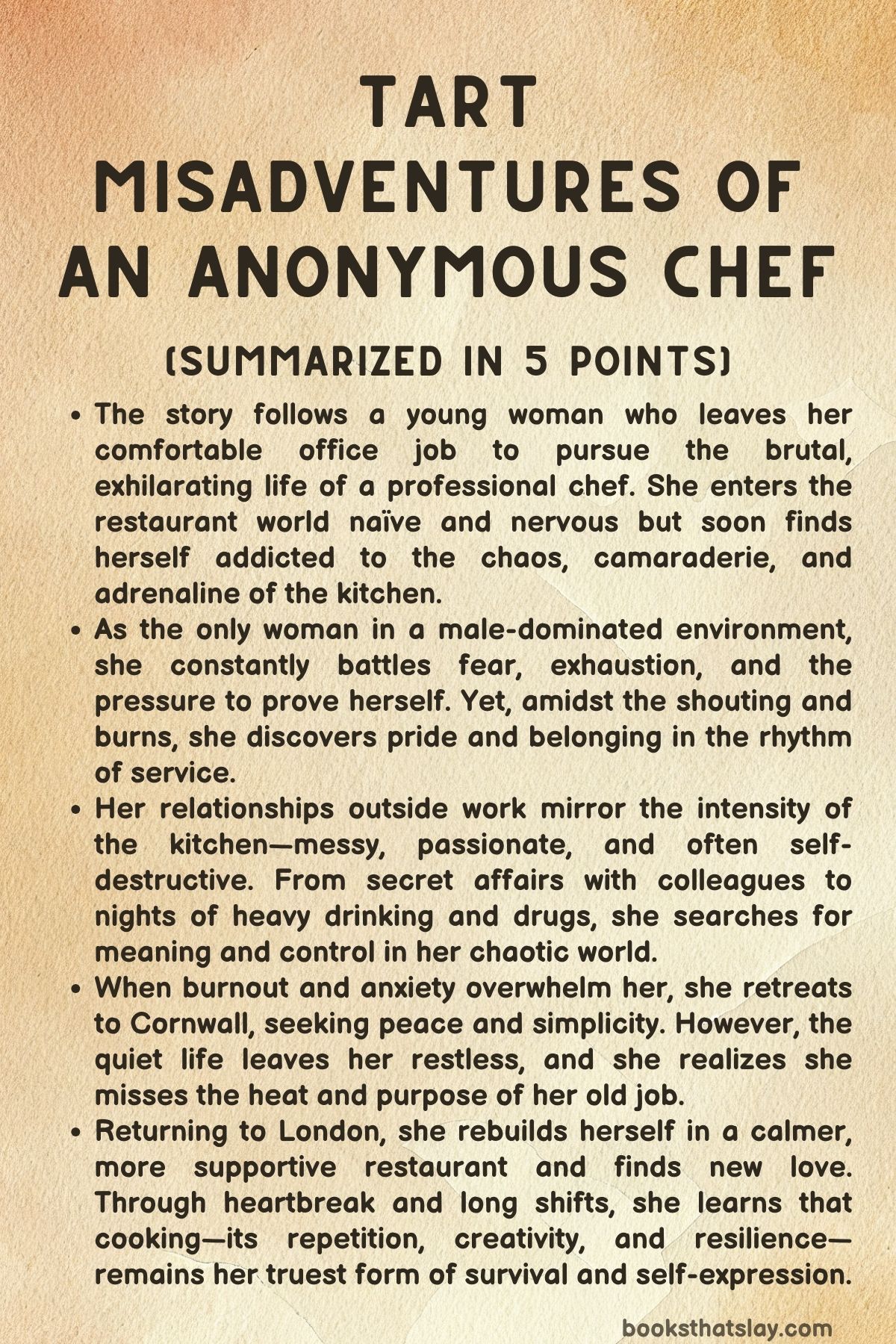
Tart: Misadventures of an Anonymous Chef by Slutty Cheff is a raw, darkly humorous, and unflinchingly honest exploration of one woman’s chaotic journey through the brutal, seductive world of professional kitchens. Through her narration, the reader witnesses the transformation of a timid office worker into a hardened chef addicted to the rhythm, heat, and chaos of restaurant life.
The book exposes the extremes of ambition, exhaustion, love, and desire that coexist in the culinary underworld. Blending sharp observation with confessional storytelling, it captures the madness of chasing perfection in an unforgiving, masculine environment where every mistake—and emotion—leaves a scar. This book can be classified as a memoir of the anonymous but quite famous persona Slutty Cheff.
Summary
The story opens in a sweltering kitchen where the unnamed narrator stands frozen after being berated by her volatile Head Chef, Marty. The moment triggers a painful childhood memory of humiliation, yet she forces herself to remain composed, unwilling to cry before her male colleagues.
Stepping outside to smoke, she reflects on how drastically her life has changed since leaving the safety of an office job. The clean desks and polite emails have been replaced by burns, noise, and aggression.
But within the exhaustion and fear, she finds a strange sense of satisfaction—an addiction to the chaos. She admits she craves too much of everything: food, sex, love, and experience.
Her pain and pleasure have become indistinguishable, and though she feels trapped between heaven and hell, she walks back into the kitchen willingly.
Her story then rewinds to when she first entered this world. Bored by the domestic monotony of culinary school and irritated by her instructor Helen’s rigid rules, she ignores the warning not to work in a restaurant before graduation.
Encouraged by her friend Ruby and her parents, she impulsively arranges a trial shift at a London restaurant. Nervous but determined, she arrives at the chic Islington venue and meets Axel, the charming manager, who leads her into the hot, testosterone-fueled chaos of the kitchen.
Marty, the Head Chef, barely acknowledges her before throwing her into work. Surrounded by men—Sous Chef Emil, Chef de Partie Zack, and junior Nathan—she starts with menial prep, chopping chillies and absorbing the rhythm of the place.
As service begins, the energy transforms. Orders fly, knives clatter, and the team’s focus becomes a form of choreography.
She watches waitresses flirt with the chefs, feels both invisible and voyeuristic, and remembers a past affair with an older office colleague, Declan—recognizing the same mingling of power and desire in this environment. Gradually, she gains confidence as Marty teaches her about sauces and plating.
When one of her dishes reaches a customer, pride surges through her fatigue. By the night’s end, the chefs celebrate with beer and laughter.
Marty praises her and offers her a job on the spot. She accepts, elated and terrified.
On the train home, she feels a sense of belonging she hasn’t felt in years.
Months later, she is a full-time commis chef—burned, bruised, and alive. The kitchen’s intensity has reshaped her.
She works grueling hours, bonded to her colleagues by exhaustion and adrenaline. The hierarchy is cruel, but she thrives under it, learning fast and slowly gaining respect.
Outside of work, she joins the restaurant’s social world of late-night drinking, drugs, and sexual tension. She starts a secret affair with the bar manager she nicknames “Topknot,” enjoying the thrill of secrecy while fearing Marty’s unpredictable temper.
Her life becomes a blur of shifts, hookups, and hangovers. She is both empowered and consumed by the chaos, sensing that the same fire that drives her might also destroy her.
The story takes a darker turn when Omar, the sleazy sous chef, is finally fired after a violent argument with Marty. The staff gossip and drink late into the night, and the narrator ends up on a drug-fueled bender that ends with her taking Topknot home to her parents’ house.
The next morning, after just an hour’s sleep, Marty calls her in for a double shift. Running on cocaine and adrenaline, she forces herself through the day, chanting “I love my job” as her mind frays.
Eventually, she suffers a panic attack mid-shift, fleeing to the toilet, her body collapsing under exhaustion. Marty sends her home.
She leaves the restaurant, sobbing into her mother’s arms, deciding never to return.
Months later, she is living in Cornwall, working part-time at a quiet seaside restaurant and trying to recover. The calm feels strange after London’s chaos.
Her new boss, Sean, is kind but uninspiring, giving her repetitive prep work. She misses the madness she once despised.
One evening, she cooks Rick Stein’s fish soup, using ingredients she forages and buys herself. The act of cooking reignites her passion.
As she eats the soup at sunset, she feels both fulfilled and lonely, realising she wants to return to the life she thought she’d escaped. She decides to go back to London.
In London again, she moves in with Raquel, a confident female chef, and lands a job at a prestigious fine-dining restaurant through her old friend Paul. The new kitchen is clean, structured, and professional—worlds apart from Marty’s volatile domain.
Her new bosses, Lenny and George, treat her with respect, and she finds friendship in Finn, a witty and flamboyant colleague. Starting on pastry and larder, she works hard, learns fast, and gradually earns her place.
The once-terrified newcomer has grown into a capable, self-assured chef. She finally feels balanced and proud, with a sense of peace she’s never known.
But stability doesn’t last. During the intense Christmas season, she runs her own section, training two new commis chefs, Jayden and Maggie.
Amid the madness, her mind drifts to her new lover, Kit—a rugged, older chef she idolises. They meet after shifts for greasy food and sex, their relationship fueled by exhaustion and passion.
One frantic lunch service nearly overwhelms her, but with help from a quiet runner, she regains control and finishes strong. The rush of survival reminds her why she loves the job.
For the first time, she feels mastery rather than chaos.
Flashbacks reveal how she met Kit months earlier. Their romance began impulsively, built on shared burnout and longing for understanding.
When he invites her over to cook dinner, she nervously agrees, terrified of cooking for another chef. The night becomes a silent contest of skill, ending in laughter, intimacy, and affection.
But just when she feels safe, Kit confesses that his ex-girlfriend is pregnant. Her illusion shatters.
The final chapter opens the next morning. Heartbroken, she drags herself through a double shift, hiding her pain behind mechanical motions.
Her colleagues barely notice her distress. Even as tears fall, she keeps chopping onions, repeating the ritual that keeps her grounded.
The kitchen becomes her refuge again—not from love or ambition this time, but from heartbreak. She accepts the cruel rhythm of her world: exhaustion as comfort, repetition as healing.
The story ends not with triumph or defeat but with understanding. The kitchen remains both her torment and salvation—demanding everything, yet giving her the only sense of purpose she knows.
Characters
The Narrator
The unnamed narrator of Tart: Misadventures of an Anonymous Chef serves as both the emotional and moral core of the novel. She begins her journey burdened by fear, insecurity, and a profound sense of alienation within the hypermasculine world of restaurant kitchens.
Her evolution is marked by a compelling tension between vulnerability and ferocity—she is both broken and brave, craving belonging even in places that wound her. Her identity as a woman in a male-dominated environment is central to her psychological landscape.
Initially timid and eager to please, she learns to navigate the complex hierarchies of kitchens where discipline and dominance define worth. Her addiction to intensity—whether through work, love, or self-destruction—reveals a deep inner hunger for validation and meaning.
The narrator’s emotional complexity makes her at once relatable and unsettling: she seeks both pain and transcendence, understanding that her passion for cooking mirrors her longing for control and connection. By the end, she emerges not unscarred but stronger, transformed through exhaustion, heartbreak, and self-discovery into a woman who reclaims agency through resilience.
Marty
Marty, the volatile Head Chef, embodies the archetypal figure of culinary authoritarianism. He rules his kitchen through fear and charisma, commanding loyalty through both intimidation and rare moments of praise.
For the narrator, Marty represents a contradictory blend of father figure, tormentor, and idol—his approval feels intoxicating, even when his cruelty cuts deep. His temper, however, conceals a complex fragility; beneath the bravado lies a man equally consumed by the pressures of perfection.
Marty’s character functions as a mirror for the narrator’s own duality: he is both the hell she must endure and the heaven she seeks within the heat of the kitchen. His relationship with her is fraught with emotional ambiguity—at once professional, paternal, and implicitly erotic—underscoring the blurred lines between power, mentorship, and desire in their shared world.
Through Marty, the novel explores the dangerous allure of authority and the fine line between passion and abuse that defines much of restaurant culture.
Ruby
Ruby, the narrator’s best friend, is a grounding presence amid the chaos. Her encouragement to pursue a trial shift becomes a catalyst for the narrator’s transformation.
Unlike the men who populate the narrator’s world, Ruby offers unconditional support without condescension. She represents an alternative form of strength—emotional steadiness rather than aggression.
Ruby’s friendship symbolizes the narrator’s connection to her former life, the remnants of normalcy and care that the brutal rhythm of kitchen life threatens to erase. Though Ruby remains largely peripheral to the professional sphere, her belief in the narrator’s potential provides an emotional counterpoint to the relentless demand for toughness that defines the culinary environment.
Axel
Axel, the charming General Manager, is the first to introduce the narrator to the restaurant’s seductive duality—elegance above, chaos below. His smooth professionalism and easy confidence contrast with the aggression of the kitchen, embodying the seductive allure of hospitality.
For the narrator, Axel’s presence heightens the sense of entering a world that is both glamorous and dangerous. He represents the bridge between the front-of-house sophistication and the raw brutality behind the pass, a reminder that the beauty the diner sees is sustained by invisible suffering.
Axel’s friendliness is performative yet magnetic, showing how charisma operates as currency in this industry of masks and appearances.
Omar
Omar, the sleazy and arrogant sous chef, personifies toxic masculinity within the kitchen hierarchy. His bullying behavior and predatory attitude toward women epitomize the darker realities of restaurant culture.
Omar’s downfall—being publicly fired by Marty—serves as both catharsis and cautionary moment. He operates as a foil to the narrator, exposing the gendered power imbalances and casual misogyny that she must navigate daily.
Yet, his presence also reveals the fragility of such men; his bluster crumbles when confronted, showing that the cruelty of the kitchen is often a performance born of insecurity. Omar’s exit from the narrative marks a small victory for justice, though it does little to change the underlying systemic violence the narrator continues to face.
Topknot Barman
The Topknot Barman, with his ridiculous hairstyle and rakish charm, represents the narrator’s descent into chaos and escapism. Their relationship is built on secrecy, lust, and the thrill of transgression rather than genuine intimacy.
For the narrator, he is both a distraction and a mirror—someone who allows her to explore power and vulnerability in private while maintaining composure in public. Their affair underscores the intoxicating mix of shame and exhilaration that defines her world.
The Topknot Barman’s superficial allure also reveals her tendency to conflate passion with meaning; her pursuit of pleasure becomes another manifestation of her craving for intensity, even when it leads to self-destruction.
Sean
Sean, the gentle Head Chef of the Cornish seaside restaurant, offers the narrator a reprieve from the brutality of her London experiences. His kindness and calm demeanor create an environment free from abuse—but also, paradoxically, devoid of the passion and adrenaline she craves.
Sean’s world is quiet, methodical, and safe, yet it leaves the narrator feeling underused and uninspired. Through Sean, the novel examines the narrator’s addiction to chaos; even comfort feels like stagnation.
He is not a villain, but rather a symbol of a life she cannot yet accept—a peaceful existence that demands the surrender of her hunger for extremes. His mentorship, though well-intentioned, inadvertently propels her back toward the intensity of London, suggesting that self-knowledge sometimes comes only through restlessness.
Kit
Kit, the narrator’s lover known as “My Chef,” embodies both the fulfillment and the destruction of her romantic ideal. Older, experienced, and charismatic, Kit represents everything she has long sought—a partner who understands her world, shares her exhaustion, and speaks the same language of heat, sweat, and steel.
Their relationship is intensely physical and emotionally consuming, built on shared vulnerability and professional respect. Yet Kit’s eventual confession—that his ex is pregnant—shatters the illusion of stability and exposes the fragility of her emotional dependence.
Kit’s betrayal forces the narrator to confront the limits of passion as salvation. His presence reveals the novel’s central paradox: the same forces that drive her—ambition, intensity, desire—are also those that threaten to destroy her.
Kit is both her muse and her undoing.
Finn
Finn, the sous chef in her later kitchen, emerges as a figure of camaraderie and balance. His easy humor and supportive nature counteract the hierarchy’s cruelty.
Their relationship—professional yet emotionally charged—shows the narrator’s growth; she has learned to work alongside men as an equal rather than an object of either scorn or desire. Finn’s presence during her breakdowns and recoveries reveals the value of teamwork and shared resilience.
Their friendship, rooted in mutual respect, redefines intimacy within the brutal environment of the kitchen. Through Finn, the narrator rediscovers not just the love of cooking but the possibility of connection untainted by exploitation.
George
George, the calm and observant senior sous chef, represents quiet strength and empathy within the otherwise harsh masculine world. Unlike Marty or Omar, George leads by example rather than aggression.
His gentle attentiveness, particularly during the narrator’s heartbreak, exposes the rare compassion that can exist within competitive spaces. George’s understanding gaze and subtle support demonstrate that authority need not rely on dominance.
He embodies the maturity that the narrator is slowly learning to emulate—the ability to balance discipline with humanity. His presence at the end of the novel signals hope: that the narrator’s world, once defined by pain, might one day be tempered by grace.
Raquel
Raquel, the narrator’s flatmate, personifies glamour, ambition, and feminine confidence. As a fellow chef, she represents the possibility of thriving within the same male-dominated system that nearly broke the narrator.
Her effortless charm and social ease contrast sharply with the narrator’s earlier self-doubt. Through Raquel, the narrator sees a version of womanhood that can coexist with professional excellence—a form of self-possession that is both powerful and unapologetically feminine.
Living with Raquel helps her rebuild her sense of identity, reminding her that survival in the kitchen need not require the abandonment of softness or style.
Maggie and Jayden
Maggie and Jayden, the young commis chefs she trains, serve as reflections of her own past. Maggie’s quiet competence and Jayden’s cheeky enthusiasm remind her of the vulnerability and eagerness that once defined her.
As their mentor, she experiences the shift from student to teacher, reclaiming authority not through aggression but through guidance. Their presence reaffirms her growth and her hard-earned confidence; she now stands where Marty once did, but without cruelty.
Through them, Tart Misadventures of an Anonymous Chef closes its emotional arc—the narrator has evolved from fearful apprentice to capable leader, capable of both tenderness and command.
Themes
Gender and Power in the Kitchen
In Tart Misadventures of an Anonymous Chef, the restaurant kitchen functions as a microcosm of patriarchal hierarchy, where masculinity dictates both authority and survival. The narrator’s experiences illustrate how gender identity shapes professional legitimacy.
She enters a space dominated by loud, competitive men and must learn to navigate their casual sexism, vulgar humor, and unspoken rules of dominance. Her initial fear of appearing weak after being shouted at reflects how femininity is often equated with fragility in this environment.
The kitchen becomes a theatre of endurance, where to be taken seriously, she must suppress emotions, withstand humiliation, and adopt toughness as armor. Yet, she is aware of the double standards: her male colleagues’ aggression is perceived as passion, while her vulnerability risks ridicule.
The dynamics between her and her Head Chef, Marty, are especially revealing—his rage and charisma embody the dual nature of male authority that simultaneously terrifies and magnetizes her. The gender imbalance also extends into the social spaces surrounding the job: the post-shift drinking, the sexualized banter, and the implicit hierarchy where women are both desired and dismissed.
Through her story, the novel critiques how ambition and femininity often clash in male-dominated industries, where respect must be earned through pain and performance rather than skill alone.
Addiction to Intensity
The narrator’s life unfolds as a study in the psychology of craving—an unrelenting hunger not just for food, but for sensation, chaos, and validation. Her description of kitchen life resembles a high: the heat, the noise, the urgency all feed her need to feel alive.
Even as exhaustion and anxiety consume her, she confesses to needing “too much” of everything—work, sex, danger, emotion. This compulsive desire to live at the edges becomes both her strength and her undoing.
The adrenaline of service replaces the comfort of her past office job; the fatigue of double shifts becomes addictive in its own right. Each night she leaves the restaurant bruised yet fulfilled, chasing the next surge of energy that keeps her tethered to the profession.
Her romantic entanglements mirror this addiction—relationships marked by secrecy, intensity, and inevitable collapse. When she finally breaks down from panic and burnout, the withdrawal from that chaos feels like an identity crisis.
Even in the calm of Cornwall, she aches for the pressure and risk that once nearly destroyed her. The narrative captures this contradiction with brutal honesty: the kitchen’s brutality is inseparable from its beauty, and she is drawn to it not in spite of the pain but because of it.
Work, Identity, and Self-Worth
The narrator’s journey through various kitchens is also a search for self-definition. Her early office life, described as safe but lifeless, leaves her feeling invisible.
Cooking offers her a sense of purpose rooted in physicality, discipline, and tangible achievement. The act of plating a dish, surviving a shift, or earning a chef’s approval becomes an affirmation of existence.
Yet, this identity comes at a price—her worth becomes tied to her ability to endure abuse, exhaustion, and constant comparison. The restaurant becomes both sanctuary and prison, a place where her professional pride thrives even as her emotional health deteriorates.
Her relationship with mentors and colleagues often mirrors her internal struggle: between craving validation and resisting subjugation. When she suffers panic attacks and leaves the kitchen, her sense of self collapses, as if she no longer exists outside that environment.
Her eventual return to London and rediscovery of balance signal a partial reconciliation—she learns to find dignity in skill rather than punishment, and pride in stability rather than chaos. Through this evolution, the book portrays work not merely as labor but as a defining force in shaping identity, self-respect, and the boundaries of endurance.
The Eroticism of Power and Submission
Sex and authority intermingle throughout the narrator’s story, blurring the line between desire and domination. From her early affair with an older office colleague to her fixation on Marty and later Kit, her relationships are charged with hierarchy.
The allure of these men lies in their control—their mastery of the kitchen, their confidence, their emotional distance. For the narrator, sexual intimacy becomes an extension of her struggle for recognition, a place where vulnerability mirrors the professional power imbalance she experiences daily.
The secrecy of her encounters, whether with the barman or Kit, amplifies this tension; pleasure is inseparable from shame and fear of exposure. The physicality of cooking—the heat, the sweat, the bodily precision—mirrors the sensuality of her relationships, reinforcing how labor and desire fuse in her world.
Yet, the same erotic charge that energizes her also traps her in cycles of self-doubt and dependence. When Kit reveals his ex’s pregnancy, the betrayal strips her of the illusion that passion equals power.
What remains is the realization that both sex and work, though intoxicating, demand self-possession to prevent total collapse. The novel’s candid exploration of this theme underscores the danger of equating love with validation and submission with belonging.
Recovery and Renewal
Amid the chaos and heartbreak, Tart Misadventures of an Anonymous Chef ultimately traces a slow, painful movement toward resilience. The narrator’s breakdown marks not just a moment of defeat but a turning point in her understanding of balance.
Her retreat to Cornwall, though lonely, allows space for reflection and healing. The scene of her cooking fish soup becomes symbolic of self-restoration—through the simple, sensual act of preparing food, she reconnects with joy untainted by ego or performance.
When she returns to London and joins a healthier kitchen, she discovers a version of the profession that sustains rather than destroys. Her confidence no longer depends on chaos; instead, it grows through mentorship, stability, and mutual respect.
Even when heartbreak resurfaces with Kit, she learns to channel pain into focus, allowing work to ground rather than consume her. By the novel’s end, she embodies quiet strength—the same intensity that once caused her collapse now fuels her discipline and craft.
The theme of recovery extends beyond mental health; it speaks to the possibility of rebuilding identity after disillusionment, of finding meaning not in extremes but in endurance and self-knowledge.