Tattered Tides Summary, Characters and Themes
Tattered Tides by Sarah A. Bailey is a contemporary romance about two young adults attempting to rebuild lives altered by violence, shame, and lost expectations.
Willow Graham returns home after a sexual violation leaves her frightened, pregnant, and uncertain of herself, while Weston Ashford arrives seeking redemption after imprisonment destroyed his promising surfing career. Their connection develops through honesty, careful boundaries, shared vulnerability, and a growing sense of safety. Set against the beaches of Pacific Shores, the novel combines competitive surfing, family relationships, recovery, and romance while showing that love can support healing without replacing the difficult personal work required to move forward. It’s the 1st book in the Celestia Cove series.
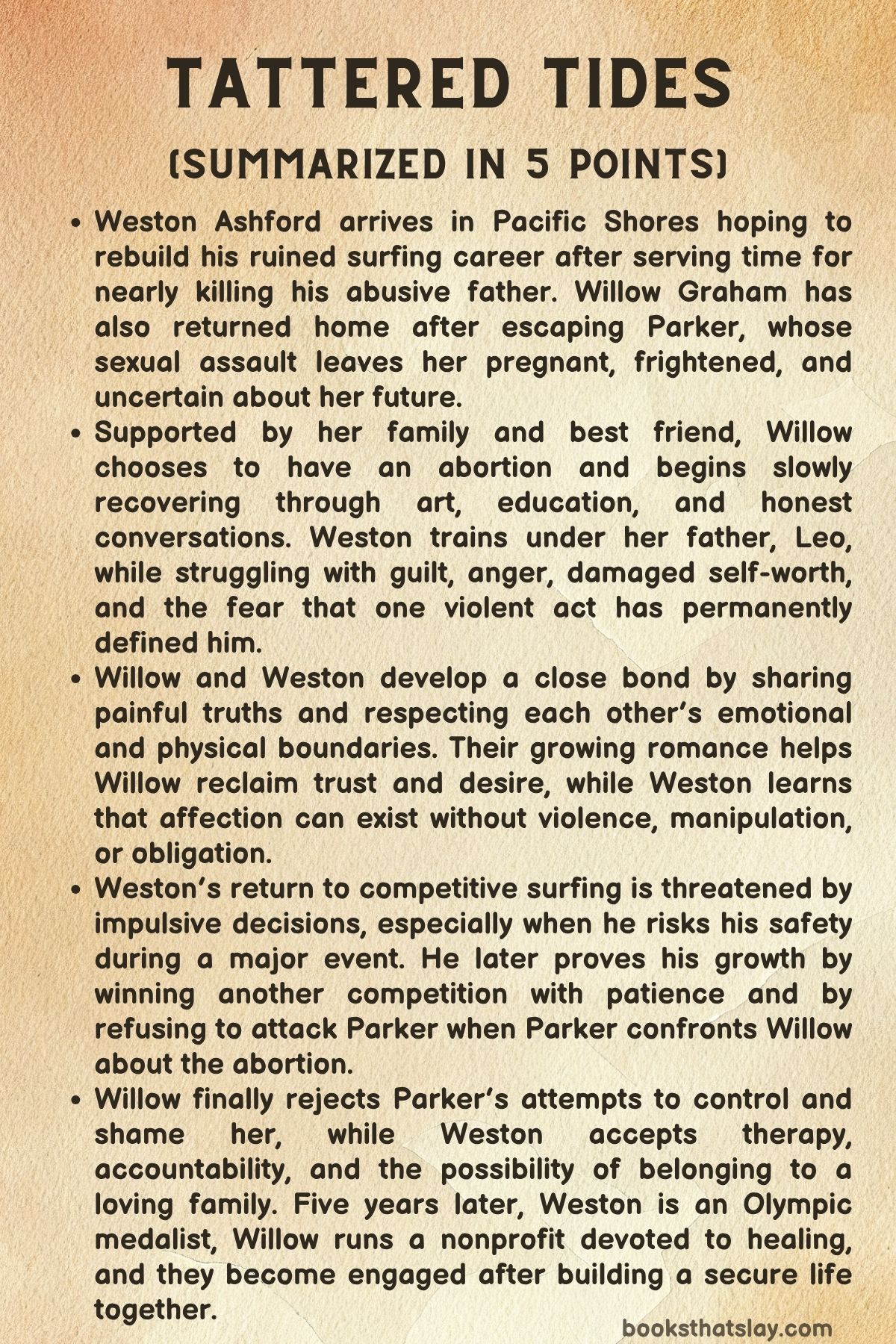
Summary
Twenty-year-old Weston Ashford has been out of county jail for six months, but freedom has not restored the life he once expected to have. Once a teenage surfing champion with Olympic ambitions, he now carries a criminal record, the loss of his title, and the belief that he has destroyed every promising part of his future.
Carter and Penelope, the foster parents who gave him stability as a teenager, continue supporting him through therapy, education, employment, and attempts at independent living. Weston appreciates their devotion, yet he remains convinced that he has become the damaged boy they first welcomed into their home.
Surfing is the only activity that quiets his guilt and gives him temporary relief from his memories. Recognizing this, Carter arranges for Weston to train with his longtime friend Leo Graham, a respected surfer and coach living in Pacific Shores.
At the same time, Willow Graham unexpectedly returns to Pacific Shores after fleeing the Berkeley apartment she shared with her boyfriend, Parker. She arrives frightened and emotionally exhausted, finally telling her parents, Leo and Darby, that Parker hurt her.
Willow initially struggles to describe what happened because the encounter began as consensual sex. Parker secretly removed the condom and ejaculated inside her without permission, then blamed her when she discovered what he had done.
Her best friend, Allie, identifies the act as sexual assault and urges her to obtain medical care. Testing reveals that Willow is pregnant, and she decides to have a medical abortion, a choice her parents support without hesitation.
Weston arrives at the Graham home during this family crisis to move into their guesthouse and begin his training. Leo briefly considers cancelling the arrangement, but Willow refuses to let her suffering cost Weston an opportunity that may determine his future.
Weston remembers Willow from a childhood visit to Disneyland, when she quietly comforted him during a moment of sensory and emotional distress. Though many details from that period are blurred by trauma, he has never forgotten her kindness or the feeling of being understood.
Leo establishes strict expectations for Weston’s training and warns him to stay away from Willow. Weston understands the protectiveness behind the rule, especially because of his criminal history, but his attraction to her makes immediate obedience difficult.
During Willow’s abortion, her parents, Allie, and extended family surround her with practical care and emotional support. Leo helps her understand that she can grieve the experience Parker stole from her while still knowing that ending the pregnancy was the correct decision.
Training begins with Olympic champion Liv Costa-Ramos, who criticizes Weston’s weakened technique and defensive attitude. Her direct coaching helps him accept that natural talent alone cannot restore his career; he must rebuild his balance, discipline, patience, and ability to make responsible choices.
Willow and Weston gradually become part of each other’s routines. Their playful arguments, conversations about art and surfing, and increasing attraction create a connection neither expected, although both remain cautious because of their histories.
When Willow accidentally encounters Weston in the outdoor shower, physical contact triggers a memory of Parker. Weston immediately withdraws, and the moment leads them to admit that touch carries complicated meanings for both of them.
Willow tells Weston about the assault, while he explains that childhood abuse left him unused to gentle physical affection. They begin a practice of “trading truths,” revealing painful or embarrassing parts of themselves without demanding more than the other is ready to share.
Weston eventually explains the crime that sent him to jail. Believing his abusive father was responsible for his mother’s death and furious that the legal system had failed her, he attacked the man outside a bar and nearly killed him.
He fears the assault proves that he has become like his father. Willow does not excuse his violence, but she separates one terrible act from his complete identity and recognizes the grief, anger, and helplessness that drove him toward it.
Their emotional intimacy strengthens during family gatherings, surfing sessions, paddleboarding trips, and quiet mornings at Celestia Cove. Willow discovers that Weston’s presence calms her, while Weston realizes she inspires him rather than interfering with his goals.
At a Fourth of July celebration, Weston is welcomed into the Graham family’s crowded, affectionate world. He meets Willow’s cousins, observes the unresolved love between Allie and Archer, and begins to imagine that lasting attachment may be possible.
Later, Camden, one of Willow’s former boyfriends, touches her with unwanted familiarity during a bonfire. Though he does not intend to harm her, Willow freezes because the contact activates memories of Parker.
Weston notices immediately, removes Camden’s hands, and later follows Willow to the beach. He asks permission before sitting near her, holding her hand, or embracing her, demonstrating the consent and patience Parker denied her.
Willow and Weston slowly begin exploring physical intimacy while communicating clearly about limits. Willow first asks only to be watched and desired without being touched, allowing her to experience attraction without surrendering control over her body.
During a storm, they finally kiss and share a deeper encounter without penetrative sex. Willow discovers that pleasure is still possible when she feels safe, while Weston learns that intimacy does not have to involve violence, manipulation, or obligation.
Weston explains that he experiences desire only after forming a strong emotional bond. His attraction to Willow comes from knowing her character, fears, humor, and creativity rather than simply responding to her appearance.
Their relationship becomes increasingly serious despite Leo’s concerns. Leo allows them to remain close but warns Weston that he must treat both Willow and his surfing career with complete commitment.
Parker continues trying to contact Willow through the flower shop, the surf store, mutual acquaintances, and social media. Leo attempts to protect her by threatening legal action, while Weston struggles to control the anger Parker’s behavior creates in him.
Willow also faces pressure from Chelsea, a Berkeley friend who remains loyal to Parker. When Willow reveals that she had an abortion, Chelsea condemns her for not informing Parker, forcing Willow to defend her right to make decisions about a pregnancy created through violation.
Weston comforts Willow without demanding an immediate explanation. Their quiet evening of cooking, reading romance novels, and discussing therapy shows that care between them is becoming domestic and dependable rather than based only on attraction.
With Penelope’s help, Weston plans an intentional date inside a university classroom decorated with food, flowers, candles, and art materials. The effort proves that he values Willow’s interests and wants to offer the consideration she should never have needed to beg for.
Their physical relationship advances only when both feel ready. Through communication, patience, and reassurance, Willow begins separating her sexuality from Parker’s criticism, while Weston learns how trust can transform vulnerability into closeness.
During Weston’s first major comeback competition, he performs exceptionally well but makes a reckless decision to pursue a dangerous wave. He crashes, frightening Willow and disappointing Leo, who recognizes that Weston’s hunger to prove himself still threatens his judgment.
The accident forces Weston to confront the difference between courage and self-destructive impulsiveness. It also makes Willow unwilling to postpone what she wants, and they choose to have sex after carefully discussing consent, fear, and control.
Their relationship soon becomes joyful and openly passionate. Willow initiates intimacy, expresses her desires, and reclaims confidence in her body, while Weston discovers that emotional trust has awakened a depth of physical desire he never previously experienced.
Willow eventually confronts Parker by telephone and rejects his attempts to make her feel guilty. She tells him he no longer controls her understanding of herself and orders him to stop contacting her.
Weston also begins therapy again and acknowledges that surfing cannot be his only method of coping. He considers how public attention surrounding his return to competition may expose his criminal history, but Willow refuses to let strangers decide whether he deserves love.
Liv secretly invites Weston to compete in the Sunrise Open despite Leo’s prohibition against further events that season. Willow encourages him to accept, believing that he must demonstrate he has learned from his earlier mistake.
Weston competes with patience and discipline, wins the event, and attracts the attention of sponsors and representatives. His victory confirms that his athletic future can be rebuilt through control rather than reckless desperation.
The celebration changes when Parker appears after tracing Willow through her social media activity. He confronts her, condemns the abortion, grabs her when she tries to leave, and exposes her private history to Weston.
Weston immediately recognizes Parker’s actions as assault and rejects his claim that a long relationship gave him permanent access to Willow’s body. Though he wants to attack Parker, Willow stops him from sacrificing the future he has worked to recover.
Willow speaks for herself, refusing to apologize for the abortion or provide explanations Parker has no right to demand. She tells him that his violation ended every claim he might once have had to information about her life.
Weston later admits that he wanted to kill Parker, just as he once wanted to kill his father. This time, however, he walks away, proving that violent thoughts do not have to become violent actions.
At Celestia Cove, Willow finally explains her abortion fully. Weston responds without judgment, telling her that the knowledge only helps him understand the weight she has been carrying.
They openly declare their love and accept that neither person’s darkest experiences reduce their worth. Their relationship becomes defined not by rescue but by the decision to remain honest, seek help, and face the future together.
Leo appears to end Weston’s summer arrangement by firing him from the surf shop and ordering him to leave Pacific Shores. He then reveals that Weston has earned a professional trainee and youth-coaching position at Huntington Surf Academy, close to UC Irvine, where Willow plans to continue her education.
The new opportunity allows Weston to pursue surfing without abandoning Willow. It also confirms Leo’s belief that Weston has the talent and discipline to build a meaningful career.
Willow decides to seek counselling, pursue a restraining order against Parker, and continue her academic and artistic goals. Surrounded by family, she understands that returning home was not a retreat but the beginning of a different life.
Five years later, Weston has won an Olympic silver medal, while Willow has completed her education and founded Healing Tides, a nonprofit combining therapy, art, sport, and recreation for underserved families. Weston helps run its youth surfing program when he is not competing.
The couple owns a home in Dana Point and plans to create a family in the future. During a trip to Tahiti, Weston proposes, and Willow accepts.
Willow chooses to keep her surname, while Weston decides that he also wants to become a Graham. By leaving behind the Ashford name associated with his father, he embraces the family that taught him love, responsibility, and belonging.
Characters
Tattered Tides develops its characters through the contrast between the identities imposed on them by trauma and the people they consciously choose to become. Each significant figure contributes to the novel’s examination of consent, accountability, family, personal agency, and recovery.
Willow Graham
Willow is a compassionate, creative, and emotionally perceptive young woman whose return to Pacific Shores begins as an act of survival. She escapes Parker before she has fully accepted that his removal of the condom was sexual assault, showing how manipulation can make a person distrust even the clearest signals from their own body.
Her early uncertainty does not make her weak; it demonstrates the psychological damage created when someone she trusted deliberately violates an agreed boundary. Fear, nausea, shame, grief, anger, and lingering attachment coexist within her because she is mourning both the assault and the false version of Parker she believed she loved.
The pregnancy and abortion force Willow to make a major decision while still processing the circumstances that created it. Her certainty about terminating the pregnancy is separate from her sadness, and the novel allows her to experience physical and emotional pain without suggesting that pain invalidates her decision.
Willow’s development is largely about reclaiming authorship over her body and future. She chooses not to return to Berkeley, applies to universities nearer home, resumes artistic work, begins considering therapy, and eventually participates directly in protecting herself from Parker rather than allowing her family to manage every danger.
Her relationship with Weston supports this growth because he listens to her boundaries instead of interpreting them as rejection. Willow gradually learns that she can desire someone, initiate intimacy, change her mind, communicate preferences, and remain fully in control of herself.
Art serves as one of Willow’s strongest forms of expression. Painting allows her to release feelings that resist ordinary language, and her later decision to establish Healing Tides shows how she transforms private pain into structured support for others.
Willow also possesses a generous instinct that can sometimes lead her to prioritize other people too quickly. She allows Weston to remain in the guesthouse during her family crisis, worries about Camden’s feelings after he triggers her, and fears disappointing others even when she has done nothing wrong.
By the end, she becomes more capable of separating compassion from self-sacrifice. She can understand another person’s emotions without surrendering her boundaries, and she can accept love without treating it as something she must earn through silence or accommodation.
Weston Ashford
Weston is a former surfing champion whose identity has been reduced, in his own mind, to a violent crime and the future it destroyed. His intelligence, discipline, kindness, and athletic talent remain intact, but guilt prevents him from believing those qualities still matter.
His attack on his father is morally serious and is never treated as harmless simply because it came from grief. Weston accepts responsibility for nearly killing a man, yet he struggles to distinguish accountability from permanent self-condemnation.
The fear that he has inherited his father’s brutality shapes nearly every decision he makes. Anger toward Parker, protectiveness toward Willow, and frustration during training all force him to confront whether violence is an unavoidable part of him or a response he can learn to control.
His greatest demonstration of growth occurs when Parker confronts Willow. Weston experiences the same murderous rage that once led him to attack his father, but he chooses to leave with Willow rather than repeat the act that sent him to jail.
Surfing initially functions as avoidance because it is the only place where his mind becomes quiet. Under Leo and Liv’s guidance, however, it becomes a discipline through which Weston learns patience, humility, restraint, and the difference between confidence and recklessness.
His dangerous wipeout reveals that talent and good intentions cannot protect him from impulsive choices. Winning the Sunrise Open later proves that he can succeed by studying conditions, trusting his training, and refusing to let desperation determine his actions.
Weston’s relationship with touch is equally important. Because affection in childhood was tied to violence, apology, or fear, he has difficulty understanding physical closeness as something freely offered.
Willow’s touch becomes meaningful because it contains no demand. His attraction develops from emotional trust, and his careful attention to consent reflects both his desire to protect Willow and his own need for intimacy that does not resemble the relationships of his childhood.
Within Tattered Tides, Weston’s second chance is not presented as a reward granted simply because he suffered. He earns trust through work, therapy, honesty, controlled choices, and an increasing willingness to accept that being loved does not remove his responsibility to keep growing.
Leo Graham
Leo is Willow’s devoted father and Weston’s demanding coach. His protectiveness sometimes becomes controlling, but it arises from genuine fear after watching his daughter return home traumatized and uncertain of her safety.
He supports Willow’s abortion without hesitation and refuses to treat her grief as evidence that she made the wrong decision. His conversations with her show that he can acknowledge emotional complexity while continuing to defend her autonomy.
As Weston’s coach, Leo sees exceptional ability beneath the young man’s criminal history. He studies Weston’s weaknesses closely and demands punctuality, patience, discipline, and control because he understands that talent without judgment could destroy Weston again.
His rule that Weston stay away from Willow reflects both paternal anxiety and an incomplete understanding of Weston. Over time, he evaluates Weston through actions rather than reputation and recognizes that the relationship is helping both young people become more honest.
Leo’s final decision to arrange a position at Huntington Surf Academy reveals the care beneath his severity. He does not simply forgive Weston’s mistakes; he creates a path where responsibility, professional development, and personal happiness can exist together.
Darby Graham
Darby offers Willow a calm, accepting form of maternal support. She recognizes immediately that something serious has happened but does not pressure her daughter to speak before she is ready.
Her response to the pregnancy and abortion is especially meaningful because her own experience with infertility could have complicated the situation. Instead of projecting personal grief onto Willow, she protects her daughter’s right to decide what happens to her body.
Darby also gives balanced advice about Weston. She sees the safety and affection between the couple but reminds Willow that love cannot replace therapy, time, or individual responsibility.
Her parenting combines warmth with respect for Willow’s adulthood. She offers guidance without demanding obedience, creating the emotional security Willow needs while rebuilding confidence in her own judgment.
Carter
Carter is one of the first adults to recognize that Weston is more than his trauma. He remembers the intelligent, determined teenager who entered his home and refuses to let Weston’s conviction erase that person entirely.
His decision to contact Leo creates the central opportunity of Weston’s recovery. Carter understands that surfing once gave Weston direction and believes that returning to it under the right conditions may restore purpose.
Carter’s support is not blind approval. He worries about Weston’s emotional withdrawal and understands that practical help cannot replace the deeper work of healing.
His faith gives Weston somewhere to return even when Weston cannot believe in himself. Through Carter, the novel presents fatherhood as consistent presence rather than biological entitlement.
Penelope
Penelope provides Weston with intellectual, emotional, and maternal guidance. She encourages his education, supports his artistic and academic interests, and worries when he abandons therapy in favour of relying entirely on surfing.
Her conversations about art and abuse also influence Willow. Penelope understands that creativity can help organize painful emotions, but she does not romanticize suffering or suggest that art alone can heal trauma.
By offering Willow a teaching-assistant position, she helps her reclaim academic direction after leaving Berkeley. She also assists Weston in planning a thoughtful date, showing her willingness to support their relationship while respecting its emotional seriousness.
Penelope represents care that is observant rather than intrusive. She notices what both young people need and creates opportunities for them to move forward without trying to control the exact shape of their futures.
Parker
Parker is defined by entitlement, manipulation, and refusal to accept responsibility. His removal of the condom is not presented as a misunderstanding but as a deliberate violation of the conditions under which Willow consented to sex.
Afterward, he attempts to rewrite the event by blaming Willow, minimizing the importance of consent within a long relationship, and portraying himself as the injured party. His excuses are designed to make Willow distrust her own interpretation and feel responsible for the consequences of his actions.
His harassment continues after she leaves. He contacts businesses, mutual acquaintances, family members, and eventually attends Weston’s competition, demonstrating that his desire for control matters more to him than Willow’s fear or repeated demands for distance.
Parker’s response to the abortion exposes his belief that he retains rights over Willow’s body even after violating it. He treats the pregnancy as something taken from him while refusing to acknowledge that it resulted from an act she never agreed to.
His contrast with Weston is central. Both men experience anger and possess the capacity for violence, but Parker protects his ego through denial while Weston accepts responsibility and works to choose differently.
Parker ultimately loses control not because another man defeats him but because Willow rejects his version of events. Her refusal to explain, apologize, or continue the conversation removes the emotional access he has repeatedly attempted to preserve.
Allie
Allie is Willow’s closest friend and one of the first people to give clear language to the assault. When Willow hesitates to call Parker’s act rape, Allie trusts Willow’s physical and emotional reactions and identifies the violation without ambiguity.
Her support is practical as well as emotional. She accompanies Willow to medical appointments, remains beside her during the abortion, and helps her confront the difference between guilt and responsibility.
Allie’s own romantic situation adds another perspective on attachment. She remains emotionally connected to Archer despite dating Declan, suggesting that love can persist even when timing, ambition, and circumstance separate people.
Her loyalty to Willow is uncomplicated by judgment. She does not demand that Willow report Parker, return to school, forgive herself immediately, or heal according to an external schedule.
Liv Costa-Ramos
Liv is an accomplished surfer whose authority comes from experience, discipline, and confidence. She refuses to flatter Weston, directly identifying technical weaknesses and the defensive attitude preventing him from rebuilding properly.
Her coaching challenges Weston to begin again without treating foundational work as humiliation. She sees that his talent remains exceptional, but she also recognizes that skill must be supported by patience and emotional control.
Liv’s decision to invite him to the Sunrise Open is risky because it defies Leo’s restrictions. However, she believes Weston needs an opportunity to prove that the earlier wipeout taught him restraint rather than fear.
Her role extends beyond sport because she becomes part of Willow’s support network. Liv demonstrates how ambition, family loyalty, and emotional care can coexist without reducing a woman to only one role.
Lou
Lou is a supportive relative whose presence strengthens the sense of family surrounding Willow. Lou helps during Willow’s abortion, participates in family gatherings, and joins the secret journey to Weston’s competition.
As Liv’s partner, Lou also represents a stable adult relationship based on companionship and mutual respect. This creates another contrast with Parker’s possessiveness and reinforces the novel’s broader presentation of love as cooperation rather than control.
Lou’s willingness to provide housing near UC Irvine contributes to Willow and Weston’s future. Though less central than several other figures, Lou helps turn the couple’s uncertain hopes into practical possibilities.
Archer
Archer is Willow’s cousin and Allie’s first love. His unresolved bond with Allie introduces a parallel story about affection that survives separation, changing ambitions, and imperfect timing.
He responds protectively when Camden triggers Willow at the bonfire, but he allows Weston to follow her after recognizing that Weston understands details others do not. This shows that Archer’s protectiveness is guided by Willow’s needs rather than competition between men.
His connection with Allie also warns against allowing fear or circumstance to decide a relationship indefinitely. Their emotional attachment remains visible despite distance and other partners.
Zander
Zander is an observant and good-humoured member of Willow’s extended family. He quickly notices the physical and emotional closeness between Willow and Weston, helping make their private attraction visible within the larger family circle.
He also supports Willow during moments of danger and joins the trip to the Sunrise Open. His presence reinforces the Graham family’s habit of responding collectively when one person needs protection.
Camden
Camden is a former boyfriend who still has feelings for Willow but is not portrayed as intentionally predatory. His unwanted touch at the bonfire becomes harmful because he assumes past familiarity gives him permission to approach her body without checking her comfort.
His role demonstrates that a person does not need malicious intentions to violate a boundary. Willow’s trauma response is valid regardless of whether Camden expected to frighten her.
Camden’s confusion and hurt also expose Willow’s tendency to take responsibility for other people’s feelings. The incident helps her learn that she does not owe physical access to someone merely because he once loved her or did not intend harm.
Chelsea
Chelsea represents the social pressure that often protects harmful men. Because she remains loyal to Parker, she approaches Willow’s disappearance as a problem Parker deserves to have explained rather than asking why Willow felt compelled to escape.
Her condemnation of the abortion reveals how quickly concern can become judgment when someone assumes entitlement on behalf of a man. Chelsea demands information without knowing the full circumstances and treats Willow’s privacy as cruelty.
Willow’s decision to leave the conversation is an important act of self-respect. She refuses to expose more trauma merely to satisfy someone already prepared to judge her.
Declan
Declan is Allie’s controlling boyfriend, whose jealousy toward Archer is partly based on a real emotional bond between Archer and Allie. However, his disrespectful treatment of Allie prevents his insecurity from appearing sympathetic.
He functions as a smaller example of possessiveness within romantic relationships. His presence reinforces the difference between expressing vulnerability and attempting to control a partner’s connections.
Elena, August, Dahlia, and the Wider Family Circle
Elena, August, Dahlia, and the extended Graham relatives contribute to the stable community surrounding the central couple. Elena connects Weston with Willow’s favourite books, August helps inspire his stained-glass tattoo, and Dahlia participates in the everyday family closeness that becomes unfamiliar but valuable to him.
The wider family is noisy, teasing, protective, and occasionally intrusive, yet its defining quality is acceptance. Weston gradually learns that belonging does not require perfection and that a family can respond to painful history with care rather than rejection.
Their support also prevents the romance from becoming the sole source of healing. Willow and Weston are held by friendships, relatives, mentors, therapists, creative work, and professional goals, allowing their love to become one part of a much larger recovery.
Themes
Consent, Bodily Autonomy, and Reclaiming Desire
Consent in Tattered Tides is treated as a continuing agreement rather than permanent permission created by a relationship. Parker’s removal of the condom changes the conditions under which Willow agreed to sex, making his act a deliberate violation regardless of their history or his later excuses.
The pregnancy intensifies the question of bodily autonomy because Willow must make another decision involving a body Parker has already attempted to control. Her abortion is presented as hers to choose, and the support offered by her parents reinforces that love does not give another person authority over her reproductive decisions.
Willow’s later intimacy with Weston creates a direct contrast. He asks before touching her, respects pauses, accepts limits without resentment, and never treats her fear as an inconvenience he must overcome.
Reclaiming desire does not mean erasing the assault or returning immediately to the person Willow was before it. Her progress appears through small choices: allowing herself to be watched, initiating contact, communicating preferences, stopping when memories intrude, and eventually experiencing pleasure without Parker’s criticism controlling her thoughts.
The theme extends beyond sexual encounters. Willow’s education, art, friendships, therapy, and decision to confront Parker all involve reclaiming authority over a life he tried to define through fear and shame.
Trauma, Healing, and Chosen Safety
Trauma appears through physical reactions, disrupted memory, insomnia, avoidance, anger, shame, sensory distress, and difficulty trusting ordinary affection. Willow and Weston understand each other partly because both know that the body may respond to danger before the mind can organize what is happening.
Healing is not shown as a straight movement from pain to complete recovery. Willow can feel safe with Weston and still freeze when Camden touches her, while Weston can rebuild his career and still experience panic attacks or violent thoughts.
Safety becomes meaningful because it is repeatedly chosen and demonstrated. Weston does not merely tell Willow that she is safe; he asks permission, listens to her responses, leaves decisions in her hands, and refuses to demand explanations when she is overwhelmed.
Willow offers Weston a similar form of acceptance. She recognizes the seriousness of his crime without reducing him to it, allowing him to admit anger, guilt, desire, fear, and uncertainty without assuming that honesty makes him dangerous.
Professional support remains essential. Both characters eventually acknowledge that romance, family, surfing, and art can assist recovery but cannot replace therapy or the personal responsibility required to manage trauma over time.
Second Chances, Accountability, and Self-Reconstruction
Weston’s return to surfing raises the question of what a second chance should require. The novel does not argue that suffering automatically erases wrongdoing, nor does it accept the idea that one violent act must define the whole of a person’s future.
Accountability begins with Weston’s refusal to deny what he did. He understands that grief and childhood abuse explain his attack on his father without making the act harmless, and he accepts that controlling future anger is his responsibility.
His development is measured through choices rather than promises. He returns to training, accepts criticism, begins therapy again, learns from his reckless wipeout, resists attacking Parker, and wins the Sunrise Open through discipline rather than desperation.
Willow also reconstructs a life that no longer resembles the one she planned. Leaving Berkeley initially feels like failure, but she gradually recognizes that choosing a different university, returning to art, seeking counselling, and creating stronger boundaries are acts of direction rather than defeat.
Their futures are not restorations of untouched earlier lives. Weston does not simply become the teenager he was before jail, and Willow does not return to the person she was before Parker; both create identities informed by the past but not imprisoned by it.
Love, Family, and the Courage to Belong
Love is presented through repeated actions rather than dramatic declarations alone. Meals, rides, medical support, training sessions, flowers, books, quiet conversations, practical opportunities, and respectful touch create the foundation on which Willow and Weston build trust.
The Graham family provides Willow with a secure place to return when her expected future collapses. Their refusal to judge her abortion, delayed education, or emotional confusion allows her to make decisions without fearing that love will be withdrawn.
Carter and Penelope offer Weston the same stability through chosen parenthood. They continue believing in him after jail, but their love includes concern about therapy, isolation, and the danger of using surfing to avoid emotional work.
Weston’s difficulty accepting family reveals how deeply abuse shaped his expectations. He is accustomed to seeing affection as temporary, conditional, or connected to pain, so the Graham family’s easy inclusion initially feels almost impossible to trust.
His decision to take Willow’s surname completes the movement from inherited identity to chosen belonging. Becoming a Graham does not erase his mother, his crime, or his childhood, but it allows him to define family through loyalty, care, responsibility, and the future he intends to build.