Tell the Ghosts I’m Gone Summary, Characters and Themes
Tell the Ghosts I’m Gone by Kalynn Bayron is a supernatural horror novel that combines paranormal investigation, family secrets, dangerous magic, and the complicated process of understanding one’s identity.
The story follows Moll Cabot, a seventeen-year-old girl whose extraordinary abilities allow her to perceive and manipulate human emotions. Alongside her equally gifted friends, she investigates mysterious hauntings that lead to a disturbing discovery about her family’s history and a secret society obsessed with supernatural power. As the investigation becomes increasingly dangerous, Moll must confront the truth about her origins, the consequences of suppressing her abilities, and the sacrifices required to protect the people she loves.
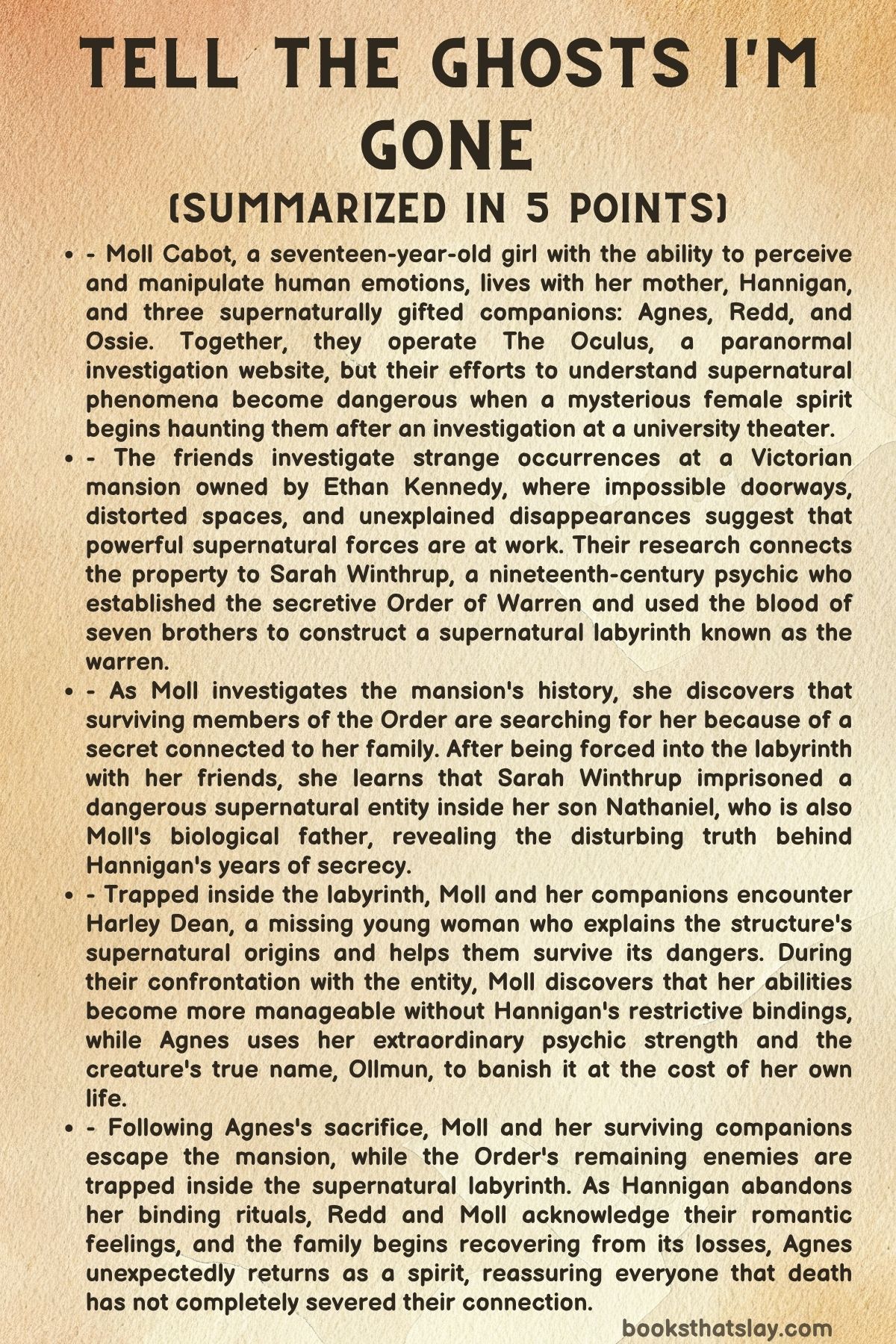
Summary
Moll Cabot is a seventeen-year-old living in Portland with her mother, Hannigan, and three young people who share her unusual supernatural nature. Moll can perceive emotions as colorful energy around people’s bodies and manipulate their feelings, although her powers become dangerously unpredictable when she experiences overwhelming emotions herself.
Her closest companions are Agnes, a gifted psychic haunted by her past; Redd, who can influence people’s thoughts through suggestion; and Ossie, a younger boy with an extraordinary connection to rodents. Together, they operate The Oculus, a website devoted to investigating paranormal activity and helping people understand supernatural experiences.
Although Hannigan protects the children through binding rituals that restrict their powers, Moll and her friends increasingly question whether these limitations prevent them from discovering their true potential. Their desire for independence becomes more urgent when Professor Louis Price contacts The Oculus about frightening disturbances in a university theater.
The professor describes encountering a terrifying apparition whose jaw opened unnaturally before it disappeared, alongside other unexplained sounds and shadows. Moll eagerly accepts the investigation, believing it offers an opportunity to establish The Oculus as a legitimate paranormal research group.
Inside the theater, the friends encounter forces far more dangerous than they anticipated. Agnes senses a mysterious female spirit searching for someone, but the appearance of another terrifying entity triggers memories of the accidental deaths of her parents, causing her psychic abilities to spiral beyond control.
Moll desperately attempts to calm Agnes while forcing Redd and Ossie away from danger through emotional manipulation. The confrontation leaves Moll unconscious and hospitalized, exposing the terrible consequences of using their restricted abilities under extreme pressure.
Although the friends conceal the incident from Hannigan, Agnes struggles with guilt, while Redd resents being forced to abandon Moll against his will. Their relationships become strained as they examine recordings that contain an unintelligible female voice but fail to preserve the most significant supernatural evidence.
Soon afterward, strange footsteps, disturbing dreams, and unexplained appearances suggest that something from the theater has followed Moll home. Meanwhile, Hannigan insists on strengthening the bindings, creating tension with Redd, who increasingly believes that suppressing their abilities is doing more harm than good.
A new investigation begins when Ethan Kennedy, the owner of a coffee shop called Alister’s, asks for assistance with disturbances inside an enormous Victorian mansion on Spring Street. The property has become associated with the disappearance of Harley Dean, a young paranormal enthusiast whom detectives believe may have vanished somewhere inside the building.
During their visit, Ethan demonstrates the mansion’s impossible architecture by pushing Moll through a doorway that transports her between locations that should not be connected. The experience, combined with unusual discrepancies in recorded time, suggests that the building can distort both physical space and ordinary reality.
Even more troubling, Moll discovers that her emotional powers cannot influence Ethan, while Redd finds that using his own dangerous abilities becomes unexpectedly easy inside the mansion. The friends suspect that the property weakens Hannigan’s bindings and amplifies supernatural abilities.
Their research leads them to Sarah Winthrup, a powerful nineteenth-century psychic who secretly commissioned the mansion under the name Martin Greenbriar. The building was constructed by seven brothers from the Merkley family, all of whom disappeared after completing their work.
As Moll investigates Winthrup’s history, she discovers connections to the Order of Warren, a secretive organization devoted to occult experimentation. Meanwhile, the mysterious female apparition begins appearing inside her home, eventually communicating through Agnes during a terrifying psychic episode that forces Moll to confess her investigations to Hannigan.
The search for information introduces Moll to Penelope Marsh, a telepathic descendant of Martin Greenbriar, who possesses an extraordinary metal-bound book containing architectural diagrams and occult symbols. Penelope warns that historical accounts of the Order are unreliable and gives Moll access to documents connected to Winthrup’s secret experiments.
Further clues emerge at Lone Fir Cemetery, where a young woman named Ruby explains that the supposed grave of Order member Ben Macomb does not contain his remains. Ruby also reveals that Harley was her friend and that dangerous followers of Winthrup’s teachings remain active.
Hannigan’s increasingly frightened reactions convince Moll that her mother knows more about the Order than she admits. Although Hannigan eventually acknowledges that a dangerous faction continues operating, she refuses to explain her personal connection to the organization.
Moll subsequently visits Rosetta Lexington, whose family helped Sarah Winthrup conceal her identity and survive long after her officially recorded death. There, Winthrup’s apparition directs Moll toward a hidden trunk containing documents that complete Penelope’s mysterious book.
The assembled materials reveal that the seven Merkley brothers possessed supernatural abilities and that their blood was essential to constructing and powering an impossible labyrinth called the warren. Franklin Merkley, the seventh brother, appears especially important because his bloodline provides access to the magical structure.
Before Moll can uncover the entire truth, members of the Order begin pursuing her. The danger becomes undeniable when Moll discovers Penelope murdered inside her ransacked home, apparently because she revealed information the Order wanted concealed.
Despite the threat, Moll secretly returns to Alister’s with her friends, including Ossie, who refuses to remain behind. Their investigation reveals supernatural passages, mysterious figures visible through mirrors, and photographs proving that someone has been monitoring Hannigan and the children since Moll’s infancy.
Ethan and an Order member named Malcolm confront them, revealing that Moll herself is central to the organization’s plans. Hannigan arrives to protect the children, but Malcolm obtains Winthrup’s book and a vial of preserved Merkley blood, which he uses to open a doorway into the warren.
Forced inside, the friends discover an enormous labyrinth filled with shifting corridors, impossible staircases, and supernatural dangers. Their bindings rapidly deteriorate, making their abilities increasingly powerful and initially more difficult to control.
They eventually encounter Harley, who has survived inside the labyrinth for weeks. She explains that Sarah Winthrup created the structure to imprison a supernatural entity that she had summoned and placed inside the body of her young son, Nathaniel.
Winthrup originally hoped to gain extraordinary power through the entity, but it became uncontrollable and murdered her husband. Unable to destroy the creature without killing Nathaniel, she imprisoned them together in the warren, dividing the Order between those who supported containment and those who wanted to exploit the entity.
Harley also reveals that Franklin Merkley was her ancestor, explaining her ability to enter the labyrinth. As the group searches for escape, they discover mirrors that allow Moll to witness Malcolm interrogating Hannigan, exposing a truth that transforms her understanding of her entire life.
Hannigan once entered the warren intending to destroy the creature but discovered that Nathaniel retained part of his humanity. She developed a relationship with him, and Nathaniel became Moll’s father, explaining why the Order has hunted Moll since childhood.
The revelation leaves Moll devastated as she realizes that the terrifying creature pursuing them is connected to her own identity. When the entity attacks, Redd suffers severe injuries, while Agnes and Ossie struggle to control their expanding powers.
During their final confrontation, Hannigan’s bindings collapse completely, but Moll discovers that her abilities become clearer rather than uncontrollable. With help from Winthrup’s spirit, she identifies the entity’s true name, Ollmun, hidden within the mysterious recordings that have haunted her since the theater investigation.
Agnes uses her full psychic strength to invoke the name and separate the entity from Nathaniel, banishing the supernatural force. The enormous release of energy destroys the prison’s stability, and Agnes sacrifices her life to ensure that her friends escape.
Back at the mansion, Malcolm and Ethan threaten the survivors, but Agnes briefly returns as a spirit and forces both men into the supernatural labyrinth. Moll and her remaining family escape, although Agnes’s death leaves an absence that none of them can easily accept.
In the aftermath, Harley reunites with her family, Redd and Ossie begin recovering, and Hannigan abandons the binding rituals after recognizing their harmful consequences. Moll and Redd finally acknowledge their romantic feelings, while the surviving family members begin accepting their complicated histories.
Although Moll continues her paranormal investigations, she struggles with the loss of Agnes until mysterious activity begins inside her bedroom on a snowy December evening. Agnes communicates through the recording equipment, reassuring her loved ones that she remains nearby and transforming their grief into the possibility of a continuing relationship beyond death.
Characters
Moll Cabot
Moll Cabot is the seventeen-year-old protagonist of Tell the Ghosts I’m Gone, whose ability to perceive and manipulate human emotions makes her extraordinarily powerful but also vulnerable to psychological and supernatural danger. Her journey centers on understanding the difference between controlling her abilities through fear and mastering them through self-acceptance.
Moll is courageous, intelligent, curious, and deeply protective of the people she loves. Her determination to establish The Oculus as a serious paranormal investigation organization demonstrates her desire to turn her unusual abilities into something meaningful rather than treating them as a burden.
However, Moll’s confidence occasionally becomes recklessness, particularly when she continues investigating the Spring Street mansion despite repeated warnings. Her choices expose her family to danger, and Penelope’s murder forces her to recognize that pursuing the truth can carry devastating consequences.
Her relationship with Hannigan is defined by affection complicated by secrecy and conflicting ideas about protection. Moll understands her mother’s fears but increasingly resents the restrictions that prevent her from discovering her full potential.
The revelation that Nathaniel is her father creates a profound identity crisis, forcing her to confront the possibility that her extraordinary powers originate from something monstrous. Ultimately, Moll learns that her ancestry does not determine her moral character, and her decision not to surrender to vengeance demonstrates genuine personal growth.
Hannigan Cabot
Hannigan is one of the most emotionally complicated characters in Tell the Ghosts I’m Gone, serving as both a devoted mother and a guardian whose protective instincts sometimes become restrictive. She has spent years shielding Moll, Agnes, Redd, and Ossie from a world that might exploit or condemn their supernatural abilities.
Her binding rituals reflect a deep fear of what uncontrolled power can accomplish. Although she believes that limiting the children’s abilities is necessary for their safety, she fails to recognize that constant suppression may actually interfere with their emotional development and supernatural stability.
Hannigan’s secrecy becomes understandable after the truth about Nathaniel emerges. Her relationship with him reveals a woman who recognized humanity inside a frightening supernatural situation and was willing to challenge conventional ideas about monstrosity.
She has also lived with the knowledge that members of the Order of Warren are searching for Moll, creating an atmosphere of anxiety beneath her seemingly ordinary parental responsibilities. Her attempts to conceal the past eventually damage the trust she wants to preserve.
By the conclusion, Hannigan acknowledges her mistakes and abandons the bindings. Her willingness to support The Oculus shows that her love becomes healthier when she accepts that protecting her children does not mean controlling every aspect of their identities.
Agnes
Agnes is among the most tragic and courageous figures in Tell the Ghosts I’m Gone, possessing exceptional psychic abilities while carrying unbearable guilt over the accidental deaths of her parents. Her history shapes nearly every important decision she makes, creating an ongoing struggle between her desire for connection and her fear of hurting others.
Agnes frequently doubts her capacity to control her abilities, particularly when terrifying supernatural experiences trigger memories of her childhood. The theater incident exposes how deeply her trauma remains embedded in her identity, even when she appears calm and capable.
Her friendship with Moll provides essential emotional stability. Moll refuses to define Agnes by her past mistakes, encouraging her to recognize that accidental harm does not make her undeserving of love.
Agnes also serves as a crucial link between the living and the dead, eventually becoming the channel through which Sarah Winthrup communicates. Her ability to confront supernatural forces makes her indispensable to the investigation, even as it repeatedly threatens her well-being.
Her final decision to sacrifice herself to defeat Ollmun represents the culmination of her development. Instead of remaining imprisoned by the fear that her abilities only cause destruction, she uses them deliberately to save the family she loves, and her later spiritual return preserves her place within that family.
Redd
Redd plays an essential emotional and intellectual role in Tell the Ghosts I’m Gone, combining supernatural suggestion abilities with a strong interest in architecture, research, and independent thinking. His skepticism toward Hannigan’s binding rituals challenges the family’s assumptions about the relationship between supernatural power and personal freedom.
Redd has a difficult history that influences his distrust of authority and his insistence on understanding his abilities. His arrival in Hannigan’s household through the assistance of Mrs. Harris gives him a chance at belonging, although he remains sensitive to situations where others make decisions without consulting him.
His relationship with Moll develops through shared experiences, disagreements, mutual concern, and growing romantic affection. When Moll manipulates his emotions to force him away from danger, he feels betrayed because her attempt to protect him denies him the freedom to make his own choices.
Redd’s architectural knowledge proves invaluable in identifying the mansion’s connection to Sarah Winthrup and its impossible construction. His intellectual contributions demonstrate that his importance extends far beyond his supernatural capabilities.
Despite suffering serious injuries during the confrontation with Ollmun, Redd survives and becomes an important source of reassurance for Moll. His insistence that her family origins do not define her reflects his understanding that identity emerges from personal choices rather than inherited circumstances.
Ossie
Ossie is the youngest member of the supernatural household in Tell the Ghosts I’m Gone, whose unusual connection to rodents gives him abilities that can appear humorous, unsettling, and extremely dangerous. His fascination with rats reflects both his distinctive personality and his comfort with creatures that most people regard with disgust.
Although Ossie often behaves impulsively, his actions reveal a strong desire to be treated as an equal member of the family. His decision to join the dangerous investigation despite Moll’s objections demonstrates that he refuses to be excluded from experiences involving the people he loves.
Ossie’s supernatural powers are closely connected to his emotional state, with fear and distress sometimes causing large numbers of rodents to gather around him. This lack of control reflects the vulnerability of a child who has experienced traumatic events without fully processing them.
Malcolm’s references to his parents’ deaths expose painful memories that Hannigan has attempted to shield him from. Ossie’s story therefore raises questions about whether concealing distressing truths genuinely protects children or merely delays their ability to understand their experiences.
His devotion to Agnes, Moll, and Redd gives the household a sense of youthful warmth, while his rodents occasionally provide practical assistance during dangerous confrontations. His eventual recovery suggests that greater emotional support and a better understanding of his powers may help him develop confidence and independence.
Nathaniel Winthrup
Nathaniel is one of the novel’s most tragic characters because his life becomes the foundation of his mother’s disastrous supernatural ambitions. As Sarah Winthrup’s young son, he is subjected to a ritual that allows an otherworldly entity to inhabit his body, depriving him of control over his own existence.
His mother’s original desire to gain greater supernatural power transforms him into both a victim and a prison for an immensely destructive force. The entity’s violence creates the impression that Nathaniel has become a monster, yet fragments of his humanity survive beneath its control.
His relationship with Hannigan reveals that he retains the capacity for affection and emotional connection. Hannigan recognizes the person hidden within the creature, and their relationship eventually results in Moll’s birth.
Nathaniel’s identity as Moll’s father complicates the distinction between human and monstrous. Although the entity commits terrible acts, Nathaniel himself is trapped within circumstances he never freely chose.
His brief emergence during the final confrontation suggests that he desires liberation from the force occupying his body. Through Nathaniel, the novel examines the cruelty of sacrificing another person’s autonomy in pursuit of power.
Sarah Winthrup
Sarah Winthrup is the historical figure whose experiments shape the central mystery and supernatural danger of the novel. A gifted nineteenth-century psychic associated with the Order of Warren, she becomes obsessed with expanding her abilities beyond ordinary human limitations.
Her decision to summon an otherworldly entity and place it inside Nathaniel reveals the destructive consequences of ambition without ethical restraint. Rather than accepting the limitations of her abilities, she sacrifices her son’s freedom in pursuit of an extraordinary supernatural achievement.
However, Sarah is not portrayed as a figure motivated exclusively by cruelty. When she realizes the entity cannot be controlled, she helps create the warren to imprison it, apparently hoping to prevent further destruction without killing her son.
Her ghostly appearances throughout the story suggest that death has not ended her attempts to address the consequences of her actions. By directing Moll toward hidden documents and helping reveal Ollmun’s true name, Sarah contributes to the eventual defeat of the force she originally summoned.
Her character illustrates the difference between possessing extraordinary knowledge and exercising moral wisdom. Although she helps repair some of the damage she caused, the suffering of Nathaniel and the Merkley brothers remains inseparable from her legacy.
Harley Dean
Harley Dean initially appears as a missing young woman whose disappearance at Alister’s transforms a paranormal investigation into an urgent search for a potentially endangered person. Her fascination with supernatural phenomena leads her into the Spring Street mansion, where her unusual ancestry allows her to access the hidden labyrinth.
As a descendant of Franklin Merkley, Harley possesses an inherited connection to the magical structure. Her survival inside the warren demonstrates exceptional adaptability, resourcefulness, and determination in circumstances that would overwhelm most people.
Rather than becoming entirely helpless, Harley learns how the labyrinth operates and develops enough knowledge to guide Moll and her friends through its shifting passages. Her experience makes her a valuable source of information about the prison’s construction and the entity occupying it.
Harley’s connection to the Merkley family also brings a historical injustice into the present. Her ancestors were exploited in supernatural experiments, and she must confront the continuing consequences of their suffering.
Her eventual escape and reunion with her family offer a hopeful contrast to the losses experienced by Moll’s household. Harley’s survival demonstrates that discovering the truth about an inherited past can become a source of strength rather than an unavoidable sentence.
Ollmun
Ollmun is the terrifying supernatural entity that Sarah Winthrup summons and places inside Nathaniel’s body. Its presence establishes the central horror of the novel because it combines extraordinary destructive power with the violation of an innocent person’s identity.
The creature can change its appearance, pursue victims through the impossible labyrinth, and manipulate their fears and painful memories. Its ability to exploit psychological vulnerabilities makes it dangerous even to people who possess powerful supernatural defenses.
Ollmun’s possession of Nathaniel creates a difficult moral situation because destroying the creature appears inseparable from harming its human host. This connection explains why Winthrup imprisoned the entity instead of simply attempting to eliminate it.
The revelation that Ollmun can be defeated through its true name establishes the importance of knowledge over brute force. Its banishment depends on cooperation between Moll, Agnes, Winthrup’s spirit, and the surviving humanity within Nathaniel.
As an antagonist, Ollmun represents uncontrolled supernatural power stripped of empathy and responsibility. Its existence exposes the terrible consequences of treating human beings as instruments for achieving extraordinary ambitions.
Malcolm
Malcolm is a dangerous member of the surviving Order of Warren who believes that the supernatural power contained within the warren should be claimed and controlled. His devotion to the organization’s ambitions demonstrates how historical obsessions can survive across generations, even when their original purpose has become distorted.
Unlike Moll and her friends, who hope to understand supernatural phenomena and protect others, Malcolm approaches extraordinary abilities as resources to be exploited. His willingness to threaten children, manipulate Hannigan, and use violence reveals his belief that achieving the Order’s objectives justifies almost any action.
Malcolm possesses considerable knowledge about the family’s past, including Nathaniel’s identity and the circumstances surrounding Ossie’s parents. He uses this information to frighten and control the children, demonstrating that his cruelty extends beyond physical intimidation.
Even after Ollmun’s defeat, Malcolm refuses to acknowledge the failure of the Order’s ambitions. His eventual imprisonment inside the labyrinth emphasizes the destructive consequences of pursuing power without regard for human suffering.
Ethan Kennedy
Ethan Kennedy owns Alister’s, the coffee shop operating inside the mysterious Spring Street mansion. Initially presenting himself as a frightened property owner seeking assistance, he gradually emerges as an untrustworthy figure connected to the surviving Order of Warren.
His unusual resistance to Moll’s emotional manipulation provides an early indication that he possesses knowledge or protection beyond that of an ordinary person. His willingness to demonstrate the mansion’s supernatural doorways also suggests that he understands more about the building than he initially admits.
Ethan’s involvement in Harley Dean’s disappearance makes him particularly suspicious. Although he claims not to have deliberately harmed her, his connection to the house and his later cooperation with Malcolm demonstrate that he has concealed significant information.
His participation in threatening the children reveals his willingness to sacrifice their safety for the Order’s ambitions. Ultimately, Ethan becomes another example of how fascination with supernatural power can turn ordinary self-interest into dangerous complicity.
Penelope Marsh
Penelope Marsh is an elderly telepath and descendant of Martin Greenbriar whose family history connects her to Sarah Winthrup’s secretive activities. Her intelligence, independence, and remarkable supernatural awareness make her an important source of information during Moll’s investigation.
Penelope immediately recognizes that Hannigan is concealing something, using her telepathic abilities to understand the fear beneath the mother’s protective behavior. Her decision to contact Moll privately reveals both her curiosity and her willingness to challenge established boundaries.
Her possession of the unusual metal-bound book proves essential to uncovering the mansion’s supernatural architecture. By sharing this material, Penelope gives Moll access to information that members of the Order have attempted to conceal for generations.
However, her actions place her in direct danger. Her murder demonstrates the seriousness of the surviving Order’s determination to protect its secrets, transforming the investigation from an intellectual mystery into a confrontation with people capable of extreme violence.
Penelope’s role also highlights the importance of preserving historical knowledge. Although she dies before the mystery is resolved, the information she provides remains essential to the eventual defeat of Ollmun.
Ruby
Ruby is a young woman connected to Portland’s contemporary spiritualist community who becomes an unexpected ally in Moll’s investigation. Her knowledge of Ben Macomb’s memorial and the surviving followers of the Order of Warren provides valuable information about the organization’s continuing influence.
Initially, Ruby appears protective of the traditions surrounding Macomb’s supposed burial site. However, her warnings reveal a deeper awareness of the dangers associated with Winthrup’s supernatural discoveries.
Her friendship with Harley Dean gives her a deeply personal reason to assist Moll. Harley’s disappearance has affected her profoundly, and Ruby’s willingness to share historical information reflects her determination to discover what happened.
Ruby also serves as a link between past and present, demonstrating that the consequences of Winthrup’s experiments continue influencing people who had no involvement in the original events. Her reunion with Harley provides one of the novel’s more hopeful resolutions.
Rosetta Lexington
Rosetta Lexington is an elderly woman whose family has maintained a secret connection to Sarah Winthrup for generations. Through her family history and the Garden Hills Home, she preserves information that challenges the accepted historical account of Winthrup’s death.
Her revelation that Winthrup survived under the name Mary Barton proves essential to Moll’s understanding of the supernatural mystery. Rosetta demonstrates that official records can conceal deliberate efforts to protect powerful or controversial individuals.
Unlike the surviving members of the Order who seek control over Winthrup’s discoveries, Rosetta primarily functions as a guardian of historical knowledge. Her willingness to let Moll examine the belongings stored in the attic creates an opportunity for the protagonist to encounter Winthrup’s spirit directly.
Although Rosetta does not participate in the final confrontation, her assistance provides a crucial connection between historical evidence and the supernatural events unfolding in the present.
Franklin Merkley
Franklin Merkley is the youngest of the seven Merkley brothers whose supernatural blood was used in Sarah Winthrup’s experiments. His birth on July 7, as the seventh son, makes him especially significant within the occult system that powers the warren.
Franklin’s importance emerges through historical records rather than extensive direct appearances. The circumstances surrounding his family’s disappearance reveal that the brothers were selected because of their unusual hereditary qualities and their usefulness to Winthrup’s plans.
His bloodline survives through Harley Dean, whose ability to enter the labyrinth demonstrates the continuing supernatural significance of her ancestry. This inheritance becomes central to understanding why certain individuals can access the impossible structure.
Franklin represents the human cost of Winthrup’s experiments. His story illustrates how supernatural ambition can exploit individuals and families across generations, leaving descendants to confront dangers created long before their births.
Michael Merkley
Michael Merkley leads the seven-man construction crew responsible for building Sarah Winthrup’s mysterious mansion. His apparent disappearance alongside the other workers becomes part of Portland’s unresolved historical mysteries.
Initially, Michael appears to be an ordinary construction supervisor involved in an unusually secretive architectural project. Later discoveries reveal that the entire crew consists of brothers whose supernatural blood is essential to the creation of the warren.
Michael’s involvement demonstrates how Winthrup concealed supernatural experimentation beneath seemingly conventional activities. The mansion’s construction was not simply a matter of unusual design but part of a larger ritual involving human lives.
Although the available account provides little information about Michael’s individual personality, his fate symbolizes the exploitation of people whose abilities make them valuable to powerful organizations. His family’s disappearance establishes the suffering hidden beneath the mansion’s supernatural achievements.
The Other Merkley Brothers
The remaining five Merkley brothers form part of the seven-member family recruited for Winthrup’s extraordinary construction project. Their individual personalities and personal histories are not developed in the supplied account, but their collective role remains essential to the mystery.
Their supernatural abilities and shared bloodline make them central to the magical system sustaining the labyrinth. The disappearance of all seven brothers suggests the extent to which Winthrup’s ambitions depended on exploiting an entire family.
The brothers represent individuals whose identities were largely erased from public history. Their suffering survives through fragmented documents, disturbing architectural evidence, and the supernatural inheritance passed down to Harley.
Martin Greenbriar
Martin Greenbriar is a historical associate of Sarah Winthrup whose name appears on documents connected to the Spring Street mansion. His involvement helps conceal Winthrup’s direct responsibility for commissioning the extraordinary building.
As the owner of The Standard, Greenbriar also plays a role in controlling the information available about the Order of Warren. The newspaper circulates misleading accounts that obscure the circumstances surrounding members of the organization.
Greenbriar illustrates how supernatural secrecy depends not only on magical abilities but also on ordinary institutions capable of shaping public knowledge. Through property records, journalism, and social influence, he helps construct a misleading historical account.
His family connection to Penelope Marsh becomes important when she reveals evidence contradicting these official narratives. Although he remains a historical figure, the consequences of his actions continue influencing the investigation more than a century later.
Ben Macomb
Ben Macomb is an early member of the Order of Warren whose supposed grave at Lone Fir Cemetery attracts spiritualist followers. His memorial becomes a point of interest because it suggests that the organization’s influence has survived long after its original members disappeared.
Ruby’s revelation that Macomb was never buried at the memorial undermines the accepted account of his death. This discovery strengthens Moll’s suspicion that the Order deliberately manipulated historical records to conceal its activities.
Macomb functions as a symbol of the organization’s mysterious legacy. Although the supplied account does not establish his exact fate or fully explain his individual activities, the continuing attention surrounding his memorial demonstrates the lasting power of supernatural reputation.
His connection to the Order also helps Moll understand that historical mysteries and contemporary dangers are parts of the same continuing conflict.
Professor Louis Price
Professor Louis Price is an acting instructor at Portland State University whose request for paranormal assistance initiates Moll and her friends’ first major investigation. His experiences inside the university theater introduce the frightening supernatural phenomena that eventually lead the group toward Sarah Winthrup.
Although initially skeptical about the investigators’ youth and inexperience, Price eventually recognizes their seriousness and agrees to cooperate. His insistence that their findings remain private demonstrates concern for his professional reputation and the consequences of public exposure.
Price represents an ordinary individual struggling to understand events that challenge conventional explanations. His fear of the apparition is genuine, but he remains willing to seek assistance rather than ignore the disturbances.
His role is relatively brief, yet his decision to contact The Oculus sets the central mystery in motion.
Mrs. Chambers
Mrs. Chambers is a psychic whom Agnes persuades to participate in an interview for The Oculus. Her appearance establishes that Moll and her friends exist within a wider community of people who possess unusual supernatural abilities.
Although she does not play a substantial role in the central mystery, her willingness to discuss psychic experiences contributes to the group’s efforts to understand paranormal phenomena through investigation and shared knowledge.
Mrs. Chambers also helps establish Agnes’s confidence in communicating with other psychics. Her inclusion suggests that supernatural abilities are not unique to Moll’s household, even if many people conceal them from ordinary society.
Mrs. Harris
Mrs. Harris is a social worker with supernatural abilities who helps bring Redd into Hannigan’s household. Her contribution is significant because it establishes that the children’s found family develops partly through the intervention of people who understand their unusual circumstances.
Her involvement suggests the existence of informal support systems for young people whose supernatural identities create difficulties within conventional social environments. Unlike those who seek to exploit gifted individuals, Mrs. Harris helps Redd find security and belonging.
Although the supplied account provides limited information about her personality and subsequent activities, her actions have lasting consequences for Redd’s development. She represents the possibility of compassionate assistance within a world that frequently responds to supernatural difference with suspicion.
Mr. Covington the Third
Mr. Covington the Third is a rescued cat who joins the household during a comparatively peaceful period between the group’s supernatural investigations. His elaborate name contributes humor and domestic warmth to a story frequently dominated by fear and uncertainty.
Although he does not possess an established role in the central supernatural conflict, his presence emphasizes that Moll and her companions maintain ordinary family routines despite their extraordinary lives. The cat becomes another small expression of the household’s capacity to provide companionship and care.
Themes
The Conflict Between Suppression and Self-Acceptance
Fear of one’s own abilities shapes the lives of Moll, Agnes, Redd, and Ossie, creating a persistent conflict between external protection and individual freedom. Hannigan’s binding rituals are intended to prevent supernatural accidents, but they also encourage the children to associate their identities with danger and instability.
In Tell the Ghosts I’m Gone, this conflict becomes especially clear through Moll’s difficulties controlling her emotional manipulation. She repeatedly experiences overwhelming reactions despite the restrictions placed upon her, suggesting that suppressing supernatural power does not necessarily produce genuine mastery.
Redd recognizes this problem earlier than the others and openly challenges Hannigan’s authority. His objections reveal that protection can become harmful when it prevents people from developing confidence, knowledge, and responsibility.
Agnes’s experiences provide a more painful perspective because she has already witnessed the devastating consequences of uncontrolled abilities. Her fear is understandable, yet her constant guilt prevents her from recognizing her capacity for positive action.
The climactic collapse of the bindings transforms the meaning of supernatural control. Instead of becoming completely unstable, Moll discovers that unrestricted access to her abilities allows her to understand and direct them more effectively.
This development challenges the assumption that unusual or potentially dangerous characteristics must be concealed or restrained. Genuine responsibility emerges from knowledge, practice, emotional awareness, and the freedom to make informed decisions.
Hannigan’s eventual rejection of the binding rituals confirms this shift in perspective. By accepting the children’s abilities rather than treating them as problems to be contained, she creates the possibility of a healthier relationship between their identities and their family life.
Family Secrets, Inheritance, and Personal Identity
Moll’s search for the truth about the Spring Street mansion gradually becomes a search for the truth about her own origins. The revelation that Nathaniel is her father fundamentally changes her understanding of her family and forces her to reconsider the meaning of her extraordinary abilities.
Hannigan’s secrecy originates in genuine fear, but her refusal to explain the past creates emotional distance between herself and Moll. The more aggressively she attempts to protect her daughter through concealment, the more determined Moll becomes to uncover the information being withheld.
The novel presents inherited identity as something simultaneously powerful and dangerous. Moll possesses abilities connected to Nathaniel, while Harley inherits a supernatural connection to the warren through Franklin Merkley.
Neither young woman chooses her ancestry, yet both must confront consequences created by previous generations. Their experiences demonstrate how historical decisions can influence individuals who had no responsibility for making them.
The Order of Warren also treats bloodlines as sources of supernatural value. Its members pursue Moll and exploit the Merkley family’s inheritance because they believe ancestry grants access to extraordinary power.
However, Moll’s development challenges the idea that heritage determines destiny. Although her father is associated with a terrifying supernatural entity, she ultimately chooses compassion, restraint, and protection rather than destruction.
Redd’s reassurance that her origins do not define her reinforces the distinction between inherited circumstances and personal character. Identity emerges through actions, relationships, and ethical decisions rather than biology alone.
By allowing Hannigan and Moll to confront their shared history, the novel suggests that difficult truths can strengthen family relationships when they replace secrecy with understanding.
Grief, Sacrifice, and the Enduring Nature of Love
The fear of losing loved ones influences nearly every member of Moll’s household, particularly Agnes, whose childhood trauma leaves her convinced that her supernatural abilities make her dangerous. Her emotional struggles demonstrate how grief can become inseparable from guilt when a person believes they contributed to a terrible loss.
Throughout Tell the Ghosts I’m Gone, love frequently motivates acts of protection that produce complicated consequences. Moll manipulates her friends’ emotions to remove them from danger, while Hannigan restricts the children’s abilities because she cannot bear the possibility of losing them.
These decisions reveal that love does not automatically guarantee wisdom. Protecting someone can become an act of control when fear prevents that person from exercising independence.
Agnes’s eventual sacrifice provides a different understanding of love and responsibility. She chooses to use her extraordinary psychic abilities to protect her family, even though doing so places her own life in danger.
Her death becomes a defining emotional experience for Moll and the surviving household. The loss is particularly painful because Agnes has spent much of her life fearing that her abilities will destroy the people she loves.
Instead, her final living act demonstrates that those same abilities can save others. Her sacrifice transforms the meaning of her troubled history without erasing the suffering she experienced.
The final appearance of Agnes as a spirit introduces a supernatural expression of continuing emotional connection. Her family cannot recover the ordinary life they shared with her, but her presence suggests that death does not necessarily eliminate the relationships formed through love.
The ending allows grief and comfort to coexist, recognizing that moving forward does not require forgetting the person who has died.
The Corruption of Power and the Consequences of Unethical Ambition
Sarah Winthrup’s pursuit of extraordinary supernatural abilities establishes the destructive consequences of ambition without moral restraint. Her desire to access powers beyond ordinary human limitations eventually leads her to summon a dangerous entity and use her own son as its vessel.
Nathaniel’s suffering illustrates the central ethical failure behind her experiments. Rather than respecting his individuality and freedom, Winthrup treats him as an instrument for achieving a supernatural objective.
The exploitation of the Merkley brothers extends this pattern beyond her immediate family. Their unusual abilities and bloodline become resources used to construct the warren, while their disappearance reveals the human cost hidden beneath the project’s remarkable achievements.
The Order of Warren preserves this dangerous philosophy through successive generations. Instead of recognizing the destruction caused by the original experiments, Malcolm and his associates remain determined to control the entity and obtain its power.
Their actions reveal how organizations can transform historical wrongdoing into an inherited mission. The passage of time does not weaken their ambitions because they continue treating extraordinary power as something more valuable than human life.
Moll and her friends provide a moral contrast to this attitude. Although they are fascinated by supernatural phenomena, their central motivation eventually becomes protecting others and preventing further suffering.
The defeat of Ollmun reinforces the limitations of domination as a solution to extraordinary danger. The creature is not overcome through the pursuit of even greater destructive power but through knowledge, cooperation, courage, and the willingness to protect another person’s humanity.
Ultimately, the novel suggests that exceptional abilities do not confer moral superiority. Their value depends on whether individuals use them to satisfy selfish ambitions or to respect and preserve the lives of others.