The Roommate by Andrea Mara Summary, Characters and Themes
The Roommate by Andrea Mara is a psychological thriller story about wealth, buried guilt, and the danger of thinking the past can be controlled. The story begins in the polished comfort of Elena Sullivan’s Dublin home, where a new television drama unexpectedly recreates a crime she believed was hidden forever.
What first seems like coincidence soon becomes a direct threat to the life she has built as a successful executive, wife, and mother. The story turns domestic security into something unstable, showing how one secret can sit beneath an entire life and how fear can expose the truth more effectively than confession. It’s the 2nd story in the Deadly Ambition series.
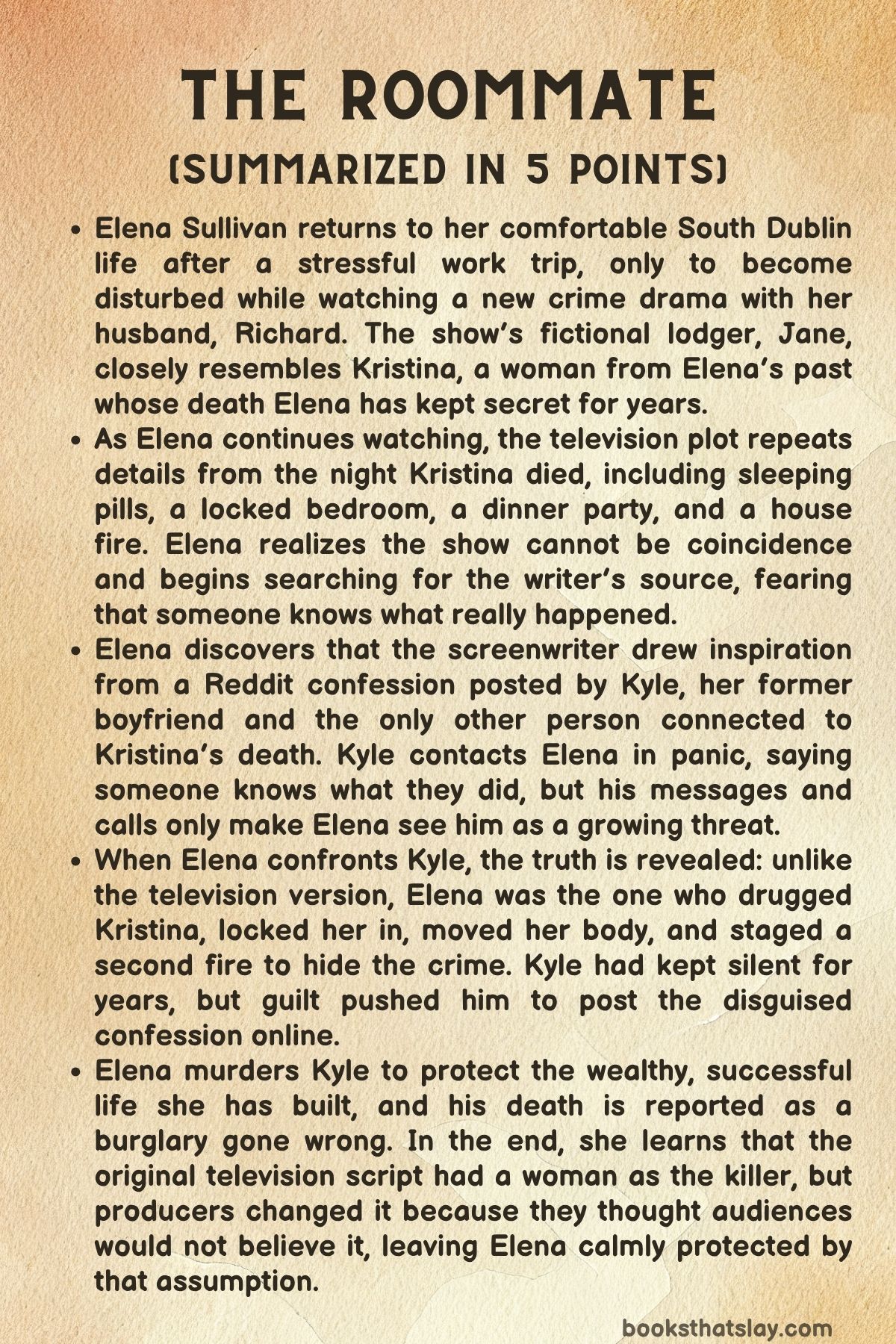
Summary
Elena Sullivan comes home to Dublin after a difficult business trip to New York, where she has spent days protecting a major deal for Ventech, the company she runs as CEO. She is exhausted but also satisfied, stepping back into the polished life she and her husband, Richard, have created in South Dublin.
Their home is expensive, comfortable, and paid off. They have two children, Cody and Leah, domestic help, demanding careers, and the kind of life that appears secure from the outside.
Richard sees all of it as proof of their discipline and hard work, but Elena is more aware of the advantages that helped them along the way, including family support and privilege.
That Friday night, Elena and Richard settle in with wine, cheese, and a new crime drama called The Roommate. Almost immediately, Elena becomes uneasy.
The show is about a well-off couple, Ben and Marcia, who take in a lodger named Jane to help afford their dream house. Jane is small, messy, noisy, strawberry-blonde, careless, and irritating.
She leaves cupboard doors open, sings badly, takes over shared spaces, uses Facebook constantly, and gets under Ben’s skin. These details alarm Elena because Jane is too similar to Kristina, a real woman who once lived with Elena and her former boyfriend, Kyle.
Richard does not know the full story of Elena’s past with Kyle. He believes Kyle moved to London and that the relationship simply ended.
He has no idea about Kristina, the lodger who once shared Elena and Kyle’s home, or about the death that Elena has hidden for years. Elena tries to suggest that they watch something else, but Richard wants to continue.
As the episode goes on, the parallels become harder for Elena to ignore. Jane’s habits, her appearance, and Ben’s irritation with her all resemble Kristina and Kyle’s old complaints.
Kyle had hated Kristina’s muddy boots, dirty dishes, hair in the drain, laundry left in the machine, and casual use of food that was not hers. Elena had not always been as angry, but Kyle’s frustration had been constant.
The first episode moves toward a dinner party that Ben needs to go well because it is connected to a promotion. Jane is supposed to leave for a family cabin, but she announces that she is staying home instead.
Elena is badly shaken because this matches a crucial night from her own past, when Kyle had an important dinner party tied to his career and Kristina’s presence became a problem. Elena knows that what she is watching cannot be an ordinary coincidence.
Still, she agrees to continue because she needs to know how much the show reveals.
The second episode confirms her worst fears. Ben crushes sleeping pills and puts them into Jane’s juice so she will sleep through the dinner party.
Elena instantly recognizes the pills as zopiclone without needing the label to be shown. In the drama, Ben waits until Jane is asleep, removes the key from her bedroom door, locks her inside, secures the garage door, and hides the pills.
The dinner party goes smoothly, and afterward Ben’s boss suggests they all go to a club. Elena is overwhelmed by panic and rushes to the bathroom because this, too, echoes what happened in real life.
When she comes back, the show continues. Ben tells Marcia that he unlocked Jane’s room before leaving, though he has not actually done it.
Elena remembers a similar exchange with Kyle about whether Kristina’s door had been unlocked. In the television version, Ben, Marcia, and their guests go out drinking champagne while a grill left on in the house starts a fire.
Crème brûlées have been left under the heat, flames spread through the kitchen, and smoke begins filling the house. Jane wakes, sees smoke under the door, realizes she is locked in, cannot find the key, and tries unsuccessfully to escape through the garage and a small locked window.
Elena had always reassured herself that Kristina never woke up, but the show forces her to imagine Kristina’s final moments differently.
The episode ends with Ben and Marcia returning to find their home burning. Elena is now certain that someone knows what happened.
She searches for information about the show and learns that it was written by Thandiwe Adams, an American screenwriter from Baltimore. Adams says in an interview that the idea came loosely from a difficult roommate she once had, but Elena does not believe the explanation.
She then searches Kyle online for the first time in years and discovers he is still in Dublin, running a nightclub called Rocks.
The final episode reveals the cover-up. In the show, Ben runs into the burning house and garage, unlocks Jane’s room, finds her dead, and realizes he is responsible.
Instead of confessing, he carries Jane’s body to the garden shed, retrieves her phone and keys, and tells emergency responders that she went to her family cabin. Marcia believes him and confirms that no one is inside.
Later, at a hotel, Ben drugs Marcia’s tea so she will sleep, sneaks out, returns to the damaged house, retrieves Jane’s body, places it in her car, and drives to the cabin. There, he stages a second fire, using wine, pills, Jane’s phone, and a Facebook post to make her death look like an accident after drinking and taking sleeping tablets.
Marcia eventually discovers Jane’s keys in Ben’s jeans just as she hears that Jane has died in the cabin fire. Ben admits he moved the body and staged the accident, arguing that both he and Marcia would have been blamed because she knew Jane had been drugged and knew she had been inside the house.
The show then jumps to Jane’s funeral, suggesting that Ben and Marcia escape justice. But a final scene adds something Elena does not recognize from real life: years later, Ben kills Marcia because she has been talking.
The next morning, Elena receives a text from Kyle saying they need to talk. She also learns that Thandiwe Adams is in Dublin for a publicity event, so she secretly attends a Q&A at the Lighthouse Cinema.
She cannot ask Adams directly where the idea came from without drawing attention, so she manipulates the man beside her into asking the question. Adams admits that the story was inspired partly by Reddit, especially a subreddit called Confessions True-or-False, where people post stories that may or may not be true.
Elena goes to a wine bar and searches Reddit until she finds the post. It was written by a user named u/HeRocks1980 and describes the incident with fictional names and altered locations.
Elena realizes Kyle wrote it. He texts again, saying someone knows what they did.
Over the weekend, he continues messaging her until she blocks him. On Monday, he starts calling her office, asking whether she is there and when she leaves.
Elena understands that Kyle has become more than a reminder of the past. He is now a threat.
She looks through Kyle’s social media and tracks him to a house called Glenmore in Deansgrange, not far from her own home. That night, she tells Richard she is going for a run, but instead drives near Kyle’s house and knocks on his door.
Kyle lets her in and admits that he wrote the Reddit confession because guilt had been eating at him for fifteen years. He insists he changed enough details to protect them and claims Kristina’s parents are dead, so no one will connect the story to reality.
Elena is furious. Kyle has created a public record of their crime, drawn the attention of a screenwriter, and then called Elena’s workplace, creating further links between them.
During the confrontation, the truth becomes fully clear. The television show reversed the gender roles.
In the drama, Ben was the one who drugged Jane, locked her in, moved the body, and staged the cabin fire, while Marcia was the frightened witness. In reality, Elena committed the crime, and Kyle knew about it but stayed silent.
Elena had drugged Kristina, locked her in, and later moved her body to stage the second fire. Kyle points out that Elena benefited from Kristina’s death.
She got the promotion, then the wealthy life, successful career, marriage, home, and family that followed.
Elena becomes colder as Kyle talks. She is not moved by guilt in the way he is.
What matters to her is danger, exposure, and the possibility that everything she has built could collapse. She moves closer, angry that he contacted her office and created evidence of renewed contact between them.
She distracts him by asking him to pass a newspaper from the table. When he turns away, she pulls a knife from her bag and stabs him.
Kyle dies before he reaches the floor.
Later, newspapers report Kyle’s death as a burglary gone wrong. His phone, iPad, car keys, and cash are missing, and the Gardaí are investigating.
Elena reads the article calmly over coffee. In the same paper, she sees an interview with Thandiwe Adams explaining that the original screenplay had Marcia as the killer, but producers changed it because they believed audiences would not accept that a woman could drug someone for a promotion, hide a body, and cover up a murder.
Elena closes the newspaper, drinks her coffee, and smiles, aware that the mistake in public imagination has helped protect her once again.
Characters
Elena Sullivan
Elena Sullivan is the central figure in The Roommate and the character through whom the story reveals the gap between public success and private corruption. At the start, she appears to be a high-achieving professional woman with a controlled life: she is the CEO of Ventech, a wife, a mother, and the owner of a beautiful South Dublin home.
Her discipline, intelligence, and ability to perform under pressure are real, but they exist beside a far darker instinct for self-preservation. Elena’s response to the television drama shows how carefully she has buried the past, not because she is remorseful, but because the truth threatens the identity she has built.
As the story develops, it becomes clear that Elena is not merely hiding from an old mistake. She is capable of ruthless action when her status, career, and family life are endangered.
Her final murder of Kyle confirms that she sees people as obstacles when they threaten exposure. The story makes her frightening because she is calm, practical, and socially credible; she does not look like a killer, which is exactly what allows her to survive.
Richard Sullivan
Richard Sullivan represents the stable, respectable life Elena has constructed after Kristina’s death. He is successful in his own right, working as a Global Sales Director, and he takes pride in the comfortable world he and Elena share.
Richard believes their prosperity is the result of hard work, and this makes him partly blind to the hidden advantages and buried compromises behind their life. His ignorance of Elena’s past is important because it shows how completely she has separated her marriage from the truth of who she used to be.
Richard is not portrayed as suspicious or cruel; instead, he is ordinary in his confidence that the life around him is what it appears to be. His small disagreement with Elena over Cody’s screen time also shows him as a parent who wants control and structure, but he remains unaware of the much larger loss of control happening beside him.
In the story, Richard’s role is not to uncover the crime but to embody everything Elena refuses to lose.
Kyle
Kyle is Elena’s former boyfriend and the one surviving person who knows what really happened to Kristina. For years, he keeps silent, but unlike Elena, he cannot fully live with the crime.
His Reddit confession shows a need to release the truth without openly admitting it, and that weakness becomes dangerous. Kyle’s guilt is mixed with carelessness.
He believes changing names, locations, and details will be enough to protect them, but he underestimates how stories can travel and how easily fiction can lead back to fact. His messages and calls to Elena show panic, but they also create the very trail she fears.
Kyle is morally compromised because he helped conceal Kristina’s death and benefited from silence, yet he is not as cold as Elena. His guilt makes him unstable, and his instability makes him vulnerable.
In the end, he becomes Elena’s second victim because he threatens the life she has built and because he reminds her of the truth she refuses to face.
Kristina
Kristina is the absent victim whose presence shapes the entire novel. She is seen mainly through Elena’s memories, Kyle’s old irritation, and the fictionalized version of Jane on television, which means the reader receives her through distorted accounts rather than through her own voice.
She is remembered as messy, loud, careless, and irritating, but these qualities also show how ordinary she was. Her death is not the result of villainy on her part; it comes from inconvenience, resentment, ambition, and a cruel decision made by someone who valued a career opportunity over another person’s safety.
Kristina’s importance lies in the way her humanity is repeatedly reduced by others. Kyle once treated her as a nuisance, Elena treated her as a problem, and later the staged fire turned her death into a false accident.
The television show briefly restores the horror of her final moments by forcing Elena to imagine that she may have awakened, understood she was trapped, and died in terror.
Thandiwe Adams
Thandiwe Adams is the screenwriter whose television drama brings the hidden crime back into Elena’s life. She does not know Elena personally and does not set out to expose her directly, yet her creative work becomes the instrument that breaks open the past.
Thandiwe’s role is important because she shows how stories can escape the control of the people who first tell them. She finds inspiration on Reddit, adapts the confession, and turns it into entertainment, but the resulting drama lands with devastating force because it is too close to Elena’s real crime.
Her public comments also add irony to the story. She says the story began with online material, and later reveals that the original version made Marcia the killer, closer to the truth, but producers changed it because they doubted audiences would believe a woman could commit such acts.
Through Thandiwe, The Roommate comments on how fiction, audience expectations, and gender assumptions can hide truth in plain sight.
Cody Sullivan
Cody Sullivan, Elena and Richard’s son, has a small but revealing role. His interruption during the television viewing seems ordinary: he wants more time on TikTok, and Elena gives in quickly because she wants peace while Richard disapproves.
This moment matters because it shows Elena in the middle of domestic normality while she is privately collapsing under the pressure of the past. Cody represents the family life Elena is determined to protect at any cost.
He is not involved in the central crime, but his presence raises the stakes for Elena because exposure would destroy not only her career and marriage but also her role as a mother. The contrast between a child asking for screen time and Elena watching a fictional version of her crime makes the scene more unsettling.
It shows how easily horror can sit beside ordinary family routines without anyone else noticing.
Leah Sullivan
Leah Sullivan, Elena and Richard’s daughter, is part of the secure family image Elena has built over the years. Although she does not play a major active role in the events, her existence matters because she is one of the reasons Elena cannot tolerate any threat to her reputation.
Leah helps define the distance between Elena’s current life and the crime that made part of that life possible. As a daughter in a prosperous household, she belongs to the world Elena wants to preserve: school, comfort, respectability, and social safety.
Her limited presence also emphasizes how much Elena’s family is shielded from the truth. Leah does not know the danger circling her home, and that innocence makes Elena’s calmness more disturbing.
The story uses Leah not as a major plot driver but as part of the emotional and social structure Elena is prepared to defend through violence.
Jane
Jane is the fictional lodger in the television drama, but she functions as a mirror for Kristina. Her habits, appearance, and personality traits are what first alert Elena to the terrifying similarity between the show and real life.
Jane is noisy, messy, intrusive, and irritating to Ben, yet the drama gradually shifts her from comic nuisance to trapped victim. Her death sequence is especially important because it forces Elena to confront what Kristina may have experienced.
Jane wakes in smoke, realizes the door is locked, searches for escape, and understands that she may die because someone else decided her presence was inconvenient. Even though Jane is not a real person within Elena’s world, she becomes morally powerful.
She gives shape and sound to the suffering Elena has avoided imagining. Through Jane, the story turns a buried crime into something visible, immediate, and impossible for Elena to dismiss as clean or distant.
Ben
Ben is the fictional husband in the television drama and the character who appears to represent Kyle, though the deeper truth later shows that he is closer to Elena’s role in the real crime. He drugs Jane, locks her in, forgets or lies about unlocking the door, then covers up her death by staging a second fire.
His actions are methodical and self-protective, making him a reflection of the kind of person who can turn panic into a plan. Ben’s importance lies in how Elena reacts to him.
At first, she watches him as if he is exposing Kyle’s guilt, but the final revelation shows that his behavior is really exposing hers. The producers’ choice to make Ben the killer also reveals how gender expectations distort belief.
Viewers accept Ben as capable of ambition, violence, and cover-up, while the truth about Elena seems less believable to them precisely because she is a woman.
Marcia
Marcia is the fictional wife in the television drama and, on the surface, a version of Elena. She knows some of what Ben has done, including the sleeping pills and Jane’s presence in the house, but she is not shown as the main actor in the cover-up until the story’s hidden real-life parallel is revealed.
Marcia’s character matters because she becomes the false container for Elena’s guilt. Elena watches Marcia with terror because Marcia seems to reflect her own past, yet the show has softened or displaced the truth by making Ben the driving criminal.
The final scene in which Ben kills Marcia years later does not match real life, but it plants a fear of what might happen when a partner starts talking. That invented ending helps push Elena toward Kyle.
Marcia therefore works both as a mirror and a misdirection, showing how fiction can come close to the truth while still protecting the real offender.
Thandiwe Adams’s Producers
The producers behind the television adaptation play an indirect but meaningful role. Their decision to change the killer from Marcia to Ben is not simply a production detail; it becomes one of the story’s sharpest ironies.
They believe audiences would not accept that a woman could drug a lodger, trap her, move her body, stage a second death scene, and continue living successfully afterward. That assumption protects Elena because it makes the fictional version less accurate than it could have been.
The producers represent the cultural blind spots that allow certain people to avoid suspicion. Their choice turns a truthful outline into a more familiar crime story, one that fits audience expectations better but misses the reality.
In doing so, they help hide Elena in the open. Their role shows that disbelief can be as useful to a criminal as secrecy.
Themes
The Fragility of a Perfect Life
Elena’s life looks secure because it is built from the visible markers of success: a high-ranking career, wealth, marriage, children, and an expensive home in South Dublin. Yet the story shows that this kind of perfection can be extremely fragile when it depends on concealment.
Elena has spent years living as if the past has been sealed away, but one television drama is enough to disturb the structure of her life. The threat does not come first from the police or from evidence but from recognition.
She sees details from her own crime reflected onscreen, and the comfort of her home immediately becomes unsafe. The theme is powerful because the life Elena protects is not fake in every way.
Her job, family, and social position are real, but they are also connected to a crime she refuses to acknowledge. The Roommate suggests that a polished life can be less solid than it appears when its foundation contains something buried, and that fear of losing status can become more dangerous than guilt itself.
Guilt, Silence, and the Need to Confess
Kyle and Elena show two very different responses to shared guilt. Kyle remains silent for years, but the silence damages him until he tries to confess indirectly through Reddit.
He does not go to the Gardaí or tell the truth openly; instead, he hides behind changed names and altered details, hoping to relieve himself without accepting consequences. Elena reacts in the opposite way.
She does not seek confession, forgiveness, or moral release. Her concern is control.
Kyle’s guilt makes him careless, and Elena’s lack of visible remorse makes her more dangerous. The theme becomes especially clear when Kyle insists that guilt has been eating at him for fifteen years while Elena focuses on the risk he has created.
Silence protects them for a long time, but it does not affect them equally. For Kyle, silence becomes a burden.
For Elena, it becomes a strategy. The story uses this contrast to show that guilt is not universal.
Some people suffer under it, while others only fear being caught.
Fiction, Truth, and Loss of Control
The television drama turns a hidden crime into public entertainment, and this creates one of the story’s strongest ideas: once a story is told, it can no longer be fully controlled. Kyle thinks his Reddit confession is safe because he changes names, locations, and details.
Thandiwe Adams treats it as inspiration and reshapes it for television. Producers alter it further to suit what they think audiences will believe.
By the time Elena watches it, the story has passed through several layers of fiction, yet it still contains enough truth to terrify her. This movement from confession to online post to television drama shows how modern storytelling can expose secrets in unexpected ways.
The internet offers anonymity, but the story shows that anonymity is unstable when the emotional facts are recognizable. Elena is not exposed because someone names her directly.
She is threatened because fiction comes close enough to reality that she sees herself in it. The danger lies not in exact detail, but in resemblance.
Gender Assumptions and Hidden Violence
The final twist depends heavily on what people believe women are capable of doing. The producers changed the original version because they thought audiences would not accept Marcia as the killer.
That decision is revealing because it shows how gender assumptions can shape what seems believable, even in crime fiction. Elena benefits from this disbelief.
She is a wife, mother, executive, and socially respected woman, so the idea that she could drug someone, trap her, move a body, stage a second fire, and later murder Kyle seems unlikely to those who rely on surface impressions. The story challenges the comforting idea that violence and ambition belong more naturally to men.
Elena is not violent because she is emotional or desperate in a simple way; she is violent because she is calculating, ambitious, and determined to preserve her life. The theme works because the story does not present female violence as shocking for shock’s sake.
It shows how disbelief itself can become protection for someone who knows how to appear respectable.