The Restaurant by Pamela M. Kelley Summary, Characters and Themes
The Restaurant (also referred to as The Nantucket restaurant) by Pamela M. Kelley is a warm family-centered novel about three sisters who inherit far more than a business after their grandmother’s death. Set largely on Nantucket, the story follows Jill, Mandy, and Emma as they are forced to work together at Mimi’s Place, a restaurant secretly owned by their grandmother for decades.
What begins as an unexpected condition in a will becomes a year of repair, discovery, and renewal. Through the restaurant, the sisters confront failing marriages, buried feelings, family history, and the question of what kind of lives they truly want.
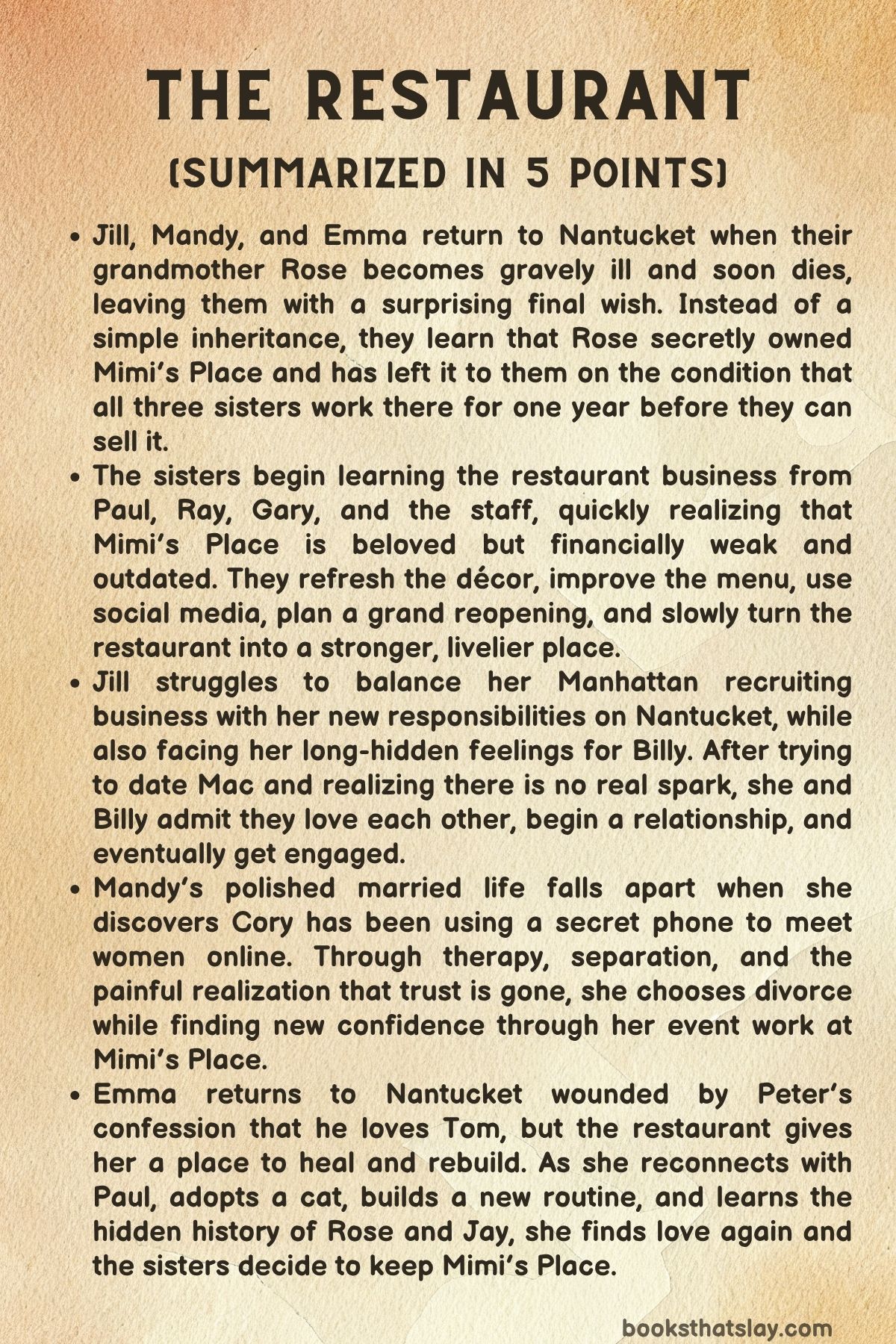
Summary
Jill O’Toole, Mandy Lawson, and Emma are sisters whose lives have moved in different directions by the time their grandmother Rose, lovingly called Grams, becomes seriously ill. Jill is living in Manhattan, where she runs a successful recruiting firm with her best friend and business partner, Billy.
Their professional partnership is strong, but Jill has started to sense that her feelings for Billy may go beyond friendship. Mandy lives on Nantucket with her husband Cory, a wealthy hedge-fund manager, and their children, Brooke and Blake.
Her life looks comfortable from the outside, but much of it is built around maintaining appearances, supporting Cory’s career, raising the children, and keeping herself busy with charity events. Emma lives in Phoenix and is dealing with the collapse of her marriage after her husband, Peter, admits he is in love with his male college friend, Tom.
The sisters are brought together when Grams, who has been living in assisted care at Dover Falls, develops serious complications after pneumonia and is transferred to Mass General in Boston. They rush to be with her, hoping she will recover, but Grams seems to know her time is short.
Before she dies, she tells them she wants them to spend more time together. She also hints that her gift to them is connected to Mimi’s Place, the Nantucket restaurant where the family has celebrated her birthday for many years.
Soon afterward, she dies peacefully, leaving the sisters grieving but also confused by her final words.
After the funeral, the family gathers for a memorial meal at Mimi’s Place. The restaurant carries years of family memories, but none of the sisters suspect that Grams had any formal connection to it.
When they later meet with her attorney, Alvin Eldridge, they expect a simple reading of her will. Instead, they receive a shock.
Grams secretly owned Mimi’s Place for forty-three years after winning it in a poker bet. She has left the restaurant to Jill, Mandy, and Emma, but not without a condition.
Before they are allowed to sell it, all three sisters must work there for exactly one year. If they refuse, their shares will go to Paul Taylor, the executive chef, who is also given a quarter share of the business.
Paul once dated Emma in high school, which makes the situation even more complicated for her.
The sisters are stunned by the news. None of them planned to run a restaurant, and their lives are already complicated.
Jill has a business in Manhattan, Emma is still dealing with the end of her marriage, and Mandy has a family and a carefully ordered life on Nantucket. Still, they understand that Grams made this decision for a reason.
They agree to try to honor her wish. Emma and Jill move into Grams’ old house, while Mandy, already on the island, helps prepare the place for them.
Their year at Mimi’s Place begins as an obligation, but it slowly becomes the center of their lives.
At the restaurant, the sisters begin learning from the people who have kept Mimi’s Place running for years. Ray Bartlesby, the longtime manager, knows the business inside out but is preparing to retire.
Gary, the assistant manager, handles many daily duties and becomes increasingly important. Paul runs the kitchen and has deep pride in the restaurant’s food and traditions.
Emma starts at the front desk, where she learns reservations, seating, customer flow, regular guests, and the relationship between the dining room and kitchen. Mandy finds herself drawn to private events, especially weddings and special gatherings.
Jill, who can only work nights because of her recruiting firm, unexpectedly returns to bartending when an employee is injured and she has to step in.
As they spend more time at Mimi’s Place, the sisters realize that the restaurant is loved but struggling. It has a loyal customer base, but the dining room feels dated, the menu has barely changed, and lunch business is weaker than expected.
The financial records show declining revenue and rising costs. Grams’ gift is not a simple inheritance; it is a responsibility.
If the sisters want the restaurant to survive, they will have to make changes without destroying the feeling that made Mimi’s Place special.
Mandy asks Cory to look over the finances, and he brings in restaurant consultant Macaulay Connor, known as Mac. Mac visits anonymously and studies the restaurant carefully.
He orders a wide variety of food, observes the service, looks at the décor, notes the condition of the carpet, and later presents his findings. He suggests practical updates: refreshing the dining room, improving the website, using social media, adding coupons and loyalty cards, reaching out to hotels and local businesses, and reworking parts of the menu.
Paul is defensive at first because he cares deeply about the restaurant and does not want outsiders dismissing what he has built. But he eventually agrees that change is necessary.
The sisters divide the work in ways that suit their strengths. Mandy organizes renovations, including new carpeting, fresh paint, local art, and a grand reopening party.
Paul begins creating new dishes that preserve the restaurant’s Italian comfort-food identity while adding Nantucket seafood and more modern specials. Emma photographs the food and posts it online, helping build interest among customers.
People begin calling about dishes they have seen on social media. Coupons attract new diners, reservations rise, and the restaurant begins to feel fresh without losing its familiar warmth.
The grand reopening becomes a success, proving that Mimi’s Place still has a strong future.
While the restaurant improves, the sisters’ personal lives also shift. Jill struggles with being divided between Nantucket and New York.
She misses the daily rhythm of her recruiting firm and, more than she first admits, she misses Billy. At first, she tries dating Mac, who is attractive, successful, and kind, but there is no lasting spark between them.
During one of Jill’s trips back to New York, Billy becomes jealous and finally admits he has feelings for her. Their kiss confirms what both have been avoiding.
They decide to go slowly, but their relationship quickly becomes serious. Jill begins traveling regularly between Nantucket and New York, balancing the restaurant, the recruiting firm, and her growing future with Billy.
Eventually, Billy proposes to her in front of their office staff, and Jill accepts. They decide to marry at Mimi’s Place, bringing her personal happiness back to the restaurant that Grams left behind.
Mandy’s marriage falls apart more painfully. Cory claims to be attending a conference in Las Vegas, but Mandy discovers a secret phone bill under another name.
When she confronts him, Cory admits he has used the phone to meet women online. He insists it meant nothing and begs her to forgive him, but Mandy makes him leave the house.
She tries to protect Brooke and Blake from the worst of the truth while explaining that their parents are separating. With help from her therapist, Maggie, Mandy begins to face what she really feels.
Part of her misses the life she thought she had, but she no longer trusts Cory or wants him close to her. Cory continues hoping they can repair the marriage, but Mandy’s trust is broken.
The final blow comes when Mandy learns from the children that Daisy, the wife of Cory’s friend Patrick, has stayed overnight at Cory’s place. Whether or not Cory tries to explain it away, Mandy sees that the marriage is over.
She contacts a divorce lawyer and begins the process of ending it. By the close of the story, the divorce is finalized, and the settlement is fair.
Mandy and Cory manage to build a civil arrangement for the children. Mandy is not ready for romance, but the presence of Matt, a widowed regular at Mimi’s Place who runs a boat business, hints that her life may one day open in a new direction.
Emma’s healing is quieter but just as important. Peter’s confession has left her hurt and disoriented, but returning to Nantucket gives her space to rebuild.
She reconnects with Paul, who once mattered to her deeply when they were teenagers. At first, their bond grows through friendship.
They share drinks after work, talk about their pasts, discuss divorce, and slowly become part of each other’s daily lives again. Paul still cares for Emma, but he does not push her because she has made it clear that she is not ready to date.
Emma creates a new routine on the island, adopts a cat named Izzy from the shelter, and becomes increasingly attached to restaurant life, food photography, and blogging.
As Peter moves forward with Tom, Emma is forced to accept that her marriage is truly finished. This acceptance does not break her; instead, it frees her.
She spends more time with Paul and begins to understand that their friendship has already turned into something deeper. When Paul kisses her gently, she realizes she is ready to let herself feel again.
They begin a relationship, and later Emma announces that she and Paul are moving in together. Her life, once fractured by betrayal, settles into a new shape built around love, work, and home.
A second story runs beneath the sisters’ present-day lives through Grams’ diary, which Mandy reads. The diary reveals the hidden past of Mimi’s Place.
As a young woman, Rose fell in love with Jay, an Italian man from Boston. They planned to marry, but World War II separated them.
Rose believed Jay had died, and she eventually married Charlie, moved to Nantucket, and built a family life with him. Years later, Jay returned, having survived as a prisoner of war.
Rose still loved him, but she chose to remain faithful to Charlie. Jay later married Brenda and opened Mimi’s Place on Nantucket, naming it after his grandmother and filling it with family recipes.
Tragedy followed Jay when Brenda and their baby died in childbirth. Later, Jay developed inoperable brain cancer.
During a poker game, he jokingly bet the restaurant, and Rose won. After Jay’s death, it became clear that he had truly left Mimi’s Place to her.
Rose kept her ownership secret for decades, honoring both Jay and Charlie in her own way. To her, the restaurant was not just a business.
It was a living memory of Jay, a connection to the road not taken, and eventually a gift that could bring her granddaughters back to each other.
At the end of the required year, the sisters choose not to sell Mimi’s Place. Emma and Paul want to keep running it.
Mandy wants to continue managing events. Jill will remain involved while living mostly in New York with Billy.
The restaurant has given the sisters exactly what Grams hoped it would: time together, purpose, healing, and a deeper connection to family history. They toast Grams, Mimi’s Place, and the unexpected inheritance that helped each of them begin again.
Characters
Jill O’Toole
Jill is independent, capable, and ambitious, with a life in Manhattan that reflects years of hard work and discipline. Her recruiting business is not just a job; it is the world she has built for herself alongside Billy, her longtime best friend and partner.
When she is forced by Grams’ will to spend a year working at Mimi’s Place, Jill becomes the sister most visibly caught between two places. She cannot simply leave New York behind, but she also cannot ignore the pull of Nantucket, her family, and the restaurant’s future.
Her return to bartending shows a practical side of her personality. She does not complain when a task needs doing; she steps behind the bar and handles the pressure.
In The Restaurant, Jill’s emotional arc centers on recognizing what has been in front of her for years. Her feelings for Billy are complicated by their friendship and business partnership, but distance helps both of them admit the truth.
Jill’s eventual engagement to Billy feels earned because it grows from loyalty, familiarity, and long-standing trust. By the end, she does not abandon one life for another.
Instead, she learns to connect her New York ambitions with her Nantucket family roots.
Mandy Lawson
Mandy begins the book as the sister whose life seems most settled from the outside. She has a wealthy husband, two children, a Nantucket home, and a public role built around social events and charity work.
Beneath that polished surface, however, Mandy is living inside a marriage that depends heavily on control, image, and denial. Her work at Mimi’s Place reveals parts of her that her marriage has overshadowed.
She has a talent for organizing events, understanding atmosphere, and making people feel taken care of. The restaurant gives her a practical purpose beyond being Cory’s wife or Brooke and Blake’s mother.
Her character becomes especially strong when she discovers Cory’s secret phone and confronts the reality of his betrayal. Mandy’s decision to separate from him is not impulsive; it develops slowly as she attends therapy, considers her children, and admits that trust cannot be rebuilt simply because Cory wants forgiveness.
Her final decision to divorce him shows emotional growth and self-respect. Mandy’s possible future with Matt is left gentle and restrained, which suits her situation.
She is not rescued by a new man. She first rescues herself by choosing honesty over appearances.
Emma
Emma is wounded, uncertain, and quietly searching for a place to belong when she returns to Nantucket. Peter’s confession that he loves Tom has left her feeling rejected and displaced, and she arrives at Mimi’s Place carrying the emotional weight of a marriage that ended in a way she never expected.
Her work at the restaurant gives her a structure for recovery. At the front desk, she learns the rhythms of hospitality, but her real transformation comes through photography, food blogging, and her renewed connection to the island.
Emma has a creative eye, and her photos help bring attention to Paul’s updated dishes. Her relationship with Paul develops with patience.
Because they share a romantic past, their bond could easily feel rushed, but the story allows Emma time to grieve, adjust, adopt Izzy, and rebuild her daily life. She is cautious because she does not want to use Paul as a way to avoid pain.
Her eventual choice to be with him shows that she has moved from heartbreak into readiness. Emma’s growth lies in accepting that one version of her life is over while trusting that another can still be meaningful.
Paul Taylor
Paul is the executive chef at Mimi’s Place and one of the emotional anchors of the restaurant. His quarter share in the inheritance places him in a complicated position with the sisters, especially because he will receive their shares if they refuse Grams’ condition.
Yet Paul does not behave like a rival. He is protective of Mimi’s Place because he has invested years of labor, pride, and personal identity into it.
His initial resistance to change comes from fear that the restaurant’s character will be erased, not from laziness or arrogance. As he listens to the sisters and Mac’s suggestions, he proves that he can adapt.
His updated menu respects the restaurant’s Italian roots while bringing in local seafood and new specials that help revive the business. Paul’s relationship with Emma reveals his patience and emotional steadiness.
He still cares for her, but he does not push her when she is vulnerable. In The Restaurant, Paul represents continuity and renewal at the same time.
He protects what matters about Mimi’s Place while accepting that love, food, and business all need room to grow.
Rose “Grams”
Grams is the guiding force of the story even though she dies early in the book. Her final act shapes the lives of Jill, Mandy, and Emma in ways they do not understand at first.
By leaving Mimi’s Place to them with the condition that they work there for a year, she does more than pass down property. She creates a situation that forces the sisters to spend time together, share responsibility, and confront what is not working in their lives.
Her wisdom is practical rather than sentimental. She knows they might sell the restaurant quickly if given the choice, so she makes time itself part of the inheritance.
The diary reveals a private side of Rose that her granddaughters never fully knew. Her love for Jay, her loyalty to Charlie, and her decades-long secret ownership of the restaurant show a woman who carried deep feeling with restraint.
She did not turn Mimi’s Place into a monument to regret. Instead, she preserved it quietly until it could serve a new purpose.
Grams’ legacy is not only the restaurant but also the chance for her granddaughters to rebuild their lives.
Cory Lawson
Cory is Mandy’s husband and the source of one of the book’s major personal conflicts. He appears successful and respectable, but his actions reveal selfishness, dishonesty, and a sense of entitlement.
His secret phone and online meetings with women expose a hidden life that directly contradicts the stable family image Mandy has helped maintain. When confronted, Cory minimizes his behavior and asks for forgiveness, but his remorse is not enough to repair what he has broken.
His continued hope of returning home shows that he does not fully understand the depth of Mandy’s loss of trust. The situation with Daisy further confirms for Mandy that the marriage cannot be restored.
Cory is not portrayed as a cartoonish villain; he remains a father who must eventually share a civil arrangement with Mandy for the sake of their children. Still, his choices force Mandy to see the difference between a comfortable life and a truthful one.
His character functions as the pressure that pushes Mandy toward independence.
Macaulay “Mac” Connor
Mac is the restaurant consultant hired to evaluate Mimi’s Place. He enters the story as an outsider, which allows him to see the business without the emotional attachment that shapes the sisters and Paul.
His anonymous visit is almost comic in its thoroughness, as he orders large amounts of food, watches service, studies the décor, and pays attention to details others have accepted as normal. Mac’s recommendations are practical and necessary.
He helps the sisters understand that affection for a restaurant cannot replace marketing, updated interiors, a stronger web presence, and a menu that speaks to current customers. His brief dating connection with Jill adds a personal layer, but he is ultimately not her match.
That failed spark is useful because it helps Jill recognize the deeper emotional pull she feels toward Billy. Mac’s role is therefore both professional and narrative.
He helps Mimi’s Place change, and he indirectly helps Jill understand her own heart.
Ray Bartlesby
Ray is the longtime manager of Mimi’s Place, and his presence reflects the restaurant’s old stability. He knows the routines, the customers, the staff, and the traditions that have kept the business alive for years.
At the same time, his approaching retirement signals that Mimi’s Place cannot keep operating exactly as it has. Ray represents an older phase of the restaurant’s life, one built on loyalty and habit but no longer enough to secure its future.
He helps the sisters learn the business, but he also steps back enough for Gary, Paul, and the sisters to take on greater responsibility. Ray is important because he gives the restaurant a sense of history.
The changes that follow do not happen in an empty space; they happen in a place shaped by people like him, who kept it running long before the sisters understood its meaning.
Gary
Gary, the assistant manager, is one of the practical figures who helps Mimi’s Place continue functioning during the transition. While he may not carry the emotional weight of Paul or the family history of the sisters, he represents the daily labor that keeps a restaurant alive.
He knows the systems, the staff, and the small problems that can turn into large ones if ignored. As Ray prepares to retire, Gary’s importance grows.
He gives the sisters support as they learn how demanding the business really is. Through Gary, the book shows that saving Mimi’s Place is not only about grand reopening parties or new menu items.
It is also about reliable management, consistent service, and people who understand the pressure of daily operations.
Peter
Peter is Emma’s estranged husband, and his confession sets her emotional journey in motion. By admitting that he is in love with Tom, he ends their marriage in a way that leaves Emma hurt but also facing a truth neither of them can avoid.
Peter is not presented mainly through cruelty. His betrayal is painful because he has built a marriage with Emma while carrying feelings that ultimately lead him elsewhere.
His decision to move forward with Tom confirms that Emma cannot wait for the past to return. Peter’s role is to close one chapter of Emma’s life, even though the closing is painful.
Without that rupture, Emma may never have returned to Nantucket in the same way, reconnected with Paul, or discovered a life that fits her better.
Jay
Jay is central to the hidden history of Mimi’s Place. As Rose’s first great love, he represents the life she might have had if war had not separated them.
His survival as a prisoner of war and later return add sadness to their story because love remains, but circumstances have changed. Jay’s decision to open Mimi’s Place gives his memories, heritage, and family recipes a lasting physical form.
The restaurant carries his love for food, his Italian background, and his connection to his grandmother, after whom it is named. His later losses, including Brenda and their baby, make his life deeply marked by grief.
When he leaves the restaurant to Rose after the poker game, the gesture carries affection, trust, and farewell. Jay’s presence lingers through the restaurant long after his death.
Charlie
Charlie is Rose’s husband and the man with whom she builds her family life on Nantucket. His role is significant because Rose’s love for Jay does not erase her loyalty to Charlie.
Through Charlie, the book avoids making Rose’s past into a simple story of lost romance. Rose chooses to honor her marriage, and Charlie represents the life she actually lived: family, stability, and years of shared history.
The fact that Rose keeps her ownership of Mimi’s Place secret can be understood partly as a way of respecting Charlie while also preserving Jay’s memory. Charlie may not dominate the present-day plot, but his place in Rose’s life helps show the emotional complexity of her choices.
Matt
Matt is a widowed regular at Mimi’s Place who runs a boat business, and his presence offers a quiet hint of Mandy’s future. He does not arrive as an immediate solution to her pain.
Mandy is clear that she is not ready to date, and that matters because her growth depends on recovering her own sense of self before entering another relationship. Matt’s role is gentle and understated.
He represents possibility rather than pressure. After the damage caused by Cory’s dishonesty, the idea of someone steady, patient, and kind suggests that Mandy’s life after divorce can contain companionship again when she is ready.
Themes
Family as an Active Choice
Family in the story is not treated as something sustained by blood alone. Jill, Mandy, and Emma are sisters, but their adult lives have taken them into separate routines, separate cities, and separate emotional struggles.
Grams understands that affection without time together can become thin, so she leaves them an inheritance that requires shared effort. The condition attached to Mimi’s Place forces them into the same physical and emotional space for a full year.
They have to make decisions together, face financial realities together, and learn each other’s private pain in a way they might have avoided otherwise. Their bond is rebuilt through work rather than speeches.
Jill’s divided life, Mandy’s failing marriage, and Emma’s heartbreak all become visible because the restaurant gives them a reason to stay close. The theme is powerful because the sisters do not become identical or abandon their separate needs.
Jill still belongs partly in New York, Mandy remains devoted to her children, and Emma builds a future with Paul. What changes is their willingness to show up for one another.
Family becomes a practice, not just a history.
Reinvention After Loss
Loss arrives in different forms throughout the novel: Grams’ death, Emma’s marriage ending, Mandy’s trust in Cory collapsing, Rose’s old separation from Jay, and Jay’s own personal tragedies. Yet the story does not treat loss as a final identity.
Instead, each major character is asked to decide what can still be built afterward. Emma’s reinvention is quiet and gradual.
She does not instantly recover from Peter’s confession; she creates new habits, finds comfort in Izzy, works at the restaurant, and slowly becomes ready for Paul. Mandy’s reinvention is more difficult because it requires dismantling a life that looked successful.
She has to choose dignity and truth over comfort and public appearance. Jill’s transformation is less about grief and more about emotional honesty, as she realizes that the love she wants may already exist in her partnership with Billy.
Even Mimi’s Place undergoes a form of reinvention. It keeps its history but accepts new menus, décor, marketing, and energy.
The Restaurant shows that beginning again does not mean pretending the past did not matter. It means carrying what is useful, releasing what is harmful, and making room for a future that feels honest.
The Meaning of Inheritance
Inheritance in the story is far more than property, money, or legal ownership. Grams leaves the sisters a restaurant, but the true gift is the experience attached to it.
If she had simply given them permission to sell Mimi’s Place, the inheritance might have become a transaction. By requiring them to work there, she turns it into a test, a lesson, and a reunion.
The sisters inherit responsibility before they inherit freedom. They must learn the business, understand its people, confront its weaknesses, and decide whether it matters to them beyond its market value.
Mandy’s reading of Grams’ diary deepens this theme by revealing that the restaurant itself was once an inheritance of love and memory from Jay to Rose. It passed through grief, loyalty, secrecy, and time before reaching the sisters.
This makes Mimi’s Place a container for several generations of choices. The sisters eventually decide not to sell because they understand that the restaurant has become part of their own lives too.
The theme suggests that the most meaningful inheritance is not always what can be divided equally. Sometimes it is the obligation that teaches people who they are.
Love, Loyalty, and Honest Commitment
The story presents love in several forms, but it repeatedly separates real commitment from appearance or habit. Rose’s past with Jay is filled with deep feeling, yet her loyalty to Charlie shapes the life she chooses.
Mandy’s marriage to Cory looks successful, but it lacks honesty, and once his betrayal is exposed, she recognizes that appearances cannot replace trust. Emma’s marriage to Peter ends because his love belongs elsewhere, and although the truth hurts her, it eventually frees both of them from a false future.
Jill and Billy show another kind of love, one built slowly through friendship, shared work, and mutual respect. Paul’s love for Emma is marked by patience.
He does not demand that she be ready before she truly is. These relationships create a wide view of commitment.
Love is not defined only by intensity or history; it is defined by honesty, timing, respect, and the choices people make when life becomes difficult. The restaurant setting reinforces this idea because loyalty to Mimi’s Place also has to be honest.
The sisters cannot save it by loving an old image of it. They must commit to what it needs now.