The Ruler by Penelope Sky Summary, Characters and Themes
The Ruler by Penelope Sky is a dark romantic suspense novel built around a woman’s recovery after betrayal and her dangerous connection with a man who lives behind a powerful hidden identity. Aurelia begins the story as someone trying to save a dying relationship, only to be abandoned in Sicily by the man she trusted.
Constantine enters her life at the lowest point, first as a magnetic stranger and then as someone whose influence reaches far beyond ordinary wealth or charm. The book follows their intense romance, the threat surrounding Constantine’s world, and Aurelia’s decision to choose love even when it comes with fear, violence, and permanent change.
Summary
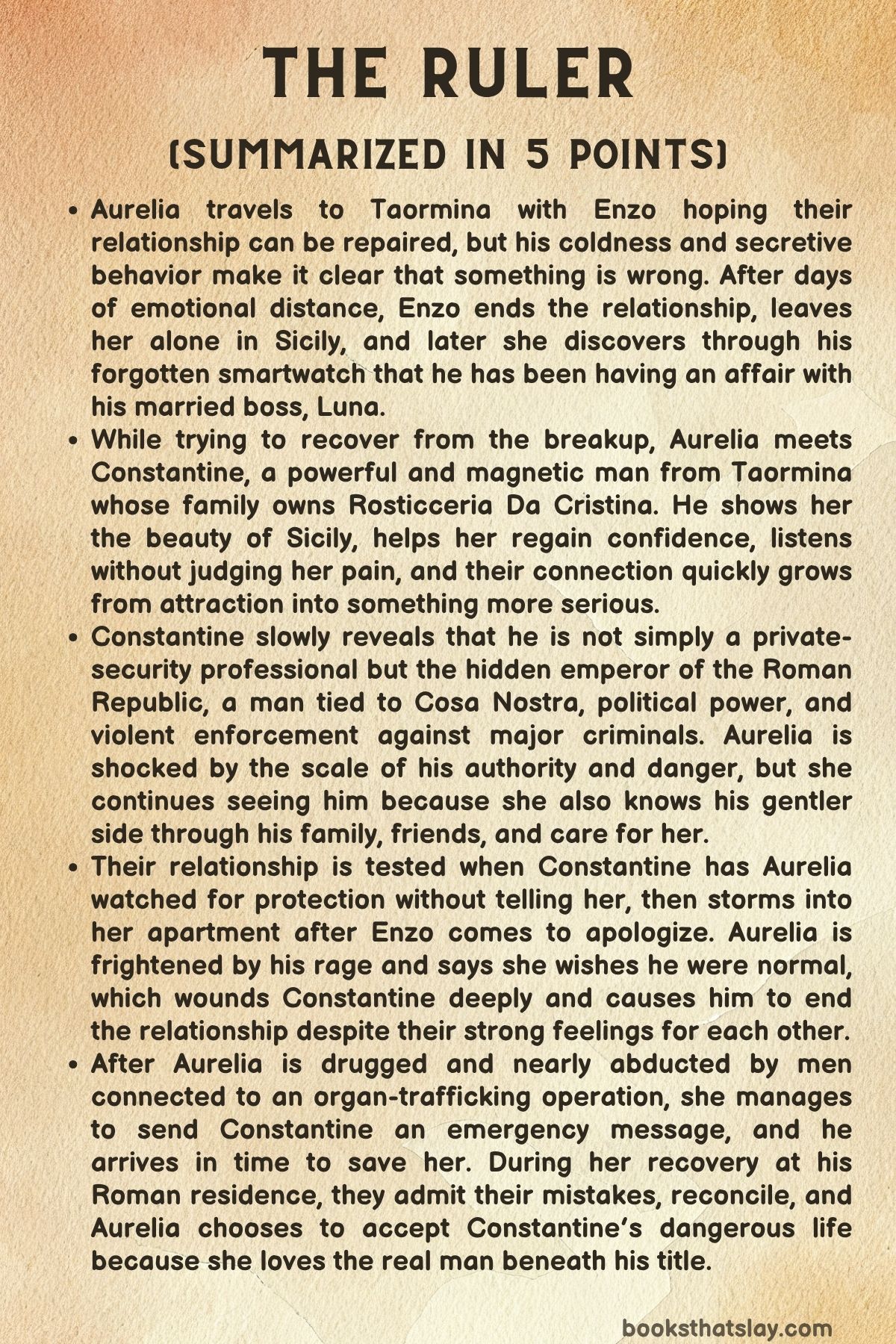
Aurelia travels from Rome to Taormina with her boyfriend Enzo, hoping the Sicilian trip will repair the damage that has been growing between them. For months, Enzo has been emotionally distant.
He blames work, stress, friends, and other excuses, but Aurelia senses that he has already left the relationship in every way except officially. She suspects another woman, though checking his phone gives her no proof.
Once they arrive in Taormina, his behavior becomes even worse. He continues messaging someone, steps away for calls, barely pays attention to her, and makes their vacation feel lonely rather than romantic.
During lunch at Rosticceria Da Cristina, Aurelia notices a striking man entering the kitchen as if he belongs there. The workers welcome him warmly, and when he briefly looks at her through the window, the moment affects her more than she expects.
His gaze makes her feel noticed, something Enzo has failed to do for months. Later, Enzo finally admits that their relationship is over.
He offers no honest explanation and gives her no comfort. He packs his bags, leaves Taormina, and tells her he will pack her things in Rome.
Aurelia is left alone in the hotel room, devastated by the coldness of his departure and unsure how to face the rest of the trip.
For a few days, she isolates herself, barely able to eat or enjoy the town. Eventually, she forces herself outside and begins taking photographs around Taormina.
Photography becomes a way for her to move through pain without being swallowed by it. At the bar of an expensive hotel, she sees the same man from the restaurant.
Other women notice him as well, but he keeps his attention on Aurelia. Just as she is about to leave, he approaches and introduces himself as Constantine.
Their conversation is easy, direct, and charged with attraction. He tells her he is from Taormina, that his family owns Rosticceria Da Cristina, and that he works in private security.
Aurelia says she is a photographer and claims she came to Sicily with a friend, but Constantine seems to sense that she is hiding something. They spend the night together, and the encounter gives Aurelia back a sense of confidence that Enzo’s rejection had damaged.
The next morning, Constantine makes it clear that he wants to see her again. Aurelia returns to her hotel room and finds Enzo’s forgotten smartwatch under the bed.
Since his phone had revealed nothing, she checks the watch and discovers the truth. Enzo has been having an affair with Luna, his married boss.
Luna’s husband has learned about it, and Luna has left her husband and children, expecting Enzo to end things with Aurelia. Aurelia realizes that Enzo abandoned her because of Luna and lied even when she directly asked whether someone else was involved.
Instead of collapsing again, she sends Enzo a message wishing him and Luna the best and tells him he forgot to delete the messages from his watch.
Constantine spends more time with Aurelia and shows her Taormina through the eyes of someone who belongs there. He takes her to Bam Bar, the Greek theatre, local sandwich shops, cannoli places, beaches, and favorite family spots.
Everyone knows him, and he moves through the town with ease. Aurelia slowly tells him the truth about Enzo, the breakup, the affair, and the humiliation of being discarded.
Constantine does not judge her. He tells her Enzo’s betrayal belongs to Enzo, not to her, and his certainty helps her begin to see herself differently.
Their bond grows through meals, walks, days by the sea, and visits with Constantine’s friends. When he encourages her to jump from a rock into the water, the act becomes a small but meaningful return to courage.
Eventually, he asks her to move into his hotel room for the rest of the trip.
As their time together continues, Aurelia begins to notice that Constantine’s life is not ordinary. He leaves in the middle of the night for unexplained work, speaks with authority, and seems connected to wealth, danger, and influence.
She starts to suspect he has ties to organized crime. Constantine’s own perspective confirms that he is far more powerful than a private-security professional.
He is connected to Cosa Nostra, meets with Tommaso Sirenuse, works with President Barsetti, and is known as Emperor Constantine of the Roman Republic. His role places him above the criminal underworld in a hidden order of power.
He enforces his own laws, controls violent threats, manages dangerous networks, and claims to protect Italy from organ traffickers, illegal weapons activity, terrorism, and criminals who operate beyond normal reach.
Before Aurelia leaves Taormina, Constantine takes her to his family’s Sunday dinner. His mother, aunt, sister Beatrice, and relatives welcome her with warmth.
Aurelia is deeply moved by the family atmosphere because she has lost her mother and has no real family support of her own. She also learns that Constantine’s father is dead and that his brother is gone too, though he is not yet ready to explain everything about that loss.
Later, he tells her about Isabella, the woman he once expected to marry. Isabella kissed Constantine’s twin brother, thinking he was Constantine, and then hid the incident.
The betrayal ended their relationship and changed Constantine’s life, leaving him with wounds of his own.
When they return to Rome, Constantine wants Aurelia to stay with him, but she refuses because she does not want to rush directly from one relationship into another. She stays with her friend Cindy while trying to rebuild her life.
Enzo asks her to collect her belongings, and Aurelia asks Constantine to accompany her. At Enzo’s apartment, she sees that Luna and her children have already moved in.
Enzo apologizes, but the apology no longer has power over her. Constantine helps Aurelia move her boxes, and afterward he explains the truth about being emperor.
Aurelia is stunned by the scope of his authority, his security network, his capacity for violence, and the political reach behind his position. Even so, she continues seeing him because she knows the man who cared for her in Sicily is real too.
Their relationship grows serious, but Aurelia struggles with the danger attached to Constantine’s life. He tells her that if she belongs to him, she will be protected constantly.
She worries about guards, surveillance, enemies, and the possibility that he could die because of the life he leads. She admits that she is already falling in love with him and fears that more time will only make leaving impossible.
Constantine wants her fully in his world and is pleased by the depth of her feelings. He introduces her to Medusa, his beloved German shepherd, and continues supporting her photography, encouraging her to think about her ambition instead of only her heartbreak.
The tension between them breaks when Enzo appears at Aurelia’s apartment to apologize again and suggest that Luna may have been a mistake. Constantine learns Enzo is there through his security detail and storms in.
Furious and possessive, he threatens Enzo and forces him away. Aurelia is shaken by his rage and disturbed to learn that he has had men watching her without telling her.
In the argument that follows, she says she wishes he were normal. She regrets it immediately, but the words wound Constantine deeply.
He tells her he is proud of what he is, calls her a coward for pulling away from the truth of his life, and ends their relationship.
For a week, Aurelia tries to reach him, but he blocks her. Rocco, Constantine’s closest ally, argues that Constantine overreacted and reminds him that Aurelia was afraid because his world is overwhelming.
Meanwhile, Cindy takes Aurelia out, but the evening turns dangerous when it becomes an unwanted setup with Timothée and his friend Pierre. Pierre drugs Aurelia’s drink and attempts to deliver her to men in a van, apparently tied to the organ-trafficking operation Constantine has been hunting.
In her drugged state, Aurelia manages to text Constantine “112,” the emergency number. Constantine and his men arrive in time, save her, capture the kidnappers, and punish them brutally.
Pierre reveals that a man named Clement ordered the abduction and gives them a warehouse address before Constantine kills him and sends his team to continue the mission.
Aurelia is taken to Constantine’s massive Roman residence, where his doctor treats her and she is allowed to recover. When she wakes, she meets Medusa again and then faces Constantine.
He is still angry, but he admits that he handled things badly too. He apologizes for storming into her apartment and worsening her fears instead of helping her understand.
Aurelia tells him that she does not need more time to decide. She is fully in, despite the danger.
Constantine warns her that he will never step down from his role, even for marriage or children, and Aurelia accepts that truth. They reconcile, and as he shows her his private quarters and the scale of his home, she remains intimidated by what his position means.
Still, he reminds her that she knows the real man beneath the title: the man from Taormina, the man who cooks with his family, laughs with his friends, protects what is his, and helped her find herself again.
Characters
Aurelia
Aurelia is the emotional center of the book, and her journey is shaped by betrayal, humiliation, recovery, and choice. At the beginning, she is still trying to save a relationship that has already become one-sided.
Her attention to Enzo’s distance shows that she is not naïve; she senses the truth before she has evidence, but she still hopes love can be repaired. Being abandoned in Taormina leaves her exposed and wounded, yet it also becomes the moment that forces her to rediscover herself outside Enzo’s approval.
Her photography is important because it gives her a way to observe beauty even when she feels broken. With Constantine, she regains confidence, desire, and emotional courage, but she is not instantly fearless.
Her fear of his world is believable because she is being asked to accept secrecy, violence, guards, and permanent risk. In The Ruler, Aurelia’s strongest quality is not that she accepts danger without hesitation, but that she questions it honestly before choosing what she wants.
By the end, she is no longer the woman waiting for Enzo to explain why he stopped loving her. She becomes someone who can face the truth, set aside humiliation, and claim a life that frightens her but also makes her feel fully alive.
Constantine
Constantine is presented as both romantic hero and dangerous ruler, and the tension between those identities defines his character. In Taormina, he appears first as a magnetic stranger with deep local roots, a man known by restaurant workers, family members, friends, and townspeople.
This side of him is warm, sensual, protective, and grounded in family. He knows how to make Aurelia feel seen without pressing her before she is ready.
At the same time, his hidden identity as Emperor Constantine of the Roman Republic reveals a life built on power, violence, secrecy, and command. He believes in his role and does not apologize for it.
His authority is not only criminal but political and strategic, placing him in a position where he enforces order through methods outside ordinary law. His flaws come from the same place as his strengths.
His protectiveness can become control, his pride can become cruelty, and his fear of rejection can make him punish Aurelia emotionally. Yet he is also capable of reflection.
After Aurelia is nearly taken, he recognizes his own mistakes and apologizes. Constantine’s character in The Ruler works because he is never just one thing.
He is lover, emperor, son, brother, protector, executioner, and wounded man, and Aurelia must decide whether she can love all of him rather than only the gentler version she first met.
Enzo
Enzo functions as the first major source of Aurelia’s pain, but he is more than a simple ex-boyfriend. His betrayal is damaging because it is carried out through silence, avoidance, and emotional cowardice.
He does not end the relationship with honesty when his feelings change. Instead, he drags Aurelia to Taormina while already involved with Luna, forcing her to experience confusion and rejection in a place that was supposed to help them heal.
His refusal to explain himself makes his actions feel colder than the affair itself. When Aurelia later discovers the truth through his forgotten smartwatch, it confirms not only his infidelity but also his willingness to lie until circumstances forced exposure.
His later apologies show regret, but they arrive after he has already allowed Luna and her children to move into his life. Enzo’s attempt to return when Luna may have been a mistake reveals his selfishness clearly.
He wants comfort from Aurelia once his new arrangement becomes uncertain, but he has not earned the right to disrupt her healing. As a character, he represents the kind of love that drains confidence because it withholds honesty.
His presence helps show how far Aurelia has come, because by the time he apologizes, he no longer has the power to define her worth.
Luna
Luna is mostly seen through the consequences of her choices, but she plays a crucial role in the collapse of Aurelia and Enzo’s relationship. As Enzo’s married boss, she enters the story as the other woman whose affair has already damaged multiple lives.
She leaves her husband and children’s established family structure expecting Enzo to end things with Aurelia, which suggests a boldness rooted in desire but also a disregard for the damage caused to others. Luna’s presence in Enzo’s apartment with her children gives Aurelia a painful visual confirmation that Enzo has already replaced her.
Yet Luna is not developed as a central villain in the same way Pierre or Clement are. Her importance lies in what she reveals about Enzo and about the cost of selfish choices.
She helps expose the emotional mess behind Enzo’s excuses and forces Aurelia to confront the truth without any remaining illusion. Luna’s affair with Enzo also contrasts sharply with Constantine’s directness.
Constantine may be dangerous, but he does not pretend to be ordinary once the truth must be faced. Luna’s role is therefore tied to deception, disruption, and the painful clarity that allows Aurelia to stop waiting for answers from a man who never respected her enough to give them.
Cindy
Cindy is Aurelia’s friend and temporary support system when Aurelia returns to Rome and refuses to move in with Constantine immediately. Her presence matters because she gives Aurelia a place to land after the breakup with Enzo and before the relationship with Constantine becomes fully settled.
Cindy represents ordinary friendship in a story dominated by extreme wealth, secret power, and criminal danger. She helps Aurelia maintain a sense of independence, especially when Aurelia wants to avoid rushing from one relationship into another.
However, Cindy’s decision to take Aurelia out leads to the dangerous setup involving Timothée and Pierre. This does not make Cindy malicious; rather, it shows how easily normal social situations can become threatening when hidden predators are involved.
Through Cindy, the book also highlights Aurelia’s vulnerability outside Constantine’s protection. Cindy’s role is not as forceful as Constantine’s or Enzo’s, but she still supports Aurelia’s attempt to rebuild a life on her own terms.
She belongs to Aurelia’s ordinary world, the world of apartments, friends, and nightlife, and that world becomes the place where danger finds Aurelia when Constantine is no longer beside her.
Rocco
Rocco is Constantine’s closest ally and one of the few people able to challenge him honestly. He understands Constantine’s authority, respects his power, and operates within the dangerous structure surrounding him, but he is not simply a follower.
His most important role comes after Constantine breaks things off with Aurelia. Rocco points out that Constantine overreacted and that Aurelia’s fear was understandable.
This makes him a valuable voice of reason in a world where most people likely obey Constantine without question. Rocco sees the emotional truth that Constantine is too wounded and proud to admit at first: Aurelia was not rejecting him entirely, but reacting to a terrifying reality that had been forced on her too quickly.
His loyalty is therefore not blind. He serves Constantine best by telling him when anger has clouded his judgment.
In the book, Rocco helps reveal that Constantine’s empire is not held together only by fear, but also by trusted relationships. His presence adds balance to Constantine’s character because he shows that even the emperor needs someone close enough to speak plainly.
Beatrice
Beatrice, Constantine’s sister, appears most clearly in the family setting, where Aurelia is introduced to the warmth and closeness of Constantine’s personal world. Her role helps humanize Constantine by placing him within a family rather than only within a hierarchy of power.
Through Beatrice and the other relatives at Sunday dinner, Aurelia sees that Constantine is not simply a dangerous man with influence; he is also a son and brother shaped by family bonds, shared meals, and old grief. Beatrice contributes to the atmosphere that moves Aurelia so deeply because Aurelia has lost her mother and lacks a strong family circle of her own.
The acceptance Aurelia receives in that setting matters because it offers her something beyond romance. It gives her a glimpse of belonging.
Beatrice may not drive the central conflict, but she supports one of the book’s important contrasts: Constantine’s world is violent and intimidating on the outside, yet his private family life contains warmth, loyalty, and tradition. Her presence helps Aurelia understand why Constantine cannot be reduced to his title or his methods.
Constantine’s Mother
Constantine’s mother represents family, continuity, and the emotional roots of the man Aurelia is beginning to love. At Sunday dinner, her welcome helps Aurelia feel included in a way she has not felt for a long time.
This matters because Aurelia’s personal losses have left her without the kind of family structure Constantine still has around him. Constantine’s mother also helps reveal the softer environment that shaped him before power, danger, and grief hardened parts of his life.
Her presence adds emotional weight to the family meal because it shows that Constantine is not detached from ordinary bonds. He belongs to people who love him, feed him, know his past, and gather around him.
For Aurelia, this becomes one more reason Constantine is difficult to dismiss as only dangerous. His mother’s warmth shows the human life behind the emperor’s title.
She also quietly reflects the losses Constantine has endured, including the death of his father and the absence of his brother. Through her, the family history around Constantine feels alive even when much of it remains painful.
Isabella
Isabella is Constantine’s former fiancée and a key figure in understanding his emotional history. Her betrayal is not presented as long and dramatic, but it is deeply important because it involves Constantine’s twin brother.
By kissing the brother while believing he was Constantine and then hiding the incident, Isabella damages more than a romantic relationship. She breaks Constantine’s trust in the people closest to him and adds another layer to his connection between love and betrayal.
The incident helps explain why Constantine responds so strongly to Aurelia’s fear and hesitation. He has already experienced a woman he intended to marry failing him in a way tied to family, identity, and secrecy.
Isabella’s role also creates a parallel with Enzo. Aurelia and Constantine have both been hurt by romantic betrayal before they meet, and both are carrying wounds into their relationship.
Isabella’s importance lies less in her present actions and more in the shadow she leaves behind. She is part of the reason Constantine guards himself with pride and reacts sharply when he feels rejected.
Medusa
Medusa, Constantine’s German shepherd, adds tenderness and domestic intimacy to Constantine’s otherwise intimidating life. She is more than a pet because she offers Aurelia a glimpse of Constantine’s private attachments.
A man who commands violence and power still has affection for an animal he trusts and loves. Medusa also becomes part of Aurelia’s entry into Constantine’s home and personal space.
Meeting her after the kidnapping places Aurelia inside Constantine’s protected world at a moment of recovery, fear, and reconciliation. Medusa’s presence softens the environment of the enormous Roman residence, making it feel less like a fortress and more like a home where Constantine has emotional ties.
She also reflects Constantine’s protective nature in a gentler form. Like him, she belongs to a world of loyalty, territory, and instinct, but her role is comforting rather than threatening.
Through Medusa, the story gives Constantine another humanizing detail, showing that his life is not only strategy, danger, and command.
Pierre
Pierre is one of the clearest predatory figures in the book. He appears during the night out with Cindy, Timothée, and Aurelia, and his actions quickly turn the scene from uncomfortable social pressure into life-threatening danger.
By drugging Aurelia’s drink and attempting to hand her over to men in a van, he becomes directly tied to the organ-trafficking threat Constantine has been pursuing. Pierre’s role is important because he brings the danger of Constantine’s world directly to Aurelia’s body.
Until then, much of the violence around Constantine has been frightening but somewhat distant. Pierre makes the threat immediate and personal.
His confession about Clement and the warehouse also moves Constantine’s larger mission forward, showing that Aurelia’s abduction is part of a wider criminal operation rather than a random attack. As a character, Pierre represents cowardly cruelty.
He targets a vulnerable woman, hides behind a social setting, and becomes useful only when forced to reveal information. His death at Constantine’s hands reinforces the brutal justice that governs Constantine’s world.
Clement
Clement is the hidden force behind Aurelia’s attempted abduction and a representative of the criminal network Constantine is fighting. Though he does not receive as much direct attention as Constantine or Pierre, his importance comes from what he stands for.
He is connected to the organ-trafficking operation, one of the kinds of crimes Constantine claims his rule exists to destroy. Clement’s order to take Aurelia makes the conflict personal for Constantine, but it also proves the reach and cruelty of the enemies operating in the shadows.
He is not merely a threat to Aurelia; he is part of a system that treats people as bodies to be stolen and sold. His presence gives moral weight to Constantine’s violent role, because the book places him against criminals whose actions are monstrous.
Clement also helps push Aurelia toward accepting the reality of Constantine’s life. Once she becomes a target, danger is no longer theoretical.
Clement’s role shows that Constantine’s world may be terrifying, but the enemies outside his protection are worse.
Tommaso Sirenuse
Tommaso Sirenuse belongs to the power structure surrounding Constantine and helps reveal the scale of Constantine’s influence. His meeting with Constantine shows that the story’s underworld has its own hierarchy, alliances, and rules.
Tommaso’s presence confirms that Constantine is not simply a wealthy man with private security or a criminal acting alone. He is part of a larger political and criminal arrangement, one that includes Cosa Nostra and reaches into the hidden governance of Italy’s most dangerous spaces.
Tommaso’s role strengthens the book’s world-building by showing that Constantine’s title carries recognition among powerful men. Even if Tommaso is not central to Aurelia’s emotional journey, he is central to understanding the environment Constantine controls.
His presence makes Constantine’s authority feel public within secret circles, respected by people who understand force and influence. Through him, the story expands from romance and betrayal into a broader structure of power.
President Barsetti
President Barsetti represents the political side of Constantine’s hidden authority. His connection to Constantine shows that the Roman Republic is not only a criminal idea but also a shadow system with links to official power.
Through Barsetti, Constantine’s role becomes more complex than that of a mafia figure. He is positioned as someone who works in cooperation with political leadership, carrying out actions that formal institutions either cannot or will not handle openly.
This makes Constantine’s power unsettling because it crosses boundaries between government, crime, justice, and personal rule. Barsetti’s role also helps explain why Constantine believes so strongly in what he does.
He sees himself as a necessary force protecting Italy from threats such as trafficking, terrorism, weapons activity, and violent criminals. Barsetti gives that belief a political frame.
In the book, his presence expands the stakes of Constantine’s life and helps Aurelia understand that loving Constantine means entering a reality shaped not only by personal danger but by national-scale secrecy and power.
Timothée
Timothée is part of the social setup that leads Aurelia into danger. His role is smaller than Pierre’s, but he contributes to the uneasy situation that places Aurelia in reach of predators.
The night out is meant to distract Aurelia from heartbreak, but Timothée and Pierre turn it into a setting where her comfort and safety are not properly respected. Timothée’s presence helps create the false normalcy of the evening.
He belongs to the surface layer of the scene, where it may appear to be only an awkward setup or unwanted introduction, before Pierre’s intentions become clear. His character shows how danger can hide behind casual social arrangements and how quickly a woman’s safety can be compromised when others ignore her boundaries.
Although Pierre is the one who commits the direct act of drugging and delivering Aurelia, Timothée’s involvement in the setup still matters because he helps create access. His role supports the book’s larger concern with protection, vulnerability, and the difference between men who see Aurelia as a person and men who treat her as an opportunity.
Themes
Betrayal as a Turning Point
Betrayal shapes the emotional foundation of the story, beginning with Enzo’s affair and his refusal to admit the truth. Aurelia’s pain is not only that Enzo loves someone else; it is that he lets her doubt herself while he quietly prepares a different life.
The forgotten smartwatch becomes powerful because it gives her facts after months of confusion. Once she sees the messages, she is no longer trapped inside uncertainty.
Constantine also carries the damage of betrayal through Isabella and his twin brother, which explains why trust is not easy for him either. Both Aurelia and Constantine enter their relationship with old wounds, and this makes their connection intense but fragile.
Betrayal in The Ruler does not simply end relationships; it exposes character. Enzo’s betrayal reveals cowardice, Luna’s reveals selfish desire, Isabella’s reveals secrecy, and Aurelia’s response reveals strength.
The story uses betrayal as the point where illusion ends. After that, the characters must decide whether they will stay broken, become harder, or risk trusting someone again.
Power, Protection, and Control
Constantine’s power is presented as both seductive and frightening. He can protect Aurelia from threats most people would never survive, but the same power also means surveillance, violence, secrecy, and a loss of ordinary freedom.
Aurelia’s conflict comes from recognizing that Constantine’s protection is not simple safety. If she belongs to him, guards may watch her, enemies may target her, and her life may never again feel private.
Constantine sees protection as love because his world is built on danger. Aurelia sees control inside that protection because she has not chosen all of it.
Their conflict over Enzo’s visit shows this clearly. Constantine believes he is defending what matters to him, but Aurelia experiences his actions as frightening and invasive.
The theme becomes most effective because neither side is entirely wrong. Constantine’s fears are justified when Aurelia is later abducted, yet Aurelia’s discomfort is also valid because love cannot survive as possession alone.
The story examines the difficult line between being guarded and being controlled.
Reclaiming Self-Worth After Rejection
Aurelia’s journey after Enzo leaves her is built around the slow return of self-worth. At first, his abandonment makes her feel unwanted and humiliated, especially because it happens during a trip meant to repair their relationship.
Her early isolation in the hotel room shows how rejection can shrink a person’s world. Photography helps her begin to move again because it allows her to choose where to look and what to capture.
Constantine’s attention also helps, but the story does not make her healing depend only on being desired by another man. Aurelia’s strongest moments come when she acts with dignity: sending Enzo a controlled message after finding the affair, collecting her belongings without collapsing, refusing to move in with Constantine too quickly, and admitting her fears instead of pretending to be fearless.
Her confidence grows through choices, not just romance. By the end, choosing Constantine is not the act of a woman desperate to be loved.
It is the decision of someone who has faced rejection, survived it, and learned that her worth was never determined by the man who left her.
Love in a Dangerous World
The romance between Aurelia and Constantine is shaped by the question of whether love can survive when danger is not temporary but permanent. Their early connection in Taormina feels almost separate from the violent world Constantine inhabits.
They share food, beaches, family dinners, and honest conversations, giving Aurelia a version of him that is tender and deeply human. Rome changes that because his title, enemies, guards, and responsibilities become impossible to ignore.
Aurelia is not being asked to accept a man with a difficult job; she is being asked to accept a life where violence may enter at any time. The kidnapping forces her to see that danger is not only attached to Constantine but also present in the world he fights.
This changes her understanding of his role. Love does not erase fear, and the story does not pretend it should.
Instead, Aurelia chooses with full awareness that Constantine will not step down, even for marriage or children. Their reconciliation matters because it is based on truth rather than fantasy.