The Subtle Art of Folding Space Summary, Characters and Themes
The Subtle Art of Folding Space by John Chu is a science fiction story about family loyalty, impossible engineering, and the hidden systems that keep reality functioning. The book follows Ellie, a graduate student and secret builder who maintains the machinery behind the universe.
When a technical failure reveals deliberate tampering with physics itself, Ellie is pulled into a conflict involving her dying mother, her dangerous sister, corrupt maintainers, and a growing conspiracy. The story treats the universe like an engineered system, but its emotional center is Ellie’s struggle to decide whether love can justify changing reality for personal gain.
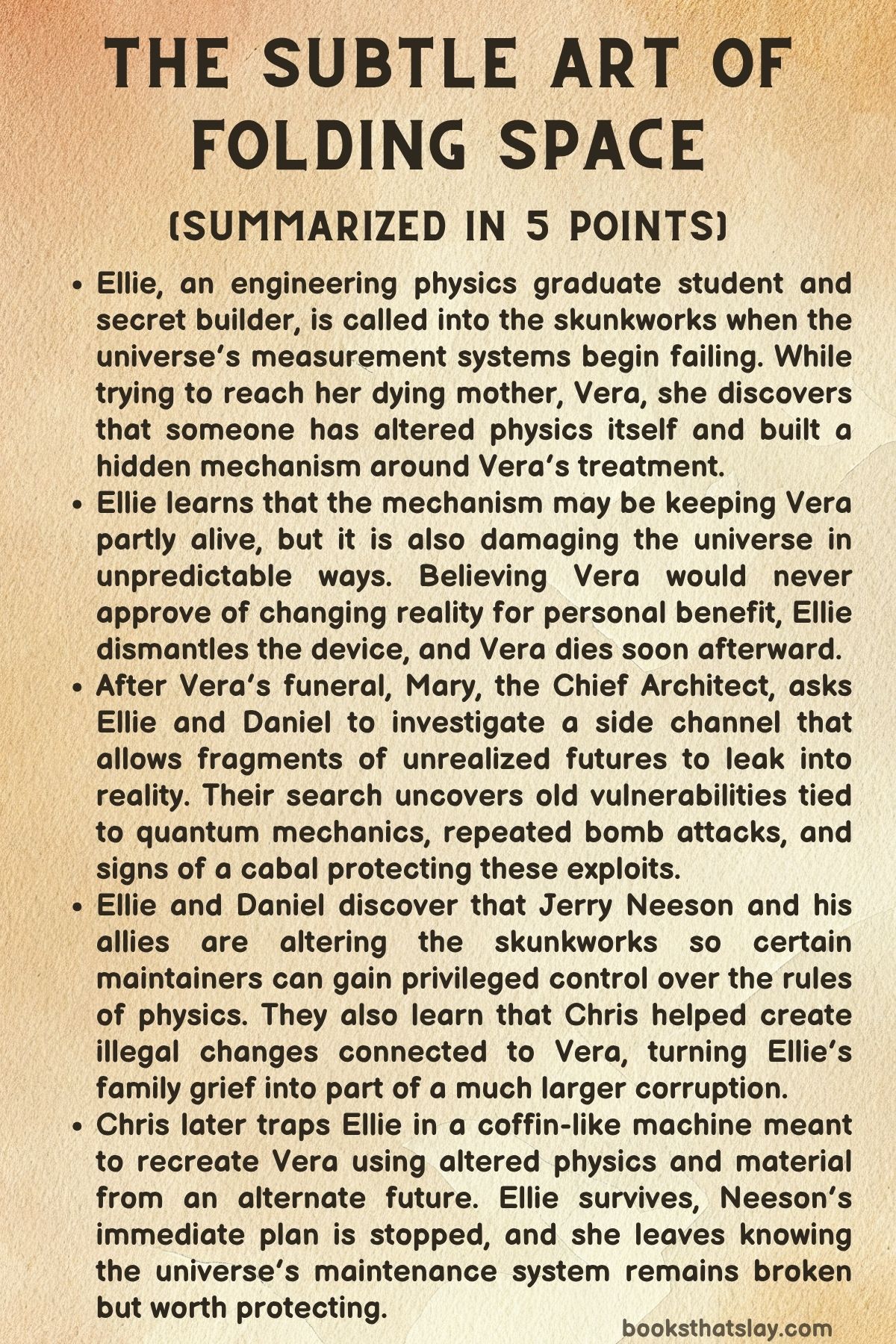
Summary
Ellie is an engineering physics graduate student in Boston, but her ordinary academic life hides a far stranger responsibility. She is also a builder, one of the people who help maintain the skunkworks, the concealed machinery that generates and controls the universe.
Her older sister Chris suddenly contacts her at Alewife Station by taking over the body of a stranger. Chris orders Ellie to go into the skunkworks and repair an urgent problem: the kilogram has become unstable, meaning one of the most basic measurements in reality is no longer behaving properly.
Ellie does not want to be pulled away. She is on her way to Washington, DC, to visit their mother, Vera, who is dying from glioblastoma and has been in Chris’s care.
Vera is comatose, and Ellie knows time with her is almost gone. Chris, however, has always treated Ellie harshly, even violently.
She has repeatedly tried to assassinate Ellie and has insisted that these attacks are only training exercises, supposedly meant to prepare Ellie for threats from isolationists. Ellie has grown up under Chris’s manipulation, cruelty, and strange logic, so even when she obeys, she remains suspicious.
Inside the skunkworks, Ellie meets her cousin Daniel, a verifier whose reports take the form of food. Together they investigate what appears to be a hold-time violation, a technical fault in the universe’s machinery.
Ellie checks the visible parts of the system, including valves, pipes, blueprints, and design rules, but everything seems correct. The problem is not in the machinery itself.
Instead, the physics of the surrounding universe has been changed, causing information to move too quickly. Daniel confirms that recent changes were made deliberately in the skunkworks one universe outward, meaning the current universe is being affected by tampering from a higher level of reality.
Ellie installs delay elements to stabilize the immediate failure, but Daniel leads her farther into the skunkworks. They discover a hidden mechanism tied directly into the state-commit machinery, the system that decides which possible states of reality become real.
Ellie realizes that the mechanism is connected to Vera’s medical treatment. It was built to alter physics around Vera, first to make her cancer drugs more effective and later to influence chemical activity in her brain.
This explains why Vera sometimes seems to wake from her coma, even though her condition should make that impossible.
The device might eventually save Vera, but it is also damaging the universe in unpredictable ways. Ellie understands that Vera would never approve of changing physics for private benefit, even to save her own life.
Removing the mechanism feels like choosing to kill her mother, but Ellie chooses the integrity of the universe over her personal grief. She dismantles it and flushes the faulty speculative state.
Two weeks later, Vera dies. Ellie meets Daniel and his boyfriend Belt for dinner in Boston, where Daniel reveals that Chris told Ellie the wrong date for Vera’s funeral.
Ellie attends anyway, but the funeral is painful and isolating. Relatives and maintainers avoid her or blame her.
Some think she neglected Vera, while others blame her for destroying the mechanism that might have saved her. During the reception, a maintainer named Tom confronts Ellie angrily and gives her a note from Mary, the Chief Architect.
Mary asks Ellie and Daniel to come to her house.
At Mary’s house, they witness a strange exploit. Mary repeatedly makes Ellie believe a key is in one hand, then reveals it is not.
Through this process, Ellie retains an object and knowledge from a future that was only speculated and should have been discarded. Mary explains that the skunkworks has a side channel, a flaw that lets pieces of unrealized futures leak into reality.
She worries this may not be an innocent bug but a covert channel deliberately installed or preserved by corrupt maintainers. Because Ellie chose the universe over her mother, Mary trusts her to investigate.
Daniel is also trusted because his loyalty to the skunkworks forced Ellie to confront the truth about Vera’s hidden mechanism.
As Ellie and Daniel leave Mary’s house, Ellie finds a bomb wired to Daniel’s car. The style resembles Chris’s methods, but Ellie is not certain Chris planted it.
Their investigation first takes them to Jerry Neeson, the Chief Verifier. Neeson insists the side channel is just an old bug caused by how quantum mechanics was implemented.
He offers Ellie a place in his organization and casually mentions that Chris has been useful to him, which deepens Ellie’s unease.
Ellie and Daniel then visit Ahdi, Daniel’s mentor and one of the finest builders. Ahdi explains that the exploit probably developed from old decisions made when maintainers added quantum mechanics to the universe.
He takes them into the skunkworks and shows how old speculative caches can be abused. Soon after, another car bomb is discovered.
This one is more advanced, and Ellie and Daniel spend hours modeling and disarming it. They nearly miss a deadman switch, but Ahdi intervenes by slowing the reaction long enough for Ellie to complete the job.
Ellie later stays at Daniel’s apartment, where Belt unexpectedly arrives. Chris takes over Belt’s body to taunt Ellie, proving she can still reach into Ellie’s life whenever she wants.
Ellie talks with Daniel about whether Chris could ever become a normal sister. Daniel makes clear that he sees Chris as dangerous and cruel, not merely damaged or misunderstood.
Daniel takes Ellie to an archive outside their universe, where an archivist named Xu helps them research the history of quantum mechanics and side channels. They learn that the exploit is not isolated.
There are more related vulnerabilities. Ahdi later warns them that he has been attacked after removing several exploits, confirming that a cabal exists and wants these side channels preserved.
After Ellie and Daniel return to Daniel’s apartment, Tom ambushes them with a gun. Daniel disarms him quickly.
Tom reveals that the cabal wants them to stop interfering and that many more side channels exist. Ahdi arrives, inspects the apartment, and discovers that Tom entered using access left behind by an unrealized future involving Vera.
He modifies the apartment to prevent similar intrusions and urges Ellie and Daniel to keep investigating.
Their search leads them to an isolationist archive. The Head Archivist reveals that Chris once helped make illegal changes to the skunkworks and was involved in an attack on the archive.
Ellie learns that the hidden mechanism around Vera was partly Chris’s work. In the archive, Ellie and Daniel study the device that trapped Vera between life and death.
Its later revisions are crude, desperate, and built around physics that did not yet exist. They discover that Chris helped build the parts that only make sense if the surrounding universe’s physics had been altered.
Incoming change records show that Neeson’s cabal is actively modifying the skunkworks so physics will favor certain maintainers. Their goal is to create a permanent ruling class with privileged access to the universe’s rules.
These changes would also destabilize universes nested beyond their own. Ellie and Daniel follow the trail to Neeson’s office, where Daniel crashes into Neeson and pins him.
Ahdi is already there. He reveals that Neeson and his allies have been blackmailing maintainers in the surrounding universe by stealing hidden images and evidence from them.
Ahdi retrieves the evidence and forces Neeson to back down.
Ellie then answers a text from Chris, who claims she wants to apologize. At Chris’s house, the apology turns out to be a trap.
Chris has built a coffin-like machine intended to use the body of Vera’s direct descendant, along with a diamond ring taken from an alternate future, to recreate Vera. Chris expects the universe’s physics to have changed in a way that will make the machine work, but Ellie tells her Neeson’s plan has been stopped.
Chris traps Daniel with crushing cords and forces Ellie into the coffin. Inside, Ellie confronts her sister’s lifelong cruelty, hypocrisy, and obsession with Vera.
Instead of submitting, Ellie begins altering the coffin’s machinery. Chris pulls her out and gets inside herself, claiming she is the daughter truly willing to sacrifice everything for their mother.
Ellie refuses to let Chris die and drills air holes into the coffin. Daniel frees himself, and Ahdi arrives despite Chris’s defenses.
Ahdi confirms that the machine might have revived Vera if the planned changes to physics had happened, but it cannot work now. Chris collapses emotionally and orders Ellie out of her life.
Ellie and Daniel report to Mary that the original side channel is a bug and that more related bugs exist, but they do not expose Neeson yet. He still has enough influence to start a war among maintainers, and the remaining dangerous machinery must be removed first.
Later, at Union Station, Ahdi sees Ellie off and tells her that the maintenance system itself is broken. Daniel wants to know whether Ellie will keep helping.
Ellie does not give a final answer, but she leaves on the train after choosing the universe’s integrity over Vera, Chris, and the comfort of a reality twisted to serve personal need. Back in Boston, the Red Line announcement is still out of sync, showing that the universe remains imperfect and unstable.
Characters
Ellie
Ellie is the central figure of The Subtle Art of Folding Space, and her role in the book is defined by the tension between technical responsibility and emotional pain. She begins as someone divided between two lives: an engineering physics graduate student in Boston and a secret builder responsible for maintaining the machinery behind reality.
Her intelligence is practical and precise, but the story repeatedly tests whether precision can survive grief, family pressure, and moral compromise. Ellie’s defining choice comes when she finds the mechanism built around Vera’s treatment.
She knows it may be her mother’s only chance, yet she also understands that changing physics for one person endangers the universe. Her decision to remove it is not cold or easy; it is an act of discipline made under emotional pressure.
Ellie is also shaped by her relationship with Chris, whose abuse has trained her to expect betrayal while still leaving her desperate for some form of sisterly bond. By the end of the book, Ellie has not become detached from her family, but she has learned that love cannot excuse damage done to reality itself.
Chris
Chris is Ellie’s older sister and one of the most disturbing figures in the book because her cruelty is mixed with wounded devotion. She presents her assassination attempts against Ellie as training, but this excuse only shows how deeply she has normalized violence and control.
Chris believes she is protecting Ellie, honoring Vera, and doing what others are too weak to do, yet her actions repeatedly harm the people she claims to love. Her involvement in illegal changes to the skunkworks and the mechanism around Vera reveals her willingness to cross almost any boundary if she can justify it as loyalty to their mother.
The coffin-like machine at her house exposes the full extent of her obsession. She is ready to sacrifice Ellie, and then herself, to recreate Vera, turning grief into a technical project and love into coercion.
Chris is not simply a villain; she is a person whose pain has hardened into entitlement. Her final breakdown shows that her certainty has been destroyed, but it does not repair the damage she has caused.
Daniel
Daniel is Ellie’s cousin, a verifier, and one of the clearest moral anchors in The Subtle Art of Folding Space. His work as a verifier suits his personality because he values truth, accuracy, and structural integrity.
His reports appearing as food gives him a strange, memorable presence, but beneath that unusual detail is a serious commitment to making sure reality functions honestly. Daniel is kind to Ellie, but he does not shield her from necessary truths.
When they discover the mechanism connected to Vera, he helps force the confrontation Ellie would rather avoid. He understands that compassion without honesty can become corruption.
His relationship with Belt also gives him a life outside the skunkworks, making him more than a technical partner in the investigation. Daniel’s courage appears repeatedly, especially when he faces bombs, ambushes, and Neeson’s cabal.
He is not reckless, but he acts decisively when the integrity of the universe is at stake. His bond with Ellie becomes one of trust built through shared danger and moral clarity.
Vera
Vera is mostly absent in direct action, but she is the emotional center around which much of the story turns. Her illness creates the pressure that drives Ellie, Chris, and the hidden mechanism at the heart of the conflict.
Vera’s coma and glioblastoma make her vulnerable to other people’s choices, especially Chris’s and Ellie’s. The tragedy is that the people who love her are not simply deciding how to care for her; they are deciding whether reality itself should be changed for her sake.
Ellie’s belief that Vera would never approve of altering physics for personal benefit becomes one of the book’s key moral guideposts. Vera represents a kind of integrity that survives even when she can no longer speak for herself.
For Chris, Vera becomes an object of obsession, someone to be restored at any cost. For Ellie, Vera remains a person whose values matter more than desperate hope.
Her death confirms the cost of Ellie’s decision, but it also preserves the meaning of Vera’s principles.
Ahdi
Ahdi is Daniel’s mentor and one of the most skilled builders in the story. He combines technical brilliance with a broader understanding of how broken the maintenance system has become.
Unlike Neeson, Ahdi does not treat the skunkworks as a tool for personal power. He sees its vulnerabilities clearly and acts to remove them, even when doing so makes him a target.
His interventions are often quiet but decisive. He saves Ellie and Daniel from the more sophisticated car bomb by slowing a reaction at the exact moment they need help, and he later appears despite Chris’s defenses when the coffin machine threatens to kill Ellie or Chris.
Ahdi also understands that the problem is larger than one bug, one cabal, or one grieving family. His warning at Union Station suggests that the entire culture of maintenance has failed.
He is a mentor figure, but he is not merely there to explain things. He acts, risks himself, and pushes Ellie to see the scale of the crisis.
Mary
Mary, the Chief Architect, represents institutional authority at its most careful and responsible. She does not simply order Ellie and Daniel into an investigation; she demonstrates the side channel herself and explains why she suspects something more dangerous than an old technical flaw.
Mary’s trust in Ellie is significant because it is based on Ellie’s painful choice to remove Vera’s mechanism. She recognizes that Ellie has already proven willing to protect the universe even at great personal cost.
Mary also trusts Daniel because of his loyalty to verification and his willingness to confront uncomfortable truths. Her role in the book is to identify the larger danger and place the investigation in the hands of people who have moral credibility.
She is cautious, aware of political risks, and conscious that corruption among maintainers could lead to conflict. Mary’s authority does not solve the problem directly, but it gives Ellie and Daniel a reason to keep going when the truth becomes dangerous.
Jerry Neeson
Jerry Neeson is the Chief Verifier and one of the central representatives of corruption in the book. At first, he tries to present himself as reasonable, dismissing the side channel as an old bug linked to quantum mechanics.
His offer of work to Ellie and his mention of Chris are calculated moves, meant to draw Ellie closer or unsettle her. Neeson’s real goal is much more dangerous.
He and his cabal want to alter the skunkworks so physics itself favors certain maintainers, giving them privileged access to reality’s rules and turning technical knowledge into permanent power. His corruption is not chaotic; it is bureaucratic, strategic, and hidden behind expertise.
He also uses blackmail, stealing evidence from maintainers in the surrounding universe to control them. Neeson shows how systems meant to protect reality can become tools of domination when their guardians become self-interested.
He is dangerous because he understands the machinery and the politics around it.
Tom
Tom is a maintainer whose anger and fear make him a useful instrument of the cabal. He first appears at Vera’s funeral reception, where he confronts Ellie and gives her Mary’s note, placing him at the edge of both grief and conspiracy.
Later, when he ambushes Ellie and Daniel with a gun, his role becomes clearer. He is not the mastermind, but he is willing to threaten violence to stop them from interfering.
Tom’s actions show how the cabal relies not only on leaders like Neeson but also on people who can be pressured, persuaded, or frightened into doing its work. His use of access left behind by an unrealized future involving Vera also demonstrates the practical danger of the side channels.
Through Tom, the book shows how technical exploits become personal threats, entering homes, relationships, and private spaces.
Belt
Belt is Daniel’s boyfriend, and his role is important because he shows the personal cost of Chris’s reach. His arrival at Daniel’s apartment should be a normal domestic moment, but Chris takes over his body to taunt Ellie.
This violation turns Belt into proof that Chris can still invade Ellie’s life through people she cares about. Belt also helps reveal Daniel’s humanity beyond his work.
Daniel is not only a verifier or Ellie’s ally; he has a relationship, a home, and someone whose safety matters to him. Belt’s presence raises the emotional stakes of the investigation because the conflict is not contained within machinery or archives.
The people around Ellie and Daniel can be used, harmed, or turned into tools by those who exploit the system.
Xu
Xu is the archivist who helps Ellie and Daniel study records outside their universe. Their role is quieter than Ahdi’s or Mary’s, but they are important because the investigation depends on access to history.
Xu helps them look into the origins of quantum mechanics and the side channels, which reveals that the flaw is part of a broader pattern rather than a single accident. Xu represents the value of preserved knowledge in a world where reality itself can be revised, speculated, and discarded.
In a story full of hidden mechanisms and manipulated futures, archival memory becomes a form of resistance. Xu’s assistance allows Ellie and Daniel to understand that old design decisions can create future vulnerabilities, especially when powerful people learn how to exploit them.
The Head Archivist
The Head Archivist of the isolationist archive gives Ellie one of the most painful pieces of information in the book: Chris helped make illegal changes to the skunkworks and participated in an attack on the archive. This character expands Ellie’s understanding of Chris from abusive sister to active collaborator in dangerous tampering.
The Head Archivist also provides a perspective from outside the maintainer mainstream, showing that distrust of the system has real roots. The isolationist archive holds knowledge that others might prefer to hide, including details about the abomination built around Vera.
Through this figure, the story suggests that institutions often label outsiders as threats while ignoring their warnings. The Head Archivist helps Ellie see that the crisis is not only technical but historical, built from past violations that were never properly addressed.
Themes
The Cost of Choosing Integrity Over Love
Ellie’s central conflict comes from being forced to choose between saving someone she loves and protecting the universe from damage. Vera’s hidden mechanism turns grief into an engineering problem, offering the possibility that a mother’s life can be preserved through altered physics.
That possibility is cruel because it is not a simple miracle. It carries consequences for the entire structure of reality.
Ellie’s decision to dismantle the mechanism is painful because she is not rejecting Vera; she is rejecting the idea that love gives her the right to endanger everyone else. This theme gives The Subtle Art of Folding Space its strongest emotional force.
The book does not treat integrity as clean or comforting. Ellie pays for it through Vera’s death, family rejection, and Chris’s rage.
Her choice shows that moral action can feel like betrayal when the person harmed is someone deeply loved. The story asks whether doing the right thing still matters when it leaves no emotional reward, no public approval, and no way to undo the loss.
Grief as a Force That Can Distort Reality
Grief in the story is not passive sadness. It becomes active, technical, and dangerous.
Chris’s grief over Vera drives her to participate in illegal changes, help construct the mechanism around Vera’s treatment, and later build a coffin-like machine meant to recreate her mother. Her mourning becomes a refusal to accept limits, and because she has access to the hidden machinery of the universe, that refusal becomes physically dangerous.
Ellie grieves too, but her grief moves in the opposite direction. She wants Vera to live, yet she understands that using the skunkworks to keep her mother alive would turn love into theft from reality.
The contrast between Ellie and Chris shows two forms of loss: one that accepts pain without surrendering judgment, and one that converts pain into control. Vera’s condition also reveals how the dying can become trapped inside the needs of the living.
Chris treats Vera as someone to restore at any cost, while Ellie tries to honor what Vera would have wanted. The theme makes grief both intimate and cosmic.
Corruption Hidden Inside Systems of Expertise
The skunkworks is maintained by people with specialized knowledge, and that expertise gives them enormous power. The danger is not only that the machinery can fail, but that the people responsible for it can decide the rules should favor them.
Neeson and his cabal understand that control over physics is the highest form of political control. By altering the machinery so certain maintainers gain unfair access to reality’s rules, they attempt to turn technical privilege into permanent class power.
Their corruption is especially alarming because it hides behind procedure, explanation, and institutional authority. Neeson can call the side channel an old bug, offer Ellie a job, and present himself as reasonable while actively protecting a scheme that could destabilize nested universes.
Ahdi’s warning that the maintenance system itself is broken shows that the crisis cannot be solved by removing one bad actor. Systems built on secrecy and expertise need trust, but trust becomes dangerous when there is no accountability.
The book treats corruption as something that grows quietly inside complex institutions until it becomes almost indistinguishable from normal operation.
Family, Control, and the Abuse of Protection
Chris repeatedly frames cruelty as protection. Her assassination attempts against Ellie are described as training, her manipulation as preparation, and her illegal work around Vera as devotion.
This pattern shows how family language can be used to excuse control. Chris wants to be seen as the daughter who sacrifices the most and the sister who understands danger best, but her version of care strips others of choice.
She takes over bodies, lies about Vera’s funeral, traps Ellie, and nearly kills herself in the name of love. Ellie’s growth depends partly on recognizing that Chris’s explanations do not make her actions acceptable.
Daniel helps clarify this by refusing to romanticize Chris’s behavior. The story presents family not as an automatic source of safety, but as a bond that can be twisted by fear, grief, and entitlement.
Ellie still cares about Chris, which is why she drills air holes into the coffin instead of letting her die. Yet saving Chris does not mean submitting to her.
The theme resolves through boundaries rather than reconciliation, showing that love sometimes requires refusing the people who claim to act for your own good.