Tender Cruelty Summary, Characters and Themes
Tender Cruelty by Katee Robert is a modern myth reimagining set in a fortified city called Olympus, where power is held by a small circle of “titles” known as the Thirteen. When the city’s protective barrier fails and an old enemy resurfaces, the ruling order starts to crack from the inside.
At the center are Zeus and Hera—publicly united, privately at war—bound by marriage, suspicion, and a dangerous attraction. As coups, betrayals, and hidden agendas collide, the question stops being who deserves the throne and becomes who survives what comes next. It’s the 9th book in the Dark Olympus series.
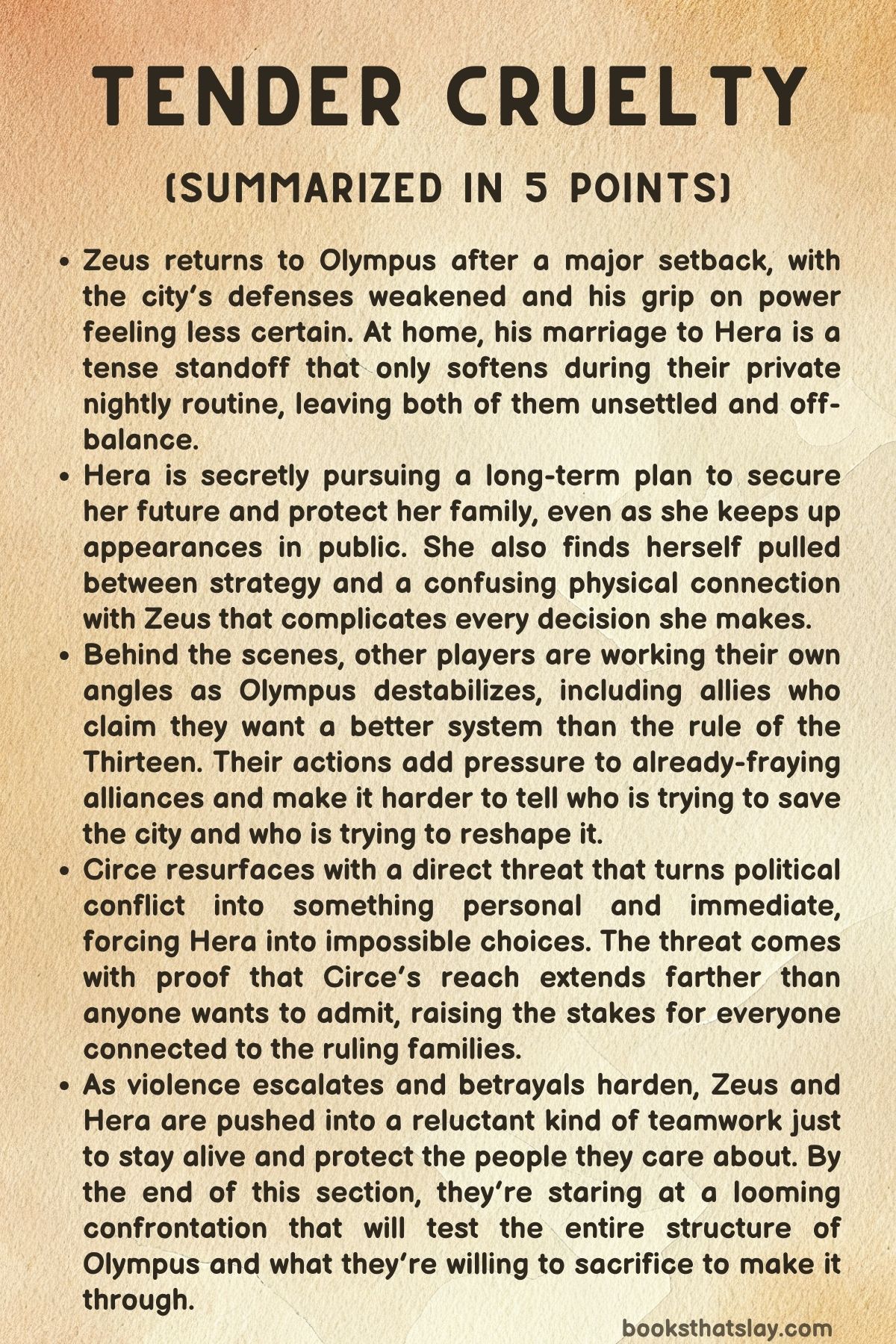
Summary
Zeus sits alone in his car after a night that was supposed to secure his rule ends in disaster. Circe’s ships slip away, Circe vanishes, and the city feels like it’s turning against him.
With the barrier around Olympus down and the assassination clause now public knowledge, attacks on the Thirteen have spiked. Zeus has already pushed the system further toward collapse by joining the other legacy title-holders in a power grab meant to break a blockade.
None of it feels like control. It feels like proof he’s losing.
Before dawn, he returns to his penthouse and finds Hera awake with Ixion, a guard she brought in through Ares’s network. Ixion is close enough to look familiar, and Zeus immediately orders him out.
Hera offers Ixion warmth she never offers Zeus, and the contrast lands hard. Their conversation turns sharp, the way most of their daylight conversations do, with Hera implying Zeus has been with someone else and Zeus implying Hera has, too.
Yet their nightly routine follows: Zeus refuses to touch her until she gives explicit consent. Hera gives it with impatience, and they have sex in darkness, hostility fading only for the duration of physical need.
Zeus tells himself the risk is real—sharing a bed with a wife who wants him dead—but it is also the only place he sleeps.
Hera’s private thoughts confirm what Zeus fears. She has despised the Zeus title since childhood, and she has been working toward his death for a long time.
Her last attempt failed, and the failure burns. Worse, she is already months pregnant with Zeus’s child, and she sees the pregnancy as leverage: if Zeus dies, she can claim control through regency and shape Olympus without him.
She tells herself she doesn’t need him, but the nights keep pulling her back. When Zeus warns her not to bring her “lover” into the penthouse, Hera recognizes jealousy and decides to let him believe Ixion is more than a guard.
If Zeus stays distracted, he might miss what she’s really building.
Elsewhere, Hermes watches Olympus from above with Atalanta. Civilians have been evacuated to the countryside, supplies are already strained, and the barrier’s collapse makes everything worse.
Circe’s location is unknown, and that uncertainty is dangerous. Atalanta wants Circe dead and probes Hermes for information.
Hermes hesitates, weighed down by an old history with Circe and by resentment toward the system that stole Circe and ruined her life. Hermes and Atalanta are working toward a long-term goal: break the Thirteen’s hold and replace the title-based rule with a representative government.
They need the rulers divided, scrambling, and exposed. Hera and Zeus, with their marriage and alliances, are a key fault line worth watching.
Zeus heads to Dodona Tower and tries to impose order. Apollo reports no camera evidence of Circe, no trace even from Hermes, who has been careful.
Apollo warns Zeus that if Zeus starts breaking laws, Apollo will have to oppose him. Athena brings new information: they found where Circe’s people landed, with dead sentries and boats hidden just inside where the barrier used to be.
It feels staged, as if Circe wants them to find clues but not answers. Zeus orders the search to continue, haunted by the idea that Olympus is open to invasion.
Then Hermes appears in his office as an intruder, attacking him with speed and skill. She tells Zeus bluntly that Circe is in the city and he’s wasting time.
Zeus accuses Hermes of betrayal and threatens to strip her title. Hermes laughs at the threat, calls him by his real name, Perseus, and tells him the entire structure is rotten.
She insists Zeus may want to protect the city, but asks who will protect it from him. Then she disappears, leaving Zeus furious and unsettled.
Hera, meanwhile, spirals as the situation worsens. She can’t reach Poseidon.
She doesn’t trust most of the Thirteen. Circe’s absence feels like a knife held just out of sight.
A MuseWatch article praises Zeus’s legacy coup for breaking the blockade and confirms Circe escaped. Hera calls Circe and gets voicemail.
Then an unknown number texts a meeting place: a bar called Wine About It, in thirty minutes. Hera goes with Ixion, Nephele, and Imbros—guards who are loyal to her rather than to Olympus as an institution.
The city is eerily empty, but the bar is open.
In the bathroom, Circe is waiting. She tells Hera she’s been watching her, and she speaks calmly about the problem as she sees it: Olympus is ruled by an entrenched, inherited power structure that serves itself.
Circe says the city deserves leadership chosen by the people, not inherited by legacy families. She doesn’t ask Hera to join her exactly—she offers her terms.
Circe will spare Hera’s family if they renounce all claims to their titles and leave the city for good. Hera rejects it as impossible.
Demeter will never abandon what she’s built. Persephone is pregnant and fiercely tied to Hades.
Hades will never leave the lower city unprotected. Circe responds with a simple certainty: then they will die.
She says she would prefer not to kill children, including Hera’s unborn child, but she will do what she must.
Hera threatens to scream and let her guards kill Circe. Circe tells her to check her phone.
Videos arrive, as if shot through a sniper scope: Persephone pregnant with twins, Eurydice with Charon and Orpheus, Demeter in the countryside with Eros and Psyche. The message is unmistakable.
Circe has snipers on Hera’s loved ones and can execute them at any time. Circe tells Hera to leave before her guards get suspicious.
Hera exits, vomits, returns to the bar, and pretends she’s fine while realizing she’s been boxed into an impossible choice.
Hera calls Persephone and demands a meeting. Persephone refuses to let Hera into the lower city and admits she doesn’t fully trust Hera’s political games.
After tense negotiation, Persephone agrees to meet the next day on a bridge, with safety arranged. Hera ends the call knowing the stakes have changed: her family’s lives now hang on what she can persuade others to do.
Zeus learns Hera has been seen at Wine About It with Ixion, and jealousy pushes him into action. He storms into the bar, orders everyone out, and confronts Hera.
He threatens Ixion’s life if Hera continues plotting. Hera, raw from Circe’s threat and desperate for something that isn’t strategy, meets Zeus’s fury with blunt honesty.
The confrontation turns sexual, fast and risky, in a booth while her guards wait outside. Afterward, shaken by what she just did and what she’s facing, Hera blurts out her real name: Callisto.
Zeus answers by giving his own: Perseus. For a moment, they see each other as people rather than titles.
Then Zeus’s phone rings, the moment breaks, and he leaves with orders and threats—be home for dinner, or he will find her.
Hera turns from that wreckage back to survival. She drives to the countryside encampment where Demeter has organized relief for displaced citizens.
Demeter’s operation is disciplined and efficient, a temporary city built from tents, food lines, and job assignments. Hera finds Psyche, who quickly notices Hera’s refusal of alcohol and guesses the truth.
Psyche confirms Hera is pregnant, offers support, and urges her to share what’s happening. Overwhelmed, Hera prepares to explain everything, beginning with the night she married Zeus.
Back at the penthouse, Zeus and Hera fall into another night together, but the tone shifts. Zeus calls her Callisto, and the name unsettles her because it is private.
In the dark, she tries to keep distance, but Zeus refuses her demand for quick, rough sex and instead takes time, focusing on her pleasure. Hera hates him, wants him dead, and still responds to him.
She says his name—Perseus—during sex, and he makes her repeat it. Afterward, he holds her and tells her she’s safe, that whatever is wrong can wait until morning.
She believes him enough to sleep.
Zeus stays awake and notices the physical signs Hera has been hiding. He realizes she is pregnant and panics—not with joy, but with dread.
He fears becoming his father, the former Zeus, who abused him and his brother. He calls Hercules, admits he’s terrified, and asks how to be a good father when he had none.
Hercules tells him the difference is choice: Zeus can decide who he becomes. The call steadies him, and Zeus clings to one resolve—when this ends, he will be Zeus, or he will be dead.
The next morning, Hera meets Persephone on a bridge near the Styx. Persephone arrives by boat, heavily pregnant with twins, with Medusa and Orpheus.
Hera lashes out at Orpheus for what he did to Eurydice, punching him before Persephone stops her. Hera warns Persephone that Circe is inside the city and plans to force the Thirteen to step down or die.
Hera urges Persephone to leave with Hades, take Circe’s offer, and survive. Persephone refuses; Hades won’t abandon the lower city, and Persephone won’t abandon him.
A shot cracks across the riverbank. Hera is hit in the shoulder.
Persephone is grazed. Orpheus is struck worse when he moves to shield Hera.
Medusa is clipped in the leg. The shooter is Hermes, acting from a rooftop.
Hermes calls paramedics anonymously, escapes, and then warns Cassandra that Circe has entered the city with a plan to eliminate the Thirteen. Hermes claims she wants change, but not this kind.
Zeus rushes to the hospital when he hears Hera is among the wounded. He learns Persephone is being treated, Orpheus is in surgery, and Medusa is with Persephone.
Hera is alive, bandaged, furious, and desperate to see her sister. Zeus quietly orders a doctor to check Hera and the pregnancy without telling her he did, and learns both Hera and the fetus are fine.
When Medusa reveals Hera’s pregnancy in Persephone’s room, Hades arrives like a storm, takes control, and transfers Persephone and Orpheus to the lower city under his protection. He warns Hera to stay out.
Zeus steps in front of Hera when Hades lashes out, demanding grace.
After discharge, Zeus and Hera travel toward the countryside again, aware their dynamic has shifted. Hera shares Circe’s videos with Persephone, which triggers Hades’s fury—Hera withheld critical information for days.
He tells her stepping down won’t stop Circe because Circe wants blood, especially from legacy titles like Zeus and Hades. Hera’s fear sharpens.
Zeus steadies her physically, guiding her breathing, and Hera clings to the reality that she will not let Circe take her child.
At the encampment, Zeus learns the shooter from the bridge attack has been identified on camera: Hermes, carrying a rifle bag. Zeus vows to deal with her.
While tracking suspicious movement near the camp, Zeus and Ares catch infiltrators—women using equipment and moving where civilians are forbidden. One captive is brought to Demeter’s tent, where Demeter runs a war room of her own.
Hera tries to warn Demeter about Circe and Hermes and the danger to the Thirteen. Demeter dismisses the idea as unrealistic and focuses on stabilization.
Then Zeus bursts in with proof the enemy has entered the camp. He demands Hera leave with him immediately.
Demeter resists, claiming the camp is safer. When Zeus tries to pull Hera away, guards block them—on Demeter’s signal.
Hera realizes Demeter has chosen a side.
Demeter reveals she accepted an offer she believes will protect Hera and the city. Circe steps forward, openly allied with Demeter, and announces plans for a vote to dismantle the Thirteen and replace them with representatives.
Legacy families will face “trials,” and Zeus will be held until his. Circe treats Hera as expendable, then offers her a cruel choice: leave Olympus after the trials and keep the pregnancy, or stay and end it.
Demeter is stunned to learn Hera is pregnant. Hera refuses to terminate, and Circe orders both Hera and Zeus taken to a cell.
Locked together, Hera and Zeus finally speak honestly. Zeus admits he knew about the pregnancy.
They admit neither has taken other lovers. They confess love—messy, dangerous, and real—and face the possibility that they will die.
Then fighting erupts outside. Hermes opens the cell and says she has been poisoned but has a narrow window to get them out.
Hermes leads them through the camp to an off-road vehicle, explaining she still wants the Thirteen abolished and a new government formed, but she refuses Circe’s plan to murder privileged families. She challenges Zeus: is holding the title worth losing Hera and the child?
They race back toward Olympus and stop at Juniper Bridge. Hermes meets Atalanta for a spare phone, warns Circe’s hunters are coming, and insists Zeus and Hera must convince Hades to shelter them or they will be killed.
Hermes and Atalanta leave. Zeus tells Hera he’s willing to give up being Zeus if it means survival with her.
He calls Hades and asks for sanctuary. Hades arrives, escorts them into the lower city, and brings them before Persephone, Eurydice, and others.
Zeus and Hera explain Demeter’s betrayal, Circe’s coming trials, and Hermes’s intervention. Charon confirms the camp is mobilizing back toward the city under Circe and Demeter’s lead.
Hades orders the remaining Thirteen contacted and offered sanctuary under lower-city law. He refuses to allow them to be slaughtered in a staged trial.
Hera and Zeus are given a suite to rest, and in the quiet afterward they admit what they’ve become to each other: not just enemies, not just titles, but partners facing war. They sleep, knowing that when morning comes, the battle for Olympus begins.
Characters
Zeus (Perseus)
In Tender Cruelty, Zeus—whose real name is Perseus—is a ruler propped up by an inherited title he both needs and resents. He enters the story in a state of unraveling: the protective barrier has fallen, Circe keeps slipping through his fingers, and the city’s violence is escalating in direct response to the Thirteen’s fragility.
What makes him compelling is that his instinct to control is inseparable from a genuine, almost desperate desire to protect Olympus; he can’t stop thinking like a commander even when his personal life is collapsing. His jealousy over Ixion is not just sexual possessiveness—it’s panic at the idea that Hera/Callisto has alliances and comforts beyond him, because anything outside his sight feels like a threat to his already-failing authority.
Beneath the title, Perseus is defined by trauma: the cigarette-burn scars and the fear of becoming his abusive father reveal why he clings so hard to rules like explicit consent—he’s trying to build a version of power that doesn’t replicate the cruelty that made him. As the stakes rise, he begins to shift from “I must be Zeus” toward “I must choose,” and that choice becomes clearest when he’s willing to give up the title if it saves Callisto and their child—an act that reframes him from legacy tyrant to someone trying, imperfectly, to break the legacy.
Hera (Callisto)
Callisto, wearing the Hera title, is a strategist forced to live inside a marriage that began as political violence long before she ever met Perseus as a person. Her defining tension is that she has built her identity around opposition—hating Zeus, plotting his death, protecting her family through ruthless calculation—yet her body and instincts keep pulling her into a nightly intimacy she cannot neatly categorize as hatred or desire.
Pregnancy intensifies everything: it is initially a weapon in her imagination (regency, control, a future without Zeus), but it becomes a vulnerability Circe can exploit and a truth that changes the emotional geometry between her and Perseus. Callisto’s sharpest edge is her ability to perform, to weaponize perception; she lets Zeus believe Ixion is a lover because the illusion creates cover for her real plans.
At the same time, her control is not absolute—her nausea, fear, and the moments where she almost kills Zeus but cannot follow through reveal a person whose internal loyalties are shifting faster than her strategies can keep up. When she finally starts telling the story—“It started on my wedding night…”—it signals that she is moving from solitary schemer to someone who may accept help, confession, and partnership, even if that partnership begins in hostility.
Circe
Circe operates as both an insurgent leader and an ideological mirror held up to Olympus’s ruling class. She frames her mission in moral terms—ending rule by entrenched legacy families and replacing it with representation—yet the methods she uses are unmistakably coercive and personal: threats against unborn children, sniper surveillance of loved ones, and an ultimatum designed to trap Callisto into betraying her own family’s nature.
She is patient and theatrical, allowing evidence to be “found,” choosing meetings in controlled spaces, and speaking as if she is already the inevitable future. The most frightening aspect of Circe is her clarity: she doesn’t bargain in good faith so much as offer a single narrow path to survival, then calmly describes the consequences of refusal.
Her ability to infiltrate systems—vanishing from cameras, positioning shooters, embedding people in the countryside encampment—makes her feel less like a single person and more like a destabilizing force that reveals how porous the Thirteen’s control really is. Even when she makes political promises (a vote, trials, a new structure), the tone is punitive and hierarchical, suggesting that her “democracy” may simply be a new throne built from the ruins of the old one.
Hermes
Hermes is the story’s most volatile agent because she is simultaneously a revolutionary, a saboteur, and a reluctant line-drawer. She believes the system of the Thirteen is broken beyond reform and actively works—alongside Atalanta—to drive it toward collapse, using division and desperation as tools.
Yet her actions show a complicated ethics: she shoots to wound rather than kill, calls paramedics, and later intervenes to extract Perseus and Callisto from Circe’s custody, not because she suddenly supports the Thirteen, but because she refuses Circe’s version of change-by-slaughter. Hermes’s direct confrontation with Perseus exposes her core power: she strips away titles, calls him by his real name, and forces him to confront the question of legitimacy—who protects the city from the ruler who claims to protect it?
Her methods are brutal, but she is driven by a long memory and personal history, including the wound of what happened to Circe and what Zeus’s title represents. She becomes a pivot point between two futures: one where Olympus is remade through political transformation, and one where it is remade through purges, and her interference suggests she wants revolution to survive its own fire.
Atalanta
Atalanta functions as a disciplined architect of systemic collapse, more ideologically cold than Hermes and more willing to let hatred guide strategic choices. She wants Circe dead, but she also wants the Thirteen dismantled, and she understands that the fastest way to bring down a ruling class is to fracture it from within.
Her deliberate poisoning of relations between Athena and Zeus demonstrates her preference for indirect warfare: she treats alliances like load-bearing beams to be quietly sawed through. Atalanta’s partnership with Hermes is pragmatic—she shares the endpoint (a democratic structure) but not necessarily the same emotional entanglements or hesitation.
When Hermes needs a spare phone and a clean handoff at the bridge, Atalanta is there like a prepared contingency, reinforcing the sense that she plans in networks rather than moments. She represents the revolution as logistics: not passion, but infrastructure.
Ixion
Ixion is introduced as a guard acquired from Ares, but he quickly becomes a symbol more than a man—an intentional trigger for Zeus and a controllable anchor for Callisto. His closeness to Callisto in the penthouse and later presence at the bar are read by Zeus as sexual betrayal, yet what matters is the political implication: Ixion represents a loyalty Callisto can claim that does not belong to Zeus.
For Callisto, Ixion is safety, continuity, and a reminder of the “orphan-raised” guard unit she trusts because their allegiance is built on shared survival rather than legacy obligation. The way Callisto leverages Zeus’s jealousy by refusing to correct the “lover” assumption shows Ixion’s narrative role as misdirection—he is a decoy that protects deeper secrets.
His scolding calls and anxious concern also humanize him: he is not merely muscle, but someone who feels responsible for Callisto’s repeated risk-taking, which hints that their bond is built on more than command hierarchy.
Nephele
Nephele belongs to Callisto’s trusted guard circle and embodies the quiet competence of chosen loyalty in a world obsessed with inherited power. She moves through the story as part of the protective wall Callisto tries to keep between herself and the chaos of Olympus, and her inclusion in the bar meeting underscores that Callisto does not feel safe alone even in supposedly controlled spaces.
Nephele’s importance is partly structural: she represents the alternative power base Callisto has built outside the Thirteen’s family webs. By being present but not dominating scenes, she emphasizes how Callisto survives through systems of trust she creates, not systems of trust she inherits.
Imbros
Imbros is the most emotionally legible of Callisto’s guards, repeatedly voicing concern in a way that suggests caretaking rather than mere obedience. When he points out that the guards had to learn Callisto was shot through Ares, it reveals how Callisto’s secrecy harms not only herself but the people who have built their lives around protecting her.
Imbros also serves as a practical bridge—bringing clothing to the hospital, handling logistics—grounding the story’s high politics in the reality of bodies, wounds, and immediate needs. His presence reinforces that “loyalty” in this world isn’t only about power; it can be about community and responsibility.
Apollo
Apollo represents institutional constraint and the tension between law and survival. When he warns Zeus that breaking laws will force Apollo to oppose him, it frames Apollo as someone who is not automatically loyal to the Zeus title, but loyal to a governing principle that could become adversarial in crisis.
His role also highlights how compromised Olympus’s surveillance and control systems are: even with cameras and authority, Apollo cannot produce evidence of Circe, and Hermes can move undetected. Apollo is the voice of consequences—reminding Zeus that emergency power grabs have a cost, and that the veneer of legitimacy can crack into open conflict among the Thirteen.
Athena
Athena functions as a hard-edged analyst trying to impose pattern on chaos. She tracks where Circe’s people landed, reads the hidden boats as intentional breadcrumbs, and continues the search with a mindset that treats Circe’s actions as strategy rather than random violence.
At the same time, she is vulnerable to manipulation from within—Atalanta’s efforts to poison her relationship with Zeus suggest Athena can be turned into a wedge, and that her loyalty is not unshakeable. She embodies the Thirteen’s dependence on intelligence and process, and the frightening reality that process is failing against an opponent who anticipates being watched.
Poseidon
Poseidon appears as a pressure point in the story’s security apparatus: his sentries are killed, his perimeter is breached, and his communications become part of the frantic effort to understand how Circe moves people through terrain and barriers. The fact that Hera cannot reach him when she most needs certainty suggests either operational overload, political mistrust, or both.
Poseidon’s vulnerability matters because it shows that even the Thirteen’s “outer defenses” are staffed by mortals who can be eliminated, leaving titles exposed and reactive rather than commanding.
Demeter
Demeter is power disguised as caretaking, and that duality makes her one of the most dangerous figures in the narrative. In the countryside, she looks like competence incarnate—organizing a tent city, food lines, job allocation, and a war-room model—proving she can build systems that actually serve people.
But that same capacity for system-building makes her susceptible to believing she can control a revolution by partnering with it. Her betrayal is chilling because it is framed as protection: she accepts Circe’s offer believing it is best for Hera and for stability, and she uses guards and authority to imprison Hera and Perseus with the confidence of someone certain she is choosing the lesser evil.
Demeter’s blind spot is that she thinks she can negotiate with an absolutist; when Circe forces Hera to choose between leaving and terminating a pregnancy, Demeter’s shock reveals she did not fully understand what she was aligning with. She is a portrait of a leader who mistakes managerial skill for moral leverage—and learns too late that leverage fails when the other party is willing to burn everything.
Psyche
Psyche provides the story’s rare moment of uncomplicated tenderness and is positioned as Callisto’s emotional lifeline. Her immediate recognition of the pregnancy, gentle insistence that Callisto isn’t alone, and practical care—water, food, ginger tea—create a contrast to the Thirteen’s political cruelty.
Psyche’s role is not to command events but to make survival possible by keeping Callisto grounded enough to speak the truth. She also represents the collateral of power struggles: she is family, and therefore a potential hostage, even if Circe’s immediate focus is elsewhere.
Psyche’s presence signals that intimacy and care are forms of resistance in a world where every relationship is treated as leverage.
Persephone
Persephone embodies the ferocity of chosen loyalty and the complicated sovereignty of the lower city. Pregnant with twins, she is physically vulnerable yet politically unyielding, refusing to abandon the lower city because Hades will not abandon his people.
Her distrust of Callisto’s maneuvering is not pettiness; it is a survival instinct sharpened by living under constant threat and by understanding that “family” and “politics” are inseparable for the Thirteen. The bridge meeting shows Persephone’s willingness to risk herself for information, but also her insistence on control through safe arrangements and escorts.
When she is injured by a sniper, it clarifies how high her value is as a target: she is both an heir-bearer and a symbol that the lower city cannot be intimidated into surrender. Persephone’s stance forces Callisto to confront a painful truth—appeasement cannot save them—because Persephone understands that Circe’s plan is not merely to remove titles, but to erase legacy holders outright.
Hades
Hades is portrayed as the only leader who already governs a community that cannot afford illusions. His barrier cutting off the lower city, his rapid militarized response at the hospital, and his insistence on transferring Persephone back under lower-city protection show that he prioritizes containment and safety over optics.
He is harsh with Callisto because he reads her secrecy as complicity in danger; his anger is the anger of someone whose home is always the first to be sacrificed by upper-city politics. Yet Hades also demonstrates pragmatic mercy: when Perseus calls honestly asking for shelter, Hades grants it, then expands protection by offering sanctuary to the rest of the Thirteen under lower-city law.
His leadership is defined by refusal—refusal to abandon people, refusal to let Circe conduct sham trials, refusal to let personal grudges override the necessity of coalition. In a story crowded with titles that feel like costumes, Hades feels like a ruler whose authority is rooted in a lived social contract.
Ares
Ares functions as the blunt instrument of immediate security and the messenger of violence. He reports the Styx gunshots, deploys Achilles and Patroclus to hunt the shooter, and serves as a node connecting battlefield response to leadership decisions.
His presence signals that Olympus has defaulted to militarized problem-solving, and that the Thirteen’s internal politics now occur under the shadow of armed enforcement. He also becomes, indirectly, a reminder that Callisto’s guard team was “acquired” through power channels—protection is never purely personal here; it is always entangled with who controls violence.
Achilles
Achilles appears as elite enforcement—someone Zeus can task with hunting a shooter in the aftermath of an attack. Even without deep interiority in the summary, his role communicates that Olympus still has loyal, capable fighters, but they are being forced into reactive posture rather than strategic control.
Achilles represents how the regime survives day-to-day: through specialists who can be pointed at threats, even when leadership is uncertain.
Patroclus
Patroclus, paired with Achilles, reinforces the theme of bonded loyalty as a counterpoint to legacy power. His function mirrors Achilles—rapid response, hunt, protection—but his inclusion as a named figure suggests that relationships among enforcers matter, and that not all allegiance is built on titles or bloodlines.
In a story where marriage can be coercion and family can be hostage, Patroclus hints at a different kind of devotion: chosen, mutual, and operationally reliable.
Hercules
Hercules is the most direct window into Perseus’s past and the fear that defines his future. When Perseus calls him in panic after realizing Callisto is pregnant, Hercules becomes a stabilizing voice who confirms their father’s abuse and reframes the problem as choice rather than destiny.
His advice—start by talking to your wife, decide what kind of parent you will be—matters because it gives Perseus a moral vocabulary outside violence and rule. Hercules’s presence is brief but structural: he proves Perseus is not alone in his history, and he provides the possibility that legacy trauma can be interrupted rather than repeated.
Cassandra
Cassandra appears as a receiver of Hermes’s warning and represents the cautious, skeptical wing of the Thirteen’s information network. She immediately suspects Hermes has her own agenda, which positions Cassandra as someone trained to distrust narratives, even when the content is urgent.
Her connection to Apollo—Hermes urging her to get Apollo out—suggests Cassandra may be part of a faction that understands the cost of institutional collapse and is trying to manage it. In a story full of blunt force, Cassandra represents the quieter power of interpretation and the danger of being correct too late.
Minos
Minos is referenced as a figure tied to betrayal and factional sponsorship, invoked when Zeus accuses Hermes of sponsoring him. Even without direct action in the summary, Minos functions as an emblem of the shadow economy of power: alternative claimants, insurgent allies, or political projects that the Thirteen fear because they erode legitimacy.
His narrative role is to widen the field of threats beyond Circe alone, implying Olympus’s instability has attracted multiple opportunists and agendas.
Eurydice
Eurydice is a focal point of familial loyalty and old wounds, most visibly through Callisto’s violence toward Orpheus for what he did to Eurydice. She also appears in Circe’s leverage videos and later among those greeting Callisto in the lower city, reminding us that she is both vulnerable and central to the emotional stakes of the family.
Eurydice represents the part of the story that is not about abstract governance: she is the personal cost of past betrayals, and the reason some characters’ “politics” are inseparable from revenge and protection.
Charon
Charon functions as a grounded witness within the lower city’s operational reality. When he confirms the camp is mobilizing back toward the city with Circe and Demeter, he serves as the kind of information source that Hades trusts—practical, immediate, tied to movement and logistics.
Charon’s role emphasizes that the lower city tracks reality in terms of flows: people, supplies, threats, and timing, rather than rumors or press narratives.
Orpheus
Orpheus carries the weight of past harm and present sacrifice. Callisto’s immediate urge to punch him at the bridge shows how unresolved the damage around Eurydice remains, and how quickly grief turns into violence in this world.
Yet Orpheus also becomes physically heroic in the hospital account—taking a worse shot while trying to protect others—complicating him from “the one who hurt Eurydice” into someone still capable of choosing protection at personal cost. His injury—surgery, collarbone damage—also underlines how the conflict is not symbolic; it breaks bodies, and even flawed people become shields when bullets fly.
Medusa
Medusa is positioned as a vigilant protector, accompanying Persephone and responding instinctively during the sniper attack by helping push Persephone down. Her fury afterward reads as both self-blame and the protective anger of someone who measures safety in seconds.
Being clipped in the leg—enough to disable without killing—places her inside Hermes’s conflicted ethics: Medusa is punished just enough to feel the threat, but spared enough to survive. She embodies the lower city’s defensive posture: always prepared, never fully safe, and unwilling to pretend otherwise.
Eros
Eros appears in Circe’s surveillance footage with Demeter and Psyche, which is significant precisely because it shows how wide Circe’s net is—she watches not only leaders but the orbiting family members who can be used as pressure points. Eros’s role is to symbolize that “noncombatants” do not exist in this conflict; association is enough to become leverage.
His presence also strengthens Callisto’s terror: the threat is not hypothetical when the enemy can see into private spaces.
Antigone
Antigone is introduced as Circe’s appointed overseer when Callisto and Perseus are taken, which marks her as an agent of the emerging regime Circe is trying to install. Even without extensive characterization, her assignment carries meaning: Circe is building bureaucracy alongside terror, choosing people to enforce decisions and manage prisoners.
Antigone represents the machinery of the new order—proof that Circe’s revolution is not spontaneous chaos, but an organized takeover with named enforcers.
Themes
Power as Performance and the Cost of Legitimacy
Authority in Tender Cruelty functions less like a stable institution and more like an act that must be repeated under pressure, especially when the audience senses weakness. Zeus’s position is constantly measured against visible outcomes: ships escaping, a barrier falling, surveillance failing, allies questioning him, and civilians evacuating.
In that environment, legitimacy becomes reactive. He grasps for control through orders, threats, and displays of dominance, yet each public move exposes how narrow his actual options are.
The assassination clause and the surge of violence turn leadership into triage, where every decision alienates someone: enforce laws and lose flexibility, bend laws and force Apollo’s opposition, compromise and look weak, escalate and look tyrannical. His personal insecurity amplifies the political problem because the title “Zeus” is not just a job; it is a symbol carrying inherited harm, old crimes, and expectations that the city projects onto the current holder.
The system’s dependence on legacy names creates a brittle kind of stability. It can look orderly until a single failure reveals that the structure was never designed for accountability or consent.
Circe’s critique lands because the ruling class appears insulated, self-protecting, and indifferent to ordinary lives except as logistics. Even the evacuation and supply strain underline how quickly citizens become collateral in elite conflict.
When Demeter runs relief operations effectively, it highlights a contrast: competence at serving people exists, yet the governing structure still centers titles, not representation. That gap becomes the fault line Circe and Hermes exploit.
The “trials” proposal is especially telling: it imitates justice while being engineered as control, using procedure as a mask for punishment. Power is shown as something people justify with narratives—security, order, tradition—until those narratives collapse under visible cruelty and fear.
What remains is the raw cost: distrust everywhere, alliances treated like weapons, and a city that empties out because it no longer believes its rulers can protect it.
Desire, Consent, and Intimacy as a Battleground
The relationship between Zeus and Hera (Callisto) turns sex into the one arena where truth threatens to surface, even when both try to keep emotions locked down. Their nightly routine of verbal consent is not presented as romantic polish; it reads like a negotiated boundary inside a marriage built on hostility, coercive history, and mutual surveillance.
Consent becomes both protection and ritual, a way to make contact possible without surrendering control. Darkness in their bedroom is not just preference; it is strategy.
It allows them to use each other’s bodies without confronting each other’s faces, history, or vulnerability. Yet the body keeps revealing what the mind tries to deny—jealousy, comfort, fear, need.
Daylight sex in the bar intensifies the theme because it is reckless and exposed, occurring right after Callisto is psychologically cornered by Circe’s ultimatum. The encounter reads like an attempt to regain agency through sensation when agency is otherwise stripped away.
It is also a power struggle: Zeus’s jealousy and threats collide with Callisto’s sharp honesty and defiance, and the scene pivots from intimidation to craving. That pivot doesn’t erase coercive undertones; it shows how easily danger, dependence, and desire can coexist when both characters have learned to treat intimacy as leverage.
Their later exchange of real names briefly punctures the title-driven world and creates an opening for personhood. Names carry recognition, and recognition carries risk.
Calling him “Perseus” and being called “Callisto” disrupts the roles they use as armor, implying that the intimacy they share is not only physical but also a reluctant form of seeing each other.
This theme also captures how intimacy becomes a site of moral testing. Zeus’s refusal to be like his father shapes how he approaches sex and later fatherhood; he tries to practice restraint and care, even while he remains politically ruthless.
Callisto weaponizes the perception of Ixion as a lover, not for pleasure but for misdirection, using sexual jealousy as camouflage for strategy. In this world, intimacy is never purely private.
It is monitored, politicized, and used as narrative by others. Yet it also becomes a rare place where safety is briefly possible, shown when Perseus holds her and promises time, and when she falls asleep believing him.
The tragedy is that tenderness exists, but it must fight through distrust, violence, and the roles that trained them to survive through hardness.
Inherited Harm and the Fear of Becoming the Monster
The legacy of abuse under the former Zeus is not background detail; it is a shaping force that determines how Perseus understands himself and how he fears the future. The scars on his torso function as evidence that violence is not only political but intimate and domestic, passed down as a template for what power looks like behind closed doors.
Perseus’s panic upon realizing Callisto is pregnant reveals that his greatest fear is not losing control of the city but reproducing the cruelty he survived. His dread is specific: fatherhood threatens to turn him into the man he hates, because the title is tied to a lineage of harm.
This makes his desire for order complicated. He does not only want stability for the city; he wants proof that he can carry the title without repeating its worst patterns.
The conversation with Hercules frames the theme as choice rather than destiny. Perseus is confronted with a hard truth: he cannot undo what shaped him, but he can decide what he does with it.
That decision is not clean or instantaneous. He still threatens, still acts possessive, still reaches for violence as a solution, because those habits are rewarded in Olympus.
But the book keeps placing him at moments where he must either lean into fear and domination or attempt a different model of strength. His insistence on consent, his urge to talk to his wife, and later his willingness to give up Zeus if it saves Callisto and the baby are not acts of perfect morality; they are acts of refusal against inherited scripts.
Callisto’s arc mirrors this theme from another angle. She has grown up hating Zeus and the Zeus title, and she plots murder as a rational path to freedom and control.
Yet she repeatedly fails to complete the act, not because she lacks capability, but because proximity exposes complexity she cannot fully hate away. She wants the title’s power through regency while also wanting liberation from what the title represents.
Pregnancy intensifies the moral pressure: it is both a political instrument and a living stake, forcing her to face the reality that revenge will not be sterile. The ultimatum from Circe—leave and keep the pregnancy, or terminate and stay—turns inherited harm into a direct threat against bodily autonomy and future family.
In that moment, Callisto’s refusal is a refusal to let the system and its rebels define her motherhood as expendable. The theme insists that cruelty replicates itself through systems and families, and breaking it requires choices that feel impossible in the moment, especially when survival has trained everyone to act first and reflect later.
Betrayal, Loyalty, and the Limits of Family
Loyalty in Tender Cruelty is never a simple virtue; it is a currency and a weapon, traded under threat. Callisto’s loyalty to her family drives most of her decisions, yet it repeatedly places her in conflict with Persephone, Hades, Demeter, and even her own guards.
Her secrecy about pregnancy and about Circe’s threats is partly strategic and partly emotional: she is used to surviving alone, and she assumes that sharing vulnerability will reduce her options. The cost of that secrecy appears when Hades erupts in anger after seeing the sniper videos.
He frames her behavior as playing power games while others bleed, and the accusation stings because it is partly true. Callisto’s loyalties are split between love and ambition, protection and control, sisterhood and political survival.
Demeter embodies the most devastating version of this theme. Her relief efforts in the countryside show her as capable, organized, and genuinely focused on displaced people.
That competence makes the betrayal sharper when she later aligns with Circe and uses guards to detain her own daughter and Perseus. Demeter’s justification—accepting an offer she believes is “best” for Hera and the city—reveals how betrayal often arrives wearing the mask of protection.
She believes she is choosing the future, yet she is also choosing who gets sacrificed. The family bond becomes conditional: Callisto is valued, but not enough to be fully informed or fully trusted; Perseus is treated as disposable; even the unborn child becomes a bargaining chip in Circe’s forced choice.
At the same time, the lower city complicates ideas of loyalty. Persephone does not trust Callisto’s maneuvering, and she sets boundaries that keep Callisto out.
That is not coldness; it reflects a learned realism about survival in a world where even sisters can be compromised. When the sniper attack hits, the aftermath shows loyalty expressed through action: Orpheus taking a worse shot, Medusa pushing Persephone down, Hades arriving in fury to extract his family, Zeus stepping in front of Callisto when Hades accuses her.
These are messy acts—some selfish, some protective, some controlling—but they reveal that loyalty is strongest when it involves immediate risk, not public declarations.
Hermes adds a final layer: betrayal as a form of moral strategy. Hermes shoots to injure and destabilize, calls paramedics anonymously, and claims to want change “not like this.” This is loyalty redirected away from individuals and toward an idea of a different system, even if the methods remain violent.
The theme becomes a question: when everyone is compromised, what does loyalty mean? To a title, to a family, to citizens, to a future child, to a political ideal?
The story suggests that loyalty without accountability becomes another form of cruelty, and that the hardest betrayals are committed by the people who sincerely believe they are saving you.
Revolution, Justice, and the Problem of “New” Power
The conflict between Circe and Hermes sets up competing visions of transformation, but neither vision is free from coercion. Circe argues for representative rule and frames the Thirteen as an entrenched oligarchy that serves itself.
Her critique resonates because the system is visibly failing: barriers fall, surveillance is unreliable, the city empties, and assassination becomes normalized. Yet Circe’s methods convert political reform into terror.
She uses snipers, hostages, and ultimatums, targeting pregnant women and family members to force compliance. Even her offer to spare Demeter’s family if they renounce titles and leave is structured as exile under threat of death.
That is not liberation for citizens; it is a takeover that substitutes one fear-based regime for another. The proposed “trials” reveal how quickly revolution can adopt the language of justice while operating as punishment.
Hermes presents herself as different, insisting she wants abolition of the titles and a democratic structure, but her actions show the same willingness to treat bodies as levers. She grazes people with bullets to manipulate outcomes, engineers chaos to divide alliances, and admits the goal is to make the Thirteen desperate enough to break.
Her argument, “who will protect the city from you,” strikes at the paradox of reform under concentrated power: the ruler claims to protect people, but the tools of protection can become the harm. Hermes’s approach exposes how revolution can become an elite project as well, planned by insiders who decide the timeline, the pain threshold, and the acceptable casualties.
The story also scrutinizes how “ordinary citizens” are invoked but rarely centered. Evacuation and supply strain are discussed as strategic considerations, yet the displaced end up in tent cities managed by Demeter, showing that survival infrastructure depends on individual competence more than on the title system.
Circe claims to represent the people, but her immediate targets are the legacy families, and her tactics risk mass instability that would most harm civilians. The barrier between upper and lower city further complicates the political vision: the lower city is governed under Hades’s law, and when the upper city’s regime collapses, sanctuary comes from the place traditionally treated as separate and subordinate.
Hades’s decision to offer sanctuary to the remaining members of the Thirteen suggests a pragmatic approach to preventing massacre, but it also raises questions about whether old power is truly being dismantled or merely reorganized.
By the time Perseus says he is willing to give up Zeus to survive with Callisto and the child, the theme lands on a difficult conclusion: real change demands personal sacrifice from those in power, but change pursued through fear produces only different winners, not different ethics. The story keeps forcing a question without comforting answers: if the system is rotten, what methods of breaking it do not reproduce the same cruelty under a new banner?