The 21 Indispensable Qualities of a Leader Summary and Analysis
The 21 Indispensable Qualities of a Leader: Becoming the Person Others Will Want to Follow by John C. Maxwell is a practical leadership guide built on one main idea: leadership starts on the inside. Instead of focusing on tactics, titles, or trendy management methods, Maxwell argues that lasting influence grows from character and everyday choices.
The book breaks leadership down into 21 personal qualities—things like character, courage, focus, listening, responsibility, and vision—and shows how each one can be learned and strengthened. Maxwell writes as a coach and encourager, urging readers to reflect honestly, spot weak areas, and work steadily, because who you are shapes how you lead.
Summary
The 21 Indispensable Qualities of a Leader presents leadership as a matter of personal development before professional success. Maxwell’s core claim is simple: effective leadership comes from internal qualities that shape behavior, decisions, and relationships.
Techniques can help, but they cannot replace the kind of person a leader becomes. He encourages readers to move slowly, evaluate themselves honestly, and focus on growth over time rather than rushing through ideas for quick motivation.
Maxwell sets the tone by describing an “inside out” approach to leadership. In his view, leadership influence expands when a person strengthens the internal foundations that support trust and credibility.
He uses the example of an executive named Bill Freeman who studied leadership principles with discipline and then applied them to real life, treating leadership as a daily practice. This establishes the book’s method: each quality is something to observe, develop, and rehearse until it becomes part of a leader’s normal way of operating.
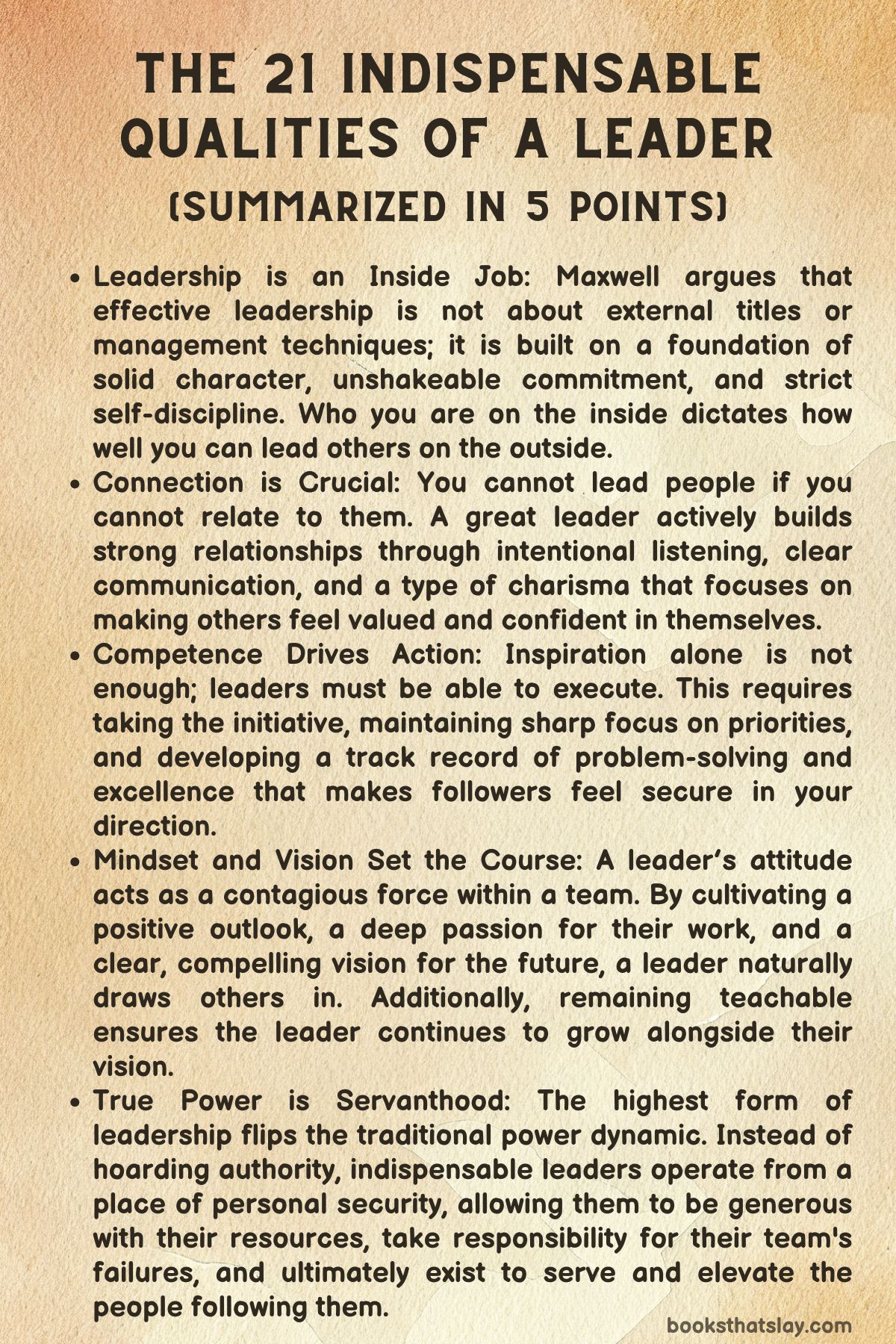
The 21 Indispensable Qualities are –
- Character: Be a Piece of the Rock. Leadership is built on trust, and true character is what inspires confidence in your followers.
- Charisma: The First Impression Can Seal the Deal. Charisma isn’t just about charm; it’s about making others feel good about themselves.
- Commitment: It Separates Doers from Dreamers. People do not follow uncommitted leaders. Commitment always precedes achievement.
- Communication: Without It You Travel Alone. If you can’t get a message across clearly and motivate others to act on it, having a message doesn’t matter.
- Competence: If You Build It, They Will Come. Cultivate a track record of excellence. Show up, keep learning, and execute your plans well.
- Courage: One Person with Courage Is a Majority. Courage isn’t the absence of fear, but doing what is right despite the fear.
- Discernment: Put an End to Unsolved Mysteries. This is the ability to find the root of a matter, relying on intuition as well as rational thought.
- Focus: The Sharper It Is, the Sharper You Are. Know your priorities and concentrate your energy on your strengths rather than trying to do everything.
- Generosity: Your Candle Loses Nothing When It Lights Another. Effective leaders put others first and freely share their time, resources, and credit.
- Initiative: You Won’t Leave Home Without It. Leaders don’t wait for things to happen; they step up and make things happen.
- Listening: To Connect with Their Hearts, Use Your Ears. A good leader encourages followers to tell them what they need to know, not just what they want to hear.
- Passion: Take This Life and Love It. Passion gives you energy. If you look at great leaders, you will find they are deeply passionate about what they do.
- Positive Attitude: If You Believe You Can, You Can. Your attitude determines your actions, and your people act as a mirror of your attitude.
- Problem Solving: You Can’t Let Your Problems Be a Problem. You can measure a leader by the problems they tackle—they always look for ones their own size.
- Relationships: If You Get Along, They’ll Go Along. The ability to work with people and develop relationships is absolutely indispensable to effective leadership.
- Responsibility: If You Won’t Carry the Ball, You Can’t Lead the Team. Good leaders take responsibility for both the successes and the failures of their team.
- Security: Competence Never Compensates for Insecurity. Insecure leaders are continually seeking validation and are often threatened by the success of their own team members.
- Self-Discipline: The First Person You Lead Is You. If you cannot lead yourself effectively, you will never be able to lead others.
- Servanthood: To Get Ahead, Put Others First. True leadership isn’t about gaining power; it’s about serving the people who follow you.
- Teachability: To Keep Leading, Keep Learning. The day you stop growing is the day you forfeit your potential to lead.
- Vision: You Can Seize Only What You Can See. Vision leads the leader. It paints the target, sparks the fire, and drives everything a leader does.
The first quality Maxwell emphasizes is character. He argues that character is the base that holds everything else up.
Talent can draw attention, but character sustains trust. To show what this looks like, he highlights Bill Lear, the inventor associated with the Learjet.
When Lear faced repeated crashes that pointed to a serious defect, he chose the hard route: he grounded the planes, put safety ahead of profit, and personally flew to recreate dangerous conditions so the issue could be understood. The decision cost him money and reputation for a time, but it protected lives and demonstrated integrity.
Maxwell’s point is that character is revealed through actions under pressure, especially when the “easy” option is to hide, delay, or excuse. He also warns that success can magnify character problems, pointing to patterns like arrogance, isolation, reckless behavior, and unfaithfulness as signs that a leader’s internal life is out of alignment.
He urges readers to identify ethical weak spots, make amends where needed, and build systems that help them choose integrity consistently.
From there, Maxwell shifts to charisma, which he defines as the ability to attract people by making them feel valued. He contrasts two political figures to show that charisma is not about displaying intelligence or importance, but about increasing others’ sense of worth.
In Maxwell’s framing, charisma grows when a leader brings energy to life, expects the best in people, offers hope, and shares themselves generously. He also names common barriers—pride, insecurity, moodiness, perfectionism, and cynicism—that push people away.
The guiding idea is “other-mindedness”: the leader pays attention to others first. Charisma, in this sense, is not performance; it is a relational habit.
Commitment follows as the dividing line between intention and achievement. Maxwell uses Michelangelo’s work on the Sistine Chapel ceiling to show what full commitment looks like.
Michelangelo did not want the assignment, and the work demanded physical strain and years of sustained effort, yet he pursued excellence even in details few would notice. Maxwell argues that commitment begins internally and becomes visible in consistent action.
He categorizes people into types: those who avoid commitment, those who hesitate out of fear, those who quit when it becomes difficult, and those who stay with it regardless of obstacles. He pushes readers to look at how they spend their time and money, because those patterns reveal true commitments better than stated goals.
Communication is presented as the bridge between a leader’s intentions and a follower’s action. Maxwell highlights Ronald Reagan as an example of someone who connected with large audiences through simple language and clear themes.
The lesson is not about fame, but about clarity and credibility. Maxwell outlines principles: simplify the message, understand the audience, live what you say so people trust it, and aim for action rather than information alone.
He treats communication as the tool leaders use to create shared direction, because without it, leaders cannot mobilize others and often end up isolated.
Competence is next, and Maxwell argues it creates credibility. He uses Benjamin Franklin to show how consistent skill and reliability can expand influence far beyond someone’s starting position.
Competence, for Maxwell, includes preparation, continuous improvement, follow-through, exceeding expectations, and raising the performance of others. He suggests that people respect leaders who deliver consistently, especially when it matters.
Competence also supports confidence, because it reduces the gap between what a leader claims and what a leader can actually do.
Courage is described as acting despite fear, and Maxwell frames it as essential for leadership because leaders must make decisions that involve risk, conflict, and uncertainty. He shares the story of Eddie Rickenbacker, who demonstrated courage both in wartime and later in business leadership, taking stands and pushing through resistance.
Maxwell also points to moral courage, using Martin Luther King Jr. as an example of choosing principle over comfort. His argument is that courage begins inside the person, then becomes visible in decisions and behavior.
When leaders show courage, they also strengthen the courage of the group.
Discernment is Maxwell’s word for seeing the real issue beneath surface noise. He describes it as a blend of intuition and thinking that helps leaders identify root causes, evaluate options, and act at the right time.
He uses Marie Curie as an example of remarkable scientific discernment, while also noting how poor judgment about safety harmed her health. He also references leaders and organizations that misjudged situations due to overconfidence or limited thinking.
Maxwell’s practical message is that discernment improves when leaders learn their strengths, pay attention to patterns, and balance instinct with analysis.
Focus is then framed as the ability to direct energy toward what matters most. Maxwell uses Tony Gwynn’s career to show the results of concentrating on a core strength instead of chasing every possible improvement.
Gwynn chose mastery in hitting rather than trying to be elite in every aspect of baseball, and his results reflected that decision. Maxwell suggests a time allocation model that favors strengths heavily, encourages growth in areas connected to those strengths, and minimizes attention on weaknesses by delegating where possible.
His overall point is that leadership grows sharper when priorities become clearer and distractions lose power.
Generosity comes next, described as giving that lifts others. Maxwell profiles Elisabeth Elliott, who continued serving even after personal tragedy, and uses her story to highlight giving that is not limited to money.
He critiques the mindset of holding tightly to possessions and status, arguing that leaders who give freely create stronger relationships and broader impact. The practical direction is to start small: build the habit of giving in ordinary ways, because leadership influence increases when others experience a leader’s willingness to share time, attention, support, and resources.
Initiative is presented as the quality that turns ideas into reality. Maxwell uses Kemmons Wilson, founder of Holiday Inn, to show how a person can notice a problem, imagine a better standard, and act decisively.
Wilson’s story demonstrates a pattern: he saw unmet needs, took risks, and moved quickly to build something better rather than waiting for someone else to solve it. Maxwell defines initiative as clarity of goals, self-motivation, willingness to take risks, and persistence through obstacles.
Listening is described as a major connector between leader and people. Maxwell uses Oprah Winfrey’s career to show how listening helps a leader understand audiences and teams, leading to better decisions and stronger loyalty.
He argues that leaders should listen to followers, customers, competitors, and mentors, because each group offers information a leader needs. He also emphasizes listening for emotional meaning, not just words, since feelings often drive behavior more than logic does.
Passion, in Maxwell’s view, is the internal fuel that makes leaders resilient and influential. He uses the example of John Schnatter and his hands-on dedication to his business to show how passion can shape culture and performance.
Passion initiates action, strengthens persistence, increases productivity, and can make ambitious goals achievable. Maxwell suggests that people respond to leaders who clearly care, because passion signals commitment and confidence.
Positive attitude is then framed as a choice that shapes outcomes. Maxwell highlights Thomas Edison’s ability to treat failure as learning and continue experimenting without losing hope.
He also points to Viktor Frankl’s belief that a person’s attitude remains a final freedom even in harsh conditions. Maxwell argues attitude influences actions and that leaders attract people who reflect their outlook.
The practical message is to guard attitude before it collapses, because rebuilding it later takes more effort than maintaining it through daily choices.
Problem solving is presented as the leader’s normal work, not a rare event. Maxwell uses Sam Walton’s responses to competition and changing markets to show how leaders adapt rather than complain.
He describes effective problem solvers as people who anticipate challenges, accept reality, keep perspective, tackle issues one at a time, and avoid major decisions at emotional low points. He also offers a structured approach to working through problems using time, exposure, assistance, creativity, and direct action.
Relationships are described as central because leadership is influence, and influence travels through connection. Maxwell uses William Osler to show how compassion and personal care strengthen professional excellence.
He emphasizes that people want to feel valued, need encouragement, and respond when leaders address what matters to them. Strong relationships require understanding people, genuinely caring, and offering help rather than treating others as tools.
Responsibility is framed as ownership. Maxwell uses the story of the Alamo defenders, including James Bonham’s return despite knowing reinforcements were not coming, to illustrate choosing duty over comfort.
He argues that leaders refuse victim thinking and instead accept accountability for actions and outcomes. Responsible leaders work hard, go beyond formal duties, pursue excellence, and find ways to deliver results even when circumstances are difficult.
Security is presented as confidence without arrogance. Maxwell uses Margaret Thatcher as an example of someone who withstood criticism and remained steady in conviction.
He warns that insecure leaders limit others because they feel threatened by talent, take credit, and create instability. Secure leaders can celebrate others, admit weaknesses, and build strong teams.
Maxwell recommends self-knowledge, feedback, and intentional habits of giving credit as ways to strengthen security.
Self-discipline follows as the ability to lead oneself before leading others. Maxwell uses Jerry Rice’s training habits and persistence to show how discipline turns potential into performance.
Discipline is shown through priorities, routines, refusal to make excuses, delaying rewards until work is done, and keeping attention on results. The larger idea is that leadership consistency depends on personal consistency.
Servanthood is presented as putting others first. Maxwell shares General Norman Schwarzkopf’s act of rescuing a wounded soldier in a minefield to illustrate service that is not about image, but about genuine concern.
He argues that service comes from security and love, not from weakness. Servant leaders take initiative to help, ignore rank when people need support, and serve without hidden motives.
Teachability is described as staying open to growth. Maxwell points to Charlie Chaplin’s careful study of audience reactions even after fame, showing that learning does not stop when success arrives.
He warns against “destination thinking,” where people believe achievement means they no longer need to grow. Teachability requires humility, rejecting shortcuts, learning from mistakes, and staying curious.
Finally, vision is presented as the quality that gives direction and draws people in. Maxwell uses Walt Disney’s observations at an amusement park to show how dissatisfaction with small flaws can spark a bigger picture, leading to a new standard.
Vision, in this view, starts inside a person’s gifts and desires, draws from life experience, aims to add value to others, and attracts resources and people. Maxwell describes different “voices” that shape vision, including inner purpose, dissatisfaction with current reality, guidance from successful people, and a higher perspective that lifts vision beyond self-interest.
In closing, Maxwell returns to the idea that leadership development is never finished. He encourages readers to revisit the qualities regularly, assess progress, and build a personal growth plan through learning resources and mentorship.
The overall arc of the book is clear: leadership becomes stronger as a person becomes stronger, and the most reliable path to influence is steady growth in the qualities that others can trust and respect.
Key People
John C. Maxwell
As the author-narrator of The 21 Indispensable Qualities of a Leader, Maxwell functions like a guide rather than a traditional character in a story. His “character” is revealed through the voice he uses: confident, instructive, and strongly values-based.
He presents leadership as a moral and personal craft, not a status symbol, and he consistently pushes the reader toward self-examination rather than blame or excuses. Maxwell’s role is also that of a curator—he selects examples from history, business, sports, politics, entertainment, and faith-based life to support his argument, and the choices he makes show what he respects: integrity, persistence, personal responsibility, and influence built through service.
His worldview is deeply action-oriented; he measures growth by what a person repeatedly does, not by what they intend. At the same time, he’s not neutral.
He interprets each example through a specific lens—character first, personal agency always—which shapes how every figure in the book is framed and what lessons are drawn from them.
Bill Freeman
Bill Freeman appears as the practical model of the reader Maxwell hopes to create: someone who treats leadership as a daily discipline instead of an abstract idea. His defining trait is consistency.
He studies leadership intentionally, applies it to himself first, then observes its impact on his colleagues and organization. Freeman is important because he embodies the method of the book—slow learning, reflection, and real-world application—and he represents the kind of person who believes improvement is measurable through habits.
He is not presented as a heroic genius; he’s presented as someone willing to do steady, repetitive work. That makes him a quiet counterweight to the larger-than-life historical figures in the book, because his example suggests that leadership growth is accessible to ordinary professionals who choose to practice it.
Bill Lear
Bill Lear is used to represent integrity under pressure, and his role is to show what character looks like when it costs something. His defining moment is his response to crisis: when his aircraft faced deadly failures, he chose transparency and responsibility over protecting his brand.
He accepts short-term damage and financial pain to prevent further harm, and he personally takes on risk to understand the problem. In Maxwell’s framing, Lear is the kind of leader whose moral center does not shift based on public relations needs.
He’s also portrayed as someone who understands that trust is a long-term asset and that safety and honesty are leadership duties, not optional virtues. Lear’s example carries an underlying message about courage tied to ethics: leadership is tested most when the easy path is available and the right path is expensive.
Stephen Berglas
Stephen Berglas appears as the psychologist whose concept of the “success syndrome” supports Maxwell’s warning that achievement can expose and intensify inner weakness. His “character” in the book is analytical and diagnostic, functioning as the voice of professional caution.
He represents the idea that leadership failure is often less about skill and more about unmanaged ego, isolation, and entitlement. Maxwell uses him to validate the claim that character gaps can destroy careers, relationships, and credibility, especially when power increases access and temptation.
Berglas is not developed personally, but his presence widens the book’s tone: it is not only encouragement; it is also a warning that internal decline can happen quietly while external success rises.
William Gladstone
William Gladstone is presented as the example of a leader who impresses people with intelligence and seriousness, but does not necessarily make them feel seen. He stands for a model of influence rooted in intellect and moral certainty—effective in its own way, but limited in personal warmth.
In Maxwell’s use, Gladstone becomes a contrast figure: he is not attacked, but he is framed as someone whose presence can leave others feeling smaller. His “character function” is to show that ability and accomplishment are not the same as interpersonal magnetism.
Gladstone represents the type of leader who may earn respect but not deep personal loyalty.
Benjamin Disraeli
Benjamin Disraeli serves as Gladstone’s counterpart and as Maxwell’s preferred model of charisma. He is defined by the way people feel around him: valued, capable, and important.
Disraeli’s role is to show that charisma is less about dominating a room and more about giving others dignity. In this framing, Disraeli is strategic in the healthiest sense—he understands human nature and chooses to invest attention outward.
Maxwell positions him as proof that leaders gain followership when they raise others’ confidence rather than compete for admiration. Disraeli becomes the embodiment of “other-mindedness,” the habit of paying attention to people as people.
Michelangelo
Michelangelo is presented as the symbol of total commitment, and his character is built around endurance, excellence, and an almost stubborn responsibility to the work itself. He accepts a task outside his preferred identity, suffers physically through the process, and still chooses to go beyond minimum expectations.
Maxwell highlights the detail that even unseen corners receive attention, which turns Michelangelo into a model of private standards—what someone does when recognition is unlikely. His role is to show that commitment is proven through sacrifice and consistency, not motivation or inspiration.
In Maxwell’s lens, Michelangelo becomes the personification of “finish what you start, and finish it well,” even when the work is painful and progress is slow.
Pope Julius II
Pope Julius II functions as the external force that creates the challenge Michelangelo must respond to. He represents authority, pressure, and the reality that leaders (and future leaders) often face assignments they did not choose.
In the book’s logic, Julius II matters less as a complex personality and more as a catalyst: he triggers the test that reveals Michelangelo’s commitment. As a character symbol, he stands for the demanding environment that can either break a person’s discipline or sharpen it.
His presence supports Maxwell’s point that commitment is often formed when someone is pushed beyond comfort.
Thomas Edison
Thomas Edison is presented as the model of positive attitude joined with persistence. The key trait Maxwell draws from him is the ability to treat failure as information rather than humiliation.
Edison’s optimism is not described as naive happiness, but as a functional mindset that keeps effort alive. Even when faced with massive setbacks, he is framed as someone who immediately looks for the next constructive step.
Edison’s role is to show how a leader’s emotional posture affects outcomes: teams, experiments, and organizations move forward when the person at the center refuses to collapse into defeat. In Maxwell’s portrayal, Edison is also an example of reframing—changing the meaning of difficulty so it becomes fuel rather than a wall.
Viktor Frankl
Viktor Frankl appears as the proof that attitude can remain a choice even when circumstances are brutal. His character in the book is defined by inner freedom, meaning-making, and psychological resilience.
Maxwell uses him to argue that leaders cannot surrender responsibility for their mindset to external events. Frankl’s role broadens the lesson beyond business and achievement; it brings the discussion into the realm of human dignity.
He becomes the moral authority for Maxwell’s claim that leadership begins with self-leadership, because a leader’s inner life shapes their outward impact even when conditions are unfair or harsh.
Ronald Reagan
Ronald Reagan represents clarity in communication and the ability to connect with broad audiences through simplicity and conviction. Maxwell’s use of Reagan centers on the idea that leaders must translate complex ideas into language people can carry with them.
Reagan’s character in this context is approachable and focused on message discipline. He stands for the skill of turning leadership into shared meaning, where people feel they understand the direction and can repeat it to others.
Maxwell frames him as someone whose credibility and consistency made his words more persuasive, reinforcing the theme that communication works best when it matches the leader’s actions and confidence.
Benjamin Franklin
Benjamin Franklin functions as the model of competence—capable across multiple domains and respected because he produces results. His defining trait in Maxwell’s telling is continuous improvement: he learns, experiments, builds systems, and earns influence through reliability rather than birthright.
Franklin represents the leader whose credibility is earned through performance and preparation. Maxwell’s framing also casts him as adaptable; he moves between roles and environments without losing effectiveness, suggesting that competence includes learning how to operate with different kinds of people.
Franklin supports the idea that excellence creates trust, and trust creates influence.
Eddie Rickenbacker
Eddie Rickenbacker is used as a portrait of courage that includes both personal risk and public conviction. Maxwell presents him as someone who repeatedly chooses action when fear and obstacles would justify hesitation.
His courage is not limited to a single arena; it appears in war, business, and conflict with powerful voices. That range matters because it shows courage as a transferable quality, not a single dramatic moment.
In Maxwell’s portrayal, Rickenbacker also represents initiative joined with backbone: he is willing to push forward, and he is willing to stand firm when others disagree. His presence reinforces the idea that courage expands a leader’s possibilities while fear narrows them.
Martin Luther King Jr.
Martin Luther King Jr. appears as the example of moral courage and principled leadership. His character function is to show that leadership often requires choosing what is right over what is safe or popular.
Maxwell uses him to connect courage to values—courage is not only about risk-taking; it is also about refusing to compromise on core beliefs. King’s presence strengthens Maxwell’s recurring message that influence grows when people trust a leader’s integrity.
He represents the leader whose conviction inspires others to act because they believe the cause is bigger than personal comfort.
Marie Curie
Marie Curie is presented as a figure of exceptional discernment in scientific work, paired with a tragic limitation in personal judgment about safety. This dual portrayal is important: Maxwell uses her to show that a person can be brilliant in one area and still miss key truths in another.
Curie’s character is defined by persistence, focus, and analytical power, but her story also serves as a warning about blind spots—especially for high achievers who believe their strength in one domain protects them in all domains. In Maxwell’s framing, Curie represents both the height of insight and the cost of neglected discernment, making her a complex example rather than a purely celebratory one.
Napoleon Bonaparte
Napoleon functions as an example of failed discernment caused by overconfidence and miscalculation. He represents the leader whose belief in personal greatness becomes a weakness when it blocks accurate reading of reality.
In Maxwell’s use, Napoleon is the cautionary figure who shows that experience and past victories can create false certainty. His presence reinforces the message that discernment requires humility and ongoing evaluation, because relying on reputation or momentum can lead to mistakes with lasting consequences.
IBM
IBM appears not as an individual character but as an institutional example of poor discernment, used to show that even large, successful organizations can misread the future. In the book’s logic, IBM represents the danger of assuming present success guarantees accurate forecasting.
It functions as a reminder that leadership judgment must remain flexible and alert, because confidence built on past dominance can slow adaptation. As an organizational “character,” IBM stands for the limits of authority and scale when vision and discernment lag behind change.
Tony Gwynn
Tony Gwynn is presented as the model of focus through disciplined specialization. His defining trait is choosing a priority and then building daily habits around it rather than scattering effort.
Maxwell portrays him as someone who studies, practices, refines, and seeks coaching to sharpen one core strength. Gwynn’s character supports the idea that success often comes from saying no to distractions, even when those distractions are appealing opportunities to be “well-rounded.” He represents the leader who becomes exceptional by concentrating effort where it produces the highest return.
Ted Williams
Ted Williams appears as a source of expertise and mentorship in Gwynn’s development. His character role is that of the seasoned master whose knowledge can speed another person’s growth.
He represents teachability from a different angle: not the learner, but the resource the learner seeks. In Maxwell’s framework, Williams shows how excellence often grows through guidance, and how focused people actively look for wisdom rather than pretending they already know enough.
Elisabeth Elliott
Elisabeth Elliott is used as the primary example of generosity expressed through sacrificial service. Maxwell portrays her as someone whose giving is rooted in commitment to others rather than comfort or recognition.
Her defining trait is persistence in serving even after deep personal loss, which Maxwell interprets as proof that generosity is a posture, not a mood. In the book’s framing, she represents giving that costs something—time, safety, and emotional weight—making generosity more than a financial topic.
She also embodies forgiveness and long-term dedication, reinforcing Maxwell’s belief that leadership influence expands when leaders consistently add value to others.
Jim Elliott
Jim Elliott appears mainly through the impact of his death on Elisabeth Elliott’s story. His character function is to represent risk, conviction, and the personal cost that sometimes accompanies service-focused work.
While he is not developed in detail, his presence increases the intensity of the generosity example by showing that leadership and service can involve irreversible consequences. In Maxwell’s presentation, Jim functions as part of the moral context that frames Elisabeth’s ongoing choices.
Kemmons Wilson
Kemmons Wilson is portrayed as the embodiment of initiative—seeing a problem, imagining a better standard, and taking action quickly. His defining trait is refusal to stay in complaint mode.
He experiences a frustrating travel situation, identifies a gap in the market, and commits resources to solve it. Maxwell also frames him as someone with lifelong drive, suggesting that initiative is not occasional but habitual.
Wilson represents the leader who starts before conditions are perfect, accepts risk, and keeps moving. He also illustrates how initiative can create systems that improve life for others, not just personal success.
Oprah Winfrey
Oprah Winfrey is used to demonstrate the leadership power of listening. Maxwell presents her as someone whose influence grew not only because she could speak well, but because she learned how to hear what mattered to people.
Her key trait in this analysis is curiosity paired with respect—she pays attention, gathers insight, and uses what she learns to shape better decisions. Maxwell highlights her willingness to seek input from her team, which frames her as a leader who does not treat authority as permission to ignore others.
Oprah’s character supports the idea that listening is not passive; it is strategic care that strengthens trust and increases accuracy.
Peter Drucker
Peter Drucker appears as the expert voice who reinforces the importance of communication and listening in organizational life. His “character” function is credibility—he represents researched wisdom rather than storytelling.
Maxwell uses him to underline that many leadership problems are not technical failures but communication failures. Drucker’s presence positions the book’s relational advice as practical, not sentimental.
He stands for the idea that leadership effectiveness often depends on how well information and meaning move between people.
John Schnatter
John Schnatter is used as a picture of passion expressed through hands-on involvement. Maxwell portrays him as someone deeply engaged with the daily realities of his business rather than detached by status.
His defining trait is personal investment—showing up, paying attention, and being willing to work alongside others when needed. In Maxwell’s framing, Schnatter represents how passion creates energy that spreads: it raises standards, strengthens culture, and keeps a leader connected to what customers and employees actually experience.
He is used to argue that passion is not just emotion; it is sustained attention and effort.
Sam Walton
Sam Walton is presented as the model problem solver who adapts to change instead of resisting it. Maxwell frames Walton as practical, observant, and willing to learn from competitors and market shifts.
When faced with the rise of discount retail, Walton chooses study and action, building systems that solve new problems as the business grows. His defining trait is forward motion through obstacles—he treats problems as normal and responds with creativity and persistence.
Walton represents the leader who does not take challenges personally as insults, but treats them as signals that require better strategy.
Gene Tunney
Gene Tunney appears as an example of adaptation under limitation, showing problem solving through reinvention. After severe setbacks early in his career, he changes his style and becomes successful through technique rather than relying only on natural strengths.
Tunney’s character function is to demonstrate that leaders and achievers can adjust their approach when the old method no longer works. He supports Maxwell’s message that problem solving includes flexibility, learning, and willingness to change identity-level habits in order to keep progressing.
William Osler
William Osler is portrayed as the symbol of relationship-centered leadership grounded in compassion. Maxwell uses him to show that caring about people is not separate from excellence; it often makes excellence possible.
Osler’s defining trait is human respect—he treats patients and students as people first and professionals second. He represents the leader who builds strong communities through care and connection, not just through expertise.
In the book’s framework, Osler helps argue that leaders gain long-term influence when they value people as ends, not tools.
Margaret Thatcher
Margaret Thatcher is used to illustrate security—inner steadiness that allows a leader to stand firm without being ruled by approval or fear. Maxwell portrays her as resilient in environments hostile to her presence and ideas.
Her defining trait here is conviction maintained under criticism. She functions as an example of the leader who does not collapse into insecurity, and therefore does not need to control or diminish others to feel strong.
In Maxwell’s analysis, she also helps show that security allows perseverance, because leaders who trust their own grounding can withstand conflict without losing direction.
Jerry Rice
Jerry Rice is presented as the model of self-discipline turned into lifestyle. Maxwell’s portrayal emphasizes that greatness is built through training when no one is watching and commitment when shortcuts are available.
Rice’s defining trait is consistent effort across time, not occasional intensity. He represents the leader who keeps promises to themselves, and therefore earns credibility with others.
Rice’s story supports Maxwell’s claim that self-discipline protects talent from wasting away and turns potential into dependable performance.
General Norman Schwarzkopf
Norman Schwarzkopf is used as the example of servanthood shown through risk and priority. His defining moment is an act of rescue where personal safety becomes secondary to another person’s need.
Maxwell uses him to argue that service is not weakness; it is strength directed outward. Schwarzkopf represents the leader who sees rank and power as responsibility rather than entitlement.
In this framing, he stands for the idea that genuine leadership earns trust because people see that the leader’s concern is real, not performative.
Charlie Chaplin
Charlie Chaplin is presented as the model of teachability, especially after success. Maxwell frames him as someone who could have relied on fame and comfort but instead kept studying audience response and improving his craft.
Chaplin’s defining trait is humility expressed through learning—he does not treat achievement as proof that growth is finished. He represents the leader who stays curious and keeps refining, which Maxwell presents as essential because the world changes and yesterday’s strengths can become tomorrow’s limitations if learning stops.
Walt Disney
Walt Disney is used as the model of vision—seeing what could be better and building a clear picture of a new standard. Maxwell portrays Disney as intensely attentive to detail and deeply committed to the experience people have, not just the product itself.
His defining trait is imagination paired with standards: he notices what breaks the sense of wonder and then decides to create a place where those breaks are removed. Disney represents the leader who can name a destination clearly enough that others want to help build it.
In Maxwell’s framing, vision is not fantasy; it is a guiding picture that attracts people, resources, and energy because it offers direction and meaning.
Themes
Leadership as Inner Character Before Outer Authority
From its opening pages, The 21 Indispensable Qualities of a Leader frames leadership as a matter of inner formation rather than external position. Titles, strategies, and systems are presented as secondary to the moral and emotional structure of the individual.
The recurring emphasis on character, security, self-discipline, responsibility, and positive attitude reinforces the idea that leadership influence cannot rise above personal integrity. Maxwell’s approach assumes that behavior flows from identity; what a leader repeatedly does under pressure reflects who that leader is at the core.
This is why stories of crisis—such as grounding aircraft at financial cost or standing firm amid criticism—carry so much weight in the book. These moments test whether principles are negotiable or fixed.
The theme challenges a purely technical understanding of leadership. Instead of asking how to manage people more efficiently, Maxwell asks who the leader is becoming.
The distinction matters because it shifts attention from performance in public settings to habits formed in private. Self-discipline, for example, is described not as a tactic but as a lifestyle that determines long-term effectiveness.
Similarly, security is not confidence gained from applause; it is internal steadiness that allows leaders to celebrate others without fear. By linking effectiveness to integrity, Maxwell suggests that leadership collapses when internal character is unstable, no matter how polished the public image appears.
This theme also carries a moral dimension. Leadership is treated as stewardship, meaning that influence carries responsibility.
Character flaws are not merely personal weaknesses; they are risks to teams and organizations. Through repeated examples of both admirable and cautionary figures, Maxwell argues that the foundation of leadership is ethical consistency.
Authority may grant temporary compliance, but sustained followership depends on trust. In this way, the book positions leadership development as a lifelong commitment to internal growth, where personal transformation becomes the primary driver of public impact.
Influence Through Relationships and Other-Mindedness
Across its examples and qualities, the book consistently defines leadership as relational influence rather than positional control. Charisma, listening, relationships, servanthood, and generosity all point to the same underlying conviction: people follow leaders who make them feel valued.
The emphasis is not on manipulating emotions, but on genuine concern and attention. Maxwell repeatedly contrasts leaders who focus on displaying their own intelligence with those who elevate others.
The difference lies in where attention is directed. Leaders who prioritize others build loyalty because people sense authenticity and care.
This relational focus reframes power. Instead of presenting leadership as dominance, the book treats it as connection.
Listening becomes strategic because it allows leaders to understand fears, hopes, and motivations. Servanthood becomes strength because it signals that authority is used for the benefit of others, not personal elevation.
Even charisma is described not as charm for its own sake, but as the habit of increasing others’ confidence. Through these qualities, influence grows from trust, and trust grows from consistent relational investment.
The theme also reflects a broader shift in leadership thinking away from command-and-control models. Leaders are encouraged to move among people, learn from them, and share credit.
Relationship-building is portrayed not as optional softness, but as essential infrastructure for progress. When teams feel seen and respected, they are more willing to commit to shared goals.
Conversely, insecurity and pride weaken influence because they create distance and competition rather than unity.
At a deeper level, this theme suggests that leadership success cannot be separated from emotional intelligence. Understanding people’s needs, responding with empathy, and communicating clearly all require awareness beyond technical competence.
Maxwell’s repeated insistence that people want to feel valued reinforces the belief that leadership is human before it is strategic. Results matter, but relationships determine whether those results are sustainable.
Personal Responsibility and Intentional Growth
The narrative arc of the book consistently returns to personal accountability. Responsibility, commitment, initiative, teachability, and self-discipline are presented as choices available to every leader, regardless of circumstance.
Maxwell’s examples emphasize individuals who respond to obstacles with action rather than complaint. Whether adapting to market change, recovering from injury, or rebuilding after loss, these figures demonstrate a refusal to surrender control of their response.
The message is clear: leadership requires ownership of one’s development and outcomes.
This theme places significant weight on intentional growth. The reader is encouraged to examine habits, allocate time deliberately, seek mentors, and measure progress.
Growth is not accidental; it results from repeated decisions aligned with long-term priorities. Teachability becomes critical because success can create complacency.
By urging leaders to avoid “arrival thinking,” Maxwell argues that stagnation begins when learning stops. Leaders must remain students, open to correction and refinement, if they want to remain effective.
Responsibility also extends to attitude. The book frames mindset as a conscious choice rather than a reaction dictated by circumstances.
This reinforces the belief that internal discipline shapes external results. Even when facing setbacks, leaders are portrayed as capable of choosing optimism, creativity, and persistence.
The focus is less on eliminating difficulty and more on strengthening response. By centering agency, Maxwell offers an empowering but demanding vision: excuses erode influence, while ownership strengthens it.
At the organizational level, this theme implies that culture begins with the leader’s example. When leaders demonstrate initiative and accountability, those traits tend to replicate in teams.
Conversely, when leaders avoid responsibility, blame spreads downward. Personal growth is therefore not private self-improvement; it is the seed of collective performance.
The book’s emphasis on consistent effort reinforces the idea that leadership maturity develops gradually through disciplined action.
Vision and Direction as the Magnet of Leadership
Vision operates as the forward-facing dimension of leadership, giving shape and meaning to effort. Throughout the book, leaders who succeed are those who see beyond current conditions and articulate a compelling destination.
Vision is portrayed not as abstract dreaming but as clarity about what should exist and why it matters. The example of creating a better amusement experience illustrates how dissatisfaction with the present can generate constructive imagination.
Vision transforms frustration into design.
This theme connects closely with passion and focus. Passion fuels the emotional energy required to pursue a vision, while focus directs resources toward it.
Without vision, energy scatters and commitment weakens. With vision, effort gains coherence.
Maxwell suggests that people commit more deeply when they understand the destination and believe it benefits them as well as the leader. Vision therefore acts as a unifying force, aligning individual contributions around a shared picture of the future.
The book also frames vision as emerging from internal conviction and personal experience rather than external pressure. Leaders are encouraged to listen to inner motivation, dissatisfaction with the status quo, guidance from mentors, and broader spiritual or moral perspectives.
This layered approach implies that vision is both personal and outward-looking. It grows from who the leader is but extends to serve others.
Importantly, vision is not treated as static. It requires communication, reinforcement, and adaptation.
Leaders must articulate it clearly enough that others can repeat it and act on it. When vision remains vague, teams struggle to coordinate.
When it is vivid and specific, it attracts talent and resources. In this way, vision becomes the bridge between internal character and external achievement.
It channels integrity, relationships, responsibility, and passion toward a defined goal, giving leadership both direction and momentum.