The 21 Irrefutable Laws of Leadership Summary and Analysis
The 21 Irrefutable Laws of Leadership: Follow Them and People Will Follow You by John C. Maxwell is a practical leadership handbook built around a simple claim: leadership is not a title, it’s influence, and it can be learned. Maxwell lays out 21 “laws” that describe what effective leaders do, why their impact grows or stalls, and how their choices shape teams and outcomes.
Instead of abstract theory, he leans on stories from business, politics, sports, and his own career to show how trust is earned, momentum is created, priorities are set, and leaders are developed. The book reads like a field guide for anyone who wants to lead with clarity and consistency.
The Laws
Here are the 21 laws outlined in the book.
- The Law of the Lid: Leadership ability is the “lid” that determines a person’s level of effectiveness. Your impact is capped by your leadership skills.
- The Law of Influence: The true measure of leadership is influence—nothing more, nothing less. If you don’t have influence, you will never be able to lead others.
- The Law of Process: Leadership develops daily, not in a day. It requires a lifetime of learning, growth, and practice.
- The Law of Navigation: Anyone can steer the ship, but it takes a leader to chart the course. Leaders anticipate obstacles and plan the route ahead.
- The Law of Addition: Leaders add value by serving others. True leadership is about making things better for the people following you.
- The Law of Solid Ground: Trust is the foundation of leadership. You build trust through consistent character, competence, and connection.
- The Law of Respect: People naturally follow leaders stronger than themselves.
- The Law of Intuition: Leaders evaluate everything with a leadership bias. They read situations, trends, and people through the lens of leadership.
- The Law of Magnetism: Who you are is who you attract. You will draw people to your team who possess similar qualities and values to your own.
- The Law of Connection: Leaders touch a heart before they ask for a hand. You have to connect with people on an emotional level before trying to move them into action.
- The Law of the Inner Circle: A leader’s potential is determined by those closest to them. Surround yourself with excellent people to elevate your own capacity.
- The Law of Empowerment: Only secure leaders give power to others. Great leaders build others up and give them the authority to succeed.
- The Law of the Picture: People do what people see. Leaders must model the behavior, work ethic, and values they want to see in their followers.
- The Law of Buy-In: People buy into the leader, then the vision. If they don’t believe in the messenger, they won’t believe the message.
- The Law of Victory: Leaders find a way for the team to win. They do whatever it takes (ethically) to achieve success, refusing to accept defeat.
- The Law of the Big Mo: Momentum is a leader’s best friend. When you have momentum, obstacles seem smaller, and success becomes easier to achieve.
- The Law of Priorities: Leaders understand that activity is not necessarily accomplishment. They focus on the tasks that yield the highest return.
- The Law of Sacrifice: A leader must give up to go up. Leadership requires sacrificing personal rights, time, and sometimes comfort for the sake of the team.
- The Law of Timing: When to lead is as important as what to do and where to go. The right action at the wrong time brings resistance; the right action at the right time brings success.
- The Law of Explosive Growth: To add growth, lead followers—to multiply, lead leaders. Developing other leaders scales your impact exponentially.
- The Law of Legacy: A leader’s lasting value is measured by succession. True success is leaving behind an organization that can thrive without you.
Summary
The book opens by defining a core idea: leadership effectiveness has a ceiling, and that ceiling determines how far a person or organization can go. Maxwell calls this the “lid.” A leader can work hard and have good intentions, but if their leadership capacity is limited, growth will stall at a predictable point.
He illustrates this through the early history of McDonald’s. The McDonald brothers built an efficient operation and created a system that worked, but their ability to scale the brand stopped short.
Ray Kroc saw what was possible, took significant personal risks, and built the team and structure needed for large expansion. The contrast shows Maxwell’s point: organizations don’t rise above the leadership strength at the top, and the quickest way to change results is often to raise leadership capacity.
From there, Maxwell argues that leadership is not the same as holding authority. Leadership, at its most basic level, is influence—getting people to choose to move in a direction.
Titles can create compliance, but they don’t automatically create commitment. He challenges common misunderstandings, such as the belief that management equals leadership, or that being the first person to do something makes a person a leader.
In Maxwell’s view, a leader’s proof is visible in one place: do people actually follow? He suggests a simple test—try leading volunteers.
Without paychecks or formal leverage, influence has to be earned through trust, clarity, and connection.
Maxwell then shifts to how leaders are formed. Leadership is not a switch that flips overnight; it’s built through steady development.
He uses examples of people who improved through long-term discipline and learning, showing that growth compounds when someone sticks with it. The main point is that leadership ability can be developed, but it requires intention—reading, learning from others, practicing skills, and reflecting on outcomes.
The leader who improves a little every day ends up far ahead of the person who relies on talent or position alone.
A major section of the book focuses on planning and direction. Maxwell argues that leaders must be able to “navigate”—to set a course before asking others to move.
He contrasts two polar expeditions where preparation, equipment choices, and planning made the difference between success and disaster. The principle is that courage alone cannot replace research, foresight, and structured planning.
Leaders gather information, listen to others, weigh risks, and then commit. Maxwell even offers a simple planning checklist that stresses setting goals, adjusting priorities, notifying key people, allowing time for buy-in, anticipating problems, and reviewing the plan regularly.
Next, Maxwell explains that leadership is not about extracting value from people; it is about adding value to them. A leader’s responsibility is to serve in a way that improves the lives and performance of those they lead.
He contrasts leaders who raise the level of everyone around them with leaders who drain energy, take credit, or create stress through selfishness and poor habits. He asks a direct question: are you making things better for the people who follow you?
He believes long-term influence depends on consistently choosing actions that help others succeed, and he describes practical habits like valuing people, finding ways to be useful, and learning what others care about.
Trust becomes the next foundation. Maxwell argues that leadership stands on “solid ground,” meaning character and credibility.
People may forgive some mistakes in judgment, but repeated poor decisions or flaws in integrity reduce confidence. He uses his own experience of making abrupt changes without proper communication, showing how quickly trust can weaken when people feel ignored or blindsided.
Trust is built through consistency, humility, and the willingness to admit mistakes and correct them. For Maxwell, character is not an optional leadership accessory—it is the base that holds everything else up.
Respect is another key element. People tend to follow leaders they believe are stronger leaders than they are, and they often choose mentors and guides they admire.
Maxwell illustrates this with Harriet Tubman, whose personal courage and leadership strength earned the loyalty of people who had every reason to be afraid. The broader point is that leadership ability draws leadership attention; higher-caliber people prefer to follow someone they trust to lead well.
Respect can come from competence, courage, success, loyalty, and a track record of adding value, but it has to be real. If a leader cannot earn respect, their influence stays limited.
Maxwell then introduces intuition as a leadership advantage. He describes it as a form of practical awareness—a leader’s ability to read situations, sense momentum, understand people, and recognize the real issue beneath the surface.
This includes noticing team morale, organizational atmosphere, and patterns that numbers may not capture. He uses an example of a military leader who quickly turned around a struggling unit, emphasizing that leaders don’t only act on procedures—they act on what they notice and interpret in real time.
Maxwell believes intuition can be strengthened through preparation and experience, even if it comes more naturally to some people.
The book also discusses how leaders attract people who resemble them. Maxwell’s “magnetism” principle says that teams often become a mirror of the leader’s attitude, values, and habits.
If a leader wants energetic, disciplined, optimistic people, they need to embody those qualities themselves. If a leader is negative, inconsistent, or complacent, they tend to draw or tolerate the same traits.
Maxwell points out that hiring systems matter, but leadership character matters more because leaders set standards—both through what they praise and what they permit.
Connection becomes another major theme: people respond emotionally before they respond logically. Leaders who only offer facts and instructions often struggle to earn true commitment.
Maxwell contrasts different public leadership responses to national crises to show how presence and personal engagement shape public trust. He argues that leaders must communicate openly, know their audience, show belief in people, and offer hope and direction.
Importantly, he insists the leader must take the first step—waiting for followers to connect is a mistake. Connection is built when people feel seen and understood, not when they feel managed from a distance.
Maxwell then explains that leadership success depends heavily on the people closest to the leader—the “inner circle.” No leader can be excellent at everything, so progress depends on surrounding oneself with capable, trustworthy people who complement weaknesses and amplify strengths. Maxwell uses competitive cycling as an example of how support teams make elite performance possible.
He outlines what makes someone valuable in an inner circle: influence, complementary skills, strategic placement, value addition, and the ability to lift others around them. He also warns that leaders must be willing to improve their inner circle over time, even when it requires hard decisions, because the quality of the team limits the quality of the outcomes.
Empowerment follows naturally. Maxwell argues that insecure leaders hold people back, while secure leaders give people room to grow.
He uses examples from business leadership to show how refusing to listen, resisting change, or undermining talented colleagues can damage results. Empowering others requires confidence, a willingness to share credit, and the habit of building people up instead of protecting ego.
Maxwell presents empowerment as a multiplier: when capable people are trusted and developed, they solve problems, create value, and reduce dependency on the top leader.
A related principle is that leaders set the example. People pay attention to what leaders do more than what they say.
Maxwell shares a military story where a leader’s actions during danger motivated others to act. He frames this as leaders providing purpose, a clear picture of the goal, and a workable plan—but also living in a way that matches their message.
If a leader asks for discipline but behaves casually, or asks for integrity while cutting corners, the message collapses. Leadership lessons are absorbed through observation, and consistency between words and actions is what makes people trust the direction.
Maxwell then introduces buy-in: people accept the leader before they fully accept the plan. Even a strong idea can fail if the leader lacks credibility with the group.
He uses Gandhi as an example of a leader whose personal trustworthiness made people willing to accept a difficult path. Maxwell also shares his own experience of needing time to earn confidence in a new environment before changing direction.
The message is that timing and persuasion matter, but the messenger matters first. When trust is established, people become open to the vision.
The drive to win is another principle. Maxwell argues that effective leaders maintain a refusal to accept defeat as the final outcome.
He points to major historical leaders who persisted through intense pressure, and he focuses less on hero worship and more on what their persistence did: it created unity, maintained morale, and kept effort focused. He says victory depends on a shared vision, diverse skills across the organization, and a leader who keeps pushing forward while helping others contribute at their best.
Momentum is presented as a practical force that changes what people believe is possible. When momentum exists, tasks that once felt heavy become easier because people expect progress and can see results.
Maxwell uses a story of Pixar’s long build-up to show how steady development can eventually create a breakthrough and then rapid success. He also describes a teacher who turned a struggling school environment into a place of high academic achievement by building step-by-step wins that shifted expectations.
Maxwell’s point is that momentum does not appear by accident. Leaders create it by setting direction, building confidence, and turning small wins into larger ones.
Priorities come next: leaders must decide what matters most and keep revisiting those choices. Maxwell explains that many people stay busy but not effective because they do not focus on the activities with the biggest payoff.
He mentions the Pareto Principle as a way of thinking about return on effort and describes how he redesigned his own life around efficiency to reclaim large amounts of time. He also offers a simple framework: do what is required (what only you can do), focus on what gives the highest return, and choose work that brings strong personal reward, because sustained energy often comes from meaning and satisfaction.
Sacrifice is one of the hardest laws in the book: leadership progress requires giving something up. The higher the responsibility, the higher the cost.
Maxwell uses the example of Martin Luther King Jr. to show that leadership often involves risk, loss, and pressure that others may never experience. He also emphasizes that sacrifice is not a one-time event.
The moment a leader becomes comfortable and stops paying the price, growth slows. Leaders who want higher impact must accept that comfort is not the main goal.
Timing becomes a separate focus. Even correct decisions can fail if made at the wrong time.
Maxwell uses the delayed response around a major disaster as an example of how costly poor timing can be. He breaks timing into combinations: wrong action at the wrong time is disastrous, right action at the wrong time meets resistance, wrong action at the right time still creates poor outcomes, and right action at the right time gives the best chance of success.
Good timing depends on experience, preparation, intuition, confidence, and the ability to read people and conditions.
Maxwell then discusses growth at scale through developing leaders. Leading followers increases results, but leading leaders increases results far more because leaders create value independently and develop others in turn.
Maxwell explains how training leaders is harder than managing followers, because leaders want responsibility and growth, but the payoff is exponential. He describes how a nonprofit initiative aimed at developing leaders succeeded by building a structure where trained leaders were expected to train others, producing rapid multiplication.
The broader argument is that organizations that only focus on the lowest common denominator become slow and heavy, while organizations that invest in high-potential people create a pipeline of capability that keeps expanding.
The final law concerns legacy: what remains after a leader is gone. Maxwell argues that achievement without succession fades quickly.
Legacy is built when a leader knows what they want to be remembered for, lives it consistently, develops people who can carry it forward, and knows when to hand responsibility over. He reflects on how his own goals changed across different stages of life until he centered his work on adding value to leaders.
To illustrate legacy beyond personal fame, he contrasts organizations and movements that continue through developed leadership with the short shelf-life of recognition that fades when there is no succession plan. In Maxwell’s view, the highest form of leadership is not only reaching goals, but building others who can continue the work without you.
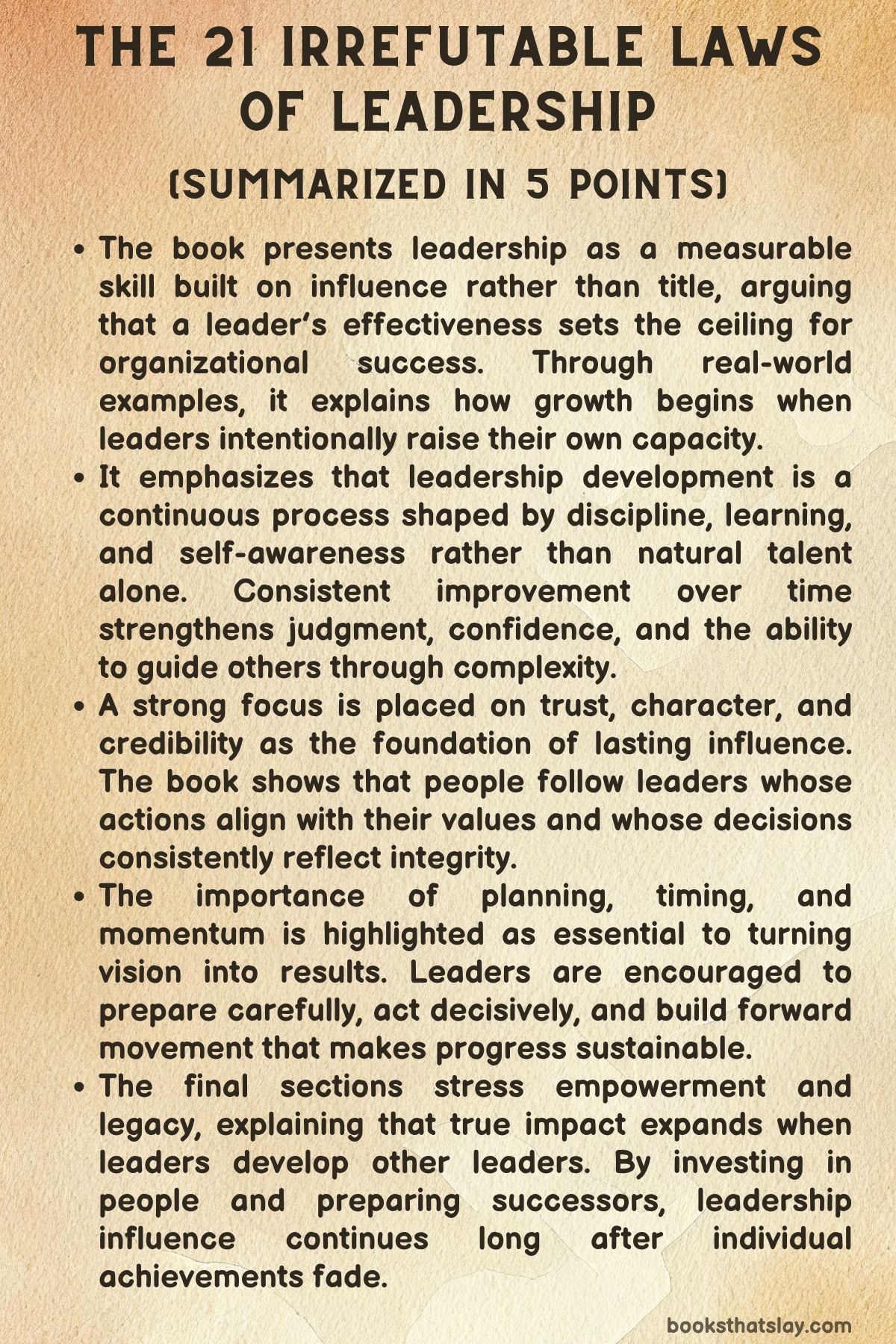
Across all 21 laws, the book’s main message stays consistent: leadership is measurable through influence, strengthened through character and discipline, multiplied through people development, and proven through results that outlast the leader’s presence.
Key People
John C. Maxwell
John C. Maxwell functions as both the author and the central “voice” guiding the reader. He presents himself as a seasoned leadership teacher who has learned through a mix of observation, professional experience, and personal mistakes.
His character on the page is confident but not distant; he repeatedly positions himself as someone who has had to grow, correct errors, and adjust his approach, especially when discussing trust, decision-making, and earning buy-in. He also comes across as intensely practical—someone who wants leadership to be measurable through results, follower response, and organizational health rather than through charisma or title.
At the same time, he is values-driven and places character at the center of credibility, returning often to integrity, responsibility, and service as the core tests of whether someone deserves influence.
Ray Kroc
Ray Kroc appears as the clearest example of a leader whose capacity raises the ceiling of an organization. In the narrative, he is portrayed as the figure who recognizes scale where others see stability and who is willing to accept discomfort to build something larger than himself.
His defining trait in the book is not inventiveness in the technical sense, but expansion-minded leadership: he identifies potential, gathers the right people, commits to long-term execution, and makes personal tradeoffs to create a system that can grow far beyond its origin. Maxwell frames Kroc as someone whose ambition is paired with endurance—he is willing to delay personal reward in order to build a structure and culture that can sustain massive growth.
Richard and Maurice McDonald
The McDonald brothers are presented as capable innovators and disciplined operators whose strengths lie in efficiency, process, and the design of a repeatable model. Their “character role” is not to be mocked or minimized; rather, they represent a leadership limit—people who can create something strong but cannot scale it into a global force because their leadership reach stops at a certain point.
Maxwell uses them to show that operational excellence and smart ideas do not automatically translate into broad influence. They function as an example of how a solid system still needs a leader with wider vision, stronger risk tolerance, and deeper people-building skills if it is to grow beyond its early success.
Maurice Saatchi
Maurice Saatchi is used to illustrate that leadership is proved by influence, not by position. His role is significant because he demonstrates followership that persists even after formal authority is removed.
When he is dismissed, others choose to leave with him, and the organization suffers, which in Maxwell’s framing shows that people were loyal to the leader rather than the title or the company structure. Saatchi’s character function is to embody a form of gravitational influence—he is a person whose presence has enough weight that it changes the behavior of peers and partners.
He represents the idea that real leadership can be measured by what happens when the leader is no longer “supposed” to be in charge.
Anne Scheiber
Anne Scheiber appears as a symbol of patience, discipline, and compounding growth. Maxwell uses her life not as an example of public leadership but as an example of long-term process: the habit of steady improvement and reinvestment over time.
In character terms, she represents the mindset of delayed gratification and consistency, showing how remarkable outcomes can come from sustained, repeated actions rather than dramatic one-time moves. Her function is to make leadership growth feel concrete: just as wealth can grow through compounding, leadership skill grows through repeated learning, practice, and persistence.
Theodore Roosevelt
Theodore Roosevelt is portrayed as the model of self-made capacity. Maxwell emphasizes his early weakness and deliberate effort to become stronger, using him to show that leadership is shaped by decision and discipline, not merely by natural advantage.
In the book’s character landscape, Roosevelt represents relentless self-improvement and the determination to expand personal limits. He also stands for the leader who prepares constantly—physically, intellectually, and socially—so that when responsibility arrives, he is ready to carry it.
Roosevelt functions as proof that leadership development is not only possible but often built out of deliberate struggle.
Roald Amundsen
Roald Amundsen is presented as the leader who wins through preparation, research, and realistic planning. He represents calm competence rather than dramatic bravery, and his strength is that he respects the environment and plans accordingly.
Maxwell frames him as someone who turns vision into execution by making the right choices early: tools, supplies, pacing, and contingencies. As a character, he stands for foresight and the discipline to make unglamorous decisions that prevent catastrophe later.
He is the example of leadership that protects people by thinking ahead.
Robert Falcon Scott
Robert Falcon Scott functions as the cautionary counterpart to Amundsen. Maxwell portrays him as brave but poorly prepared, and his story represents what happens when courage replaces planning.
He is not described as lazy or stupid, but as a leader whose decision-making fails under extreme conditions because he does not anticipate realities accurately and does not adjust his approach to what the environment demands. Scott’s character role is to show that optimism and determination are not enough when leadership requires navigation.
He embodies how a leader can endanger followers through misjudgment, late changes, and choices driven more by hope than by solid preparation.
Jim Sinegal
Jim Sinegal is used as the example of a leader who adds value by serving people rather than using them. Maxwell presents him as grounded, employee-focused, and willing to reject the status games that often come with executive roles.
His character is defined by restraint and fairness: he chooses compensation and company practices that keep the workforce stable, loyal, and respected. Sinegal’s importance in the book is that he represents service as strategy.
He demonstrates that treating people well is not only morally admirable but also a practical leadership decision that strengthens culture and performance.
Harriet Tubman
Harriet Tubman is portrayed as leadership strength emerging from courage and commitment rather than formal education or high status. She is positioned as someone who earns deep trust under terrifying conditions, which in Maxwell’s framework makes her an ideal example of respect-based leadership.
Her defining qualities in the book are fearlessness, persistence, and the ability to steady other people when panic could destroy the mission. Tubman represents leadership that is validated by results and loyalty, and she functions as a reminder that influence often comes from character and action long before it comes from recognition.
H. Norman Schwarzkopf
H. Norman Schwarzkopf is presented as a leader with sharp situational awareness—someone who can enter a broken environment, diagnose what is really wrong, and change the emotional and operational direction quickly. In the narrative, his role is to demonstrate intuition as a leadership tool that goes beyond training manuals.
He represents the leader who senses morale problems, discipline gaps, and cultural decay and then responds decisively. His character function is to show that leadership often hinges on what can’t be measured easily, and that strong leaders can correct invisible problems that weaker leaders fail to even notice.
George W. Bush
George W. Bush appears as an example used to compare leadership connection in different situations. Maxwell doesn’t present him as a single-note figure; instead, he is a case study in how visible empathy and presence can strengthen public trust, while distance and perceived detachment can weaken it.
In this context, Bush’s “character role” is not about partisan politics but about the leadership effect of relational connection. He represents the idea that people respond to whether they feel their leader cares, and that emotional credibility can rise or fall based on how leaders show up when people are afraid or suffering.
Napoleon Bonaparte
Napoleon Bonaparte is used as an example of a leader who understands personal connection at scale. Maxwell highlights the way certain military leaders notice individuals, create loyalty, and build commitment by making followers feel recognized.
Napoleon’s character role is to represent the leader whose influence is strengthened through attention, confidence, and a presence that makes followers feel directly linked to the mission. He functions as a historical example of connection driving performance, illustrating how emotional bonds can power discipline and endurance.
Douglas MacArthur
Douglas MacArthur appears in the same leadership category as Napoleon in Maxwell’s discussion of connection. He represents the leader who builds loyalty by engaging people personally and by creating a sense that each follower matters.
In the book’s use of him, his defining trait is not only strategic command but also the ability to create devotion through presence and recognition. MacArthur’s role is to reinforce Maxwell’s claim that people respond first to the heart-level relationship, even in highly structured institutions like the military.
Lance Armstrong
Lance Armstrong is presented as the example that personal achievement depends on an inner circle. Maxwell’s portrayal focuses on dependency on support systems—coaches, teammates, sponsors, planners—rather than on individual athletic brilliance alone.
As a character in the book, Armstrong represents the high performer who recognizes that success is built with others and that the people closest to a leader set the boundaries of what is possible. His role is less about heroism and more about illustrating the reality that leadership and performance are team outcomes, even when one person receives the spotlight.
Chris Carmichael
Chris Carmichael is portrayed as the kind of inner-circle figure who turns potential into consistent performance. Maxwell uses him as an example of specialized support: a person who brings expertise, structure, and development to someone else’s goal.
In character terms, Carmichael represents the disciplined builder behind the scenes—the person who adds value through training, preparation, and guidance. His presence in the narrative supports the argument that strong leaders and high performers intentionally surround themselves with people who strengthen them in areas they cannot fully master alone.
Johan Bruyneel
Johan Bruyneel appears as another inner-circle example, representing strategy, planning, and operational direction within a high-performance team context. Maxwell uses him to show that support leadership is still leadership: the ability to coordinate, position people effectively, and design the conditions for success.
Bruyneel’s character role is to embody the kind of trusted partner who can make complex systems work, proving that a leader’s results are often shaped by the competence and influence of the people working closest to them.
Henry Ford
Henry Ford is presented as a warning about what happens when a leader’s insecurity or rigidity limits growth. Maxwell emphasizes that Ford’s refusal to listen and adapt contributed to decline, especially when others around him saw the need for improvement.
Ford’s character role is to represent the leader who mistakes control for strength. In the context of empowerment, he stands for the dangers of believing personal authority is more important than organizational learning.
Maxwell uses him to show that clinging to a fixed vision while rejecting input can shrink a leader’s influence over time.
Abraham Lincoln
Abraham Lincoln is framed as the model of secure leadership that empowers others. Maxwell presents him as someone willing to take responsibility when others fail and willing to share credit when others succeed.
Lincoln’s character role is to demonstrate humility paired with resolve: he is not passive, but he is not threatened by strong people either. Instead, he seeks capable leaders, gives them space to operate, and maintains the larger mission as the guiding priority.
He represents the leader who strengthens the whole by strengthening others.
Dick Winters
Dick Winters is portrayed as the leader whose example creates courage in others. Maxwell uses him to show that followers look at what leaders do in moments of fear, uncertainty, and danger.
Winters’s defining trait in the narrative is personal bravery combined with action—he moves first, and that movement changes what others believe they can do. His character role is to embody the Law of the Picture: leaders create the model that others copy.
He represents the idea that leadership is communicated most powerfully through lived behavior.
Mahatma Gandhi
Mahatma Gandhi is presented as the embodiment of buy-in: a leader whose credibility makes people willing to accept a difficult path. Maxwell emphasizes that people often commit to a mission because they trust the person carrying it.
Gandhi’s role is to show leadership rooted in moral authority, persistence, and personal sacrifice. He represents the messenger whose life and consistency persuade others that the vision is worth the cost, and he functions as proof that trust can mobilize large-scale collective action.
Winston Churchill
Winston Churchill is used as an example of a leader whose commitment to victory shapes national endurance. Maxwell frames him as someone who refused to normalize defeat even when conditions were bleak.
In character terms, Churchill represents defiance under pressure and the ability to rally others toward perseverance. His role is to show that leadership is often tested when the odds are poor, and that a leader’s refusal to quit can stabilize fear and keep effort aligned.
Franklin D. Roosevelt
Franklin D. Roosevelt appears as the leader who responds to crisis with plans, direction, and resilience. Maxwell uses him as an example of victory-minded leadership during economic and global turmoil.
In the narrative, Roosevelt represents the leader who tries to create hope through action—building systems and policies that push people toward recovery and forward motion. His character role is to show that leadership is not only emotional reassurance; it is also the willingness to make large decisions and sustain effort until results appear.
Nelson Mandela
Nelson Mandela is presented as a leader defined by endurance, discipline, and an unwavering commitment to change under extreme constraint. Maxwell uses him as an example of victory-oriented leadership that lasts through long struggles and personal risk.
Mandela’s role is to represent the leader who is willing to suffer personally without abandoning the mission, while still maintaining enough strategic focus to negotiate and shift systems. He functions as a model of sustained influence grounded in personal strength and purpose.
Ed Catmull
Ed Catmull is portrayed as the builder of momentum through long-term vision and technical commitment. Maxwell uses him to show that momentum can take years of steady work before it becomes visible to outsiders, but once it exists, it changes what becomes possible.
In character terms, Catmull represents patience, belief in a future others can’t yet see, and the ability to gather experts and resources over time. His role is to support the idea that leaders don’t only react to momentum—they create the conditions that allow it to grow.
Jaime Escalante
Jaime Escalante is presented as the example of a leader who creates momentum by raising standards and refusing to accept the story that people “can’t” succeed. Maxwell portrays him as persistent, demanding in a constructive way, and focused on giving students hope through real achievement.
Escalante’s character role is to show that leadership can transform a culture when someone commits to a clear goal, sticks through early failure, and builds belief through measurable wins. He represents the leader who changes reputation and outcomes by changing expectations and effort.
Ray Nagin
Ray Nagin appears mainly as an example tied to timing and decision-making under pressure. Maxwell uses him to highlight how delayed action can multiply harm when warnings are already available.
In character terms, Nagin represents the cost of hesitation and the consequences of decisions made too late. His role is not to define him as wholly good or bad, but to serve as a cautionary illustration that leadership includes acting early enough for action to matter, especially when lives and safety are at stake.
General Robert E. Lee
General Robert E. Lee is referenced in connection with timing in war and the consequences of missing critical moments. Maxwell uses him to show that even strong leaders can lose advantage when action does not align with opportunity.
In the book’s framing, Lee represents the weight of timing on outcomes: skill and courage may be present, but failure to seize the moment can shift history. His character function is to reinforce the lesson that leadership decisions are judged not only by what was done, but by when it was done.
General George Meade
General George Meade is used as a contrasting example of timing after success. Maxwell portrays him as a leader who had an opportunity to press advantage but did not act decisively, allowing the opposing force to recover.
In character terms, Meade represents the danger of complacency right after a win. His role is to show that leadership requires sustained urgency, especially when the window for decisive action is short.
Clare Boothe Luce
Clare Boothe Luce appears through the concept Maxwell borrows from her, serving as a guiding figure for the idea of a personal “life sentence,” meaning a central purpose statement that changes as a person grows. She functions as an intellectual influence in the book rather than as a narrative character with action scenes.
Her character role is to help frame Maxwell’s discussion of legacy and purpose: leaders become more effective when they can articulate what they are trying to do with their lives and then align their daily choices with that purpose.
Mother Teresa
Mother Teresa is presented as the example of legacy that continues through an organization and through leaders who carry the mission forward after the founder is gone. Maxwell uses her not to focus on biography, but to highlight the leadership result: work that outlives the individual because successors and systems continue it.
In character terms, she represents significance that remains active through trained and committed people. Her role is to show that legacy is measured not by fame, but by whether a mission keeps producing impact across time.
Orval Butcher
Dr. Orval Butcher is shown as a leader whose personal strengths shaped what kinds of people were drawn into his organization. Maxwell uses him to demonstrate how a leader’s gifts influence the culture and talent profile of a group, noting that Butcher’s musical ability attracted musicians in large numbers.
In character terms, Butcher represents the leader as a cultural magnet: what the leader is skilled at and values becomes reflected in the organization. His function is to make the “magnetism” principle concrete by showing how leadership traits can shape a community’s makeup.
John Brown
John Brown appears as a supporting historical figure in Harriet Tubman’s context, mainly to demonstrate the kind of influential people who recognized her leadership strength. His role is not deeply developed, but his presence signals that Tubman’s influence reached beyond the people she directly led, earning recognition among notable abolitionists.
In the book’s structure, Brown functions as a marker of credibility: when respected figures pay attention to a leader, it underscores the respect that leader commands.
Frederick Douglass
Frederick Douglass serves a similar purpose to John Brown in the Tubman example. He appears as a recognized leader who acknowledged Tubman’s effectiveness, reinforcing the idea that respect follows demonstrated leadership capacity.
In character terms, Douglass functions as a validating presence in the narrative, supporting Maxwell’s claim that leadership is recognized through outcomes and the caliber of people who respond to it.
William Seward
William Seward is referenced as another prominent figure connected to Harriet Tubman’s story, again serving to underline her influence and the respect she earned. His role is brief and illustrative, helping show that Tubman’s leadership was not limited to private acts but was recognized by major voices of the time.
In Maxwell’s use, Seward functions as evidence that strong leadership can draw attention and support from powerful networks even when the leader does not begin with status or formal authority.
Themes
Leadership as Influence, Not Position
Influence stands at the center of The 21 Irrefutable Laws of Leadership, redefining leadership as something far deeper than authority, rank, or formal control. Throughout the book, leadership is presented as a relational force that depends on voluntary followership rather than enforced compliance.
A person may hold a title and still fail to inspire action, loyalty, or commitment. Conversely, someone without formal authority can mobilize people if trust and credibility exist.
This distinction shifts leadership from an organizational chart to human dynamics. Influence grows out of character, competence, consistency, and connection, and it becomes visible in how people respond when there is no obligation to comply.
The book repeatedly reinforces that influence cannot be demanded; it must be earned. Followers decide whether a leader is worth following, and their response becomes the true measure of leadership effectiveness.
When influence is strong, people align not just their behavior but also their belief with the direction set before them. When influence is weak, even well-designed plans struggle to gain traction.
The emphasis on influence also exposes the fragility of positional power. If a leader depends entirely on hierarchy, their leadership disappears the moment authority is removed.
However, if leadership is rooted in influence, it survives transitions, setbacks, and even formal dismissal.
This theme reframes success. Leadership is no longer about personal achievement or public recognition; it becomes about shaping attitudes, guiding decisions, and building shared purpose.
The text demonstrates that influence grows through trust, respect, empowerment, and personal example. It is cumulative and fragile at the same time, strengthened by integrity and weakened by inconsistency.
In this framework, leadership becomes an ongoing relational exchange rather than a static role. The leader must continually invest in credibility and connection because influence is sustained by daily choices rather than by position alone.
Growth as a Continuous Process
Development in leadership is portrayed as gradual, intentional, and lifelong. Skill does not appear automatically with promotion, nor does experience alone guarantee wisdom.
Instead, growth requires deliberate effort, reflection, and a willingness to improve. The book frames leadership ability as expandable; a leader’s “lid” can be raised, but only through sustained commitment to learning and refinement.
This perspective challenges the idea that leadership is purely innate. While some individuals may possess natural tendencies toward influence, maturity and effectiveness still demand disciplined development.
This theme emphasizes habits. Reading, learning from mentors, evaluating mistakes, and practicing decision-making form the daily structure that shapes long-term effectiveness.
The leader who commits to consistent improvement becomes more capable of handling complexity, uncertainty, and pressure. Over time, these small, repeated efforts compound into major shifts in capacity.
The book compares leadership growth to financial investment: incremental progress, reinvested consistently, creates exponential results.
Importantly, growth is not limited to technical skill. Emotional awareness, judgment, timing, and strategic thinking also develop over time.
The text makes clear that leadership maturity often emerges from setbacks as much as from victories. Leaders who reflect on failure and adjust their approach strengthen their intuition and resilience.
This creates a mindset in which learning never stops. Growth becomes part of identity rather than a temporary goal.
The emphasis on process also tempers unrealistic expectations. Leadership effectiveness cannot be built overnight, nor can influence be manufactured instantly.
The gradual strengthening of character, decision-making, and relational skill produces durable authority. By treating leadership as a continual process rather than a destination, the book positions improvement as a permanent responsibility rather than a phase that ends once a title is achieved.
Empowerment and Multiplication
The concept of empowerment transforms leadership from a solo pursuit into a multiplying force. Leaders who attempt to centralize control may maintain authority in the short term, but they limit overall growth.
By contrast, leaders who intentionally develop and release others expand their influence far beyond what they could achieve alone. Empowerment in the book is not symbolic encouragement; it involves trust, responsibility, shared credit, and genuine investment in others’ development.
This theme exposes insecurity as one of the greatest barriers to organizational growth. Leaders who fear being overshadowed often restrict capable individuals, creating frustration and stagnation.
When empowerment is absent, talent leaves or disengages. When empowerment is present, capable individuals innovate, solve problems, and extend the leader’s reach.
The organization becomes stronger because authority is distributed responsibly rather than hoarded.
Multiplication is presented as the highest level of leadership growth. Developing followers increases output incrementally, but developing leaders increases it exponentially.
Leaders who are trained to lead others create a chain reaction of influence. This principle shifts attention from short-term productivity to long-term capacity building.
Empowerment becomes strategic, not sentimental. It requires discernment—identifying high-potential individuals, equipping them, and giving them room to operate.
The text also ties empowerment to legacy. Leaders who invest in others ensure continuity beyond their own tenure.
Instead of creating dependency, they create capability. This multiplication effect transforms leadership from personal performance into institutional strength.
It reframes success as something shared and sustained rather than concentrated and temporary. Through empowerment, leadership evolves from individual authority into a system of influence that continues expanding.
Character, Trust, and Credibility
Character functions as the structural base upon which all other leadership principles rest. Trust determines whether influence can be sustained, and trust depends on integrity, consistency, and responsibility.
The book presents character not as moral abstraction but as practical necessity. A leader may possess talent, vision, and charisma, yet if credibility erodes, influence collapses.
Trust is compared to a resource that can be accumulated through wise decisions and depleted through careless actions.
This theme highlights that people tolerate occasional mistakes in judgment but rarely forgive repeated lapses in integrity. Consistency between words and actions reinforces reliability.
When leaders model the standards they expect, followers feel secure. When leaders contradict their own message, doubt spreads quickly.
Trust, once weakened, requires time and humility to rebuild.
Character also shapes respect. Followers evaluate leaders not only by outcomes but by how those outcomes are achieved.
Sacrifice, accountability, and fairness strengthen credibility because they signal commitment to something larger than personal comfort. Leaders who accept responsibility during failure and share credit during success reinforce loyalty and confidence.
These behaviors cultivate a climate where people feel protected rather than exploited.
The emphasis on character further connects to timing, decision-making, and connection. Trust allows leaders to act decisively because followers believe their intentions are sound.
Without credibility, even correct decisions may be resisted. Character therefore becomes both moral compass and strategic asset.
It stabilizes influence during crisis and strengthens unity during change. In this framework, leadership endurance depends less on charisma and more on consistency, humility, and ethical clarity.