The 5 Second Rule Summary and Analysis
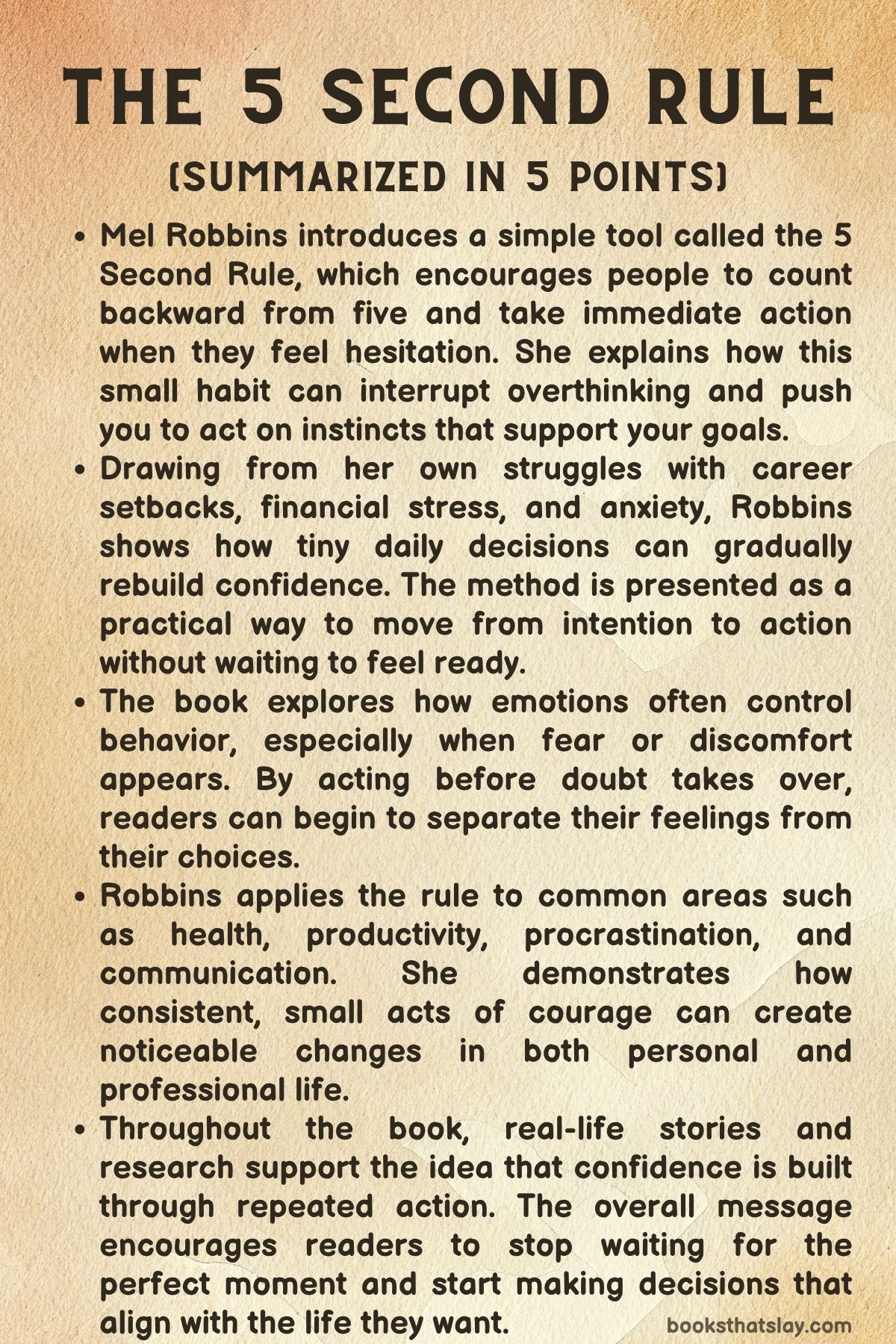
The 5 Second Rule: Transform your Life, Work, and Confidence with Everyday Courage by Mel Robbins is a practical self-help book built around one simple idea: when you know you should do something but hesitate, count backward 5-4-3-2-1 and move. Robbins explains how she created the rule during a personal low point, then shows how that tiny countdown can interrupt overthinking and push you into action.
Through her own story, reader examples, and research she’s gathered, she argues that real change usually starts with small, uncomfortable choices made quickly—getting out of bed, speaking up, starting the workout, sending the email.
Summary
In The 5 Second Rule, Mel Robbins introduces a tool designed for the moments when you want to act but stall. She argues that most people don’t fail because they lack knowledge or talent.
They fail because they hesitate. That hesitation is usually small, quiet, and fast, but it’s powerful enough to shut down bold choices before they begin.
Her central claim is straightforward: if you have an impulse to do something that supports your goals, you must act within five seconds, or your mind will begin producing excuses, doubt, and fear. The countdown—5-4-3-2-1—becomes a signal to move before the mental resistance takes over.
Robbins explains that the rule was born out of her own crisis. From the outside, her life looked fine, but in private it was unraveling.
Her career had stalled, money problems were mounting, and stress had seeped into her marriage. Her husband’s business was in deep trouble, and the pressure of debt and uncertainty made their home feel tense and unstable.
Robbins found herself waking up each day with dread, relying on alcohol to numb her feelings at night, and repeatedly pressing snooze in the morning even when she knew her kids needed her to be steady and present. The mornings became a daily defeat: missed buses, forgotten lunches, rushed chaos, and the sinking feeling that she was failing at basic responsibilities.
Each bad start fed more shame, and the shame fed more avoidance.
What frustrated her most was that she wasn’t confused about what to do. The needed changes weren’t complicated.
She needed to get up when the alarm rang, stop blaming everyone else, ask for help, face the bills, search for work, and take small steps that would rebuild momentum. Yet she still didn’t do them.
She would lie in bed thinking, bargaining, and promising herself she’d do better tomorrow. That “tomorrow” rarely arrived.
She began to notice something important: the decision to avoid action often happened quickly. It wasn’t a long debate.
It was a short window where she either moved or surrendered to the comfort of staying the same.
One night, she watched a rocket launch on television. As the countdown began, she had a sudden thought: she could treat her alarm like a launch.
Instead of negotiating with herself in the morning, she would count down and get up like a rocket leaving the pad. The next morning, she felt the familiar heaviness and the urge to hide under the covers.
Then she counted backward from five and forced her body to move. It wasn’t pleasant, and it didn’t magically solve her problems, but it broke the pattern.
She got out of bed. That single action became proof that she could interrupt her usual response.
Robbins repeats the method and finds that it continues to work, not because she suddenly “feels like it,” but because she acts before the excuses show up. She begins to understand her own procrastination as something that happens in small moments of surrender.
In her view, people are not held back by huge dramatic failures as often as they are held back by tiny choices to delay, avoid, or stay quiet. She frames the rule as a way to turn good intentions into physical movement.
When the mind starts offering reasons to wait—“later,” “not now,” “you’re not ready,” “it won’t matter”—the countdown interrupts the loop and pushes you into doing something, even if it’s the smallest step.
She supports this idea by pointing to how habits form and how the brain tends to protect comfort. When a person sets a goal, they may feel an urge to take a step toward it—an impulse to speak up, apply for something, get off the couch, or stop scrolling.
Robbins calls this inner wisdom: that quick signal that points toward growth. But she says the brain quickly counters it, scanning for risk, embarrassment, or discomfort, and then talking you out of acting.
The five-second window matters because it’s the gap before the mind builds a full argument against change. Counting backward is her chosen technique because it focuses attention and creates a sense of “now,” like a starting gun.
As her own behavior improves, Robbins notices a shift in confidence. She defines confidence less as a personality trait and more as the result of repeated action.
Each time she moves despite fear or discomfort, she proves to herself that she can be trusted. This builds a sense of control over her life.
She connects this to the idea that people thrive when they believe their choices matter. When people feel powerless, they become passive.
When they take action, even small action, they begin to feel capable again.
Her husband, watching her change, begins to adopt the rule as well. He starts addressing his own patterns, including drinking, avoidance, and the weight of shame surrounding the failed business.
The rule does not erase consequences or guarantee success, but it helps him stop running from reality and start engaging with it. Robbins emphasizes that action doesn’t have to be perfect to matter.
The real victory is showing up and doing the next right thing, especially when you’d rather hide.
Robbins then shares how the rule spread beyond her personal life. After briefly mentioning it at the end of a TEDx talk, she received an unexpected flood of stories from people who tried it.
She began researching behavior change, motivation, hesitation, and habits to understand why such a simple method could help. Over time, she positions the rule as a repeatable practice for everyday courage: not heroic moments on a stage, but ordinary moments where a person chooses to act instead of wait.
She expands the concept of courage by arguing that many meaningful decisions are made quickly. People often imagine courage as something reserved for famous leaders, public heroes, or major life events.
Robbins argues that courage is more common than that, and it often looks unimpressive from the outside: stepping on a scale, making a hard phone call, going to a meeting, asking for help, or walking up to someone you want to talk to. She uses public examples to show how major social and personal changes can start with quick choices made without long analysis, because too much time invites fear to take over.
A recurring theme in the book is that waiting is not neutral. Robbins argues that waiting often becomes a disguised form of avoidance.
People tell themselves they’ll start when they feel ready, confident, or certain. But readiness rarely arrives as a feeling.
She gives examples of talented people who delayed opportunities because of doubt, and she points out that the cost of waiting is usually regret. In her view, the only reliable moment to act is the one you’re in.
The question isn’t “Will I feel like it?” The question is “Will I commit to doing it anyway?”
She also challenges the idea that feelings should control behavior. Robbins argues that many people treat emotions like instructions.
If they feel nervous, they stay silent. If they feel tired, they quit.
If they feel uncertain, they delay. She introduces the idea that emotions are real but not always useful as decision-makers.
She references research and examples suggesting that people are driven by feelings more than logic, especially when discomfort appears. The rule becomes a way to separate action from mood.
You may still feel fear, laziness, or doubt, but you move anyway.
From there, Robbins applies the rule to common areas of change. In health, she argues that most people already know what to do, but they struggle to do it consistently because comfort is persuasive.
Exercise, meal choices, and routines often lose to whatever feels easiest in the moment. She shares examples of people who made major health improvements through repeated small acts of discipline, not through sudden inspiration.
The rule becomes a way to start: stand up, walk into the gym, pour the healthy drink, put on the shoes. The focus is less on transforming your whole life in a day and more on winning the next decision.
In productivity, Robbins separates focus into two kinds: immediate focus for the task in front of you, and long-range focus for what matters most. She suggests that distractions are not removed by wishing but by acting.
If your phone pulls you in, you must physically move it away. If an app consumes your time, you must delete it.
The rule helps with that first uncomfortable moment of change. She also emphasizes morning routines as a practical foundation for productivity, arguing that the way you start the day affects your ability to make decisions later.
She discourages the snooze habit because it trains you to negotiate with yourself and can leave you groggy and scattered. She describes building mornings around a small number of “must-do” priorities and protecting early hours from outside noise so your own goals don’t get buried under other people’s demands.
When addressing procrastination, Robbins distinguishes between taking a useful break and avoiding a task while knowing it will hurt you later. She argues that destructive procrastination often functions like stress relief.
Avoidance gives a quick sense of comfort, and that comfort becomes a habit. Her approach begins with self-forgiveness, because shame can trap people in the same cycle they want to escape.
She then encourages readers to picture their future selves and make choices that support that person. Finally, she returns to the rule as the engine that starts movement: begin with fifteen minutes, begin with one email, begin with one paragraph.
Starting matters more than doing everything.
In later sections, Robbins applies the rule to mental patterns like worry and anxiety. She describes long-term anxiety in her own life and explains how she learned to notice when her mind spiraled.
Instead of trying to force calm instantly, she focuses on interrupting the pattern and redirecting attention. She also introduces reframing, suggesting that the physical sensations of anxiety and excitement can feel similar, and the label you apply can change how you perform.
For moments of fear—such as fear of flying—she discusses preparing a steady “anchor thought,” a specific positive image to return to when panic rises. The rule becomes the switch that moves her from spiraling thoughts to that anchor.
In the final part of the book, Robbins focuses on confidence, passion, and relationships. She insists that confidence is not something you either have or don’t have; it is something you practice.
Each time you act despite discomfort, you build evidence that you can rely on yourself. She extends this to purpose by encouraging curiosity and exploration rather than waiting for certainty.
Passion, in her view, grows through action: trying things, learning, testing ideas, and committing before you feel fully prepared. She also argues that strong relationships require speaking honestly rather than waiting for the perfect moment.
Say what matters, even if it feels awkward. The rule is used here as a push to have the conversation, express gratitude, apologize, or tell someone you care.
By the end, Robbins presents the five-second countdown as a simple method with wide reach: it can help you get out of bed, speak up, stop avoiding, reduce worry, build courage, and strengthen trust in yourself. The book’s message is that transformation doesn’t come from grand plans alone.
It comes from repeated moments where you choose action over hesitation. Each countdown is small, but the accumulation changes how you see yourself—and what you believe you’re capable of doing.
Key People
Mel Robbins
Mel Robbins stands at the center of The 5 Second Rule, not as a distant expert but as a flawed and evolving protagonist. She presents herself first in a state of stagnation—overwhelmed by debt, career uncertainty, and anxiety.
Her defining trait at the beginning is hesitation. She knows what she should do but repeatedly fails to act.
This internal conflict between awareness and inaction shapes her transformation. As she develops the 5 Second Rule, her character shifts from reactive to proactive.
She becomes someone who chooses movement over rumination. What makes her compelling is that she does not claim to eliminate fear or self-doubt; instead, she learns to move alongside them.
Over time, her identity changes from a person controlled by mood and anxiety to someone who sees courage as a daily practice. Her evolution illustrates that confidence is built through repetition, not personality.
By the end, she embodies the philosophy she teaches: ordinary decisions, executed consistently, can reconstruct a life.
Chris Robbins
Chris Robbins, Mel’s husband, functions as both a mirror and a partner in transformation. At the outset, he is burdened by the collapse of his business and the weight of financial failure.
His struggles contribute to the tension in their marriage, and he appears withdrawn, discouraged, and ashamed. He represents how setbacks can distort self-worth and lead to avoidance.
As Mel begins applying the 5 Second Rule, Chris observes her gradual shift and eventually adopts the method himself. His arc demonstrates humility and resilience.
He confronts habits that numbed his stress, recommits to responsibility, and works toward repairing financial damage. Importantly, he does not become a flawless success story; rather, he becomes more self-aware and disciplined.
Through Chris, the book shows that courage is contagious. When one person changes their response to fear, it can influence others to do the same.
His character reinforces the idea that growth is not about erasing failure but about facing it directly.
Kendall Robbins
Kendall, Mel’s daughter, appears as a younger figure navigating modern distractions and social comparison. She represents a generation shaped by social media pressure and constant digital noise.
When she chooses to remove certain apps from her life to improve focus and self-esteem, she embodies the principle of intentional action. Kendall’s decision is not dramatic, yet it is meaningful because it reflects self-regulation.
She illustrates how the 5 Second Rule can apply to everyday temptations rather than life-altering crises. Through her, the book highlights the importance of boundaries and personal responsibility in a hyperconnected world.
Kendall’s presence also humanizes Mel, reminding readers that the stakes of change extend beyond personal ambition to family dynamics and example-setting.
Sawyer Robbins
Sawyer, Mel’s other daughter, plays a quieter but emotionally significant role. She appears in moments that reveal Mel’s struggle with anxiety and anticipatory worry.
When Mel catches herself projecting catastrophic futures onto joyful experiences with her daughter, Sawyer becomes a symbol of the present moment. Her character functions less as an active decision-maker and more as an emotional anchor in Mel’s journey.
Through interactions with Sawyer, Mel learns to interrupt spirals of fear and redirect attention toward gratitude. Sawyer represents innocence, possibility, and the fleeting nature of time.
She underscores one of the book’s key themes: that unmanaged worry steals joy from ordinary experiences.
Christine
Christine is presented as a professional who hesitates to voice her idea during an important meeting. She symbolizes the internal battle between competence and insecurity.
Her intelligence is not in question; what holds her back is the fear of judgment. Christine’s moment of counting backward and speaking up becomes a turning point.
Her character demonstrates how silence often stems from emotional discomfort rather than lack of ability. She reflects the many capable individuals who shrink themselves in high-pressure environments.
Through Christine, the narrative emphasizes that confidence is often built in a single brave moment. The outcome of her idea matters less than the act of sharing it.
Her development shows that asserting oneself reshapes identity over time.
Tom
Tom appears in a social setting, hesitating to approach someone he finds attractive. He represents the fear of rejection and the habit of waiting for perfect conditions.
His divorce and self-doubt amplify his reluctance. Tom’s character is important because his struggle is relatable and ordinary.
He is not chasing fame or a career breakthrough; he simply wants connection. When he uses the 5 Second Rule to walk across the room and initiate conversation, he reclaims agency over his narrative.
Tom’s growth is symbolic of choosing participation in life rather than passive observation. Whether the interaction succeeds romantically is secondary.
His courage lies in acting despite vulnerability.
Charlie
Charlie’s story centers on health transformation. He commits to a consistent habit—drinking green juice daily—and sustains it long enough to produce dramatic weight loss.
His character highlights discipline rather than motivation. Charlie does not claim to enjoy the process; he commits to it.
This distinction reinforces the book’s argument that action precedes feeling. Charlie embodies persistence and the power of routine.
His journey shows that substantial change often grows from repetitive, mundane decisions. He illustrates that the 5 Second Rule is not about intensity but about consistency.
Pakinam
Pakinam represents the intimidation that can accompany long-term struggles with weight and self-image. Her character reflects the psychological barrier of starting when the goal feels overwhelming.
She symbolizes those who feel defined by past failures. Pakinam’s significance lies in her willingness to confront the first step despite fear.
She demonstrates that courage is often required simply to begin. Through her, the book addresses self-doubt rooted in history and emphasizes that forward motion is available regardless of background.
Amy Robach
Amy Robach appears as a public figure who agrees to undergo a mammogram on television, a decision that leads to an early cancer diagnosis. Her character illustrates the intersection of courage and vulnerability.
She is already successful and visible, yet she faces a personal fear in a public space. Amy’s story reinforces the theme that avoidance can have serious consequences, while action can be lifesaving.
She exemplifies how small decisions—such as agreeing to a screening—can carry profound impact. Her presence in the narrative broadens the scope of the rule from productivity and confidence to physical survival.
Todd
Todd’s arc revolves around abandoning a path imposed by expectation and pursuing a field aligned with his interests. He symbolizes the tension between external approval and internal calling.
His decision to leave law school challenges family expectations and risks disappointment. Todd’s courage is not impulsive rebellion but a deliberate alignment with personal values.
His transformation reflects the cost of suppressing passion and the relief that follows authenticity. Through Todd, the book argues that fear of disapproval often traps individuals more effectively than lack of opportunity.
Don
Don introduces the relational dimension of courage. His choice to tell his daughter that he is proud of her breaks a long-standing pattern of emotional restraint.
Don represents generational habits of silence, especially among those who struggle to express affection openly. His story underscores the fragility of time and the regret that can arise from withholding meaningful words.
Don’s development is subtle but powerful; he learns that emotional honesty strengthens bonds rather than weakens them. His character reinforces the idea that courage is not only about ambition but also about intimacy.
Rosa Parks
Rosa Parks appears as a historical example of immediate moral conviction. She is portrayed not as someone who meticulously calculated her act of defiance, but as someone who responded in the moment when she felt she had reached her limit.
Her inclusion elevates the concept of everyday courage into the realm of social change. Parks represents the idea that transformative acts can arise from spontaneous resolve rather than prolonged deliberation.
She serves as a reminder that decisive action can shift history.
Dr. Martin Luther King Jr.
Dr. King is referenced as another figure who stepped into leadership quickly, without exhaustive analysis of the consequences. His character symbolizes responsibility accepted in real time.
He embodies the willingness to act despite uncertainty. In the context of the book, he reinforces the theme that waiting for perfect readiness can delay meaningful progress.
His presence adds moral weight to the argument that courage often operates under pressure.
Stephen
Stephen shares his experience of waking earlier and applying the rule despite disliking mornings. He represents the ordinary individual reshaping daily routine.
His story emphasizes that improvement does not require enjoyment. Stephen’s character highlights how short-term discomfort can coexist with long-term satisfaction.
His transformation is not dramatic but steady, showing how identity shifts from “someone who settles” to “someone who follows through.”
Brian Little
Brian Little appears as a psychologist who challenges the belief that personality is fixed. He represents academic support for the idea that traits can be practiced.
His presence strengthens the argument that confidence is trainable. By embodying the notion of “free traits,” he helps frame courage as behavior rather than destiny.
Paulo Coelho
Paulo Coelho is referenced as a writer who persisted despite early rejection. He symbolizes faith in one’s work without immediate validation.
His inclusion reinforces the theme that external success often follows sustained commitment rather than instant approval. Coelho’s perseverance mirrors the book’s emphasis on continuing action even when results are uncertain.
Each of these characters contributes to a broader portrait of courage as accessible and repeatable. Through personal stories, historical figures, and everyday individuals, The 5 Second Rule presents action not as an extraordinary trait but as a decision made within a narrow window of time.
Themes
Everyday Courage as a Practice
Courage in The 5 Second Rule is reframed as a daily decision rather than a dramatic act reserved for extraordinary circumstances. The book presents courage as something required in small, private moments: getting out of bed when anxiety weighs heavily, speaking up in a meeting despite self-doubt, making a difficult phone call, or beginning a task that feels overwhelming.
These actions may appear minor, but they shape identity over time. By focusing on ordinary situations instead of heroic narratives, the text shifts attention from grand achievements to behavioral consistency.
Courage becomes less about fearlessness and more about willingness to act while afraid.
This perspective challenges the common belief that bravery appears when confidence is already present. Instead, the book argues that confidence follows repeated courageous acts.
Each five-second decision to move forward builds evidence that a person can trust themselves. The emphasis is not on eliminating fear but on shrinking its influence.
In this way, courage is democratized. It is not dependent on personality traits, upbringing, or external validation.
It is available to anyone willing to interrupt hesitation. The cumulative effect of these small acts is profound.
They reshape self-perception, increase agency, and gradually replace passivity with engagement. Courage becomes less about isolated breakthroughs and more about sustained participation in one’s own life.
The Battle Between Feelings and Action
A central tension explored throughout the book is the conflict between emotional comfort and meaningful progress. The narrative suggests that people often mistake their feelings for instructions.
When fear, laziness, or uncertainty arise, they interpret those emotions as signals to stop. The five-second countdown functions as a barrier between impulse and avoidance, creating space to act before emotions dictate behavior.
This framework rests on the idea that feelings are immediate and persuasive, while long-term goals require discipline that may feel uncomfortable in the moment.
By separating action from mood, the text argues that growth depends on behavior rather than motivation. Waiting to feel ready becomes a trap.
The book illustrates how hesitation often lasts only seconds, yet those seconds determine whether a person advances or retreats. Emotional resistance is portrayed as predictable; it emerges whenever change threatens familiarity.
The method does not attempt to eliminate emotion but to prevent it from dominating decision-making. Over time, repeated action despite discomfort reduces the power of those emotions.
Anxiety may still appear, but it no longer controls outcomes. The broader implication is that personal development requires challenging the assumption that feelings must align with effort.
Progress becomes possible when action leads and emotion follows, rather than the other way around.
Personal Responsibility and Locus of Control
Throughout The 5 Second Rule, control is portrayed as an internal quality that can be strengthened. The narrative emphasizes that external circumstances—financial hardship, career setbacks, social pressure—are not always within one’s power.
However, the response to those circumstances remains a choice. By encouraging immediate physical movement after a countdown, the book reinforces the belief that individuals possess more influence over their direction than they assume.
This sense of agency counters feelings of helplessness that often accompany stress and failure.
The concept of responsibility is framed not as blame but as empowerment. When people repeatedly choose action, they begin to see themselves as active participants rather than victims of events.
This shift changes how challenges are interpreted. Obstacles become situations to engage with instead of signals to withdraw.
The idea aligns with psychological theories suggesting that people who believe their actions matter are more resilient and persistent. The five-second tool reinforces that belief in practical terms.
Each decision to act strengthens internal control and weakens the narrative of inevitability. Responsibility becomes a source of confidence because it proves that behavior can be directed.
The emphasis on small, consistent actions underscores that regaining control does not require dramatic reinvention. It begins with a single deliberate step.
Reframing Fear and Anxiety
Fear and anxiety are treated not as enemies to be erased but as sensations to be redirected. The book acknowledges that nervousness often accompanies ambition, visibility, or change.
Rather than attempting to suppress these responses, it suggests reinterpreting them. The physical symptoms of anxiety—racing heart, heightened alertness, sweating—are described as similar to excitement.
By consciously labeling these sensations differently, individuals can alter their performance and reduce escalation into panic. This reframing strategy transforms fear from a warning signal into a sign of readiness.
The five-second rule supports this shift by interrupting spirals of catastrophic thinking. When worry begins to build, the countdown disrupts rumination and encourages a conscious pivot toward constructive thoughts.
In cases such as fear of public speaking or flying, the technique includes preparing an anchor image that represents safety or success. The repeated pairing of countdown and redirection retrains mental habits over time.
Anxiety loses its automatic authority. This theme highlights the malleability of thought patterns and the importance of awareness.
Instead of attempting to eliminate negative feelings, the focus is on managing interpretation and response. Mastery of fear becomes less about emotional control and more about cognitive choice.
In this way, anxiety becomes a manageable experience rather than a defining trait.