The 5 Types of Wealth Summary and Analysis
The Five Types of Wealth by Sahil Bloom is a thought-provoking and practical guide that challenges our cultural obsession with money and redefines what it means to live a rich life.
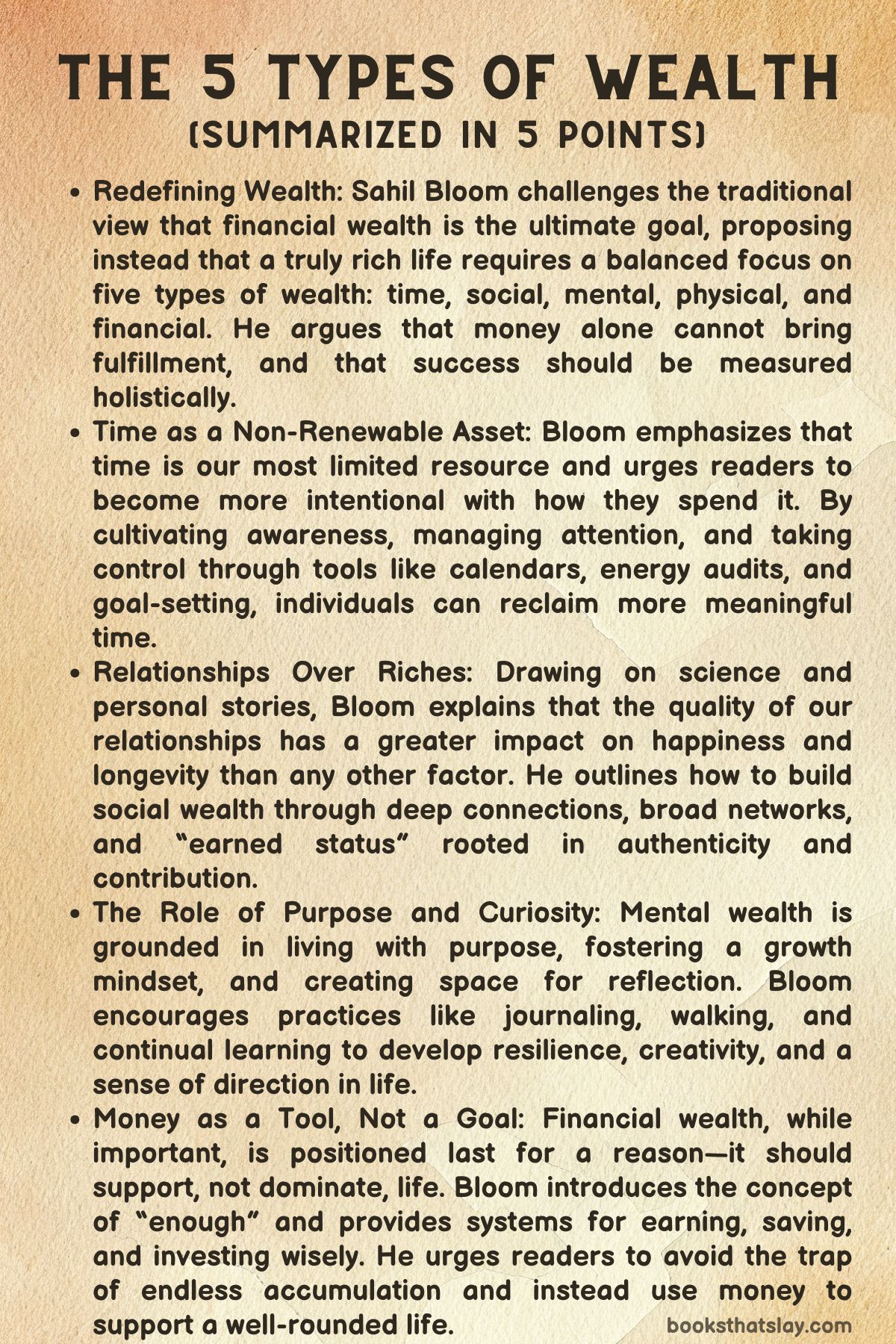
Drawing from personal experiences and historical stories, Bloom presents five key areas of life that he calls “wealth types”: time, social, mental, physical, and financial. He argues that true fulfillment comes from balancing and nurturing all five. With a structured yet empathetic tone, Bloom offers frameworks, exercises, and questions that help readers evaluate where they are—and where they want to go—in building a more intentional, purpose-driven, and joyful life.
Summary
Sahil Bloom’s The Five Types of Wealth begins with a personal account of disillusionment.
By 30, Bloom had achieved what many would define as success: a lucrative job in finance, a luxury lifestyle, and societal status. But beneath the surface, he felt empty—his mental health, time, relationships, and physical wellbeing were eroding. This realization became the foundation for the book’s central thesis: financial wealth is only one part of a meaningful life.
Bloom introduces four additional forms of wealth—time, social, mental, and physical—and invites readers to reframe how they measure success.
In Part 1, Bloom lays the philosophical groundwork, encouraging readers to define what their dream life actually looks like.
He introduces the “arrival fallacy,” the belief that happiness lies just one more achievement away. Instead of chasing endlessly, Bloom recommends intentional living through a balanced “wealth scoreboard” to assess personal wellbeing across all five areas.
He introduces the concept of a “life razor,” a personal principle that simplifies decision-making and keeps actions aligned with one’s priorities. He also stresses the power of combining goals with “anti-goals”—clear boundaries to avoid sacrificing health, relationships, or integrity while pursuing ambitions.
Part 2 focuses on time wealth, perhaps the most finite resource. Bloom opens with a stark question: How many moments do you have left with the people you love? Drawing on Stoic philosophy, particularly memento mori (“remember you must die”), he emphasizes time’s fragility. He defines time wealth through three pillars: awareness, attention, and control.
Through tools like energy calendars, the Eisenhower Matrix, and self-imposed deadlines, Bloom outlines strategies to eliminate distractions and prioritize meaningful activities. He stresses that focusing doesn’t require more hours—just better use of them.
Part 3 explores social wealth, highlighting the enormous value of deep, supportive relationships. Bloom draws from psychology and anthropology to argue that strong social connections are the greatest predictor of health and longevity—more so than wealth or fame.
Through heartfelt stories like that of a grieving husband who reprioritized his life after his wife’s death, Bloom underlines the need to cultivate relational depth. He also provides practical tools like a “relationship map,” monthly “life dinners” with a partner, and strategies for building authentic networks.
The three pillars of social wealth are depth, breadth, and earned status—genuine respect and affection built over time, rather than superficial validation.
Part 4 addresses mental wealth, or the health of the inner life. Bloom encourages reconnecting with childlike curiosity, drawing from global philosophies like dharma, ikigai, and arete to define a sense of purpose.
Mental wealth, he says, rests on purpose, growth, and space. Using tools like journaling, walking, and the Feynman technique, Bloom encourages readers to continually learn, reflect, and take breaks to recharge.
He also introduces the idea of a “pursuit map,” which helps individuals evaluate what activities are energizing versus draining, and how they align with skill and purpose.
In Part 5, Bloom shifts focus to physical wealth, the foundation that supports all other types.
Through stories like that of Dan Go, who transformed his life through fitness, Bloom emphasizes the importance of movement, nutrition, and recovery. He discourages fad diets and health gimmicks, instead advocating for simple, sustainable habits: daily movement, eating mostly whole foods, and getting quality sleep.
He introduces systems like a 30-day challenge, sleep hygiene routines, and stress-reducing breathwork practices to help readers embed healthy habits.
Finally, Part 6 brings the conversation back to financial wealth, but with a twist. Bloom encourages readers to define their own “enough”—a personal, balanced vision of satisfaction. The three pillars here are income generation, expense management, and long-term investment.
He walks readers through saving, budgeting, and investing in index funds, while warning against financial obsession. He insists that wealth should be a tool, not the end goal.
In his conclusion, Bloom reflects on his “leap of faith”—leaving finance to pursue a life aligned with his values. He urges readers to continuously assess and refine their own five types of wealth, building lives of substance, intention, and true prosperity.
Key People and Characterizations
Sahil Bloom
Sahil Bloom is both narrator and central figure in The 5 Types of Wealth, and his role is designed to function as proof that a “successful” life can still feel empty when it is built around a single scoreboard. He begins as a young person shaped by comparison—motivated by what money seems to promise and by the comfort he associates with a wealthier childhood friend.
When a baseball injury closes one identity path, he commits fully to another: the high-performing finance professional who believes external wins will eventually produce internal calm. His turning point is not a single crisis but a sustained realization that his satisfaction keeps moving away from him; the “arrival fallacy” becomes his name for the pattern of chasing a future version of life that never becomes emotionally real.
As he changes direction, his character becomes less about achievement and more about design: he treats life as something that can be measured, adjusted, and rebuilt through deliberate choices. He carries the voice of someone who respects ambition, but now wants ambition to serve relationships, health, meaning, and time.
By the end, Bloom’s defining trait is intentionality—he presents himself as a person who learned to stop letting money be the lead character and instead made it a supporting tool.
Lakshmi Bloom
Bloom’s mother appears primarily through the origin story that frames Bloom’s relationship with sacrifice, love, and choice. Her willingness to endure discomfort and opposition to be with the person she chose establishes a quiet standard for values-driven decision-making.
In the background of Bloom’s later success-chasing, her story works like an early moral compass: real commitment may require giving up ease, approval, or convenience. Even though she is not present as an active participant throughout the book’s later lessons, her role matters because she represents a form of wealth that cannot be bought—relationship depth and loyalty.
The emotional weight of her experience also helps explain why Bloom later becomes so focused on relationships and time: he is not simply reacting to burnout; he is returning to a model of life where love and priorities set the direction.
David E. Bloom
Bloom’s father is portrayed as both a symbol of difficult family history and an example of how to balance responsibility with presence. The book notes that Bloom never met his paternal grandparents, which adds a shadow of absence and fracture to the family story, suggesting how conflicts can echo across generations.
Against that backdrop, Bloom’s father stands out as someone who still creates steadiness at home. He models a practical form of social wealth by being consistently available to his child in meaningful ways, even while pursuing demanding work.
His habit of being present in the evenings and then returning to work later shows a pattern Bloom later tries to formalize through systems: protect what matters first, then build the rest around it. In character terms, Bloom’s father represents earned status within family life—respect gained through reliability and care rather than through public success.
Bloom’s Paternal Grandparents
Bloom’s paternal grandparents function less as fully drawn individuals and more as a defining absence that shapes the emotional terrain of his family narrative. Their disapproval of the relationship that created Bloom’s family results in a lasting separation, and the fact that Bloom never meets them turns them into an example of how pride, control, or rigid values can cost people irreplaceable connection.
Their presence in the book is brief but purposeful: they embody the risk of misplacing priorities and losing access to the very relationships that should matter most. In a book focused on different forms of wealth, they represent a cautionary figure—the price of choosing “being right” or “maintaining status” over closeness.
Ben
Bloom’s friend who makes $100 million, serves as a sharp illustration of how comparison operates even at the highest levels of financial success. He is depicted as someone who genuinely wants to use his wealth for joy and connection—bringing friends and family together for a celebratory trip—yet he is instantly pulled back into dissatisfaction when confronted by an even more extravagant symbol nearby.
This moment reveals him as a character caught in the same trap Bloom once lived in: the feeling that satisfaction is conditional and always delayed by the existence of a “next level” in someone else’s life. He is important because he proves the book’s claim that the chase does not end with big numbers; it simply upgrades its reference points.
His character also adds realism to Bloom’s message: even generous intentions can be undermined by status reflexes if a person has not defined “enough” internally.
Roman Reddy Bloom
Bloom’s son appears as a catalyst for Bloom’s shift from theory to lived change. He is not presented with a detailed personality arc, but his importance is emotional and structural: he represents time that cannot be recovered and a relationship that either deepens through presence or thins through neglect.
Bloom’s decision to coach his son’s sports team becomes a concrete symbol of his revised values because it anchors him in recurring, scheduled commitment. The son therefore functions as a living boundary against the old version of Bloom who postponed life to the future.
Through this relationship, Bloom’s ideas become less abstract; time wealth and social wealth are no longer concepts but choices that show up in ordinary weekly routines.
Marc Randolph
Marc Randolph appears as a model for disciplined prioritization rather than as a fully developed character study. His defining trait in the book is consistency: he protects a recurring commitment to his partner regardless of work demands.
This makes him an example of someone who treats relationships as non-negotiable infrastructure rather than optional leisure. In the story logic of the book, Randolph represents a person who achieved professional success without allowing it to consume the space where meaning and connection are built.
His role supports Bloom’s belief that a simple rule can prevent life from drifting into imbalance.
Isaac Newton
Isaac Newton is presented as an illustration of attention and concentrated effort rather than as a historical portrait. In Bloom’s use of him, Newton’s significance lies in what happens when distractions fall away and focus becomes possible.
He represents the idea that scattered energy produces scattered results, while protected attention can create breakthroughs that change everything. As a “character” in the book’s framework, Newton stands for the payoff of time control: fewer obligations, more depth, and a stronger ability to do meaningful work in less time.
Erik Newton
Erik Newton is one of the book’s most emotionally consequential figures because his story links social wealth to mortality in an immediate way. As a busy executive, he lives the common modern pattern of postponing relationships for professional momentum until tragedy interrupts the script.
His wife’s diagnosis and death reorganize his priorities overnight, and his transformation is rooted in regret and clarity: he recognizes that relationships are not a category to optimize later but the center of life’s meaning. Erik is portrayed as someone who learns through loss, and his character serves as a reminder that values often become obvious only when options disappear.
He embodies the book’s warning that time is not promised and that closeness requires action while people are still here.
Erik Newton’s Wife, Aubrie
Erik Newton’s wife appears briefly, but her presence shapes the emotional thesis of the social wealth section. She is defined by what her illness reveals: at the end of life, the longing is not for more accomplishment or more money, but for more time and deeper connection with friends and family.
She functions as a voice of final perspective, the kind that cuts through noise because it is formed under extreme constraint. In character terms, she represents clarity—the view of what matters when the usual distractions fall away.
Her role also turns the social wealth argument into something personal rather than theoretical.
Vivek Murthy
Vivek Murthy is included as a public figure whose work validates the book’s claims about loneliness and isolation. He functions as an authority character in the narrative, grounding Bloom’s argument in modern public health framing.
Rather than being explored as an individual with a storyline, he represents the reality that disconnection is not merely a private sadness but a widespread condition with serious consequences. His inclusion strengthens the idea that social wealth is not soft or optional; it is linked to physical and mental outcomes in measurable ways.
Greg Sloan
Greg Sloan is portrayed as a father who faces a direct moral choice between professional prestige and presence at home. His character is defined by responsiveness: he listens when he realizes his child experiences him as absent, and he takes action even though it reduces his income and status.
He represents a turning point many readers can recognize—when the narrative of career success collides with the daily reality of family life. Sloan’s decision embodies Bloom’s idea of avoiding pyrrhic victories.
His role is to show that prioritizing social wealth can be practical and empowering, not merely sentimental.
Lionel Messi
Lionel Messi appears as a symbol of strategic restraint and efficiency. In Bloom’s framing, Messi’s greatness is partly about patience and timing—conserving energy until the moment of highest leverage.
This depiction supports Bloom’s argument that success does not always come from constant exertion; it can come from intelligent pacing and deliberate focus. As a character example, Messi represents the discipline to wait, the confidence to ignore noise, and the ability to act decisively when it matters most.
Warren Buffett
Warren Buffett serves as a parallel example to Messi, representing selective attention and long-term thinking. Bloom uses him to illustrate a system in which most opportunities are ignored so that the few that truly fit can receive full commitment.
Buffett’s character function is to model an approach to decision-making that protects time and mental energy. He embodies the idea that saying “no” is not deprivation but design, and that clarity about criteria creates freedom rather than limitation.
Rohan Venkatesh
Rohan Venkatesh is presented as someone forced into rapid perspective by a severe diagnosis. His story highlights the distinction between what cannot be controlled and what still can be: even when outcomes are uncertain, a person can choose how to spend the time that remains and who to spend it with.
Rohan’s character is defined by conscious response—shifting energy toward closeness and meaning rather than spiraling into helplessness. He illustrates Bloom’s belief that love and attention are choices, and that social wealth becomes most visible when time feels scarce.
Hank Behar
Hank Behar represents childlike curiosity sustained into old age, a living argument for mental wealth. His desire to keep learning, even late in life, marks him as someone who experiences the world as open rather than closed.
Bloom treats him as a role model because he shows what it looks like to stay mentally alive through wonder and active engagement. As a character, Behar stands for a mindset that refuses to shrink with age—a person who continues to ask questions, seek new experiences, and remain interested in the world.
Dan Buettner
Dan Buettner appears as a researcher figure whose work supports Bloom’s claims about purpose and longevity. He functions primarily as a source of insight into communities where people live long lives, reinforcing the idea that meaning and social connection contribute to mental stability and health over time.
As a “character” in the book’s structure, Buettner represents evidence-based curiosity—someone who looks for patterns in human flourishing and translates them into lessons others can apply.
Robert Butler
Robert Butler is positioned as a scientific voice underscoring the benefits of purpose in later life. He is not developed personally, but his presence supports Bloom’s argument that purpose is not motivational decoration—it is connected to measurable outcomes such as lifespan and well-being.
In narrative terms, Butler functions as reinforcement: mental wealth is not just a feeling; it shows up in how people live and age.
Carol Dweck
Carol Dweck appears as a key influence on the growth pillar of mental wealth through her work on mindsets. Bloom uses her research to explain how beliefs about learning and capability shape performance, resilience, and openness to change.
Her character function is to give structure to Bloom’s claim that mental wealth can be built intentionally: by shifting from a fixed identity to a learning identity, people become more adaptable and less fragile in the face of setbacks.
Richard Feynman
Richard Feynman is used as a teaching figure whose approach to learning becomes a practical method readers can apply. Bloom highlights the idea that real understanding is proven by the ability to explain something simply.
Feynman’s role is to make learning feel accessible and active rather than abstract, turning mental wealth into something that can be practiced through everyday habits. As a character reference, he represents clarity, curiosity, and the craft of making complex things understandable.
Bill Gates
Bill Gates appears as an example of making deliberate space for thinking. His “think day” concept supports Bloom’s point that mental wealth grows when people step back from constant input and create room for reflection.
Gates represents a kind of disciplined solitude, where isolation is not loneliness but a chosen environment for deep planning. In the book’s logic, he is evidence that stepping away from nonstop busyness can be a performance advantage and a mental health asset at the same time.
Jane McGonigal
Jane McGonigal is introduced through the idea of future thinking, a method for motivating present behavior by imagining future scenarios in vivid detail. She functions as a guide for turning long-term health into something emotionally real today.
Her role is to bridge intention and action: when people can picture their future self clearly, they make better choices in the present. In Bloom’s framework, she strengthens the physical wealth section by offering a mental tool that makes discipline easier to sustain.
Andrew Luck
Andrew Luck is presented as an example of someone who prioritized long-term well-being over external rewards. In Bloom’s framing, Luck’s decision to step away from a highly lucrative career is less about quitting and more about protecting the foundation that supports every other area of life.
He represents the theme that physical wealth enables all other wealth, and that ignoring health for achievement can create irreversible costs. His character function is to challenge the assumption that the highest-status option is always the best one.
Dan Go
Dan Go is shown as a transformation figure whose life changes through rebuilding physical habits. His background includes bullying, depression, and addiction, and exercise becomes the turning point that gives him agency again.
Bloom uses Dan’s story to show that physical wealth is not about appearance or trends; it is about reclaiming energy, confidence, and stability. Dan’s character illustrates how the body can become an entry point to broader life change, because improved health often creates momentum that spreads into relationships, work, and identity.
Jakob Fugger
Jakob Fugger appears as a historical example of extreme financial success paired with personal cost. Bloom uses him to show how wealth-building skill can become obsession and how the pursuit of more can erode a person’s ability to enjoy life and maintain relationships.
Fugger represents the danger of letting financial wealth dominate the entire scoreboard. In character terms, he embodies a warning: competence and ambition can build enormous fortunes, but without “enough” defined, the chase can consume everything else that makes life worth living.
Benjamin Franklin
Benjamin Franklin is referenced as an example of structuring daily life through defined time blocks and intentional routines. He functions as a model for personal systems that convert vague intention into repeatable practice.
As a character reference, Franklin represents disciplined self-management and the belief that good days are designed, not stumbled into. In Bloom’s broader message, Franklin supports the idea that time wealth increases when people create simple structures that reduce decision fatigue and protect what matters.
Analysis and Lessons
True Wealth is Multifaceted and Hence, Financial Wealth Alone Won’t Lead to Fulfillment
The core lesson of the book is that true wealth is not just about accumulating financial resources. Bloom argues that a fulfilling life is built on five types of wealth: time, social, mental, physical, and financial.
In his early career, Bloom had amassed significant financial wealth, yet he felt disconnected, unhealthy, and unfulfilled. He realized that financial wealth alone cannot guarantee a happy, meaningful life.
This lesson challenges the common societal notion that the pursuit of more money is the ultimate path to success. Instead, Bloom urges readers to intentionally balance and develop all five wealth types to design a life that feels genuinely rich and rewarding.
Takeaway: A life focused solely on money can lead to neglecting other important areas of well-being. True success and happiness arise from integrating time, social, mental, physical, and financial wealth.
Time is Your Most Valuable Resource – Treat It Like a Luxury
Time is finite, and once it is gone, it cannot be reclaimed.
Bloom emphasizes the scarcity of time in life, urging readers to view it as their most valuable resource. In the section on time wealth, he introduces the Stoic concept of memento mori—the reminder of our mortality. This reflection is designed to provoke a deeper awareness of how we spend our time and what we truly value.
Bloom highlights the importance of awareness, attention, and control as the three pillars of time wealth. By consciously assessing how we spend our time, we can free up moments for what truly matters—whether it’s family, personal growth, or pursuing passions.
Takeaway: Become mindful of how precious time is. By prioritizing what truly matters and avoiding distractions, you can live a more meaningful life and prevent the regret of wasted time.
Build Deep Relationships – Social Wealth is the Key to Happiness and Longevity
Bloom’s research and personal experiences underscore the vital importance of nurturing relationships. He introduces the concept of social wealth, which refers to the quality and depth of one’s relationships.
Bloom draws from studies like the Harvard study on adult development, which found that strong social bonds are the best predictors of health and happiness.
His message is clear: material success may provide comfort, but it cannot replace the joy derived from meaningful relationships with family, friends, and communities. He encourages readers to invest time and energy into deepening their relationships with the people who matter most.
Takeaway: Invest in relationships over material wealth. Meaningful connections with family, friends, and communities lead to greater happiness, health, and overall life satisfaction.
A Growth Mindset is Essential for Mental Wealth
Mental wealth is rooted in a growth mindset—the belief that our abilities and intelligence can be developed through dedication and effort. Bloom teaches that cultivating curiosity, purpose, and personal growth is essential for maintaining mental well-being.
By engaging in continuous learning, reflecting on one’s purpose, and creating space for personal growth, we can enhance our mental wealth. Bloom emphasizes the importance of staying open to new ideas, overcoming limiting beliefs, and embracing challenges as opportunities for growth.
By developing these mental muscles, we become more resilient and adaptable to the inevitable changes and challenges in life.
Takeaway: Embrace lifelong learning, remain curious, and continuously seek personal growth. A growth mindset fosters mental resilience and enriches your life with purpose and fulfillment.
Physical Health is the Foundation for All Other Types of Wealth
Bloom discusses the crucial importance of physical health, which he argues is the foundation upon which all other types of wealth can be built.
If you neglect your physical health, other forms of wealth will suffer as well—whether it’s a lack of energy to pursue your goals or the emotional toll of poor health.
He introduces the three pillars of physical wealth: movement, nutrition, and recovery. Bloom encourages readers to engage in regular exercise, adopt a whole-foods-based diet, and prioritize rest and recovery to build a solid foundation for a healthy, fulfilling life. Without good physical health, it’s hard to fully enjoy any other form of wealth.
Takeaway: Take care of your body—movement, nutrition, and rest are the building blocks of a healthy life. When your physical health is strong, it supports all other aspects of your life, including mental and social well-being.