The 7½ Deaths of Evelyn Hardcastle Summary, Characters and Themes
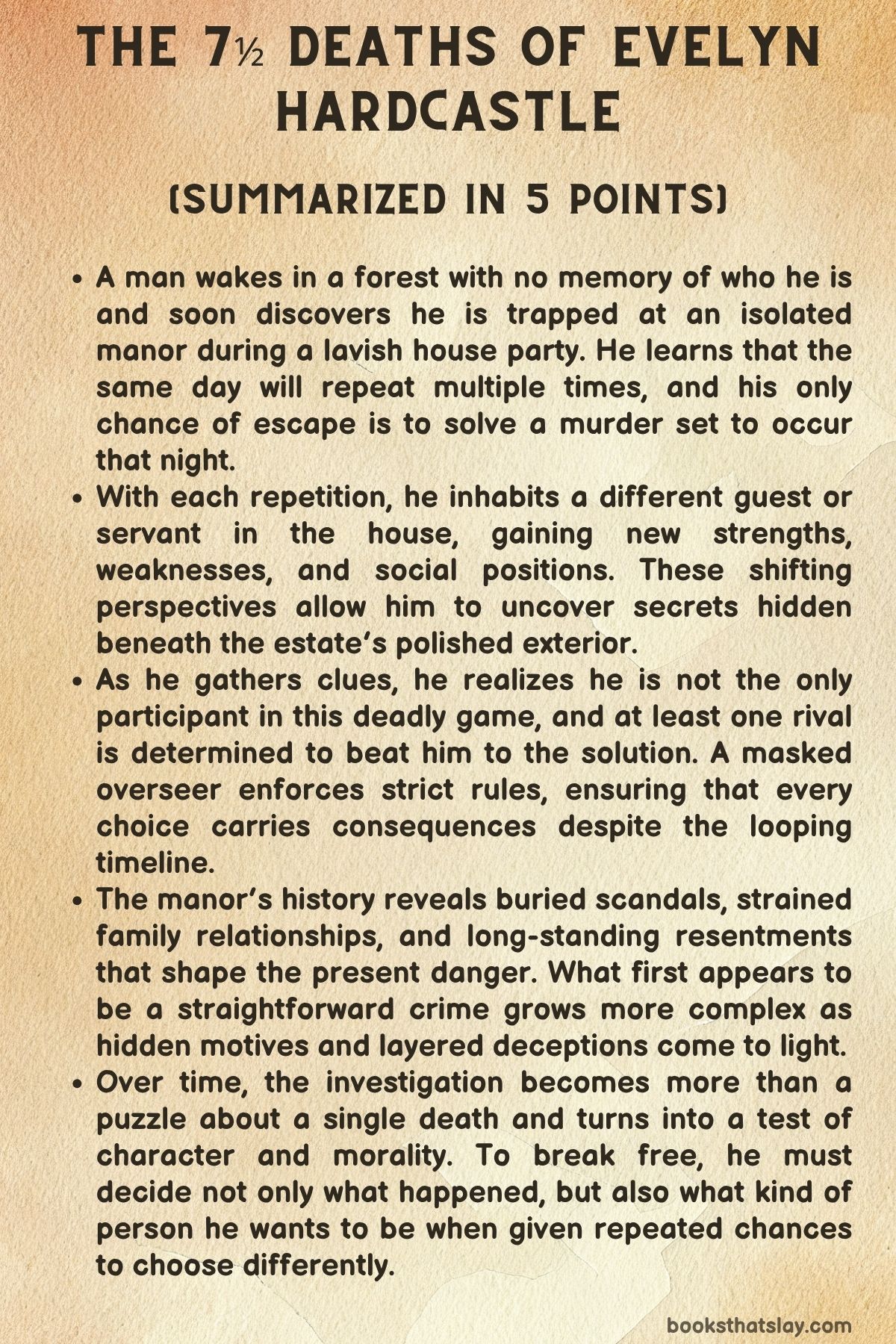
The 7½ Deaths of Evelyn Hardcastle by Stuart Turton is a high-concept mystery set in an isolated English manor where time refuses to behave. A man wakes with no memory, discovers he’s trapped in a repeating day, and learns he must solve a killing to earn his freedom.
The twist is that each cycle he inhabits a different person in the house, inheriting their strengths, limitations, and temptations. As he gathers clues from shifting angles, the estate’s polished surface cracks, exposing blackmail, old crimes, and a brutal power struggle behind the party’s masks.
Summary
A man awakens at dawn in a forest, panicked and calling out for a woman named Anna. His mind is blank—names, history, even his own identity have been wiped clean.
He sees a frightened woman running and hears a gunshot. A shadowy figure approaches from behind, slips a silver compass into his pocket, and tells him to go east.
With no better option, he follows the compass through the trees until a grand, remote manor appears: Blackheath.
At the door, a burned-faced butler admits him. Inside, a guest insists the man is Dr. Sebastian Bell.
Confused but forced to accept the role, he tries to assemble a self from objects in a bedroom: an invitation to a masquerade ball hosted by Lord and Lady Hardcastle for their daughter, Evelyn. Another doctor examines him, notes a head injury and knife wounds, and warns him someone tried to hurt him.
The house is full of wealthy guests who complain and sneer at staff. One bullying man, Ted Stanwin, seems to carry quiet authority through menace and money.
As “Sebastian,” he meets Michael Hardcastle, Evelyn’s brother, who shares the estate’s old horror: years earlier, seven-year-old Thomas Hardcastle was murdered near the lake. A staff member, Charlie Carver, was executed for the crime, but a second accomplice was never identified.
The mystery still stains the family. Meanwhile, no one in the house admits to knowing any Anna, and no one is missing, which clashes with the narrator’s certainty that he witnessed her death.
A strange figure in a plague doctor costume corners him with warnings about someone called the Footman—an enemy whose name triggers fear even without memory. Soon the narrator receives a note signed “Anna,” asking him to meet in the graveyard at night.
He suspects a trap but goes anyway, accompanied by Evelyn, who carries a pistol. No one arrives.
Instead, he finds blood and his compass broken. Back in his room, a dead rabbit awaits with a message from the Footman.
He faints.
He wakes to banging at the front door—and sees Dr. Sebastian Bell standing there, begging for help. The impossible becomes real: he is now in the body of the burned-faced butler, Mr. Collins, watching the same morning play out again from a new angle.
The loop has restarted. Before he can make sense of it, Gregory Gold attacks him viciously, and pain drags him into darkness.
When he next wakes, a plague-masked figure confronts him with the rules. The narrator is not Sebastian Bell, nor Collins, nor any single person in the house.
His true identity has been stripped away. Each “day” he will wake in a different host within Blackheath, reliving the same date.
He will have eight attempts. His escape depends on solving a murder—though the overseer initially withholds the victim’s name.
Worse, two other competitors are also trying to solve it, and only one will be allowed to leave.
The narrator tries to flee the grounds in another host body—Donald Davies—but is stopped and forced back. In yet another cycle he wakes as Lord Ravencourt, an older aristocrat engaged to Evelyn.
He begins taking a methodical approach: leaving notes, recruiting help, and observing repeat events to spot what changes. He enlists Ravencourt’s valet, Charles Cunningham, by leveraging Cunningham’s secrets.
The Footman’s presence haunts corridors, appearing as footsteps, giggles, and threats.
The narrator learns the central target: Evelyn Hardcastle will die tonight, during the ball, near the reflecting pool. He wants to save her, but another competitor, Daniel Coleridge, argues it’s pointless and urges him to focus only on identifying the killer.
The narrator refuses to accept that the best outcome is merely naming a murderer after the fact. He warns Evelyn.
Strangely, she doesn’t react as if shocked, as though she already expects danger.
At dinner, Michael announces that Evelyn will marry Ravencourt. The narrator realizes this is not romance but punishment and transaction: the family needs money, and the marriage deal is tied to saving Blackheath.
Evelyn is being traded. In the ballroom chaos, the narrator chases plague-masked figures and tries to position himself near Evelyn.
He sees her by the pool with a pistol. Before anyone can stop her, she shoots herself and collapses into the water.
The narrator witnesses her death and is thrown into confusion—if she killed herself, what exactly is he meant to solve?
As the loops continue, the narrator gathers ugly truths. His host bodies aren’t neutral vessels; their instincts and tempers bleed into him.
As Jonathan Derby, he experiences sudden violent impulses and learns why Derby is feared: he has a history of assault. Attempting to prevent an attack on Evelyn and her maid Madeline, the narrator accidentally causes the very scene he first misread in the woods—proving that his own actions can lock events into place.
Pieces of a larger conspiracy surface. Two guns are stolen from Lady Helena Hardcastle.
Evelyn carries a revolver at key times, yet later uses a silver pistol to “die.” Ted Stanwin appears to be blackmailing multiple people, including the Hardcastles. Cunningham reveals he has a complicated connection to the family.
In a coded notebook, Stanwin keeps secrets that could ruin everyone. The narrator suspects the real weapon is leverage: whoever controls reputations controls outcomes.
Meanwhile, a second death appears: Millicent Derby, Jonathan’s mother, is found dead. Lord Peter Hardcastle, Evelyn’s father, is later poisoned.
The narrator realizes Blackheath is a nest of layered crimes, not a single tragedy. Evelyn’s death is the puzzle’s centerpiece, but other killings orbit it, either as cover or consequence.
The narrator also discovers that Evelyn’s apparent suicide is not straightforward. Evelyn confesses she received a threat: kill yourself publicly or someone you love will die instead.
She planned to fake her death using a blood vial and tranquilizer, with Doctor Dickie’s cooperation, to escape the forced marriage. That means the “suicide” is a staged event vulnerable to being turned into a real murder.
During one loop, the narrator sets himself to intercept what happens after the staged shooting. He hides where Evelyn’s body is taken and catches Michael trying to finish her off by shooting her.
The narrator has tampered with Michael’s gun, stopping the shot. Confronted, Michael reveals desperate motives—he believes Evelyn cannot truly escape and would rather end her life than see her trapped and broken again.
But before the narrator can extract everything, poison takes Michael too. Evelyn also shows symptoms.
With limited antidote, the narrator saves Evelyn but cannot save Michael. Before he can follow the trail further, the Footman kills him.
The contest between players turns vicious. The narrator notices Daniel Coleridge’s story doesn’t hold: Daniel cannot be the narrator’s future host as claimed.
Daniel is another competitor, lying to gain trust. The narrator later sees Daniel coordinating with a person who resembles the plague doctor.
He assumes betrayal by the overseer, until the truth emerges: there are two masked officials. The original plague doctor is named Oliver, while a second supervisor—nicknamed Silver Tear—has been secretly meeting Daniel.
Daniel has hired the Footman as a weapon: a brutal man paid to hunt, torture, and kill the narrator in each host body, slowing him down and eliminating rivals. A showdown in the woods ends with Daniel dead, but the game’s structure remains, and time still resets.
Eventually, the narrator reaches the final cycle with enough recorded knowledge to connect the major lines. Oliver explains the deeper purpose: Blackheath is a prison designed to force moral change through repetition and consequence.
Prisoners must solve the crime to earn release. The narrator is different—he entered voluntarily.
Oliver reveals the narrator’s true name: Aiden Bishop. Anna’s true name is Annabelle Caulker, and she is imprisoned for violent crimes.
Aiden came to Blackheath seeking revenge because Annabelle murdered his sister, Juliette. Over many loops, however, his rage has been worn down, and the woman beside him has become “Anna” to him—someone he protects, not punishes.
Aiden refuses to leave without her. He argues that freedom should require the whole truth, including the second killer behind the chain of deaths.
Together, Aiden and Anna race to expose what really happened, not only now but nineteen years ago.
The long-buried crime is revealed: the true killer of Thomas Hardcastle was Evelyn Hardcastle herself. Years ago, under the pretense of riding, Evelyn arranged a secret meeting with Thomas at the boathouse and killed him with a stolen knife.
Her goal was to shift blame onto the stable staff. Charlie Carver and Lady Helena discovered the scene and, shocked and desperate, accepted Evelyn’s story that it was an accident.
Carver fetched clean clothes to help Evelyn hide evidence. Ted Stanwin later found Lady Helena with the body and assumed Helena was the murderer, giving Stanwin power to blackmail her for years.
The murder connects to another disappearance: a stableboy, Keith Parker, died earlier after falling into a hole in caves while with Evelyn. Evelyn chose not to get help, leaving him to die.
Thomas’s strange behavior in the week before his death now makes sense: he had seen something about Keith’s fate and became a threat.
In the present, Evelyn has been hiding in plain sight by living as her own maid, Madeline Aubert, while a criminal named Felicity Maddox posed publicly as “Evelyn.” Evelyn murdered her parents—first poisoning, then finishing what needed to be finished to protect herself. She killed Millicent Derby because Millicent recognized her.
She planned to kill Aiden and Anna to erase witnesses and walk away unseen.
At the gatehouse, Evelyn corners them with a shotgun. Aiden realizes Michael’s death was accidental: poison meant for Felicity was consumed by Michael.
The last missing piece is answered when Felicity arrives and shoots Evelyn repeatedly, taking revenge for the attempted betrayal and the death Evelyn planned for her. Oliver arrives to judge the outcome.
With the killers identified and the full story exposed, Oliver declares that Aiden has earned freedom and offers Anna the same if she formally answers who killed Evelyn Hardcastle. Aiden and Anna choose to leave together, stepping out of the loop into linear time, aware that the past will not simply vanish, but determined to face what comes next side by side.
Characters
Aiden Bishop
Aiden is the novel’s moving center: a man forced to build an identity from fragments while living inside other people’s bodies. His sharpest trait is adaptability—each host gives him new tools, but also new limitations and impulses, and Aiden learns to work with both.
What makes him more than a puzzle-solver is his moral movement. He arrives at Blackheath driven by vengeance, certain that punishment is justice, yet the repeated days erode his certainty and replace it with responsibility.
He becomes someone who refuses easy wins: he won’t accept “solving” a death if the truth is incomplete, and he won’t take freedom that abandons Anna. His intelligence is practical rather than showy—he watches what changes between loops, notices who benefits from certain lies, and treats cruelty as evidence, not background.
By the end, Aiden’s defining shift is that he stops using the loop as a weapon against someone else and starts using it to protect, repair, and tell the whole truth.
Anna
Anna is both person and problem: a woman Aiden feels he has known forever even when he cannot explain why. She is cautious, alert, and constantly aware of threat, because she is hunted and because she understands the prison’s rules in her bones.
Unlike Aiden, she carries flashes of memory from previous cycles, which makes her feel older than the day she is living—she remembers consequences before they happen. Her relationship with Aiden is strained by history: she knows he has killed her in an earlier loop, and that knowledge forces her to judge him by what he chooses now rather than what he did before.
Anna’s strength is emotional realism; she does not romanticize Blackheath or pretend it will reward kindness by default. She wants survival, truth, and a clean exit, and she pushes back when Aiden’s need to “save” someone threatens to get them both killed.
Yet she is not cold—her loyalty is earned slowly, and once earned, it becomes stubborn and brave. By the end, she stands as the clearest measure of redemption in the book: whether a person can change enough that someone they once hated can trust them with their life.
Evelyn Hardcastle
Evelyn is the story’s most important illusion: she appears first as a threatened daughter trapped by family expectations, but gradually becomes the hidden engine behind both past and present crimes. She understands performance better than anyone at Blackheath because she has been using it for years—first to hide a childhood murder, later to stage an elaborate false suicide, and finally to conceal herself inside another identity.
Evelyn is intelligent, decisive, and frighteningly willing to treat other people as obstacles to be removed. Her charm and vulnerability are not always fake, but they are always useful; even her moments of fear can be leverage.
She also embodies the book’s ugliest theme: wealth as insulation. Evelyn’s life has trained her to believe that scandal is worse than death, and that reputations can be managed the way bodies can.
The reveal does not turn her into a cartoon villain; it clarifies her logic: she kills to keep control, and she keeps control because she cannot imagine living without it.
Felicity Maddox
Felicity is the hired replacement “Evelyn” presented to society, a criminal used as camouflage and bargaining chip. Her role is defined by exploitation—she is paid, managed, threatened, and ultimately positioned to take risks that protect the real Evelyn.
That setup makes her easy to dismiss as a pawn, but the story gives her one decisive act that reclaims agency: she refuses to die quietly for someone else’s plan. Felicity’s violence is not presented as noble, but it is understandable inside the world Blackheath creates, where deception is constant and mercy is often a tactic.
She functions as a mirror to Evelyn: both are capable of ruthless action, but for Felicity it comes from survival and betrayal, while for Evelyn it comes from entitlement and long practice.
The Plague Doctor (Oliver)
Oliver is the face of the system: calm, clinical, and infuriatingly certain that structure produces truth. He runs the loop like a controlled experiment, selecting hosts, monitoring outcomes, and limiting information to steer behavior.
His authority is part warden, part referee, and part judge, and he measures people by whether they learn from consequences rather than whether they suffer. Oliver’s complexity lies in his contradictions.
He insists the game exists for redemption, yet he tolerates brutal harm as “part of the process.” He claims neutrality, yet he clearly shapes the field—granting Aiden advantages and keeping certain players hidden. Oliver also carries a personal weariness: he has overseen enough cycles to know how often people fail.
In the end, his most revealing trait is that he can be persuaded by moral clarity. He does not become soft, but he recognizes that Aiden’s refusal to abandon Anna is itself evidence of change, and that forces him to apply his own rules honestly.
Silver Tear
Silver Tear represents oversight and institutional coldness: a second masked supervisor concerned less with justice and more with compliance. Where Oliver argues for the prison’s “purpose,” Silver Tear worries about process, control, and the risk of a prisoner escaping before the system is satisfied.
Silver Tear’s presence changes the tone of authority at Blackheath, making it clear this place is not a quirky test but a managed machine with layers of supervision. He is important because he exposes Oliver’s bias; Oliver is not simply the rulebook, but a person making choices within it, and those choices can be questioned.
Daniel Coleridge
Daniel is the most dangerous kind of opponent because he understands trust as a tool. He presents himself as ally, future host, and fellow problem-solver, then uses that story to gain access to Aiden’s plans and timing.
Daniel’s intelligence is social and strategic: he reads motives quickly, exploits fear, and treats murder as temporary because the day will reset. That belief reveals his central moral flaw—he uses the loop to erase responsibility.
His partnership with hired violence, and his willingness to sacrifice others for a faster solution, position him as a corrupted version of Aiden: what Aiden might become if he chose winning over meaning. Even when Daniel occasionally helps, it is never clean help; it is help that keeps Aiden close enough to be controlled.
The Footman
The Footman is not a mystery to be understood so much as a force designed to make the game physical. He embodies pursuit, punishment, and terror, operating as an extension of another player’s will.
His violence is crude and personal—stabbing, torture, taunts, and cruelty meant to break resolve rather than merely remove competition. In narrative terms, he turns the loop from an intellectual exercise into something that costs pain every time, ensuring that solving the crime is not just about cleverness but endurance.
He also serves a thematic purpose: Blackheath claims to be about redemption, yet it allows a predator to operate freely, exposing how “systems” can justify brutality under the banner of correction.
Michael Hardcastle
Michael begins as a worried brother and anxious heir, someone watching his family decay under debt and old guilt. He loves Evelyn, but his love is tangled with control and despair, and that mix pushes him toward terrible choices.
Michael’s attempted killing of “Evelyn” emerges from a warped protective instinct: he believes death is kinder than a life of forced marriage, public humiliation, and ongoing manipulation. That reasoning is tragic and frightening because it treats another person’s future as a decision he can make.
Michael’s arc shows how Blackheath damages people who are not the original architects of its crimes. He inherits a family built on secrets and learns to solve problems the Hardcastle way—by making a body and a story match.
Lady Helena Hardcastle
Helena is power behind etiquette: a woman who uses reputation, money, and fear to keep a collapsing world upright. At first she appears as the classic controlling matriarch, harsh and calculating, willing to trade her daughter’s happiness for financial survival.
As the truth emerges, Helena becomes more complicated—both guilty and trapped. She participates in cover-ups, manipulates those around her, and uses leverage where she can, but she is also someone who has lived for years under the weight of a hidden crime and the blackmail it created.
Her “strangeness” over the last year is the behavior of someone who has realized she saved the wrong child and cannot undo it without destroying everything. Helena is not written as sympathetic in a simple way; she is written as someone who chooses preservation over honesty until preservation becomes impossible.
Lord Peter Hardcastle
Peter is the public face of the family’s decline: proud, defensive, and primarily motivated by keeping Blackheath and its status intact. He talks about deals, contracts, and consequences in terms of money and legacy, often ignoring the human cost.
His worst trait is moral compartmentalization—he can acknowledge ugliness and still ask whether it threatens the marriage arrangement. Yet he is not merely greedy; he is terrified of collapse, and that terror makes him surrender his household to whoever can promise stability, even if the price is cruelty.
His death by poison underlines a key rule of Blackheath: people who treat others as pieces eventually become pieces themselves.
Charles Cunningham
Cunningham is one of the novel’s most revealing characters because he stands at the intersection of class, family hypocrisy, and buried history. Raised as a servant’s son while carrying the shadow of illegitimacy, he has learned to survive through observation, charm, and careful restraint.
He is capable and loyal, but his loyalty is not blind; it is negotiated, tested, and sometimes forced into action by Aiden’s pressure. Cunningham’s hunger for truth—especially about Thomas’s murder and about his own origins—makes him both useful and vulnerable.
He shows how Blackheath manufactures secrecy: it turns children into rumors and turns love into leverage. When Cunningham helps Aiden, it isn’t only altruism; it is also a bid to reclaim his own story from the lies others wrote for him.
Dr. Richard “Dickie” Acker
Dickie is the estate’s convenient professional: the doctor who can explain injuries away, sign papers, and make uncomfortable realities seem medically tidy. He is not presented as monstrous, but he is complicit.
He has looked the other way during assaults, enabled the powerful, and accepted that his role includes silence. His participation in the fake suicide plan shows both his skill and his cowardice—he knows exactly how to make deception convincing.
Yet he also shows flashes of conscience, moments where disgust breaks through routine. Dickie represents how evil often persists through the respectable people who keep things functioning, not through dramatic villains alone.
Dr. Sebastian Bell
Sebastian Bell, as a host identity, is a portrait of corruption hidden behind credentials. He has the authority of a physician and uses it to supply drugs to the wealthy, turning medicine into access and access into profit.
Through him, the narrator experiences disgust at “being” someone who harms others casually, which deepens the theme that identity is not only memory but habit and reputation. Bell is also a useful lens into the house’s hypocrisy: guests condemn scandal in public while paying for vice in private.
Even when Bell is not acting directly in the present plot, his existence shows that Blackheath has long rewarded predators who wear the right title.
Gregory Gold
Gold is volatility wrapped in entitlement and fear. He swings between aggression and panic, lashing out physically and then appearing terrified, as if he knows the ground beneath him is unstable.
He also functions as a sign that the loop affects more than just Aiden; people around Blackheath behave as though pressured by secrets they cannot say aloud. Gold’s violent attack on the butler body is especially telling: he is willing to beat a servant nearly to death because he believes he can.
Later, his fear suggests he has glimpsed something that breaks his understanding of reality. Gold’s presence reinforces the book’s social critique—cruelty is a habit for some people, and the loop simply exposes it.
Millicent Derby
Millicent is status anxiety given human form: a woman invested in hierarchy, reputation, and payment schedules, treating people as assets and annoyances. Her relationship with threats and debt makes her easy prey in a house where secrets circulate like currency.
Millicent’s importance is less about personal depth and more about function: she shows how families like the Hardcastles maintain control through financial entanglements, and how quickly someone becomes disposable when they recognize the wrong face or step into the wrong secret. Her death is a reminder that in Blackheath, noticing too much is dangerous.
Jonathan Derby
Jonathan is a host whose presence forces the narrator to confront the ugliness of embodied influence. Jonathan’s history of assault and violence is not softened, and the fact that the narrator struggles to restrain Jonathan’s impulses makes a point about power and entitlement living in the body as much as in the mind.
Jonathan is also socially protected—people enable him, doctors cover for him, and the household treats his predation as something to manage rather than stop. In the structure of the mystery, he is a recurring source of misdirection and threat, but thematically he exposes how certain men are allowed to keep harming as long as they belong to the right class.
Ted Stanwin
Stanwin is blackmail turned into a man: someone who built a new life by collecting other people’s shame and selling silence back to them. He appears as a bully, but his real weapon is knowledge, and he uses it to keep the Hardcastles and their circle obedient.
Stanwin’s claims about “saving” Thomas and his later revelations show his slippery relationship with truth—he will tell whatever version protects his position. The discovery that Lucy is his daughter adds another layer: even his private life is built on concealment, and he perpetuates the same exploitation he fears.
Stanwin’s death inside the loop underscores the moral hazard of Blackheath: when consequences reset, cruelty becomes easier.
Lucy Harper
Lucy is one of the few characters who shows the human cost of the house’s cruelty in plain terms. A young maid subjected to bullying and threat, she reacts not only with fear but with surprised recognition, implying she knows more about certain men than she wants to admit.
Her connection to Stanwin complicates her position: she is not only a servant at risk, but also someone tied by blood to a man who endangers her. Lucy’s role highlights how little control staff have, and how quickly their lives can be shaped by the secrets of the powerful.
Alf Miller
Miller, the stable master, is a practical witness trapped by circumstance. His recollections about the day Thomas died and about the vanished stableboy show how the estate’s working class carry information without having the authority to use it.
Miller’s fear is grounded: the wrong accusation could ruin him, and evidence can be planted or misread easily. He represents the people who live near the truth but are pressured into silence—either by direct orders, by shame, or by the simple fact that nobody powerful benefits from listening to them.
Madeline Aubert
Madeline is the identity mask that makes the larger scheme possible. As “Madeline,” the true Evelyn can move through the house with less scrutiny, hear private conversations, and position herself close to danger while appearing harmless.
The fact that a maid’s identity can be worn like a costume is a sharp commentary on how the household views servants: interchangeable, unnoticed, and easy to overwrite. Once revealed, “Madeline” becomes one of the book’s clearest demonstrations of control—Evelyn chooses the role that gives her the best hiding place, and the house provides it because it never truly looks at the people serving it.
Richard Dance
Dance, the lawyer host, gives Aiden access to the estate’s legal and financial machinery. Through Dance, the story emphasizes that Blackheath’s tragedies are tied to contracts, dowries, and negotiated futures, not only personal hatred.
Dance’s mind—trained for logic, argument, and strategy—helps Aiden treat the mystery like a case, weighing statements against incentives. Dance is less a “character” in the emotional sense and more a tool that shows how perspective changes power: the same house looks different when you can enter rooms as counsel rather than as prey.
Jim Rashton
Rashton, the constable host, brings procedure, evidence, and moral clarity to Aiden’s investigation. In this body, Aiden starts approaching clues like a policeman rather than a frightened guest, which shifts the story from rumor-chasing to proof-building.
Rashton also has ties to ordinary people outside the manor’s power games, especially through Grace Davies, which reminds the reader that the estate’s corruption spills beyond its gates. As a host, Rashton anchors Aiden’s better instincts: fairness, skepticism, and the refusal to accept a convenient story without verifying it.
Donald Davies
Davies is the host that shows how privilege can also be a trap. Wealth and youth give him mobility—a car, freedom to move, access to spaces—yet he is also surrounded by gossip about drugs and reckless behavior.
In Davies’s body, Aiden tries to escape early, revealing the desperation that comes before he commits to the investigation. Davies’s connections, especially through Grace, open the subplot of drugs supplied by Bell and the ways indulgence is quietly normalized among the guests.
Grace Davies
Grace is one of the few characters who behaves like a normal human being dropped into a nightmare house. She is worried for her brother, angry about exploitation, and willing to act rather than merely complain.
Her relationship with Rashton gives her access to official channels, but she is not naive about how little those channels matter at Blackheath. Grace’s presence is important because she refuses the manor’s social spell; she treats wrongdoing as wrongdoing, whether the culprit is a servant or a lord.
When she arms herself and shows up ready to intervene, she proves that courage in this story is not limited to the main players.
Themes
Identity and Moral Transformation
In The 7½ Deaths of Evelyn Hardcastle, identity is unstable, transferable, and deeply connected to moral choice. Aiden Bishop’s experience of waking in different bodies forces him to confront the idea that the self is not fixed to a face or a social role.
Each host carries habits, weaknesses, privileges, and reputations that shape how others respond to him. When he inhabits a violent man, he must fight against impulses that are not entirely his own.
When he occupies a respected aristocrat or a methodical lawyer, he gains authority and clarity that alter how he thinks. The novel suggests that identity is both internal and external: it is formed by memory and intention, but it is also shaped by how society treats a body.
At the same time, the repetition of the day functions as a moral testing ground. Aiden begins the story motivated by revenge, having entered Blackheath to punish Anna for a crime in his past.
The loop gradually strips away his certainty, revealing how vengeance has narrowed him. Forced to relive suffering and witness harm from multiple angles, he becomes less interested in triumph and more interested in justice.
The constant resets deny him the comfort of permanent mistakes, yet they also deny him the illusion that actions do not matter. He learns that while the day may restart, the moral weight of a decision accumulates within him.
By the end, identity is no longer about who he once was but about who he chooses to be when given repeated chances. The prison’s purpose becomes clear: it is not simply to solve a murder, but to decide what kind of person emerges from repeated failure and temptation.
Justice, Punishment, and Redemption
Blackheath operates as a constructed prison disguised as a country estate, raising difficult questions about what justice means. The system is designed to force offenders to solve another person’s murder in order to earn freedom.
On the surface, this appears reformative: rather than physical confinement alone, prisoners must demonstrate growth, empathy, and intellectual effort. However, the brutality of the environment complicates this claim.
The presence of the Footman, the manipulation by overseers, and the constant threat of torture suggest that punishment is not cleanly separated from cruelty. The estate becomes a place where suffering is permitted if it serves a larger corrective aim.
Aiden’s journey interrogates whether redemption can be engineered. He enters voluntarily, fueled by the desire to extend Anna’s suffering.
Yet the longer he remains, the more the framework challenges his original motive. The system allows him advantages because he is not technically a criminal, but that privilege exposes the imbalance in how justice is distributed.
Anna, who committed terrible acts in her past, is given fewer tools and less support. The contrast invites reflection on whether redemption should depend on fairness or on endurance.
The ultimate resolution refuses a simple equation of crime and punishment. Anna is not freed because she suffers; she is freed because she demonstrates understanding and accountability.
Aiden is not released merely for solving the puzzle; he earns freedom by refusing to abandon someone he once hated. The prison’s logic therefore rests on transformation rather than retribution.
Yet the novel does not romanticize this model. It leaves lingering discomfort about a system that plays with memory and identity in the name of moral reform, suggesting that even well-designed justice can risk becoming another form of control.
Power, Class, and Corruption
Blackheath’s grandeur masks a decaying moral structure sustained by wealth and reputation. The Hardcastle family’s status protects them from immediate scrutiny, allowing secrets to fester for decades.
Money becomes a mechanism for silence: blackmail payments to Ted Stanwin, a strategic marriage to secure finances, and the quiet hiring of Felicity Maddox to impersonate Evelyn all reveal how power bends truth. Social hierarchy determines whose voices matter.
Servants witness key events but lack authority to speak without risk. Doctors and lawyers enable cover-ups because their positions are tied to the family’s survival.
Evelyn’s long-hidden crimes are made possible by this imbalance. When she kills her brother and allows a stableboy to die, the machinery of class shields her.
Others step in to protect the family name, shifting blame and destroying evidence. The appearance of order at the masquerade ball contrasts sharply with the rot beneath it.
Guests complain about minor discomforts while ignoring deeper moral collapse. Violence is tolerated as long as it remains discreet and advantageous.
The repetition of the day exposes how fragile this structure truly is. Once Aiden can observe from multiple perspectives, the supposed stability of aristocratic life appears performative.
Authority figures panic when their secrets are threatened, and alliances crumble under pressure. The estate is less a symbol of tradition and more a monument to accumulated lies.
By revealing that Evelyn hides in plain sight as her own maid, the novel underscores how class blindness operates: those with power rarely look closely at those who serve them. Corruption is not only an individual flaw but a collective agreement to prioritize status over truth.
Truth, Memory, and the Limits of Perception
The looping structure transforms truth into something that must be assembled from fragments. Aiden’s lack of memory at the beginning underscores how fragile certainty is when context disappears.
He cannot rely on instinct or past experience; he must treat every interaction as potential evidence. Each new host offers a partial view, and only by comparing these views does a fuller picture emerge.
The narrative suggests that perception is always limited by position. What appears to be a murder in one body becomes a misunderstanding in another.
The same scene, replayed, reveals new details depending on who is watching and what they already believe.
Memory functions as both burden and guide. Aiden gradually retains clues from previous cycles, while Anna carries emotional memory from earlier loops, including betrayal and loss.
These retained fragments shape decisions in subtle ways. At the same time, the overseers manipulate information, controlling who knows what and when.
This controlled disclosure highlights how truth can be distorted not only by lies but by selective revelation.
The novel also confronts the idea that truth is not synonymous with resolution. Discovering who killed Thomas Hardcastle does not automatically clarify who is responsible for Evelyn’s death.
Layers of deception require patience and moral persistence. The final revelations show that truth can be hidden not because it is invisible, but because it is unthinkable within existing assumptions.
Evelyn’s transformation into Madeline works because no one considers that the victim might also be the architect. Ultimately, the book argues that truth demands humility.
Only by accepting the possibility of error and revisiting earlier conclusions can Aiden and Anna reach clarity. The repeated day becomes a metaphor for investigative rigor: return, reassess, and refuse the comfort of the first explanation.