The 6:20 Man Summary, Characters and Themes
The 6:20 Man by David Baldacci is a contemporary thriller that blends high finance, political corruption, and personal redemption. At its center is Travis Devine, a former Army Ranger who now works as a junior analyst at a powerful Manhattan investment firm.
His daily commute from the suburbs into the city becomes the quiet backdrop to a far darker reality unfolding inside the glass towers of corporate America. When a colleague is found dead under suspicious circumstances, Devine is drawn into a dangerous investigation involving secret trading operations, money laundering, and hidden power brokers. The novel examines ambition, guilt, loyalty, and the cost of truth in a world driven by wealth and influence.
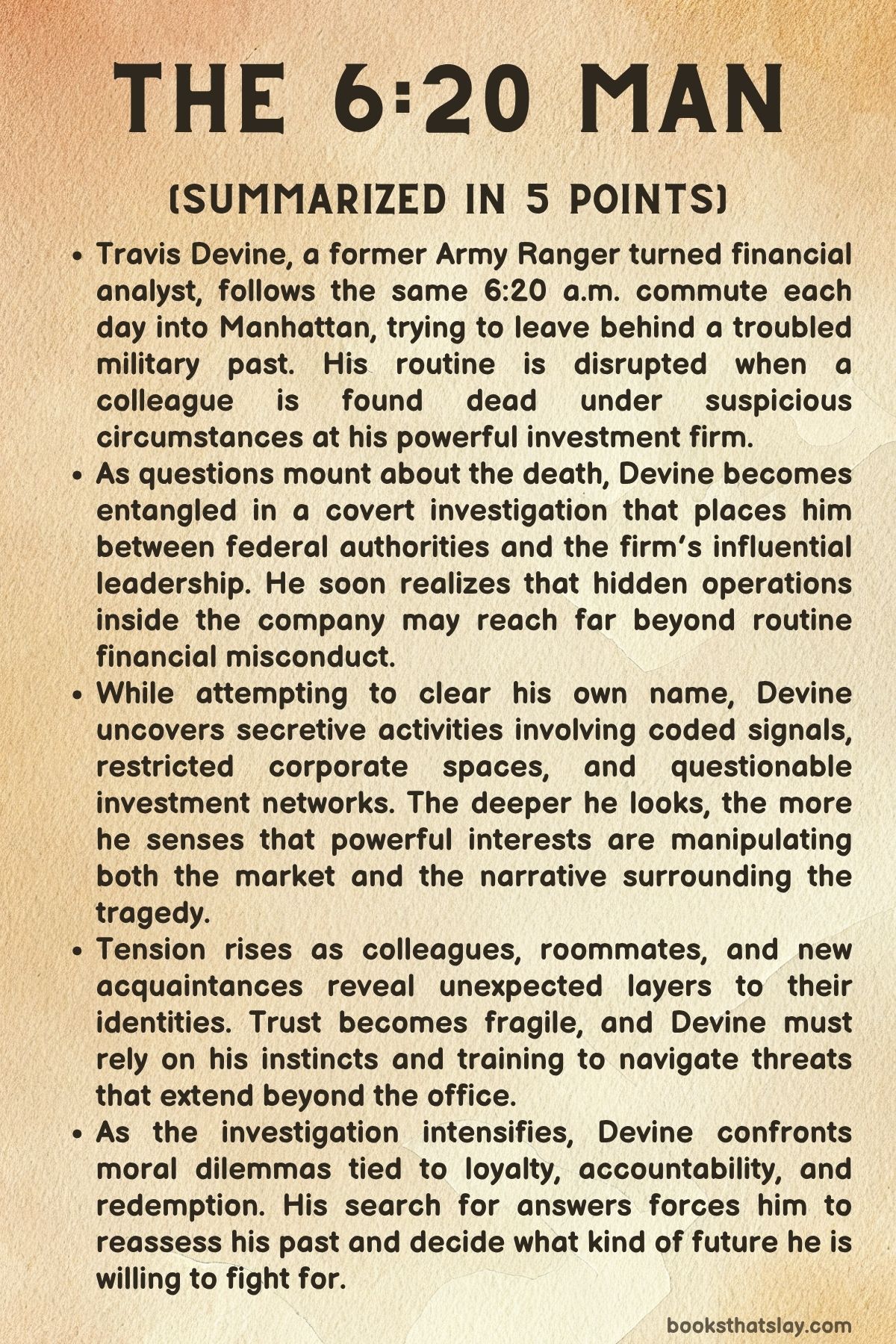
Summary
Travis Devine is thirty-two years old and living a life that feels like penance. Each morning he boards the 6:20 a.m.
train from Mount Kisco to Manhattan, dressed in a modest suit that never quite fits his former identity as a soldier. Once an Army Ranger with a promising future, Devine left the military under a cloud of tragedy.
An incident overseas resulted in the death of a fellow officer, followed by violence that the military quietly buried. Devine carries that burden daily, believing that his current job in finance is a form of self-imposed punishment.
He works at Cowl and Comely, a prestigious investment firm led by the charismatic and immensely wealthy Brad Cowl. Devine is far from the top of the corporate hierarchy.
While Cowl travels in luxury cars and lives in a sprawling estate visible from the commuter train, Devine shares a townhouse with three roommates: Will Valentine, a cybersecurity specialist from Russia; Helen Speers, a law student; and Jill Tapshaw, founder of a dating app called Hummingbird. Devine’s only indulgence is a BMW motorcycle.
Otherwise, his life is restrained and tightly controlled.
During his commute, the train slows as it passes Cowl’s mansion. There, passengers often glimpse a woman swimming in the backyard pool.
One morning she removes her swimsuit and enters the water naked, aware that the train provides an audience. Devine senses something unsettling beneath the display.
The swimmer is Michelle Montgomery, Cowl’s companion.
Devine’s routine fractures when he receives an anonymous email informing him that Sara Ewes, a colleague, has been found dead in a supply closet at the firm. Though their romantic involvement had been brief, Devine is shaken.
Management quickly labels the death a suicide, but inconsistencies trouble him. Soon after, a man posing as NYPD Detective Karl Hancock begins questioning him about Sara and his military background.
The pressure escalates when Devine is approached by Emerson Campbell, a federal operative with ties to Devine’s past. Campbell reveals that the military incident Devine thought was buried could be reopened.
In exchange for silence, Devine must secretly investigate Cowl and Comely. The Department of Homeland Security suspects the firm of serious financial crimes.
Devine has no real choice. He becomes an unwilling informant, trapped between law enforcement, federal intelligence, and his powerful employer.
As Devine digs deeper, Sara’s death is reclassified as murder. Evidence suggests staging.
Security logs place Devine in the building at the time of her death, though he knows he was not responsible. Someone is manipulating digital records to frame him.
Meanwhile, he uncovers signs of a hidden operation on the firm’s restricted fifty-first floor, known internally as Area 51. Rumors point to high-speed trading servers and possibly illegal financial activity tied to an entity called the Locust Group.
Devine follows leads outside the office. He trails Jennifer Stamos, another employee who had been close to Sara.
He also encounters Christian Chilton, a wealthy entrepreneur connected to both Montgomery and Tapshaw’s company. Violent confrontations begin to occur.
Devine is attacked more than once, suggesting that powerful interests want him silenced.
Through his investigation, Devine learns that Montgomery’s poolside appearances may not be random acts of exhibitionism. The color of her swimsuits appears to correspond with trading signals observed by commuters tied to financial markets.
The pool becomes a covert communication channel, a visual code used to transmit information to traders on the train. Cowl has been orchestrating this display as part of a sophisticated insider trading and money laundering scheme.
The Locust Group emerges as a central player. Funds are routed through shell companies and international networks, eventually influencing political campaigns in the United States.
Campbell suggests that Cowl is not the ultimate authority but a conduit for even more powerful figures. Devine realizes he is entangled in a network that blends corporate greed with national security threats.
As he pushes forward, the body count rises. Jennifer Stamos is murdered.
Sara’s parents are later killed as well, deepening the horror and intensifying suspicion around Devine. Christian Chilton is found dead in Cowl’s pool.
Each death appears connected, yet motives remain obscured. Devine’s own roommates become sources of doubt.
He discovers a firearm in Speers’s room. Valentine’s technical expertise and mysterious background raise questions.
Tapshaw’s startup receives a large investment from Chilton, money that may be tied to the laundering scheme.
Devine infiltrates the fifty-first floor using a duplicate of Cowl’s phone, capturing evidence of massive trading activity linked to the Locust Group and Mayflower Enterprises. But before authorities can act, the entire operation vanishes overnight.
Servers are removed. Data is erased.
The floor stands empty. It becomes clear that the conspiracy reaches into government agencies capable of shutting down investigations.
In a climactic confrontation at Cowl’s residence, Devine and Montgomery are ambushed by Hancock and armed men. Montgomery reveals she has been more than a passive participant; she carries a concealed weapon.
Devine overpowers the attackers, capturing Cowl and Hancock. Yet before justice can be secured, both men are eliminated, silenced by forces higher up the chain.
The focus then shifts to Devine’s own household. A gas leak nearly kills him and his roommates.
Evidence points to Valentine’s involvement in the broader scheme. Suspicion intensifies, but the final revelation is more personal and devastating.
Tapshaw confronts Devine at gunpoint. Her cheerful ambition masks a darker history.
She confesses that her brother Dennis had been connected to Sara Ewes and had taken his own life after emotional turmoil involving her. Tapshaw blames Sara and others for manipulating him.
Her involvement in Hummingbird allowed her to gather information and orchestrate revenge. She manipulated financial channels, exploited connections to Chilton, and committed multiple murders, including Sara’s, to satisfy a desire for retribution.
Her actions merged personal vengeance with the chaos already unfolding inside Cowl and Comely.
In the final struggle, Tapshaw shoots Devine in the shoulder. Helen Speers intervenes and kills Tapshaw.
Speers then reveals her true identity as an undercover operative embedded to monitor financial crimes linked to Cowl’s firm. Her relationship with Devine, once ambiguous, gains new clarity.
Her feelings for him, though genuine, were complicated by her assignment.
Devine recovers in the hospital, physically wounded but morally steadier than before. The vast laundering network has been disrupted but not fully dismantled.
Many architects of the conspiracy remain beyond reach. Still, Devine has confronted both external corruption and his internal guilt.
The shame he carried from his military past no longer defines him.
In the closing moments, Devine rides the 6:20 train again. Cowl’s mansion stands for sale, stripped of its aura.
The pool is empty. The coded swimsuits and secret signals are gone.
Devine understands that power can vanish quickly, yet corruption rarely disappears entirely. He moves forward with a new purpose, offered an opportunity to work in a capacity more aligned with his sense of justice.
His journey from soldier to reluctant financier to investigator has reshaped him. Though the world remains dangerous and imperfect, Devine is no longer punishing himself.
He has chosen action over silence, truth over comfort, and accountability over fear.
Characters
Travis Devine
Travis Devine is built around contradiction: a disciplined former Army Ranger who now performs corporate obedience in a job he neither respects nor enjoys. His daily routine, plain clothing, and restrained lifestyle signal a man trying to stay invisible, yet his instincts push him toward confrontation and truth-seeking.
The core of Devine’s character is guilt—he believes he deserves a diminished life because of a lethal incident tied to his military past. That self-punishment shapes how he relates to power: he resents wealth like Brad Cowl’s, but he also watches it closely, studying the rules of an environment he refuses to admire.
When Sara Ewes dies, Devine’s moral center reasserts itself; he cannot accept tidy explanations, especially when the evidence feels staged. His combat training makes him effective under pressure, but his greater strength is endurance—he continues investigating even when the system turns on him, his reputation collapses at work, and he is repeatedly placed in physical danger.
Across the story, Devine moves from passive atonement to active responsibility, choosing to act not because he expects redemption, but because he can’t tolerate being used as someone else’s disposable scapegoat.
Brad Cowl
Brad Cowl is the face of polished corporate dominance, but he’s less a mastermind than a skilled operator who profits from appearing untouchable. He cultivates a myth of self-made success and uses wealth as a weapon: private elevators, hidden floors, and an inner circle that reinforces his control.
Cowl’s defining trait is instrumental thinking—people are assets, liabilities, distractions, or leverage. His relationship with Jennifer Stamos shows his preference for hierarchy even in intimacy; he positions himself as patron and judge, measuring others by their usefulness and obedience.
With Michelle Montgomery, he weaponizes her visibility, turning her into a signaling device and a tool for control, which exposes the cruelty beneath his charm. Yet Cowl is also fearful in a way that matters: when pushed, he reveals he answers to forces above him.
That tension makes him a realistic portrait of a high-status gatekeeper—dangerous not only because of what he does personally, but because he provides access and cover for larger systems of corruption.
Michelle Montgomery
Michelle Montgomery initially appears as spectacle—an alluring presence glimpsed from a commuter train—but the novel gradually shows that this visibility is part performance, part coercion, and part survival strategy. Her public display is not simple vanity; it becomes a symbol of how powerful men can turn someone’s body and reputation into a functional tool.
Montgomery’s deeper conflict is insecurity paired with intelligence: she feels judged as less educated or less legitimate in elite spaces, yet she’s observant and increasingly strategic once she understands the danger around her. Her financial dependence on Cowl complicates every choice she makes; she is not fully free, but she is not helpless either.
As the story progresses, she shifts from being watched to watching, from being used to taking calculated risks of her own. Her relationship with Devine is shaped by mistrust and testing—she wants connection, but she also knows proximity can be exploited as a trap.
By the end, Montgomery reads as someone trying to reclaim agency in an environment designed to strip it away, learning to survive without surrendering her ability to choose.
Sara Ewes
Sara Ewes functions as the story’s ignition point, but she isn’t merely a victim-shaped mystery. Even through limited direct presence, she emerges as a person living under pressure, secrecy, and fear.
Her conversations about art and meaning, including her interest in Waiting for Godot, suggest a mind trying to name emptiness and control in a world that treats people as replaceable. The missing diary implies she kept records not for sentimentality, but because she felt unsafe and needed proof.
Her connection to multiple characters makes her death threatening to the powerful: she seems to have seen something she wasn’t supposed to see, or to have become inconvenient at the wrong moment. Sara’s narrative impact is that she forces everyone else to reveal who they are under stress—Devine’s conscience, Cowl’s evasions, Stamos’s fear, Tapshaw’s hidden rage.
She represents the danger of knowing too much in a system where secrecy is protected more aggressively than human life.
Jennifer Stamos
Jennifer Stamos is presented at first through the lens of office rumor and male attention, but her character deepens into a sharp portrait of survival within corporate gender politics. She understands that proximity to power can look like privilege while actually functioning like captivity.
Her affair with Cowl is not framed as a simple scandal; it is also a reflection of how influence can be traded for protection, advancement, or the illusion of control—until the balance shifts and the person with less power becomes expendable. Stamos’s guardedness around Sara Ewes reads as fear rather than indifference, suggesting she knows the costs of speaking too openly.
Her conversations with Devine show a person trying to set boundaries in a workplace that erodes them, and her insistence that he delete photos of her with Cowl signals both shame and a practical understanding of how evidence can be weaponized. Her murder underscores a central theme: in corrupt systems, the people closest to the truth are often removed first, not because they are the guiltiest, but because they are the most vulnerable.
Emerson Campbell
Emerson Campbell is the novel’s embodiment of state power operating in shadows—someone who speaks in choices that aren’t really choices and treats individuals as instruments in larger missions. His relationship to Devine is built on leverage: he uses Devine’s buried military incident as a pressure point to force cooperation.
Yet Campbell isn’t portrayed as purely villainous; he comes across as pragmatic, convinced that the threat landscape requires morally compromised methods. He believes ends justify means, especially when national security is invoked, and he is skilled at manipulating narratives so that his actions appear necessary.
At the same time, his limitations become clear: even he runs into invisible walls when political interests and institutional protection converge. Campbell’s role highlights the uncomfortable overlap between justice and strategy—he wants outcomes, not courtroom purity, and his presence raises the question of how often “security” is used to excuse secrecy and collateral damage.
“Karl Hancock” / Bartlett
The man calling himself Karl Hancock is a predator masquerading as authority. By adopting the identity of a detective, he gains access, intimidates targets, and manufactures pressure without the procedural constraints real law enforcement would face.
His character is defined by professional violence: he threatens, orchestrates attacks, and attempts to frame Devine and Montgomery when events turn against his employers’ interests. The later reveal of his background as an ex-CIA operative reframes him as part of a world where identities are tools and truth is flexible.
He represents the privatization of coercion—someone who has moved from official structures into deniable operations for powerful clients. Hancock/Bartlett is frightening not because he is complicated, but because he is efficient: he knows how to exploit fear, create false narratives, and erase evidence, and he expects obedience as the default response to force.
Will Valentine
Will Valentine appears as the brilliant roommate with elite technical skills, and his temperament—dry, guarded, often humorous—makes him easy to underestimate. His expertise becomes essential when Devine needs to trace anonymous communications and breach corporate systems, and Valentine’s willingness to help suggests loyalty on the surface.
But his emotional distance and carefully controlled personal story signal that he is practiced at concealment. The later suspicion around him works because the groundwork is there: he can disappear, he can manipulate digital trails, and he has the kind of background that could plausibly intersect with transnational financial crime.
Valentine also embodies a recurring theme of the story: competence without transparency. His skills can protect friends or destroy them, and the uncertainty around his motives keeps tension alive even in domestic spaces that should feel safe.
Helen Speers
Helen Speers is written as composed and ambitious, someone navigating systems stacked against her while keeping her emotions tightly contained. Early on, she seems like the most grounded of Devine’s roommates—practical, observant, and capable of reading risk.
Her later reveal as an undercover operative forces a re-evaluation of her earlier choices: her proximity to Devine, her legal focus, and her watchfulness gain a dual meaning as both personal and professional. Speers complicates the novel’s discussion of trust because she is both sincere and strategic; she can care about Devine while also managing him as part of a mission.
The firearm Devine discovers in her room acts as a symbol of that duality—she is not merely studying power, she is trained to meet it with force. Speers ultimately represents controlled identity: a person who survives by compartmentalizing, whose real challenge is deciding where duty ends and genuine attachment begins.
Jill Tapshaw
Jill Tapshaw is the most striking example of misdirection in The 6:20 Man because she initially reads as energetic, quirky, and harmless—a founder absorbed in her dating app, casually ambitious, socially integrated into the roommate dynamic. That surface charm is part of what makes her later actions so chilling.
Tapshaw’s psychology is driven by unresolved grief and obsession, and she channels that pain into a carefully engineered revenge campaign. Her company and her social persona become camouflage for surveillance, manipulation, and ultimately murder.
The turning point with her confession reveals that she is not acting out of impulsive rage; she is strategic, patient, and capable of playing long games, using investments, relationships, and digital tools as weapons. Tapshaw also embodies how personal trauma can be distorted into moral certainty—she justifies escalating violence as correction, as punishment, as balance.
In the end, she isn’t simply “the culprit”; she is a portrait of someone who turns intelligence and entrepreneurship into instruments of harm when grief hardens into ideology.
Rachel Potter
Rachel Potter represents the media as pressure system rather than neutral observer. She pursues Devine not to understand him but to extract usable narrative—angles, scandal, implication.
Her methods reveal how easily public perception can be shaped in real time, especially when official information is scarce and rumors fill the vacuum. Potter’s presence increases Devine’s vulnerability because she can make suspicion contagious; even if he proves innocence, headlines and insinuations can linger.
She functions as a reminder that danger in the story isn’t only physical or legal—it is reputational, and reputation can be destroyed with questions that never need to be answered.
Elaine Nestor
Elaine Nestor operates as a counterpoint to Potter: still part of the information ecosystem, but oriented toward patterns and systems rather than quick spectacle. She brings historical knowledge and social context that helps Devine and Montgomery interpret what they are seeing, especially the financial and real-estate dimensions of the scheme.
Nestor’s value is her long memory—she understands that elite wrongdoing often repeats in recognizable forms, dressed in new technology and new terminology. She also serves as a conduit for closure, the person Devine can bring information to without expecting the immediate distortion of the facts into sensationalism.
Wanda Simms
Wanda Simms is a gatekeeper figure inside Cowl and Comely—someone who has survived long enough to understand that the firm runs on controlled access and selective blindness. Her early insistence that Sara Ewes died by suicide reflects the company’s reflex to contain damage and protect leadership.
Whether she believes the narrative or repeats it out of fear, she functions as the human face of corporate self-preservation. Simms illustrates how institutions maintain secrecy not only through technology and security guards, but through employees trained to normalize silence.
Sam
Sam, the security guard, is one of the story’s quieter but important moral figures. He doesn’t have power in the corporate hierarchy, yet he notices patterns—an oddly quiet morning, a door left ajar, details that suggest the scene could have been tampered with.
His willingness to talk to Devine shows a modest integrity: he is not playing a grand game, he is responding to what doesn’t add up. Sam represents the theme that truth often survives in the observations of people who are overlooked, the ones who watch doors and hallways while executives control narratives upstairs.
Jerry Myers
Jerry Myers, the custodian who discovers Sara Ewes’s body, sits at the intersection of vulnerability and information. His access to spaces others overlook makes him both useful and dangerous to conspirators; he can unintentionally disrupt staging or notice inconsistencies simply by doing his job.
The fact that he later ends up dead suggests he knew something, or was made to look like he did. Myers’s arc reinforces a bleak idea running through the novel: in systems designed to protect powerful criminals, low-status witnesses are the easiest to remove.
Christian Chilton
Christian Chilton is a social predator with an investor’s veneer, the sort of man who uses money and charm as entry tools and intimidation as follow-up. His interest in Tapshaw’s company is not purely financial; it has the feel of strategy, as if access to Hummingbird and its data matters as much as profits.
Chilton’s interactions oscillate between friendly and threatening, revealing a person who wants control of the room at all times. His association with Montgomery and the Locust Group positions him as a connector—someone who moves between elite circles and questionable networks.
His eventual death clarifies that he was never truly safe, even with wealth; in this world, being useful protects you only until you become inconvenient.
Danny Devine
Danny Devine functions largely as contrast for Travis: the successful sibling whose achievements highlight Travis’s sense of being the family outlier. Danny’s presence in the background helps define Travis’s emotional landscape—where approval feels scarce, comparisons feel constant, and personal worth is measured against conventional success.
Even without dominating the plot, Danny contributes to why Travis accepts punishment as normal; he has lived for years inside a family dynamic where he feels secondary.
Claire Devine
Claire Devine, like Danny, is part of the pressure Travis carries rather than the action on the page. She represents the kind of stability and professional accomplishment that Travis believes he forfeited, first through military scandal and then through his choice to bury himself in a job he dislikes.
Claire’s role in the story is to sharpen the theme of identity: Travis isn’t only running from external threats, he’s running from the version of himself he thinks his family expected.
Mr. and Mrs. Ewes
Sara Ewes’s parents are portrayed as rigidly moral, convinced of their own righteousness, and emotionally damaging in the way they frame their daughter’s life and choices. Their insistence on a missing diary suggests both love and control: they want answers, but they also want to define what those answers mean.
Mrs. Ewes’s harsh judgment, particularly around sexuality and reproductive decisions, adds a social dimension to Sara’s fear and isolation. Their later deaths intensify the stakes of the conspiracy plot, but they also underline how family systems can fail someone long before any external villain appears.
Themes
Guilt and Self-Imposed Punishment
Travis Devine’s emotional landscape is defined by unresolved guilt, and this guilt functions not simply as backstory but as a governing force in his present life. His departure from the Army under shadowed circumstances leaves him convinced that he deserves a diminished existence.
Instead of pursuing meaningful work aligned with his values, he chooses a monotonous and morally ambiguous job in high finance. The repetition of his commute, the plainness of his lifestyle, and his refusal to indulge in luxury all reflect a subconscious sentence he has imposed on himself.
He equates comfort with unearned absolution.
This inner punishment shapes his responses to danger and injustice. When Sara Ewes is declared a suicide victim, Devine’s refusal to accept that explanation stems partly from his own experience with official cover-ups.
He knows what institutions are capable of hiding because he has benefited from such concealment before. His determination to uncover the truth becomes an indirect way of confronting his past.
Instead of running from culpability, he steps toward risk. The novel positions guilt not as weakness but as a catalyst; it pushes Devine to act where others remain silent.
However, guilt also clouds his judgment. He initially suspects himself capable of moral failure in the present because he believes he has already failed irreparably in the past.
His struggle is not merely to survive accusations of murder but to redefine his own identity beyond a single violent episode. Over the course of the narrative, Devine’s arc suggests that redemption is not granted through suffering alone.
It requires active responsibility, moral courage, and a willingness to confront corruption without hiding behind shame. His journey transforms guilt from a prison into a motive force that leads him toward accountability rather than self-erasure.
Corruption and the Illusion of Legitimacy
The corporate world depicted in The 6:20 Man operates behind polished glass and carefully crafted narratives, yet beneath that surface lies a system sustained by secrecy and exploitation. Cowl and Comely presents itself as a prestigious investment firm driven by talent and ambition, but its internal operations reveal manipulation, hidden trading floors, and coded signals designed to exploit financial markets.
The presence of the fifty-first floor, physically elevated and restricted, becomes a metaphor for concealed authority. Those at the bottom see only what they are permitted to see, while decisions that shape markets and politics occur out of view.
Brad Cowl embodies this illusion of legitimacy. He speaks the language of entrepreneurship and merit, yet his power depends on bending rules and collaborating with shadowy financial entities.
The Locust Group and its international connections widen the scope of corruption, suggesting that the firm’s misconduct is not isolated but embedded in a broader network that includes political influence. Funds laundered through complex channels eventually shape policy through campaign donations, blurring the line between private wealth and public governance.
The narrative underscores how corruption survives through performance. Michelle Montgomery’s swimsuit signals appear frivolous at first glance, but they function as covert communication tools.
The spectacle distracts observers from its true purpose. Similarly, the firm’s employees, security systems, and official statements reinforce a story of order while concealing criminality.
Even law enforcement figures are compromised or impersonated, eroding trust in institutions meant to protect justice. The novel suggests that corruption thrives not only because individuals are greedy, but because systems are designed to reward secrecy and shield those who control information.
Legitimacy becomes a costume worn by power, and dismantling that costume requires exposing the hidden mechanisms beneath it.
Surveillance, Identity, and Control
Control in the novel is exerted through observation. Security logs track employee movements.
Emails are encrypted or disguised. Hidden cameras monitor restricted floors.
Even a swimming pool becomes part of a signaling apparatus. In this environment, identity is unstable because it can be manipulated by whoever controls the data.
Devine’s presence in the building on the night of Sara’s murder is digitally fabricated, demonstrating how easily technological records can be weaponized. Truth becomes negotiable when surveillance systems are controlled by those with motive to distort them.
The false detective Hancock further complicates the idea of authority. By assuming an official identity, he gains power over Devine without legal legitimacy.
His performance reveals how fragile public trust can be; a badge and confident demeanor are often enough to command obedience. Meanwhile, Helen Speers’s eventual revelation as an undercover operative challenges Devine’s assumptions about intimacy and transparency.
Personal relationships are shaped by hidden assignments and concealed loyalties.
Michelle Montgomery’s body is also subject to surveillance. What appears to be voluntary exhibition becomes part of a larger scheme orchestrated by Cowl.
Her visibility is curated and exploited, turning her into both signal and spectacle. The novel repeatedly emphasizes that to be watched is to risk losing autonomy, especially when observers hold more power.
Yet surveillance is not one-directional. Devine observes Cowl, tracks transactions, and infiltrates restricted spaces.
By reclaiming the act of watching, he shifts from target to investigator. The struggle over information mirrors the struggle over identity; whoever controls the narrative controls how others are perceived.
The story suggests that in a data-driven world, selfhood itself becomes vulnerable to manipulation unless one actively resists imposed definitions.
Revenge, Justice, and Moral Ambiguity
The line between justice and revenge grows increasingly unstable as the story progresses. Jill Tapshaw’s transformation from supportive roommate to calculated killer forces a reconsideration of motive and morality.
Her grief over her brother’s death evolves into a belief that she alone must correct the perceived wrongs done to him. She uses intelligence, technology, and financial networks to carry out murders she frames as necessary retribution.
In her mind, she is restoring balance. Yet her actions demonstrate how easily personal pain can rationalize escalating violence.
Devine faces his own moral ambiguities. His willingness to break into restricted floors, manipulate evidence, and conceal information places him outside strict legality.
However, his choices are driven by a desire to prevent further harm rather than to settle personal scores. The contrast between Devine and Tapshaw highlights intention as a critical dividing line.
Both operate beyond official boundaries, but one seeks truth while the other seeks punishment.
The broader conspiracy complicates ideas of justice even further. Cowl and Hancock are arrested only to be silenced by forces higher up the hierarchy, suggesting that formal accountability is fragile when powerful interests are threatened.
Institutional justice proves inconsistent, sometimes obstructed by politics or influence. As a result, characters are forced to navigate ethical gray zones where the legal path may not align with moral necessity.
By the conclusion, revenge is shown to be corrosive, consuming the person who pursues it and expanding harm rather than containing it. Justice, by contrast, is portrayed as incomplete but necessary, dependent on courage and persistence rather than guaranteed outcomes.
The novel ultimately argues that while systems may fail, individual choices still matter. Acting with integrity, even in compromised circumstances, is presented as the only sustainable response to corruption and betrayal.