The Adventures of Ulysses Summary, Characters and Themes
The Adventures of Ulysses by Bernard Evslin is a retelling of the Greek hero Ulysses’s long journey home after the Trojan War. It presents myth as a fast-moving adventure filled with gods, monsters, temptations, betrayals, and tests of courage.
The story follows Ulysses from his victory at Troy through years of punishment by Poseidon, as he struggles to return to Ithaca, his wife Penelope, and his son Telemachus. The book turns ancient legend into a dramatic tale about intelligence, endurance, pride, loyalty, and the painful cost of becoming a hero.
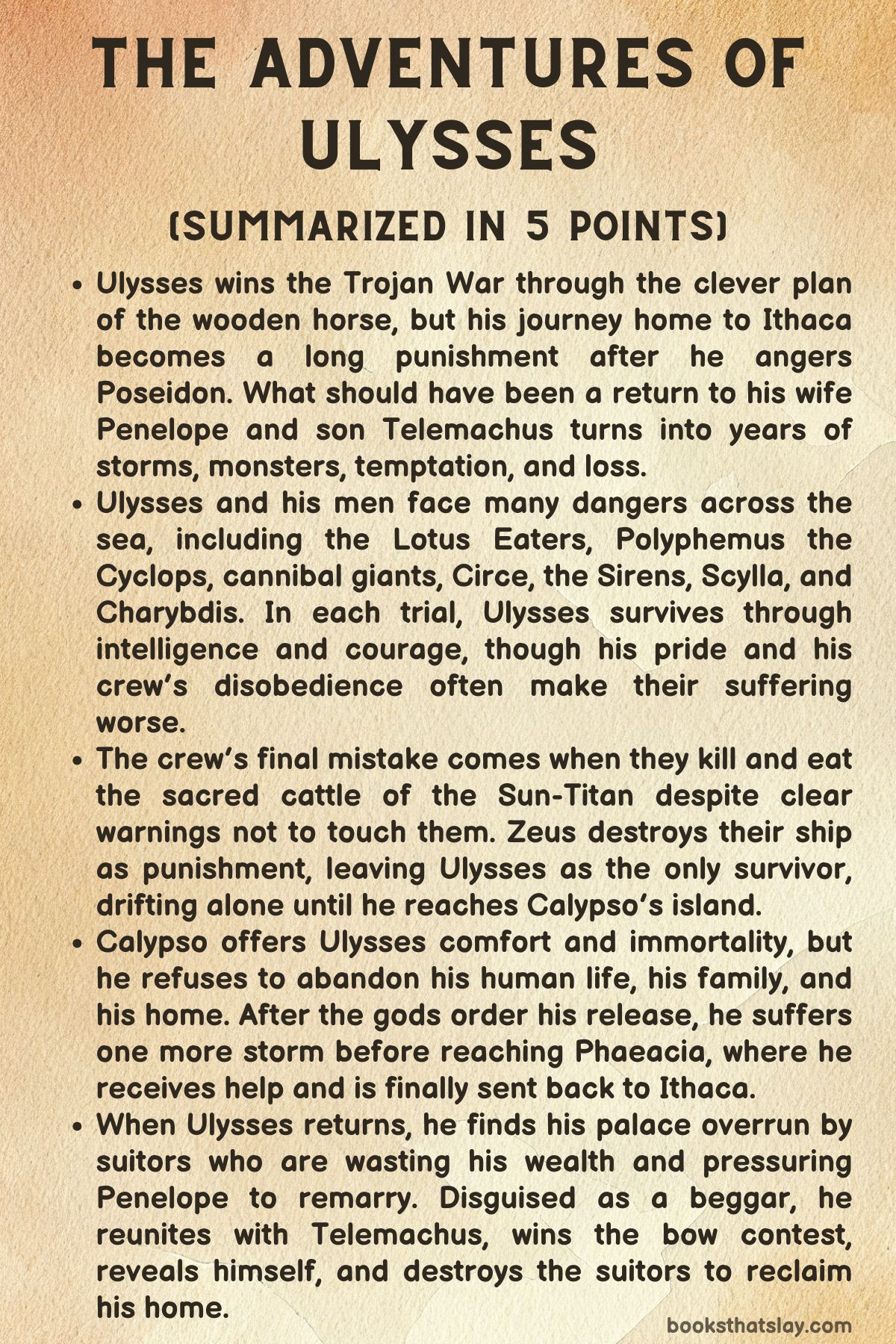
Summary
The Adventures of Ulysses begins with the cause of the Trojan War. At the wedding of Peleus and Thetis, Eris, the goddess of discord, arrives in anger because she has not been invited.
She leaves behind a golden apple meant for the fairest goddess, and Hera, Athene, and Aphrodite each claim it. Paris, secretly a prince of Troy, is chosen to judge the contest.
Hera offers power, Athene offers wisdom, and Aphrodite offers him the most beautiful woman in the world. Paris chooses Aphrodite and is led to Helen, wife of Menelaus of Sparta.
When Paris takes Helen to Troy, the Greeks gather to fight for her return.
The war lasts ten years. The Trojans hold out behind their walls, even after the death of Hector, their greatest warrior.
Ulysses finally wins the war not through strength but through strategy. He designs the wooden horse, hides Greek warriors inside it, and tricks the Trojans into dragging it into their city.
At night, the warriors emerge, open the gates, and the Greeks destroy Troy. Ulysses then sets out for Ithaca, hoping to return to his wife Penelope and son Telemachus, but Poseidon becomes his enemy and condemns him to years of wandering.
Ulysses begins the voyage with three ships and many men, but early mistakes weaken them. His crew attacks the Ciconians, taking wealth and food instead of sailing on quickly.
The Ciconians strike back, killing many Greeks and damaging the ships. When the vessels begin to sink under the weight of stolen treasure, Ulysses orders the gold thrown into the sea.
This angers Poseidon further, and the god drives them toward strange and dangerous lands.
The men reach the land of the Lotus Eaters, where a magical flower makes people forget sorrow, duty, and home. Ulysses’s crew eats the lotus and loses all desire to leave.
Ulysses nearly gives in but resists, dragging his men back to the ships and forcing them onward. His dreams there hint at greater horrors ahead, including monsters, shipwrecks, and a one-eyed giant.
Soon after, hunger leads the men to the island of the Cyclopes. In the cave of Polyphemus, they eat roasted meat without knowing that the owner is a man-eating giant.
Polyphemus traps them inside, eats several sailors, and plans to devour them all. Ulysses uses wine and deception to survive, calling himself Nobody before blinding the giant.
He and his men escape by clinging beneath the giant’s goats. Yet Ulysses’s pride betrays him.
As they flee, he reveals his real name. Polyphemus, the son of Poseidon, prays for revenge, asking that Ulysses suffer storms, loss, years of wandering, and trouble at home.
Poseidon grants the curse.
Ulysses next comes to the island of Aeolus, keeper of the winds. Aeolus enjoys Ulysses’s stories and gives him a bag containing dangerous winds, leaving only a gentle west wind to carry him home.
Ithaca comes into sight, but Ulysses falls asleep. His men, thinking the bag contains treasure, open it and release the winds.
The ships are blown back to Aeolus, who refuses to help again after realizing Poseidon hates Ulysses.
The fleet then lands in a cove ruled by cannibal giants. The giants slaughter most of the men and smash two ships.
Ulysses escapes with only one vessel and a reduced crew. The survivors arrive at the island of Circe, a powerful sorceress.
Some of the men enter her home, eat her enchanted food, and are changed into pigs. Eurylochus escapes and warns Ulysses.
With help from Hermes, Ulysses resists Circe’s magic, forces her to swear not to harm him, and makes her restore his men.
For a time, Ulysses and his crew live comfortably with Circe. Ulysses is tempted to forget Ithaca, especially as Circe loves him and offers pleasure, safety, and ease.
Yet he remembers his oath and his family. Circe warns him that his path home will still be terrible and that he must visit the Land of the Dead before he can continue.
Ulysses sails west into darkness and reaches the underworld. There he speaks with ghosts who give him warnings.
His mother tells him about the troubles at home, where Penelope is surrounded by suitors. Achilles warns him about the Sirens.
Ajax, still bitter over losing Achilles’s armor to Ulysses, declares his hatred. Elpenor, a dead crewman, asks for a memorial.
Teiresias, the prophet, gives the most important warning: Ulysses and his men must not eat the sacred cattle of the Sun-Titan, or none of the crew will return home.
Back at sea, Ulysses tries to avoid the dangers he has been warned about, but moving rocks force him toward them. First he faces the Sirens.
He blocks his men’s ears with wax and has himself tied to the mast so he can hear the song without leaping into death. The song nearly overpowers him, but his men hold him fast, and the ship passes safely.
Then comes the strait of Scylla and Charybdis. Charybdis is a monstrous force that swallows and spits out the sea, creating a whirlpool that can destroy the whole ship.
Scylla is a six-headed creature who snatches sailors from passing vessels. Ulysses chooses the lesser disaster, steering away from Charybdis though it means losing six men to Scylla.
He survives, but the cost is awful.
The crew reaches the island where the sacred cattle graze. Ulysses warns his men not to touch them, but bad winds trap them there for a month.
Hunger wears them down. While Ulysses sleeps, Eurylochus convinces the men to kill the cattle, arguing that a full death is better than slow starvation.
They eat the forbidden meat and bring divine punishment upon themselves. When they sail again, Zeus destroys the ship with lightning.
Every man dies except Ulysses, who clings to wreckage and drifts alone. He narrowly survives Charybdis again and eventually reaches Ogygia, the island of Calypso.
Calypso rescues Ulysses, heals him, and claims him as her husband. She is beautiful, powerful, and immortal.
She shows him visions of his greatness and offers him eternal life. For a time, Ulysses enjoys the island, but his longing for home returns.
He learns that Penelope still waits and that Telemachus is in danger. Calypso tries to persuade him to stay by showing him the pain, age, and death waiting in Ithaca, but Ulysses refuses immortality.
Without mortality, courage would mean nothing to him. The gods finally decide he has suffered enough, and Hermes orders Calypso to let him go.
Ulysses leaves on a boat, but Poseidon attacks again, wrecking it in a storm. The sea nymph Ino gives him a magical veil that keeps him from sinking, and he swims for days until he reaches Phaeacia.
There Princess Nausicaa finds him bruised and naked by a river. She treats him kindly and brings him to her parents, King Alcinous and Queen Arete.
Though the king first fears that Ulysses may bring Poseidon’s anger upon them, Ulysses proves his strength and reveals his identity. The Phaeacians honor him, give him gifts, and send him home to Ithaca.
At last, after twenty years away, Ulysses returns. But Ithaca is no safe homecoming.
Suitors have invaded his palace, consumed his wealth, threatened his son, and pressured Penelope to choose a new husband. Ulysses hides his treasure and disguises himself as a beggar.
He visits the loyal swineherd Eumaeus, then reunites with Telemachus. Father and son plan their revenge.
In the palace, Ulysses remains disguised. His old dog recognizes him and dies.
The suitors insult and abuse him, but he waits for the right moment. Penelope, still unaware of his identity, speaks with him, and he gently guides her toward holding a contest using Ulysses’s great bow.
Whoever can string the bow and shoot an arrow through twelve axe rings will win her hand.
The suitors fail one by one. The disguised Ulysses asks to try.
They mock him, but Telemachus allows it. Ulysses strings the bow easily and shoots the arrow perfectly through the axe rings.
Then he reveals himself and claims what is his. With Telemachus, Eumaeus, and a loyal servant beside him, he kills the suitors in a fierce battle.
The book ends with Ulysses victorious, reunited with his son, and ready to reclaim his place beside Penelope as king of Ithaca.
Characters
Ulysses
Ulysses is the central figure of The Adventures of Ulysses, and he is defined by a mixture of intelligence, courage, pride, endurance, and longing. He is not the strongest hero in Greek legend, but he is one of the most resourceful.
His victory at Troy comes through planning rather than brute force, and the same quality saves him repeatedly during his journey home. He tricks Polyphemus with the name Nobody, survives Circe through caution and divine help, passes the Sirens by preparing for his own weakness, and returns to Ithaca through disguise and strategy.
His mind is his greatest weapon, but it is also tied to his flaws. He often understands danger better than his men, yet he cannot always control his pride.
His decision to reveal his name to Polyphemus turns a local escape into a long curse from Poseidon.
Ulysses is also a leader under severe pressure. He commands men who are tired, hungry, frightened, greedy, and sometimes openly disobedient.
He saves them again and again, but he cannot save them from every monster or from their own impulses. His leadership carries guilt because nearly all his companions die before he reaches home.
The book presents him as brave but not untouched by error. He is tempted by pleasure, fame, love, safety, and immortality, yet he keeps returning to the idea of Ithaca.
His refusal of Calypso’s offer shows the deepest part of his character. He does not simply want to live; he wants a human life with loyalty, risk, age, love, duty, and death.
Ulysses becomes heroic not because he avoids weakness, but because he struggles through it and still chooses home.
Penelope
Penelope is the emotional center of Ithaca and the strongest symbol of patient loyalty in the book. Though she appears mainly through reports, visions, and the final return, her influence shapes Ulysses’s choices throughout his journey.
She is not passive in any simple sense. Surrounded by suitors who want her wealth, position, and body, she survives through intelligence rather than force.
Her trick of weaving a funeral shroud by day and undoing it at night shows that she possesses a quiet cleverness that mirrors Ulysses’s own. She cannot fight the suitors directly, but she can delay them, mislead them, and preserve the possibility of her husband’s return.
Penelope’s strength lies in restraint. She lives in uncertainty for twenty years, not knowing whether Ulysses is alive or dead.
The pressure on her is both emotional and political, because choosing a new husband would decide the future of Ithaca. Her refusal to surrender quickly protects Telemachus, honors her marriage, and keeps Ulysses’s household from fully falling into enemy hands.
When she speaks with the disguised Ulysses, she responds most deeply to the story of her voice being imitated near the Trojan Horse. This detail suggests that what she values most is not fame or treasure but proof of emotional truth.
Penelope represents memory, fidelity, and intelligence under pressure. In the world of the story, where many characters are overwhelmed by desire, hunger, pride, or fear, she survives by waiting with purpose.
Telemachus
Telemachus begins as the son of an absent hero, forced to grow up in a house occupied by men who disrespect his family and threaten his future. His position is dangerous because he is old enough to challenge the suitors but not powerful enough to defeat them alone.
His journey to search for news of his father shows both courage and immaturity. He wants to act, but he does not yet have the experience or strength to restore order by himself.
His return to Ithaca and reunion with Ulysses marks the beginning of his full transformation from endangered son into active defender of the household.
Telemachus’s importance lies in how he completes the idea of home. Ulysses is not returning only to a wife or a throne; he is returning to a son who has grown up without him.
Their embrace at Eumaeus’s hut gives the story one of its most human moments. After that, Telemachus becomes a partner in the plan against the suitors.
He protects Ulysses, supports the archery contest, and fights beside him in the final battle. His bravery is not merely physical.
He must trust a father he barely knows and step into a violent struggle that could easily kill him. Through Telemachus, the book shows that inheritance is not just about blood or property.
It is about courage, loyalty, and the ability to stand beside one’s family when the moment demands it.
Poseidon
Poseidon is the great divine enemy of Ulysses and the force that turns a homeward voyage into years of suffering. His anger begins with the blinding of Polyphemus, his son, but the punishment he inflicts goes far beyond ordinary revenge.
He sends storms, wrecks ships, misleads travelers, and turns the sea itself into a hostile world. Since Ulysses must travel by water, Poseidon controls the very path between the hero and home.
This makes him less like a single opponent and more like a vast condition of existence: the journey cannot be separated from his anger.
Poseidon represents the danger of offending powers greater than oneself. Ulysses defeats Polyphemus through cleverness, but he cannot outwit the consequences of revealing his name.
Poseidon’s rage also shows how the gods in this story are emotional, proud, jealous, and personal. They do not behave like distant moral judges.
They interfere, punish, protect, and compete with one another. Poseidon is cruel, but he is not random.
He acts from wounded family pride and divine authority. His hostility tests whether Ulysses can keep choosing home despite repeated ruin.
By the end, Poseidon cannot stop the hero forever, but he leaves permanent marks on the journey. Ulysses reaches Ithaca stripped of his fleet, his crew, and many illusions about glory.
Circe
Circe is one of the most dangerous and fascinating figures in The Adventures of Ulysses because she combines beauty, hospitality, cruelty, loneliness, and power. Her island at first seems like a refuge after the horrors of the sea, but her home hides a threat more subtle than monsters like Polyphemus or Scylla.
She does not simply kill men; she transforms them, reduces them, and keeps them under her control. By changing Ulysses’s companions into pigs, she exposes the animal hunger already present in them, especially their eagerness for food and comfort after suffering.
Yet Circe is not only a villain. Once Ulysses resists her magic and forces her promise, she becomes a lover, host, and guide.
Her island offers pleasure, food, rest, and escape from danger. That makes her temptation powerful.
She gives Ulysses what he has lacked for so long: comfort. Her danger lies in making him forget Ithaca.
She wants him not through open violence but through delay and attachment. Her former lovers, transformed into animals, suggest what happens to men who surrender their purpose entirely.
Circe’s sadness at his departure shows that she has emotional depth, but her love remains possessive. She is drawn to men yet unwilling to let them remain fully human unless they resist her.
In the book, she tests whether Ulysses’s desire for home is stronger than enchantment and ease.
Calypso
Calypso is similar to Circe in her power over men, but her temptation is even greater because she offers Ulysses immortality. Her island is beautiful, safe, and removed from human time.
After the destruction of his crew, Ulysses arrives broken and alone, and Calypso rescues him. Her care is real, but it comes with ownership.
She tells him that he belongs to her and treats marriage as something she can declare rather than something mutually chosen. This makes her both a savior and a captor.
Calypso understands Ulysses’s greatness and feeds his pride by showing him visions of his heroic past. She knows that glory can distract him from grief and longing.
Her offer of eternal life forces Ulysses to define what he values most. With Calypso, he could avoid age, weakness, and death.
He could escape the pain waiting in Ithaca. Yet he refuses because immortality would empty courage of meaning.
Calypso’s tragedy is that she can offer endless life but not the human bonds that make life meaningful to Ulysses. Her grief when Hermes orders her to release him suggests that she truly loves him in her own way, but her love cannot respect his freedom until the gods compel her.
She represents the seductive danger of comfort without duty and life without mortality.
Eurylochus
Eurylochus is Ulysses’s first officer and one of the most important human counterweights to him. He is not a simple coward or traitor.
He often voices the fears and needs of the ordinary sailors. He wants rest, food, land, and relief from endless danger.
On Circe’s island, his caution saves him from transformation and allows him to warn Ulysses. This shows that his fear can be useful.
He sees danger where others rush forward, and he survives because he hesitates.
At the same time, Eurylochus becomes a figure of weakness under pressure. On the island of the Sun-Titan’s cattle, he persuades the starving men to break Ulysses’s command.
His argument is understandable: the crew is hungry, trapped, and desperate. Still, he chooses immediate satisfaction over obedience to divine warning.
He also lies about the meat, trying to hide the crime until it is too late. Through Eurylochus, the book shows how desperation can corrupt judgment.
He is not evil in the grand sense, but he lacks Ulysses’s larger endurance. He can face danger for a time, but prolonged suffering pushes him toward rebellion.
His failure helps bring about the destruction of the crew, making him a tragic example of practical fear turned fatal.
Polyphemus
Polyphemus is the brutal Cyclops whose cave becomes one of Ulysses’s defining trials. He is physically overwhelming, savage, and almost completely outside the rules of civilized conduct.
He gives no true hospitality, respects no guest-right, and treats human beings as food. His size and strength make direct battle impossible, forcing Ulysses to rely on patience, deception, and timing.
In that sense, Polyphemus is the perfect opponent to prove Ulysses’s intelligence.
Yet Polyphemus is also more than a monster. As Poseidon’s son, he connects Ulysses’s immediate danger to a much larger divine conflict.
His prayer after being blinded changes the entire course of the journey. He is defeated in the cave but victorious in consequence, because his suffering summons Poseidon’s long revenge.
Polyphemus also exposes Ulysses’s flaw. The escape is complete until Ulysses taunts him and reveals his identity.
Without that prideful moment, the curse might not have followed him so fiercely. Polyphemus therefore functions as both enemy and mirror.
His savagery shows what strength without intelligence looks like, while Ulysses’s mistake shows what intelligence weakened by pride can cost.
Athene
Athene serves as Ulysses’s divine supporter, representing wisdom, strategy, and balanced judgment. She does not remove every danger from his path, but she intervenes when the larger order of justice requires it.
She argues before the gods that Ulysses has suffered long enough and deserves to return home. Later, in Ithaca, she helps protect Telemachus and guides events so father and son can reunite.
Her aid is measured rather than indulgent. Ulysses must still act, suffer, plan, and fight.
Athene’s connection to Ulysses is fitting because he survives through the very qualities she embodies. He is a warrior, but his greatest victories come from intelligence.
The Trojan Horse, the escape from Polyphemus, the Sirens plan, and the beggar disguise all belong to her world of cunning and foresight. Athene also stands against Poseidon’s uncontrolled anger.
Where Poseidon reacts through force and revenge, Athene works through timing, disguise, and persuasion. Her presence suggests that the universe of the book is not ruled only by violence.
Wisdom has power too, though it must often operate quietly and indirectly. She helps restore Ulysses not because he is flawless, but because his intelligence and reverence make him worthy of divine support.
Nausicaa
Nausicaa is a brief but memorable figure who brings kindness, youth, and admiration into the later part of Ulysses’s journey. She finds him at one of his lowest points: naked, wounded, exhausted, and far from home.
Unlike many others he encounters, she does not exploit his weakness. She listens, helps him bathe and dress, and brings him toward safety.
Her compassion is important because it restores human hospitality after so many distorted versions of welcome, from Polyphemus’s cave to Circe’s enchanted meal and Calypso’s captivity.
Nausicaa is also intelligent and emotionally perceptive. She is surrounded by suitors of her own and is under pressure to marry for political reasons, yet she resists choosing carelessly.
Her attraction to Ulysses is clear, but she does not become merely a romantic distraction. Instead, she helps him reach the court where his identity can be recognized and his return made possible.
Her later life as a traveling singer gives her a special role as keeper of heroic memory. She does not possess Ulysses, but she preserves his story.
In that way, Nausicaa represents the generosity of admiration without ownership.
Eumaeus
Eumaeus, the loyal swineherd, represents faithfulness without reward or recognition. When Ulysses returns in disguise, Eumaeus does not know him, yet he still offers food and shelter to a ragged stranger.
His loyalty to the absent king has survived years of uncertainty, social disorder, and the rise of the suitors. Unlike those who attach themselves to power, Eumaeus remains devoted to what is right even when the rightful ruler seems dead.
His role in the final movement of the story is crucial. He gives Ulysses a safe place to begin his return, helps connect him with Telemachus, and fights beside them in the palace.
Eumaeus proves that a kingdom is not held together only by kings, warriors, or gods. It also depends on humble servants who remember duty when others abandon it.
His loyalty has moral weight because it is practiced in ordinary acts before it becomes heroic in battle. He feeds the stranger before he knows the stranger is his master.
That choice reveals the goodness of his character.
Antinous
Antinous is one of the clearest human villains in the book. As a leading suitor, he represents arrogance, greed, and the abuse of hospitality.
He lives off Ulysses’s household, insults the disguised king, threatens the stability of Ithaca, and treats Penelope as a prize to be seized. His violence toward the beggar reveals his true nature.
He has power inside the occupied palace, but no honor.
Antinous is dangerous because he is not merely rude; he is part of a political corruption that has taken root during Ulysses’s absence. The suitors do not simply court Penelope.
They consume the estate, endanger Telemachus, and prepare to replace lawful rule with force. Antinous’s failure to string the bow shows the gap between his ambition and his worthiness.
He wants the position of king but cannot meet the test attached to it. His death by Ulysses’s arrow is therefore symbolic as well as practical.
He is the first major obstacle removed when rightful order returns to Ithaca.
Eurymachus
Eurymachus is another leader among the suitors, but he differs from Antinous in his use of words and excuses. When Ulysses reveals himself and kills Antinous, Eurymachus tries to save himself by apologizing and shifting blame.
He claims they did not understand the situation and offers repayment. This moment reveals his cowardice and moral emptiness.
His regret appears only when punishment becomes unavoidable.
Eurymachus represents the kind of corruption that hides behind charm, negotiation, and convenience. He participates in the suitors’ abuse as long as they seem powerful, but once Ulysses returns, he attempts to separate himself from the consequences.
Ulysses rejects this because the harm done to his house cannot be erased by late politeness. Eurymachus then turns to violence, proving that his apology was only a tactic.
His death confirms that the suitors’ guilt is collective. Some are more openly brutal than others, but all have helped create the disorder that Ulysses must destroy.
Themes
The Cost of Pride
Pride repeatedly turns survival into suffering. Ulysses is clever enough to escape Polyphemus, but after the danger has nearly passed, he cannot resist announcing his true name.
That single act gives Polyphemus the knowledge needed to call on Poseidon, and the whole voyage changes because of it. The book does not condemn pride entirely, because heroic identity depends on reputation.
Ulysses wants his enemies and the world to know who has defeated them. In a warrior culture, fame matters.
Yet the story shows that pride becomes destructive when it overrides caution. Ulysses’s name is valuable, but in that moment, silence would have saved lives.
The later episodes keep returning to this lesson. His men mistake the bag of winds for hidden treasure because they suspect their leader of keeping glory and wealth for himself.
Calypso flatters him with visions of greatness, nearly distracting him from home. Even in Phaeacia, his athletic display reveals the old fire of pride, though there it helps him win respect.
The Adventures of Ulysses presents pride as a double-edged force: it helps create heroes, but when it is not governed by wisdom, it invites punishment.
Home as Duty, Memory, and Identity
Ithaca is more than a destination; it is the measure of Ulysses’s identity. Many places offer him escape from hardship.
The lotus offers forgetfulness. Circe offers pleasure and comfort.
Calypso offers immortality. Phaeacia offers honor and admiration.
Each stop tests whether Ulysses still understands who he is apart from fame, hunger, desire, and exhaustion. Home is not presented as easy or ideal.
When he finally reaches Ithaca, it is full of danger. His palace has been taken over, his wife is pressured, his son is threatened, and he must enter in rags rather than triumph.
Yet this makes home more meaningful, not less. Ithaca requires responsibility.
It demands that Ulysses protect Penelope, guide Telemachus, punish the suitors, and reclaim a broken household. His longing for home is therefore not simple homesickness.
It is a commitment to the life that belongs to him, including its age, pain, and mortality. When he rejects Calypso’s immortality, he chooses a limited human life over endless escape.
The story suggests that identity depends on remembering one’s obligations even when forgetting would be easier.
Temptation and Self-Control
Temptation appears in many forms throughout the story, and it is rarely presented as obvious evil at first glance. The lotus flowers are sweet and peaceful.
Circe’s island offers food, rest, beauty, and love. Calypso’s island offers healing, admiration, and eternal life.
The sacred cattle offer relief from starvation. The Sirens offer music so beautiful that the listener longs to abandon reason.
These temptations are dangerous because they answer real needs. Ulysses and his men are not tempted in comfort; they are tempted when exhausted, hungry, lonely, or wounded.
This makes self-control one of the hardest forms of heroism in the book. Ulysses survives the lotus by refusing forgetfulness, the Sirens by planning against his own weakness, and Calypso by choosing mortal duty over divine pleasure.
His men often fail because their suffering makes immediate relief seem more important than future consequences. The cattle episode is especially tragic because their hunger is real, but the warning is clear.
The story does not treat self-control as easy moral superiority. It shows that discipline must survive pain, fear, desire, and time.
Without it, even brave people can destroy themselves.
Leadership, Loyalty, and Broken Trust
Leadership in the story is tested not in victory but in crisis. Ulysses begins as a commander of many ships, but his authority weakens as the journey becomes longer and more terrible.
His men obey him when danger is visible, yet they often resist him when desire or suspicion takes hold. They pressure him into raiding the Ciconians, open Aeolus’s bag of winds, and finally slaughter the sacred cattle.
These failures are not only acts of disobedience; they show the slow breakdown of trust between leader and crew. Ulysses is responsible for guiding them, but he cannot control every hunger, fear, or rumor.
His grief is sharpened by the fact that he repeatedly knows better and still loses men. At the same time, the book honors loyalty through figures like Penelope, Telemachus, Eumaeus, and Eurycleia.
Their faithfulness contrasts with the crew’s wavering and the suitors’ betrayal. True loyalty is shown through patience, secrecy, service, and courage.
By the end, Ulysses wins not with a large army but with a small circle of trustworthy people. The restoration of Ithaca depends on loyal bonds that survive absence, disguise, and danger.