The Age of Magical Overthinking Summary and Analysis
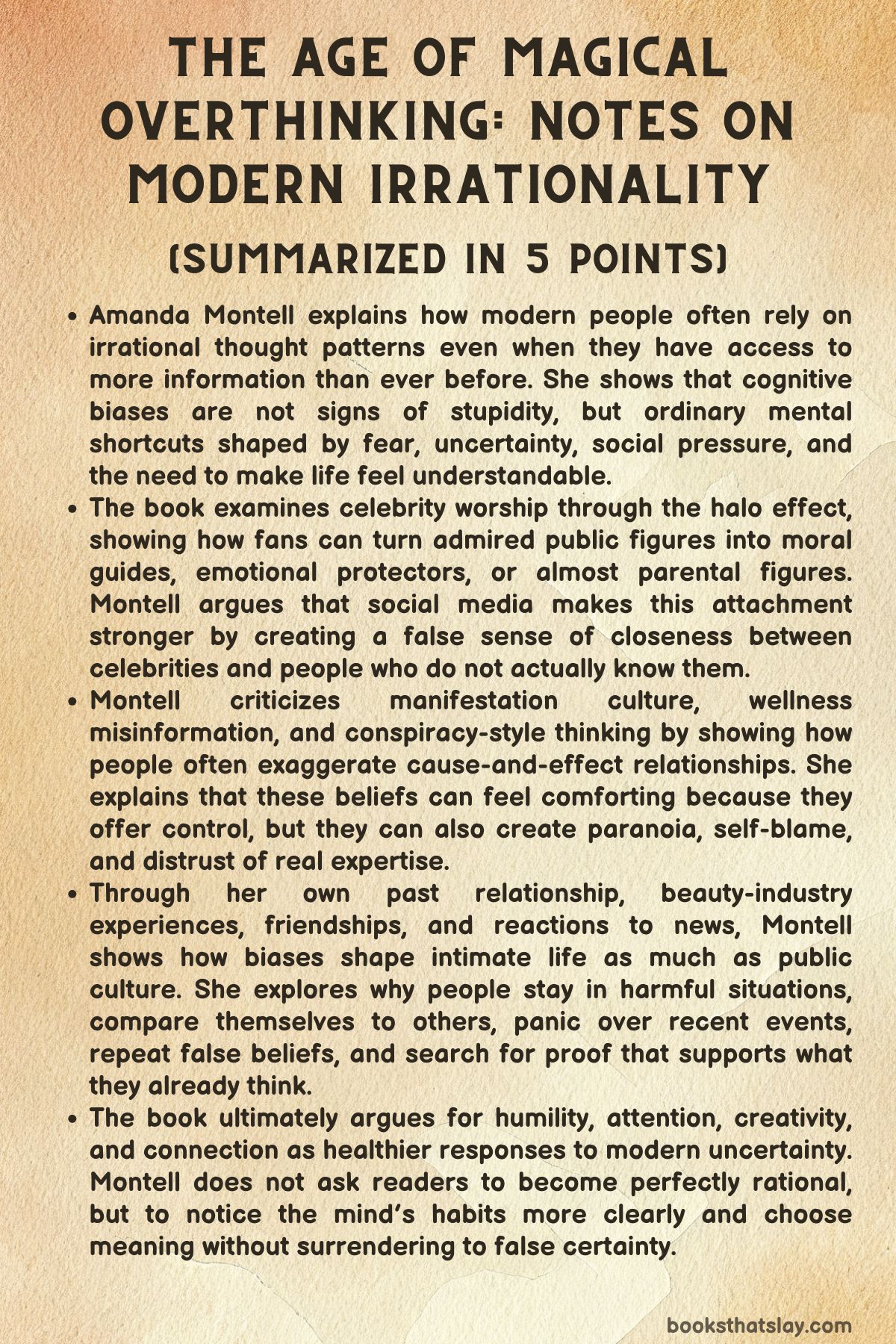
The Age of Magical Overthinking: Notes on Modern Irrationality by Amanda Montell is a nonfiction book about why modern people often think irrationally even while surrounded by endless information. Montell uses cognitive biases as the central lens, showing how the brain tries to create order from uncertainty, stress, social media, celebrity culture, romance, illness, news cycles, nostalgia, and productivity.
The book mixes research, cultural criticism, memoir, and humor to explain why people cling to patterns, heroes, fears, and stories that may not be fully true. Its larger purpose is not to shame irrationality, but to help readers notice it and live with more humility and awareness.
Summary
Amanda Montell’s The Age of Magical Overthinking begins with her attempt to understand why the modern world feels so irrational, even though people have more access to facts than ever before. She describes trying different ways to escape the noise of modern life and regain perspective, from strange wellness experiments to travel.
These efforts lead her toward the central idea of the book: human beings are not built to be perfectly rational. The brain developed for survival, not for calm, objective processing of endless information.
In the present age, people are overloaded with news, social media, personal anxiety, public crises, and cultural pressure. As a result, they often think too much about the wrong things and too little about what really deserves careful thought.
Montell explains cognitive biases as mental shortcuts that distort judgment. These biases are not rare flaws found only in gullible people.
They affect everyone because they are part of how the brain manages uncertainty. One of the book’s core claims is that magical thinking, the belief that thoughts, signs, patterns, or personal behavior can influence external events, has become especially visible in contemporary life.
In a world that feels unstable and hard to explain, people look for meaning everywhere. They seek comfort in celebrities, conspiracy theories, manifestation, nostalgia, wellness culture, online communities, and stories about why things happen.
The book first looks at celebrity worship through the halo effect. Montell argues that people often take one admired quality in a public figure and expand it into a complete moral or emotional fantasy.
A celebrity may be talented, beautiful, funny, or politically outspoken, and fans may begin to treat that person as if they are wise, pure, protective, or almost parental. Montell connects this tendency to early parent-child attachment and reflects on her own admiration for her mother, Denise, a cancer researcher who continued her work while experiencing illness herself.
The emotional need to idealize a caregiver can shift onto celebrities in a media culture that encourages fans to feel close to people they do not actually know. Social media deepens this illusion by making stars seem intimate and available.
Montell shows that while fandom can be joyful and even intellectually rich, it can also become rigid, possessive, and cruel, harming both fans and the people they idolize.
Montell then turns to manifestation culture and proportionality bias, the tendency to assume that big events must have big, meaningful causes. She focuses on an online wellness figure she calls The Manifestation Doctor, who tells followers that traditional therapy and medication can be harmful while promising that people can heal themselves by aligning with the universe.
Montell sees this as part of a broader distrust of institutions, especially after the COVID-19 pandemic. When people feel abandoned by health care systems, governments, or experts, simple explanations become attractive.
Manifestation offers control, but it can also create self-blame. If a person believes they create their own reality, then suffering can start to look like personal failure.
Montell connects this thinking to conspiracy theories, showing how both offer emotionally satisfying explanations for events that are frightening or confusing.
The book becomes more personal when Montell discusses the sunk cost fallacy through her long toxic relationship with an older man she calls Mr. Backpack. She met him when she was eighteen, and over several years she built her life around him, giving up other dreams and excusing behavior that became manipulative and abusive.
Looking back, she recognizes that she stayed partly because she had already invested so much time, energy, and identity in the relationship. Leaving would mean admitting that the years she spent with him had not led where she hoped.
Montell compares toxic relationships to cult-like systems, not because every abusive partner is a formal cult leader, but because manipulation, charm, loyalty, and fear can trap someone inside a private world. Her eventual departure becomes an example of cutting losses and choosing a future over past investment.
Montell also examines social comparison through zero-sum bias, the mistaken feeling that another person’s success reduces one’s own worth. She reflects on her years working in the beauty industry in Los Angeles and the tension between her feminist beliefs and her participation in beauty culture.
Surrounded by images of other women’s bodies, careers, and achievements, she found herself measuring her value against theirs. Social media intensified this habit by presenting peers and competitors in an endless stream.
Montell argues that capitalism and individualism make people feel as if attention, beauty, career progress, and social approval are scarce resources. To counter this, she discusses “shine theory,” the idea that supporting successful peers can create connection rather than rivalry.
Praising others can change the emotional logic of competition and allow admiration to replace resentment.
Illness and death online allow Montell to explore survivorship bias. While writing about young people who shared serious medical diagnoses on social media, she met Racheli, who became her best friend.
Some of the people Montell interviewed survived, while others did not. She warns against the tendency to look only at survivors and then invent reasons for their survival.
Optimism, discipline, faith, or online community may help people endure suffering, but they do not guarantee recovery. Montell is careful to respect the value of illness narratives online.
For people with diseases or disabilities, sharing their lives can create visibility, honesty, and connection. Yet she resists the idea that survival proves moral strength or that death reflects some missing virtue.
Life does not always behave like a story with fair rewards.
The book then considers modern panic through the recency illusion, the belief that something is new or uniquely alarming simply because it has recently entered public attention. Montell reflects on news stories about UFOs and the way headlines can create a sudden sense of crisis before public attention quickly moves elsewhere.
She argues that humans are not built to process constant breaking news, mass trauma, and algorithmic urgency. The nervous system reacts strongly to novelty and threat, but the digital world supplies those sensations endlessly.
During the pandemic, many people also experienced distorted time because ordinary markers of memory and routine disappeared. Montell suggests that awe, nature, and attention to meaningful but non-urgent experiences can help people resist the frantic rhythm of modern media.
Overconfidence bias becomes another major subject. Montell opens with the bizarre case of a man who robbed banks after putting lemon juice on his face because he believed it would make him invisible to cameras.
From there, she discusses the Dunning-Kruger effect and the broader human habit of overrating one’s knowledge, skill, and moral judgment. American culture often rewards confidence, even when it is unsupported.
At the same time, many people experience imposter syndrome, doubting themselves despite evidence of competence. Montell sees humility as a possible answer to both extremes.
Humility does not mean hating oneself. It means thinking about oneself less obsessively and accepting that one’s judgments may be incomplete.
Montell also studies the illusory truth effect, which makes repeated statements feel true. She uses her own mistake about medieval wedding bouquets as an example: after repeating a popular claim about flowers masking body odor, she was corrected by an expert.
The incident shows how myths survive because they are memorable, funny, simple, or widely repeated. Proverbs, slogans, political claims, wellness phrases, and personal stories all gain power through repetition.
Montell broadens the idea to internal storytelling, suggesting that people can repeat private narratives about themselves until those narratives feel like facts.
Confirmation bias appears through Montell’s visit to a dinosaur exhibit with her friend Kristen, who grew up in a fundamentalist environment where religious teachings had to explain dinosaurs in ways that preserved existing doctrine. Montell uses this to show how people select evidence that supports what they already believe.
Confirmation bias can help people make fast decisions and maintain group identity, but it becomes dangerous when it blocks shared reality. Political beliefs, cult thinking, astrology, apocalypse predictions, and conspiracy movements all rely on the same basic habit: finding proof for a conclusion already chosen.
Near the end, Montell considers declinism, the belief that society is always getting worse and the past was better. She connects this to nostalgia, fading negative memories, and the marketing or political use of an imagined golden age.
While she does not deny real crises such as climate change, she warns that constant doomsday thinking can become paralyzing or destructive. Progress has occurred in many areas, but modern people may still feel unhappy because freedom from consumerism, comparison, and pressure has not increased in the same way.
The book closes with the IKEA effect, the tendency to value things more when we help create them. Montell finds comfort in crafting and furniture flipping during the pandemic, discovering that making something with her hands gives her a sense of presence and contribution.
In a world shaped by automation and artificial intelligence, she argues that human effort still matters because meaning is not only found in perfect outcomes. It is also found in participation, attention, and care.
Overall, The Age of Magical Overthinking presents irrationality as both a problem and a deeply human response to uncertainty. Montell does not ask readers to become emotionless rational machines.
She asks them to notice the mental tricks that guide their fears, loyalties, hopes, and stories, so they can live with more honesty and less needless suffering.
Key Figures
Amanda Montell
Amanda Montell is the guiding consciousness of the book, serving as researcher, cultural critic, narrator, and case study. She does not position herself as someone standing above irrationality; instead, she repeatedly uses her own experiences to show how easily intelligent, self-aware people can still fall into biased thinking.
Her voice is curious, funny, skeptical, and personally exposed without becoming self-pitying. In The Age of Magical Overthinking, Montell’s strongest quality is her willingness to examine her own mind with the same seriousness she applies to social trends.
She admits to idolizing people, staying too long in a damaging relationship, comparing herself to other women, making public mistakes, fearing current events, and repeating private narratives until they feel true. This makes her more than a commentator on cognitive bias.
She becomes evidence of the book’s argument that irrationality is ordinary, human, and often tied to a desire for safety, meaning, and control. Her growth across the book is not a movement toward perfect rationality, but toward humility.
She learns to hold uncertainty without always forcing it into a pattern.
Denise Montell
Denise Montell, Amanda’s mother, appears as one of the most emotionally important figures in the book. She is presented as brilliant, disciplined, and admirable, especially through her work as a cancer researcher while facing illness herself.
For Amanda, Denise becomes an early model of strength and near-heroic competence. This makes her central to the book’s discussion of the halo effect, because Amanda’s admiration for her mother shows how love can turn a real person into an idealized figure.
Denise is not only a parent but also a way for Amanda to explore how children first learn to attach greatness, safety, and authority to another human being. As the book progresses, Denise becomes more fully human through vulnerability, especially in her written exchanges with Amanda.
This shift matters because the book is not arguing against admiration. It is arguing against turning admiration into emotional perfection.
Denise’s role shows that mature love requires accepting flaws, limits, and ordinary human need alongside achievement.
Taylor Swift
Taylor Swift functions less as a traditional character and more as a cultural symbol of modern celebrity attachment. In the book, she represents how fans can transform a public figure into an emotional authority, a friend, a mother figure, or a moral ideal.
Montell uses Swift’s relationship with her fan base to examine how social media creates a manufactured closeness between celebrities and audiences. Swift’s openness, songwriting, online presence, and carefully built public identity make fans feel personally seen by her, even though the relationship remains one-sided.
This does not make the admiration false or meaningless; music and public art can genuinely help people understand themselves. But Swift’s role in the book also shows the cost of extreme fandom.
Fans may defend her aggressively, critics may censor themselves, and the celebrity herself may be trapped by the impossible expectations of devotion. Within The Age of Magical Overthinking, Swift becomes an example of how adoration can dehumanize the person being adored.
The Manifestation Doctor
The Manifestation Doctor is one of the book’s most troubling figures because she represents the seductive power of simple answers. She is portrayed as an online wellness personality who speaks with certainty about healing, trauma, medication, therapy, and the universe.
Her appeal comes from confidence, relatability, and the promise that people can regain control over pain. In a time marked by institutional mistrust and psychological strain, her message reaches people who are desperate for clarity.
Yet the book treats her influence as dangerous because she turns uncertainty into certainty and suffering into personal responsibility. By suggesting that people can make the universe bend in their favor, she gives followers a sense of agency while also inviting obsessive self-blame.
Her role in the book is not just to expose one influencer, but to reveal the larger system that rewards wellness figures who sound emotionally satisfying, even when their claims are unsupported or harmful. She embodies how magical thinking can become marketable.
Mr. Backpack
Mr. Backpack is one of the most personally painful figures in the book. As Amanda’s older former partner, he represents the emotional logic of the sunk cost fallacy in intimate life.
Their relationship begins with charm, excitement, and attachment, but gradually becomes a space where Amanda gives up parts of herself and excuses behavior that harms her. He is not described as a cartoon villain, which makes the analysis more realistic.
Montell acknowledges that the relationship contained good moments and that human relationships are rarely simple. Still, his presence shows how manipulation can operate through affection, familiarity, and shared history.
The longer Amanda stays, the harder it becomes to leave, because leaving would mean facing the loss of years, dreams, and identity. Mr. Backpack’s role in the book also connects toxic romance to cult dynamics.
He becomes an example of how one person can create a private belief system around another, making departure feel not only painful but almost impossible.
Racheli
Racheli is one of the warmest and most grounding figures in the story. Montell first encounters her while researching people who document illness online, and Racheli later becomes her best friend.
As a Hodgkin’s lymphoma survivor, she brings depth to the book’s discussion of survivorship bias. She shares her illness publicly in order to help others feel less alone, but she resists the cruel idea that survival is proof of having done life correctly.
This makes her morally clear and emotionally intelligent. Racheli’s optimism is not shallow positivity.
It is a way of enduring hardship while refusing to turn survival into a hierarchy of deserving and undeserving people. Her presence helps the book separate useful hope from magical thinking.
She shows that people can find meaning, humor, friendship, and public connection during illness without pretending that attitude alone controls medical outcomes. Racheli’s role also gives the book tenderness and lived reality amid its cultural analysis.
Casey
Casey, Amanda’s partner, often appears as a steady companion and emotional counterweight. His presence is especially important in discussions of time, fear, nostalgia, creativity, and artificial intelligence.
Because he has known Amanda since childhood, he connects her present life to memory and shared history. Their interest in space videos, their conversations about happiness, and his anxieties as a composer facing the rise of AI all give Montell a way to make broad cultural questions intimate.
Casey is not presented as a dramatic figure, but his quiet role matters. He helps show how cognitive biases do not exist only in public controversies or online movements.
They enter ordinary relationships, daily conversations, shared fears, and creative work. In The Age of Magical Overthinking, Casey also helps Montell think about what remains meaningful when modern life feels unstable.
His music, for example, matters to her not because it is technically unbeatable, but because it comes from him.
Kristen
Kristen is important because her background allows the book to explore confirmation bias with personal specificity rather than abstraction. Raised in a fundamentalist environment, she was taught explanations about dinosaurs and apocalypse that fit the belief system around her.
Her presence at the dinosaur exhibit with Amanda creates a contrast between wonder, doctrine, memory, and evidence. Kristen is not treated with mockery.
Instead, she helps the book show how belief systems can train people to interpret facts before they even encounter them. Her childhood teachings about dinosaurs and the end of the world reveal how confirmation bias protects a worldview by reshaping inconvenient information.
At the same time, Kristen’s adult friendship with Amanda suggests that people are not trapped forever inside inherited frameworks. She represents both the power of early belief and the possibility of looking back on that belief with distance, humor, and insight.
Mary
Mary appears through Montell’s discussion of people who share illness online, and her role is closely tied to the ethics of visibility. As one of the survivors Montell continues to follow, Mary shows how public storytelling about disease can be therapeutic for the person sharing and meaningful for those watching.
She represents a form of online presence that counters the polished perfection of much social media. Instead of presenting a flawless life, Mary offers an honest account of vulnerability, limitation, and survival.
Her role complicates any simple criticism of social media. The book does not treat online sharing as automatically narcissistic or harmful.
Through Mary, it shows that digital platforms can create real comfort and representation for people whose lives are often ignored. At the same time, her presence reinforces the warning against survivorship bias.
Her survival should not be turned into proof that illness follows a fair moral script.
Themes
The Search for Control in an Uncertain World
Modern irrationality in The Age of Magical Overthinking often begins with the desire to feel less helpless. Manifestation, conspiracy theories, celebrity worship, nostalgia, and even personal storytelling offer people a sense that life can be explained, predicted, or influenced.
This desire is understandable because many of the forces shaping contemporary life feel too large for any individual to manage: illness, climate change, political instability, social media algorithms, economic pressure, and the speed of technological change. Montell shows that magical thinking becomes attractive when reality feels random or indifferent.
If a person believes that the universe rewards the right thoughts, that a public figure can provide emotional rescue, or that every crisis has a hidden design, then uncertainty becomes easier to bear. The problem is that these beliefs can also become traps.
They may lead to self-blame, paranoia, denial, or dependence on false authorities. The book treats control as both a human need and a dangerous illusion when it replaces evidence, humility, and acceptance.
The Distorting Power of Social Media and Online Culture
Social media in the book is not merely a background setting; it is one of the main engines that intensify biased thinking. Platforms turn admiration into stan culture, wellness advice into authority, illness into public narrative, competition into constant comparison, and news into emotional emergency.
Montell shows that the internet does not invent cognitive biases, but it gives them speed, scale, and financial value. The halo effect becomes stronger when celebrities seem personally accessible.
The illusory truth effect becomes stronger when false claims are repeated across feeds. Zero-sum bias becomes sharper when people are surrounded by curated images of peers succeeding.
Recency illusion becomes harder to resist when every headline is presented as urgent. Online life also rewards certainty, outrage, beauty, confidence, and emotional simplicity, while slower thinking is often less visible.
The book’s criticism of digital culture is not that the internet is wholly bad. Instead, it argues that human minds are vulnerable inside systems designed to capture attention and convert emotion into engagement.
Humility as an Answer to Overthinking
Humility becomes one of the book’s most important responses to cognitive bias. Montell does not define humility as weakness, passivity, or self-hatred.
She presents it as the ability to think about oneself with less obsession and to accept that one’s perceptions may be incomplete. This matters because many biases are strengthened by certainty.
Overconfidence bias convinces people that their judgments are accurate. Confirmation bias pushes them to gather evidence for what they already believe.
Proportionality bias makes them assume they have discovered the hidden cause behind confusing events. Even imposter syndrome can be self-focused, trapping people in repeated doubts about their own worth.
Humility offers another way. It allows people to say, “I might be wrong,” without collapsing into shame.
It encourages curiosity, correction, and patience. In Montell’s personal stories, humility also appears as the willingness to admit past mistakes, whether in love, work, online claims, or private fears.
The book suggests that clear thinking begins not with knowing everything, but with loosening the need to be certain.
Meaning, Making, and Human Connection
The book does not end by telling readers to reject emotion, imagination, or meaning. Instead, it asks them to choose forms of meaning that keep them connected to reality and to other people.
This is clearest in Montell’s discussion of crafting, furniture flipping, friendship, awe, and care. Making something by hand matters because it gives people a direct relationship with effort and outcome, even when the result is imperfect.
Friendship matters because it counters isolation and turns suffering into something witnessed rather than privately endured. Awe matters because it shifts attention away from panic and self-importance toward a larger sense of scale.
These experiences do not require false certainty. They do not promise that the universe will reward the right thoughts or that every loss will become part of a perfect story.
They offer smaller, sturdier forms of meaning. Montell’s treatment of creativity and connection suggests that humans do not need to abandon wonder in order to think clearly.
They need wonder that opens the mind rather than closes it.