The Amberglow Candy Store Summary, Characters and Themes
The Amberglow Candy Store by Hiyoko Kurisu is a quiet, slightly uncanny collection of linked stories set on a backstreet that most people can’t find twice. The shop’s owner, Kogetsu—a fox-eared proprietor with a mischievous calm—welcomes the occasional human who arrives when their emotions are off-balance.
Each visitor is drawn to a sweet with a name that feels uncomfortably specific to their wish. Kogetsu offers warnings, rules, and a smile that suggests he already knows what they’ll choose. The candy may seem magical, but the real change comes from what the customers learn about themselves.
Summary
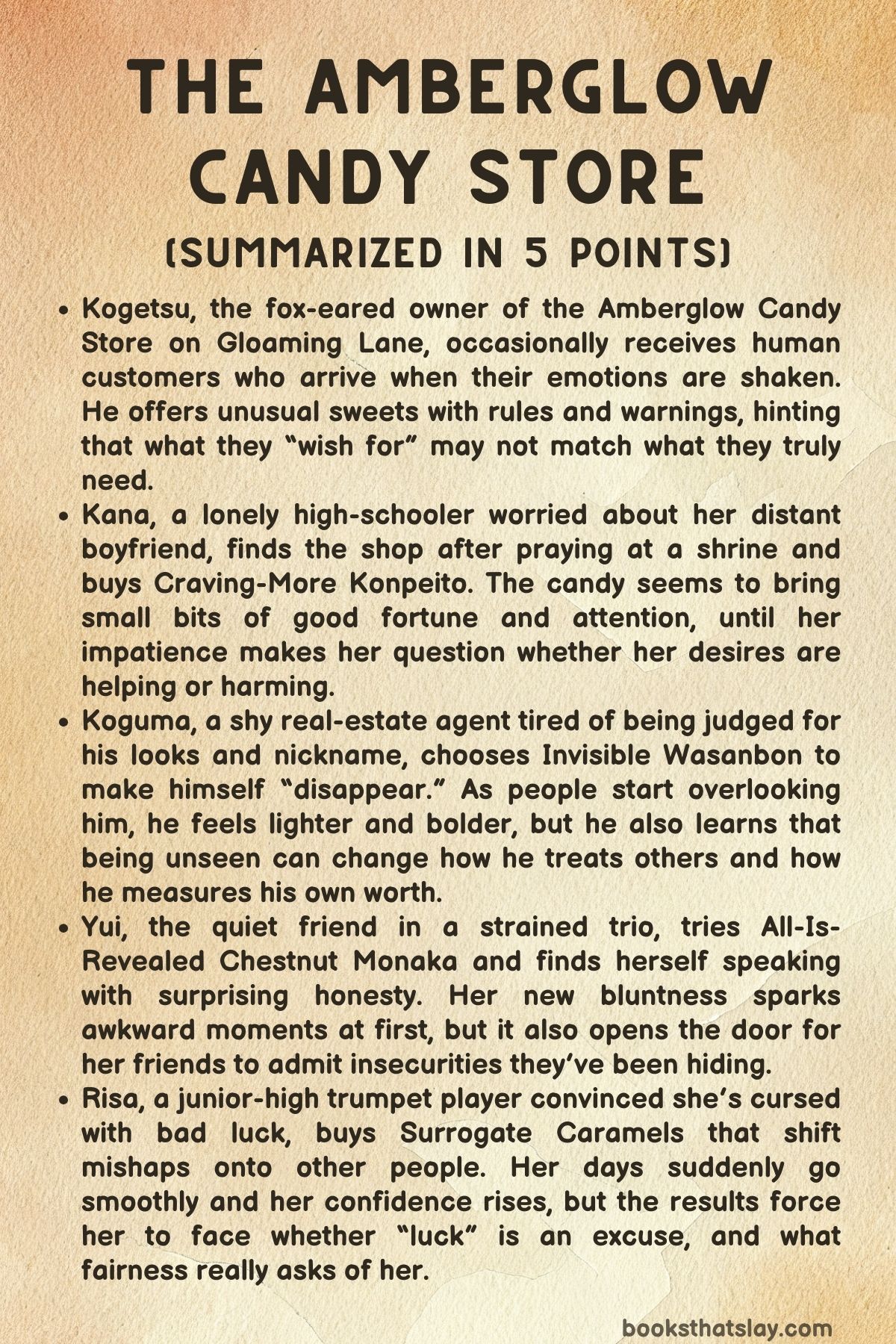
Kogetsu, the fox-eared owner of the Amberglow Candy Store on Gloaming Lane, speaks directly to the rare humans who stumble into his shop. He tells them that people don’t arrive here by accident: the lane appears when someone’s feelings are shaken or unstable.
His shelves hold old-fashioned sweets with strange names, and he cautions that results can be unpredictable. Still, he always makes the sale, watching closely as each customer tests the boundary between wanting help and avoiding the work of change.
Kana, a high-school girl, finds the hidden street after visiting a shrine in frustration. Her boyfriend has been distant, buried in entrance-exam preparation, and Kana’s loneliness has started to feel like a constant ache.
At the end of the deserted shopping lane, she enters Kogetsu’s store and is drawn to a jar of Craving-More Konpeito. Kogetsu warns her to eat no more than one a day.
Kana agrees, but she’s already thinking about what she wants most: more attention, more reassurance, more proof that she matters.
When she eats her first konpeito at home, her boyfriend calls unexpectedly—something he hasn’t done in ages. The next day brings another small stroke of good timing, then another.
Kana begins to treat the candy like a secret switch she can flip whenever she feels the familiar fear of being forgotten. As long as she follows the rule, the rewards stay modest but steady: a pleasant surprise, a lucky coincidence, a little more closeness.
She convinces herself it’s working, and the candy becomes a daily ritual.
Then pressure spikes. Midterms arrive, her boyfriend is busy again, and Kana’s patience snaps.
She eats a handful, chasing a bigger result. That night, she gets a comfort she’d wanted—her favorite meal, a warm moment at home—but the news reports a scandal involving her boyfriend’s cram school.
Kana panics, sure that her greed has caused disaster. The fear grows into guilt so sharp she can’t hide it.
The next day, seeing her boyfriend trying to act normal while carrying stress, she confesses everything: the shrine, the hidden street, the candy, and her rule-breaking.
Instead of laughing, he listens. He even tries a konpeito himself, and almost immediately receives news that the cram school has been cleared and will reopen.
The timing unsettles Kana, but it also exposes something important: she has been using “luck” as a way to dodge hard conversations. Kana admits she feels selfish and unworthy.
Her boyfriend surprises her by admitting his own selfishness—he’s been so focused on exams that he forgot to show her care, even though he’s liked her for a long time. They reconcile with a new agreement: they’ll talk honestly, even when it’s inconvenient.
Kana stops hoarding the candy and gives the remaining konpeito to people around her, taking pleasure in their small joys rather than chasing her own. When she later returns to the shrine, the path to the lane is gone.
From a rooftop, Kogetsu watches with amused interest, collecting the empty jar as if it contains something more than candy.
Another visitor, Ayumu Koguma, arrives at the shop with a different kind of wish. He’s a shy, heavyset estate agent who has spent years feeling judged—by customers, coworkers, and memories of classmates.
Humiliated by his own name and body, he wishes he could disappear. At the shrine he finds the hidden street and buys Invisible Wasanbon, sugar sweets Kogetsu says can make someone “vanish.” Koguma eats one and discovers the effect is real: people look right past him, clerks fail to notice him, and even his boss searches for him while he stands nearby.
At first, it feels like relief. Without the sting of being watched, Koguma speaks more freely and works with less fear.
Yet the more he relies on being overlooked, the more his behavior shifts. He becomes bolder in ways that aren’t always kind, assuming confidence means pushing harder.
When he crosses paths with Takada, a former crush who once joked about him being “more mascot than man,” he expects old pain. Takada is engaged now—to someone who resembles him more than he expected—and the meeting gives him closure, though he cuts short her attempt to apologize.
Eventually his boss confronts him, not to mock him, but to explain something Koguma never understood: his gentle, patient style had been a strength, and the office had valued him. The candy’s “invisibility” didn’t reveal the world’s cruelty; it revealed Koguma’s own distorted assumptions.
Later, a colleague named Kazama invites him to dinner and admits she’s liked him for a long time, precisely because he’s considerate. Koguma accepts the possibility of a relationship, choosing to start slowly and honestly.
That night he throws away the remaining wasanbon. Kogetsu, watching nearby, retrieves what’s left as if saving a record of the wish that no longer fits.
A university student named Yui reaches the shop after being worn down by silence. She’s the quiet one in a trio of close friends: Saya, loud and stylish, and Reo, composed and thoughtful.
Lately Saya’s constant talk about her boyfriend and her cutting remarks have been straining the group, but Yui can’t bring herself to object. After following a cat near a shrine, she finds the lane and buys All-Is-Revealed Chestnut Monaka.
When she eats one, words come more easily. She speaks with a frankness that surprises everyone, offering genuine compliments and noticing what others try to hide.
At dinner, her new openness slips into danger when she blurts out that Reo is tired of Saya’s boyfriend talk. Tension flares, but Yui doesn’t run from it.
She shares the remaining sweets, and the three finally say what they’ve been circling for months: Reo admits she feels pressured to want romance, while Saya admits her bragging is armor for insecurity. The friends reassure each other, recognizing that admiration and resentment have been tangled together.
Outside, Kogetsu notes—almost casually—that only the first monaka had any effect. The rest were ordinary, not even made properly.
The change came from Yui choosing honesty and sticking with it.
Finally, Risa, a junior-high trumpet player, arrives at the shop with a wish shaped by rivalry. She loves her instrument and wants the solo at the autumn festival, but she believes she’s cursed with bad luck.
Her section leader, Ayaka, was chosen for responsibility and grades, and an audition will decide the soloist. Risa prays at a shrine for protection from misfortune and finds the lane.
In Kogetsu’s shop she notices Surrogate Caramels—an unnerving match for the thought she doesn’t want to admit: if her bad luck could land on someone else, she might finally win.
After eating a caramel, Risa realizes accidents stop happening to her and start happening around her. Others step where she would have stepped, stumble where she would have stumbled, and make mistakes that feel strangely familiar.
Risa tells herself it’s only temporary, only a little borrowing of fortune. As the audition nears, her confidence rises, and when Ayaka plays first, Ayaka falters badly.
Risa performs cleanly and wins the vote. The victory tastes wrong almost immediately.
Hearing Ayaka cry over how hard she practiced, Risa faces a brutal possibility: her “bad luck” wasn’t fate. Much of it came from rushing, carelessness, and blaming chance instead of preparing.
Risa stops eating the caramels and begins changing her habits—slowing down, paying attention, practicing seriously. Then she does the hardest thing: she asks the teacher for a redo of the audition, saying Ayaka didn’t get a fair chance.
In the second audition Ayaka plays beautifully and earns the solo unanimously. Risa feels both loss and relief, and the two girls reconcile, choosing to become real rivals rather than enemies.
When Risa returns to the shrine, the lane won’t appear again. She leaves the nearly empty caramel box as an offering, declaring she doesn’t need a “surrogate” anymore.
Watching from above, Kogetsu reveals to himself that something had indeed been clinging to her—a spirit drawn to her belief in misfortune. With that belief broken, it has no hold.
Kogetsu takes the final caramel as a sample for his collection, disappearing back into the quiet lane that only opens when someone is ready to face the wish behind their wish.
Characters
Kogetsu
Kogetsu is the enigmatic fox-eared proprietor of the Amberglow Candy Store, serving as the mysterious figure who observes and manipulates the human emotions of his customers. His role as the keeper of the store places him at the heart of the story, offering sweets that provide temporary magical effects to those who are emotionally unstable or in need of something to change in their lives.
Despite his seemingly helpful nature, Kogetsu’s actions are often guided by his curiosity about human emotions rather than a desire to truly help. He enjoys watching the consequences of the sweets’ effects, often leaving his customers to navigate the results of their desires and regrets on their own.
His amusement and detached approach to the unfolding events reveal a deeper understanding of human nature, suggesting that he does not view his interventions as wrong but rather as part of an ongoing exploration of emotional growth. Kogetsu’s interactions with the characters are tinged with subtle manipulation, as he appears to be more interested in studying their emotional responses than in providing direct solutions to their problems.
His final act of encasing the sweets in amber is a metaphor for his collection of the human experiences he observes, cementing his role as both an observer and a collector of emotions.
Kana
Kana, a high school girl struggling with loneliness due to her distant boyfriend, is introduced to the Amberglow Candy Store after feeling emotionally vulnerable. Seeking something to improve her relationship, she falls into the trap of relying on the magical Craving-More Konpeito, believing that the candy’s effects will lead to personal fulfillment.
Initially, the candy provides small, serendipitous blessings—her boyfriend calls, she gets movie tickets, and life seems to offer a series of small joys. However, Kana’s overindulgence leads to a larger crisis when she breaks the rules and consumes more than one konpeito, resulting in her boyfriend’s involvement in a scandal.
The consequences force Kana to confront her selfishness and guilt. Her journey reflects the dangers of relying on external forces for happiness and the importance of facing reality with honesty.
Ultimately, Kana learns to let go of her dependency on the magical candies and embraces a more grounded approach to her relationship. Through her interactions with her boyfriend, she realizes that mutual honesty and support are the keys to a strong bond.
Kana’s story is one of emotional growth, as she matures from a girl who sought shortcuts to happiness into someone who understands the value of personal responsibility and connection.
Ayumu Koguma
Ayumu Koguma is a shy and self-conscious estate agent who initially feels invisible in the eyes of others, plagued by a lack of confidence and self-esteem. When he stumbles upon the Amberglow Candy Store, he buys the Invisible Wasanbon, a candy that grants the ability to disappear, which initially seems to offer him the freedom he desires.
As Ayumu enjoys the sensation of being overlooked, he gains confidence and becomes more assertive in his work. However, his newfound boldness comes at the cost of the qualities that made him valuable in the first place—his kindness and empathy.
Ayumu’s journey illustrates the dangers of relying on magic to solve personal insecurities. His encounter with Takada, a former classmate and crush, provides him with closure, but it also forces him to confront the emptiness of his desire for invisibility.
Ayumu’s eventual realization that true self-worth comes from authentic relationships and personal growth is a significant turning point in his character arc. By the end of the story, Ayumu has discarded the candies and embraced the idea that his worth comes from his genuine qualities, not from external validation or magical shortcuts.
His growth is marked by his willingness to accept the affection of Kazama, a colleague who sees him for who he truly is.
Yui
Yui, a university student, is initially portrayed as quiet, reserved, and emotionally withdrawn. Her friendship with Saya, an outspoken fashionista, and Reo, a calm and composed friend, is strained by Saya’s boastful attitude and condescending remarks.
Feeling unable to express her true feelings, Yui is drawn to the Amberglow Candy Store, where she buys the All-Is-Revealed Chestnut Monaka, a candy that causes her to speak her mind more freely. The candy’s effects lead to a series of honest conversations that help Yui navigate the complexities of her relationships.
Yui’s character arc revolves around the power of communication and self-expression, as she learns that speaking up and being true to herself can strengthen bonds with others. Her actions allow her friends to reveal their insecurities, which ultimately brings them closer together.
However, the candy itself is revealed to have had no real magic—Yui’s sincerity and openness were the true catalysts for change. This realization highlights that personal growth comes not from external aids, but from the internal courage to be vulnerable and honest.
Yui’s character journey is a powerful reminder of the importance of authenticity in relationships.
Risa
Risa, a junior-high trumpet player, struggles with her self-image, feeling overshadowed by her more reliable and academically successful peers. Her passion for playing the trumpet and her desire for recognition are threatened by her belief in her own bad luck.
When Risa encounters the Amberglow Candy Store, she is drawn to the Surrogate Caramels, which promise to transfer her bad luck to others. In her pursuit of success in a trumpet audition, Risa uses the caramels to eliminate the obstacles she perceives as holding her back.
The candy’s effects are subtle at first, but as she continues to rely on it, Risa begins to feel guilt over the misfortunes she is causing others. The climax of her arc occurs when she wins the solo, but is confronted with the realization that Ayaka, the other candidate for the solo, had put in more effort than she had.
This moment of empathy and self-awareness prompts Risa to reflect on her own behavior and the role that responsibility and effort play in achieving success. In the end, Risa decides to make things right by requesting a redo of the audition, allowing Ayaka to perform without the burden of bad luck.
This act of humility marks Risa’s growth from someone who relied on external forces to someone who embraces personal responsibility and effort. Her story is one of redemption and the realization that true success is earned through hard work and integrity.
Themes
Self-Reflection and Personal Growth
Throughout The Amberglow Candy Store, characters undergo significant personal growth, often spurred by their experiences with magical sweets that reveal deeper aspects of themselves. The story demonstrates how emotional instability and personal insecurities often lead people to seek external solutions for their internal struggles.
For Kana, the candy’s magical effects initially seem like a blessing, offering temporary relief from loneliness and helping her feel more connected to her boyfriend. However, as she consumes more candy and faces the consequences of her actions, she begins to confront her own emotional dependence and realizes the importance of genuine communication and self-awareness in relationships.
This realization allows Kana to let go of her reliance on external sources of happiness, making space for true emotional maturity.
Similarly, Ayumu Koguma’s transformation highlights the journey from seeking external validation to embracing self-acceptance. The candy grants him invisibility, allowing him to escape judgment and embarrassment.
However, it also reveals his need to face his fears of rejection and the reality that others see his worth beyond his appearance. His journey teaches him that confidence does not stem from disappearing or becoming someone else, but from accepting who he truly is.
His growth culminates in his decision to discard the candy, symbolizing his willingness to face the world as his authentic self, without the need for magical shortcuts.
Risa’s struggle with her perceived bad luck further emphasizes the theme of personal growth. Initially, she uses the Surrogate Caramels to transfer her misfortune to others, believing that the source of her failures lies in bad luck.
However, as she reflects on her actions and the consequences they cause, she learns that personal responsibility and self-improvement are the true paths to success. The realization that her misfortunes were largely due to her own carelessness marks a turning point in her character arc.
By choosing to confront her shortcomings and put in the necessary effort, Risa demonstrates that growth is not just about overcoming external obstacles, but about understanding and correcting one’s own behaviors.
Through these characters’ transformations, The Amberglow Candy Store explores how personal growth is often accompanied by painful but necessary self-reflection. The characters’ journeys emphasize the importance of taking responsibility for one’s actions, letting go of superficial solutions, and embracing self-awareness as the foundation for lasting change.
The Consequences of Desires
Desire plays a central role in The Amberglow Candy Store, often serving as the catalyst for the characters’ personal dilemmas and moral conflicts. Each magical candy offers a form of fulfillment that seems to promise happiness, but it ultimately highlights the darker side of unchecked desires.
For Kana, the craving for more affection from her boyfriend leads her to rely on the Craving-More Konpeito, which brings her small joys but also creates an unhealthy attachment to her boyfriend’s attention. Her guilt over the negative consequences of her overindulgence, particularly her belief that her greed caused his troubles, reveals the dangerous implications of seeking happiness through external means rather than through personal growth and healthy relationships.
In Ayumu’s case, his desire for invisibility stems from his deep-rooted insecurity and fear of judgment. The Invisible Wasanbon grants him temporary freedom, but it also makes him less attuned to the needs of others and less capable of fostering meaningful connections.
His experience suggests that the desire to escape discomfort or avoid negative emotions can lead to isolation and misunderstanding, as seen in his misjudgment of the value others place on him. His eventual realization that true confidence comes from facing challenges head-on, rather than hiding from them, underscores the theme that desires, when pursued without consideration of their consequences, can lead to unintended outcomes.
Risa’s desire to overcome her bad luck further exemplifies this theme. Initially, she sees the Surrogate Caramels as a way to finally escape her misfortune and prove herself worthy of success.
However, the caramels allow her to transfer her misfortune to others, leading to a moral conflict when she realizes the harm her actions are causing. The eventual recognition that her so-called bad luck was a result of her own neglect and carelessness marks the moment when Risa begins to understand that desires must be tempered with self-awareness and accountability.
Her desire to win at all costs, by any means necessary, ultimately leads her to confront her own shortcomings and embrace hard work as the true path to success.
The theme of desire in the book thus explores the complexities of human longing and how unchecked desires can lead to moral dilemmas, emotional turmoil, and ultimately, self-discovery. It underscores the importance of examining one’s desires critically and ensuring that they do not overshadow the pursuit of personal growth and ethical behavior.
The Power of Emotional Healing
Emotional healing emerges as a significant theme in The Amberglow Candy Store, illustrated through the transformative experiences of the characters as they confront their deepest fears and insecurities. The candy store’s magical treats offer more than just temporary solutions to surface-level problems—they become a medium for deeper emotional healing, forcing the characters to confront their inner struggles and begin their journeys toward self-acceptance and healing.
For Kana, the path to healing begins when she realizes that her happiness should not be dependent on her boyfriend’s attention. Through the emotional upheaval caused by her overuse of the Craving-More Konpeito, Kana learns that her desire for external validation has kept her from developing a deeper connection with herself and others.
Her healing process is tied to her ability to let go of guilt and selfishness, embracing a healthier, more honest approach to her relationship. By sharing her feelings with her boyfriend and encouraging open communication, Kana is able to heal her emotional wounds and rebuild her relationship on a stronger, more authentic foundation.
Ayumu’s emotional healing unfolds as he confronts his insecurities about his appearance and his need for approval. The Invisible Wasanbon initially helps him escape his fears, but it also forces him to face the emptiness that comes from avoiding the realities of human connection.
Ayumu’s healing begins when he recognizes that true self-worth comes not from hiding away, but from being seen and valued for who he is. By confronting his fears and accepting himself, Ayumu finds a sense of peace and contentment that was previously eluding him.
His emotional healing reflects the importance of facing one’s vulnerabilities and learning to embrace imperfection.
Risa’s journey toward emotional healing is perhaps the most profound. Through her reliance on the Surrogate Caramels, she learns that her perceived misfortune was not an external force but a reflection of her own behavior and mindset.
The healing comes when Risa acknowledges that her failures were rooted in her own carelessness and lack of responsibility, and by taking ownership of her actions, she frees herself from the emotional weight of blame and guilt. Her decision to allow Ayaka a fair chance to compete for the solo, and her willingness to work hard and improve through her own efforts, marks her emotional healing—a process of letting go of past fears and embracing a future shaped by personal accountability.
The emotional healing theme in the novel underscores the idea that true growth and recovery are not about external solutions or magical fixes, but about introspection, self-awareness, and taking responsibility for one’s actions. The characters’ emotional journeys serve as reminders that healing comes from within, and that facing one’s emotional wounds with courage and honesty is the only way to move forward.