The American Way of Eating Summary and Analysis
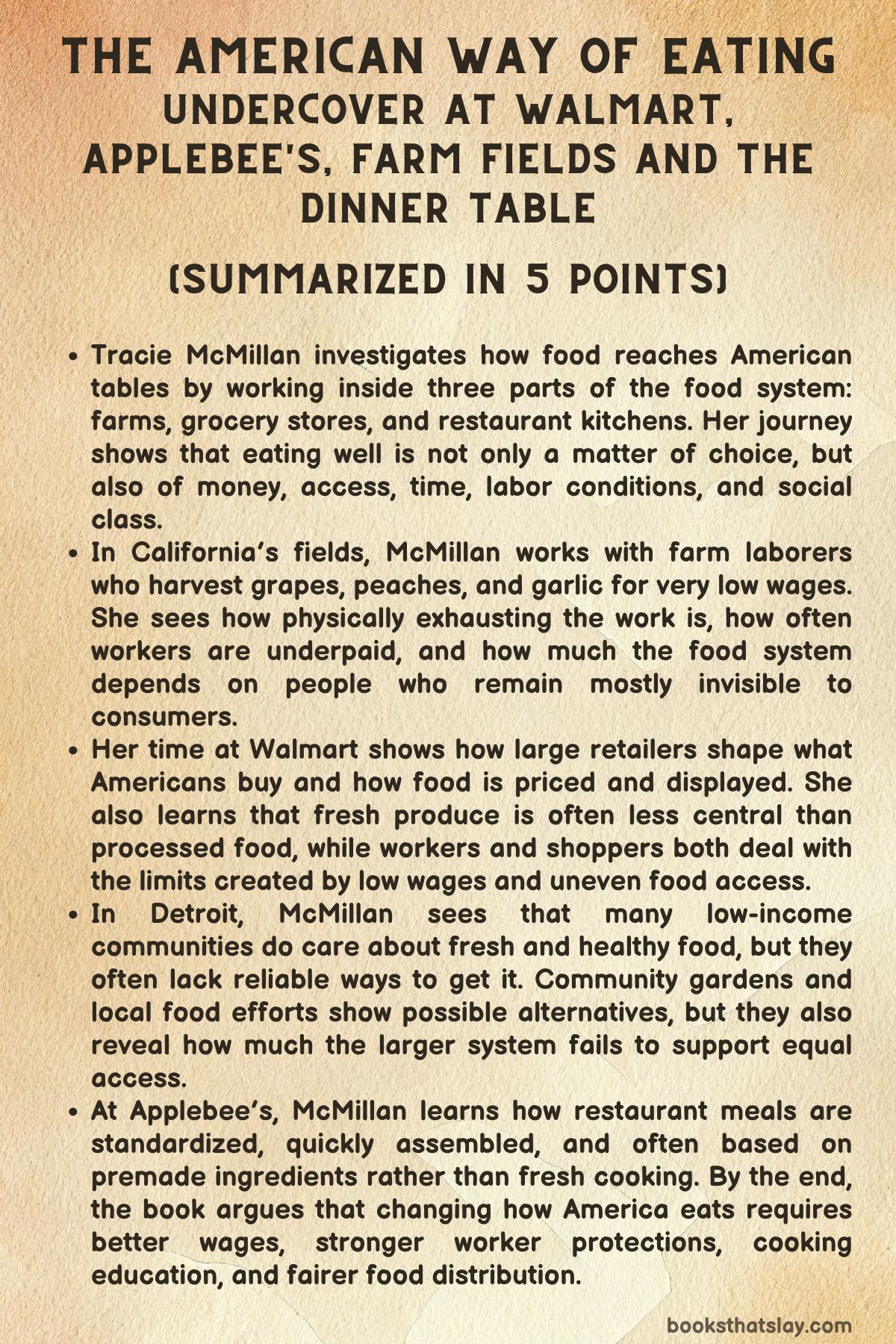
The American Way of Eating: Undercover at Walmart, Applebee’s, Farm Fields and the Dinner Table by Tracie McMillan is a work of investigative nonfiction about how food reaches American tables and why healthy eating is often treated as a privilege rather than a basic possibility. McMillan follows the food system from farm fields to grocery shelves to restaurant kitchens by working inside each setting herself.
The book studies labor, poverty, food access, wages, cooking skills, corporate power, and the everyday decisions people make when money and time are limited. Its central concern is not only what Americans eat, but why so many people are pushed toward cheap, processed food.
Summary
The American Way of Eating begins with Tracie McMillan reflecting on her own habits and assumptions about food. Living in Brooklyn on a tight budget, she shops at a neighborhood grocery store even after seeing disturbing signs of poor cleanliness and low-quality food.
Her choice is not based on indifference alone; it is shaped by limited money, limited time, and the exhaustion that comes with trying to manage both. She connects this adult pattern to her childhood in Michigan, where processed meals were normal and fresh, locally grown food seemed like something meant for richer people.
Healthy eating, in her mind, had long been associated with class privilege.
That attitude begins to change when McMillan meets Vanessa, a teenager who wants to eat better after taking a class about health, cooking, and farming. Vanessa lives in a place where junk food is easy to find, while fresh food is harder to afford and obtain.
Her situation makes McMillan question the common belief that poor eating habits are mainly the result of bad choices. She begins to see that the American food system gives many low-income families very few practical options.
Cheap processed food is everywhere, while fresh produce may be costly, distant, unfamiliar, or too time-consuming to prepare. To understand the system more honestly, McMillan decides to work inside it.
She takes undercover jobs as a farm laborer, a grocery worker, and a restaurant worker.
Her first stage takes her to California’s agricultural regions, where she tries to find work in the fields. In Bakersfield, she meets Pilar, a forewoman who helps her get a job picking grapes.
McMillan quickly learns that farm labor is much harder than it appears from the outside. Experienced workers move with speed and precision, while she struggles to keep up.
After a full day of work, her earnings are shockingly low. The experience shows her how physically demanding the work is and how little of the price consumers pay for food actually goes to the people who harvest it.
She explains that raising farmworker wages would not greatly increase grocery bills, but growers have little pressure to pay more because workers are vulnerable. Many fear deportation, job loss, or replacement by machines.
McMillan also spends time selling drinks in the fields with Pilar and Pilar’s young son, Sergio. The money they make is tiny, but for Pilar the question is not whether the pay is fair.
It is whether any money is coming in at all. This changes McMillan’s understanding of poverty.
Work that looks irrational from the outside can make sense when every dollar matters. Even a small amount of cash can help a family survive another day.
She later moves to other agricultural jobs, including work sorting peaches. She rents a room in a crowded house shared by many farmworkers and sees how low wages shape living conditions.
The house is cramped, uncomfortable, and unhealthy, but it allows workers to save money. In the fields, the heat becomes another danger.
McMillan suffers from heat exhaustion and begins to understand how environmental conditions, labor demands, and poor protections combine to make farm work hazardous. She also reflects on the land itself.
California’s agricultural abundance depends on irrigation, but that system damages soil and water over time. The food system is not only hard on workers; it is also hard on the environment that supports it.
In another farming community, McMillan stays with Dolores and her family while trying to find more work. As a woman seeking field labor, she faces added vulnerability because harassment and assault are known dangers for female farmworkers.
Dolores helps her find a garlic-cutting job. Again, McMillan is slower than experienced workers and earns very little.
She spends much of her income on food and rent, leaving almost nothing to spare. Her relationship with Dolores’s daughter, Inez, becomes one of the more personal parts of this stage.
McMillan helps Inez with English, while Inez teaches her how to make tortillas. Through this exchange, McMillan sees food not only as a commodity, but also as knowledge, culture, family, and care.
As McMillan continues cutting garlic, she improves but still cannot earn enough. The piece-rate system makes minimum wage nearly impossible unless a worker can perform at an extremely fast pace.
She also sees how employers ignore safety standards and underpay workers. When she is injured from repetitive labor, she is moved to a different task, but the work continues to hurt her.
Eventually, she realizes she has been cheated out of significant wages. Before leaving farm work, she tells the people she has met that she is a writer.
They ask her to tell the truth about poor pay, unsafe conditions, wage theft, and the hidden labor behind American produce.
McMillan then turns to grocery retail. She wants to work at Walmart because of its power in American food sales.
The process of getting hired is very different from farm work. It requires formal applications, documentation, and background checks.
She gets a part-time overnight stocking job and begins to study how Walmart sells food. The store’s system is built around scale, efficiency, and corporate pressure over suppliers.
Processed foods dominate the central shopping space, while fresh ingredients sit more at the edges. Walmart can sell some goods cheaply to bring customers in, then make profits elsewhere.
Its size allows it to influence prices throughout the supply chain.
The job gives McMillan insight but does not provide real financial stability. Overnight work disrupts her life, and the pay is not enough to meet her needs.
She later works in produce at a suburban Walmart near Detroit. This move lets her study food access in a city often described as lacking enough full-service grocery stores.
Many Detroit residents shop at convenience stores or travel to the suburbs for groceries. McMillan discovers that local smaller grocers can sometimes sell produce more cheaply than Walmart because fresh food does not always follow the same pricing logic as processed goods.
This complicates the idea that large chains always offer the best solution for low-income shoppers.
Working in produce, McMillan learns how much food is thrown away, trimmed, rearranged, or made to look fresher than it is. She sees spoiled food as a constant part of the job.
She also realizes that many Americans, including herself, have lost confidence in judging and preparing fresh produce. Food companies have responded by selling convenience versions of fresh food, such as pre-cut or packaged items, which reduce effort but also reflect a broader loss of kitchen skill.
In Detroit, however, she also sees another side of food culture. Community gardens and urban farms show that low-income communities do care deeply about fresh, healthy food when they have the means to grow, buy, and use it.
McMillan’s final stage takes her into restaurant work at Applebee’s in Brooklyn. She becomes an expediter, checking that plates are assembled correctly before they go to customers.
The kitchen is highly timed and standardized, with computers controlling the pace. The restaurant presents itself as casual, familiar, and middle-class, but behind the scenes it depends heavily on premade, packaged ingredients and strict systems of preparation.
McMillan learns that many meals served in the restaurant could be made at home for much less money, often in a similar amount of time. The barrier is not always cooking time itself, but planning, energy, knowledge, and confidence.
As she moves into prep work, McMillan handles bags of mashed potatoes, pasta, vegetables, and sauces. The experience reminds her of the processed foods she grew up eating.
The restaurant kitchen is not centered on cooking from scratch; it is centered on assembling food efficiently and consistently. She reflects on the importance of cooking to human life and health, arguing that kitchen competence matters because it affects what people can afford, understand, and control.
Yet her own work schedule makes it harder for her to cook for herself. She starts relying more on food from the restaurant, showing how low-wage work can trap people in the very food patterns they may want to avoid.
The restaurant job also exposes wage problems. McMillan is paid less than promised during training and later finds that some of her work time was not paid at all.
Even in a chain that follows more rules than many independent restaurants, workers still face gaps in training, pay, and protection. She enjoys parts of the job, especially the joking and closeness among kitchen staff, but the experience darkens after she is drugged and sexually assaulted after socializing with co-workers.
She recognizes that, unlike many women in low-wage jobs, she can leave. Others may have to return because they need the paycheck.
By the end, McMillan argues that eating is a social act because every meal is connected to many people: farmworkers, truckers, stockers, cooks, managers, cashiers, and families. Her undercover work changes how she sees food and poverty.
She understands that many people want healthier food, but the system often denies them the money, access, time, safety, and knowledge needed to make that possible. She supports changes such as better access to produce, cooking education, urban farming, fairer distribution, and higher wages.
The book closes with the argument that changing how America eats requires changing the economic conditions that shape daily life.
Key Figures
Tracie McMillan
Tracie McMillan is the central figure in The American Way of Eating, both as narrator and investigator. She enters the book with personal skepticism about the world of healthy food, partly because she grew up associating fresh, carefully prepared meals with class privilege.
This background makes her investigation more than an outside report; it becomes a personal correction of assumptions she once held. Her strongest quality is her willingness to place herself inside difficult work rather than observe it from a distance.
In the fields, she is slow, physically strained, and often dependent on the kindness of others. In Walmart, she becomes part of the machinery of retail food sales.
At Applebee’s, she learns how restaurant meals are standardized and assembled. Her limitations are also important.
She is not a career farmworker, grocery worker, or restaurant worker, and she knows she can eventually leave. That difference gives the book moral tension because her temporary hardship reveals the permanent hardship of others.
McMillan grows from someone who once saw healthy eating as a matter of personal taste into someone who understands it as a result of wages, access, labor, education, and power.
Vanessa
Vanessa is important because she helps change McMillan’s direction before the undercover investigation fully begins. She is a teenager who wants to improve her diet after learning about health, cooking, and farming, but her environment makes that goal hard to achieve.
Her life challenges the shallow idea that people in low-income neighborhoods eat poorly because they do not care. Vanessa does care, and that is exactly why her situation matters.
She represents desire without access, motivation without resources, and awareness without enough structural support. Through her, the book shows that knowledge alone cannot solve food inequality.
A person can understand the value of fresh food and still be blocked by cost, distance, neighborhood conditions, and family circumstances. Vanessa’s role is brief compared with others, but she provides the emotional and intellectual spark for the larger investigation.
She pushes McMillan to ask why the American food system makes unhealthy choices easy and healthy choices difficult for people with limited money.
Pilar
Pilar is one of the most memorable working figures in the book because she introduces McMillan to the realities of agricultural labor. As a forewoman and a mother, she carries responsibility in several directions at once.
She helps McMillan find work, guides her through the field environment, and also tries to earn what she can alongside her young son. Pilar’s life shows how poverty changes the meaning of work.
The small profits she makes selling drinks in the fields would seem unacceptable to someone with better options, but for her they still count because they are cash in hand. She does not have the luxury of judging work only by fairness or long-term opportunity.
Pilar’s character in The American Way of Eating reveals the survival logic that governs low-wage labor. She is practical, resilient, and generous, but she is also trapped in a system that benefits from people who cannot easily refuse bad terms.
Through Pilar, the human cost of cheap produce becomes visible.
Sergio
Sergio, Pilar’s eleven-year-old son, represents the way the food labor system reaches into family life. He is not simply a child standing beside his mother; he is drawn into the economy of the fields because his family needs money.
His presence makes the labor conditions feel even more severe because it shows how early children can become aware of adult financial pressure. Sergio’s role also highlights the absence of a clean boundary between work and home for families living near the edge of survival.
When a parent’s earnings are too low, children may become part of the effort to stretch income, even if indirectly. He also brings attention to the generational effects of poverty.
The work surrounding him is exhausting, unstable, and poorly paid, and that environment shapes what childhood looks like. Sergio is not analyzed through long speeches or dramatic actions; his significance lies in what his presence reveals about family, necessity, and the hidden social cost of cheap food.
Constantino
Constantino appears as a boss in the peach orchard, and his importance lies in how he represents the field hierarchy. He is not shown as the owner of the food system’s injustices, but as one of the people who helps organize and enforce its daily routines.
His interaction with McMillan is practical: he explains the task, places her in the work, and expects performance. Through him, the reader sees how field labor depends on speed, discipline, and immediate productivity.
There is little room for learning slowly or struggling physically. Constantino’s role also shows how agricultural labor can appear orderly from the outside while remaining harsh for those doing the work.
He is part of a system in which the individual worker’s body must adapt to the pace of production. His character does not need to be overtly cruel to matter.
The structure around him is already demanding enough, and his position makes clear how easily workers can be treated as replaceable units in a larger process.
Dolores
Dolores is a crucial figure because she offers McMillan shelter, help, and a view into farmworker family life. She is practical and protective, especially when McMillan is struggling to find work and facing the risks that come with being a woman seeking field labor.
By asking her cousin to help McMillan get a job, Dolores becomes a link between private survival networks and the formal labor market. Her home is crowded, but it is also a place of food, family, language, and shared support.
Dolores shows that farmworker communities often survive not because the system supports them, but because people support one another. Her presence also complicates any simple picture of poverty as only deprivation.
There is hardship in her household, but there is also skill, generosity, and discipline. Dolores’s family meals and willingness to include McMillan demonstrate how care can exist under severe economic limits.
She is one of the characters who makes the book feel grounded in lived community rather than abstract policy.
Inez
Inez, Dolores’s fourteen-year-old daughter, adds tenderness and cultural depth to the book without becoming sentimental. Her first language is Triqui, which makes McMillan’s effort to help her with English more difficult and more meaningful.
Their relationship becomes an exchange rather than a one-sided act of help. McMillan assists Inez with language, while Inez teaches McMillan how to make tortillas.
This matters because it reverses the idea that formal education is the only valuable knowledge. Inez has skills rooted in family, food, and cultural practice, and those skills carry dignity.
She also represents the pressures faced by young people in immigrant and indigenous farmworker families, where language, school, labor, and adaptation all meet. Her character helps the book show that food is not only an economic product.
It is also memory, instruction, identity, and connection. Through Inez, McMillan recognizes a kind of kitchen knowledge that many Americans have lost or undervalued.
The Garlic Gleaning Women
The women who work with McMillan gleaning garlic represent collective endurance within a system that extracts as much labor and profit as possible from both land and workers. Their conversations about earnings show how closely every worker tracks daily pay, because small differences matter.
They understand the work through experience, comparison, and survival. Their presence also highlights how women in farm labor face both economic pressure and gendered risk.
They are skilled, fast, and realistic about the conditions around them. Unlike McMillan, they are not experimenting with the job for a project; they are working because their lives require it.
Their significance comes from the way they show the shared knowledge of laboring communities. They know which tasks pay better, which arrangements are unfair, and how bodies are worn down by repetitive work.
In The American Way of Eating, these women help reveal that the food system depends on workers whose intelligence and strength are rarely recognized by consumers.
The Walmart Co-worker
The Walmart co-worker who expresses dismissive views about fieldworkers is important because this character shows how workers in one part of the food chain can misunderstand workers in another. From the co-worker’s perspective, stricter immigration enforcement might force farms to pay better wages.
McMillan, because of her field experience, knows this view is too simple. The co-worker is not presented as powerful, wealthy, or in control; this person is also part of a low-wage workplace.
That makes the attitude more revealing. The food system can divide workers from one another by race, immigration status, job type, and distance from production.
Someone stocking produce in a store may not understand the conditions under which that produce was picked. This character exposes how misinformation and resentment can move horizontally among workers rather than upward toward the companies and policies that shape their lives.
The role is small, but it sharpens the book’s critique of social division.
Freddie
Freddie, McMillan’s manager at Applebee’s, represents the complicated nature of restaurant management. He is not shown only as an antagonist.
McMillan likes parts of the workplace under him and finds some belonging in the kitchen culture. Freddie also sees promise in her and suggests that she could move up if she stayed.
At the same time, his workplace reflects serious failures, especially around food safety training, wage issues, and the performance of compliance during inspection. Tools and practices appear when an inspector is present, suggesting that rules may be treated as something to display rather than something fully built into daily work.
Freddie’s role shows how managers can be both personable and part of a flawed structure. He may not personally create every problem, but he works within a system that values speed, standardization, and passing assessments.
His character helps the book show how low-wage workplaces can offer friendship and opportunity while still leaving workers exposed.
Applebee’s Co-workers
McMillan’s Applebee’s co-workers give the restaurant section much of its social energy. The kitchen becomes a place of jokes, rough humor, rhythm, and temporary belonging.
These workers are not simply background figures; they show why people may remain attached to difficult jobs even when the pay is low and conditions are imperfect. Workplaces can provide identity, companionship, and routine.
At the same time, the assault McMillan experiences after socializing with co-workers reveals the danger that can exist beneath workplace familiarity. The event changes how the community feels and forces attention to the vulnerability of women in low-wage environments.
Many workers cannot simply walk away from a job after harm, because rent, food, children, or immigration status may limit their choices. The co-workers therefore represent both solidarity and risk.
Their presence makes the restaurant world feel human, but also unsafe and unequal in ways that formal job descriptions never capture.
Detroit Gardeners and Urban Farmers
The gardeners and urban farmers in Detroit serve as a counterpoint to the corporate food system. They show that low-income communities are not passive recipients of poor food options.
Many people actively care about fresh produce, land use, health, and self-sufficiency. Their gardens and farms challenge the assumption that food deserts exist because residents lack interest in good food.
Instead, these characters demonstrate that the problem is often distribution, investment, and access. By using vacant land to grow food, they create local alternatives to suburban grocery dependence and corporate supply chains.
They also connect food to community control. Their work suggests that healthy eating can be supported through local knowledge and cooperation when people have resources and land.
These figures are not romanticized as a total solution to national food inequality, but they offer a practical model of resistance. They show that another food system is possible when communities are given room to build it.
Themes
Food Inequality and Access
Food inequality in the book is shown as a problem of structure rather than taste. McMillan repeatedly finds people who want better food but lack the money, transportation, time, or neighborhood resources to obtain it.
Vanessa wants to improve her diet, Detroit residents seek fresh produce through local stores and gardens, and low-wage workers know that healthy meals matter. The problem is that the food system often makes processed food the easiest option.
Large retailers can sell packaged goods cheaply because those products are durable, scalable, and profitable. Fresh produce is more fragile, harder to distribute evenly, and often placed out of reach for people in under-resourced areas.
The book also shows that access is not only about whether food exists somewhere nearby. It is about whether people can afford it, understand how to use it, carry it home, store it, and cook it after long hours of work.
This theme challenges the idea that eating well is mainly a private responsibility. Personal choice exists, but it operates within conditions shaped by wages, store locations, transportation systems, corporate pricing, public policy, and education.
Healthy eating becomes difficult not because people lack desire, but because the system denies many of them practical power.
Labor Behind Cheap Food
The low price of food depends on labor that is hidden, underpaid, and often physically punishing. McMillan’s fieldwork makes this especially clear.
Grapes, peaches, garlic, and other foods reach stores because workers bend, lift, sort, cut, and carry under intense pressure. Their wages remain low not because their work lacks value, but because they have limited bargaining power.
Immigration status, fear of job loss, piece-rate systems, and weak enforcement allow employers and contractors to keep costs down. The same pattern continues in grocery and restaurant work, though in different forms.
Walmart workers stock food through the night for wages that do not meet basic needs. Restaurant workers assemble meals quickly while facing pay errors, unpaid time, limited training, and unsafe social conditions.
The American Way of Eating makes cheapness look less like a consumer victory and more like a transfer of burden onto workers. Someone pays the real cost of low prices, even when that cost does not appear on the receipt.
The theme is powerful because it connects the dinner plate to the bodies and lives of people consumers rarely see. Food is not just grown, sold, and cooked; it is labored into existence by people whose hardship is built into the final price.
Cooking, Knowledge, and Control
Cooking appears in the book as a form of power. People who know how to cook can stretch money, judge ingredients, avoid some processed foods, and make choices with greater independence.
Yet McMillan shows that many Americans have lost this confidence because of work schedules, processed-food marketing, convenience culture, and lack of public education around food. In Walmart’s produce section, she notices her own uncertainty in judging freshness.
At Applebee’s, she sees how restaurant meals that seem convenient and special are often assembled from premade ingredients that could be replaced by simpler home cooking at much lower cost. The issue is not that people are lazy.
Planning a meal requires mental energy, time, ingredients, equipment, and experience. A worker coming home exhausted from a low-wage job may not have enough of any of these.
The book treats cooking knowledge as something society has allowed to weaken while corporations offer substitutes. Bagged salads, prepared sauces, restaurant chains, and boxed meals all promise relief from effort, but they also reduce control over cost, nutrition, and skill.
When Inez teaches McMillan to make tortillas, the moment stands against that loss. It shows cooking as inherited knowledge, practical intelligence, and a source of dignity.
Food as a Social and Political System
Food is often treated as a private matter, but the book argues that eating is deeply social and political. Every meal connects consumers to farmworkers, store employees, restaurant staff, managers, transport networks, land policy, immigration rules, and corporate decisions.
McMillan’s experiences show that food choices are shaped long before a person enters a store or sits at a table. Agricultural policy influences what is grown and where.
Retail systems determine which neighborhoods receive full grocery stores and which rely on convenience shops. Wages decide whether people can afford fresh ingredients.
Education affects whether they know how to prepare them. Labor enforcement determines whether the people producing and serving food can live safely and decently.
This theme also expands the meaning of responsibility. The book does not argue that individuals have no role in changing their diets, but it insists that individual effort cannot fix a system built on inequality.
A better food culture would require fair pay, safer workplaces, wider produce access, stronger public support, and renewed cooking education. Food becomes a measure of democracy: who gets health, who gets choice, who gets respect, and who remains invisible.