We the Women Summary and Analysis
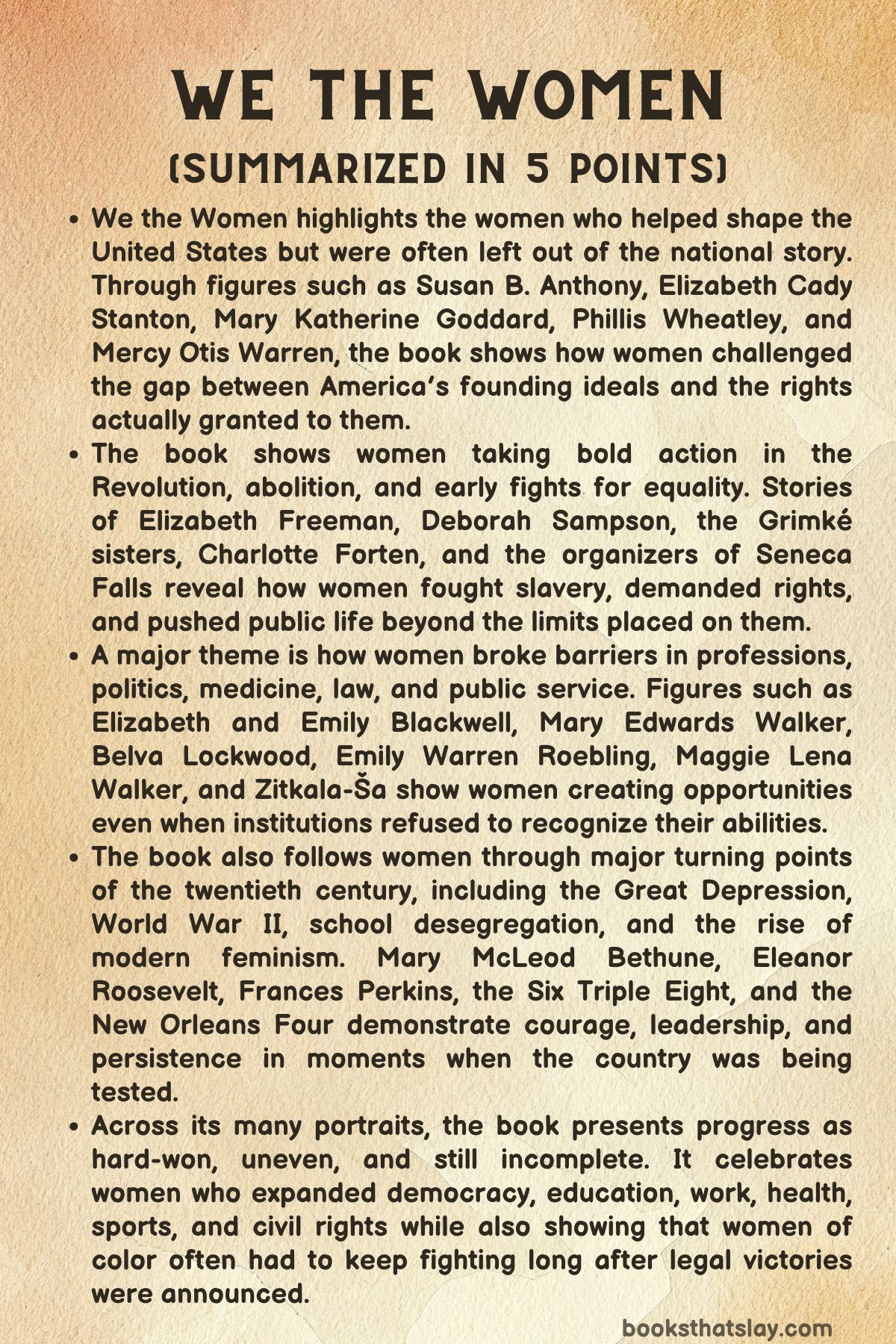
We the Women: The Hidden Heroes Who Shaped America by Norah O’Donnell and Kate Andersen Brower is a history of the United States told through the lives of women who challenged exclusion, expanded freedom, and forced the nation to live closer to its own ideals. Rather than treating women’s history as a side story, the book places women at the center of America’s political, social, legal, and cultural development.
It moves from the Revolution to the modern era, highlighting suffragists, abolitionists, doctors, educators, soldiers, lawyers, athletes, codebreakers, activists, and public servants. The book shows how progress was built through courage, persistence, sacrifice, and work that was often ignored in its own time.
Summary
We the Women opens with a powerful scene from America’s centennial celebration in Philadelphia in 1876. The country was honoring one hundred years of independence, but women were denied a formal place in the official program.
Susan B. Anthony, Elizabeth Cady Stanton, and other suffragists responded by interrupting the ceremony and presenting their own declaration, the “Declaration of Rights of the Women of the United States.” Afterward, they read it outside Independence Hall. Their act exposed a central contradiction in American history: the nation praised liberty and equality while refusing full rights to women.
This moment becomes a frame for the book’s broader argument that American democracy has been shaped by women who demanded that founding promises apply to everyone.
The story then returns to the Revolution and the early republic, showing that women were present at the creation of the nation in ways often left out of traditional accounts. Mary Katherine Goddard, a printer and postmaster in Baltimore, printed the first official copy of the Declaration of Independence that included the names of the signers.
By putting her own name on the document, she took a real risk and claimed a place in a political world that rarely recognized women’s authority. Phillis Wheatley, taken from Africa and enslaved in Boston, became a famous poet whose writing celebrated liberty while revealing the hypocrisy of slavery in a country fighting for freedom.
Mercy Otis Warren used literature, political commentary, and historical writing to shape public debate and argue for limits on government power. Elizabeth Ellet later worked to preserve women’s contributions to the Revolution, collecting stories that might otherwise have been forgotten.
The book also follows women who acted directly in the struggle for independence and freedom. Elizabeth Freeman, born enslaved and known earlier as Bett, heard the language of equality in Massachusetts and used it to challenge her own bondage in court.
Her case helped bring slavery to an end in that state. Deborah Sampson disguised herself as a man, enlisted in the Continental Army under the name Robert Shurtleff, fought in battle, suffered wounds, and later demanded recognition through a military pension.
Patience Lovell Wright, a celebrated wax sculptor in London, used her access to powerful British circles to pass intelligence to American patriots. These women were not merely observers of history; they shaped it through legal action, military service, art, and courage.
From there, We the Women moves into the abolitionist movement and the early fight for women’s rights. Sarah and Angelina Grimké, born into a wealthy slaveholding family in South Carolina, rejected the system that had benefited them.
They moved north, joined the Quaker community, wrote against slavery, and spoke publicly at a time when women were expected to remain silent in public life. Their activism connected abolition with women’s equality, making clear that one form of oppression could not be challenged while another was accepted.
Charlotte Forten, from a prominent free Black family in Philadelphia, recorded racism, abolition, and political struggle in her diary. During the Civil War, she taught formerly enslaved people in South Carolina and later helped advance Black women’s organizing.
The book then turns to Seneca Falls in 1848, where Elizabeth Cady Stanton, Lucretia Mott, Jane Hunt, Martha Coffin Wright, and Mary Ann M’Clintock organized the first women’s rights convention. Their Declaration of Sentiments called for equality and suffrage, echoing the language of the Declaration of Independence while exposing women’s exclusion from political rights.
At the same time, the book acknowledges the limits of the early movement, especially its failure to fully include Black women. Sojourner Truth’s later importance shows how Black women challenged both racism and sexism and insisted that the movement for women’s rights had to be broader than the concerns of white women alone.
The narrative then follows women who broke barriers in professions and public life. Elizabeth and Emily Blackwell became pioneering physicians and created medical institutions serving women and children.
Dr. Mary Edwards Walker served as a Civil War surgeon, was taken prisoner, and became the only woman awarded the Medal of Honor. Susan and Susette La Flesche fought for Native rights, health care, and legal recognition.
Anna Dickinson became a famous Civil War speaker whose political speeches drew national attention and even reached Congress. Belva Lockwood became a lawyer, argued before the Supreme Court, and ran for president before women had the right to vote.
Through these lives, the book shows how women forced their way into fields that had been closed to them and used those openings to serve others.
As America entered the modern age, women continued to change the country’s physical, political, and social landscape. Emily Warren Roebling helped complete the Brooklyn Bridge after her husband became ill, mastering engineering knowledge and managing the project’s public demands.
Katharine Wright supported the Wright brothers’ aviation work and handled major parts of their public and business affairs. Inez Milholland became one of the most visible figures of the suffrage movement and died while campaigning for women’s voting rights.
Maggie Lena Walker built financial institutions that served Black communities. Mary Tape fought school segregation after her Chinese American daughter was denied equal access to public education.
Zitkala-Ša exposed injustices against Native people, especially the harm done by boarding schools and federal policies. The Hello Girls served as telephone operators during World War I but had to fight for proper military recognition.
The passage of the Nineteenth Amendment marked a major victory, though the book makes clear that many women of color continued to face voter suppression and discrimination.
The book then moves through the years between 1926 and 1976, a period shaped by the Great Depression, World War II, civil rights battles, Vietnam, and modern feminism. Mary McLeod Bethune’s story shows the power of education and political organizing.
Born to formerly enslaved parents, she founded a school for Black girls in Daytona, Florida, and defended it even when the Ku Klux Klan tried to intimidate her. She registered Black voters, built Bethune-Cookman College, advised Franklin Roosevelt, led the Black Cabinet, founded the National Council of Negro Women, and helped open military service to Black women.
Eleanor Roosevelt transformed the role of First Lady from a ceremonial position into a platform for action. She held women-only press conferences, wrote a public column, traveled widely, supported women in government, advocated for civil rights, opposed Japanese American internment, and visited soldiers during World War II.
After Franklin Roosevelt’s death, she helped draft the Universal Declaration of Human Rights at the United Nations. Frances Perkins, shaped by witnessing the Triangle Shirtwaist Factory fire, became the first woman in a presidential Cabinet and helped build key New Deal protections, including Social Security, unemployment insurance, child labor limits, minimum wage standards, and the forty-hour workweek.
World War II and the civil rights era bring more examples of women doing essential work without immediate recognition. The Six Triple Eight, an all-Black female battalion led by Major Charity Adams, went to Europe to clear a huge backlog of military mail.
Facing racism, sexism, and difficult conditions, they created an efficient system and completed their mission ahead of schedule. In 1960, Ruby Bridges, Leona Tate, Gail Etienne, and Tessie Prevost helped desegregate New Orleans elementary schools as six-year-old girls.
Escorted by federal marshals through angry mobs, they endured isolation and threats while helping enforce school integration.
The later figures in We the Women show women entering government, sports, law, banking, and national politics. Romana Acosta Bañuelos overcame deportation as a child despite being a U.S. citizen, returned to the United States, built a successful tortilla business, co-founded a Latino-owned bank, and became the first Latina U.S. Treasurer.
Babe Didrikson Zaharias became one of the greatest athletes of the twentieth century, winning Olympic medals, excelling in multiple sports, co-founding the LPGA, and competing even while publicly facing cancer. Patsy Mink, blocked from medical school because she was a woman, became the first woman of color in Congress and helped lead the fight for Title IX, which expanded opportunities for women and girls in education and athletics.
Pat Schroeder entered Congress in the 1970s, confronted sexism openly, and worked on family leave, women’s health, and feminist legislation. Constance Baker Motley helped enforce school desegregation, defended Martin Luther King Jr., won major civil rights cases, and became the first Black woman federal judge.
Across these lives, We the Women presents American history as a long struggle to widen the meaning of citizenship. The book shows that women did not simply wait for rights to be granted.
They printed, wrote, sued, taught, organized, fought, healed, built, argued, governed, coded, marched, and led. Their victories were often incomplete, and many faced racism, sexism, violence, poverty, and erasure.
Yet their actions changed laws, institutions, public expectations, and national memory. The book’s central message is that the United States was shaped not only by famous founding men, but also by generations of women who insisted that democracy must include them.
Key Figures
Susan B. Anthony
Susan B. Anthony is one of the central figures in the book’s vision of women as active makers of American democracy. Her interruption of the 1876 centennial celebration shows her courage, discipline, and refusal to accept symbolic exclusion.
She understood that the nation’s public rituals often celebrated liberty while denying women a voice in shaping it. Anthony appears as a determined reformer who knew how to use public confrontation to expose political hypocrisy.
Her character is defined by persistence: she does not simply ask for rights quietly, but forces the country to look at the gap between its ideals and its treatment of women.
Elizabeth Cady Stanton
Elizabeth Cady Stanton is presented as a bold intellectual and political strategist whose words helped give the women’s rights movement its foundation. Her role in organizing Seneca Falls and shaping the Declaration of Sentiments shows her gift for turning private frustration into public argument.
Stanton’s character is forceful, ambitious, and deeply aware of the power of language. She is not shown merely as someone who wanted reform, but as someone who understood that reform needed structure, documents, speeches, and demands.
At the same time, the book also places her within the limitations of the early movement, especially its failure to fully include Black women.
Mary Katherine Goddard
Mary Katherine Goddard is a courageous and historically important figure in We the Women because she represents the power of women’s labor behind the public documents of American freedom. As a printer and postmaster, she worked in a profession that required intelligence, reliability, and political nerve.
By printing the first official copy of the Declaration of Independence that included the signers’ names and placing her own name on it, she took a real personal risk. Her character reflects quiet bravery rather than battlefield glory.
She shows that women contributed to the Revolution not only through speeches and protest, but also through skilled work that preserved and circulated the nation’s founding ideas.
Phillis Wheatley
Phillis Wheatley is one of the most powerful and morally revealing figures in the book. Kidnapped from Africa and enslaved in Boston, she became a celebrated poet whose literary achievements challenged racist assumptions about intelligence, creativity, and humanity.
Her character carries a deep contradiction at the heart of early America: she wrote about liberty while living in a society built on enslavement. Wheatley’s importance lies not only in her talent, but in the way her life exposed the hypocrisy of a nation that praised freedom while denying it to millions.
She represents the strength of the human spirit under oppression and the ability of art to become political truth.
Mercy Otis Warren
Mercy Otis Warren is portrayed as a woman of intellect, political vision, and literary courage. Through plays, poems, pamphlets, and historical writing, she shaped public debate during and after the Revolution.
Her character shows that political influence does not always come through holding office; it can also come through ideas, arguments, and written memory. Warren’s concern with limiting federal power reveals her as a serious political thinker, not just a patriotic writer.
She belongs to the book’s larger pattern of women who entered public life through the tools available to them and expanded what counted as political participation.
Elizabeth Ellet
Elizabeth Ellet is important because she acts as a guardian of women’s memory. Her work preserving the stories of women in the Revolution shows that history itself can exclude people unless someone makes the effort to recover them.
Ellet’s character is less about dramatic public action and more about historical responsibility. She understood that women’s contributions could disappear if they were not collected, written down, and valued.
In this way, she becomes a figure of preservation, making sure that women who had served, sacrificed, and influenced the nation were not erased from the story.
Elizabeth Freeman
Elizabeth Freeman, also known as Bett, is one of the clearest examples of moral courage in the book. Born enslaved, she heard the language of equality in Massachusetts and used that language to challenge her own bondage.
Her decision to sue for freedom shows remarkable intelligence and bravery, because she transformed revolutionary ideals into a legal demand. Freeman’s character is powerful because she exposes whether American principles were meant to be real or merely decorative.
Her victory helped end slavery in Massachusetts, making her not only a seeker of personal freedom but also a force for wider justice.
Deborah Sampson
Deborah Sampson is a figure of physical courage, endurance, and defiance of gender expectations. By disguising herself as a man and serving in the Continental Army as Robert Shurtleff, she entered a world that formally excluded women.
Her wounds in battle and later fight for a military pension reveal both her bravery and the injustice she faced after serving her country. Sampson’s character challenges narrow ideas about patriotism and military sacrifice.
She shows that women were not simply observers of the Revolution; some risked their bodies and lives directly, even when the nation was reluctant to recognize them.
Patience Lovell Wright
Patience Lovell Wright is one of the more unusual and fascinating figures in the book because she combines artistry with espionage. As a wax sculptor in London, she gained access to British elites and used that access to pass intelligence to American patriots.
Her character is clever, socially skilled, and politically daring. Wright’s importance lies in the way she turned a creative profession into a channel of revolutionary action.
She shows that women’s influence could move through salons, studios, and private conversations, not only through battlefields or formal political spaces.
Sarah Grimké
Sarah Grimké is presented as a woman who rejected the values of the slaveholding world into which she was born. Her movement from a wealthy South Carolina family to abolitionist activism in the North reflects deep moral transformation.
Sarah’s character is serious, principled, and willing to separate herself from comfort and social approval in order to oppose slavery. She also helped connect abolition with women’s equality, recognizing that injustice was often defended by the same systems of power.
Her role in the book shows how conscience can require a person to break with family, region, and tradition.
Angelina Grimké
Angelina Grimké shares Sarah’s moral courage but is also marked by public boldness and emotional force. As a speaker and writer against slavery, she challenged both racial injustice and the belief that women should remain silent in public affairs.
Her character is passionate, fearless, and reform-minded. Angelina’s importance comes from her ability to turn personal rejection of slavery into public advocacy.
She helps show that the fight against slavery also opened a larger debate about women’s right to speak, organize, and lead.
Charlotte Forten
Charlotte Forten is one of the most reflective and emotionally rich figures in the book. From a prominent free Black family in Philadelphia, she used her diary to record the realities of racism, abolitionist commitment, and personal struggle.
Her later work teaching formerly enslaved people in South Carolina during the Civil War shows her dedication to education as a form of liberation. Forten’s character combines sensitivity with resolve.
She is important because she gives the story an interior voice, showing not only what women did but also how they thought, suffered, hoped, and endured.
Lucretia Mott
Lucretia Mott is shown as a principled reformer whose work helped shape the organized women’s rights movement. As one of the organizers of Seneca Falls, she brought moral authority and abolitionist experience to the cause of women’s equality.
Her character is calm, firm, and deeply committed to justice. Mott’s importance lies in her ability to connect religious conviction with public action.
She represents a kind of leadership grounded in conscience, patience, and steady resistance to social inequality.
Jane Hunt
Jane Hunt is important because she helped create the conditions for a historic gathering. As one of the women involved in organizing the Seneca Falls convention, she represents the practical side of reform: meetings, conversations, invitations, and shared planning.
Her character may not appear as dramatically as some others, but her role shows that movements depend on people who make spaces for change to begin. Hunt’s presence in the book reminds readers that history is often shaped in homes and private discussions before it reaches public platforms.
Martha Coffin Wright
Martha Coffin Wright is portrayed as part of the circle of women who turned dissatisfaction into organized activism. Her role in the Seneca Falls convention places her among those who helped give the women’s rights movement a public form.
Her character suggests determination, reformist energy, and loyalty to a larger cause. Wright’s significance lies in her participation in a collective act of political imagination.
She helped create a moment in which women publicly named the inequalities they faced and demanded recognition as full citizens.
Mary Ann M’Clintock
Mary Ann M’Clintock is significant as one of the organizers of Seneca Falls and as a figure connected to the drafting of reformist ideas. Her character reflects the intellectual and practical labor behind political movements.
She helped turn grievances into language, and language into a public declaration. M’Clintock represents the women who worked not only through visible speeches but also through planning, writing, and organizing.
Her role shows that the women’s rights movement was built by collaboration as much as by famous individual leadership.
Sojourner Truth
Sojourner Truth is one of the most necessary figures in the book because she exposes the racial limits of the early women’s rights movement. As a Black woman who had experienced enslavement, she brought a perspective that white reformers often failed to include.
Her character is commanding, direct, and morally powerful. Truth’s importance lies in her insistence that womanhood could not be defined only through the experiences of white middle-class women.
She expands the meaning of women’s rights by making race, labor, and survival impossible to ignore.
Elizabeth Blackwell
Elizabeth Blackwell is portrayed as a pioneer who challenged the exclusion of women from medicine. Her character is disciplined, intelligent, and determined to enter a profession that resisted her presence.
By becoming a doctor and helping open institutions for women and children, she did more than achieve personal success; she created pathways for others. Blackwell’s importance lies in her refusal to accept the idea that women were intellectually or professionally unfit for medical work.
She represents the broader struggle for women’s access to education, science, and public authority.
Emily Blackwell
Emily Blackwell continues and deepens the professional breakthrough associated with her sister Elizabeth. Her character is practical, capable, and institution-building.
She helped prove that women doctors were not exceptions or novelties but necessary professionals who could serve communities with skill. Emily’s role in opening medical institutions for women and children shows her commitment to both health care and women’s advancement.
She is important because she helped transform one woman’s breakthrough into a lasting professional movement.
Mary Edwards Walker
Dr. Mary Edwards Walker is one of the most defiant characters in the book. As a Civil War surgeon who served under dangerous conditions, was captured as a prisoner of war, and later became the only woman awarded the Medal of Honor, she challenged expectations about both medicine and womanhood.
Her character is independent, brave, and unwilling to conform. Walker’s life shows how women who served the nation could still be questioned, minimized, or treated as exceptions.
She represents both heroic service and the struggle for recognition after that service.
Susan La Flesche
Susan La Flesche is a significant Native figure whose work joined health care, leadership, and community service. Her character is marked by responsibility and dedication to Native rights and medical care.
She understood that professional achievement mattered most when it served people who had been neglected or harmed by larger systems. Susan’s importance lies in the way she used education and medicine to strengthen her community.
She stands as a figure of service, resilience, and advocacy within a history that often marginalized Native women.
Susette La Flesche
Susette La Flesche is portrayed as a powerful advocate for Native rights and legal recognition. Her character is articulate, determined, and politically aware.
She used her voice to challenge injustice against Native peoples and to demand that the United States recognize their humanity and rights. Susette’s importance comes from her ability to move between cultures while defending her own people.
She represents the role of Native women as public advocates in struggles over citizenship, land, dignity, and survival.
Anna Dickinson
Anna Dickinson is one of the book’s examples of a woman whose voice became a political force. As a Civil War orator who addressed Congress, she broke expectations about women’s public speech.
Her character is bold, eloquent, and ambitious. Dickinson’s importance lies in the fact that she entered a space where women were rarely welcomed and used oratory to influence national debate.
She shows that public speaking could become a form of power for women at a time when silence was often demanded of them.
Belva Lockwood
Belva Lockwood is a barrier-breaking legal and political figure. As a lawyer who argued before the Supreme Court and ran for president before women could vote, she challenged the boundaries of citizenship in direct and dramatic ways.
Her character is persistent, confident, and unafraid of ridicule. Lockwood’s presidential campaigns were not only attempts to win office; they were arguments that women belonged in the highest levels of public life.
She represents the power of symbolic action when the political system refuses full participation.
Emily Warren Roebling
Emily Warren Roebling is presented as a woman of intelligence, technical ability, and quiet authority. Her work helping complete the Brooklyn Bridge shows that women’s contributions to engineering and public infrastructure were often hidden behind men’s names.
Her character is composed, capable, and deeply committed to finishing a monumental project. Roebling’s importance lies in how she stepped into responsibility when circumstances demanded it and proved herself equal to complex technical and managerial challenges.
She represents the invisible expertise of women in achievements often credited elsewhere.
Katharine Wright
Katharine Wright is important because she shows the emotional, managerial, and public labor behind famous innovation. While her brothers are associated with aviation, Katharine supported their work, managed public and business affairs, and helped make their success sustainable.
Her character is intelligent, loyal, organized, and socially skilled. She reminds readers that invention does not happen only in workshops; it also depends on communication, planning, negotiation, and trust.
Katharine’s role reveals how women’s contributions to scientific and technological progress have often been treated as secondary even when they were essential.
Inez Milholland
Inez Milholland is a dramatic and symbolic suffrage figure. Her character combines beauty, courage, idealism, and sacrifice, but the book presents her as more than an image.
She campaigned intensely for women’s voting rights and died while still fighting for the cause. Milholland’s importance lies in how she embodied the urgency of suffrage.
Her death turned her into a martyr-like figure, reminding the movement and the nation that the demand for political equality required personal cost, endurance, and public pressure.
Maggie Lena Walker
Maggie Lena Walker is one of the strongest examples of economic leadership in the book. By building financial institutions for Black communities, she addressed inequality through ownership, banking, and collective advancement.
Her character is visionary, practical, and deeply committed to racial uplift. Walker understood that freedom required more than legal rights; it also required access to financial power and institutional stability.
Her importance lies in her ability to create structures that served communities excluded from mainstream economic opportunity.
Mary Tape
Mary Tape is a powerful figure in the fight against school segregation. As a Chinese American mother who challenged the exclusion of her child from public education, she represents the determination of immigrant families to claim equal rights.
Her character is courageous, protective, and unwilling to accept discrimination as normal. Tape’s importance lies in showing that the struggle for educational justice included Asian American communities as well as Black and white Americans.
She expands the book’s portrait of civil rights by showing how race, citizenship, and schooling intersected.
Zitkala-Ša
Zitkala-Ša is one of the book’s most important Native voices. She exposed injustices against Native people, especially the harms caused by forced assimilation and government policies.
Her character is artistic, intellectual, and politically courageous. She used writing and advocacy to reveal experiences that many Americans ignored or misunderstood.
Zitkala-Ša’s significance lies in her ability to turn personal and collective pain into public witness. She represents the power of storytelling as resistance and the importance of Native women in the fight for justice.
The Hello Girls
The Hello Girls are presented as disciplined, skilled, and patriotic women who served as World War I telephone operators. Their work required speed, language ability, technical competence, and calm under pressure.
Yet after serving, they had to fight for recognition, revealing how the country depended on women’s labor while denying them full honor. As a group, their character is defined by professionalism and perseverance.
They show that military service can take many forms and that women’s wartime contributions were often essential even when officially minimized.
Agnes Meyer Driscoll
Agnes Meyer Driscoll is a brilliant and important figure in the history of codebreaking. Her character is analytical, patient, and intellectually formidable.
As a major codebreaker, she worked in a field where success depended on precision, secrecy, and exceptional mental discipline. Driscoll’s importance lies in showing women’s contributions to national security and intelligence work.
She belongs to the book’s larger argument that women were not simply symbolic participants in public life; they performed highly specialized work that shaped modern America.
Margaret Sanger
Margaret Sanger is a complicated figure in the book because her work advanced birth control while leaving a troubling legacy. Her character is reformist, determined, and controversial.
She believed that women needed control over reproduction in order to gain greater freedom over their lives, families, and futures. At the same time, the book does not allow her legacy to remain simple, because her work is connected to ideas and movements that raise serious moral questions.
Sanger represents how reformers can expand freedom in one area while also carrying harmful assumptions or associations.
Katharine McCormick
Katharine McCormick is significant because she used her resources and determination to advance birth control. Her character is strategic, wealthy, and committed to women’s reproductive autonomy.
Unlike some figures whose influence came through public speaking or officeholding, McCormick’s power came through funding, persistence, and behind-the-scenes support. Her importance lies in showing that social change often depends on financial backing as well as ideas.
She is also part of the book’s more complex treatment of reform, where progress and controversy can exist together.
Mary McLeod Bethune
Mary McLeod Bethune is one of the most inspiring figures in We the Women because her life combines education, racial justice, political leadership, and personal bravery. Her decision to stand firm when the Ku Klux Klan marched on her school shows extraordinary courage.
Born to formerly enslaved parents, she understood education as a path to dignity and power, especially after experiencing racial humiliation as a child. By founding a school for Black girls with almost no money and helping it grow into Bethune-Cookman College, she proved herself a builder of institutions.
Her later role as an advisor to Franklin Roosevelt, leader of the Black Cabinet, founder of the National Council of Negro Women, and advocate for Black women in military service shows her as a national leader who turned personal conviction into lasting public change.
Eleanor Roosevelt
Eleanor Roosevelt is portrayed as a woman who transformed personal hardship into public purpose. Her lonely childhood, difficult marriage, and Franklin Roosevelt’s paralysis shaped her, but they did not confine her.
As First Lady, she expanded the role into one of activism, travel, journalism, civil rights advocacy, and political influence. Her women-only press conferences and “My Day” column gave women journalists and women’s issues greater public visibility.
Her resignation from the Daughters of the American Revolution after Marian Anderson was barred from Constitution Hall shows her willingness to take moral stands even when they were politically uncomfortable. After FDR’s death, her work on the Universal Declaration of Human Rights made her a global figure of conscience.
Frances Perkins
Frances Perkins is a deeply consequential character because she turned tragedy into reform. Witnessing the Triangle Shirtwaist Factory fire shaped her understanding of labor injustice and unsafe working conditions.
Her character is practical, serious, and morally driven. As the first woman in a presidential Cabinet, she did not merely represent women’s advancement; she helped create policies that changed American life.
Her role in shaping Social Security, unemployment insurance, child labor laws, minimum wage protections, and the forty-hour workweek makes her one of the book’s most important policy figures. Perkins shows how compassion, when joined with political skill, can become law.
Charity Adams
Charity Adams stands out as a strong military leader through her command of the Six Triple Eight. Her character is disciplined, intelligent, and steady under pressure.
Leading an all-Black female battalion during World War II meant confronting racism, sexism, poor conditions, and the burden of proving her unit’s value. Adams and the women under her command created an efficient system to clear a massive mail backlog, restoring communication between soldiers and families.
Her leadership shows that competence can become a form of resistance when institutions underestimate those who serve within them.
The Six Triple Eight
The Six Triple Eight are presented as a collective character of endurance, skill, and dignity. As an all-Black female battalion sent to Europe during World War II, they performed essential logistical work that had a direct emotional impact on soldiers waiting for mail.
Their success came despite discrimination, difficult working conditions, and lack of recognition when they returned home. Their character as a group is defined by efficiency, unity, and quiet excellence.
They reveal how Black women served the nation even while the nation failed to fully honor them.
Ruby Bridges
Ruby Bridges is one of the most moving figures in the book because she entered history as a very young child forced to carry the weight of adult hatred. As one of the children who desegregated New Orleans schools, she walked through mobs under federal protection.
Her character is marked by innocence, courage, and endurance. Ruby’s significance lies in the contrast between her age and the violence directed at her.
She shows how the fight for civil rights often demanded extraordinary strength from children who simply wanted to go to school.
Leona Tate
Leona Tate is part of the New Orleans Four and represents the courage of children placed at the front line of desegregation. Her character is shaped by bravery under terrifying circumstances.
She faced mobs, threats, and isolation not because she sought fame, but because equal education had to be made real through action. Tate’s role in the book reminds readers that school integration was not an abstract legal victory; it was lived by children who had to enter hostile buildings day after day.
Her story is a testament to the human cost of progress.
Gail Etienne
Gail Etienne is another of the New Orleans Four, and her character reflects the emotional burden carried by Black children during desegregation. At six years old, she faced hatred that no child should have had to understand.
Her importance lies in showing that courage is not always loud or chosen with full adult awareness. Sometimes it appears in the simple act of continuing to attend school despite fear, isolation, and danger.
Etienne’s role strengthens the book’s portrayal of civil rights as a struggle fought not only by famous adults but also by children.
Tessie Prevost
Tessie Prevost, as part of the New Orleans Four, represents quiet but profound courage. Her experience of entering a desegregated school under threat shows the cruelty of segregation and the strength required to challenge it.
Her character is important because she helps complete the collective portrait of young girls whose actions forced the country to confront its own injustice. Prevost’s presence in the book shows that children were not merely symbols in the civil rights movement; they were participants who endured real fear and loneliness for the sake of equality.
Romana Acosta Bañuelos
Romana Acosta Bañuelos is a character of resilience, ambition, and economic achievement. Deported to Mexico as a child despite being a U.S. citizen, she returned to America and built a life through work, business, and public service.
Her rise from hardship to becoming a successful entrepreneur, co-founder of a Latino-owned bank, and the first Latina U.S. Treasurer shows determination and practical intelligence. Her character reflects the immigrant and Mexican American struggle for recognition, dignity, and opportunity.
Bañuelos is important because she demonstrates how economic success can become a form of representation and community power.
Babe Didrikson Zaharias
Babe Didrikson Zaharias is portrayed as a fiercely talented athlete who refused to be limited by gender expectations. Her excellence in track and field, basketball, baseball exhibitions, and golf makes her one of the most extraordinary sports figures in the book.
Her character is competitive, confident, and physically fearless. By co-founding the LPGA and continuing to compete while publicly battling cancer, she shaped women’s sports both through performance and institution-building.
Zaharias represents the fight for women to be seen as powerful, skilled, and serious athletes.
Patsy Mink
Patsy Mink is one of the most important political figures in We the Women because her life shows how exclusion can become a source of legislative purpose. Denied medical school because she was a woman, she entered politics and became the first woman of color in Congress.
Her character is determined, principled, and focused on opening doors for others. Her leadership in the fight for Title IX changed education and athletics for women and girls across the country.
Mink’s importance lies in her ability to turn personal discrimination into national protection against discrimination.
Pat Schroeder
Pat Schroeder is presented as a sharp, outspoken, and resilient feminist lawmaker. Entering Congress in 1973, she confronted sexism directly and used her position to fight for family policy, women’s health, and workplace fairness.
Her character is witty, tough, and politically strategic. Schroeder’s work on issues such as the Family and Medical Leave Act shows her commitment to making public policy reflect the realities of family life and women’s labor.
She represents a later stage of women’s political power, when women were not only demanding entry into government but reshaping its priorities.
Constance Baker Motley
Constance Baker Motley is a towering legal figure whose character is defined by brilliance, courage, and discipline. As a civil rights lawyer, she helped enforce Brown v.
Board of Education, defended Martin Luther King Jr., and won major desegregation cases. Her work required legal skill as well as personal bravery, because she challenged entrenched racism through the courts.
Becoming the first Black woman federal judge made her a symbol of progress, but her importance goes beyond symbolism. Motley opened doors for future women in law while helping dismantle the legal structures of segregation.
Themes
Women Expanding the Meaning of American Freedom
The struggle for freedom is presented as unfinished work carried forward by women who forced America to live closer to its own ideals. The centennial protest in Philadelphia captures this tension clearly: a nation celebrating liberty still refused women a place in public political life.
We the Women shows that women did not simply ask to be included in history; they challenged the meaning of citizenship itself. Mary Katherine Goddard gave public form to independence by printing the Declaration with the signers’ names, while Phillis Wheatley used poetry to expose the contradiction between liberty and slavery.
Elizabeth Freeman turned the language of equality into legal action, proving that founding principles could be used against oppression. Later, the Seneca Falls organizers transformed private frustration into a public demand for rights, especially suffrage.
The theme develops through women who understood freedom not as an abstract promise but as something that had to be claimed in courts, conventions, schools, speeches, newspapers, and political campaigns. Their actions reveal that American democracy grew because excluded women kept insisting that its promises belonged to them too.
Courage Against Social and Political Barriers
Courage in the narrative is not limited to battlefield bravery; it appears in the daily decision to act despite punishment, ridicule, violence, or exclusion. Deborah Sampson risked her life by disguising herself to fight in the army, but the same kind of courage appears in Mary McLeod Bethune facing the Ku Klux Klan to protect her students and continue registering Black voters.
The New Orleans Four showed extraordinary strength as young children, walking into schools through mobs and threats simply to claim the right to learn. Eleanor Roosevelt used her public position to challenge segregation, defend human rights, and speak against injustice even when her views were politically uncomfortable.
The Six Triple Eight endured racism, sexism, and poor conditions while serving in World War II, completing essential work without receiving proper recognition at the time. This theme shows that progress often depended on women who acted without certainty of reward.
Their courage was practical, persistent, and public. They faced systems designed to silence them and still chose action over safety, comfort, or approval.
The Power of Voice, Education, and Public Influence
Speech, writing, teaching, and documentation become major tools of change throughout the account. Mercy Otis Warren used literature and political history to shape revolutionary debate, while Elizabeth Ellet preserved women’s Revolutionary contributions so they would not disappear from public memory.
The Grimké sisters used lectures and writings to connect abolition with women’s rights, challenging expectations that women should remain silent in public reform movements. Charlotte Forten’s diary recorded racism, activism, and education during a period when Black women’s voices were often ignored.
Anna Dickinson’s speeches proved that women could command national political attention, and Eleanor Roosevelt’s press conferences, columns, and speeches expanded the influence of the First Lady far beyond ceremony. Education also appears as a force of liberation: Bethune’s school, the Blackwells’ medical institutions, and Patsy Mink’s fight for Title IX all show that access to learning changes both individual lives and national possibilities.
In We the Women, voice is a form of power. Women speak, write, teach, and record because controlling the story is part of changing the country.
Recognition, Memory, and the Cost of Being Overlooked
A repeated concern is that women often shaped major events but were denied credit, authority, or lasting recognition. Patience Lovell Wright used her access in Britain to aid the patriot cause, yet espionage and political intelligence were rarely remembered as women’s work.
Emily Warren Roebling helped complete the Brooklyn Bridge, but public memory long centered on male engineering achievement. Katharine Wright supported aviation history through management, communication, and business skill, yet her role stood behind the fame of her brothers.
The Hello Girls served in World War I as skilled telephone operators, but they had to fight for military recognition. The Six Triple Eight also completed vital wartime labor and returned home without the honor they deserved.
This theme shows that exclusion happens not only when women are blocked from action, but also when their actions are later minimized. The book’s recovery of these lives becomes an argument about memory itself: history is incomplete when it celebrates outcomes while ignoring the women who made them possible.
Recognition is presented as justice, not decoration.