We Were Never Friends Summary, Characters and Themes
We Were Never Friends by Kaira Rouda is a psychological suspense novel about old college secrets, polished social masks, and the damage caused by people who protect themselves at any cost. The story brings a group of former sorority sisters back together for an engagement weekend in Palm Springs, where a glamorous celebration quickly turns sour.
Beneath the luxury, cocktails, and wedding talk lies the unresolved death of Sunny, their friend who drowned twenty-five years earlier. As another death echoes the past, the women are forced to face the lies, betrayals, and crimes they buried long ago.
Summary
We Were Never Friends begins with a disturbing image: a woman’s body floating in the pool of the old Desert Sunrise at night while someone watches from the shadows and then vanishes. This opening sets the tone for a story in which the past is never truly past, especially for the women who once belonged to the same college sorority and shared one terrible spring break in Palm Springs.
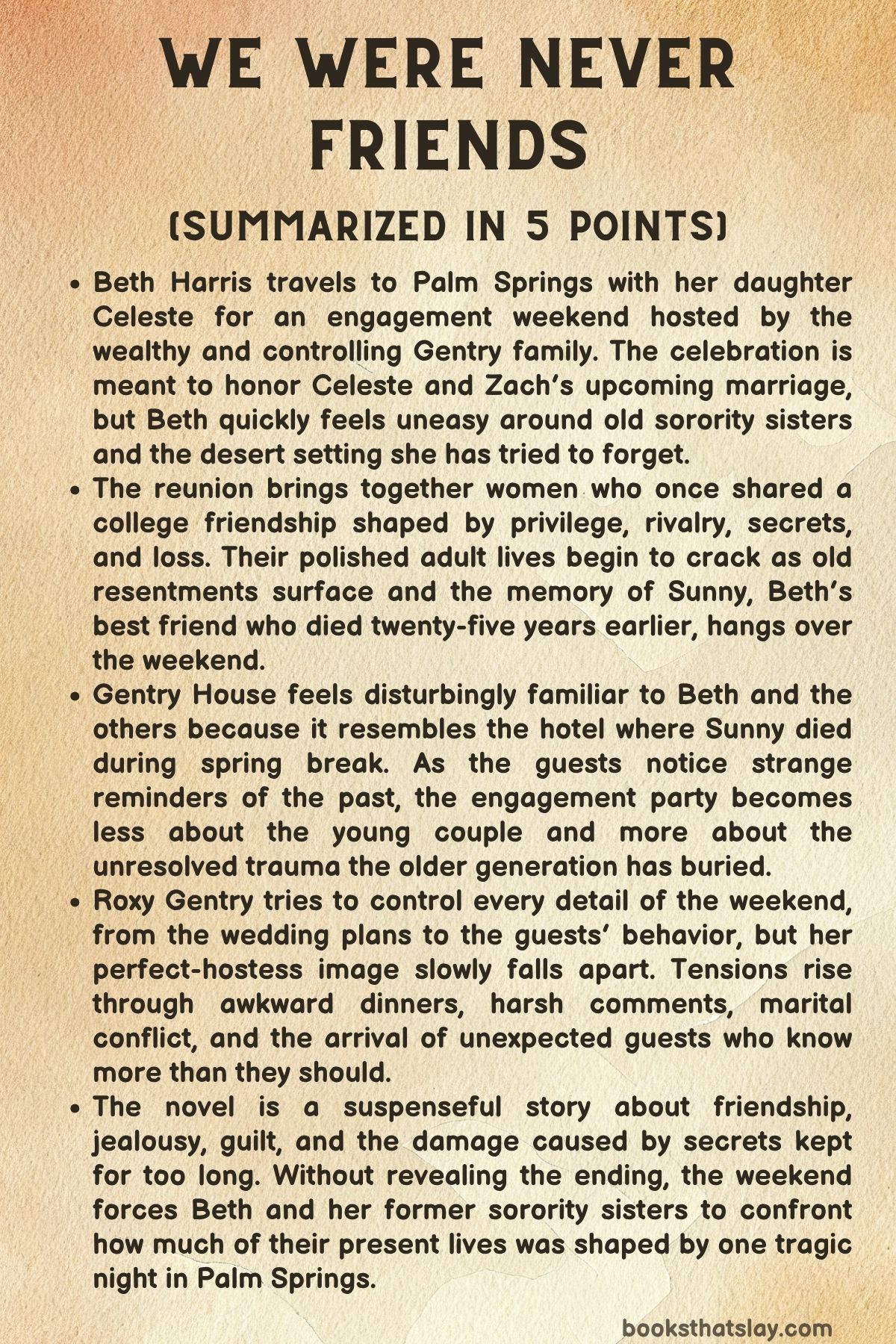
Years later, Beth Harris travels to Palm Springs with her daughter Celeste for an engagement weekend. Celeste, twenty-two and in law school, has recently become engaged to Zach Gentry after a brief romance.
The celebration is being hosted by Zach’s parents, Ryan and Roxy Gentry, at their grand estate. Beth is uneasy from the start.
Roxy was one of her Theta Gamma Mu sorority sisters, and Beth remembers her as wealthy, forceful, and socially powerful. Beth has never felt equal to women like Roxy, and the weekend already feels like a test she is destined to fail.
Her anxiety deepens when she reaches Gentry House. The estate seems almost identical to the Desert Sunrise, the Palm Springs hotel where Beth’s best friend, Sunny, died twenty-five years earlier.
Ryan insists the property is different, only restored from the same 1920s period, but Beth cannot shake the feeling that she has stepped back into the scene of the worst night of her life. The pool, the layout, and the mood of the place all remind her of Sunny.
Other former sorority sisters arrive. Jamie Vale comes with her husband Greer.
Jamie is now a respected cardiologist, composed and successful, but she also notices how much the house resembles the Desert Sunrise. Then Amelia Dell appears unexpectedly with Brett Logan, a former football player and chemistry teaching assistant from their college days.
Roxy is furious because Amelia was not invited, but Ryan allows Amelia and Brett to stay in the pool house.
At first, everyone tries to behave as though the weekend is only about Zach and Celeste. Roxy controls the house, the drinks, the seating, and the wedding discussion with the confidence of someone used to getting her way.
Beth feels pushed aside as Roxy takes over plans for the rehearsal dinner and treats the wedding as another event under her command. Celeste is caught between her mother and her future mother-in-law, while Zach seems used to his mother’s dominance.
But the past keeps pushing into the present. The guests cannot ignore the resemblance between Gentry House and the Desert Sunrise.
At dinner, Amelia drinks too much and openly mentions Sunny’s death, embarrassing Beth in front of Celeste. She suggests that all their lives were changed because Sunny died and implies that Beth’s marriage and family were shaped by that loss.
Beth is shaken, especially because Celeste does not know the full story.
Later, Celeste asks her mother what happened to Sunny. Beth explains that during their senior-year spring break, Sunny said she was tired and stayed behind while the others went out.
During the night, Sunny supposedly went outside, slipped near the pool, hit her head, fell in, and drowned. Beth admits she has always felt guilty for not checking on her friend.
What she does not tell Celeste is that she had a one-night stand that night and has carried shame about it ever since.
The next morning, the tension grows worse. Ryan tells Roxy he plans to leave her after the wedding.
Beth finds an old article about Sunny’s death in her room, but it later disappears, making her feel watched and manipulated. The guests play pickleball, where Brett behaves roughly and hits Amelia in the face with the ball.
Later, during lunch, a dust storm sweeps in. Brett stumbles outside, struggling to breathe, and disappears into the storm.
Ryan goes after him, then calls for help. Beth, Jamie, and Greer follow and find Brett floating in the pool.
Jamie attempts CPR, but Brett dies.
Brett’s death mirrors Sunny’s in a way that horrifies everyone. The storm prevents emergency services from reaching the estate, so the group brings his body inside and places it on the baby grand piano.
Instead of allowing the tragedy to stop the weekend, Roxy tries to force everyone back into celebration mode. She changes into a blue gown, gathers the guests, and tells them to clean up and dress for dinner, claiming Brett would have wanted them to continue.
Ryan finally loses patience and accuses her of making everything about herself. In front of everyone, he announces that he and Roxy are getting divorced.
Roxy is humiliated, and the room breaks apart. When she is alone with Amelia, the truth about the old spring break begins to surface.
Amelia remembers finding Roxy in Sunny and Ryan’s hotel room twenty-five years earlier while Sunny was drugged and incoherent. Roxy had slipped roofies into Sunny’s margaritas so she could get Ryan alone and seduce him.
Amelia helped by distracting Beth that night, and afterward she used the secret to blackmail Roxy for years.
Meanwhile, Beth tries to comfort Zach and Celeste, who are shaken by Ryan’s announcement and Brett’s death. Celeste worries the disastrous weekend is a warning about her own marriage, but Beth reassures her.
Beth also finds a postcard in her room showing a blond woman in green, which reminds her of Sunny. Other strange signs appear: notes, photos, a striped towel, and glimpses of a blond woman in a green dress.
It begins to seem as though someone is staging a haunting around Sunny’s memory.
At dinner, the group makes another attempt at normalcy, but the mood is strained and fearful. Jamie thinks she sees Sunny in green, and Amelia claims she has seen her too.
Then Amelia accuses Roxy of harming Sunny. Celeste and Zach are sent away, and Roxy is forced to confess that she drugged Sunny to get Ryan alone.
Ryan is furious. He realizes Sunny may have died because Roxy left her confused and vulnerable.
Roxy also admits Amelia has been blackmailing her ever since.
More secrets come out. Roxy says Brett supplied the roofies.
She also reveals Jamie’s connection to him. In college, Jamie used drugs, bought them from Brett, and stole money from the sorority to support her habit.
Jamie admits that Sunny had discovered the theft and planned to report both her and Brett after spring break. Then Jamie confesses something worse: on the night Sunny died, she found Sunny floating in the pool and believed Sunny might still be alive, but she chose not to save her because Sunny’s survival would ruin Jamie’s future.
Jamie also admits Brett was still tied to her years later and had come to the weekend to threaten her. Beth suspects Brett’s death was deliberate, and Jamie confesses she killed him by injecting potassium chloride into his Gatorade during the pickleball game.
She then pretended to save him with CPR while making sure the drug spread through his body. Beth suggests that the women keep Jamie’s secret only if she gets treatment for her addiction, and they agree.
As the storm intensifies, a tree crashes through the dining room ceiling and nearly kills them. Beth helps free Roxy, whose arm is trapped and bleeding.
Later, Beth finds Celeste and Zach safe in the pantry. The strange signs of Sunny continue, and Beth finally realizes that Ryan may be behind much of it.
He has transformed Gentry House into a shrine to Sunny because he never let go of her. Ryan admits he bought the house because it reminded him of the Desert Sunrise and says that Sunny is there with them.
In the morning, Amelia reveals the final truth. Jamie did not cause Sunny’s death, because Amelia had already killed her before Jamie arrived.
Sunny had discovered that Amelia was secretly broke and behind on sorority dues despite pretending to be wealthy. Amelia feared Sunny would expose her and destroy the life she was trying to protect, so she made sure Sunny died in the pool.
By the end of We Were Never Friends, the engagement weekend has exposed nearly everyone. Roxy drugged Sunny and built a marriage on a crime.
Amelia killed Sunny and blackmailed Roxy for years. Jamie allowed Sunny to die and later murdered Brett.
Ryan turned his home into a shrine to the woman he lost. Beth, though less guilty than the others, has lived with shame and silence.
The celebration meant to unite two families instead reveals a circle of women who were never truly friends, only people bound together by envy, fear, ambition, and a death they all helped hide.
Characters
Beth Harris
Beth Harris stands at the emotional center of We Were Never Friends because she is the character through whom the past most painfully returns. She arrives in Palm Springs as Celeste’s protective mother, but she is also returning as a woman still burdened by the unresolved death of her college best friend, Sunny.
Beth’s discomfort around Roxy, Ryan, Jamie, and Amelia reveals how deeply old social hierarchies still affect her. She never fully belonged among the wealthy, polished sorority women, and even decades later she feels intimidated by their money, confidence, and ability to control a room.
This insecurity makes her more sympathetic, because she is not simply revisiting a glamorous college past; she is being forced back into a world where she once felt vulnerable and dependent.
Beth is also defined by guilt. She believes she failed Sunny because she went out on the night Sunny died instead of checking on her.
This guilt becomes even heavier because Beth hides part of the truth from Celeste, especially the fact that she had a one-night stand that night. Her silence does not make her malicious, but it shows how shame can distort memory and self-judgment.
Beth has spent years believing that her own selfishness may have contributed to Sunny’s death, when in reality far more deliberate cruelty and betrayal surrounded Sunny that night. Her guilt makes her emotionally honest, but it also blinds her to the possibility that others were far more responsible.
As a mother, Beth is cautious, loving, and protective. Her concern about Celeste’s sudden engagement to Zach is not presented as simple disapproval; it comes from fear that her daughter may be entering a powerful family too quickly and too trustingly.
Beth sees how Roxy dominates the wedding plans and how easily Celeste’s wishes may be swallowed by the Gentry family’s wealth and control. At the same time, Beth tries not to crush Celeste’s happiness.
This balance between warning and reassurance makes her a believable parent: she wants to protect her daughter without turning into another controlling force.
By the end of the story, Beth becomes one of the few characters who responds to the truth with some moral seriousness. She does not emerge completely innocent, because she has kept secrets and allowed guilt to shape her life, but she is not cruel in the way Roxy, Jamie, Amelia, or Ryan are.
Her proposal that Jamie’s secret be kept only if Jamie gets treatment reveals Beth’s complicated ethics. She is willing to compromise with the truth, but she does so from a desire to prevent more destruction rather than from greed or self-preservation.
Beth’s character shows how the past can trap a person for decades, especially when guilt is based on incomplete knowledge.
Celeste Harris
Celeste Harris represents the younger generation unknowingly walking into the wreckage left behind by the older one. She is intelligent, ambitious, and seemingly grounded, as shown through her law school background and her confidence in marrying Zach after a short relationship.
Yet her arrival at Gentry House exposes her innocence about the emotional and moral history surrounding her mother and Zach’s family. Celeste thinks she is attending an engagement celebration, but she is actually entering a place haunted by betrayal, class tension, addiction, blackmail, and murder.
Celeste’s relationship with Beth is important because it reveals both her independence and her vulnerability. She is old enough to make her own choices, but she still turns to Beth when the weekend becomes frightening and confusing.
Her questions about Sunny show that she senses something deeper beneath the polite conversations and elegant surroundings. Celeste is not foolish; she notices tension, secrecy, and emotional evasions.
However, because she does not know the full history, she cannot immediately understand the danger of the world she has entered.
Her engagement to Zach is also tested by the collapse of the Gentry family’s public image. Celeste initially sees Zach through the lens of romance and future possibility, but the weekend forces her to confront the instability beneath his family’s wealth.
Ryan and Roxy’s marriage breaks apart in front of everyone, Brett dies during the event, and long-buried secrets turn the celebration into a nightmare. Celeste’s fear that the disastrous weekend may be a bad sign for her marriage makes sense because she is surrounded by evidence that love, status, and family loyalty can all be corrupted by lies.
Celeste’s role in the book is not to solve the mystery but to show what is at stake if the cycle of secrecy continues. She and Zach are supposed to represent a new beginning, yet their engagement becomes the stage on which the older generation’s sins are exposed.
Celeste’s presence forces Beth to reexamine the past and gives emotional urgency to the truth. She is a reminder that buried crimes do not stay buried; they eventually threaten the lives and futures of those who had nothing to do with the original wrongdoing.
Zach Gentry
Zach Gentry is the bridge between the wealthy Gentry world and Celeste’s more grounded life with Beth. He appears as the young groom-to-be, but his role becomes more complicated as the weekend reveals the rot inside his family.
Zach is not presented as cruel or manipulative like some of the older characters, but he is deeply shaped by a household built around image, privilege, and emotional control. His mother dominates the wedding plans, his father is obsessed with a dead woman from the past, and his family home has been transformed into something close to a shrine.
Zach’s relationship with Roxy shows the influence of wealth and parental control. Roxy treats the engagement not simply as her son’s celebration but as an event she can design, manage, and display.
Zach’s willingness to discuss wedding plans with Roxy in a way that pushes Beth aside suggests that he may be accustomed to his mother’s control, even if he does not fully recognize it. He is not necessarily malicious in this, but he benefits from a family structure where Roxy’s money and confidence dictate the terms.
His relationship with Celeste gives him a more sympathetic dimension. The engagement is meant to be joyful, and Zach seems to care for her, but the chaos of the weekend forces him into a painful confrontation with his parents’ failures.
Ryan’s public announcement that he is leaving Roxy humiliates the family and destabilizes the event that was supposed to celebrate Zach’s future. In that moment, Zach becomes less a privileged son and more a young man watching his family’s polished surface collapse.
Zach’s significance lies in how little control he has over the legacy he inherits. He did not cause Sunny’s death, Brett’s murder, Roxy’s betrayal, Ryan’s obsession, or the women’s long history of secrets.
Yet all of these things intrude on his engagement. Through Zach, the story shows that family wealth and status do not protect the next generation from the moral consequences of the past.
He may want a clean beginning with Celeste, but the book makes clear that beginnings are fragile when built on unexamined histories.
Roxy Gentry
Roxy Gentry is one of the most controlling and morally compromised figures in the novel. From the moment she welcomes Beth and Celeste, she performs wealth, authority, and perfection.
Her home, her hosting, her clothing, her wedding plans, and even her reaction to death are all shaped by her need to control appearances. Roxy does not simply want to celebrate Zach and Celeste; she wants to stage the event as proof of her own power and taste.
This makes her both intimidating and hollow, because her identity depends on being admired, obeyed, and envied.
Roxy’s marriage to Ryan exposes the emptiness beneath her performance. When Ryan tells her he is leaving after the wedding, her carefully managed world begins to fracture.
His public accusation that she turns everything into “the Roxy Show” is cruel but accurate. Even after Brett dies, Roxy’s instinct is not grief or moral reflection, but damage control.
She changes into an elegant gown, gathers the guests, and tries to force the celebration forward. This response reveals her emotional coldness and her belief that social order matters more than human life.
Her darkest secret is her role in Sunny’s death. Roxy drugged Sunny so she could get Ryan alone and seduce him, reducing Sunny to an obstacle in her pursuit of desire and status.
Although Roxy may not have directly killed Sunny, her action placed Sunny in danger and helped create the conditions that led to her death. The roofies show the depth of Roxy’s selfishness: she was willing to violate another woman’s body and safety for romantic and social gain.
Her later payment of hush money to Amelia proves that she knew the seriousness of what she had done and chose concealment over accountability.
Roxy is not just a villain because she made one terrible choice; she is dangerous because she built an entire adult life around suppressing that choice. Her wealth allows her to manage people, buy silence, and maintain her public identity.
Yet the weekend shows that control built on secrets eventually collapses. Roxy’s character represents the cruelty of image obsession, especially when social power allows a person to harm others and continue performing respectability for decades.
Ryan Gentry
Ryan Gentry is a haunted and disturbing character whose grief has hardened into obsession. At first, he appears to be the polished husband and father, welcoming guests into Gentry House and explaining away its resemblance to the Desert Sunrise.
Yet the house itself reveals more about him than his words do. His decision to buy and restore a property that mirrors the place where Sunny died suggests that he has never moved on.
Instead of mourning Sunny honestly, he has recreated the scene of her death and forced others to inhabit it.
Ryan’s relationship with Roxy is bitter and broken. His decision to leave her after the wedding shows that their marriage has become a performance, much like Roxy’s hosting.
When he publicly announces the divorce, he humiliates her in front of their guests, revealing his own capacity for cruelty. Although Roxy’s actions are terrible, Ryan is not morally pure.
His timing shows that he, too, is willing to turn private pain into public punishment.
His connection to Sunny is central to his character. Sunny’s death did not simply mark him; it consumed him.
The disturbing signs around the house, including postcards, photos, towels, and sightings associated with Sunny, suggest that Ryan may be manipulating the atmosphere to make the past feel alive again. His statement that Sunny is “here” reveals a mind trapped between grief, guilt, and fantasy.
Rather than seeking justice or closure, he has preserved the memory of Sunny in a way that becomes unsettling and unhealthy.
Ryan’s role in the story is to show that obsession can be as destructive as direct guilt. He may not be the person who drugged Sunny, abandoned her, or killed her, but he creates a space where the past is revived for everyone else to suffer through.
Gentry House becomes an emotional trap because of him. Ryan is tragic in the sense that he loved or idealized Sunny, but he is also dangerous because he turns grief into control, performance, and psychological manipulation.
Jamie Vale
Jamie Vale is one of the most morally complex characters in the book because she combines professional success with deep corruption and addiction. As a successful cardiologist, she appears to have built a respectable and accomplished life.
Her career depends on saving lives, discipline, and trust. Yet beneath that identity is a history of drug use, theft, cowardice, and murder.
This contrast makes Jamie especially disturbing because her public self is almost the opposite of her hidden self.
Jamie’s past is rooted in addiction and fear of exposure. In college, she bought drugs from Brett and stole sorority funds to support her habit.
Sunny discovered the theft and planned to report Jamie and Brett, which threatened Jamie’s future. This makes Sunny not just a friend or sorority sister in Jamie’s memory, but a danger to the life Jamie wanted to build.
Jamie’s response to that danger reveals her moral weakness. When she found Sunny floating in the pool and believed Sunny might still be alive, she chose not to save her.
That choice is devastating because it turns inaction into a form of violence.
Her later murder of Brett shows that Jamie’s instinct for self-preservation has not disappeared with age. Brett threatens her, and she responds with clinical precision, using potassium chloride and her medical knowledge to kill him while disguising the act as a health crisis.
Her performance of CPR is especially chilling because she uses the appearance of care to conceal murder. The very skills that should make her a healer become tools of deception.
Jamie is not without moments of fear, shame, or vulnerability, but these do not erase her guilt. Her addiction gives context to her choices, but it does not excuse them.
Beth’s insistence that Jamie seek treatment if the women keep her secret suggests that Jamie is both culpable and damaged. She is a character shaped by weakness that becomes cruelty, and by ambition that becomes deadly when threatened.
Her life shows how success can be built over a buried moral failure without ever truly escaping it.
Amelia Dell
Amelia Dell is one of the most dangerous characters because her charm, bitterness, and apparent recklessness hide a cold survival instinct. She arrives uninvited, drinks heavily, provokes others, and seems at first like an unstable guest determined to embarrass Roxy.
Yet as the truth unfolds, Amelia becomes far more important than a disruptive outsider. She has carried secrets for decades and used them for profit, power, and protection.
Amelia’s blackmail of Roxy reveals her opportunism. After finding Roxy with Sunny drugged and incoherent, Amelia does not act out of concern for Sunny.
Instead, she helps Roxy by distracting Beth and later turns the secret into a source of money. This makes Amelia deeply cynical.
She understands wrongdoing clearly, but she responds to it not with justice, loyalty, or remorse, but with leverage. Her long-term blackmail shows that she is willing to live beside corruption as long as it benefits her.
The final revelation that Amelia killed Sunny makes her one of the central villains of the story. Her motive is rooted in class performance and fear of humiliation.
Sunny had discovered that Amelia was secretly broke and behind on sorority dues, threatening the wealthy image Amelia had carefully maintained. Amelia’s desperation to preserve that image leads her to murder.
This makes her crime especially cruel because Sunny dies not over love, revenge, or passion, but because she threatens Amelia’s social mask.
Amelia’s character exposes the violence behind status anxiety. She is terrified of being revealed as less wealthy and secure than she appears, and that fear becomes deadly.
Her cold reflection on making sure Sunny died shows a chilling lack of remorse. Amelia may seem chaotic on the surface, but her deepest actions are calculated.
She represents the kind of person who will destroy others rather than let the truth puncture her carefully constructed identity.
Brett Logan
Brett Logan is a menacing figure whose presence pulls the college past into the present. As a former SCU football player and chemistry teaching assistant, he belongs to the old world of spring break, sorority secrets, and hidden misconduct.
His arrival with Amelia immediately disturbs the balance of the weekend because he is connected to the drugs, betrayals, and threats that many characters want to keep buried. Even before his death, he carries the atmosphere of danger.
Brett’s past as a campus drug dealer makes him central to the chain of events that harmed Sunny. He supplied the roofies that Roxy used and also supplied drugs to Jamie, tying him to both Roxy’s betrayal and Jamie’s addiction.
He is not merely a side character from the past; he is part of the machinery that enabled the women’s worst choices. His role shows how predatory men can move through social circles by supplying what others secretly want while avoiding immediate accountability.
In the present, Brett remains threatening rather than reformed. His aggressive behavior during pickleball, especially when he hits Amelia in the face, suggests that he still uses intimidation and physical dominance.
His presence also threatens Jamie because he remains connected to her drug use and can expose her. He is dangerous because he knows too much and because he seems willing to use that knowledge.
Brett’s death mirrors Sunny’s in setting but not in innocence. Unlike Sunny, he is not a victim of other people’s secrets without having created harm himself.
Jamie kills him to protect herself, but his death also symbolizes the return of buried consequences. He helped poison the past, and in the present he is poisoned in return.
This does not make his murder morally acceptable, but it does make his role thematically fitting: Brett is the past returning in human form, and his death proves that old crimes have not lost their power.
Greer Vale
Greer Vale is a quieter character, but his presence helps reveal the contrast between public respectability and private corruption. As Jamie’s husband, he appears to belong to the stable adult world the former sorority sisters have built after college.
He is part of the respectable surface surrounding Jamie’s successful career and polished identity. Yet his relative normalcy also emphasizes how much he does not know, or at least how much remains hidden beneath his marriage.
Greer’s role during Brett’s death is important because he is present when the group follows Ryan and discovers Brett floating in the pool. His presence helps make the scene feel communal rather than private; Brett’s death is not something one person can quietly absorb.
It becomes another shared trauma, forcing the group into a renewed version of the horror surrounding Sunny. Greer is not the emotional focus of that moment, but he helps anchor the present-day crisis.
As Jamie’s husband, Greer also represents the life Jamie is trying to protect. Her career, marriage, and reputation all depend on keeping her addiction, theft, and past cowardice hidden.
Greer may not be deeply developed compared with the central women, but that is part of his function. He stands for the ordinary domestic life that can exist beside enormous secrets.
His presence makes Jamie’s double life more visible because the reader sees how successfully she has hidden her corruption from the world closest to her.
Greer is not shown as one of the major guilty figures, but his limited role contributes to the story’s atmosphere of uncertainty. In a house where nearly everyone is hiding something, even quieter characters become part of the uneasy social arrangement.
Greer’s significance lies less in what he does and more in what his marriage to Jamie reveals: that a polished adult life can be built around secrets another spouse may never fully understand.
Sunny
Sunny is the absent character who controls the emotional and moral structure of We Were Never Friends. Though she is dead before the main events unfold, her presence dominates the weekend.
She appears through memory, guilt, objects, stories, sightings, and the recreated setting of Gentry House. The other characters may try to continue with the engagement celebration, but Sunny’s death keeps interrupting them because it was never truly resolved.
In Beth’s memory, Sunny is generous, loyal, and central to her college life. She paid for Beth’s spring break trip using sorority funds, which suggests kindness and a desire to include her friend.
Sunny also seems observant and principled. She noticed financial irregularities in the sorority, including stolen money and unpaid dues, and she intended to expose wrongdoing.
This moral clarity made her dangerous to others. Jamie, Brett, and Amelia all had reasons to fear what Sunny knew, while Roxy saw her as an obstacle to Ryan.
Sunny’s tragedy lies in the fact that multiple people failed or harmed her at once. Roxy drugged her, Amelia killed her, Jamie chose not to save her, Brett supplied the drugs that made part of the crime possible, and Beth spent decades blaming herself without knowing the full truth.
Sunny becomes a symbol of innocence destroyed not by one accident, but by an entire social circle’s selfishness. Her death exposes the cruelty beneath sorority loyalty, wealth, romance, and ambition.
Sunny is also idealized, especially by Ryan. His transformation of Gentry House into a shrine-like echo of the Desert Sunrise shows that she has become more than a person in his mind.
She is memory, obsession, accusation, and ghostly presence. Yet the story also makes clear that Sunny was not merely a symbol; she was a young woman whose life was ended because others valued their secrets more than her survival.
Her character gives the novel its moral weight because every revelation leads back to the question of who failed Sunny and why.
Themes
Guilt and the Long Life of the Past
Guilt controls the characters more powerfully than any present danger. Beth carries the pain of leaving Sunny alone that night, even though she does not know the full truth for most of the story.
Her guilt is emotional rather than criminal, yet it shapes how she sees the reunion, the house, the pool, and every reminder of Sunny. Roxy’s guilt is darker because it comes from deliberate selfishness: she drugged Sunny to get Ryan’s attention and then built a life on the silence that followed.
Jamie’s guilt is tied to ambition and fear, because she allowed Sunny to die when saving her could have ruined her future. Amelia’s guilt is the most chilling because she seems least disturbed by it.
In We Were Never Friends, the past does not stay buried because none of the women truly faced what they did. Their reunion becomes a forced return to the moment they avoided for twenty-five years, proving that guilt can survive time, wealth, success, marriage, and reinvention.
Friendship, Betrayal, and False Sisterhood
The relationships among the women expose how shallow and dangerous their idea of sisterhood really was. Their sorority bond appears glamorous from the outside, with shared memories, social status, and long histories, but beneath it lies jealousy, fear, competition, and betrayal.
Sunny seems to have been the one person who threatened the false peace because she noticed what others were hiding. Instead of protecting her, the women protected themselves.
Roxy betrays Sunny for romance and status. Jamie betrays her to protect her career.
Amelia betrays her to protect her image of wealth. Beth’s betrayal is less intentional, but her failure to check on Sunny still leaves her feeling responsible.
The title gains its force because the women were never truly friends in any honest or loyal sense. Their reunion shows that shared history does not equal love, and closeness without trust can become a trap where secrets matter more than human life.
Wealth, Image, and Social Performance
Status is treated as both a weapon and a disguise. Roxy uses money, elegance, and hospitality to control the weekend, turning even grief into something she tries to manage with clothes, dinner plans, and social rules.
Her restored estate is not just a home; it is a stage where she performs power, taste, and superiority. Amelia also performs wealth, hiding financial insecurity behind confidence and social polish.
This obsession with appearances reaches back to college, where fear of being exposed drives her toward violence. The characters repeatedly choose image over truth, whether it is Roxy protecting her perfect marriage, Jamie protecting her professional success, or Amelia protecting her rich-widow persona.
The engagement party itself becomes a symbol of social performance, because everyone is expected to celebrate while death, betrayal, addiction, and blackmail sit just beneath the surface. We Were Never Friends shows how the desire to look successful can become morally destructive when reputation matters more than honesty or compassion.
Truth, Exposure, and Moral Collapse
The weekend works like a slow stripping away of false identities. At first, the characters try to behave as polished adults gathered for a celebration, but each new shock forces another hidden truth into the open.
Brett’s death repeats the pattern of Sunny’s death and breaks the illusion that the past is finished. Once Roxy’s role is revealed, the group’s moral structure collapses quickly: blackmail, drug use, theft, murder, and cowardice all come out.
What makes the exposure powerful is that no single confession fully explains the past. Each woman has only part of the truth, and each secret reveals another layer of selfishness.
The final revelation about Amelia changes the meaning of everything that came before, showing that the tragedy was not caused by one mistake but by a chain of cruel choices. Truth in the story is not healing in a simple way.
It is brutal, humiliating, and necessary because every lie has protected someone guilty.