Weavingshaw Summary, Characters and Themes
Weavingshaw by Heba Al-Wasity is a dark fantasy novel about poverty, illness, secrets, ghosts, and the brutal systems that feed on the powerless. The story follows Leena Al-Sayer, a young woman from Golborne’s poor New Algaraa District, whose ability to see ghosts becomes both a curse and a weapon.
When her brother Rami falls gravely ill, Leena turns to Bram St. Silas, a feared collector of secrets, and is drawn into a world of aristocratic crime, prison trafficking, demons, and inherited blood debts. At its center, Weavingshaw is about survival under oppression and the cost of making bargains with dangerous people.
Summary
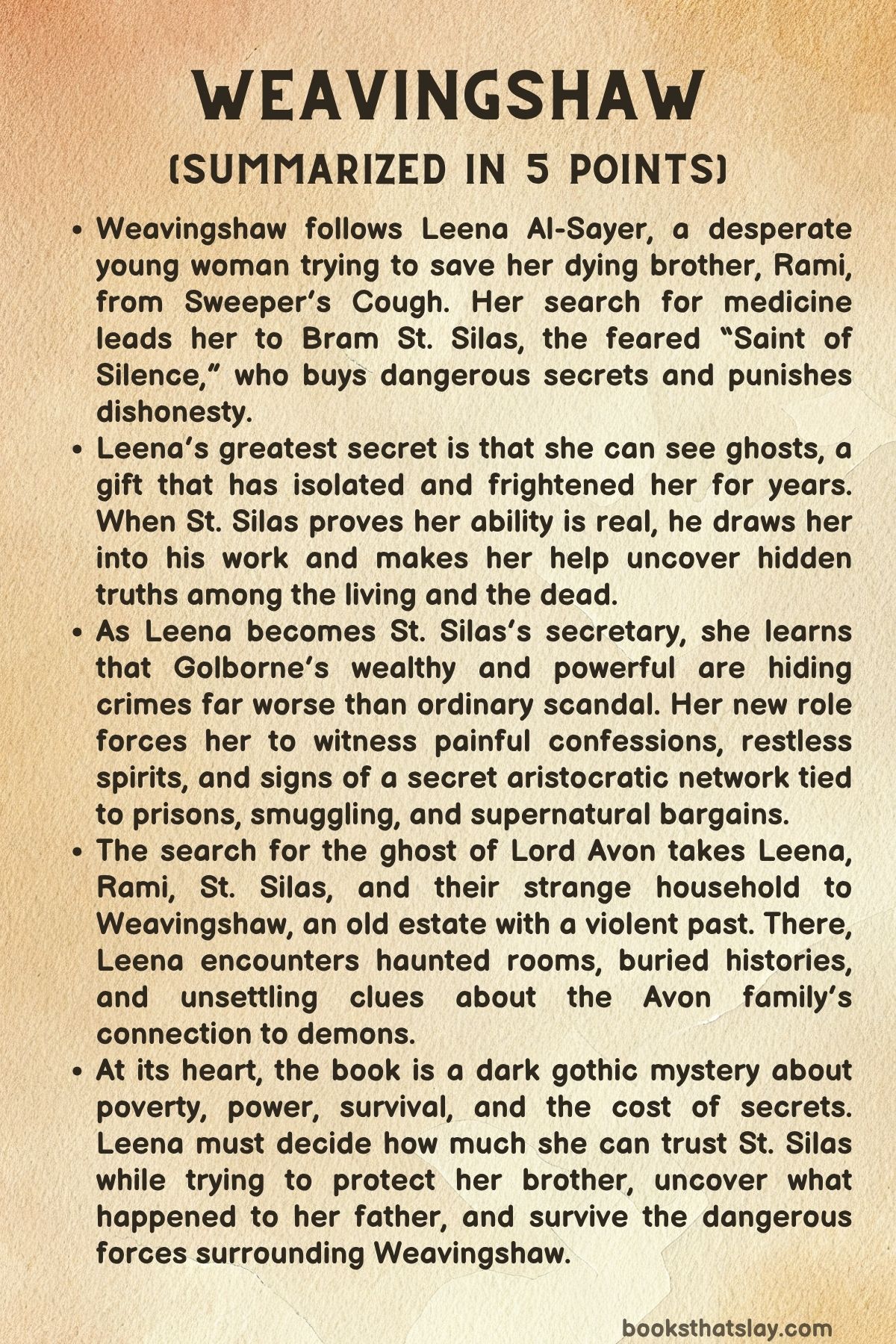
Leena Al-Sayer is desperate to save her younger brother, Rami, who is dying from Sweeper’s Cough. With no money and few choices, she asks her neighbor Margery how to find Bram St. Silas, also known as the Saint of Silence.
St. Silas is feared across Golborne because he pays people for valuable secrets, but those who lie to him suffer terrible punishment. Margery warns Leena that he is not a man to test and that even truthful confessions can ruin a person.
Leena understands the risk, but Rami’s life matters more than her fear.
She travels at night from the poor New Algaraa District toward the wealthier Northern Quarters. On the way, she sees signs of the city’s violence and inequality.
She also runs into trouble connected to Rami’s illegal sword fighting. Rami has missed a fight, and the Black Coats, the gang linked to those matches, may punish him for it.
This adds to Leena’s urgency. By the time she reaches St. Silas’s shop, it is closed, but a ghost leads her to the back entrance.
His housekeeper, Mrs. Van, tries to keep her out, yet Leena forces her way inside and demands that St. Silas hear her secret.
St. Silas agrees only after making her sign a contract. If her secret is true and valuable, he will give her medicine for Rami.
If she lies, she will be punished. Leena tells him her secret: she can see ghosts.
He doubts her, so he takes her to Newtorn Prison to prove it. There, Leena sees the cruelty of the prison system, including prisoners forced to work through the night.
She asks about her father, Ali Al-Sayer, who was imprisoned for union organizing, but the Warden gives her no useful answers.
To test her gift, St. Silas brings her to Colson, a starving prisoner accused of murdering his business partner. Leena sees the ghost of the murdered man.
The ghost reveals that Colson is innocent and that St. Silas himself killed him. Instead of showing guilt, St. Silas seems satisfied.
Leena’s ability is proven, and he accepts the value of her secret.
Back at his study, St. Silas gives Leena the medicine for Rami, but he reveals another cruel truth: Leena also has Sweeper’s Cough. He had noticed the signs earlier and arranged matters so that she would need him again.
He offers to save her life if she works for him. Her task will be to help him find the ghost of Percival Avon, the dead Marquess of Avon and former master of Weavingshaw.
Trapped by illness and responsibility, Leena negotiates a contract. She will become his secretary, live in his house, receive necessities, and get rent money for her own home.
Once she finds Lord Avon’s ghost, she will be released.
As Leena and Rami recover, Leena remembers the beginning of her ghost-sight. Three years earlier, while working as a lady’s companion at Hythe House, she saw her first ghost and fled.
That same night, soldiers arrested her father because of his union work. Since then, Leena and Rami have learned how to defend against spirits using salt circles, copper coins, and humming.
Still, ghosts can threaten her, especially when she is weak. During her fever, Leena dreams of her dead mother, who warns that “the Wake” will take her father and tells her to beware Weavingshaw and the Avons.
Once stronger, Leena begins researching the Wake, Lord Avon, and Weavingshaw. She finds little about the Wake, though prison guards react strangely when she mentions it.
She learns that Lord Avon supposedly died without heirs, that Weavingshaw is an old fortress-like estate later bought by Mr. Martin, and that the Avon crest shows a wolf and a poisonous flower called Deathgrip. Before beginning her new work, Leena tries to buy a dagger but fails.
Margery gives her a broken gold timepiece as a farewell gift.
Leena moves into St. Silas’s house and starts working for him. During a private exchange, she tells him that Lady Hargreaves’s ghost haunted her husband because she drowned with stones in her pockets.
In return, St. Silas tells her that the Wake is a secret group of aristocrats involved in smuggling and selling prisoners from Newtorn. He also reveals that Lord Avon did not die from illness, as the public story claims, but was murdered with a sword through the heart.
Leena begins to see that St. Silas may be cruel, but he may also be her best chance of discovering what happened to her father.
Her duties expose her to the hidden crimes of Golborne’s upper classes. She sits in on St. Silas’s consultations and identifies ghosts attached to confessors.
People confess theft, violence, betrayal, and old guilt while St. Silas records their secrets in his ledgers. One elderly former factory owner admits that during a fire, he locked his workers inside to stop theft, killing hundreds.
Leena sees the burned ghost of one of those workers beside him. Her job forces her to face both living corruption and the suffering it leaves behind.
The story also reveals Lord Hargreaves’s role in the wider evil. Decades earlier, he and Percival Avon began selling prisoners to demons.
What began with an escaped Algaraan convict became a system of exploitation disguised as mercy. In the present, Hargreaves visits Newtorn Prison and selects more prisoners for the same fate.
Among them is Leena and Rami’s father. Hargreaves recognizes his connection to Leena and sentences him to fifteen years in the underworld, planning to use him later.
Leena, Rami, Mrs. Van, and St. Silas travel north to Weavingshaw to search for Percival Avon’s red diary and summon his ghost. On the way, they stop near Lytham.
That night, Lady Hargreaves’s drowned ghost leads Leena through the woods to the shore. St. Silas follows.
The ghost points Leena toward a hidden box in a willow tree. Inside are old letters, one of which accuses someone of horrors connected to Weavingshaw, demons, and “that poor boy.” St. Silas then admits that Mrs. Van and Orley are demons, though he does not fully explain his own connection to them.
At Weavingshaw, the group becomes unwanted guests of Mr. Martin, who now owns the estate. Leena and Rami are introduced as St. Silas’s wards.
Martin is hostile, and Lord Kilworth’s presence disturbs Leena because she remembers him from her time in Hargreaves’s household as a dangerous nobleman. Soon after arriving, Leena sees the ghost of a young woman named Moira.
Moira possesses her and forces Leena to relive her memories: Percival Avon seduced her, made her keep a secret, and strangled her to protect it.
While pretending to join the hunting party, the group searches for the red diary. They look through the library, study, attics, smugglers’ caves, and crypts.
In the crypts, Rami triggers an old trap, and Leena is attacked by a powerful demon presence. They overhear Martin and Kilworth discussing a hidden supply of Tar, an illegal drug stored in a tomb.
Rami destroys it, placing them all in danger. They find Percival’s tomb, but the diary is not there.
Leena then encounters the ancient demon bound to Weavingshaw. Through its memories, she learns that the First Marquess of Avon made a blood pact with it.
Every Avon descendant would serve and feed it in exchange for the estate’s protection. She also sees Percival begging the demon to stop feeding on him.
St. Silas brushes off this revelation, making Leena suspect he already knew much more than he had told her.
The truth of St. Silas’s identity comes out. He is Bramwell Avon, the seventeenth Marquess, Percival’s son and heir.
Percival and Hargreaves traded him to demons, and his search for Percy’s ghost and the red diary is part of a larger effort to reclaim Weavingshaw and uncover the Limitless Vessel. Martin discovers that the Tar has been destroyed and challenges St. Silas to a duel.
Before the confrontation, St. Silas returns Leena’s treasured botany book, which she believed was gone.
On the final day, St. Silas enters the crypts alone. Because only an Avon can cross the demon lake, he goes where the others cannot.
He resists a demonic illusion of his father’s corpse and finds the red diary. The group leaves Weavingshaw, but they are pursued.
Their carriage overturns in the snow, and St. Silas is badly wounded. To survive, they escape into the demon world.
There, Leena bargains with Orley for a vial that may save him. Orley warns her that Avon men will sacrifice anything for Weavingshaw.
Even so, Leena stays with Bram as he wakes in hiding, bound now not only by contract and need, but by the dangerous knowledge they share.
Characters
Leena Al-Sayer
Leena Al-Sayer is the central character of Weavingshaw, and she is defined by desperation, courage, intelligence, and moral pressure. At the beginning of the book, she is not seeking danger for adventure or power; she approaches Bram St. Silas because her younger brother Rami is dying and she has no safe way to get medicine.
This immediately establishes her as a character driven by love and responsibility. Her willingness to enter the Saint of Silence’s world shows both bravery and helplessness, because she knows the risks but has been pushed into a situation where refusing danger would mean allowing Rami to die.
Leena’s ability to see ghosts makes her valuable to St. Silas, but it also makes her vulnerable. She is constantly exposed to suffering that others cannot see, and her gift forces her to witness the hidden violence beneath polite society.
She is not simply frightened by ghosts; she is burdened by the truth they carry.
Leena is also emotionally complex because she is both cautious and bold. She forces her way into St. Silas’s study, bargains for better conditions, and refuses to be treated as powerless, yet she is also afraid, ill, and deeply uncertain about whom she can trust.
Her relationship with St. Silas is especially tense because she recognizes his danger, cruelty, and manipulation, but she also understands that he may be the only person capable of helping her discover what happened to her father. This makes her loyalty complicated rather than simple.
Leena’s strength lies in her ability to keep thinking even when trapped. She negotiates, observes, researches, and pieces together clues about the Wake, the Avons, and the estate.
Her compassion separates her from many of the powerful people around her: where others treat prisoners, ghosts, workers, and the poor as disposable, Leena continues to see them as human beings. In the book, she becomes a witness to both the living and the dead, and her character gains depth because she must decide what to do with the terrible truths she learns.
Rami Al-Sayer
Rami Al-Sayer is Leena’s younger brother, and his illness gives the opening conflict its emotional urgency. He is physically vulnerable because of Sweeper’s Cough, but he is not written as merely weak or passive.
His connection to illegal sword fighting and the Black Coats suggests that he has also been trying to survive through dangerous means. This makes him a mirror to Leena: both siblings are pushed into risky worlds because poverty has left them few choices.
Rami’s missed fight adds another layer of danger, showing that illness is not the only threat surrounding him. The gangs and exploitative systems of Golborne are just as dangerous as disease.
Rami’s role becomes more active during the journey north. He travels with Leena, St. Silas, and Mrs. Van, and his presence keeps Leena emotionally anchored.
He is one of the few people she is trying to protect without calculation. In the estate’s crypts, Rami accidentally triggers a trap and later destroys the hidden supply of Tar, an action that is reckless but also morally significant.
By destroying the illegal drug supply, he disrupts Mr. Martin’s power and refuses to let corruption remain untouched. His character carries youthful impulsiveness, but that impulsiveness is tied to courage.
Rami’s importance in the book lies not only in being Leena’s motivation but also in showing how young people from poor families are forced into adult danger before they are ready.
Bram St. Silas / Bramwell Avon
Bram St. Silas, later revealed as Bramwell Avon, is one of the most morally complex figures in the book. At first, he appears as the feared Saint of Silence, a man who buys secrets and punishes lies.
His reputation is built on terror, control, and knowledge. He understands the value of secrets because secrets are currency in a corrupt society.
When Leena comes to him, he does not respond with simple generosity. Instead, he tests her, manipulates her, and uses her illness to trap her into employment.
This makes him dangerous from the start. He is intelligent, calculating, and often cruel, and he treats truth less as a moral good than as a tool.
Yet Bram is not only a villainous figure. His own past reveals why he is so obsessed with Percival Avon, the red diary, the Limitless Vessel, and Weavingshaw.
He is the heir of the Avon line, but he is also one of its victims. His father and Hargreaves traded him to demons, turning his inheritance into a curse rather than a privilege.
This history explains his hardness without excusing it. Bram’s search for Percy’s ghost is not just about property or revenge; it is about uncovering the structure of betrayal that shaped his life.
His relationship with Leena complicates him further. He exploits her, but he also shares information with her, protects her at times, and returns her botany book, a gesture that shows he can understand emotional value even when he rarely expresses tenderness openly.
Bram is a character shaped by trauma, aristocratic rot, and ambition. He wants control because control was taken from him, but his desire to reclaim power risks making him resemble the very men who destroyed him.
Margery
Margery is Leena’s neighbor and one of the first characters to show genuine concern for her. Her role may be smaller than Leena’s or Bram’s, but she is important because she represents ordinary community care in a world where official systems have failed.
She warns Leena repeatedly not to seek out St. Silas and especially not to lie to him. These warnings establish the danger of the Saint of Silence before he fully enters the story.
Margery understands enough about his reputation to fear him, and her reluctance to give Leena directions shows that she is not careless with Leena’s life.
At the same time, Margery also understands desperation. She eventually helps Leena because she knows Rami’s situation is severe.
This makes her practical rather than sentimental. She cannot save the siblings herself, but she can provide knowledge, caution, and emotional support.
Later, when she gives Leena the broken gold timepiece, the gesture feels protective and symbolic. It suggests memory, affection, and perhaps a wish that Leena carry something of home with her.
Margery’s character grounds the book in the lives of people outside aristocratic schemes and demonic bargains. She reminds the reader that kindness still exists, even in a harsh city.
Mrs. Van
Mrs. Van begins as St. Silas’s cold housekeeper, but the later revelation that she is a demon changes the meaning of her behavior. Her first interaction with Leena is guarded and hostile, as she tries to send her away from St. Silas’s house.
At first, this makes her seem like a stern servant protecting her master’s boundaries. Once her demonic nature is revealed, however, her composure and distance become more mysterious.
She belongs to the hidden supernatural structure behind Bram’s world, and her presence suggests that his household is not merely eccentric or dangerous but connected to forces beyond ordinary human society.
Mrs. Van’s importance lies in how she blurs the line between domestic order and supernatural threat. A housekeeper is usually associated with maintaining a household, but Mrs. Van helps maintain a space filled with contracts, secrets, punishments, and ghosts.
She travels with Leena, Rami, and Bram to the estate, which places her inside the central investigation. Her character is restrained, but that restraint creates tension.
She seems to know far more than she says, and because she is tied to demons, her loyalty cannot be read in simple human terms. In the story, Mrs. Van represents hidden power disguised as service.
Orley
Orley is another demon connected to Bram’s world, and although he appears less often than some of the human characters, his role is crucial. He becomes especially important after the carriage overturns and Bram is wounded.
In the demon world, Leena bargains with Orley for a vial meant to save Bram’s life. This moment shows that Orley operates by rules of exchange, bargain, and warning.
He is not simply a monster attacking from the shadows; he is a being who negotiates, withholds, and understands the dangerous patterns of the Avon family.
Orley’s warning that Avon men sacrifice anything for the estate gives him an unsettling wisdom. He seems to know the legacy of the family more clearly than Leena does, and his words challenge her emotional attachment to Bram.
His warning suggests that Bram’s suffering does not automatically make him safe, and that inheritance can become an obsession powerful enough to consume others. Orley’s character therefore functions as both supernatural helper and moral alarm.
He provides what Leena needs, but he also forces her to confront the possibility that saving Bram may pull her deeper into the same destructive legacy that ruined him.
Ali Al-Sayer
Ali Al-Sayer, Leena and Rami’s father, is central to the emotional and political heart of the book even though he spends much of the story imprisoned. He was arrested after trying to organize a union, which immediately positions him as a threat to the powerful because he challenged labor exploitation.
His imprisonment is not presented as an isolated misfortune; it is part of a broader system that punishes workers and protects aristocrats, industrialists, and prison authorities. Through Ali, the book connects family suffering to political oppression.
Ali’s situation also deepens Leena’s motivation. She is not only trying to save Rami or survive St. Silas’s bargain; she is also trying to understand what happened to her father and whether he can be rescued.
Hargreaves’s recognition of Ali as Leena’s father makes him even more vulnerable, because his connection to Leena turns him into a potential tool in a larger game. His sentence to fifteen years in the underworld is horrifying because it shows how prisoners are treated as commodities.
Ali represents dignity under persecution, but he also represents the terrifying helplessness of people trapped inside corrupt institutions. His character makes the book’s social criticism sharper because his suffering comes from human greed as much as supernatural evil.
Leena and Rami’s Mother
Leena and Rami’s mother appears through memory and fever dream, but her presence carries emotional and prophetic weight. When Leena sees her during illness, she warns that the Wake will take Baba and tells Leena to beware the estate and the Avons.
This makes her more than a comforting maternal image. She becomes a figure of warning, memory, and inherited fear.
Her appearance connects the family’s private grief to the larger mystery surrounding the Wake and the Avon line.
Her character also reveals Leena’s vulnerability. In fever, Leena is not only a determined survivor but also a daughter longing for guidance.
The mother’s warning suggests that the family’s suffering is not random; it is tied to forces Leena does not yet fully understand. Even though she is not physically present in the main action, she shapes the atmosphere of dread and foreshadowing.
She represents the past speaking into the present, urging Leena to recognize danger before it fully reveals itself.
Hargreaves
Hargreaves is one of the book’s clearest examples of aristocratic cruelty hidden beneath respectability. His past with Percival Avon reveals that he helped begin the practice of trading prisoners to demons.
What makes him especially disturbing is the language of mercy he accepts or uses around this evil. The escaped Algaraan convict is not treated as a human being with rights or suffering; he becomes an object to be disposed of.
Hargreaves’s moral corruption lies in his ability to turn exploitation into something that sounds civilized.
In the present, Hargreaves continues this cruelty at Newtorn Prison, selecting prisoners for the underworld. His recognition of Ali Al-Sayer and decision to sentence him to fifteen years in the underworld show how personal and political cruelty intersect.
He does not merely participate in a system; he uses it strategically. His connection to Lady Hargreaves’s ghost also suggests hidden guilt and violence within his own household.
Hargreaves is important because he embodies the ruling class’s ability to transform prisons, labor, and even supernatural horror into profit and power.
Percival Avon
Percival Avon is dead during the main events, but his influence dominates much of the plot. As the former Marquess of Avon and Bram’s father, he represents the rotten inheritance Bram is trying to uncover and reclaim.
His murder by a sword through the heart makes him a mystery, but his actions make him morally repulsive long before the full truth is known. He helped trade prisoners to demons, participated in the horrors connected to the Wake, and sacrificed his own son to demonic forces.
His cruelty is both public and intimate: he harms nameless prisoners, but he also destroys his own child.
Percival’s relationship with Moira adds another layer to his character. He seduces her, forces her to keep a secret, and then strangles her to protect that secret.
This shows that his violence is not limited to political conspiracy or supernatural bargains; it also enters personal relationships. He treats people as disposable whenever they threaten his power.
His diary becomes important because it may contain the truth he tried to control, and his ghost is sought because the dead may reveal what the living concealed. Percival is not present as a living character, but the damage he caused structures the book’s conflicts.
Lady Hargreaves
Lady Hargreaves appears as a drowned ghost, and her haunting suggests a life and death shaped by secrets. St. Silas reveals that her ghost haunted her husband because she drowned with stones in her pockets, a detail that implies despair, coercion, guilt, or some hidden tragedy.
Her later appearance to Leena near Lytham is especially important because she leads Leena to the hidden box of letters. In doing so, she becomes one of the dead who actively helps expose the crimes of the living.
Lady Hargreaves’s character is tragic because she seems trapped between silence and revelation. As a ghost, she cannot simply explain everything in ordinary speech, but she can guide Leena toward evidence.
The surviving letter she leads Leena to connects the estate, demons, and “that poor boy,” making her a key figure in uncovering the past. Her haunting is not random horror; it is testimony.
Through Lady Hargreaves, the book shows that the dead remain restless when truth has been buried.
Mr. Martin
Mr. Martin is the wealthy tradesman who now owns the Avon estate, and his character shows that corruption is not limited to old aristocratic bloodlines. He is openly hostile when Bram’s group arrives, and his behavior suggests insecurity as well as possessiveness.
Although he owns the property, he does not fully control the history buried beneath it. His ownership places him inside a legacy of violence, smuggling, hidden crypts, and demonic influence.
Martin’s involvement with the hidden supply of Tar reveals his criminality and greed. The illegal drug stored in a tomb shows how he uses the estate’s secret spaces for profit.
When Rami destroys the supply, Martin’s anger exposes how much he depends on that hidden corruption. His challenge to Bram also shows that he is willing to defend his power through violence.
Martin is important because he represents a newer form of ambition: not ancient nobility, but moneyed ownership that eagerly adopts the same brutality.
Lord Kilworth
Lord Kilworth is unsettling because Leena remembers him from her time in Hargreaves’s household as a predatory noble. This memory immediately marks him as dangerous even before he takes major action in the present.
He belongs to the social world that Leena has already learned to fear: aristocratic, entitled, and protected by status. His presence at the estate intensifies her discomfort because he brings past vulnerability into the current investigation.
Kilworth’s conversation with Martin about the hidden Tar supply places him within the corrupt network surrounding the estate. He is not merely an unpleasant nobleman; he is connected to illegal dealings and secrecy.
His character reinforces one of the book’s central patterns: powerful men use houses, titles, prisons, and social gatherings to hide exploitation. Kilworth’s predatory quality makes that corruption personal and bodily for Leena, while his involvement with Martin makes it political and criminal.
Moira
Moira is the ghost of a young woman whose death reveals Percival Avon’s personal cruelty. When she possesses Leena, she forces her to relive memories of seduction, secrecy, and murder.
This possession is terrifying because it violates Leena’s body and mind, but it is also an act of desperate testimony. Moira cannot allow her story to remain hidden.
Through Leena, she makes the truth of her death felt rather than merely known.
Moira’s tragedy lies in how Percival used intimacy as a weapon. He seduced her, made her keep a secret, and then strangled her when she became a danger to him.
Her character shows the cost of secrets for women with less power than the men who exploit them. As a ghost, Moira is not peaceful or detached; she is forceful, wounded, and insistent.
She expands the book’s moral world by showing that the estate’s victims include not only prisoners and heirs but also women destroyed in private by powerful men.
Colson
Colson is a starving prisoner at Newtorn Prison and a former secretary accused of murdering his business partner. His role is brief but important because he becomes the test case for Leena’s ghost-seeing ability.
St. Silas takes Leena to him expecting proof, and the ghost of the murdered man reveals that Colson is not the killer. Instead, the ghost identifies St. Silas.
This moment confirms Leena’s gift and also exposes the disturbing moral world she has entered.
Colson’s condition shows the cruelty of Newtorn Prison. He is starving, imprisoned, and apparently wrongly accused, yet the system has no interest in truth unless truth becomes useful to someone powerful.
His former status as a secretary also creates a dark parallel with Leena, who later enters St. Silas’s employment as a secretary. Colson’s character warns that secretarial work in this world can place a person dangerously close to powerful men’s crimes.
Themes
Survival Under Cruel Social Systems
Leena’s choices are shaped by a world where poverty, illness, prison labor, and aristocratic power leave ordinary people with almost no safe options. Her decision to seek Bram St. Silas is not presented as reckless curiosity but as the act of someone trapped by desperation.
Rami’s illness, the cost of medicine, the danger of gang punishment, and their father’s imprisonment all show how survival depends on bargaining with people who hold power. Newtorn Prison becomes a key symbol of this cruelty because prisoners are treated as labor, property, and later even as material for secret aristocratic trade.
The system punishes people like Ali Al-Sayer for union organizing while protecting nobles and wealthy men who commit far greater crimes. In Weavingshaw, survival often requires moral compromise: Leena accepts dangerous employment, enters threatening spaces, and trades secrets because refusal could mean death.
The theme becomes powerful because the characters are not simply fighting individual villains; they are fighting a society designed to make the weak dependent on the ruthless.
Secrets as Power and Punishment
Secrets control nearly every relationship in the story. St. Silas’s work depends on buying confessions, recording private sins, and turning hidden knowledge into influence.
His study becomes a place where truth is treated almost like currency: people pay, confess, bargain, and risk punishment if they lie. Yet secrets do not bring freedom; they usually create deeper danger.
Leena’s ability to see ghosts is valuable because it exposes what the living try to bury, but it also makes her useful to St. Silas and vulnerable to manipulation. The dead carry truths that the powerful want hidden, from murder to prison trafficking to demonic bargains.
At the same time, St. Silas himself is built around secrecy. His real identity, his connection to the Avons, and his dealings with demons are revealed slowly, forcing Leena to decide how much she can trust a man who uses truth as a weapon.
The theme suggests that truth has force, but in a corrupt world, whoever controls its timing and use often controls the people around them.
Class, Exploitation, and Inherited Violence
The contrast between poor districts, wealthy quarters, prisons, factories, and old estates shows a society divided by class and protected by violence. Leena and Rami live with illness, rent pressure, and fear, while aristocrats and wealthy men hide crimes behind titles, houses, and social respectability.
The former factory owner’s confession is especially important because it shows how working-class lives are treated as disposable; he locks workers inside during a fire to protect property, and the dead continue to haunt the living. Ali’s imprisonment for union organizing strengthens this theme, showing that demands for dignity are punished as crimes.
The Wake turns exploitation into something even darker by smuggling and selling prisoners, proving that the upper classes do not merely benefit from unfair systems but actively maintain them. In Weavingshaw, inherited wealth is tied to inherited guilt.
The Avon estate is not just a grand house; it is the result of bargains, sacrifices, and generations of abuse. Power passes down through families, but so do the consequences.
The Burden of Seeing What Others Ignore
Leena’s ghost-seeing ability is more than a supernatural gift; it is a painful form of awareness. She cannot move through the world as others do because the dead force her to witness the results of hidden violence.
Ghosts reveal drowned women, murdered victims, burned workers, and people destroyed by systems that the living prefer to ignore. This makes Leena’s role emotionally heavy because she is not only solving mysteries; she is carrying the grief and testimony of those who were silenced.
Her ability also isolates her. Others doubt her, fear her, or try to use her, while spirits can threaten her body and mind through possession.
Still, her gift gives the powerless a way to speak. The dead may not be able to change what happened, but through Leena they can expose guilt and challenge false versions of the past.
This theme gives the story its moral force: seeing the truth is dangerous, but refusing to see it allows cruelty to continue unchecked.