Web Of Vows And Vengeance Summary, Characters and Themes
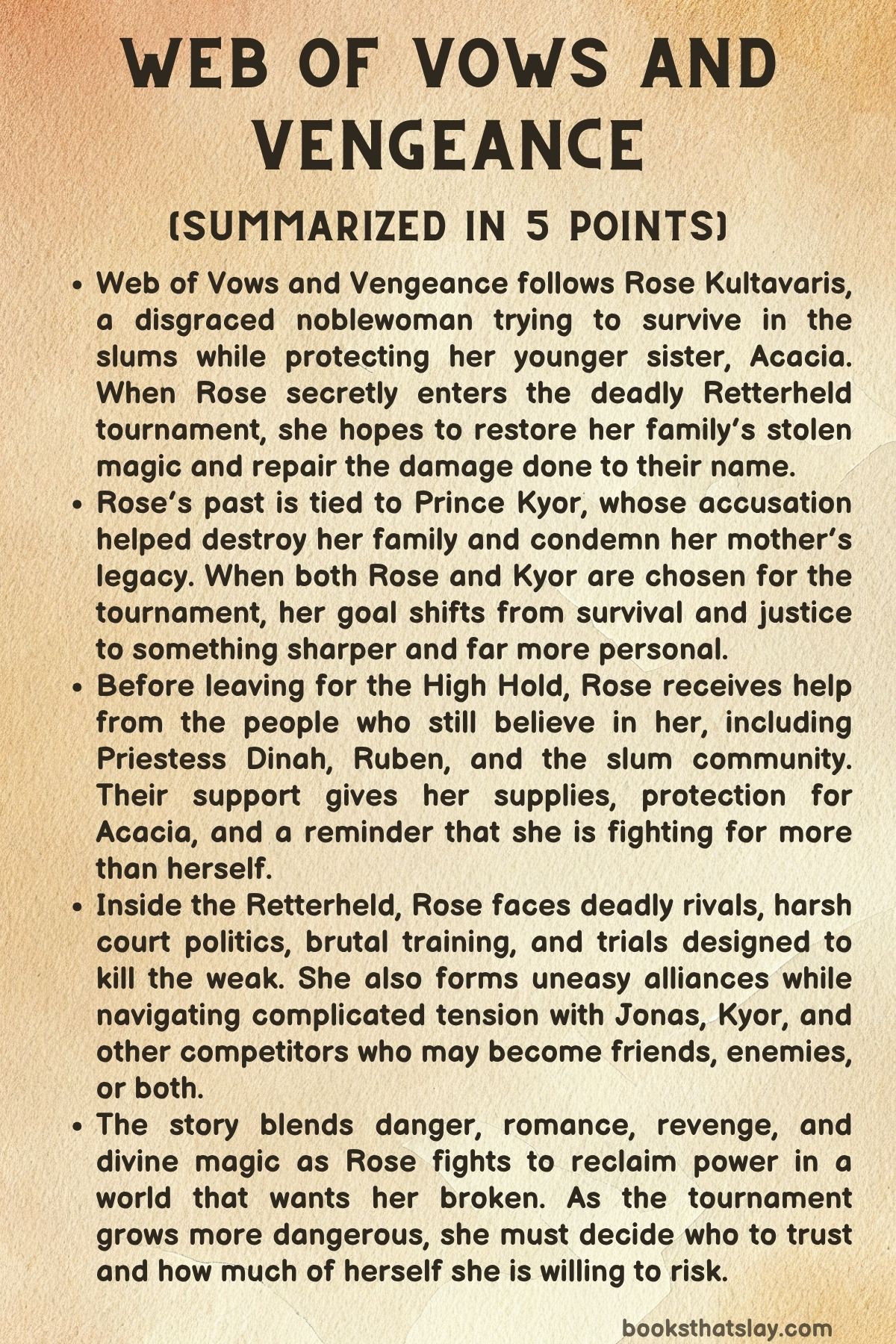
Web Of Vows And Vengeance by Aria Ashbrook is a dark fantasy romance about a fallen noblewoman fighting for survival, justice, and revenge in a kingdom that has punished her family for a royal tragedy. The story follows Rose Kultavaris, who enters the Retterheld, a lethal divine tournament, hoping to win back her family’s stolen magic and protect her younger sister from the slums.
With enemies at court, dangerous rivals, and Prince Kyor tied to the worst pain of her past, Rose must decide how far she will go for power, truth, and vengeance. It’s the first book of the Hirathean Path series.
Summary
Rose Kultavaris lives in the slums with her younger sister, Acacia, after her noble family was ruined by scandal and royal punishment. Years earlier, Rose’s mother, a healer, was blamed for the death of the queen.
Prince Kyor’s accusation helped destroy the Kultavaris name. Rose’s baby brother was killed, the family’s magic was stripped away, and Rose and Acacia were cast out of the life they once knew.
Since then, Rose has survived through hunger, danger, and humiliation while trying to keep Acacia safe.
Rose believes the only way to change their future is to enter the Retterheld, a rare and deadly tournament blessed by Etta, the Goddess of Life. The winner receives a divine gifting, and Rose hopes that gift might restore her family’s magic, clear her mother’s name, and give Acacia a life beyond poverty.
Entry into the tournament requires a secret offering at Etta’s temple, so Rose breaks in at great risk. She evades guards and dire wolves, falls into an icy moat, cuts herself, climbs through a window, and reaches the temple despite the danger.
Inside, she offers her tears to the goddess and marks her fingers with charcoal as proof of what she has done. While there, she meets a beautiful, arrogant man with striking blue eyes who has also entered the temple by dangerous means.
Their conversation is sharp, hostile, and charged with attraction, though Rose does not know his identity. She leaves the temple and returns to the slums, hiding the truth from Acacia while trying to continue as if nothing has changed.
The next day, in the market, the names of the chosen Rettlings are announced earlier than expected. Rose’s name is called, confirming that Etta has accepted her offering.
Acacia is horrified and angry, knowing that the Retterheld is deadly and that Rose may never return. The announcement grows even worse when Prince Kyor Knavin is also named as a Rettling.
To Rose, Kyor is not only a prince but the person whose lie destroyed her mother, her family, and her childhood. Winning the tournament is no longer her only goal.
She now sees the Retterheld as a chance to get close enough to Kyor to take revenge.
Before leaving, Rose visits Priestess Dinah, who knew her mother. Rose asks Dinah to contact Lord Artur Lorathin and arrange protection for Acacia while she is gone.
Dinah helps Rose prepare by giving her old formal clothing, healing supplies, seeds, gloves, and a strange dagger with a copper hilt. The weapon reacts to Rose’s touch in a way that suggests it carries power or history she does not yet understand.
Ruben, Rose’s friend and sometimes lover from the slums, also helps her. He gives her a one-use fire bead from the slum community and promises to watch over Acacia.
As Rose leaves, the people of the slums support her with chants of “one of us,” reminding her that she is not only fighting for herself.
At the High Hold, Rose steps back into the noble world that rejected her. She reunites with Jonas Lorathin, her childhood friend, who welcomes her and helps her settle among the other Rettlings.
Jonas’s presence gives her some comfort, but the tournament is already dangerous. Rose quickly learns that two competitors have been killed before the trials have even begun.
Her first major conflict comes from Zara Duarte of Rowell, a cruel and powerful Rettling who targets Rose as weak prey. Zara attacks her, calls her a runt, and uses magic to reopen Rose’s old wounds.
Rose responds with the fire bead Ruben gave her, setting Zara ablaze and badly burning her. Zara survives, but the attack makes Rose feared and hated among the Rettlings.
Other competitors refuse to share a room with her, so Jonas offers Rose his small private room. Their bond grows stronger, though Jonas’s protectiveness begins to carry tension of its own.
Rose also meets Llinos, Benny, Loch, and others from the Eastern Isles. These relationships form the beginning of uncertain alliances.
Trust is difficult in the Retterheld because every competitor wants to survive, and survival may require betrayal. Still, Rose understands that she cannot rely only on anger and instinct.
She needs allies, information, and skill if she is going to last.
At the first major ball, Rose sees Zara alive and also meets Prince Kyor properly. She realizes he is the blue-eyed man from Etta’s temple.
The discovery complicates everything. Kyor is the person she hates most, yet their exchanges carry a dangerous attraction neither of them can fully ignore.
King Korvane openly insults Rose and threatens Jonas’s family for standing near her, making it clear that the court has not forgotten or forgiven the Kultavaris name. Rose sees that the tournament is not only a trial of strength but also a battlefield of reputation, politics, and royal power.
Later, Rose finds Kyor in the weapons room and nearly attacks him. Instead of simply mocking her, he warns her that the Retterheld and the court are more dangerous than she understands.
Though he remains cruel and guarded, he shows that he knows the rules and hidden pressures surrounding the competition. Rose does not trust him, but she begins to realize that Kyor may be more complicated than the villain she has carried in her mind for years.
The Rettlings then take their blood vows, a ritual that binds them to the tournament. The ceremony proves deadly when some competitors die or lose their magic after being rejected.
Rose survives, but the violence of the ritual confirms that the Retterheld can kill before the trials even begin. Afterward, she follows a clue from Kyor and searches the library for information.
There she meets Caroline, a scribe connected to Llinos, adding another layer to the alliances and secrets forming around Rose.
Training begins under Zelle and Holden. Rose works to sharpen her body and instincts, knowing that she lacks the magic many others possess.
Kyor unexpectedly helps train her, revealing himself as an overwhelming fighter. His skill unsettles Rose, but his attention also pushes her to improve.
Jonas becomes increasingly protective and jealous as Rose’s connection with Kyor grows more complicated. Rose is caught between old friendship, new desire, and the memory of everything Kyor cost her.
The first trial sends the Rettlings to a beach, where they must survive enormous jötnar until a sand timer runs out. The giants are deadly, and several competitors die.
Rose survives through courage, climbing skill, and quick thinking. She scales one of the giants and helps bring it down by cutting its throat.
Her performance proves she is not the weak slum girl others expected. Benny earns a reward that allows him to skip a future trial, making him both fortunate and more visible.
After the trial, Zara’s allies retaliate. They trap Rose in a fire, leaving her badly injured and unconscious for five days.
When she wakes, she is devastated to learn that she missed a ball where she had hoped to see Acacia. The attack deepens her anger and reminds her that the danger does not end when a trial does.
The Rettlings are willing to kill each other outside the official tests, and Rose must stay alert at every moment.
As she recovers, Rose trains harder, studies her enemies, and grows closer to both Jonas and Kyor. She also notices hidden tensions among her allies, including Benny, Llinos, Caroline, and others whose motives are not always clear.
Her desire for revenge remains strong, but the tournament forces her to think beyond Kyor. She must survive rival competitors, court cruelty, divine rules, and the mystery of her own family’s fall.
When the second trial bell rings before midnight, Rose arms herself and enters a dark forest. This trial strips away certainty and sends her toward a goal tied to Acacia, forcing her deepest fears into the open.
Without magic, she must rely on instinct, endurance, and will. As she moves through the trees before dawn, the forest suddenly falls silent.
Then Rose sees a dire wolf watching her, and the next stage of the Retterheld’s danger begins.
Characters
Rose Kultavaris
Rose Kultavaris is the central figure of Web Of Vows And Vengeance, and she is shaped by loss, humiliation, survival, and a fierce hunger for justice. Once born into nobility, she now lives in the slums after her family’s disgrace, carrying the emotional weight of her mother’s ruined name, her brother’s death, and her younger sister Acacia’s poverty.
Rose is not merely ambitious; her desire to enter the Retterheld comes from desperation and love. She wants to restore her family’s stolen magic, reclaim the dignity that was violently taken from them, and give Acacia a future beyond hunger and fear.
Her decision to break into Etta’s temple shows her courage, but also her recklessness. She is willing to risk death before the tournament even begins, which reveals how little safety she believes she has left to lose.
Rose’s personality is marked by pride and defiance. Even when she is injured, mocked, threatened, or treated as beneath the other Rettlings, she refuses to shrink.
Her confrontation with Zara shows both her vulnerability and her danger. Zara’s attack reopens Rose’s old wounds, but Rose responds with the fire bead, proving that she can be pushed into ruthless action when cornered.
This makes Rose morally complex because she is not a gentle victim. She is compassionate toward people like Acacia and her dying neighbor, but she is also capable of revenge, violence, and cold determination.
Her anger at Kyor is deeply personal, and once she learns he is part of the Retterheld, her goal changes from simply winning to punishing the man she believes destroyed her life.
Rose’s relationships reveal different sides of her. With Acacia, she is protective, secretive, and guilt-ridden.
With Ruben, she is connected to the slums and the people who believe in her. With Jonas, she is tied to her lost noble childhood and the possibility of loyalty from the world that abandoned her.
With Kyor, she is drawn into a dangerous mixture of hatred, attraction, rivalry, and suspicion. Rose’s journey in the book is not only about surviving trials; it is about confronting the difference between justice and vengeance.
She wants to reclaim what was stolen, but the Retterheld forces her into a world where survival may demand choices that could harden her beyond recognition.
Acacia Kultavaris
Acacia Kultavaris is Rose’s younger sister and one of the strongest emotional anchors in the story. She represents the life Rose is trying to protect and the future Rose hopes to rebuild.
Acacia’s fear and anger when Rose is chosen as a Rettling are understandable because she knows the Retterheld is not a simple opportunity; it is a deadly contest that could take away the only family she has left. Her reaction also shows that she is not passive.
She may be younger and more vulnerable than Rose, but she has strong emotions, clear instincts, and a deep awareness of how dangerous Rose’s choices are.
Acacia’s role in the book is especially important because she keeps Rose’s motives grounded. Rose does not enter the tournament for glory alone.
She enters because Acacia is trapped in poverty, and Rose cannot bear to leave her there forever. Acacia also brings out Rose’s tendency to hide painful truths.
Rose keeps secrets from her because she wants to protect her, but this protection also creates distance between them. Their relationship is loving, but strained by fear, poverty, and Rose’s dangerous decisions.
Acacia is also a symbol of innocence damaged by political cruelty. She did not cause the fall of the Kultavaris family, yet she suffers from it every day.
Her existence reminds the reader that the consequences of court lies and royal power extend far beyond the palace. Through Acacia, the story shows what Rose is truly fighting for: not only revenge against Kyor, but the chance to give her sister safety, dignity, and choice.
Prince Kyor Knavin
Prince Kyor Knavin is one of the most complicated figures in the book because he appears first as Rose’s enemy, then slowly becomes more layered. To Rose, Kyor is the person whose lie destroyed her family.
His accusation against her mother led to disgrace, the loss of magic, the death of Rose’s brother, and the sisters’ fall into the slums. Because of this history, Kyor enters the story carrying the weight of Rose’s hatred before the reader fully understands him.
His identity as the arrogant blue-eyed man from Etta’s temple adds another layer, because Rose meets him first through tension and attraction before realizing he is the prince she despises.
Kyor is arrogant, controlled, and dangerous, but he is not presented as simple. His behavior toward Rose often seems cruel, especially in public, yet he also gives her warnings and hints that help her survive.
In the weapons room, he cautions her about court politics and the hidden dangers of the Retterheld, suggesting that he understands the game more deeply than she does. He follows certain rules of the tournament, and his help during training complicates Rose’s belief that he is only a monster.
This does not erase what Rose believes he did, but it makes him a character surrounded by mystery, power, and possible secrets.
Kyor’s relationship with Rose is built on conflict. Their conversations are full of insults, tension, and unspoken attraction, but beneath that is a brutal history neither can ignore.
He represents everything Rose hates: royalty, privilege, betrayal, and the court that ruined her. Yet he also becomes someone she cannot easily dismiss, because he repeatedly proves that he knows more than he says.
His magical blue eyes, changed after his mother’s death, connect him to grief as well as power. Kyor is therefore both antagonist and possible reluctant ally, a character whose true motives remain uncertain.
Jonas Lorathin
Jonas Lorathin is Rose’s childhood friend and one of the first people from her old life to show her kindness after she enters the Retterheld. His presence matters because he connects Rose to the noble world before her family’s disgrace.
Unlike many others at the High Hold, Jonas does not treat Rose as untouchable or shameful. He greets her, helps her settle, gives her his private room when others refuse to share space with her, and tries to protect her from danger.
His loyalty gives Rose a rare source of comfort in a place filled with enemies.
Jonas is protective, but his protectiveness is not entirely simple. He cares for Rose, yet he also becomes jealous as she grows closer to Kyor.
This jealousy reveals that his feelings may go beyond friendship, or at least that he struggles with the idea of losing his place in Rose’s life. His magic, the ability to temporarily blind and disorient one person, fits his personality in an interesting way.
It is not the loudest or most destructive gift, but it is strategic and useful, suggesting that Jonas may be more capable than he first appears.
Jonas also carries the pressure of his family’s position. King Korvane threatens his family for standing near Rose, which shows that even a noble ally is not free from royal intimidation.
Jonas’s support of Rose comes with consequences, and that makes his loyalty more meaningful. At the same time, his closeness to the old noble world may eventually create tension, because Rose’s life in the slums has changed her in ways Jonas may not fully understand.
He is a source of safety, but also a reminder of everything Rose lost.
Zara Duarte
Zara Duarte is one of Rose’s most direct enemies among the Rettlings. She is brutal, proud, and quick to use cruelty as a way of establishing dominance.
Her attack on Rose is not only physical but psychological, because she calls Rose a runt and uses magic to reopen old wounds. This shows that Zara understands how to humiliate as well as harm.
She wants Rose to feel weak, exposed, and unworthy of standing among the competitors.
Zara’s conflict with Rose also reveals how dangerous the Retterheld environment is before the official trials even begin. She represents the kind of competitor who believes intimidation is part of survival.
Even after Rose burns her with the fire bead, Zara remains a threat. Her warning that others should not room with Rose isolates Rose socially and forces her into dependence on Jonas.
This makes Zara powerful not only because of her magic, but because she can influence the group’s behavior through fear.
Zara is important because she brings out Rose’s darker side. Rose’s use of the fire bead is defensive, but it is also extreme, leaving Zara badly burned.
Through Zara, the story shows that Rose’s enemies may be cruel, but Rose herself is capable of terrifying retaliation. Zara’s later involvement in the burning of Rose’s room intensifies the rivalry and proves that she is not easily defeated.
She is a character driven by aggression, status, and the desire to make Rose suffer.
Priestess Dinah
Priestess Dinah is a quieter but deeply important character because she connects Rose to her mother and to a more compassionate side of faith. Unlike the guards, nobles, and royal figures who treat Rose as a threat or disgrace, Dinah responds to her with care.
She knew Rose’s mother, which gives her relationship with Rose emotional significance. Through Dinah, Rose receives not only practical help but also a reminder that her mother has not been completely forgotten or condemned by everyone.
Dinah’s gifts to Rose are meaningful because each one prepares her for survival in a different way. The formal clothes help Rose re-enter the noble world with dignity.
The healing supplies and seeds suggest care, restoration, and life. The gloves and dagger hint at protection and hidden power.
The copper-hilted dagger, especially because it reacts to Rose’s touch, suggests that Dinah may understand more about Rose’s fate or inheritance than she fully explains. This makes her both nurturing and mysterious.
Dinah also helps protect Acacia by promising to contact Lord Artur Lorathin. This shows that she recognizes Rose’s deepest fear: leaving her sister vulnerable.
Her role in the book is not centered on combat, but on guidance, memory, and preparation. She gives Rose the tools to enter a deadly world while also preserving a connection to the past Rose is trying to redeem.
Ruben
Ruben represents Rose’s bond with the slums and the people who have become her community after her fall from nobility. He is her friend and sometime lover, which gives their relationship intimacy without making it simple or fully secure.
His gift of the fire bead is one of the most important acts of support Rose receives before entering the High Hold. It is not just a weapon; it is a symbol that the people of the slums are placing hope in her.
Ruben’s promise to watch over Acacia shows his loyalty and emotional importance. Rose’s greatest fear is leaving her sister behind, and Ruben helps ease that fear by becoming someone she can trust in her absence.
He understands the harshness of their world and does not dismiss the danger Rose is entering. His support is practical, grounded, and deeply tied to survival.
Ruben also contrasts with the noble and royal characters. He belongs to the life Rose has been forced to live, not the life she lost.
Because of that, he represents the part of Rose that has been shaped by poverty, community, and shared suffering. His presence reminds her that even though the slums are brutal, they are also where she found people who claim her as “one of us.” This makes Ruben a symbol of loyalty from below, while characters like Jonas represent loyalty from Rose’s former world.
Llinos
Llinos is one of the Rettlings from the Eastern Isles and becomes part of Rose’s uneasy network of alliances. Her importance lies in the fact that Rose cannot survive the Retterheld alone, yet she also cannot fully trust everyone around her.
Llinos represents the complicated middle ground between stranger, ally, and possible source of hidden information. In a tournament where competitors are dying before the trials even begin, any alliance is valuable but dangerous.
Llinos is connected to Caroline, which suggests that she has ties beyond the visible competition. This connection introduces a sense of secrecy and strategy around her character.
She is not just another Rettling; she appears to be part of a wider web of relationships that Rose does not yet completely understand. That makes Llinos useful, but also potentially complicated.
As part of the Eastern Isles group, Llinos helps expand the world of the story beyond Rose’s personal revenge. Her presence shows that the Retterheld draws people from different regions, each with their own motives, loyalties, and histories.
Llinos’s role may seem quieter than Zara’s or Kyor’s, but she matters because she belongs to the uncertain alliances that may determine whether Rose survives.
Benny
Benny is another Rettling from the Eastern Isles and one of the competitors who becomes connected to Rose’s circle. He stands out during the first trial because he earns a reward that allows him to skip the next trial.
This immediately makes him significant. In a deadly tournament, the ability to avoid even one trial is a major advantage, and Benny’s reward suggests that he is capable, lucky, strategic, or some combination of all three.
Benny’s presence also adds tension because rewards in the Retterheld change the balance among competitors. His success means that while others must continue risking their lives, he gains temporary safety.
This could create admiration, resentment, or suspicion among the Rettlings. Rose notices hidden tensions around Benny, which suggests that his role may become more complicated as the story continues.
Benny’s character is important because he shows that survival in the tournament is not only about strength. The Retterheld rewards certain actions, choices, and outcomes, and Benny’s advantage proves that the rules can shift quickly.
He is part of the alliance network around Rose, but his reward separates him from the others and makes him a figure to watch.
Loch
Loch is part of the Eastern Isles group that Rose encounters among the Rettlings. Although less is revealed about him than about Llinos or Benny, his inclusion in this circle matters because he helps form the social landscape Rose must navigate.
The Retterheld is not only a series of trials; it is also a dangerous community of competitors, and Loch belongs to one of the groups that may offer Rose support or become entangled in future conflict.
Loch’s presence contributes to the sense that alliances are necessary but unstable. Rose enters the High Hold isolated by her reputation and by Zara’s hostility, so any group willing to speak with her becomes important.
Loch helps represent the possibility that Rose can find allies outside her old noble connections and outside the slum community she left behind.
As a character, Loch currently functions more as part of the wider Rettling world than as a fully revealed individual. Still, his role is useful because he broadens the cast and shows that Rose is surrounded by competitors whose motives are not yet entirely known.
In a story built on vows, vengeance, and hidden loyalties, even quieter characters can become important as the trials continue.
Caroline
Caroline is introduced in the library, and her role immediately connects knowledge, secrecy, and alliance. Rose meets her while searching for information after surviving the blood vow, which places Caroline in a space associated with answers.
In a deadly tournament where information can be as valuable as strength, Caroline’s position as a scribe-like figure makes her potentially important.
Her connection to Llinos adds intrigue. Caroline is not simply a random person Rose encounters; she belongs to a hidden network that Rose is only beginning to notice.
Because of this, Caroline may become a source of guidance, information, or complication. She represents the idea that not all power in the High Hold comes from weapons or magic.
Some power comes from knowing where to look, what to record, and what others are trying to hide.
Caroline also contrasts with the more openly violent characters. She does not need to attack Rose to matter.
Instead, her significance lies in access and knowledge. In the book, she helps deepen the mystery around the Retterheld and the alliances surrounding it, especially because Rose is still learning how much she does not know.
Zelle
Zelle is one of the trainers who prepares the Rettlings for the trials. Her role is important because she belongs to the structure of the Retterheld rather than to the competitors themselves.
She represents discipline, instruction, and the harsh reality that the participants must become stronger quickly if they want to survive. Training under Zelle marks Rose’s transition from desperate entrant to active competitor.
Zelle’s presence also shows that the Retterheld is not random violence. It has systems, rules, rituals, and people responsible for preparing the chosen competitors.
This makes the tournament feel more institutional and more frightening. The danger is not chaotic alone; it is organized, watched, and accepted by those in power.
For Rose, Zelle’s training becomes part of her transformation. Rose already has courage and survival instincts, but she needs skill, endurance, and strategy.
Zelle helps provide the environment where Rose can sharpen herself. Even if Zelle is not emotionally close to Rose, her role helps shape Rose’s ability to endure the trials ahead.
Holden
Holden, like Zelle, is connected to the training of the Rettlings. His role reinforces the seriousness of the Retterheld and the expectation that competitors must be physically and mentally prepared for lethal challenges.
He belongs to the machinery of the tournament, helping turn chosen participants into fighters capable of facing monsters, rivals, and magical dangers.
Holden’s importance comes from what he represents within the High Hold. He is part of a system that treats danger as normal and death as expected.
The Rettlings are young people with personal motives and fears, but to the trainers, they are competitors who must be prepared for survival or elimination. This adds to the cold atmosphere surrounding the tournament.
For Rose, training under figures like Holden forces her to confront her limitations. She cannot rely only on anger or luck.
She must learn, adapt, and harden herself. Holden’s role may be less emotionally central than Jonas’s or Kyor’s, but he is still part of the pressure that shapes Rose into someone capable of lasting beyond the first trial.
King Korvane
King Korvane is a powerful antagonist figure because he represents the cruelty and arrogance of the ruling order. His public insult toward Rose shows that the disgrace of the Kultavaris family is still alive in court memory and that Rose’s presence among the Rettlings is seen as offensive by those in power.
He does not merely dislike her; he uses his authority to humiliate and threaten.
His threat toward Jonas’s family is especially revealing. Korvane understands that power is not only exercised through direct punishment but also through fear.
By threatening the Lorathins for standing near Rose, he isolates her and warns others against helping her. This makes him dangerous even when he is not physically involved in the trials.
His influence shapes the social rules of the High Hold.
King Korvane also deepens the political stakes of Web Of Vows And Vengeance. Rose’s struggle is not only against individual enemies like Zara or even Kyor.
She is up against a royal system that can ruin families, rewrite reputations, and punish loyalty. Korvane embodies that system, making him one of the clearest symbols of the world Rose wants to challenge.
Lord Artur Lorathin
Lord Artur Lorathin is mostly important through the protection he may offer Acacia. As Jonas’s father, he belongs to the noble world Rose once knew, but his potential involvement suggests that not every noble family has completely abandoned the Kultavaris sisters.
Dinah’s decision to contact him shows that he may be trustworthy enough to help guard Acacia while Rose is away.
Artur’s role also strengthens Jonas’s importance. Jonas does not exist apart from family pressure; his choices affect the Lorathin household, especially when King Korvane threatens them.
Artur therefore represents the political risks surrounding anyone who supports Rose. Helping her is not a small private kindness.
It could bring royal punishment.
Though Artur is not shown in direct action here, his presence matters because he may serve as a protective force outside the tournament. Rose cannot focus on the Retterheld unless she believes Acacia has some chance of safety.
Artur’s possible protection becomes one of the fragile supports allowing Rose to move forward.
Rose’s Mother
Rose’s mother is one of the most important absent characters in the story. Her reputation, death, and disgrace shape nearly every major choice Rose makes.
She was a healer, but after the queen’s death, Kyor’s accusation caused her to be blamed, destroying the family. Whether she was truly guilty or falsely condemned, Rose believes her mother’s name must be cleared, and that belief becomes one of Rose’s main reasons for entering the Retterheld.
As a figure in Rose’s memory, her mother represents lost honor, stolen magic, and the life Rose should have had. Her connection to Priestess Dinah suggests that she was once respected and known by people who may still believe in her.
This gives Rose’s mission a moral dimension beyond personal revenge. She is not only trying to improve her own future; she is trying to correct the story told about her mother.
Rose’s mother also functions as a symbol of healing turned into accusation. If she was a healer blamed for a death she did not cause, then her fate reveals the cruelty of political blame.
Her absence haunts Rose, and the mystery around what truly happened to the queen continues to influence the emotional and political heart of the book.
Rose’s Brother
Rose’s baby brother is another absent but deeply significant character. His death is part of the tragedy that shattered the Kultavaris family.
Although he does not act within the present events, his loss intensifies Rose’s grief and makes her hatred of Kyor and the royal family more understandable. He represents innocence destroyed by the consequences of power, accusation, and punishment.
His death also explains why Rose’s desire for revenge is so fierce. The family did not merely lose status or comfort; they lost a child.
This makes the past impossible for Rose to treat as something that can be forgotten or forgiven easily. Every humiliation she suffers in the present is connected to a wound that began with violence and loss.
In the larger emotional structure of the story, Rose’s brother represents what can never be restored. Winning the Retterheld might bring back magic or status, and clearing her mother’s name might restore honor, but it cannot bring him back.
His death gives Rose’s mission a tragic edge because even victory may not fully heal what was broken.
The Queen
The queen is central to the backstory because her death triggered the downfall of Rose’s family. Although she is not active in the present events, the mystery of her death shapes the conflict between Rose and Kyor.
Kyor’s accusation against Rose’s mother after the queen died changed the course of Rose’s life, making the queen’s death a political and emotional turning point.
The queen also matters because of her connection to Kyor. His eyes were magically changed after his mother’s death, suggesting that the event marked him deeply as well.
This complicates the situation. For Rose, the queen’s death led to injustice against her family.
For Kyor, it may be connected to grief, trauma, and whatever truth he believes he witnessed or was told.
As an absent character, the queen represents the hidden truth at the center of the story’s past. Until the real circumstances of her death are known, Rose’s hatred, Kyor’s guilt or innocence, and the royal family’s actions remain surrounded by uncertainty.
Her death is the wound from which much of the present conflict grows.
Jai
Jai is a Rettling whose death during the blood-vow ceremony proves how merciless the Retterheld truly is. His role may be brief, but it is important because his death shows that the danger does not begin with the official trials.
Even the ritual meant to bind the competitors can kill or strip people of magic if it rejects them. Jai becomes a warning to everyone who survives.
His death changes the emotional atmosphere around the tournament. Before this moment, the Retterheld is already known to be dangerous, but Jai’s horrible end makes that danger immediate and undeniable.
Rose survives her vow, but Jai’s fate shows her that survival is never guaranteed, even when she thinks she is only completing a required ceremony.
Jai’s character functions as a symbol of the tournament’s brutality. He reminds the reader that the Rettlings are not simply rivals in a contest; they are sacrifices to a system that accepts death as part of its sacred process.
His death raises the stakes for Rose and reinforces the idea that divine selection does not mean divine protection.
Etta
Etta, the Goddess of Life, is one of the most powerful presences in the story even though she is not a conventional human character. The Retterheld exists because of her divine gifting, and Rose’s journey begins when she breaks into Etta’s temple to offer her tears.
Etta represents hope, judgment, danger, and divine authority all at once. To Rose, the goddess may be the only force capable of restoring what was taken from her family.
Etta’s connection to tears, vows, and gifting gives the story a sacred but unsettling atmosphere. The fact that competitors can die during the blood vow suggests that divine power in this world is not gentle or easily controlled.
Etta may be associated with life, but the path toward her blessing is filled with death. This contrast makes her presence morally complex.
In Web Of Vows And Vengeance, Etta functions as the force behind the tournament and the source of the reward everyone desires. Yet her true will remains mysterious.
Rose risks everything to reach her, but receiving divine attention does not mean Rose is safe. Etta’s role raises a larger question about whether the goddess offers salvation, judgment, or both.
Themes
Revenge and the Cost of Justice
Rose’s desire for justice begins as a need to restore what was stolen from her family, but it quickly becomes sharpened by personal anger. Her mother’s disgrace, her brother’s death, the loss of family magic, and Acacia’s poverty all create a wound that cannot be healed by survival alone.
When Kyor is named as one of the Rettlings, Rose’s purpose changes. Winning the Retterheld is no longer only about receiving a divine gifting; it becomes a chance to punish the person she holds responsible for her ruin.
This makes revenge a powerful emotional force in Web Of Vows And Vengeance, but it is not shown as simple or clean. Rose’s anger gives her courage, yet it also risks narrowing her judgment.
Her near-attack on Kyor in the weapons room shows how easily vengeance can push her toward danger before she fully understands the larger political game around her. The theme asks whether justice can still remain pure when it is driven by grief, humiliation, and rage.
Survival in a Cruel Social Order
Rose’s life in the slums shows survival as both physical endurance and emotional resistance. She is not only poor; she is someone who once belonged to nobility and now lives among people treated as disposable by the powerful.
Her journey into Etta’s temple, where she faces cold water, guards, injury, and dire wolves, reflects the brutal effort required simply to claim a chance at a better life. The Retterheld continues this pattern on a larger scale.
Competitors are killed before the trials even begin, and the blood vows prove that the system values divine selection and noble ambition more than human life. Rose’s world rewards status, magic, and royal favor, while punishing those who have been publicly disgraced.
Yet the slum community’s support, especially Ruben’s fire bead and the chant of “one of us,” shows that survival is not only individual. Rose carries the strength of people who have also been pushed aside, making her fight a challenge to the order that tried to erase her.
Power, Privilege, and Public Shame
Power in Web Of Vows And Vengeance is shown through magic, royal authority, reputation, and access to safety. Rose’s family loses everything because a prince’s accusation is accepted over her mother’s truth.
That single act reveals how privilege can shape reality: the powerful do not merely control armies or courts; they control which stories are believed. King Korvane’s public insults and threats show that shame is used as a weapon to keep Rose beneath those born into secure status.
Even in the Retterheld, where all Rettlings are supposedly chosen by the goddess, hierarchy remains present. Zara’s cruelty toward Rose is not only personal; it reflects a wider belief that Rose is lesser because she has fallen.
At the same time, Rose’s presence threatens this structure because she refuses to accept the identity imposed on her. Her skill, courage, and stubbornness challenge a society that equates worth with birth, magic, and political approval.
Loyalty, Protection, and Complicated Bonds
Rose’s relationships are shaped by danger, debt, affection, and fear. Her love for Acacia is the emotional center of her choices, because everything she risks is tied to giving her sister a life beyond poverty and shame.
Acacia’s anger at Rose’s decision to enter the Retterheld comes from love as much as fear, showing that protection can become painful when one person chooses danger for another’s sake. Ruben represents loyalty from the slums, giving Rose the fire bead and promising to watch over Acacia, while Jonas offers comfort from her old noble life but also carries jealousy and protectiveness that may become restrictive.
Kyor complicates loyalty even further because he is both enemy and helper. His warnings and training assistance do not erase what Rose believes he did, but they make hatred less simple.
These bonds create emotional tension because Rose must decide whom to trust in a place where affection can protect her, expose her, or make her vulnerable.