A Murder Most Camp Summary, Characters and Themes
A Murder Most Camp by Nicolas DiDomizio is a comic mystery about privilege, reinvention, family secrets, and the strange education that can come from being forced far outside one’s comfort zone. At its center is Mikey Hartford, a rich and reckless heir who thinks money can solve anything until his father sends him to a rustic summer camp as a lesson in responsibility.
What begins as punishment turns into a murder investigation, a romance, and a painful confrontation with the past. The novel mixes sharp humor, camp drama, queer romance, and true-crime curiosity while showing Mikey slowly becoming less selfish and more honest.
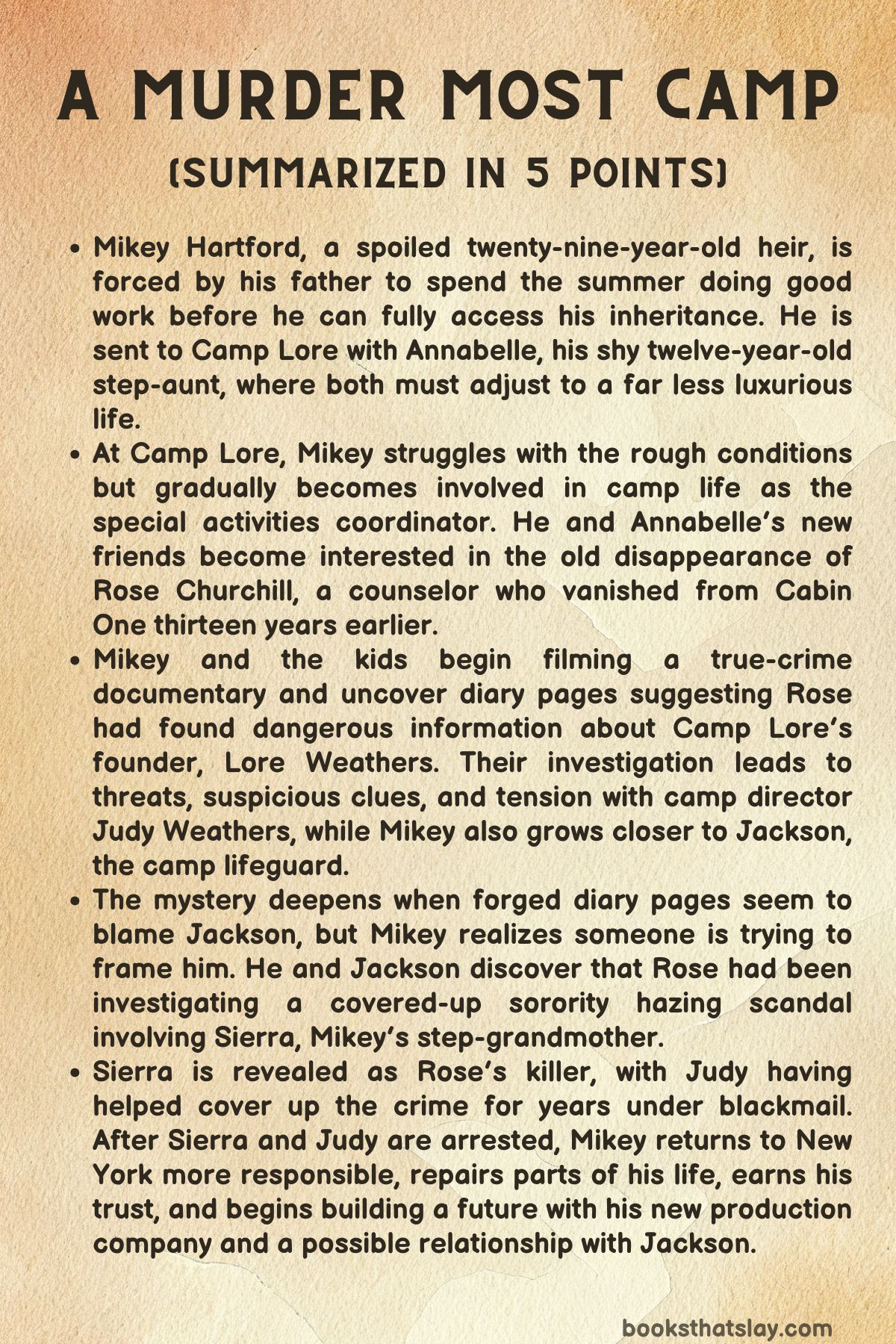
Summary
Mikey Hartford is twenty-nine, wealthy, spoiled, and used to getting whatever he wants. As heir to the HartMart fortune, he lives with almost no limits, spending money freely and avoiding responsibility whenever possible.
His latest mistake is serious even by his standards: he forges his father’s signature to buy a five-million-dollar Brooklyn townhouse for his best friend, Jamie. Mikey sees the gesture as generous and glamorous, but his father, Michael Hartford III, sees it as proof that Mikey has no respect for work, money, or consequences.
While Mikey is away on a luxury vacation, his father calls him home. Mikey expects another lecture, but the punishment is much worse than he imagined.
His father has changed the terms of Mikey’s trust. Unless Mikey spends the summer doing something useful before his thirtieth birthday, he will not receive full access to his inheritance.
His Porsche is taken away, his allowance is reduced, and he is sent to meet Sierra, his father’s much younger stepmother and Mikey’s former schoolmate. Sierra has arranged for Mikey to work at Camp Lore, an old-fashioned summer camp on Lake George.
Mikey is also given another responsibility. He must escort Annabelle, Sierra’s quiet twelve-year-old daughter, to the camp.
Because Annabelle is technically Mikey’s aunt, their family connection is awkward, especially for a child trying to fit in. They agree to tell people that Mikey is her uncle instead.
Annabelle is shy and nervous, while Mikey is horrified by nearly every part of camp life before he even settles in.
Camp Lore is nothing like the luxurious world Mikey knows. The cabins are basic, the food is plain, the outdoors are messy, and the bathrooms are far from glamorous.
Mikey dislikes the mud, the bugs, the lack of comfort, and the general feeling of being cut off from the life he prefers. Still, he is assigned the role of special activities coordinator, and he begins trying to survive the summer with as much style as possible.
Annabelle adjusts more quickly than Mikey does. She becomes friends with Miranda, Danny, Cody, and Paula, a group of campers who welcome her into their circle.
Around a campfire, Danny tells the story of Rose Churchill, a nineteen-year-old counselor who disappeared from Cabin One thirteen years earlier. The story sounds like camp legend at first, but Mikey checks online and discovers that Rose’s disappearance was real.
No one ever found her, and the case still hangs over Camp Lore.
Mikey becomes fascinated by what happened to Rose. He learns that Sierra knew Rose years earlier, and he also hears that some people believed Rose faked her disappearance to get money from Lore Weathers, the billionaire founder of Camp Lore.
The idea does not fully satisfy him. The more Mikey hears, the more he senses that the story has been shaped by people who had reasons to protect themselves.
Mikey and the campers decide to make a true-crime documentary about Rose’s disappearance. What starts as a camp project soon becomes a real investigation.
They find diary pages that appear to have belonged to Rose. In them, Rose writes about discovering damaging information connected to Lore Weathers.
The information was supposedly stored on a flash drive, and Rose feared that someone might kill her because of it. The diary also mentions an onion incident, a hidden knife from Momma Moo’s café, and suspicion around Marie Samuels, the café’s owner.
The investigation makes some adults uncomfortable. Judy Weathers, the camp director, warns Mikey to stop asking questions.
Her reaction only makes him more curious. At the same time, Mikey is sharing a cabin with Jackson McGraw, the camp lifeguard and a medical student.
Jackson worked at Camp Lore as a teenager during the summer Rose disappeared, which places him close to the old mystery. Mikey and Jackson do not get along at first.
Their arguments are sharp, and both men seem annoyed by each other. Yet the tension between them changes after they spend time together, especially during a late-night swim.
Their attraction grows, giving Mikey a connection at camp that feels real rather than transactional.
As Mikey and the kids keep digging, the danger becomes more direct. Someone pins a death threat to Mikey’s cabin door with an arrow.
Instead of stopping, Mikey becomes more determined. He and the campers secretly visit Momma Moo’s café to speak with Marie Samuels.
Marie admits that she once had an affair with Lore Weathers. She also says she believes Rose was murdered, not missing by choice.
According to Marie, Rose’s body may have been buried beneath the tennis courts, which were being poured on the day Rose vanished.
Mikey later finds more diary entries that seem to accuse Jackson of being violent toward Rose. The discovery shakes him because he has begun to care about Jackson, but Annabelle notices something important: the handwriting does not match the earlier diary pages.
Mikey realizes the newer pages are fake. Someone is trying to frame Jackson and redirect the investigation away from the real killer.
Mikey and Jackson then look through Rose’s old journalism files and find the clue that changes everything. Rose had not only been investigating Lore Weathers.
She had also been looking into a Syracuse sorority scandal involving Omega Beta Zeta. A violent hazing incident had caused a serious injury, and the truth had been covered up.
The person responsible was Sierra. Rose had discovered Sierra’s role and planned to expose her.
This gives Sierra a clear motive. Rose was a threat to Sierra’s future, reputation, and access to power.
Mikey and Jackson rush to Judy’s office and find Judy tied up. Judy reveals that Sierra killed Rose and that Judy helped cover it up after learning what Sierra had done.
For years, Sierra has used Judy’s involvement to blackmail her and keep the truth buried.
Sierra appears and tries to control the situation. She appeals to Mikey’s emotions, telling him that exposing her will destroy Annabelle.
She wants him to think of the innocent child who will suffer if her mother goes to prison. Mikey is shaken, but he does not let Sierra manipulate him.
He understands that protecting Annabelle cannot mean hiding a murder or allowing Sierra to keep escaping responsibility. Mikey calls 911, and Sierra and Judy are arrested.
After the truth comes out, Camp Lore closes, and the children return home. Annabelle is devastated by what her mother has done, but she faces the truth with more courage than many of the adults around her.
She also tells her friends that Mikey is not really her uncle but her nephew. The revelation does not make them reject her.
They accept her without judgment, giving Annabelle one of the first honest friendships of her life.
Back in New York, Mikey has changed. He cuts Jamie off, recognizing that their friendship was tied too closely to money, indulgence, and bad choices.
He decides that the Brooklyn townhouse should be used for something better than Jamie’s comfort. When Mikey meets with his father, Michael grants him access to his trust, seeing that Mikey has finally begun to grow up.
Mikey also challenges his father to improve HartMart’s labor practices, showing that his summer has taught him to think beyond his own pleasure.
A month later, Mikey and Annabelle fly to California. Mikey reunites with Jackson and begins building a new future.
He prepares to launch Cinema Cassandra, a production company named after his late mother. By the end, Mikey has not become perfect, but he has become more aware, more responsible, and more willing to use his wealth with purpose.
The summer that began as punishment becomes the turning point that forces him to confront murder, family lies, love, loyalty, and the person he wants to become.
Characters
The character work in A Murder Most Camp is built around growth, secrecy, privilege, guilt, and the consequences of choices that people try to hide. Each character contributes to the book either by shaping the mystery of Rose Churchill’s disappearance or by helping Mikey Hartford transform from a shallow, entitled heir into someone capable of responsibility, loyalty, and moral courage.
Mikey Hartford
Mikey Hartford is the central character of the book and begins as a spoiled, reckless, and deeply privileged twenty-nine-year-old heir who has grown used to comfort, money, and avoidance. His decision to forge his father’s signature in order to buy Jamie a five-million-dollar townhouse shows how carelessly he treats wealth and responsibility at the beginning of the story.
Mikey does not initially understand consequences in a serious way because his life has trained him to expect rescue, indulgence, and luxury. His horror at Camp Lore’s rustic conditions reveals how disconnected he is from ordinary discomfort, and his early reactions make him appear shallow and self-absorbed.
However, Mikey’s development is one of the strongest parts of the book. His forced stay at Camp Lore begins as a punishment, but it gradually becomes a moral education.
His curiosity about Rose Churchill’s disappearance shows that beneath his dramatic personality and privileged behavior, he has intelligence, emotional instinct, and a genuine desire to uncover the truth. His interest in the mystery is not purely entertainment; as he learns more, he becomes increasingly protective of Rose’s memory and more aware of the real harm caused by secrets, power, and money.
Mikey’s relationship with Annabelle is especially important because it reveals his capacity for care. At first, he sees her partly as another awkward obligation, but he becomes protective of her and learns to think about someone else’s emotional needs before his own convenience.
His decision to call 911 despite Sierra’s attempt to manipulate him proves that he has changed. He understands that protecting Annabelle cannot mean hiding a murder or allowing injustice to continue.
By the end of A Murder Most Camp, Mikey is no longer simply a rich man being disciplined by his father; he has become someone willing to challenge his family, cut off unhealthy friendships, use his resources with purpose, and build a more meaningful future.
Annabelle
Annabelle is a reserved twelve-year-old who becomes one of the emotional anchors of the book. As Sierra’s daughter and technically Mikey’s aunt, she enters Camp Lore in an unusual and potentially embarrassing position.
Her agreement with Mikey to present him as her uncle shows her sensitivity to social judgment and her desire to fit in. Unlike Mikey, who often responds to discomfort with exaggeration and complaint, Annabelle is quieter, more observant, and more emotionally controlled.
Her friendships with Miranda, Danny, Cody, and Paula are important because they show her gradual opening up. Camp gives her a chance to exist outside the shadow of her complicated family structure and her mother’s hidden past.
Annabelle’s role in the investigation is also significant because she is not just a child watching adults solve a mystery. She notices the handwriting inconsistency in the forged diary pages, which becomes a crucial clue.
This moment shows her intelligence, attention to detail, and ability to see what others miss.
Annabelle’s tragedy is that the truth about Rose’s murder directly affects her understanding of her own mother. Sierra’s arrest forces Annabelle to confront a painful reality that no child should have to face.
Yet her response shows maturity. She is devastated, but she does not collapse into denial.
Her decision to tell her friends the truth about Mikey being her nephew shows that she has learned courage and honesty from the events around her. Annabelle represents innocence affected by adult wrongdoing, but she also represents resilience and the possibility of growing beyond family shame.
Sierra
Sierra is one of the most morally corrupt and dangerous figures in the book because her polished surface hides a long history of violence, manipulation, and self-preservation. She is introduced as Mikey’s step-grandmother and Annabelle’s mother, but her true importance lies in her connection to Rose Churchill’s disappearance.
Sierra’s past involvement in the Syracuse sorority hazing scandal shows that she had already been part of a culture of cruelty and cover-up before the events at Camp Lore. When Rose threatens to expose her, Sierra chooses murder rather than accountability.
What makes Sierra especially disturbing is not only that she kills Rose, but that she continues living with the consequences while manipulating others into silence. She blackmails Judy for years and allows false stories about Rose to circulate.
Her actions reveal a person who values reputation, comfort, and control above human life. Sierra’s attempt to manipulate Mikey by using Annabelle’s future against him is one of her clearest character moments.
She understands emotional vulnerability and tries to weaponize it.
Sierra also functions as a dark mirror to Mikey. Both come from wealth and privilege, and both initially benefit from systems that protect people with power.
The difference is that Mikey eventually learns to take responsibility, while Sierra uses privilege to escape responsibility. Her downfall is important because it exposes the moral rot hidden beneath respectability.
She is not a sudden villain but a character whose past choices have shaped years of fear, silence, and damage.
Rose Churchill
Rose Churchill is absent from the present action, but she is one of the most important characters in the story. Her disappearance drives the mystery, and her diary pages allow her voice to remain alive within the book.
Rose is portrayed as curious, brave, and determined to expose wrongdoing. Her investigation into Lore Weathers, her discovery of damaging information, and her earlier work on the sorority scandal show that she is someone drawn to truth even when truth places her in danger.
Rose’s character carries a strong sense of tragedy because she is young, ambitious, and morally alert. She understands that powerful people often rely on silence, and she tries to resist that silence through evidence and investigation.
Her fear that someone is trying to kill her makes her situation increasingly heartbreaking because the reader sees that her instincts were correct. She is not paranoid or reckless; she is a young woman who discovers something dangerous and pays for it with her life.
Rose also represents the cost of buried truth. For years, people reduce her disappearance to gossip, suspicion, and theories that she may have faked it for money.
This false framing robs her of dignity until Mikey, Jackson, Annabelle, and the children begin restoring the truth. Rose’s role in the book is therefore both personal and symbolic.
She is a murder victim, but she is also a reminder that truth can survive through fragments, memory, and the persistence of those willing to listen.
Jackson McGraw
Jackson McGraw is the camp lifeguard, a med student, and Mikey’s main romantic interest. At first, he appears guarded and somewhat antagonistic toward Mikey, which creates tension between them.
His practical nature contrasts sharply with Mikey’s dramatic, luxury-loving personality. Jackson is comfortable in the camp environment, while Mikey sees the camp as a punishment.
This contrast allows their relationship to develop through conflict, attraction, and gradual trust.
Jackson’s connection to Camp Lore’s past gives him an important role in the mystery. Because he worked there as a teenager when Rose disappeared, he becomes both a source of information and a target of suspicion.
The forged diary entries that attempt to implicate him make his character vulnerable to false judgment. This plotline shows how easily evidence can be manipulated and how quickly suspicion can attach itself to the wrong person.
Jackson’s position becomes especially tense because Mikey must decide whether to trust his growing feelings or believe the evidence placed in front of him.
As a romantic figure, Jackson helps bring out Mikey’s sincerity. Their bond during the late-night swim marks a shift from surface-level attraction to emotional connection.
Jackson is not simply a love interest; he also represents a grounded, purposeful life that Mikey has not known before. His medical ambitions, camp experience, and steadier personality challenge Mikey to become less selfish and more courageous.
By the end, Jackson is connected not only to romance but also to Mikey’s new sense of direction.
Judy Weathers
Judy Weathers is the camp director and one of the book’s more complicated authority figures. At first, she appears mainly as an obstacle to Mikey’s investigation because she warns him to stop snooping.
Her behavior creates suspicion because she seems overly invested in keeping the past buried. As the truth emerges, it becomes clear that Judy’s role is not simple villainy but guilt, fear, and long-term complicity.
Judy helped cover up Rose’s murder after learning what Sierra had done, and this choice defines her character. She may not be the killer, but she protects the killer and allows Rose’s name to remain surrounded by falsehoods.
Her years under Sierra’s blackmail show that she is trapped by her own wrongdoing. Judy’s fear does not excuse her actions, but it explains why she becomes so desperate to control the investigation.
She is a character shaped by one terrible decision that grows heavier over time.
Her presence also shows how institutions protect themselves. Camp Lore is supposed to be a place of childhood, friendship, and innocence, but Judy’s cover-up turns it into a place built on silence.
Her eventual exposure reveals that passive complicity can be deeply harmful. Judy is not as calculating as Sierra, but her failure to come forward makes her morally responsible for the long concealment of Rose’s fate.
Lore Weathers
Lore Weathers is the billionaire founder of Camp Lore and a character whose power influences the story even when he is not always directly present. He represents wealth, influence, and the kind of social position that can distort truth.
Rose’s investigation into damaging information about him suggests that he has secrets worth hiding, and his connection to Marie Samuels through an affair adds another layer of moral compromise around the camp’s history.
Lore’s importance lies partly in how others respond to his power. Because he is wealthy and influential, people are willing to believe that Rose may have disappeared for financial reasons or that the truth can be managed through settlements and rumors.
His presence helps create the environment in which Rose’s disappearance can be misunderstood for years. Even when he is not revealed as the murderer, the world around him is filled with secrecy, privilege, and damage.
As a character, Lore helps expand the book’s critique of wealth. He is part of the same broader world of money and status that shaped Mikey, Sierra, and the Hartford family.
The difference is that his role is tied to institutional power rather than personal growth. Camp Lore, despite its cheerful purpose, becomes connected to adult corruption because of the powerful figures surrounding it.
Marie Samuels
Marie Samuels, the owner of Momma Moo’s café, is an important witness-like figure who helps deepen the mystery surrounding Rose Churchill. Her past affair with Lore Weathers gives her personal knowledge of the camp’s hidden adult conflicts.
She is not just a background character; she provides information that helps Mikey and the children understand that Rose’s disappearance was likely not a harmless escape or a financial scheme.
Marie’s belief that Rose was murdered and buried beneath the tennis courts shows that she has carried suspicion and fear for years. Her perspective matters because it challenges the official or convenient versions of the past.
She represents the kind of local memory that survives outside formal authority. While Judy tries to suppress questions and Sierra tries to manipulate truth, Marie keeps alive the possibility that something terrible happened.
Her character also adds texture to the world around Camp Lore. Through Marie, the book shows that secrets do not remain contained within one location.
They spread through nearby businesses, old relationships, and community gossip. Marie may not solve the mystery herself, but she helps push the investigation toward the truth by giving Mikey a more serious understanding of Rose’s fate.
Michael Hartford III
Michael Hartford III, Mikey’s father, is a stern and powerful figure whose decision sets the plot in motion. By changing the terms of Mikey’s trust, taking away his Porsche, limiting his allowance, and forcing him to spend the summer doing good, he becomes the reason Mikey ends up at Camp Lore.
At first, his actions may seem like a rich father’s attempt to discipline an irresponsible son, but they also reveal a deeper frustration with Mikey’s wasted potential.
Michael is not portrayed as purely warm or emotionally open. His parenting style is controlling and severe, and his use of money as discipline reflects the privileged world the Hartfords inhabit.
However, he understands that Mikey’s life has become empty and irresponsible. His punishment creates the conditions for Mikey’s transformation, even though he cannot predict the mystery and danger that will follow.
His final interaction with Mikey is important because it shows that both father and son have changed. Michael grants Mikey access to his trust, but Mikey no longer sees money only as personal freedom.
Mikey’s push for HartMart to improve its labor practices suggests that he has begun thinking ethically about family wealth. Michael therefore functions as both a source of pressure and a measure of Mikey’s growth.
Jamie
Jamie is Mikey’s best friend and one of the clearest symbols of Mikey’s shallow life before Camp Lore. The fact that Mikey forges his father’s signature to buy Jamie a five-million-dollar townhouse shows how unhealthy and extravagant their friendship has become.
Jamie benefits from Mikey’s wealth without encouraging him to become more responsible or grounded. Their relationship reflects Mikey’s old pattern of using money to express loyalty, solve problems, or avoid emotional seriousness.
Jamie’s importance is less about direct involvement in the mystery and more about what he reveals in Mikey. At the beginning, Mikey’s loyalty to Jamie seems generous, but it is also careless and immature.
He does not think about legality, consequences, or whether such a gift is truly meaningful. Jamie belongs to the world of indulgence that Mikey must outgrow.
When Mikey eventually cuts Jamie off, it marks a major step in his development. This decision shows that Mikey has begun to understand the difference between real love and enabling.
Jamie represents the old life Mikey can no longer fully return to. By separating from him, Mikey chooses responsibility over performance and purpose over empty extravagance.
Miranda
Miranda is one of the children who befriends Annabelle at Camp Lore and becomes part of the group involved in the documentary project. Her role helps create the sense of childlike curiosity and group energy that surrounds the investigation.
Along with Danny, Cody, and Paula, she helps Annabelle feel included and gives the camp setting emotional warmth despite the darker mystery beneath it.
Miranda’s importance lies in the way she contributes to Annabelle’s social growth. Annabelle arrives at camp reserved and burdened by an unusual family situation, but Miranda and the others accept her into their circle.
This acceptance allows Annabelle to become more confident. The children’s involvement in the true-crime documentary also gives the investigation a playful but meaningful structure.
Although Miranda is not one of the central adult figures in the mystery, she helps show what Camp Lore is supposed to be: a place for friendship, creativity, and belonging. Her presence makes the eventual exposure of the camp’s dark history more painful because it contrasts childhood innocence with adult corruption.
Danny
Danny is important because he introduces the campfire story of Rose Churchill, which becomes the doorway into the central mystery. His telling of the story gives Rose’s disappearance the quality of a camp legend, but Mikey’s later confirmation that the disappearance was real turns that legend into something much more serious.
Danny therefore helps shift the book from camp comedy into mystery.
As part of Annabelle’s friend group, Danny also represents curiosity and youthful excitement. His interest in the frightening story reflects the way children often engage with mystery as entertainment before understanding its real human cost.
Through Danny and the other children, the book explores how stories can begin as rumors but lead toward truth when someone takes them seriously.
Danny’s role may be smaller than Mikey’s or Annabelle’s, but it is structurally important. Without his campfire story, Mikey may not have become so fascinated by Rose’s disappearance.
Danny helps awaken the investigation and gives the children a place within the larger movement toward justice.
Cody
Cody is another member of Annabelle’s camp friend group and contributes to the child-centered energy of the book. His presence helps make the group feel like a real circle of campers rather than a background crowd.
Along with Miranda, Danny, and Paula, Cody gives Annabelle a place to belong and helps make the documentary project feel collaborative.
Cody’s character matters because the children collectively contrast with the adults who have hidden the truth. The children are curious, open, and willing to investigate, while many adults are evasive, guilty, or manipulative.
Cody is part of that younger group whose honesty and curiosity help move the story toward revelation.
Although Cody is not individually central to the murder mystery, he strengthens the book’s emotional balance. The story is not only about a past crime; it is also about the children who inherit the consequences of adult secrets.
Cody helps represent the innocence that Camp Lore should have protected.
Paula
Paula is part of Annabelle’s group of camp friends and helps create the supportive social world that Annabelle needs. Her presence adds to the sense that Annabelle is not isolated at Camp Lore.
Through Paula and the others, Annabelle experiences friendship, acceptance, and shared adventure, all of which become important as the truth about Sierra emerges.
Paula also participates in the children’s connection to the documentary project, which turns them from passive campers into active investigators. Like the others, she belongs to the part of the book that treats curiosity as a force for discovery.
The children may not fully understand every adult secret at first, but their willingness to ask questions helps expose what older characters have tried to bury.
Paula’s role is subtle but meaningful because she supports the book’s contrast between innocence and corruption. She helps show that Camp Lore still contains genuine friendship and possibility, even though its history has been poisoned by violence and silence.
Cassandra
Cassandra, Mikey’s late mother, does not appear directly in the present events, but her memory is deeply significant to Mikey’s future. The fact that Mikey names his production company Cinema Cassandra after her suggests that she represents love, loss, and emotional purpose.
Her memory gives Mikey’s creative ambitions a personal foundation rather than making them another expression of wealth.
Cassandra’s importance becomes clearer through Mikey’s transformation. At the beginning, Mikey’s life is defined by luxury, avoidance, and careless spending.
By the end, his desire to create something meaningful in his mother’s name shows that he is beginning to connect his identity to legacy in a healthier way. Cassandra becomes a symbol of the person Mikey wants to honor through action rather than sentiment.
Although she is not directly involved in Rose’s mystery, Cassandra helps shape the emotional direction of Mikey’s ending. Her memory connects his past grief to his future purpose, giving his growth a more personal and lasting meaning.
Themes
Privilege and Personal Responsibility
Mikey begins with a life shaped by wealth, comfort, and the belief that problems can be solved through money or charm. His father’s decision to restrict his access to the trust forces him into a world where his usual advantages have little value.
Camp life strips away the luxury he depends on and places him in situations where he must be useful to others rather than simply entertained by them. His growth is not instant; he resists discomfort, complains about basic conditions, and initially treats the camp as a punishment.
Yet his investigation, his bond with Annabelle, and his concern for the children gradually shift his sense of purpose. By the end, he no longer sees wealth only as a tool for personal pleasure.
His decision to cut Jamie off, repurpose the townhouse, and challenge HartMart’s labor practices shows a clearer understanding of responsibility. In A Murder Most Camp, privilege becomes meaningful only when it is connected to accountability, moral courage, and action.
Truth, Secrets, and the Cost of Silence
The mystery surrounding Rose’s disappearance shows how hidden truths can damage people long after the original crime. Many characters live under the weight of secrecy: Sierra hides her violent past, Judy protects the lie to preserve herself and the camp, and Rose’s real story is buried beneath rumors that blame her for her own disappearance.
The false idea that Rose faked everything becomes a convenient excuse for others to avoid asking harder questions. Mikey’s investigation matters because it challenges this accepted version of events and gives Rose back her dignity.
The forged diary pages also show how truth can be distorted by people who want to protect themselves. Silence is not neutral in the story; it allows injustice to continue and lets the guilty control the narrative.
When Mikey chooses to call the police despite Sierra’s emotional manipulation, he breaks that pattern. The truth is painful, especially for Annabelle, but the story suggests that honesty is necessary before healing can begin.
Found Family and Acceptance
The relationships formed at Camp Lore show that family is not limited to traditional roles or simple labels. Mikey and Annabelle’s connection is unusual from the beginning because of their complicated family structure, yet their bond becomes one of the most sincere relationships in the story.
Annabelle arrives reserved and anxious, but through camp friendships and Mikey’s support, she becomes more confident. Her friendships with Miranda, Danny, Cody, and Paula give her a place where she can be seen without judgment.
The final reveal that Mikey is actually her nephew could have made her feel embarrassed or rejected, but the children’s acceptance proves that real connection does not depend on social expectations. Mikey also learns what it means to care for someone in a steady, protective way.
His relationship with Annabelle helps him move beyond selfishness and gives him a reason to act with maturity. The theme presents acceptance as something practical and generous: people show love by staying, listening, protecting, and refusing to shame one another.
Reinvention and Moral Growth
Mikey’s summer becomes a period of reinvention because he is forced to face the gap between who he has been and who he could become. At first, he defines himself through status, money, indulgence, and loyalty to people who enable his worst habits.
Camp Lore disrupts that identity. The murder investigation gives him a purpose that is larger than his own comfort, while Jackson challenges him to be more honest and emotionally open.
Mikey’s growth is shown through choices rather than speeches. He protects Annabelle, risks himself to uncover the truth, rejects Sierra’s manipulation, and later changes the direction of his own life.
His decision to start a production company named after his late mother suggests that he is ready to build something meaningful instead of simply spending inherited wealth. Reinvention does not erase his flaws, but it shows that he can redirect his energy toward justice, creativity, and care.
The story treats growth as the result of difficult choices made when comfort and honesty are in conflict.