A Killer in the Family Summary, Characters and Themes
A Killer in the Family by Amin Ahmad is a crime novel about wealth, marriage, power, and the damage caused by family secrets. The story follows Ali Azeem, a drifting wedding photographer from Mumbai, whose arranged marriage into the powerful Khan family of New York changes the course of his life.
What begins as a search for stability soon becomes a dangerous entanglement with desire, murder, buried crimes, and ruthless ambition. Through Ali’s entry into the Khan household, the book explores how privilege can hide violence, how loyalty can become a trap, and how the people closest to us may be the most dangerous.
Summary
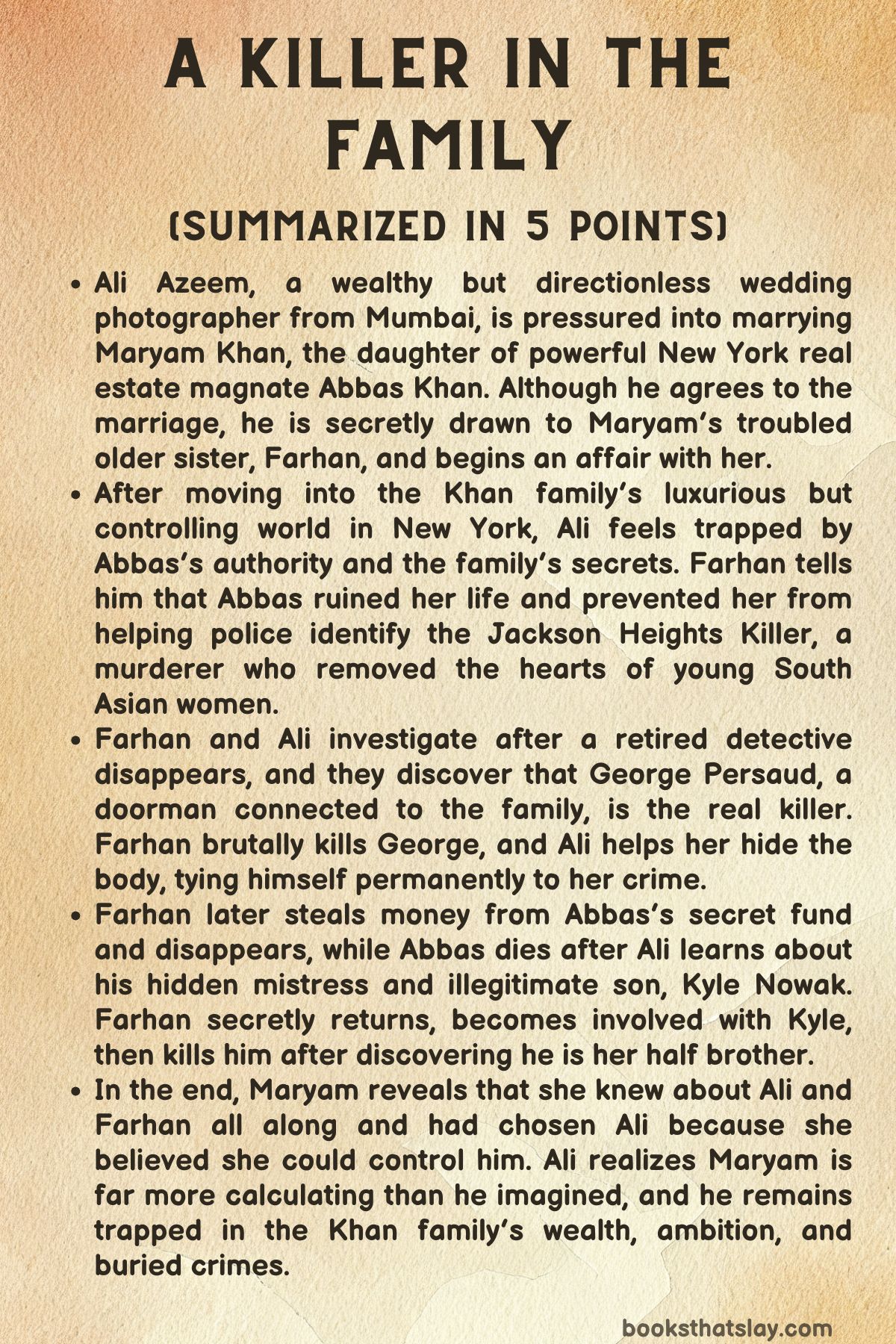
Ali Azeem is a wealthy but directionless wedding photographer living in Mumbai. Though he has money and talent, he lacks a clear purpose and drifts through life without much ambition.
His mother, eager to secure his future, pushes him toward an arranged marriage with Maryam Khan, the daughter of Abbas Khan, a powerful New York real estate tycoon. The Khans represent everything Ali’s family wants for him: wealth, status, international connections, and a secure place among the elite.
When Ali visits the Khan family, he is expected to court Maryam. She is elegant, controlled, and shaped by the expectations of her father’s world.
Yet Ali is not immediately drawn to her. Instead, he becomes fascinated by her older sister, Farhan.
Farhan is divorced, emotionally troubled, and unpredictable, but she also has an artistic energy that Ali recognizes. She is a jewelry designer and quickly notices Ali’s creative eye.
Their connection is immediate and charged with secrecy.
Farhan begins texting Ali privately, and soon their attraction becomes an affair. This happens even as Ali agrees to marry Maryam.
His decision is not driven by love alone. He is influenced by family pressure, the promise of security, and the appeal of entering the Khan fortune.
He knows the marriage will give him access to a powerful world, even though his feelings are divided from the beginning.
Ali and Maryam marry in Mumbai, surrounded by the rituals and expectations of family. During their honeymoon in Spain, Ali remains emotionally torn.
He is now Maryam’s husband, but Farhan still occupies his thoughts. Eventually, he and Maryam become intimate, yet the moment does not bring them closer in any simple way.
Maryam cries afterward, revealing that she too has entered the marriage with wounds of her own. Ali later learns that Maryam had once loved David Weissberg, a Jewish surgeon, but gave him up because her father would never have accepted the match.
Her marriage to Ali is also shaped by duty, pressure, and sacrifice.
After moving to New York, Ali enters the Khan world more fully. The family lives in luxury, surrounded by servants, costly art, and the constant presence of Abbas’s authority.
Abbas is controlling, intimidating, and deeply involved in the lives of his children. Ali, who is far from home, begins to feel trapped.
He has gained comfort and status, but he has also lost freedom. In this atmosphere, his affair with Farhan resumes, and they meet secretly in Chinatown.
Farhan tells Ali that Abbas is cruel and corrupt. She claims he destroyed her life and used his power to silence her.
Through her diary, Ali learns more about her past. After a failed marriage, rumors of addiction, mental illness, and a suicide attempt that left a scar over her heart, Farhan had once met a frightening man in Jackson Heights.
The man reacted violently when he saw her scar. Soon afterward, young South Asian women were murdered by a serial killer known as the Jackson Heights Killer, who removed their hearts.
Farhan believes the man she encountered was the murderer.
As Ali becomes more involved in the Khan family business, Tiger Corp, he is drawn into Abbas’s real estate empire and its financial schemes. One of these is a profitable EB-5 financing plan, which brings foreign investment into the company.
Ali starts to understand that the Khan fortune is not clean or harmless. Behind the polished surface of wealth are hidden arrangements, manipulation, and moral compromise.
Farhan’s fears intensify when she begins receiving threatening postcards from Jackson Heights. She hires Orlando Epps, the retired detective who once investigated the murders.
Epps tells Ali that Abbas has “blood on his hands.” Years earlier, Farhan tried to speak to the police about the man she believed was the killer, but Abbas stopped her interview and had her committed to protect the family’s reputation. Farhan also blames Maryam, who was thirteen at the time.
Maryam had promised not to tell Abbas, but she called him anyway. After Farhan was silenced, five more women were killed.
When Epps disappears, Farhan and Ali begin investigating on their own. Their suspicion falls on George Persaud, the doorman at the Apthorp, who had access to the family’s lives and a shadowy past in Guyana.
They follow him to Queens and uncover horrifying evidence. George has a collage made from cut-up images of Indian women, along with a valise containing eight preserved human hearts.
The truth becomes clear: George is the real Jackson Heights Killer.
Farhan attacks George. She breaks his legs and then beats him to death with a metal pole.
Ali, instead of going to the police, helps her cover up the murder. Together they wrap George’s body, bury it in the Southampton woods, and hide what they have done.
This act binds Ali to Farhan and to the Khan family’s darkness in a way he cannot easily escape.
Farhan then uses Ali’s computer login to steal money from Abbas’s secret slush fund. She disappears, leading others to believe she has gone to Costa Rica.
In truth, she has fled to Paris. Maryam fears that Farhan may have been killed, and her grief turns into terror when one of the hidden hearts later appears in a salt pile.
The past refuses to stay buried, and the family’s secrets continue to surface in disturbing ways.
Meanwhile, Abbas grows ill and dies of a heart attack in a Bronx apartment. Ali later learns that the apartment belonged to Abbas’s longtime Jewish mistress, Ewa Nachtmann.
Even more shocking, Ewa’s son, Kamran, had been renamed Kyle Nowak. Kyle is a Tiger Corp executive, but he is also Abbas’s illegitimate son.
This makes him Farhan’s half brother.
Farhan has secretly returned and formed both an alliance and a romantic relationship with Kyle. Together, they help position him as the new head of Tiger Corp.
When Ali discovers the truth and reveals Kyle’s real identity to Farhan, she is shattered. She realizes she has been sleeping with her own brother.
In a violent response to this revelation, she shoots Kyle dead. Afterward, she is institutionalized, removing her from the family’s power struggle.
Maryam, now pregnant with twins, begins to take control. She is no longer simply the wounded wife Ali thought he understood.
At New Year’s Eve, she reveals that she knew about Ali and Farhan all along. She had chosen Ali not because she was naïve, but because she believed he could be shaped and controlled.
She also admits that she deliberately helped stop Farhan’s police interview years earlier in order to protect the family.
This revelation changes Ali’s understanding of Maryam completely. He sees that beneath her composed surface is a cold and ambitious mind.
She is not merely a victim of Abbas’s power; she has learned from it. She plans the future carefully.
Ali will eventually become CEO of Tiger Corp, but she will guide him from behind the scenes. Their children will inherit the Khan fortune and influence.
By the end of A Killer in the Family, Ali is trapped inside the world he once wanted to enter. He has gained wealth, status, and a place in a powerful family, but the cost is his freedom and moral safety.
He has helped conceal murder, betrayed his wife, been used by Farhan, and finally understood that Maryam may be the most dangerous member of the family. The novel closes with Ali bound to the Khan legacy, surrounded by crimes, secrets, money, and a future planned by someone far more ruthless than he ever imagined.
Characters
In A Killer in the Family, Amin Ahmad presents characters who are shaped by wealth, secrecy, desire, family pressure, and moral compromise. The book does not treat crime as something separate from family life; instead, it shows how violence, ambition, shame, and silence can exist inside the same household, protected by money and respectability.
Ali Azeem
Ali Azeem is the central figure through whom much of the book’s moral confusion is experienced. At the beginning, he appears wealthy, privileged, and artistically inclined, but also passive and directionless.
His career as a wedding photographer suggests that he has an eye for beauty and human emotion, yet his own life lacks firmness and purpose. He is easily pushed into the arranged-marriage process by his mother, and this early weakness becomes one of his defining traits.
Ali often understands that something is wrong, but he rarely acts with the courage needed to stop it. His attraction to Farhan reveals his hunger for intensity, danger, and artistic recognition, while his decision to marry Maryam shows his dependence on security, social approval, and wealth.
Ali’s greatest flaw is not simple wickedness but moral surrender. He enters the Khan family hoping for stability and status, but he gradually becomes entangled in betrayal, financial corruption, murder, concealment, and emotional manipulation.
His affair with Farhan exposes his dishonesty, yet his marriage to Maryam also shows his desire to belong somewhere powerful. When he helps Farhan hide George Persaud’s body, Ali crosses a line from observer to participant.
By the end of the story, he is no longer merely a confused outsider trapped in a powerful family; he has become part of its machinery. His tragedy lies in the fact that he sees the corruption around him, yet keeps accepting the benefits of that corruption.
Maryam Khan
Maryam Khan initially appears to be the more conventional and sympathetic sister: obedient, controlled, dutiful, and willing to sacrifice personal happiness for family expectations. Her abandoned relationship with David Weissberg makes her seem like a victim of Abbas’s authority and the family’s obsession with image.
Her tears after intimacy with Ali suggest emotional pain, loss, and the burden of living according to someone else’s rules. At first, she seems trapped in the same world that traps Ali, only more quietly and with fewer visible rebellions.
As the story develops, however, Maryam becomes far more complex and chilling. Her final revelation changes the reader’s understanding of her character.
She is not simply a wounded daughter or betrayed wife; she is also calculating, patient, and deeply committed to preserving Khan power. She knows about Ali and Farhan, but instead of reacting openly, she studies the situation and uses it.
Her admission that she chose Ali because he could be molded reveals a cold intelligence beneath her composed surface. Maryam’s role in stopping Farhan’s police interview years earlier shows that even as a child, she had already absorbed the family instinct for protection, secrecy, and control.
By the end, Maryam emerges as one of the most dangerous figures in the book because her violence is not physical but strategic. She represents inherited power made calm, practical, and ruthless.
Farhan Khan
Farhan Khan is one of the most tragic and morally unstable figures in the book. She is introduced as glamorous, damaged, unpredictable, and emotionally intense.
Her work as a jewelry designer gives her a creative identity, and her recognition of Ali’s artistic eye creates an immediate bond between them. Unlike Maryam, who hides her feelings behind discipline, Farhan lives closer to chaos.
Her divorce, addiction rumors, mental health struggles, and suicide attempt all suggest a woman who has been repeatedly wounded and then dismissed by the people who should have protected her.
Farhan is also a truth-bearer, even when her truth is buried under instability. She understands Abbas’s cruelty and recognizes that the family’s respectable surface conceals something rotten.
Her memory of the man in Jackson Heights connects her personal trauma to the larger pattern of murders, and her anger comes partly from knowing that she was silenced when speaking might have saved lives. Yet Farhan’s suffering does not make her innocent.
When she kills George Persaud, the act contains rage, revenge, justice, and brutality all at once. Her later alliance and relationship with Kyle, followed by the horrifying discovery that he is her half brother, completes her tragic collapse.
Farhan is a character destroyed by family secrecy, but she also becomes destructive herself. She is both victim and danger, both witness and criminal.
Abbas Khan
Abbas Khan is the patriarch whose power poisons nearly every relationship around him. As a New York real estate tycoon, he represents wealth, authority, and public success, but his private world is built on control and concealment.
He treats his daughters less as independent people than as extensions of his reputation. His refusal to accept Maryam’s relationship with David shows his prejudice, possessiveness, and obsession with family image.
His decision to block Farhan’s police interview is even more morally horrifying because it suggests that he values reputation over human life.
Abbas’s influence continues even when he is absent from a scene. His money, apartments, company, servants, and secrets create the environment in which others move.
Tiger Corp is not just a business empire; it is an extension of his personality, built on ambition, hidden dealings, and domination. The revelation of his Jewish mistress, Ewa Nachtmann, and his illegitimate son, Kamran, exposes the hypocrisy beneath his public authority.
Abbas forbids others from crossing social and religious boundaries while secretly doing so himself. His death does not end his control, because the consequences of his lies continue to destroy the people he leaves behind.
George Persaud
George Persaud is the hidden monster beneath the surface of ordinary life. As the Apthorp doorman, he occupies a position that allows him to observe, enter, and understand the lives of others while remaining almost invisible.
This makes him especially frightening. He is not presented as a distant criminal figure but as someone who exists within familiar spaces, using trust and access as cover.
His past in Guyana and his connection to the Khan world deepen the sense that violence travels quietly through personal histories and social environments.
George’s role as the real Jackson Heights Killer gives physical form to the book’s darker themes. His preserved human hearts and collage of cut-up images reveal a mind that turns women into objects, symbols, and trophies.
He is a murderer driven by obsession and dehumanization. Yet his exposure also reveals the guilt of others.
George committed the murders, but Abbas’s silence allowed more women to die. In that sense, George is both an individual killer and a test of the family’s moral failure.
His death at Farhan’s hands is brutal and emotionally charged, but it does not restore justice cleanly. Instead, it pulls Ali and Farhan deeper into crime.
Orlando Epps
Orlando Epps serves as a figure of investigation, memory, and delayed accountability. As the retired detective who once worked on the Jackson Heights murders, he carries knowledge that the Khan family tried to bury.
His importance lies not only in what he knows about the killer but also in what he understands about Abbas’s interference. When he tells Ali that Abbas has blood on his hands, he exposes the difference between direct murder and moral responsibility.
Epps understands that silence, obstruction, and reputation-protection can also become forms of violence.
Epps also functions as a link between the past and the present. His involvement brings the old crimes back into active danger, proving that buried truth does not disappear.
His disappearance increases the atmosphere of fear and suggests that anyone who approaches the truth becomes vulnerable. Though he is not present for as long as the central family members, his role is crucial because he confirms that Farhan was not merely delusional or unstable.
He validates her memory and reveals the depth of the family’s guilt.
Kyle Nowak / Kamran
Kyle Nowak, born Kamran, is one of the most disturbing examples of hidden identity in A Killer in the Family. As a Tiger Corp executive, he appears to belong to the professional world of corporate ambition and succession.
However, the revelation that he is Abbas’s illegitimate son transforms his role completely. He is not just an ambitious executive but a secret member of the Khan bloodline, concealed by Abbas’s double life with Ewa Nachtmann.
His existence reveals how deeply Abbas’s hypocrisy shaped the family’s future.
Kyle’s relationship with Farhan becomes horrifying because it is built on ignorance created by Abbas’s secrecy. Farhan’s discovery that she has been sleeping with her half brother is psychologically devastating and leads directly to her killing him.
Kyle is therefore both a participant in the struggle for power and a victim of the lies that produced him. His rise toward leadership of Tiger Corp shows how family power tries to reproduce itself through hidden channels, but his death shows that secrets, once exposed, can destroy the very structures they were meant to protect.
Ewa Nachtmann
Ewa Nachtmann is not as central as the Khan family members, but her presence is essential to understanding Abbas’s hidden life. As Abbas’s longtime Jewish mistress, she exposes the contradiction between his public authority and private behavior.
Abbas rejects Maryam’s Jewish boyfriend while maintaining a secret relationship with a Jewish woman himself. Through Ewa, the story reveals the patriarch’s hypocrisy in its most personal form.
Ewa also represents the lives kept outside the official family structure but still shaped by it. Her son, Kamran, is renamed Kyle Nowak, suggesting an attempt to erase or disguise his connection to Abbas.
This concealment has devastating consequences. Ewa’s role shows that Abbas’s secrets do not remain private; they spread into the next generation and create new forms of damage.
Even though she remains more shadowy than Maryam or Farhan, her existence changes the meaning of the entire family history.
David Weissberg
David Weissberg represents the life Maryam might have chosen if she had been free from Abbas’s control. As a Jewish surgeon, he stands outside the acceptable boundaries set by the Khan family, not because of any moral failing but because Abbas refuses to allow the match.
Maryam’s decision to give him up reveals the emotional cost of obedience. David’s absence is therefore as important as his presence, because he becomes a symbol of lost freedom and sacrificed love.
David also helps reveal Maryam’s complexity. At first, her lost relationship with him makes her seem like a victim of family pressure.
It explains some of her sadness and emotional distance from Ali. Later, however, when Maryam’s colder ambitions are revealed, David becomes part of the contrast between who she might have been and who she has chosen to become.
He represents a path away from the Khan empire, but Maryam ultimately remains committed to that empire and learns to control it from within.
Ali’s Mother
Ali’s mother plays a smaller role, but she is important because she helps set the story in motion. By pushing Ali toward the arranged-marriage meeting with Maryam, she represents family expectation, social ambition, and the pressure to secure a respectable future.
Her influence over Ali shows his lack of independence at the beginning of the book. He does not enter the Khan family because of strong love or clear conviction; he is guided into it by family pressure and by the promise of status.
Her role also highlights the social world that surrounds the main characters. Marriage is not treated simply as a private emotional decision but as a negotiation involving class, wealth, family reputation, and future security.
Ali’s mother may not intend harm, but her pressure contributes to Ali’s entry into a destructive family system. In that sense, she represents the ordinary social expectations that can lead people toward extraordinary moral danger.
Abbas’s Servants and Household Staff
The servants and household staff around the Khan family help create the atmosphere of wealth, distance, and control. They are part of the grand lifestyle that impresses and traps Ali when he enters the New York world of the Khans.
Their presence shows how Abbas’s power is not only financial but domestic; his authority extends into living spaces, routines, privacy, and movement. The household feels luxurious, but it also feels watched and controlled.
These figures also emphasize the contrast between appearance and reality. The Khan home has the surface of order, elegance, and privilege, yet beneath that surface are affairs, manipulation, murder, hidden money, and old crimes.
The staff help maintain the smooth functioning of the family’s public image, even while the family itself is morally collapsing. They are not major psychological figures, but they are important to the social world of the story.
Themes
Marriage as a Transaction of Power
Marriage operates less as a bond of trust and more as a calculated arrangement shaped by money, family pressure, social standing, and control. In A Killer in the Family, Ali’s marriage to Maryam begins with emotional compromise: he is attracted to Farhan, yet accepts Maryam because the match offers security and entry into a powerful family.
Maryam, too, sacrifices her own romantic past for the demands of her father and the future of the family empire. Their marriage is therefore built on hidden losses rather than genuine openness.
As the story progresses, the marriage becomes a structure that traps Ali inside the Khan world. He gains wealth, status, and opportunity, but loses moral freedom and emotional independence.
Maryam’s final revelation shows that she never saw Ali simply as a husband; she saw him as someone useful, someone who could be shaped into a future leader while she remained the mind behind him. Marriage becomes a business strategy, a tool for inheritance, image, and power.
Family Secrets and the Cost of Silence
Silence protects the family’s reputation, but it also allows violence and corruption to continue. Abbas refuses to let Farhan speak to the police because public scandal matters more to him than justice.
That decision has terrible consequences, since more women die after Farhan’s warning is buried. Maryam’s role in stopping Farhan adds another layer of moral damage, because she is young but still chooses family protection over truth.
The family survives by hiding what is ugly: Abbas’s mistress, his illegitimate son, Farhan’s trauma, Ali’s affair, the buried body, and the hidden money. Each secret creates another crime or emotional wound.
The truth does not disappear; it returns in more dangerous forms, through suspicion, fear, revenge, and murder. The novel shows that family loyalty becomes destructive when it demands silence at any cost.
Instead of love, the family is held together by fear, manipulation, shame, and the constant need to preserve power.
Moral Corruption Through Wealth
Wealth gives the characters comfort, but it also weakens their sense of responsibility. The Khan family’s money creates a world where crimes can be hidden, reputations can be managed, and people can be controlled.
Abbas uses his influence to silence Farhan, protect his business image, and maintain authority over everyone around him. Ali is initially an outsider to this world, but he slowly becomes part of it.
His choices grow darker as he accepts luxury, joins the business, assists in hiding George’s body, and remains tied to the family despite knowing how dangerous it is. Money does not simply tempt him; it surrounds him so completely that escape begins to feel impossible.
Farhan also uses stolen money to disappear and rebuild her life under false terms. The novel presents wealth as a force that does not create evil by itself, but gives people the tools to excuse, hide, and continue their wrongdoing without immediate punishment.
Identity, Control, and Self-Deception
Many characters survive by inventing versions of themselves that hide their fear, guilt, or ambition. Ali sees himself as sensitive and artistic, yet he repeatedly chooses comfort over courage.
He believes he is being pulled into events by stronger personalities, but he often makes decisions that deepen his own guilt. Farhan presents herself as damaged but truthful, someone seeking justice for past victims, yet her pain becomes mixed with obsession, revenge, and violence.
Maryam appears gentle, wounded, and emotionally neglected, but the ending reveals a colder intelligence beneath her quiet surface. Even Abbas constructs a respectable public identity while concealing corruption, cruelty, and another family.
Identity in the novel is unstable because almost everyone performs a role. The characters deceive others, but more importantly, they deceive themselves.
They explain their choices as love, survival, loyalty, or justice, when many of those choices are also driven by desire, fear, pride, and hunger for control.