Everyone in This Bank Is a Thief Summary, Characters and Themes
Everyone in This Bank Is a Thief is a comic mystery about a bank robbery that becomes far stranger than it first appears. Benjamin Stevenson builds the story around Ernest Cunningham, a self-aware detective who understands crime fiction almost too well, and who finds himself trapped inside a heist where every hostage seems to be hiding a theft of their own.
The novel mixes locked-room logic, insurance fraud, family guilt, medical scams, old goldfield secrets, and a very talkative parrot into one chaotic case. Its charm comes from the way danger, absurdity, and clever clue-work sit side by side. It’s the 4th book of the Ernest Cunningham series.
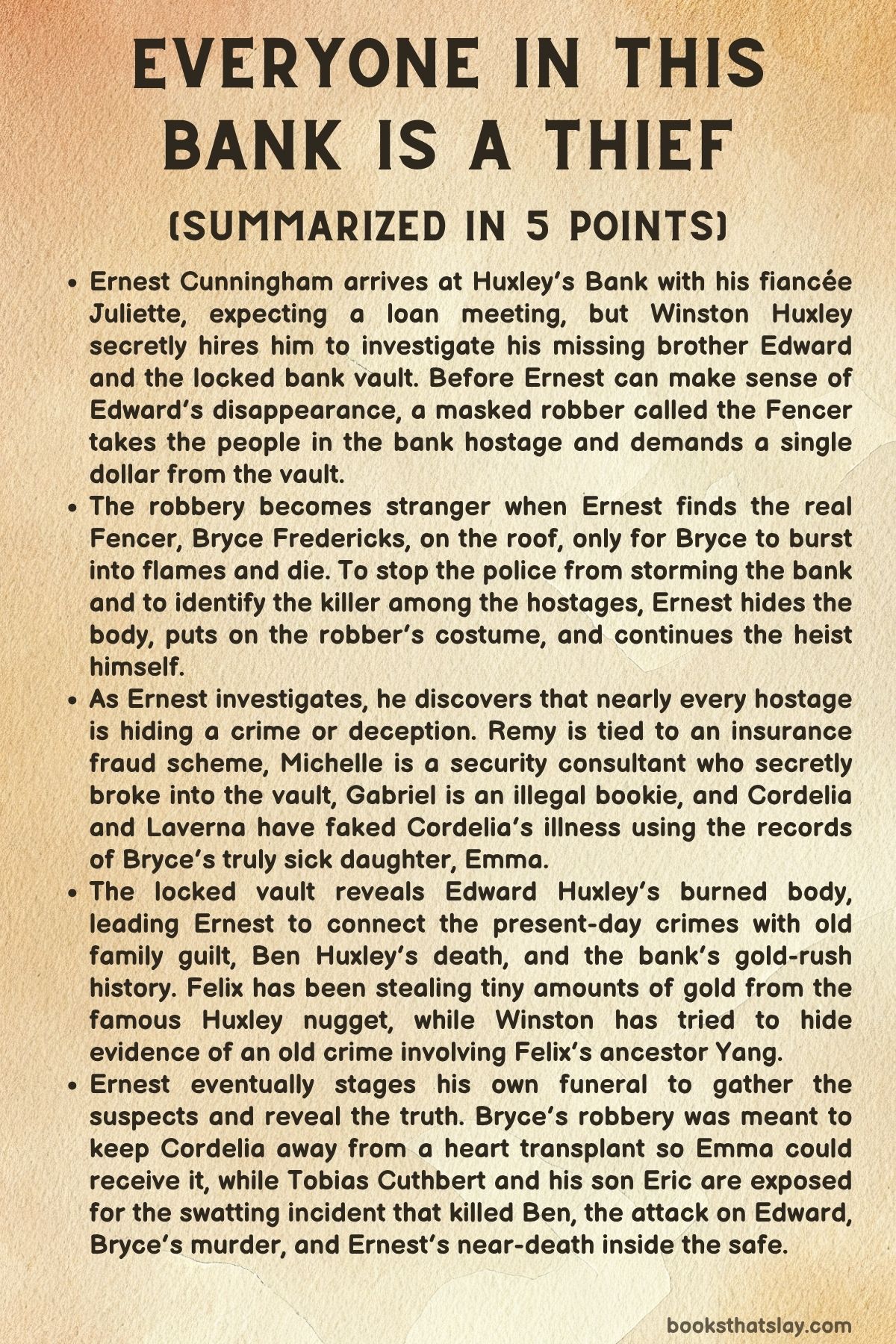
Summary
Ernest Cunningham begins the story in an impossible position: locked inside a steel safe with only a limited supply of air, a notebook, a few tools, and a revolver with two bullets. He knows he is in the middle of a murder case, but for once he cannot reveal the killer immediately, because he has not solved the mystery yet.
He also admits something strange and incriminating: he was robbing the bank. More than that, everyone inside the bank is a thief in some way.
Before this crisis, Ernest and his fiancée Juliette arrive in the country town of Huxley, Australia, where they believe they are attending a loan meeting at Huxley’s Bank. Outside, a swarm of white moth-like butterflies fills the sky.
Ernest is already distracted by news that Laurence Birch, the actor chosen to play him in a television adaptation, has died after being hit by a delivery van. Birch had been copying Ernest as part of his method acting, even taking his coffee loyalty card and writing Ernest’s name on a cup.
At the bank, Ernest and Juliette meet Winston Huxley, one of the bank’s elderly directors. Winston has not called them in for a loan.
He wants Ernest to investigate the disappearance of his brother and co-director, Edward Huxley. Edward changed the vault code and vanished, leaving the bank unable to access its money.
Winston refuses to call the police and is evasive about Edward’s dead son, Ben, who was killed the year before. Ernest also accidentally pockets Winston’s gold pen, making him, technically, the first thief.
The bank soon becomes a crime scene. A disguised robber wearing a fencing mask appears, fires a shot, and takes the people inside hostage.
Ernest calls him the Fencer. The hostages include Juliette, Winston, security guard Felix, receptionist Michelle, producer Remy Allard, Father Gabriel, Cordelia Bright, Cordelia’s mother Laverna, and teenager Eric Cuthbert.
The Fencer seems strangely focused on having the correct number of hostages and demands only one thing: a single dollar from the vault. That demand makes no sense, because the vault cannot be opened.
The police surround the bank, and Tobias Cuthbert, Eric’s father, becomes the negotiator. Ernest is allowed to search for clues to the vault code, escorted by Felix.
In Edward’s office, he finds Edward’s parrot Ditto, strange repeated phrases, a safe with a message from Ben, a gold bar, a thank-you card from Cordelia, and an invoice for a security review. The clues suggest that Edward’s disappearance, the locked vault, and the robbery may be connected.
Ernest also learns that Ben died during a swatting incident, when police were falsely sent to his house and killed him after mistaking video-game sounds for real gunfire.
Ernest eventually finds the Fencer on the roof without his disguise. The robber is Bryce Fredericks, a man Ernest had seen earlier that day.
Bryce says the robbery is over, claims he has killed “her,” and speaks in a confused way about death and energy. Before Ernest can bring him back inside, Bryce bursts into flames.
Ernest knows spontaneous combustion cannot be accepted as a real answer, so he concludes that Bryce has been murdered. To keep the police from storming the bank and to find the killer among the hostages, Ernest hides Bryce’s body, puts on the Fencer costume, and continues the robbery himself.
This decision drives much of the chaos that follows. Ernest must impersonate the robber, fool the police, control the hostages, and secretly investigate.
He discovers a payment from Remy to Bryce and initially suspects Remy. Remy’s crime is real, but different from murder.
He had insured the television production in a way that made Ernest’s death worth twenty-five million dollars. Laurence Birch’s death exposes Remy’s scheme, but Birch was not killed as part of that plan.
Remy had hoped Ernest’s detective work would eventually get him killed, allowing the production to collect the payout.
Ernest also uncovers Michelle’s secret. She is not a normal receptionist but a professional security consultant hired by Edward to test the bank’s defenses.
She broke into the vault, changed the code, and left ten thousand dollars on Edward’s desk as proof of her success. The vault code is hidden in her invoice through leetspeak.
When Ernest opens the vault, the money is still mostly there, but Edward Huxley’s body is inside. His corpse is badly burned, while his severed feet remain unburned.
The vault itself is otherwise clean, making his death seem impossible.
Cordelia and Laverna are then exposed. Cordelia is not actually terminally ill.
She and Laverna stole the medical records of Emma Fredericks, Bryce’s daughter, who truly needed a heart transplant. They used those records to fake Cordelia’s illness and raise money online.
Their fraud became even more destructive when Cordelia was moved ahead of Emma on the transplant list. Laverna crashed their car deliberately so Cordelia would miss the donor-heart window, preventing doctors from discovering the lie, but the crash also wasted a heart that might have saved Emma.
Father Gabriel’s secrets are also revealed. He is not simply a quiet priest with gambling debts.
He is an illegal bookie who took bets on competitive video-game matches. Edward Huxley had lost a huge amount betting against his own son Ben.
Gabriel’s shame over his role in the events leading to Ben’s death caused him to take a vow of silence. He also stole celebrity items, including things from Laurence Birch, and sold them online to launder betting money.
The old Huxley gold nugget provides another mystery. Felix, the security guard, has been slowly stealing microscopic amounts of gold from it using a corrosive acid solution.
His motive is rooted in family history. Harold Huxley, the bank’s founder, had cheated and likely murdered Felix’s ancestor Yang during the gold-rush era.
Winston knows that Yang’s ashes might prove the crime because traces of gold would remain. To hide that evidence, Winston broke into the family mausoleum and stole the ashes.
Ernest keeps connecting clues and realizes that Bryce’s robbery was not about money at all. Bryce’s daughter Emma needed a heart, and Laurence Birch’s sudden death created the chance for a transplant.
Cordelia, however, was still ahead of Emma on the list. Bryce staged the robbery to trap Cordelia in the bank long enough for the donor-heart window to close, so Emma could receive the heart.
His strange demand for a single dollar was only a cover.
The final truth centers on Eric and Tobias. Eric had lost to Ben in a competitive game and resented him.
Eric made the false emergency call that caused the police raid in which Ben was killed. Edward later discovered the truth through a recording of the game and contacted Tobias.
Tobias struck Edward with Ben’s gold bar. Edward, injured and frightened, locked himself in the vault, where he later died after pistachio nuts in his pocket ignited and his body burned through the wick effect.
Tobias also murdered Bryce. He used white phosphorus hidden in sunscreen, knowing Bryce’s medical condition made him vulnerable to sunlight and skin absorption.
Eric, meanwhile, later pushed Ernest into the safe to protect himself and his father. Ernest survives by using desperate chemistry, a gunshot that wounds him, and finally by tipping the safe out of a window.
At his own staged funeral, he reveals he is alive and gathers everyone for the final explanation.
The case ends with multiple crimes exposed. Cordelia and Laverna are punished for fraud.
Remy profits from the story in his own shameless way. Eric is held accountable for the swatting.
Winston gives the gold nugget to Felix to manage the scandal. Ernest refuses Winston’s money and donates his wedding budget to Emma’s medical fundraiser.
He and Juliette still marry, with Gabriel officiating while under house arrest. By the end, the title proves true: almost everyone in the bank stole something, whether money, truth, identity, hope, or a life.
Characters
Ernest Cunningham
Ernest Cunningham is the central detective and narrator of Everyone in This Bank Is a Thief, and his intelligence is matched by a dangerous weakness for narrative control. He understands crime fiction rules so deeply that he uses them as tools for survival, but the bank robbery tests the limits of that habit.
When Bryce Fredericks dies, Ernest chooses deception over honesty, puts on the Fencer costume, and continues the heist in order to solve the murder from inside the crime. That choice shows both courage and arrogance.
He is willing to risk himself for the truth, but he also risks other people because he believes he can manage the situation better than anyone else. His relationship with Juliette exposes his moral flaws most clearly.
He loves her, but he withholds vital information and even points what he believes is a loaded gun at her while playing the robber. Ernest is clever, funny, and observant, yet the book does not let his cleverness excuse his behavior.
His survival depends not only on logic but also on humility, pain, and Juliette’s faith in his better self.
Juliette
Juliette is Ernest’s fiancée, but she is never reduced to the role of supportive partner. She is sharp, brave, impatient with Ernest’s self-importance, and often morally clearer than he is.
While Ernest becomes absorbed in clues and patterns, Juliette keeps returning to the human cost of his choices. Her anger after discovering that he impersonated the Fencer is one of the most important emotional moments in the story, because she forces him to see that solving a case does not automatically make every tactic acceptable.
She also contributes vital reasoning, including ideas about Edward’s movements, Cordelia’s medical fraud, and the investigation outside the bank. Juliette’s courage is practical rather than theatrical.
She attacks the Fencer when she believes hostages are in danger, negotiates with Ernest when she realizes what he is doing, and helps expose the truth about Cordelia by going beyond the bank’s walls. In Everyone in This Bank Is a Thief, she acts as Ernest’s conscience, but she is also a detective figure in her own right.
Winston Huxley
Winston Huxley represents inherited power, family shame, and the instinct to protect reputation at almost any cost. At first, he appears as an anxious old banker trying to find his missing brother and reopen the vault, but his behavior is shaped by years of concealment.
He refuses to involve the police, hides information about Edward and Ben, and attempts to control the investigation through secrecy. His oversized shirt and ink-stained accident make him seem comic, but beneath that comedy lies a man who has spent his life benefiting from the Huxley name.
Winston’s greatest theft is not merely a gold pen or a hidden family relic; it is his attempt to erase evidence of an old murder tied to the bank’s origin. His theft of Yang’s ashes shows how deeply the Huxley family depends on buried history.
He is not the main murderer, but he is morally compromised because he cares more about scandal than justice. Winston’s public transfer of the gold nugget to Felix at the end is less a pure act of remorse than a calculated gesture of damage control.
Edward Huxley
Edward Huxley is dead for much of the book, but his presence shapes nearly every mystery. His disappearance creates the locked-vault problem, his office contains many of the early clues, and his grief over Ben drives the deeper story.
Edward is not innocent. He was a compulsive gambler who bet against his own son, and his desperation helped create the conditions that led to Ben’s death.
Yet he is also a grieving father who eventually tries to uncover the truth. His repeated viewing of Ben’s final game, which teaches Ditto fragments of speech, shows a man trapped in guilt and obsession.
Edward’s death is tragic because it comes after he begins moving toward accountability. He discovers Eric’s role in the swatting and reaches out to Tobias, only to be attacked.
His final attempt to protect the hard drive by locking himself in the vault ends in a bizarre accidental death. Edward’s character is built from contradiction: weakness, guilt, love, cowardice, and a late effort to do the right thing.
Bryce Fredericks
Bryce Fredericks begins as the masked robber, but the truth transforms him from apparent villain into a desperate father. His crime is real: he takes hostages, threatens people, and creates terror inside the bank.
Yet his motive is not greed. He wants to trap Cordelia long enough to stop her from taking the donor-heart opportunity that should belong to his daughter Emma.
Bryce’s plan is morally disturbing because he chooses violence as a way to correct an injustice caused by Cordelia and Laverna’s fraud. His grief and fear have narrowed his world until he sees the robbery as the only remaining path.
His demand for a single dollar is a distraction, a meaningless surface goal that hides the real purpose of the heist. Bryce’s death is especially cruel because he is murdered after his plan has already begun to collapse.
He is not a heroic figure, but he is a deeply sympathetic one. The story treats him as a man broken by a system that allowed fraud to threaten his child’s life.
Queenie Fredericks
Queenie Fredericks remains mostly outside the bank, but her role is crucial to the motive behind Bryce’s robbery. As a seamstress working on Remy’s production, she is close enough to Laurence Birch to gather information that matters for Emma’s transplant hopes.
Her discovery that Birch may be a donor match gives Bryce the desperate opening he needs. Queenie’s actions come from maternal fear and practical intelligence.
She does not appear as a mastermind, yet she helps connect the world of the television production to the medical emergency driving the heist. Her position also shows how ordinary workers are caught inside the schemes of more powerful people.
Remy treats the production as an insurance scam, but for Queenie the same environment becomes a source of information that might save her daughter. She is defined by urgency, not criminal ambition.
Her presence expands the emotional scope of the story beyond the bank and reminds readers that the robbery is tied to a family waiting outside for a life-saving chance.
Emma Fredericks
Emma Fredericks is the moral center of the medical plot, even though she appears mainly through other characters’ actions. She is the truly sick child whose medical records are stolen by Cordelia and Laverna.
Her suffering exposes the cruelty of fraud that is often treated abstractly as a financial crime. Cordelia and Laverna do not merely steal money; they steal credibility, medical priority, public sympathy, and time from someone who genuinely needs help.
Emma’s place on the transplant list becomes a measure of justice. Bryce’s extreme actions are driven by the belief that every official path has failed his daughter.
Emma’s later gratitude toward Ernest shows that she understands the terrible love behind her father’s choices without necessarily erasing their harm. She represents innocence endangered by adult selfishness, bureaucracy, and desperation.
The story uses her condition to ask how far a parent might go when a child’s survival depends on a system already distorted by lies.
Felix
Felix is one of the most layered suspects in the bank. At first, he appears to be a weak security guard because he surrenders his gun quickly, but his apparent failure hides a long private grievance.
His family history is tied to the Huxleys through Yang, whose goldfield partnership with Harold Huxley ended in betrayal and murder. Felix’s theft of gold from the famous nugget is slow, careful, and symbolic.
He is not stealing only for profit; he is reclaiming value from a monument built on his ancestor’s erasure. His anger toward the Huxleys is justified in origin, though his methods are illegal and dangerous.
The spectrometer report in his locker makes him look suspicious, and the story uses that suspicion to complicate the murder investigation. Felix’s character shows how historical injustice can survive inside institutions long after the original crime is hidden.
In Everyone in This Bank Is a Thief, his theft becomes a form of protest, revenge, and family remembrance.
Michelle
Michelle is introduced as the bank receptionist, but she is actually a professional security consultant testing the institution from the inside. Her deception is one of the cleanest examples of the book’s interest in role-playing.
She pretends to be an employee in order to expose weaknesses, and in doing so she accidentally becomes part of a real hostage crisis. Michelle’s theft of ten thousand dollars is technically part of her contracted proof of success, yet it still places her among the bank’s thieves.
She is competent, observant, and practical, but her confidence in controlled simulations blinds her when the real robbery begins. She initially assumes the Fencer might be another test, which shows the danger of treating security as a game.
Michelle also gives Ernest the path to the vault through the invoice code. Her character adds a professional, procedural angle to the story and contrasts with the more emotional crimes around her.
She steals under the logic of work, but that logic becomes absurd once real violence enters the room.
Remy Allard
Remy Allard is a producer whose charm hides cowardice and greed. His insurance scheme is one of the most cynical crimes in the story because it turns Ernest’s dangerous life into a financial asset.
Remy does not need to kill directly to be morally rotten; he builds a business model around hoping that Ernest will die. When that does not happen quickly enough, the production collapses, and Laurence Birch learns the truth.
Remy’s reaction to Birch’s death is cold and self-serving, focused more on production problems and insurance implications than on the loss of life. His attempted escape through the bathroom window captures his character perfectly: desperate, ridiculous, and willing to run when consequences approach.
Remy is not the central killer, but he embodies a parasitic form of theft. He steals trust, risk, identity, and creative work, turning human danger into a payout.
His later decision to make a film about the robbery suggests that he has learned very little, except how to profit from scandal.
Laurence Birch
Laurence Birch is dead early in the story, but he matters because his identity becomes confused with Ernest’s. As a method actor, he copies Ernest’s clothes, habits, and even his coffee cup.
This imitation makes him both comic and symbolically important. He is hired to play Ernest, but his death also becomes part of a plot in which Ernest himself has been financially targeted.
Birch’s anger after learning about Remy’s insurance scheme makes him more than a celebrity prop. He realizes he has been used in a project built on deception and death.
His sudden accident creates the medical opportunity that Bryce sees as a chance to save Emma, which means Birch’s death links the production scam to the bank robbery. Even after he is gone, stolen memorabilia, the coffee cup, and his donor status continue to drive the plot.
Birch shows how a person can become valuable to others in ways that have nothing to do with who he really is.
Father Gabriel
Father Gabriel first appears as a silent priest, communicating through an iPad, but his vow of silence hides guilt rather than holiness. He is an illegal bookie who took bets on video-game matches, including the matches involving Ben, Eric, and Edward.
His role in that world makes him partly responsible for the financial pressure and resentment that led to tragedy. Gabriel’s silence is therefore both penance and avoidance.
He wants to punish himself, but he also avoids speaking the full truth. His thefts of celebrity memorabilia and his use of online sales to launder money further complicate his moral position.
He is capable of kindness and shame, but he is also dishonest and opportunistic. When he finally breaks his vow, the act matters because it turns silence into confession.
Gabriel’s character is built around the difference between religious appearance and moral reality. He is not without conscience, but conscience arrives late and after real harm has already spread.
Cordelia Bright
Cordelia Bright is one of the most disturbing figures in the story because her fraud begins with a desire for attention and becomes a theft of life-saving opportunity. As a child, she learns that sickness brings care, sympathy, and special treatment.
Over time, that need grows into deception. Her fake illness, built on stolen medical records, allows her and Laverna to raise money and gain public support.
The worst consequence is not the fundraiser alone but her position ahead of Emma on the transplant list. Cordelia’s actions help waste a donor heart and nearly deny Emma a chance to survive.
Yet the book also gives her complexity. She eventually withdraws from the scam after recognizing the damage, which suggests she is not empty of conscience.
Her name, associated with the heart, becomes bitterly ironic because her central crime concerns both emotional manipulation and a literal heart transplant. Cordelia is selfish, damaged, and guilty, but not beyond recognition of harm.
Laverna Bright
Laverna Bright is Cordelia’s mother and the stronger force behind the medical fraud. Her chosen alias, linked to a goddess of thieves, suits her role in the story.
She is controlling, practical, and willing to injure her own daughter to preserve a lie. Her decision to crash the car so Cordelia would miss the transplant window is one of the coldest acts in the book, because it protects the scam while wasting a donor heart.
Laverna frames her actions as care, but her care is possessive and corrupt. She keeps Cordelia trapped in illness, medication, and dependence, even when Cordelia wants the deception to stop.
Her background as a truck driver and her knowledge of dangerous cargo also become important to Ernest’s reasoning about combustion. Laverna is a character shaped by survival instincts turned predatory.
She knows how to manage appearances, pressure others, and keep a fraud alive, but her devotion to Cordelia becomes inseparable from exploitation.
Eric Cuthbert
Eric Cuthbert is introduced as a teenage hostage, but he is eventually revealed as one of the story’s most important criminals. His youth initially makes him appear vulnerable, especially because his father is outside as the negotiator.
Yet his connection to Ben Huxley through competitive gaming reveals a darker side. Eric resents losing to Ben and protects his pride by accusing Ben of cheating.
His anonymous swatting call causes Ben’s death, turning petty rivalry and wounded ego into irreversible tragedy. Eric’s later attempt to silence Ditto and his role in pushing Ernest into the safe show how fear of exposure can make him more dangerous.
Still, the book does not portray him as purely evil. He is immature, angry, ashamed, and terrified of consequences.
His eventual confession separates him from Tobias, because Eric insists that he never wanted his father to kill anyone. Eric represents the frightening gap between online hostility and real-world harm.
Tobias Cuthbert
Tobias Cuthbert is one of the most chilling characters because he enters the story as a figure of authority and concern. As the police negotiator and Eric’s father, he appears to be trying to save the hostages.
In reality, he is managing the crisis while hiding his own crimes and protecting his son. Tobias attacks Edward after learning that Edward has evidence of Eric’s swatting call.
He later murders Bryce with white phosphorus, using his access and tactical knowledge to make the death seem impossible. His calm role outside the bank makes him especially dangerous because he controls information, pressure, and police response.
Tobias’s love for Eric has become corrupt. Rather than helping his son face accountability, he commits further violence to bury the truth.
His final actions in the church show a man still trying to escape exposure through force. Tobias is the story’s clearest example of parental protection turned monstrous.
Ben Huxley
Ben Huxley is dead before the main action, but he is the emotional and moral trigger behind several crimes. As Edward’s son and a gifted gamer, he becomes the focus of gambling, resentment, and false accusation.
Eric’s jealousy and Edward’s betting both reduce Ben to a symbol in their own private contests. His death during the swatting incident is senseless and devastating because it comes from a chain of irresponsibility: illegal betting, online rivalry, a false emergency call, and police misinterpretation.
Ben’s preserved message on Edward’s safe and the recording of his final game keep him present throughout the story. Ditto’s repeated phrases are not murder clues in the way Ernest first imagines; they are echoes of Ben’s last gaming session and the grief that follows.
Ben represents the human cost behind puzzles that might otherwise seem clever or comic. His absence is the wound that many characters spend the book hiding, exploiting, or misunderstanding.
Milton
Milton, the teller, is a minor character, but he plays an important structural role in the bank robbery. At the start, he is seen arguing with Remy and appears to be one of the people caught in the crisis.
In reality, he escapes when the teller area is sealed off, and Ernest later uses Milton’s supposed captivity as part of his deception while impersonating the Fencer. Milton’s absence becomes a problem because Ernest must keep the other hostages and the police believing that he is still inside.
This makes Milton less important as a personality than as a moving piece in Ernest’s risky performance. He also shows how easily assumptions form during panic.
The hostages believe they know who is trapped, who is missing, and who is dangerous, but the physical layout of the bank creates gaps in everyone’s knowledge. Milton’s role helps sustain the uncertainty that Ernest exploits.
Ditto
Ditto, Edward’s parrot, is both comic relief and a vital clue. At first, his repeated phrases seem like direct evidence, perhaps even Edward’s final words.
Ernest treats them as classic mystery clues, but their true meaning is more complicated. Ditto has absorbed lines from Ben’s gaming footage, turning grief, trash-talk, and memory into strange fragments.
This makes the bird a living recorder of the past, but an unreliable one until the context is understood. Ditto also helps expose the real killer when the funeral announcement claims he will give a reading.
The trap works because the guilty party knows the bird may reveal too much. In the final confrontation, Ditto’s sudden movement in the tower helps distract Tobias and changes the outcome.
The bird’s importance is funny without being meaningless. He represents the way truth can survive in odd forms, waiting for someone to hear it correctly.
Harold Huxley
Harold Huxley never appears in the present action, but his legacy defines the bank’s history and the Huxley family’s wealth. He is remembered publicly as a founder and goldfield success story, but the hidden truth suggests that his fortune was built on betrayal.
His likely poisoning of Yang turns the proud family legend into a crime scene stretched across generations. Harold’s character matters because he shows that institutions can be founded on violence and then protect that violence through monuments, stories, and respectable names.
The gold nugget in the bank is not only a symbol of prosperity; it is also evidence of stolen history. Harold’s crime shapes Winston’s fear, Felix’s revenge, and the final transfer of the nugget.
He represents the original theft beneath all the later thefts, the one that makes the bank’s wealth morally unstable from the beginning.
Yang
Yang is Felix’s ancestor and one of the most important absent figures in the historical mystery. His story has been erased by the official Huxley version of events, which claims he died of illness.
Ernest’s reasoning suggests something darker: Yang was poisoned with gold, then cremated in a way that helped hide the evidence. Yang’s importance lies in how his silencing continues to shape the present.
Felix’s anger is not random resentment but a response to generations of injustice. The possible traces in Yang’s ashes would threaten the entire Huxley myth, which is why Winston steals them.
Yang’s character gives the novel a deeper moral foundation by connecting present-day thefts to colonial-era exploitation, racism, and greed. Even though he does not speak in the story, the fight over his remains becomes a fight over truth itself.
His stolen life and stolen recognition stand behind Felix’s attempt to reclaim the gold.
Themes
Theft Beyond Money
The central idea of Everyone in This Bank Is a Thief is that theft can take many forms, and the book keeps expanding the meaning of the word until nearly every character is implicated. Some thefts are obvious, such as Michelle’s ten thousand dollars, Felix’s gold, Winston’s pen, Gabriel’s stolen memorabilia, and Juliette’s money taken for the doctor bribe.
Others are more disturbing because they involve identity, truth, time, health, or life. Cordelia and Laverna steal Emma’s medical reality and public sympathy.
Remy steals Ernest’s danger and turns it into a financial bet. Eric steals Ben’s safety through the swatting call.
Tobias steals justice by covering up his son’s crime and murdering those who threaten the secret. Even the Huxley family fortune rests on the theft of Yang’s labor, life, and historical recognition.
The bank setting makes this theme sharper because a bank is supposed to measure value in money, yet the most important losses cannot be counted in cash. The title becomes less like a joke and more like a moral verdict.
Performance, Disguise, and False Roles
Nearly every major character performs a role, and the tension comes from the gap between the role and the truth. Bryce dresses as the Fencer and pretends to be a traditional robber, while his real motive is connected to Emma’s transplant.
Ernest then takes over that costume and discovers that the mask gives him power, freedom, and moral danger. Michelle performs the role of receptionist while secretly testing bank security.
Gabriel performs holiness and silence while hiding his work as a bookie. Cordelia performs illness, Remy performs legitimacy as a producer, and Tobias performs authority as a negotiator while secretly steering events to protect himself and Eric.
Even Laurence Birch’s method acting becomes part of this pattern because he copies Ernest so completely that his identity becomes useful to other people’s schemes. The book suggests that performance is not always harmless.
A false role can protect someone, expose a weakness, manipulate sympathy, or hide a crime. The mystery works because people are constantly mistaken for what they pretend to be.
Parental Love and Moral Corruption
Parents in the story often act from love, guilt, or fear, but those feelings do not always lead to goodness. Bryce’s robbery is motivated by the desire to save Emma, and although his desperation is understandable, he still terrifies innocent people and creates a dangerous crisis.
Laverna claims to protect Cordelia, but her care becomes control, fraud, and physical harm. Edward loves Ben, yet his gambling against his own son reveals weakness and selfishness before grief changes him.
Tobias is the darkest version of this theme. His desire to protect Eric leads him to attack Edward, kill Bryce, and threaten others rather than let his son face the truth.
The book refuses to treat love as an automatic moral excuse. Instead, it shows how love can become possessive, cowardly, or violent when separated from accountability.
The healthiest contrast comes through Ernest and Juliette’s relationship, where love survives only because truth eventually has to be faced. Care without honesty becomes another kind of theft.
Truth Hidden in Absurd Details
The mystery repeatedly hides serious truth inside strange, comic, or easily dismissed details. A parrot’s phrases, a butterfly in a safe, a gold pen, a coffee cup, a children’s chemistry textbook, a sunscreen request, a sports drink bottle, a Duolingo streak, and a bag of pistachios all become meaningful.
The book’s humor does not weaken the mystery; it trains the reader to notice that ridiculous details may carry real weight. Ernest’s method depends on taking oddities seriously while also recognizing when he has interpreted them too quickly.
Ditto’s words seem like direct evidence of murder, but they are really fragments of a gaming recording. Edward’s burned body looks impossible, but chemistry and circumstance explain it.
Bryce’s demand for one dollar seems absurd, but it hides the fact that his real target is time, not money. This theme rewards attention and humility.
Truth is present, but rarely in the form people expect. The smallest object may expose the largest crime when placed in the right context.