Honor and Heresy Summary, Characters and Themes
Honor and Heresy by Max Francis is a dark fantasy novel about scholarship, power, loss, and rebellion in a city ruled by fear. Set in war-torn Northgard, the story follows Roy Dawnseve, a young nobleman whose secret life as a scholar places him in danger within a society that treats knowledge as a crime.
Forced into an ancient library to research the terrifying Old Ones, Roy discovers that the city’s war is tied to buried history, forbidden magic, and the restless dead. The book blends political cruelty, supernatural mystery, romance, and questions about what people owe to truth when authority survives by suppressing it.
Summary
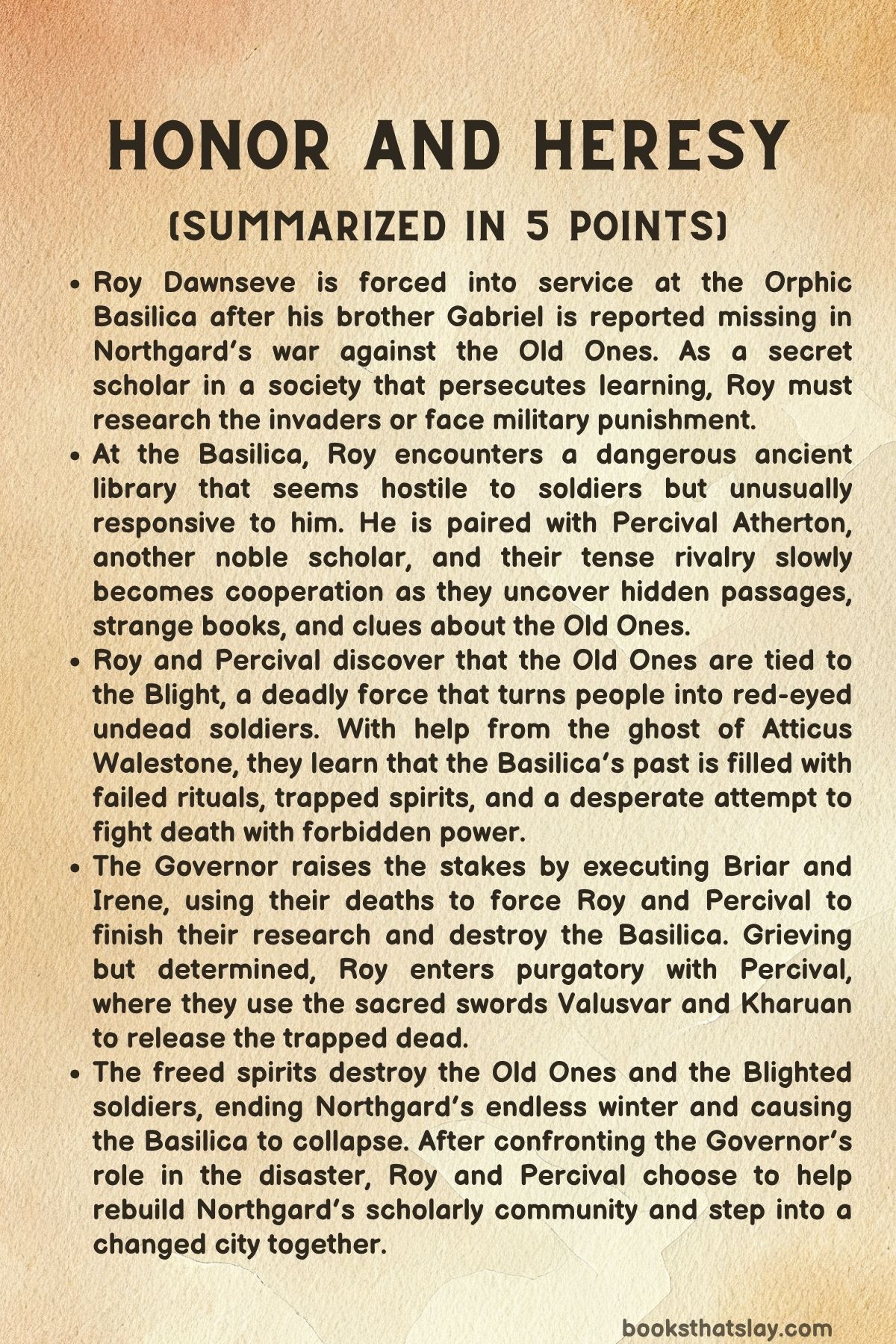
Northgard is a city on the edge of ruin. It has been trapped in a losing war against the Old Ones, strange black-armored invaders who have driven its people into hunger, terror, and obedience.
The ruling powers have responded not with mercy, but with harsher control. Soldiers known as Radiant Droves patrol the streets, scholars are hunted, and books have become symbols of treason.
In this world, Roy Dawnseve lives as the son of a powerful aristocratic family, but he also hides a dangerous secret: he is a scholar. His learning, curiosity, and private devotion to forbidden knowledge could destroy him if exposed.
Roy’s life changes after his brother Gabriel, a soldier, is reported missing and presumed dead. The news wounds the Dawnseve household, but grief is quickly followed by coercion.
The Governor sends a letter to Roy’s family presenting him with two choices that are not choices at all. Roy must either go to the Orphic Basilica and spend six months researching the Old Ones, or he will be sent to the Iron Citadel as a soldier.
For someone like Roy, the Citadel is almost certainly a death sentence. His mother, Matron Dimestra, accepts the Basilica assignment on his behalf, treating his future as a matter of family strategy rather than personal will.
Roy leaves Dawnseve Manor after a painful farewell with his sister Briar, one of the few people whose love and understanding give him strength.
The journey to the Basilica strips away any remaining illusion Roy has about Northgard’s nobility or order. In the streets, he sees starving citizens, cruelty from the Radiant Droves, and a child killed without justice.
He also sees executed scholars displayed as warnings, their books nailed to their faces. The sight confirms the truth he has always known privately: Northgard fears thought because thought threatens power.
By the time Roy reaches the Orphic Basilica, he understands that his assignment is not only dangerous because of the Old Ones. It is dangerous because the city has made knowledge itself into a crime.
The Orphic Basilica is an immense ancient library, beautiful, decaying, and deeply unnatural. The Governor explains that soldiers sent inside have suffered hallucinations, madness, and suicide.
The building does not behave like an ordinary structure. It reacts, resists, and seems to possess a will of its own.
Roy is paired with Percival Atherton, another noble scholar, and together they are ordered to discover the Old Ones’ origins and purpose. The Governor wants answers that can save Northgard’s war effort, but his command carries an obvious threat.
Roy and Percival are useful only as long as they produce results.
Roy soon learns that the Basilica is hostile to many who enter it, especially non-scholars, yet it appears strangely responsive to him. It guides him with sudden winds, shifting routes, hidden passages, and carefully placed books.
The library feels less like a storehouse than a thinking presence. Roy’s early days inside are frightening and disorienting.
He sees a shadowy figure with red eyes and is rescued by Percival, whose first impression is far from comforting. Percival is brilliant, proud, sharp-tongued, and determined to keep control of the research.
He resents Roy’s involvement and treats the assignment as a contest of intellect.
The two young men clash almost immediately. Their arguments cover scholarship, philosophy, the war, the purpose of knowledge, and the best way to conduct research.
Percival proposes that they turn the investigation into a competition: whoever identifies the Old Ones first will claim the academic credit. Roy accepts the rivalry, partly out of pride and partly because he refuses to be diminished.
Yet beneath their hostility, both are driven by the same hunger for truth. They are also among the few people in Northgard who understand what it means to love learning in a society built against it.
As they search the Basilica, Roy and Percival begin uncovering connections between the Old Ones, ancient battles, and the library’s hidden past. The building keeps guiding them toward relevant texts and concealed spaces, as though it wants them to find a buried answer.
Their research eventually leads them below the library into a hidden tunnel system. There, they discover a necropolis filled with bones, whispers, and a sense of waiting.
They also find two supernatural swords, Valusvar and Kharuan, whose purpose is unclear at first but whose presence signals that the Basilica was once tied to powers far older and stranger than Northgard’s current rulers admit.
The rivalry between Roy and Percival slowly changes. Shared danger forces them to rely on one another, and their arguments begin to reveal honesty rather than mere contempt.
They learn each other’s fears, ambitions, and wounds. Roy sees that Percival’s arrogance conceals loneliness and pressure, while Percival begins to respect Roy’s insight, courage, and moral clarity.
Their partnership becomes more balanced, then more intimate. Friendship turns into attraction, and attraction becomes romance.
In the middle of war, threat, and death, their relationship gives both of them a reason to keep going.
Their investigation moves into thanatology, the study of death, ghosts, and magical forces connected to the dead. Through this field, they encounter Atticus Walestone, one of the Elder Scribes who once served the Basilica.
Walestone is not simply a historical figure. He haunts the library, and Roy and Percival learn that he was also the famous philosopher Razkamun.
His presence links scholarship, memory, and the supernatural history buried beneath Northgard’s official version of events.
Walestone reveals pieces of the past through memories. The Elder Scribes once fought the Old Ones, and that earlier war involved a deadly force called the Blight.
The Blight kills people and transforms them into red-eyed undead soldiers, leaving them trapped between life and death. Roy and Percival realize that the Old Ones are not merely foreign invaders.
They are an army of the dead, or soldiers bound unnaturally to death, sustained by forbidden power. Even worse, many of the Radiant Droves who enforce the Governor’s rule have also been Blighted.
The corruption Roy witnessed in Northgard’s streets is not only political; it is magical and physical.
Just as Roy and Percival begin to understand the scale of the truth, the Governor returns and raises the cost of failure. Briar and her companion Irene have been arrested for involvement with hidden scholars.
The Governor executes them and uses their deaths as a weapon against Roy. He orders Roy and Percival to complete their work within three weeks and prepare for the Basilica’s destruction.
Briar’s death devastates Roy. She was not only his sister, but a source of love and moral courage in a world that tried to isolate him.
Her execution turns the Governor’s cruelty from a distant system into a personal wound.
Roy nearly collapses under grief, but Percival helps him continue. Their bond becomes a lifeline.
Roy also begins sensing Briar’s ghostly presence, which changes his purpose. He no longer wants only to solve the mystery of the Old Ones or survive the Governor’s command.
He wants to free the dead who have been trapped by old mistakes, failed rituals, and the Blight’s unnatural hold. Briar’s spirit reminds him that the dead are not abstractions.
They are people who were loved, harmed, and denied peace.
Walestone eventually shows Roy the central truth of the Basilica’s past. The Elder Scribes tried to use the sacred swords to open purgatory and release ghosts against the Old Ones.
Their plan was desperate, and it failed. Instead of freeing the dead, the ritual trapped Walestone and countless spirits in a state of unrest.
The Basilica became a prison of memory, death, and unfinished duty. Roy and Percival now understand that the swords are not trophies or weapons in the ordinary sense.
They are keys to correcting what the Elder Scribes could not complete.
Roy and Percival enter purgatory and face the burden left by the past. Using Valusvar and Kharuan correctly, they open the way for the trapped spirits to return.
The ghosts pour into Northgard, not as mindless horrors, but as the force that the Elder Scribes once hoped to summon. They attack the Old Ones and the Blighted soldiers, breaking the army that has terrorized the city.
As the spirits are released, the Basilica collapses, its purpose fulfilled at last. The endless winter storm that has hung over Northgard finally breaks, and sunlight returns to the city.
In the aftermath, Roy and Percival confront the Governor. They piece together the likelihood that he caused much of the disaster himself.
After the death of his wife, Cordelia, he attempted forbidden resurrection magic. The spell aged him, helped create or worsen the supernatural storm, and may have drawn the Old Ones back to Northgard.
His grief became tyranny, and his refusal to accept death helped condemn an entire city. Without his Blighted forces, the Governor’s power is weakened, but he remains politically dangerous.
Rather than simply surrender, the Governor bargains. He offers a future in which surviving scholars may come out of hiding if they help reshape the Law of Intervention and expand Northgard’s influence.
Roy and Percival accept, not because they trust him, but because the opening gives them a chance to rebuild what Northgard tried to destroy. They intend to restore the scholarly community, protect knowledge, and use the city’s fragile new beginning for something better.
The story ends with Roy saying goodbye to Briar’s ghost. He also learns that Gabriel’s spirit helped in the attack against the Old Ones, giving him a final connection to the brother he lost.
Grief does not vanish, and Northgard is not healed in a single moment, but the city has changed. The storm has ended, the dead have been released, and the truth has broken through years of fear.
Roy walks with Percival into a sunlit Northgard, carrying sorrow, love, and the responsibility of beginning again.
Characters
Roy Dawnseve
Roy Dawnseve is the central figure of Honor and Heresy and one of its most emotionally layered characters. He begins as an aristocratic young man trapped between privilege and persecution, because although he comes from a noble family, he is also a secret scholar in a society that treats scholarship as a crime.
His forced journey to the Orphic Basilica places him at the center of a war he does not fully understand, but it also reveals the strength of his mind and spirit. Roy is not a soldier in the traditional sense, yet his courage appears through investigation, endurance, compassion, and his willingness to face truths that others have buried.
Roy’s character is shaped deeply by grief. Gabriel’s presumed death, Briar’s execution, and the suffering he witnesses in Northgard all push him toward despair, but they also sharpen his sense of justice.
He is sensitive to cruelty in a way many powerful people around him are not, and this sensitivity becomes one of his greatest strengths. Rather than becoming numb, Roy allows pain to deepen his understanding of the world.
His connection to the Basilica also suggests that he has a rare spiritual and intellectual openness. The library responds to him because he approaches knowledge not merely as a tool for power, but as something sacred, dangerous, and necessary.
Roy’s development is also closely tied to his relationship with Percival. At first, Roy is defensive, wounded, and intellectually competitive, but through their partnership he learns to trust another person in both thought and emotion.
His romance with Percival gives him comfort, but it also gives him a fuller sense of purpose. By the end of Honor and Heresy, Roy is no longer simply surviving the demands placed upon him.
He becomes someone capable of confronting political corruption, honoring the dead, and helping rebuild a future for scholars. His journey is therefore one from helplessness to moral agency.
Percival Atherton
Percival Atherton is one of the most important characters in the story because he challenges Roy intellectually, emotionally, and morally. When he is first introduced, he appears arrogant, sharp-tongued, and fiercely independent.
His desire to work alone makes him seem cold, and his competitive attitude toward the investigation initially creates tension between him and Roy. However, this arrogance is not shallow.
It grows out of pride, insecurity, discipline, and a deep belief in scholarship as a serious pursuit. Percival wants recognition, but he also wants truth.
As the story develops, Percival becomes much more than Roy’s rival. His transformation from adversary to partner reveals a softer and more loyal side of his character.
He is not naturally comforting in a sentimental way, but he proves his care through action, persistence, and intellectual companionship. When Roy collapses under the weight of grief after Briar’s death, Percival helps him continue, not by erasing the pain but by standing beside him inside it.
This makes Percival an emotionally significant figure because he represents the possibility of trust in a world built on suspicion and coercion.
Percival also reflects the book’s larger interest in knowledge. He begins by treating discovery as a contest, but gradually learns that some truths are too large and too tragic to belong to one person.
His partnership with Roy changes his understanding of scholarship from personal achievement into shared responsibility. His courage is shown not only in entering dangerous spaces like the necropolis and purgatory, but also in allowing himself to become vulnerable.
By the end, Percival stands as both a scholar and a survivor, someone who helps carry knowledge forward after the collapse of the old order.
Briar Dawnseve
Briar Dawnseve is one of the most emotionally powerful characters in the book, even though much of her importance comes through her relationship with Roy and through the effect her death has on him. She represents familial love, innocence, resistance, and the human cost of Northgard’s oppression.
Her painful goodbye with Roy at Dawnseve Manor establishes her as someone deeply connected to his emotional life. She is not simply a sibling figure placed in the background; she is one of the people who gives Roy something to lose and something to protect.
Briar’s involvement with hidden scholars shows that she has courage of her own. She is not passive in the face of Northgard’s cruelty.
Her association with forbidden learning and resistance places her in direct danger, and her execution reveals the brutality of the Governor’s rule. Through Briar, the story shows how authoritarian power destroys not only soldiers and rebels but also young people whose only crime is hope, loyalty, or intellectual sympathy.
Her death becomes one of the clearest examples of the Governor’s willingness to use personal suffering as a weapon.
After her death, Briar continues to matter as a ghostly presence. Her spirit keeps Roy connected to the dead, and her farewell at the end gives emotional closure to his journey.
She symbolizes the people who cannot be saved physically but can still be honored spiritually. Briar’s role in the story is therefore both intimate and symbolic.
She is Roy’s sister, but she also represents the lost future Northgard must answer for.
Gabriel Dawnseve
Gabriel Dawnseve is important because his absence shapes the story almost as strongly as another character’s presence might. As Roy’s soldier brother, Gabriel represents the traditional path of service to Northgard, a path Roy himself is threatened with when the Governor forces him to choose between the Basilica and the Iron Citadel.
Gabriel’s reported disappearance and presumed death create the first major wound in Roy’s family and help establish the war as a personal tragedy rather than a distant political event.
Gabriel also functions as a contrast to Roy. Where Roy is scholarly, Gabriel is connected to military duty.
Yet the story does not treat one form of courage as superior to the other. Gabriel’s spirit helping attack the Old Ones near the end suggests that his loyalty and bravery continue beyond death.
His presence among the dead gives Roy a final confirmation that his brother was not simply erased by the war. Gabriel’s role deepens the book’s treatment of death by showing that the dead are not only victims; they can also become witnesses, protectors, and participants in liberation.
Through Gabriel, the story also shows how families are consumed by political violence. His disappearance pushes Roy into a new life, affects Matron Dimestra’s decisions, and haunts the Dawnseve family.
Though he is not active through much of the plot, Gabriel’s significance lies in how strongly he influences Roy’s grief, fear, and eventual understanding of the dead.
Matron Dimestra
Matron Dimestra is a complicated parental figure whose actions reveal the pressures and compromises of aristocratic survival. Her decision to accept the Governor’s demand without consulting Roy makes her seem controlling and emotionally distant.
She treats Roy’s future as something to be negotiated within political reality rather than something he should be allowed to choose. This creates pain because Roy is already vulnerable after Gabriel’s disappearance, and instead of being protected by his mother, he is sent into danger.
However, Matron Dimestra should not be read only as cruel. She lives in a society where power is concentrated in the Governor’s hands, and refusal may have led to even worse consequences for Roy or the family.
Her choice reflects fear, calculation, and perhaps a belief that the Basilica is less deadly than the Iron Citadel. This does not excuse her lack of tenderness, but it makes her morally realistic.
She is a character shaped by hierarchy, reputation, and survival.
Dimestra’s role in the story highlights the limits of aristocratic privilege. Although the Dawnseves are noble, they are not free.
The Governor can still command them, threaten them, and use their children as instruments of war. Through Dimestra, the book shows how oppressive systems force even powerful families into painful obedience, and how love can become distorted when filtered through fear and social duty.
The Governor
The Governor is one of the most morally corrupt and dangerous figures in the book. He presents cruelty as necessity and power as order, but his actions reveal a man willing to sacrifice almost anyone to preserve control.
His demand that Roy work in the Basilica or become a soldier is framed as an offer, yet it is really coercion. From the beginning, he manipulates Roy’s family and uses the war to justify his authority.
His execution of Briar and Irene shows the full extent of his brutality. He does not merely punish them; he uses their deaths to force Roy and Percival into obedience.
This makes him not only a political antagonist but also a deeply personal enemy. His cruelty is strategic, theatrical, and intimate.
He understands that grief can be used as a weapon, and he uses that knowledge without hesitation.
The later revelation that he may have caused much of Northgard’s disaster through forbidden resurrection magic gives him tragic dimensions, but it does not redeem him. His grief over Cordelia appears to have driven him toward unnatural power, yet instead of accepting loss, he tried to bend death itself.
This selfish refusal to let go may have unleashed wider catastrophe. The Governor therefore represents the destructive side of grief when it is joined with political authority and moral arrogance.
He is a warning about what happens when love becomes possession and leadership becomes domination.
Atticus Walestone / Razkamun
Atticus Walestone, also known as Razkamun, is one of the most mysterious and intellectually significant figures in the story. As an Elder Scribe and a hidden philosopher, he connects the present crisis to the buried history of the Basilica.
His ghostly existence makes him both a character and a living remnant of the past. He is trapped between life, death, memory, and guilt, which makes him central to the book’s exploration of purgatory and unfinished responsibility.
Walestone’s importance lies in what he reveals. Through him, Roy and Percival learn that the Old Ones are tied to the Blight, that the Elder Scribes once fought them, and that a failed ritual trapped countless spirits.
He is therefore a keeper of forbidden truth. Yet he is not merely a source of information.
He is also a tragic figure who must confront the consequences of his own era’s choices. The failure of the Elder Scribes did not simply remain in the past; it shaped the suffering of the present.
As Razkamun, Walestone also represents the power of ideas. His philosophical identity suggests that thought can survive persecution, but his ghostly imprisonment shows that knowledge without wisdom can lead to disaster.
He helps Roy not because he is untouched by failure, but because he understands it. His character adds depth to the story’s moral world by showing that even noble intellectuals can make catastrophic mistakes when they try to command forces beyond their understanding.
Irene
Irene is a smaller but meaningful character whose role is tied to resistance, loyalty, and sacrifice. As Briar’s companion, she is associated with hidden scholars and the dangerous world of forbidden learning.
Her arrest and execution show that the Governor’s violence does not fall only on central figures or noble heirs. It reaches anyone connected to knowledge, defiance, or those the regime considers inconvenient.
Irene’s character helps widen the emotional scope of Briar’s death. The execution is not only a personal tragedy for Roy’s family but also part of a larger pattern of political terror.
Irene represents the many people whose lives are destroyed because they stand near forbidden truth. Even with limited detail, her presence matters because she shows that Briar was not alone and that resistance existed beyond Roy and Percival’s investigation.
Her death also intensifies the story’s condemnation of the Governor. By killing both Briar and Irene, he turns young lives into instruments of pressure.
Irene therefore becomes a symbol of the hidden scholarly community’s vulnerability. She reminds readers that the fight for knowledge is not abstract; it is carried by real people who risk everything.
Cordelia
Cordelia is significant because her death appears to be the emotional origin of the Governor’s worst choices. Though she is not active in the present action, her absence drives a major part of the story’s hidden history.
The Governor’s attempt at forbidden resurrection magic after losing her suggests that she was deeply loved, but the consequences of that love become horrifying. Cordelia becomes the center of a grief that is transformed into obsession.
Her character is important because she helps explain, though not excuse, the Governor’s actions. Through Cordelia, the story explores the danger of refusing mortality.
The desire to bring back a loved one may begin as sorrow, but in the Governor’s hands it becomes a violation of natural limits and a source of collective suffering. Her death may have contributed to the storm, the aging of the Governor, and the return or empowerment of the Old Ones.
Cordelia’s role is therefore symbolic as much as personal. She represents the beloved dead whom the living cannot release.
Unlike Briar and Gabriel, whose spirits become part of healing and liberation, Cordelia’s memory is tied to possession and catastrophe. This contrast makes her important to the book’s larger meditation on grief.
Some characters honor the dead by freeing them, while the Governor tries to control death and damages the world.
The Old Ones
The Old Ones function as both antagonists and mysteries. At first, they appear to be monstrous invaders in black armor, a terrifying outside force pushing Northgard toward collapse.
Their strange appearance and military power make them seem almost unknowable. This mystery is central to the plot, because Roy and Percival’s investigation begins with the need to discover who they are and what they want.
As the truth emerges, the Old Ones become more tragic and horrifying than simple enemies. Their connection to the Blight reveals that they are tied to death, undeath, and forbidden prolonging of life or violence.
They are not merely soldiers from another land; they are part of a corrupted relationship between war and death. Their red-eyed presence and association with Blighted forces make them embodiments of a world where the dead are not allowed to rest and the living are turned into weapons.
The Old Ones also expose Northgard’s moral blindness. The city sees them as the only threat, but the story gradually reveals that Northgard’s own cruelty, persecution, and forbidden experiments are also part of the disaster.
The Old Ones are frightening because they attack from outside, but they are even more meaningful because they reflect corruption already present within the city’s systems of power.
The Radiant Droves
The Radiant Droves represent Northgard’s militarized cruelty and the collapse of moral order within the city. They are seen abusing starving citizens and enforcing violence against the vulnerable.
Their role shows that Northgard is not simply a victim of invasion. It is also a society capable of turning on its own people.
Through them, Roy witnesses the brutality that official power permits and encourages.
The later realization that many Radiant Droves have been Blighted adds a supernatural layer to their corruption. They are both agents of oppression and victims of a deadly force that turns people into red-eyed undead soldiers.
This makes them disturbing because they blur the line between human cruelty and magical contamination. Their violence is political, but it is also tied to deathly corruption.
As a group, the Radiant Droves help define the world Roy must reject and eventually help transform. They show what happens when obedience replaces conscience.
Their presence strengthens the story’s criticism of institutions that use fear, hunger, and violence to maintain control.
The Elder Scribes
The Elder Scribes are important because they represent the lost scholarly past of the Basilica. They once possessed knowledge powerful enough to challenge the Old Ones, but their failed ritual also trapped Walestone and countless spirits.
This makes them morally complex. They were defenders of knowledge and perhaps protectors of Northgard, but they also made choices that carried terrible consequences.
Their attempt to use sacred swords to open purgatory suggests courage and desperation. Like Roy and Percival, they tried to find a way to defeat an overwhelming enemy.
Unlike Roy and Percival, they failed to use that power correctly, and their failure created a spiritual wound that lasted across time. The Elder Scribes therefore show that scholarship is not automatically pure or safe.
Knowledge must be joined with humility, responsibility, and moral clarity.
Their legacy shapes the entire story. The Basilica, the necropolis, the swords, Walestone’s haunting, and the trapped dead all connect back to them.
Through the Elder Scribes, the book presents history as something unfinished. The mistakes of the past remain active until someone has the courage and understanding to repair them.
Valusvar and Kharuan
Valusvar and Kharuan are not ordinary human characters, but they carry enough symbolic and narrative importance to be treated as major presences in the story. These supernatural swords are connected to death, purgatory, and the failed ambitions of the Elder Scribes.
Their discovery beneath the Basilica marks a turning point in Roy and Percival’s investigation because the conflict shifts from historical research into direct spiritual action.
The swords represent power that requires understanding rather than domination. In the wrong hands or used incorrectly, they are connected to failure and entrapment.
In Roy and Percival’s hands, they become instruments of release. This contrast is important because it reflects one of the story’s central moral ideas: power itself is not enough.
What matters is the purpose, wisdom, and compassion behind its use.
Valusvar and Kharuan also connect the living and the dead. Through them, Roy and Percival are able to enter purgatory and free the trapped spirits.
The swords therefore become symbols of corrected history. They allow the present generation of scholars to complete what the past generation could not, transforming a legacy of failure into an act of liberation.
Themes
Knowledge, Persecution, and Intellectual Freedom
In Honor and Heresy, scholarship is treated as both a crime and a necessity, creating a sharp conflict between public law and private truth. Roy belongs to a society that punishes scholars, yet the city’s survival depends on the very kind of learning it has tried to erase.
The executed scholars with books nailed to their faces show how Northgard turns knowledge into a symbol of shame and fear. At the same time, the Orphic Basilica proves that knowledge cannot be fully destroyed, because its books, hidden passages, memories, and spirits continue to preserve truths the rulers have buried.
Roy’s role becomes powerful because he does not simply collect facts; he restores value to forbidden thought. His research reveals that ignorance has allowed the Governor’s lies, the Blight, and the war itself to continue.
The theme shows that societies which fear learning become vulnerable to manipulation, while genuine scholarship can expose corruption, recover history, and create the possibility of renewal.
Grief, Memory, and the Presence of the Dead
Death in the story is not presented as a clean ending, because grief keeps the dead emotionally present while supernatural forces keep many spirits physically trapped. Roy’s losses shape his choices, especially after Gabriel’s disappearance and Briar’s execution.
His grief could destroy him, yet it also deepens his purpose, pushing him to understand purgatory and free those caught between life and death. The presence of ghosts suggests that memory is not passive; it demands recognition, justice, and release.
Walestone’s haunting shows the burden of unresolved history, while Briar’s ghostly presence gives Roy both pain and comfort. The dead are not merely victims waiting to be mourned; they become witnesses to past wrongdoing and active participants in Northgard’s survival.
This theme gives emotional weight to the battle against the Old Ones, because victory is not only about defeating an enemy. It is also about allowing the dead to rest and helping the living move forward without forgetting them.
Power, Corruption, and Moral Compromise
The Governor represents a form of power that hides cruelty behind duty, order, and patriotism. His letters, threats, executions, and bargains show how authority can make violence appear official and necessary.
He does not simply command Northgard; he controls people by turning their loved ones, social positions, and fears into weapons. His possible role in causing the disaster through forbidden resurrection magic makes his corruption even more personal, because public suffering may have begun with private obsession.
The Radiant Droves also reflect how power dehumanizes both its victims and its servants, especially once the Blight turns soldiers into tools of control. Roy and Percival face moral compromise when they accept the Governor’s final bargain, but their choice is not simple surrender.
They recognize that change may require entering flawed systems in order to protect hidden scholars and reshape the law. The theme suggests that power becomes dangerous when unchecked, but resistance sometimes requires strategic patience rather than pure rejection.
Love, Trust, and Shared Purpose
Roy and Percival’s relationship begins in rivalry, pride, and suspicion, which makes their gradual trust feel earned rather than sudden. Their early arguments reveal different ways of thinking: Roy is emotionally open, curious, and responsive to the Basilica, while Percival is guarded, competitive, and determined to protect his independence.
As they face danger together, their connection becomes more than romance. It becomes a partnership built on respect, shared discovery, and mutual survival.
Percival helps Roy continue after devastating loss, while Roy helps Percival move beyond isolation and academic vanity. Their love also challenges the coldness of the world around them, where families, rulers, and institutions often treat people as tools.
Together, they show that trust can become a form of resistance. Their bond does not remove grief, fear, or danger, but it gives both characters the strength to act with courage.
By the end, their shared purpose points toward rebuilding, not only personally but intellectually and socially.