Honey in the Wound Summary, Characters and Themes
Honey in the Wound by Jiyoung Han is a multigenerational novel about Korea’s suffering under Japanese occupation and the long shadow left by violence, silence, and survival. Moving from a remote mountain home in 1902 to Seoul and Tokyo in the late twentieth century, the book follows one family through loss, forced separation, wartime sexual slavery, and the struggle to speak the truth.
It blends realism with folklore, especially through the figure of a lost girl who returns as a tiger. At its core, Honey in the Wound is about memory: what is buried, what survives, and what must finally be named.
Summary
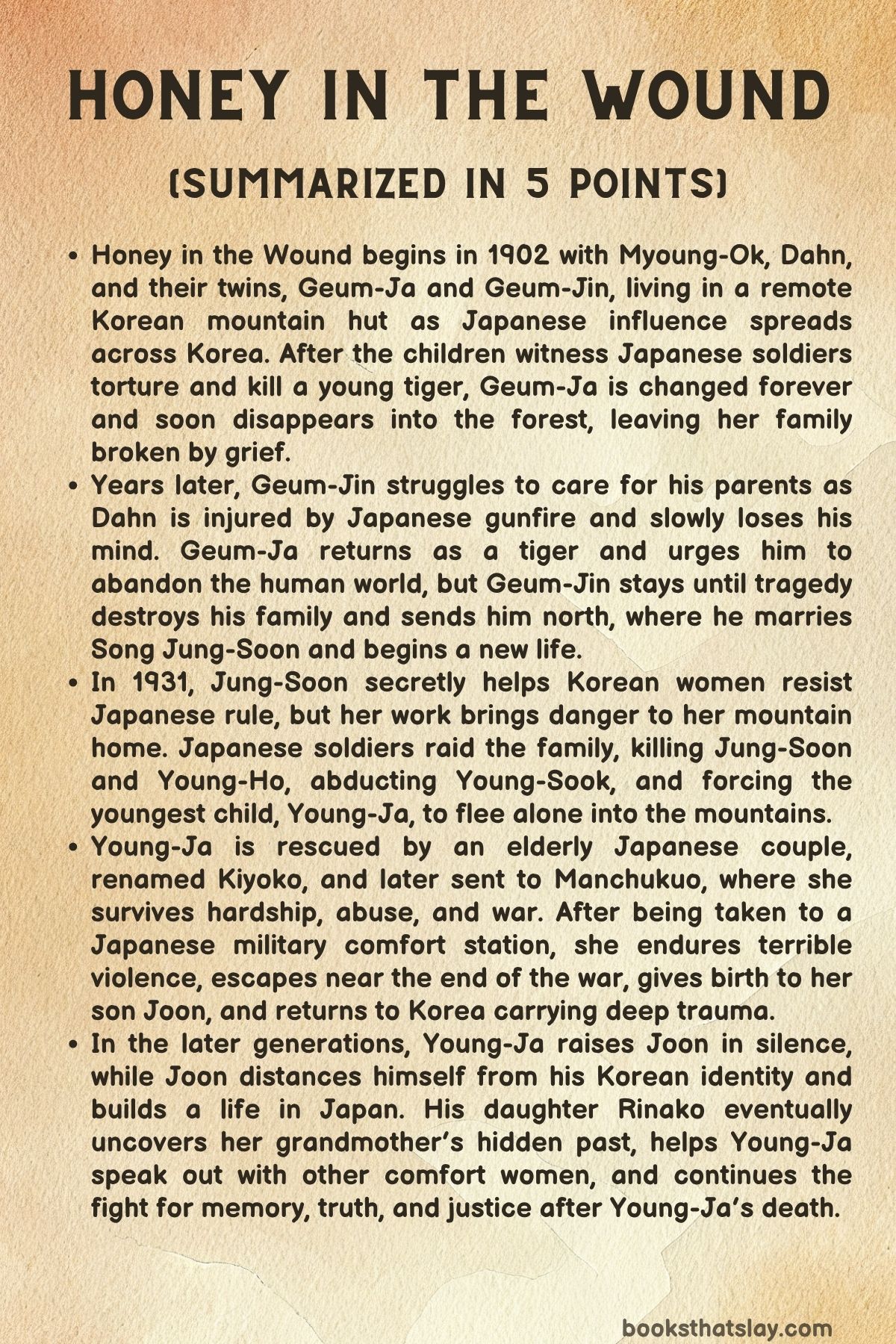
Honey in the Wound begins in 1902, in a remote Korean mountain hut where Myoung-Ok gives birth to twins, a girl named Geum-Ja and a boy named Geum-Jin. Their father, Dahn, is a huge, powerful hunter, feared and respected for his strength.
The family lives apart from the nearby village, surviving through Dahn’s hunting and Myoung-Ok’s close relationship with the land. Their home is simple, isolated, and deeply tied to the forest around them.
The children grow up with the mountains as their world, but beyond that world, Korea is changing. Japan’s influence is spreading, and soldiers begin to appear even in places that once seemed beyond the reach of empire.
When the twins are still young, Myoung-Ok takes them into the forest to help a trapped tiger cub. The children hide nearby and see Japanese soldiers torment and kill the young animal.
The cruelty of the scene marks Geum-Ja in a way no one fully understands. Soon after, she begins to hear the forest crying.
Then she vanishes. The villagers believe a tiger has taken her, especially after only her shoe and clothing are found.
For her parents and brother, her disappearance becomes a wound that never closes.
Years pass, and Geum-Jin grows into a young man under the weight of his family’s grief. Dahn is later shot and badly injured by Japanese forces, leaving him maimed and increasingly unstable.
His pain, anger, and helplessness twist his mind. Myoung-Ok, once grounded and strong, carries the sorrow of losing her daughter and watching her husband decline.
Geum-Jin becomes the one who tries to hold the family together.
Then Geum-Ja returns, not as the girl who disappeared, but as a tiger. She tells Geum-Jin that humans are destroying the forest and urges him to leave with her.
Geum-Jin cannot accept this. However much he loves his sister, he refuses to abandon their parents.
His loyalty keeps him tied to the human world, even as that world grows more dangerous.
At a market, Geum-Jin has a confrontation with Japanese officials and is chased. Geum-Ja rescues him and again warns him that he should flee.
But when he returns home, tragedy is waiting. Dahn, driven mad by pain and poison, attacks his own son.
Myoung-Ok kills Dahn to save Geum-Jin. Afterward, she disappears into the earth with her husband, leaving Geum-Jin alone.
He mourns the collapse of the only home he has known, then travels north.
There he meets Song Jung-Soon, a woman with scars and a strange gift: her voice forces truth from others. She has also been marked by violence, but she is strong, sharp, and purposeful.
Geum-Jin and Jung-Soon marry and build a home in the mountains. Together they have three children: Young-Sook, Young-Ho, and Young-Ja.
For a time, the family creates a life of work, love, and protection, but Japanese rule continues to tighten around Korea.
By 1931, Jung-Soon is secretly helping women in Cheongju resist occupation. She gathers information from Japanese soldiers and warns families who may be in danger.
Her courage places her own family at risk. The Japanese police eventually trace suspicion to the mountain home.
Soldiers raid the family’s house, beat Geum-Jin, murder Jung-Soon and Young-Ho, and abduct Young-Sook. Geum-Ja, still in tiger form, attacks the soldiers, but she cannot save everyone.
Young-Ja, the youngest child, is forced to run alone into the mountains.
Young-Ja is found near death by an elderly Japanese couple, Masaharu and Seiko Uchida. They take her in and give her a Japanese name, Kiyoko.
Seiko nurses and cares for her, but the safety Young-Ja seems to have found does not last. Masaharu later abuses her, and she is sent away by train to Manchukuo.
Torn from her family, language, and homeland, Young-Ja enters a new world where survival depends on silence, caution, and quick learning.
In Xinjing, she is taken into Fenghuang Teahouse, a place controlled by the commanding Feng-nüshi. The teahouse is both refuge and cage.
Young-Ja learns how to serve customers, protect secrets, read danger, and endure. She forms a bond with Meiyu and becomes connected to Baek Yong-Woo, who is involved in an anti-Japanese resistance network.
Through him and others, she sees that resistance takes many forms: information, hidden messages, protection, refusal, and memory.
As the war grows worse, even the teahouse cannot protect its women. Japanese forces burn it, and many die.
Young-Ja is captured and taken to a military comfort station, where she and other girls are repeatedly abused by soldiers. This part of her life is defined by terror, humiliation, and the struggle to remain human in a system designed to erase her.
She befriends Bok-Hee and tries to protect younger girls who are even more vulnerable. The women suffer brutal punishments, pregnancies, illness, and despair, but they also form bonds that help them survive from one day to the next.
Near Japan’s defeat, chaos creates a chance to escape. Young-Ja flees with others, but in the darkness and confusion, she loses Bok-Hee.
Pregnant and crushed by everything she has endured, Young-Ja tries to drown herself. She is saved by Xiuying, who helps her live long enough to give birth to a son, Joon.
With him, Young-Ja eventually returns to Korea.
Back in Korea, Young-Ja faces another kind of struggle. She must survive war, poverty, and motherhood while carrying a past she cannot speak aloud.
She raises Joon in silence, refusing to tell him the truth about his conception or the horrors she endured. Her silence is not emptiness; it is protection, shame, fear, and trauma all bound together.
Joon grows up without understanding the full story of his mother’s life. He later studies in Japan, changes his name to Shun Matsumoto, marries a Japanese woman, and has a daughter named Rinako.
In the years 1989 to 1992, Rinako grows up in Tokyo feeling isolated. She is bullied for her mixed Korean and Japanese heritage and is troubled by visions she does not understand.
When she learns that her grandmother in Seoul is ill, she visits Young-Ja. That visit opens the sealed history of her family.
Rinako begins to learn about Korea, Japanese occupation, and the comfort women. She also starts to understand that her grandmother’s silence has shaped the whole family, including her father, who has tried to distance himself from his Korean identity.
Rinako pushes Joon, now Shun, to face the truth of who he is and where he comes from. At the same time, she helps Young-Ja move toward public testimony.
Young-Ja begins to join protests demanding recognition and justice for the women who were forced into sexual slavery by the Japanese military. Speaking is painful, but silence has also caused damage.
For Young-Ja, telling the truth becomes a final act of resistance.
Young-Ja dies after beginning to tell her story, but her voice does not disappear. Rinako continues the work her grandmother started.
She confronts journalists, officials, and former perpetrators, insisting that the dead and the violated must not be erased. The novel ends with the burden of memory passing to a younger generation.
What began in a mountain hut with a family living close to the forest becomes a larger story of colonization, war, women’s suffering, inherited trauma, and the need for justice. Through Young-Ja and Rinako, Honey in the Wound shows that truth may be delayed, buried, or denied, but it can still rise through those willing to carry it forward.
Characters
In Honey in the Wound, the characters are shaped by family, land, colonial violence, silence, memory, and survival. Their lives are deeply connected across generations, and each character carries forward some part of the wounds left by history.
Myoung-Ok
Myoung-Ok is one of the earliest and most spiritually rooted figures in the book. She is introduced as a mother whose connection to the earth feels almost sacred, and this bond makes her more than a domestic figure.
She represents an older, natural world that exists before war, empire, and violence fully invade the family’s life. Her motherhood is central to her character, but it is not simple or passive.
She gives birth to twins in a remote mountain hut and raises them in a world that is both isolated and deeply alive. Her relationship with nature suggests wisdom, intuition, and a kind of quiet power that stands apart from the political forces beginning to threaten Korea.
Myoung-Ok’s tragedy lies in the way she is forced to witness the destruction of the world she understands. The loss of Geum-Ja breaks something in the family, and Dahn’s injury and madness place an unbearable emotional burden on her.
Yet Myoung-Ok remains protective until the end. When Dahn attacks Geum-Jin, she kills her husband not out of hatred, but out of desperate love for her son.
This act shows the terrible moral choices forced upon people living under violence and grief. Her final dissolution into the earth with Dahn makes her character feel almost mythic.
She returns to the natural world she has always belonged to, becoming a symbol of maternal sacrifice, grief, and the wounded land itself.
Dahn
Dahn is a giant hunter whose strength initially defines him. He is physically powerful, self-sufficient, and closely tied to the mountains through his hunting.
At the beginning of the story, he appears as a protector and provider, a man capable of sustaining his family outside village life. His size and skill make him seem almost legendary, but this strength does not protect him from the violence of colonial power.
When Japanese gunfire maims him, his body becomes a site of historical injury. His decline shows how war and occupation destroy not only communities but also individual dignity.
Dahn’s transformation from protector to danger is one of the most painful parts of his character. His injury, pain, and poisoning lead him into madness, and he becomes a threat to the very family he once guarded.
This does not make him a villain in a simple sense. Instead, he becomes a tragic figure whose mind and body have been broken by forces larger than himself.
His attack on Geum-Jin reveals how trauma can turn inward and destroy the home. His death at Myoung-Ok’s hands is devastating because it is both necessary and heartbreaking.
Dahn represents wounded masculinity, the collapse of physical power, and the way colonial violence enters even the most private spaces of family life.
Geum-Ja
Geum-Ja is one of the most haunting and symbolic characters in the book. As a child, she is changed forever after witnessing Japanese soldiers torment and kill a trapped young tiger.
That moment connects her emotionally and spiritually to the forest’s suffering. Her disappearance soon after suggests that she crosses a boundary between the human world and the natural world.
When she returns in the form of a tiger, she becomes both sister and spirit, both survivor and warning. She is no longer fully human, but she remains tied to Geum-Jin and to the family she left behind.
Geum-Ja’s tiger form gives her character a powerful symbolic role. She represents the rage of the violated forest, the innocence destroyed by cruelty, and the wild resistance that human beings cannot control.
Her repeated warnings to Geum-Jin show that she understands the danger humans pose to nature and to themselves. She wants him to leave before destruction becomes unavoidable, but he remains bound by duty to his parents.
Geum-Ja’s appearances create a bridge between realism and myth. She is a reminder that violence against animals, land, and people is connected.
Her character turns grief into a living force, and her presence suggests that the dead and disappeared are never truly gone.
Geum-Jin
Geum-Jin is a deeply burdened character whose life is shaped by loyalty, loss, and survival. After Geum-Ja disappears, he becomes the child who remains, carrying the grief of his parents and the responsibilities of a damaged household.
He supports Myoung-Ok and Dahn after Dahn is maimed, and his refusal to leave with Geum-Ja shows how strongly he is tied to human obligation. He cannot abandon his parents, even when the forest itself seems to call him away.
This makes him compassionate, dutiful, and tragic, because his love keeps him in a place of danger.
As Geum-Jin grows older, he becomes a bridge between the first generation’s suffering and the next generation’s trauma. His marriage to Jung-Soon and the birth of their children offer him a chance to rebuild life after catastrophe.
For a time, he creates a new mountain home and appears to recover some sense of stability. Yet the violence of Japanese rule follows him and destroys his family again.
The murder of Jung-Soon and Young-Ho, the abduction of Young-Sook, and Young-Ja’s flight into the mountains break the life he has tried to build. Geum-Jin represents the survivor who keeps choosing family, even as history repeatedly tears family apart.
Song Jung-Soon
Song Jung-Soon is a courageous and morally powerful character. Her scarred body and truth-compelling voice make her feel marked by suffering but also gifted with unusual strength.
She is not simply Geum-Jin’s wife or the mother of his children. She is a woman who acts with political awareness and personal bravery during Japanese rule.
Her secret work in Cheongju, where she gathers information from soldiers and warns endangered families, shows that she resists oppression through intelligence, risk, and solidarity.
Jung-Soon’s character is important because she expands the story from private grief into organized resistance. She understands danger, but she chooses to help others anyway.
Her mountain home, which should be a place of safety, becomes vulnerable because of her resistance work. When Japanese soldiers raid the family, her murder becomes one of the book’s clearest examples of how colonial power punishes women who refuse silence.
Jung-Soon’s death is devastating, but it does not erase her influence. Her courage echoes through Young-Ja and later Rinako, both of whom inherit the struggle to speak truth against denial.
Jung-Soon represents resistance, moral clarity, and the cost of refusing to submit.
Young-Sook
Young-Sook is one of Geum-Jin and Jung-Soon’s children, and her character carries the terror of disappearance. Her abduction during the raid reveals the helplessness of children caught in political violence.
Although she is not developed as extensively as Young-Ja, her fate is emotionally significant because it shows how families are not only killed but scattered. She becomes one of the lost children of occupation, taken away from family, identity, and home.
Young-Sook’s role in the book is also symbolic. Her abduction foreshadows the wider violence inflicted on girls and women during wartime.
She represents the countless young people whose stories are interrupted and whose futures are stolen. The uncertainty around her fate deepens the family’s grief because it leaves behind no closure.
Through Young-Sook, the book shows that absence can be as painful as death, especially when the missing person becomes part of a history that others try to bury.
Young-Ho
Young-Ho, the son of Geum-Jin and Jung-Soon, is a brief but important figure because his murder marks the destruction of the family’s fragile peace. As a child, he represents innocence and continuity.
His existence suggests that Geum-Jin has managed, at least for a time, to create a new generation after the losses of his youth. His death during the Japanese raid shows how violently that hope is shattered.
Young-Ho’s character matters because he reflects the vulnerability of children in a world ruled by military force. He is not given the chance to grow into a full life, and that absence becomes part of the family’s inherited grief.
His murder also intensifies Young-Ja’s trauma, because she survives while members of her family are killed or taken. Young-Ho represents innocence destroyed by political brutality and the way war attacks the future by killing children.
Young-Ja / Kiyoko
Young-Ja is one of the central figures in the book and one of its most devastating survivors. As a child, she loses nearly everything in a single act of violence: her mother is murdered, her brother is killed, her sister is abducted, and she is forced to flee into the mountains alone.
This early trauma defines her life, but it does not fully destroy her. When she is found by Masaharu and Seiko Uchida and renamed Kiyoko, her identity begins to fracture.
The new name marks an attempt to erase her Korean self and replace it with a Japanese identity imposed by circumstance.
Young-Ja’s life in Manchukuo and later in the military comfort station shows the extreme vulnerability of women under empire and war. At Fenghuang Teahouse, she learns how to survive by observing, hiding, serving, and adapting.
Her friendships and involvement with resistance reveal that she is not passive, even when trapped in dangerous systems. Later, as a comfort woman, she endures repeated abuse, punishment, pregnancy, and despair.
Yet even in that brutal world, she tries to protect younger girls and forms a bond with Bok-Hee. These acts of care are crucial to her character because they show that her humanity survives even when others try to reduce her to an object.
After returning to Korea with Joon, Young-Ja becomes a mother shaped by silence. Her refusal to tell Joon the truth is not simple dishonesty; it is a survival mechanism built from shame, trauma, and fear.
She carries a past that is almost impossible to speak aloud. Her later decision to begin telling her story publicly is therefore a profound act of courage.
Young-Ja’s journey moves from loss to survival, from silence to testimony. She is one of the book’s strongest representations of historical trauma, maternal endurance, and the painful necessity of remembrance.
Masaharu Uchida
Masaharu Uchida is a disturbing and morally dark character because he participates in the abuse of a vulnerable child who has already lost everything. When Young-Ja is taken in by the elderly Japanese couple, there is initially the possibility that she may be protected.
Masaharu destroys that possibility. His abuse of Young-Ja shows how private cruelty can exist alongside public systems of domination.
He is not a soldier in the same way as the men who later brutalize women in the comfort station, but his actions belong to the same world of entitlement and exploitation.
Masaharu’s character also reveals the danger of false rescue. Young-Ja is saved from death in the mountains, but she is not truly safe.
His abuse becomes another stage in her dispossession, leading to her being sent away by train to Manchukuo. Through Masaharu, the book shows that violence against colonized girls does not happen only on battlefields or in official institutions.
It can happen inside homes, under the appearance of care, and through the power adults hold over abandoned children.
Seiko Uchida
Seiko Uchida is more complex than Masaharu because she nurses Young-Ja and appears to offer care when the child is near death. Her decision to help Young-Ja gives her character a degree of tenderness, and she initially functions as a substitute caregiver.
However, her care exists inside a deeply unequal situation. Young-Ja is renamed Kiyoko and absorbed into a Japanese household, which complicates the meaning of Seiko’s kindness.
Even when Seiko is gentle, Young-Ja’s original identity is being displaced.
Seiko’s character reflects the limits of compassion when it does not fully protect the vulnerable. She may nurse Young-Ja, but she does not prevent the larger harm that follows.
Her presence shows that individual kindness can exist within oppressive systems without undoing those systems. Seiko is therefore not a simple villain, but neither is she a full savior.
She represents partial care, moral limitation, and the uneasy space between sympathy and complicity.
Feng-nüshi
Feng-nüshi is the formidable ruler of Fenghuang Teahouse and one of the most powerful women Young-Ja encounters after being sent away. She is strict, commanding, and skilled at managing a dangerous world.
The teahouse is not a place of innocence, but under Feng-nüshi’s authority it becomes a place where women learn survival, secrecy, and discipline. Her strength lies in her ability to control an environment shaped by men, war, money, and political danger.
Feng-nüshi’s character is important because she shows a different form of female power. She may not be openly tender, but she teaches Young-Ja how to read danger and how to endure.
Her authority is practical rather than sentimental. She understands that survival often requires silence, performance, and strategy.
When the teahouse is burned and many women die, the destruction of Feng-nüshi’s world shows how fragile even strong female spaces are under wartime violence. She represents survival through control, female authority under pressure, and the temporary shelters women create in hostile worlds.
Meiyu
Meiyu is Young-Ja’s friend at Fenghuang Teahouse, and her character brings warmth and companionship into a dangerous stage of Young-Ja’s life. Friendship is essential in the book because many characters survive not through institutions or governments, but through bonds with other vulnerable people.
Meiyu helps Young-Ja feel less alone in Xinjing, where Young-Ja is displaced, renamed, and forced to adapt to unfamiliar surroundings.
Meiyu’s role also reveals the importance of chosen relationships. Young-Ja has lost her family, and Meiyu becomes part of the emotional world that allows her to continue living.
In a place defined by secrecy and survival, friendship becomes a quiet form of resistance. Meiyu represents the tenderness that can exist even in exploitative or dangerous environments.
Her presence reminds the reader that survival is not only physical; it also depends on being seen, understood, and accompanied by others.
Baek Yong-Woo
Baek Yong-Woo connects Young-Ja to organized anti-Japanese resistance. His role in the book is significant because he helps link Young-Ja’s personal survival to a broader political struggle.
Through him, Young-Ja becomes involved with a resistance network, and this involvement shows that she is not merely carried by events. Even when she is young and vulnerable, she becomes connected to people who are actively working against Japanese power.
Baek Yong-Woo’s character represents risk, patriotism, and the dangerous hope of resistance. His presence suggests that political defiance continues even in occupied and controlled spaces.
However, his role also shows that resistance does not guarantee safety. The intensifying war and the burning of the teahouse reveal how vulnerable these networks are.
Baek Yong-Woo is important because he shows that the struggle against empire is carried not only by armies, but also by hidden relationships, secret information, and ordinary people willing to risk their lives.
Bok-Hee
Bok-Hee is one of the most emotionally important figures in Young-Ja’s life at the comfort station. She is a fellow victim and friend, someone who shares the horror of captivity and abuse.
In a place designed to strip women of identity, dignity, and hope, Bok-Hee’s friendship helps Young-Ja remain emotionally alive. Their bond is built not on ordinary freedom but on shared suffering, care, and the desperate need to protect one another.
Bok-Hee’s importance lies in the way she embodies both companionship and loss. Young-Ja tries to protect younger girls, and her bond with Bok-Hee shows how women create fragile forms of family inside extreme violence.
When Young-Ja loses Bok-Hee in the dark during their escape, that loss becomes another wound she must carry. Bok-Hee represents the many women whose stories disappear into chaos, war, and silence.
Her character deepens the book’s commitment to remembering not only those who survive, but also those who are lost before they can speak.
Xiuying
Xiuying is a life-saving figure who appears at a moment when Young-Ja is overcome by despair. After Young-Ja escapes, loses Bok-Hee, and attempts to drown herself while pregnant, Xiuying saves her.
This act gives Xiuying a crucial role in the continuation of the family line. Without her intervention, Joon would not be born, and Rinako’s later work of remembrance would not happen.
Xiuying therefore becomes part of the hidden chain of women who make survival possible.
Xiuying’s character represents rescue, compassion, and the possibility of life after unbearable suffering. She does not erase Young-Ja’s trauma, but she interrupts death.
Her presence shows that even in the aftermath of war, human kindness can create a future. Xiuying is important because she helps transform Young-Ja’s story from one of destruction alone into one that also contains continuation.
She represents the quiet but powerful role of those who save others without demanding recognition.
Joon / Shun Matsumoto
Joon is Young-Ja’s son, born from trauma and raised in silence. His life is shaped by truths he does not know.
Young-Ja refuses to tell him the full story of his conception and her past, and this silence creates distance between mother and son. Joon grows up carrying an identity built on absence.
His later move to Japan, his studies there, his name change to Shun Matsumoto, and his marriage to a Japanese woman all show his attempt to live apart from the pain and stigma attached to his Korean origins.
Joon’s character is complex because his choices can seem like rejection, but they also reveal the pressure of shame, assimilation, and inherited trauma. By changing his name, he tries to control how the world sees him.
Yet this control comes at the cost of denying part of himself. His daughter Rinako eventually pushes him to face the Korean identity he has avoided.
Through Joon, the book explores how silence does not end trauma; it passes it down in altered forms. He represents the second generation’s struggle with identity, denial, and the painful inheritance of a past that was never fully explained.
Rinako
Rinako is one of the most important later-generation characters in Honey in the Wound because she turns inherited silence into public memory. Growing up in Tokyo, she is isolated and bullied for her mixed heritage.
Her visions suggest that the past is reaching toward her even before she fully understands it. Unlike Joon, who tries to distance himself from Korean identity, Rinako moves toward the buried history of her family.
Her visit to Young-Ja in Seoul becomes the beginning of a painful awakening.
Rinako’s character develops through discovery, confrontation, and responsibility. As she learns about Young-Ja’s past and the history of comfort women, she begins to understand that family history and national history are inseparable.
She pushes her father to face the identity he has tried to avoid, and she helps Young-Ja speak publicly. Her involvement in protests and her confrontations with journalists, officials, and former perpetrators show that she refuses to let silence continue.
Rinako represents remembrance as action. She inherits grief, but she also transforms it into testimony, justice-seeking, and resistance against forgetting.
Themes
Colonial Violence and the Destruction of Home
Honey in the Wound presents colonial violence not only as public oppression, but as a force that enters homes, forests, bodies, and memories. The Japanese occupation is shown through repeated acts of invasion: soldiers enter the mountains, kill animals, wound Dahn, raid Geum-Jin’s family, abduct Young-Sook, and later turn women’s bodies into sites of military cruelty.
The violence is not limited to one generation; it changes the direction of every life that follows. What begins as the destruction of a tiger becomes the destruction of family safety, cultural belonging, and personal identity.
The mountain home, once a place of protection and kinship with nature, becomes unsafe under military power. Through this, the story shows that colonial rule does not only control land; it breaks the emotional and moral structure of a people’s lives.
The damage continues long after the official violence ends, because survivors carry fear, grief, shame, and silence into the future.
Silence, Memory, and the Burden of Survival
Silence becomes both a shield and a prison for the survivors. Young-Ja does not tell Joon the truth about her past because speech would force her to return to pain that she has spent years trying to bury.
Her silence protects her son from a brutal history, but it also leaves him cut off from his origins and allows shame to grow where understanding should have existed. This hidden history later affects Rinako, who feels haunted by something she cannot yet name.
The story shows that memory does not disappear when it is suppressed; it waits inside families, shaping identity through fear, distance, and confusion. When Young-Ja finally begins to speak publicly, her testimony becomes an act of resistance.
She changes memory from a private wound into a public demand for justice. The theme suggests that survival is not complete when the body lives on.
True survival also requires the right to name what happened and to be believed.
Women’s Suffering, Strength, and Resistance
Women in the story endure extreme violence, but they are never reduced only to victims. Myoung-Ok protects her son even when it costs her everything.
Jung-Soon uses her voice and intelligence to support resistance against occupation. Young-Ja survives abuse, forced displacement, captivity, and motherhood under unbearable conditions.
Rinako later carries the struggle into public spaces by confronting denial and demanding recognition. These women resist in different ways: through nurture, secrecy, testimony, protection, and refusal to forget.
Their strength is not shown as simple bravery, but as the difficult act of continuing after repeated loss. The story also pays attention to female solidarity.
In the teahouse, in the comfort station, and after Young-Ja’s escape, women help one another survive systems designed to isolate and destroy them. This theme shows how women’s bodies become targets during war, yet their voices and relationships become powerful tools against erasure, denial, and historical silence.
Identity, Inheritance, and the Search for Belonging
Identity is shaped by names, language, bloodline, trauma, and the histories families choose or refuse to tell. Young-Ja is renamed Kiyoko, and Joon later becomes Shun Matsumoto, showing how colonial power and social pressure can push people to hide or alter who they are.
These name changes are not simple acts of choice; they reflect fear, survival, and the desire to escape stigma. Rinako inherits the confusion created by these fractured identities.
Bullied for her mixed heritage and separated from the truth of her family’s past, she begins as someone caught between worlds. Her journey toward Young-Ja helps her understand that belonging is not found by erasing one side of herself, but by facing the painful history that shaped her family.
The story suggests that identity is not only personal. It is inherited through silence, memory, shame, love, and resistance.
By accepting this inheritance, Rinako turns confusion into responsibility.