Holy Island Summary, Characters and Themes
Holy Island by L.J. Ross is a crime thriller set on Lindisfarne, a remote Northumberland island cut off from the mainland by the tide. The novel introduces DCI Ryan, a detective trying to recover from a damaging case, only to be pulled into a new investigation when a young woman is found murdered in a disturbing ritual scene.
Mixing police procedure, local secrets, occult practices, and personal trauma, the book builds a tense mystery around a close-knit community where nearly everyone seems to be hiding something. It is the first novel in Ross’s popular DCI Ryan series.
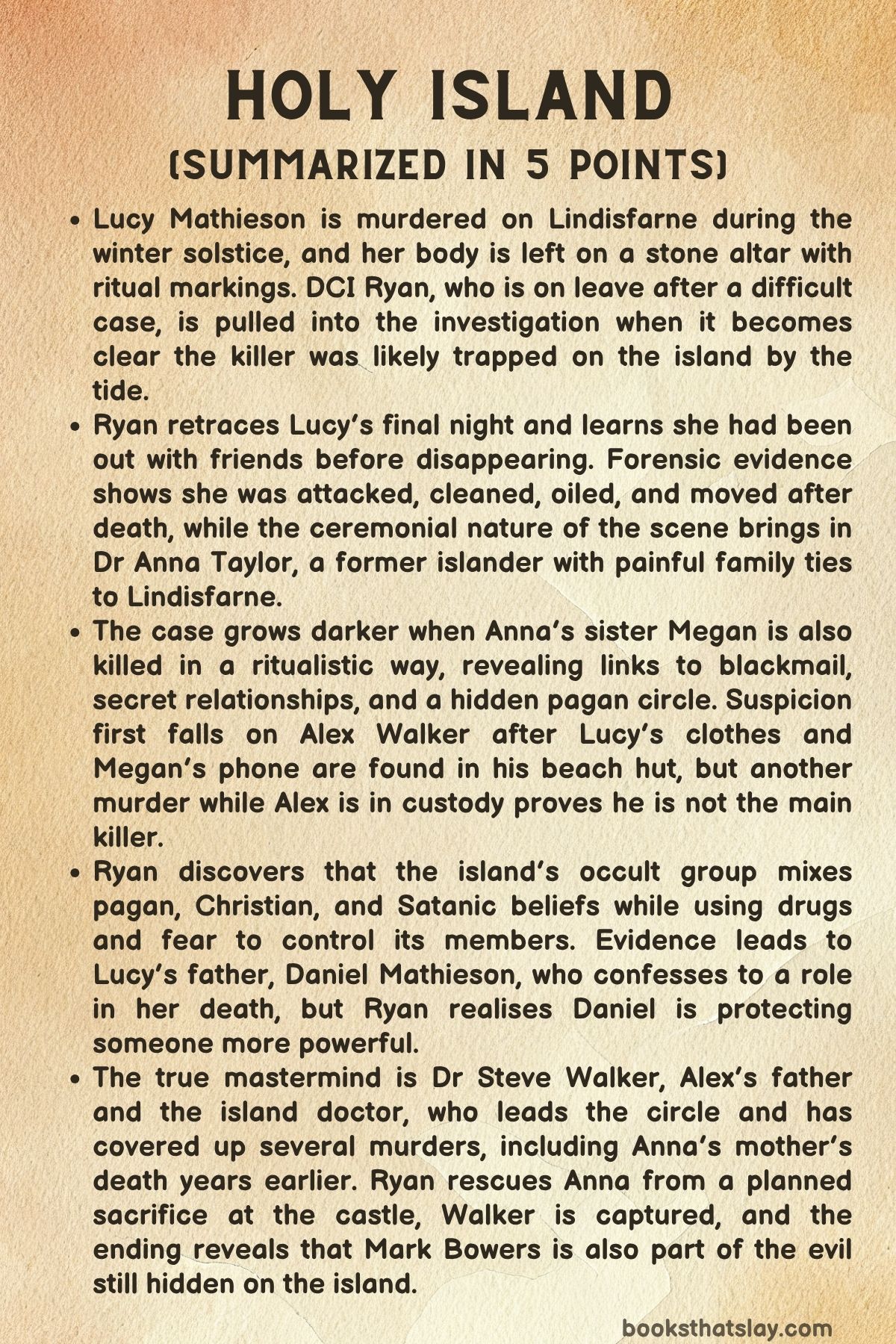
Summary
Lucy Mathieson, a young student who has returned home to Lindisfarne for Christmas, wakes in the freezing darkness near the ruins of the island’s Priory after a night out with friends. She is confused, terrified, and barely able to understand what has happened to her.
A man she recognises approaches and apologises, but his apology offers no mercy. He strangles her, leaving her dead in a place loaded with religious and historical meaning.
The next morning, Lucy’s body is discovered by Liz Morgan. She is naked, arranged on a stone altar, and marked with blood and strange ritual symbols.
The scene is shocking not only because of the murder itself, but because of the clear care taken in presenting the body. It suggests a killer who wants the death to be seen as part of a ceremony rather than an ordinary act of violence.
DCI Ryan is on Lindisfarne at the time, living there while on enforced leave after a traumatic investigation. He is supposed to be away from police work, but the discovery of Lucy’s body makes that impossible.
His instincts take over at once. He secures the crime scene, calls in DS Frank Phillips, and brings in forensic support.
One fact quickly becomes crucial: Lucy was killed while the tide had cut the island off from the mainland. That means the murderer was almost certainly already on Lindisfarne.
Ryan visits Lucy’s parents, Daniel and Helen Mathieson, to give them the devastating news. Their grief is immediate and overwhelming.
He then begins reconstructing Lucy’s final hours. She had spent the evening at the Jolly Anchor with her friends Ellie and Rachel.
She left around closing time and never made it home. The forensic evidence shows that she was struck, strangled, cleaned, oiled, and then carried to the Priory.
Her clothes and phone are missing, suggesting the killer removed anything that might reveal more about what happened before her death.
Because the murder took place on the winter solstice and appears to have ceremonial features, Ryan’s superiors bring in Dr Anna Taylor as a consultant. Anna is an academic with knowledge of ritual practices, symbolism, and the island’s local history.
She is also a former islander, which makes her return difficult. Her sister Megan still lives on Lindisfarne, and Anna’s past there is marked by family loss and unresolved pain.
At first, Ryan is not interested in Anna’s help. He sees the case as a murder investigation, not an academic exercise, and he dislikes outside interference.
Anna, however, understands parts of the island’s hidden culture that Ryan cannot easily access. Her knowledge becomes more important when Megan’s flat is found covered in blood.
Soon after, Megan herself is found dead, mutilated and arranged in another ritual display.
Megan’s murder changes the investigation. It is no longer possible to treat Lucy’s death as an isolated killing.
Megan had been involved with people on the island who were connected to a secret pagan circle, and she had also been blackmailing an unnamed lover. The case begins to expose a hidden world beneath Lindisfarne’s respectable surface, one in which old beliefs, fear, secrecy, and sexual control have been used to bind people together.
Suspicion turns toward Alex Walker, the island coastguard. Ryan learns that Alex had concealed a relationship with Lucy, and when evidence appears in Alex’s beach hut, the case against him seems strong.
Lucy’s missing clothes are found there, along with Megan’s phone. Alex is arrested, and for a time it seems as though the police may have found their killer.
That certainty collapses when another body is discovered while Alex is still in custody. Rob Fowler, another coastguard, has been burned and displayed near the shore.
His death proves that Alex cannot be responsible for all the killings. During questioning, Alex admits he lied, but not because he is a murderer.
He had been secretly involved with Rob as well as Lucy, and his deception came from fear that his sexuality and private relationships would be exposed. Ryan releases him, though he continues to treat him as someone close to the truth.
As the investigation continues, Ryan and Anna grow closer. Their connection develops under the pressure of the case, but it is complicated by danger and by Anna’s own history on the island.
When Anna receives a strange protective amulet, it becomes clear that someone connected to the secret circle is watching her. The gift feels both like a warning and a sign that she has been drawn into the same world that destroyed her sister.
Ryan and his team uncover more about the group operating on Lindisfarne. It blends pagan, Christian, and Satanic elements, using ritual, secrecy, and drugs to control its members.
Megan’s diary gives Ryan one of the most important clues: she had a powerful lover she referred to only as “D.” This figure seems to have influence over the group and may be connected to the murders. Ryan begins to suspect that the killings are not random ceremonies, but acts carried out to protect the leader and silence anyone who threatens him.
The investigation briefly focuses on Reverend Ingles and his wife Jennifer. They clearly know more about the island’s secret practices than they are willing to admit.
Their evasiveness makes them suspicious, but Ryan senses that they are not the centre of the case. They may be frightened, compromised, or guilty of hiding the truth, yet the true power appears to lie elsewhere.
A major breakthrough comes from physical evidence connected to a ride-on lawnmower hidden at the Lindisfarne Inn. The mower belongs to Daniel Mathieson, Lucy’s father.
When Lucy’s DNA is found in its carrier, the discovery is devastating. Daniel is arrested, and he calmly confesses.
His admission seems to solve part of the case, but Ryan does not believe it explains everything. Daniel appears to have acted under instruction, and he refuses to name the person behind him.
The danger increases when Daniel attacks DC Lowerson, leaving him critically injured. This act confirms that the case is far from closed.
Daniel is not simply a grieving father who killed his daughter; he is part of a larger structure of obedience and fear. Ryan realises that the mastermind is still free and still dangerous.
The clue in Megan’s diary finally leads Ryan to the real meaning of “D.” It does not point to Daniel Mathieson, but to Dr Steve Walker, Alex’s father and the respected island doctor. Walker has used his status to hide in plain sight.
He is the High Priest of the secret circle and the person who has controlled others through fear, belief, drugs, and manipulation.
Walker’s crimes go back years. He murdered Anna’s mother long before the current investigation, and he killed Megan to stop her blackmail.
He arranged Rob’s death to protect his secrets and to shift suspicion. He also used Daniel in Lucy’s killing, turning a father into an instrument of his own daughter’s murder.
His power over the group comes not only from ritual authority, but from his position as a trusted doctor and long-standing member of the island community.
On Christmas Eve, the case reaches its climax. Bill Tilson drugs Anna and takes her to the castle, where Walker and the masked members of the circle are preparing another sacrifice.
Anna is to be their next victim. The location, the storm, and the isolation of the island all heighten the danger.
Ryan realises what is happening and races back to Lindisfarne, determined to reach Anna before Walker can complete the ritual.
With Alex’s help, Ryan reaches the castle and confronts the group. The rescue is violent and desperate.
Ryan shoots Walker and saves Anna, while the police move in to arrest several members of the circle, including Bill Tilson and Alison Rigby. The authority that Walker built over years begins to collapse in a single night.
On Christmas Day, Walker is taken away alive. Alex is forced to face the horror of what his father truly was, while Anna must absorb the truth about her mother and sister.
Ryan and Anna remain together, both marked by the case but also given a chance to move forward. The murders have exposed a hidden evil at the heart of the island, but they have also broken its hold over many of the people trapped inside it.
The ending shows that the danger has not completely passed. Mark Bowers is revealed to be involved as well.
He has captured Reverend Ingles and Jennifer in his cellar and murders them with a ceremonial sword. This final revelation leaves the story with a dark warning: although Walker has been stopped, the beliefs and violence he encouraged may still survive in others.
Characters
In Holy Island, the characters are shaped by secrecy, grief, faith, fear, and hidden corruption. The book uses each person not only as part of the murder investigation but also as a way to reveal the dangerous emotional and moral atmosphere of the island.
Lucy Mathieson
Lucy Mathieson is the first major victim in the book, and her death immediately establishes the dark, ritualistic tone of the story. She is a young student who returns home for Christmas, which makes her murder feel especially cruel because she is killed in a place that should have represented safety, family, and familiarity.
Lucy is not presented as simply a victim; her hidden relationship with Alex Walker gives her character a more complex place in the story. Through Lucy, the book explores how private choices, secret relationships, and local gossip can become dangerous in a closed community.
Her murder also exposes the deeper corruption beneath the island’s peaceful surface, because the way her body is arranged shows that her death is connected to something larger and more organised than ordinary violence.
DCI Ryan
DCI Ryan is the central investigator and one of the most emotionally layered characters in the book. At the beginning, he is on enforced leave after a traumatic case, which shows that he is not an untouched or invincible detective.
He carries emotional wounds, but he is still disciplined, observant, and deeply committed to justice. His presence on the island at the time of Lucy’s murder places him between personal recovery and professional duty.
Ryan’s strength lies in his ability to stay focused even when the case becomes increasingly disturbing and personal. His relationship with Anna Taylor softens his character and reveals a more vulnerable side of him.
As the story develops, Ryan becomes more than the detective solving the murders; he becomes a protector, especially when Anna is endangered. His courage during the final confrontation shows that he is willing to risk himself not only for the case but also for the people he cares about.
Dr Anna Taylor
Dr Anna Taylor is one of the most important characters in the story because she connects the investigation to the island’s older secrets. She returns reluctantly, which shows that Lindisfarne is not simply a home to her but a place of pain, memory, and unresolved trauma.
As an academic consultant, Anna brings knowledge of ritual, symbolism, and local belief systems, making her valuable to the police investigation. However, her role is not only intellectual.
Her personal history, especially her connection to Megan and the death of her mother, makes her emotionally tied to the crimes. Anna is intelligent, brave, and wounded, and the book presents her as someone who must face the past in order to survive the present.
Her growing bond with Ryan gives her a source of emotional stability, but she remains strong in her own right. By the end, Anna becomes a direct target of the cult, showing that her knowledge and family history make her dangerous to those who want their secrets protected.
DS Frank Phillips
DS Frank Phillips is a steady and dependable figure in the investigation. He acts as Ryan’s trusted colleague and brings experience, loyalty, and practical support to the case.
While Ryan often carries the emotional and intellectual pressure of the investigation, Phillips helps ground the police work in procedure and teamwork. His presence gives Ryan someone he can rely on, especially as the case becomes more complicated and dangerous.
Phillips also represents the professional side of policing, where persistence and loyalty matter just as much as dramatic breakthroughs. He may not be as emotionally central as Ryan or Anna, but he is important because he helps hold the investigation together.
Daniel Mathieson
Daniel Mathieson is one of the most disturbing characters in the book because he is both a grieving father and a guilty participant in Lucy’s death. At first, he appears to be a devastated parent who has lost his daughter in a horrific way.
This makes the later revelation of his involvement especially shocking. Daniel’s character shows how obedience, fear, and devotion to a hidden authority can destroy natural human feeling.
His calm confession suggests a man who has surrendered part of his moral self to something darker. However, he is not the true mastermind, which makes him both guilty and manipulated.
His attack on DC Lowerson proves that he remains dangerous even after arrest. Daniel represents the terrifying idea that evil can hide behind ordinary family life and that a person can participate in monstrous acts while still appearing respectable.
Helen Mathieson
Helen Mathieson is Lucy’s mother, and her character represents the emotional devastation caused by the murder. She is not as deeply involved in the criminal side of the plot as Daniel, but her grief adds human weight to Lucy’s death.
Through Helen, the story shows the private suffering of a family shattered by violence. Her role also increases the tragedy of Daniel’s guilt, because his involvement does not only betray Lucy but also destroys Helen’s trust and family life.
Helen’s character reminds the reader that murder affects more than the victim; it spreads pain through everyone connected to them.
Liz Morgan
Liz Morgan plays a significant role because she discovers Lucy’s body and becomes the first person to witness the horror of the crime scene. Her discovery pulls the island into fear and alerts the police to the ritual nature of the murder.
Although she is not one of the main suspects or investigators, her role is important because she marks the transition from hidden crime to public terror. Liz represents the ordinary islander suddenly forced into contact with extraordinary violence.
Her presence also helps show how the murder affects the wider community, not only those directly connected to Lucy.
Ellie
Ellie is one of Lucy’s friends and is important because she helps reconstruct Lucy’s final known movements. She belongs to the social world Lucy was part of before the murder, especially the night out at the Jolly Anchor.
Ellie’s role shows how friendships become part of an investigation when someone disappears or dies under suspicious circumstances. She also helps present Lucy as a normal young woman with friends, routines, and a life beyond the crime scene.
Through Ellie, the story reminds the reader that Lucy had a personal world before she became a victim.
Rachel
Rachel, like Ellie, is connected to Lucy’s last evening and helps establish the timeline of events before the murder. Her character is part of the social circle that shows Lucy’s ordinary life before violence interrupts it.
Rachel’s role may be smaller, but she contributes to the investigation by helping reveal where Lucy was, who she was with, and when she disappeared. She represents the confusion and fear experienced by people who were close to a victim but did not realise danger was approaching.
DCS Gregson
DCS Gregson represents senior police authority and makes important decisions about the direction of the investigation. His decision to appoint Anna Taylor as a consultant shows that he recognises the unusual nature of the case and understands that ordinary police methods may not be enough.
Gregson’s character helps widen the investigation beyond Ryan’s personal involvement and shows the institutional pressure surrounding such a shocking murder. He is important because he authorises the use of specialist knowledge, which becomes essential as the ritual and occult elements grow more significant.
Megan
Megan is one of the most tragic characters in the book because her death is tied to both personal vulnerability and dangerous knowledge. She is Anna’s sister, and their strained family connection adds emotional depth to her role.
Megan is involved with the hidden pagan circle and is also blackmailing an unnamed lover, which places her in a dangerous position. Her actions suggest recklessness, desperation, or a desire for control, but they also show that she knows too much about powerful people.
Her murder is not random; it is an attempt to silence her and protect the cult’s secrets. Megan’s character also forces Anna to confront painful family history.
Through Megan, the story explores how damaged relationships, secrecy, and exploitation can lead to tragedy.
Alex Walker
Alex Walker is one of the most complex suspects in the story. At first, his hidden relationship with Lucy and the discovery of evidence connected to him make him appear guilty.
However, his lies are eventually revealed to come from fear and shame rather than murder. Alex hides his relationships with both Lucy and Rob because he is struggling with his sexuality and the consequences of exposure in a close community.
This makes him a morally complicated but sympathetic character. He is dishonest, but his dishonesty comes from self-protection rather than evil.
Alex’s situation becomes even more painful when the truth about his father is revealed. His help during the final confrontation shows courage and a desire to act against the darkness connected to his own family.
Alex’s character is important because he shows how suspicion can fall on someone for the wrong reasons when secrets make innocent behaviour look guilty.
Rob Fowler
Rob Fowler is another victim whose death deepens the mystery and changes the direction of the investigation. As a coastguard, he belongs to the practical and protective structure of island life, but his secret relationship with Alex connects him to the hidden emotional world beneath the surface.
His murder while Alex is in custody proves that Alex cannot be the main killer, which makes Rob’s death crucial to the plot. Rob’s character also adds another layer to Alex’s fear and secrecy.
His death shows that the killer is not only eliminating people but also manipulating suspicion and controlling the investigation. Rob represents another life destroyed because he is connected to secrets others want hidden.
Reverend Ingles
Reverend Ingles is an important religious figure whose character reflects the book’s interest in faith, secrecy, and moral compromise. As a reverend, he should represent spiritual clarity and moral courage, but he and Jennifer know more than they admit.
This makes him suspicious and morally uneasy. His presence also strengthens the contrast between official religion and the darker ritual practices hidden on the island.
Reverend Ingles is not simply a symbol of faith; he is a man caught near corruption and danger. His later capture and murder by Mark Bowers show that even those who seem connected to religious authority are not safe from the violence surrounding the cult.
Jennifer Ingles
Jennifer Ingles is connected to Reverend Ingles and shares in the sense that the couple are hiding knowledge. Her character adds to the atmosphere of secrecy surrounding the island’s religious and social life.
Jennifer’s importance lies partly in what she knows and partly in how her silence contributes to suspicion. Like her husband, she becomes a victim of Mark Bowers, which shows that the danger does not end with Steve Walker’s exposure.
Jennifer’s fate also helps create the unsettling ending, proving that the evil at the heart of the story has spread further than the police initially realise.
Dr Steve Walker
Dr Steve Walker is the main villain and one of the most chilling characters in the book. As the respected island doctor, he holds a position of trust, care, and authority, which makes his true identity as the High Priest of the occult circle especially disturbing.
His evil is powerful because it is hidden beneath respectability. Walker manipulates others, controls the cult, uses drugs to make people obedient, and commits or directs multiple murders to protect his power.
He is also connected to Anna’s deepest trauma because he murdered her mother years earlier. His relationship to Alex adds another layer of horror, because Alex must face the truth that his father is not merely flawed but monstrous.
Walker represents corruption disguised as respectability. His role shows how dangerous a trusted person can become when authority, secrecy, and fanaticism are combined.
Bill Tilson
Bill Tilson is a dangerous supporting figure because he helps carry out the cult’s plans. His role in drugging Anna and taking her to the castle makes him directly responsible for placing her in danger.
Bill represents the obedient follower who enables a stronger and more dominant evil. He may not be the mastermind, but his actions are still deeply threatening.
Through Bill, the book shows that such a secret group survives not only because of its leader but because others are willing to assist, obey, and remain silent. His arrest confirms his involvement and exposes how deeply the cult has entered the island community.
Alison Rigby
Alison Rigby is one of the circle members arrested after the final confrontation. Her character is important because she shows that the cult is not limited to one or two isolated people; it has spread into the ordinary community.
Alison’s involvement suggests that danger has been hidden among people who may have seemed normal or harmless. She helps show the wider reach of Walker’s influence and the disturbing willingness of local people to participate in secret rituals and violence.
Her arrest gives some sense of justice, but it also leaves the reader aware that the community has been deeply contaminated by fear and belief.
DC Lowerson
DC Lowerson is significant because Daniel’s attack on him proves that the danger continues even after a confession. Lowerson’s injury raises the emotional stakes of the investigation and shows that the police themselves are not protected from the violence they are trying to uncover.
His character represents the risks faced by officers working close to dangerous suspects. The attack also helps Ryan understand that Daniel is not the full answer and that a larger mastermind remains free.
Lowerson’s suffering therefore becomes an important turning point in the investigation.
Mark Bowers
Mark Bowers is one of the most unsettling characters because the ending reveals that evil remains active even after the apparent resolution. His capture and murder of Reverend Ingles and Jennifer show that the cult’s influence or violence has not been fully contained.
Mark’s actions create a disturbing final twist, suggesting that the darkness exposed in Holy Island extends beyond Steve Walker alone. He represents the continuation of hidden evil and leaves the story with a sense of danger rather than complete closure.
His character is important because he prevents the ending from feeling fully safe and reminds the reader that secret belief systems and violent loyalty can survive even after their leader is defeated.
Themes
Isolation and Entrapment
In Holy Island, isolation is not only a setting but a source of fear, pressure, and danger. Lindisfarne’s tidal causeway cuts the island off from the mainland, turning a small community into a closed world where escape is difficult and suspicion becomes unavoidable.
Lucy’s murder gains greater force because the killer must already be present among people who know one another, which makes the island feel both intimate and threatening. The physical separation from the mainland also reflects the emotional isolation of several characters.
Ryan arrives carrying trauma from his past, trying to distance himself from police work, yet the crime forces him back into the life he wanted to avoid. Anna also returns to a place filled with painful memories, showing that isolation can be psychological as much as geographical.
The island becomes a space where secrets are trapped, old wounds remain unresolved, and every character is forced to confront what they have tried to hide.
The Corruption of Faith and Ritual
Religious and spiritual symbols are repeatedly twisted into instruments of fear, control, and violence. The murders are staged with ritual markings, sacred locations, and ceremonial imagery, creating a disturbing contrast between belief and brutality.
Instead of offering comfort or moral guidance, faith becomes a mask for manipulation. The secret circle uses pagan, Christian, and Satanic elements not as sincere worship, but as tools to gain obedience and hide criminal acts.
This corruption is especially clear in the way respected community figures exploit trust. People who should protect others instead use their authority to frighten, drug, and control vulnerable members.
The ritual staging of the bodies is meant to create mystery and power, but beneath it lies ordinary human cruelty: greed, secrecy, lust, fear, and the desire to dominate. The theme shows how dangerous belief becomes when it is separated from conscience and placed in the hands of people who value power over human life.
Secrets, Deception, and Hidden Lives
Nearly every major turn in the story depends on something concealed. Characters hide affairs, family histories, criminal connections, private fears, and divided loyalties.
Alex’s lies make him appear guilty, but his deception comes from shame and fear of exposure rather than murder. Daniel’s confession also seems to provide closure, yet it hides the deeper truth that he is following another person’s command.
Megan’s diary, Anna’s past, and the secret circle all show that the island’s calm surface is built over years of silence. This theme is powerful because secrecy does not merely delay the investigation; it actively harms people.
Hidden relationships create false leads, hidden rituals protect killers, and hidden trauma leaves characters vulnerable. The story suggests that deception spreads damage far beyond the original lie.
Once truth is suppressed for long enough, it becomes easier for powerful people to control the narrative, frame others, and turn a close community into a place of suspicion.
Trauma, Justice, and Renewal
Ryan and Anna both carry painful histories, and the investigation forces them to face fear rather than avoid it. Ryan begins as a man damaged by a previous case, living apart from his professional identity and unsure whether he can return to duty.
The murders push him back into action, but his journey is not simply about solving crimes; it is about recovering purpose. Anna’s return is equally personal.
She must confront the island, her sister’s death, and the truth about her mother’s past. Their growing bond offers emotional balance against the violence surrounding them, showing that trust can survive even in a place shaped by betrayal.
Justice is difficult because the visible culprit is not the whole answer, and the real source of evil hides behind respectability. By the end, survival and exposure matter as much as arrest.
The theme suggests that renewal does not erase trauma, but it can begin when truth is faced and silence is broken.