The Dhammapada Summary and Analysis
The Dhammapada is a Buddhist scripture made up of brief, memorable verses traditionally attributed to the Buddha. Rather than telling a conventional story with a beginning, middle, and end, it presents a spiritual map for human conduct, mental discipline, and freedom from suffering.
Its teachings focus on self-control, awareness, nonviolence, wisdom, detachment, and the dangers of craving, anger, and ignorance. The book speaks in simple images drawn from daily life, nature, aging, animals, and social roles, which makes its spiritual advice direct and practical. Its central concern is how a person can transform the mind and move toward enlightenment.
Summary
The Dhammapada is not a plot-driven book in the usual sense. It does not follow a single hero through a chain of events, nor does it depend on conflict, romance, suspense, or dramatic reversal.
Instead, its movement is spiritual and moral. The book presents a path from confusion to clarity, from careless living to disciplined awareness, and from suffering to liberation.
Across its verses, the reader is guided toward a life shaped by restraint, insight, compassion, and detachment from desires that create pain. The book’s central message is that human life is governed first by the mind.
Thought comes before speech and action, and the quality of thought determines the quality of the life that follows.
The opening movement establishes one of the book’s most important teachings: the mind is the source of both suffering and happiness. A corrupt mind leads to suffering just as surely as a wheel follows the ox that pulls it, while a clear mind brings happiness as naturally as a shadow follows the body.
This idea sets the pattern for the rest of the work. Human beings are not helpless victims of fate.
They are responsible for training their thoughts, words, and actions. Self-restraint is not presented as punishment but as protection.
To control the mind is to guard oneself against the forces that produce misery.
The book then turns to awareness, treating it as the foundation of spiritual life. Awareness is not simply paying attention in an ordinary sense.
It is a wakeful state in which a person sees the danger of careless living and chooses discipline instead. Those who live with awareness are shown as rare and admirable.
They are not easily defeated by temptation, fear, or confusion. The careless, by contrast, are compared to people already close to death because they live without true understanding.
This contrast gives the book much of its moral force. Life can be wasted through negligence, but it can also be transformed through vigilance.
The mind is described as restless, difficult to hold, and vulnerable to temptation. It moves quickly and is easily misled.
Because of this, the work repeatedly insists that spiritual progress begins with mental discipline. The uncontrolled mind can be attacked by Māra, the figure who represents temptation, illusion, and obstruction.
Māra does not merely threaten from outside; he succeeds when a person’s inner life is weak. The person who trains the mind, however, becomes harder to defeat.
Control of the mind becomes a form of self-defense, and the disciplined mind becomes the strongest support for enlightenment.
The book frequently uses images from nature and ordinary life to explain its teachings. Flowers, for instance, are used in several ways.
They can suggest beauty, good deeds, temptation, and the teachings of the Dhamma. The shifting use of this image reminds the reader that the same object can teach different lessons depending on how it is understood.
Flowers may attract the senses, but they can also stand for spiritual practice and the fragrance of virtue. This method gives the book a practical quality.
Its wisdom does not remain abstract; it takes shape through things familiar to daily experience.
A major part of the book is the contrast between foolishness and wisdom. Foolishness is shown through arrogance, lack of self-knowledge, empty pride, and bad companionship.
The fool thinks too highly of himself while failing to recognize his own ignorance. He may seek status, praise, or company, but he does not seek truth.
The wise person is his opposite. Wisdom is not defined mainly as intelligence or social success.
It is the ability to control oneself, accept correction, practice the Dhamma, and live with humility. A wise person may walk alone rather than keep harmful company.
Solitude is better than fellowship with those who lead the mind away from truth.
The book also presents the Arahat, the fully awakened person, as an ideal of spiritual completion. Such a person has moved beyond ordinary attachment, craving, and fear.
The path of the Arahat is difficult to trace because it no longer follows the habits of ordinary desire. This ideal shows what the teachings are moving toward.
The goal is not simply good behavior, though good behavior matters deeply. The final aim is release from the forces that keep human beings trapped in suffering.
Several sections emphasize that quality matters more than quantity. A long life without insight is less valuable than a single day lived with understanding.
A thousand victories over enemies are less meaningful than victory over oneself. This teaching shifts the reader’s attention away from external achievement.
True conquest is inward. The greatest battle is not against other people but against craving, anger, ignorance, and pride.
Through this idea, the book rejects worldly standards of success and replaces them with spiritual standards.
Good and evil are also treated as forces that accumulate through repeated action. Evil may seem small at first, just as drops of water seem insignificant, but repeated wrong actions fill a person with suffering.
Goodness works in the same way. Small acts of restraint, kindness, truthfulness, and discipline gradually shape the person.
This teaching makes moral life concrete. A person becomes what he repeatedly does.
No action is completely meaningless, because each one contributes to the direction of the mind.
Nonviolence is one of the strongest ethical teachings in the book. Harmful action, harsh speech, anger, and cruelty are rejected because all beings fear pain and death.
Recognizing one’s own fear of suffering should lead to compassion toward others. Violence is not limited to physical attack.
Words can wound, and anger can damage both the person who feels it and the person who receives it. The book praises those who restrain anger, answer hatred with patience, and refuse to return harm for harm.
Such restraint is presented not as weakness but as a sign of great inner strength.
The realities of aging, decay, and death appear as urgent reminders of the need for spiritual effort. The body is compared to a house that weakens over time.
Beauty fades, strength declines, and life moves toward death. These facts are not used merely to create sadness.
They are meant to awaken understanding. If the body is temporary, then clinging to youth, pleasure, and appearance is foolish.
The fear of old age and death can only be answered by following the Dhamma and seeking liberation from the cycle of rebirth.
The book repeatedly returns to the question of the self. Each person is responsible for his own conduct.
No one can purify another person by force, and no one can walk the path for someone else. This gives the work a demanding but empowering tone.
A person must correct himself before criticizing others. He must guard his own speech, actions, and thoughts.
The path is personal, but it is not selfish. By mastering oneself, a person becomes less harmful to the world and more capable of compassion.
The physical world is described as deceptive and unstable. Sensory pleasures may appear attractive, but they cannot provide lasting peace.
Attachment to loved people, possessions, status, and pleasure gives rise to grief and fear because everything dear can be lost. The book does not deny that human attachments feel powerful.
Instead, it argues that the more tightly a person clings, the more deeply he suffers. Freedom requires a dispassionate understanding of impermanence.
Happiness, in this work, is not ordinary pleasure. It is the peace that arises when craving, hatred, and delusion lose their power.
The enlightened person is happy because he is no longer ruled by what the world gives or takes away. Anger is treated as another obstacle to this happiness.
To master anger is to master one of the most destructive forces in human life. The person who can remain calm under provocation is spiritually stronger than one who wins through aggression.
The later teachings reinforce the importance of the Eightfold Path, right conduct, and disciplined religious life. Wrong action leads to painful consequences, including rebirth in hell realms.
Right action, right speech, right meditation, and right understanding lead toward freedom. The monk is presented as one who should live gently, carefully, and with steady devotion to the Dhamma.
The final ideal expands beyond social identity. True nobility does not come from birth, caste, title, or outward position.
The true Brahmin is the enlightened person, one who has cut off craving, overcome attachment, and reached spiritual freedom.
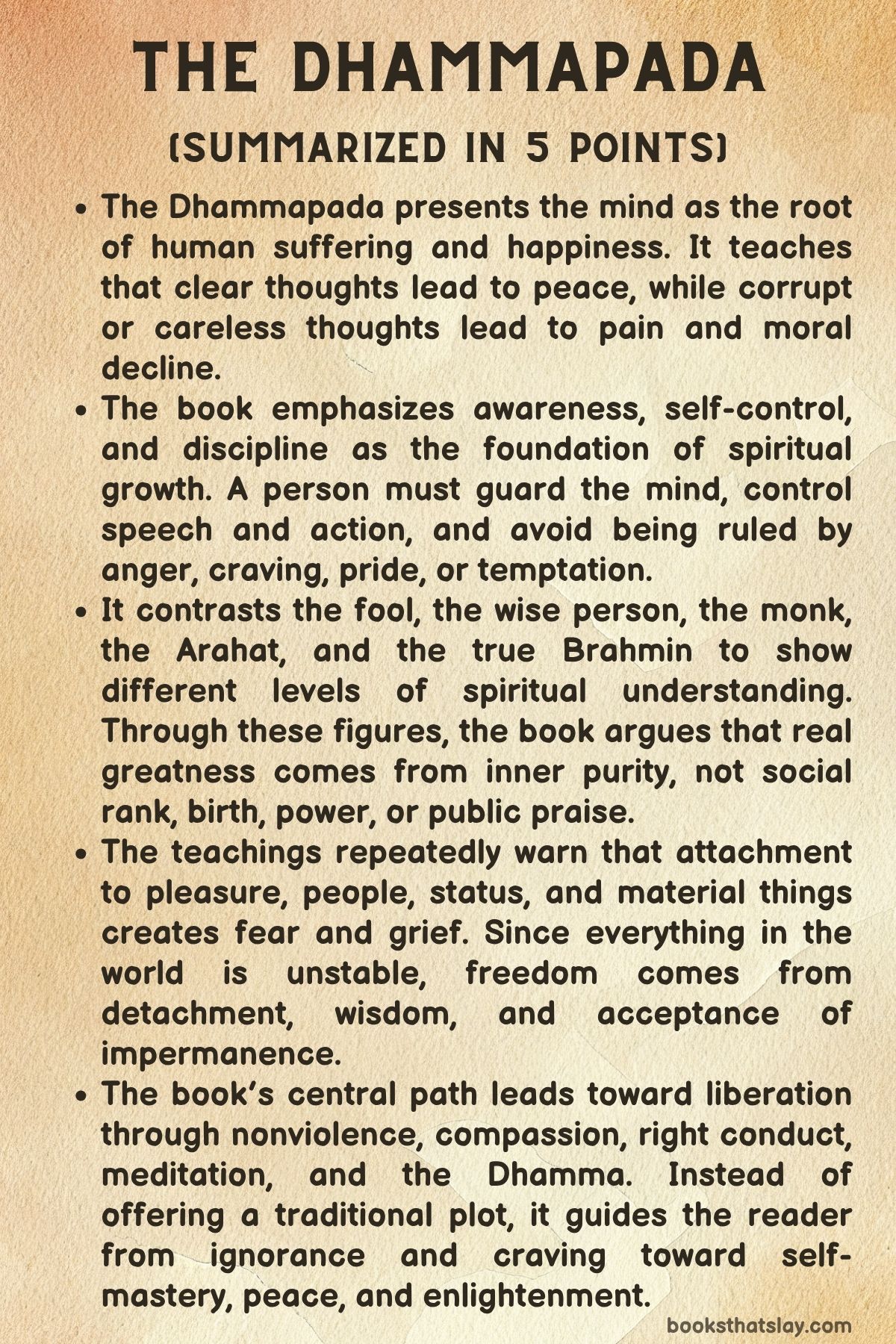
By the end, The Dhammapada has built a complete moral and spiritual vision. It teaches that the mind shapes experience, that craving causes suffering, that awareness protects life, and that liberation requires discipline.
Its “plot” is the journey from ordinary bondage to awakened freedom. The reader is asked to leave behind carelessness, anger, arrogance, violence, and attachment, and to cultivate clarity, patience, wisdom, compassion, and self-mastery.
The book’s power lies in its directness. It speaks as a guide for anyone who wants to live with greater awareness and move toward peace.
Key Figures
The Buddha
The Buddha is the central guiding presence in the book, even when he is not presented as a character in the conventional fictional sense. He functions as teacher, moral authority, spiritual example, and source of the verses’ wisdom.
In The Dhammapada, the Buddha’s voice is calm, firm, and uncompromising. He does not flatter human weakness or soften the consequences of careless living.
At the same time, his teachings are not cruel or distant. He speaks with the purpose of freeing people from suffering.
His understanding of human life is based on the recognition that the mind can either trap a person or release them. Because of this, he constantly directs attention inward, asking people to examine their own thoughts, speech, actions, anger, craving, and attachments.
The Buddha also rejects shallow measures of greatness. For him, nobility is not social rank, birth, age, or outward religious identity.
True greatness belongs to the person who has mastered the self, lives without violence, and moves toward enlightenment. His role in the book is therefore both personal and universal: he is a historical teacher, but also the model of awakened wisdom itself.
Māra
Māra appears as the force of temptation, spiritual danger, illusion, and obstruction. He is not simply an external enemy who attacks people from outside.
His power depends on the weaknesses already present in the human mind. When the mind is careless, undisciplined, angry, desirous, or confused, Māra finds an opening.
In this sense, he represents everything that keeps a person tied to suffering. His presence makes the book’s moral struggle more vivid.
The danger is not abstract; it is active, persistent, and waiting for the unguarded mind. Māra’s role also reveals why awareness is so important.
A person who sees clearly cannot be easily captured by temptation. A person who understands the emptiness of worldly attractions becomes difficult for Māra to perceive or defeat.
This makes Māra an important figure because he dramatizes the inner battle at the center of spiritual life. He is the shadow cast by craving and ignorance, and his defeat depends not on physical strength but on clarity, restraint, and insight.
The Arahat
The Arahat represents the person who has reached a state of spiritual completion. In the book, the Arahat is presented with reverence because he has gone beyond the ordinary patterns of desire, fear, attachment, and confusion.
His path is difficult for others to understand because he no longer moves according to worldly motives. He has achieved a freedom that cannot be measured by social standards.
The Arahat does not seek praise, possession, victory, or status. His greatness lies in the fact that he has overcome the inner forces that rule most people.
This figure shows the highest result of the teachings. The Arahat is what disciplined practice can produce when the mind is fully trained and craving is cut away.
He also brings a sense of peace into the world around him. His presence suggests that enlightenment is not only private achievement but also a quiet blessing to others.
In The Dhammapada, the Arahat stands as proof that liberation is possible, even if the path is rare and demanding.
The Wise Person
The wise person is one of the book’s most important human ideals. Wisdom here does not mean cleverness, education, argument, or intellectual display.
It means the ability to live rightly. The wise person accepts correction, controls the mind, avoids harmful company, follows the Dhamma, speaks carefully, and acts with restraint.
He understands that the greatest victory is victory over oneself. This figure is especially important because he stands between ordinary humanity and the fully awakened ideal.
He may not yet be described with the complete freedom of the Arahat, but he is moving in the right direction. The wise person recognizes danger before it becomes ruin.
He knows that anger, pride, and craving begin in the mind and must be stopped there. He also values solitude when companionship would corrupt him.
His wisdom is practical, disciplined, and humble. Through him, the book teaches that the path to liberation is built from repeated choices: listening well, restraining speech, practicing self-control, and choosing the Dhamma over pleasure or pride.
The Fool
The fool is not merely an ignorant person; he is a person who refuses self-knowledge. In the book, foolishness is shown through arrogance, vanity, carelessness, and attachment to false forms of success.
The fool may believe himself wise, but this belief only deepens his danger. He does not recognize his own faults and therefore cannot correct them.
He seeks poor companions, values praise, and may chase status without understanding the damage caused by his own mind. The fool is spiritually dangerous because he mistakes appearance for truth.
He may perform actions that seem impressive in worldly terms, but if his mind is untrained, those actions do not lead to freedom. His presence in The Dhammapada gives sharp contrast to the wise person.
Through the fool, the book warns readers against pride without insight and activity without moral direction. He shows that the greatest ignorance is not lack of information but the failure to see oneself clearly.
The Monk
The monk represents disciplined religious life and the daily practice of the Dhamma. He is expected to live with kindness, restraint, simplicity, and focus.
His role is not fulfilled merely by appearance, clothing, or social recognition. A monk must control his senses, guard his speech, practice meditation, and avoid attachment.
The book presents the monk as someone who should reduce harm in the world while purifying his own mind. He is not meant to be restless, vain, harsh, or careless.
His life should show the peace that comes from self-mastery. The monk’s character is important because he turns the book’s teachings into a visible way of living.
He demonstrates that enlightenment is not reached through belief alone but through repeated practice. His conduct must match the path he claims to follow.
When he lives properly, he becomes a source of light in the world, not through power or display, but through quiet discipline and inner clarity.
The Brahmin
The Brahmin is used in a striking way because the book challenges the idea that spiritual worth comes from birth or caste. In the society around the text, Brahmins held high religious and social status.
The book redefines the term by making the true Brahmin a person of enlightenment rather than lineage. This figure is therefore both a social and spiritual statement.
The true Brahmin is not noble because of family background, ritual position, or public honor. He is noble because he has cut off craving, overcome attachment, restrained the mind, and moved beyond the bonds of suffering.
This redefinition rejects inherited superiority and replaces it with ethical and spiritual achievement. The Brahmin, as the book presents him, becomes a symbol of inner purity.
His importance lies in the claim that liberation is not owned by any class or group. True holiness belongs to the person who has transformed himself.
The Just Person
The just person appears as a figure who contrasts worldly judgment with spiritual justice. In the book, justice is not a matter of quick decisions, public authority, or legal position alone.
A person is just only when he examines carefully, acts fairly, and is protected by the Dhamma. This figure shows that truth requires patience and discernment.
Hasty judgment is rejected because it comes from ego, anger, or carelessness rather than wisdom. The just person’s authority comes from moral clarity, not from office or social status.
He must be fair to others because he has first disciplined himself. His presence expands the book’s teaching beyond private meditation into social life.
The Dhamma is not only something one practices alone; it shapes how one speaks, judges, leads, and treats others. The just person becomes an image of wisdom applied to human relations.
Themes
The Mind as the Source of Suffering and Freedom
The book’s spiritual vision begins with the mind because every word and action grows out of thought. A person’s outer life cannot be separated from inner discipline.
When the mind is corrupt, confused, angry, or ruled by craving, suffering follows naturally. When the mind is clear, restrained, and aware, happiness becomes possible.
This teaching gives human beings responsibility for their own transformation. The work does not present suffering as something caused only by outside events.
Instead, it shows that the way a person thinks, reacts, desires, and speaks creates the conditions of pain or peace. This does not mean life is easy or that aging, loss, and death disappear.
It means the trained mind can face reality without being destroyed by attachment and fear. Mental discipline becomes the foundation of ethics, meditation, wisdom, and liberation.
The restless mind must be guarded like a vulnerable place under threat. Once trained, however, it becomes the strongest ally on the path to freedom.
Detachment from Craving and Attachment
Craving is treated as one of the deepest causes of suffering because it binds people to what cannot last. The desire for pleasure, possession, status, loved ones, and continued youth creates fear because everything desired is unstable.
The more tightly a person clings, the more painful loss becomes. The book does not deny that attachment feels natural or powerful.
It challenges the assumption that attachment can provide lasting happiness. Love mixed with possession brings grief and fear because the beloved can change, leave, suffer, or die.
Material desire works in the same way. It promises satisfaction but keeps producing new hunger.
Detachment, then, is not coldness or hatred of life. It is clear seeing.
A detached person understands impermanence and no longer demands permanence from the world. This theme is central to The Dhammapada, where freedom depends on cutting the roots of craving rather than decorating them with religious language or social approval.
Self-Mastery as the Highest Victory
Worldly victory is repeatedly shown as inferior to self-conquest. Defeating enemies, gaining status, living long, or performing many outward actions means little if the mind remains uncontrolled.
The person who masters anger, speech, desire, and pride has achieved a greater victory than someone who wins battles outside himself. This theme changes the meaning of strength.
Strength is not aggression, domination, or public success. It is the ability to resist harmful impulses when they arise.
A person who can answer anger with patience is stronger than one who retaliates. A person who can walk away from foolish company is stronger than one who seeks approval at any cost.
Self-mastery also requires honesty because no one can correct what he refuses to see. The path therefore begins with self-examination.
Before judging others, a person must discipline his own conduct. This makes the teaching demanding but practical.
Every moment of speech, thought, and action becomes a chance either to remain bound or to move closer to freedom.
Nonviolence, Compassion, and Moral Responsibility
Nonviolence in the book extends beyond refusing physical harm. It includes careful speech, restraint from anger, compassion toward all beings, and recognition that others fear pain just as oneself does.
This creates an ethical vision based on shared vulnerability. Since all beings tremble before suffering and death, cruelty becomes morally indefensible.
Harsh words, revenge, and violent impulses are not small matters because they strengthen the very conditions that keep people trapped in suffering. Compassion is not presented as sentiment alone.
It is a disciplined way of living that requires control over reaction and ego. Moral responsibility appears in the teaching that actions accumulate.
Wrongdoing may seem small at first, but repeated actions shape the person and lead to painful consequences. Goodness also grows through repetition.
Each act of restraint, patience, honesty, and kindness matters because it trains the mind in a new direction. Nonviolence therefore becomes both an ethical duty toward others and a spiritual practice that protects the person who follows it.