The Light Fantastic Summary, Characters and Themes
The Light Fantastic is Terry Pratchett’s second Discworld novel, a comic fantasy about fear, survival, fate, and the absurd logic of a magical universe. It continues the misadventures of Rincewind, a failed wizard who wants nothing more than a quiet life, and Twoflower, a cheerful tourist whose optimism causes trouble almost everywhere he goes.
The story moves across the flat Discworld as a giant red star threatens the world, the magical book called the Octavo stirs, and wizards, barbarians, trolls, gods, and Death himself become part of the chaos. It is fast, strange, funny, and deeply inventive.
Summary
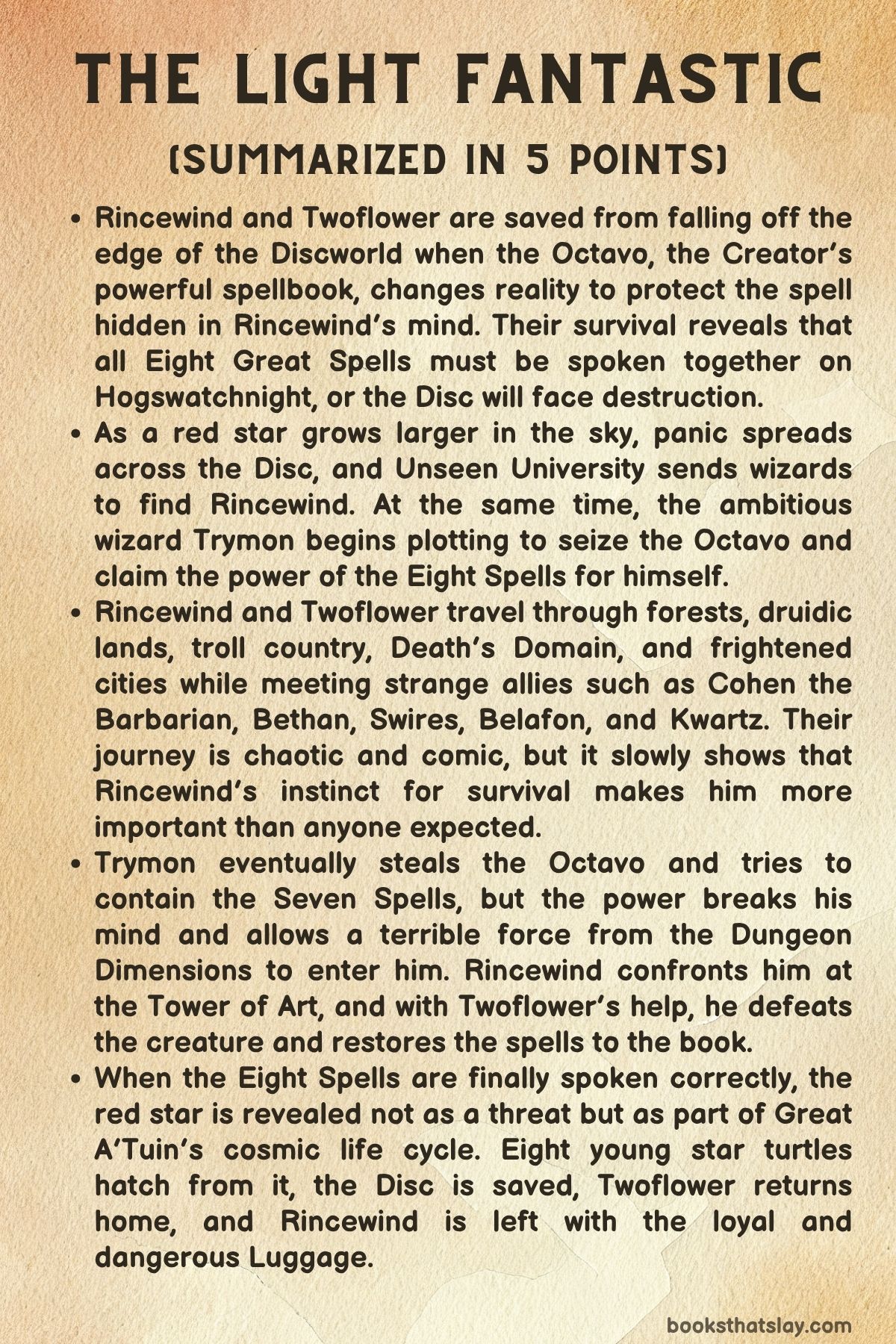
The Light Fantastic begins on the Discworld, a flat world carried through space on the backs of four enormous elephants standing on the shell of Great A’Tuin, the star turtle. The Disc is a place where magic has weight, light moves slowly, and absurdity often behaves like a law of nature.
Great A’Tuin is traveling toward a destination known only to itself, while philosophers and priests argue about its purpose without understanding that the answer will soon affect everyone.
Rincewind, an unsuccessful wizard, and Twoflower, the Disc’s first tourist, are falling off the edge of the world after the events of their previous adventure. Twoflower is inside a bronze spaceship called the Potent Voyager, which had been built to investigate Great A’Tuin, while Rincewind is falling separately and realizing that his makeshift spacesuit is missing a helmet.
Their deaths seem certain, but far away in Unseen University, the magical center of Ankh-Morpork, the Octavo begins to react.
The Octavo is the Creator’s own spellbook and contains eight immensely powerful spells. One of these spells has lived inside Rincewind’s mind for years, making him unable to learn ordinary magic but also keeping him strangely important.
The remaining spells inside the book become restless because the lost spell is in danger of leaving the universe with Rincewind. Raw magic breaks loose from the Octavo and spreads through the University, transforming rooms, alarming wizards, and turning the Librarian into an orangutan.
The magic finally forms a perfect model of the universe and releases a great Change spell.
That Change spell saves Rincewind and Twoflower. Instead of dying in space, Rincewind wakes in the Forest of Skund, hanging upside down in a tree, while Twoflower lands safely in a lake with the Potent Voyager.
They are soon reunited with the Luggage, Twoflower’s fierce chest made from sapient pearwood. The forest itself is magical, with talking trees, strange mushrooms, and small beings who do not match Twoflower’s cheerful ideas about storybook creatures.
Rincewind refuses to accept much of what he sees because accepting it would require him to live in a world even more dangerous than he already believes it to be.
At Unseen University, the senior wizards summon Death to understand what has happened. Death explains that the Octavo changed reality to save Rincewind because all eight spells must be spoken together on Hogswatchnight.
If they are not, the Disc will be destroyed. This creates a race to find Rincewind, though the wizards’ motives are not noble.
Ymper Trymon, an ambitious and coldly practical wizard, begins to realize that controlling the Eight Spells could grant him enormous power. He studies ancient texts and positions himself to rise within the University.
Rincewind and Twoflower continue through the forest with Swires, a small gnome-like figure, and find a cottage made of confectionery. The place carries the remains of old magic, and Twoflower treats it as another charming attraction.
Wizards sent to capture Rincewind converge on the cottage, leading to panic and confusion. Rincewind and Twoflower escape on a flying broomstick, but while they are above the clouds, they see a terrifying red star ahead of the Disc.
Rincewind understands that the world itself may be moving toward disaster.
Meanwhile, Trymon’s pursuit of power becomes more open. Galder Weatherwax, the Chancellor, attempts to recover the spell from Rincewind by magical means, but the plan fails and brings the Luggage to the University instead.
Trymon’s fear of the Luggage shows that even a ruthless man can be shaken by something that does not fit into his careful schemes. Galder vanishes, Trymon rises in influence, and the University becomes increasingly unstable.
Rincewind and Twoflower next find themselves on a flying stone piloted by Belafon, a druid. Belafon explains that stones fly because they are persuaded to do so, and that druids use huge stone circles as computing devices to calculate astronomical events.
His worldview is absurd but internally consistent, which is typical of the Disc. When Rincewind dreams, the spells of the Octavo speak to him directly.
They tell him that he was chosen not because he is brave or talented, but because he is very good at staying alive. His constant flight from danger has made him the ideal carrier of the spell.
As the red star grows larger, Rincewind and Twoflower encounter a druidic sacrifice. Twoflower, unable to ignore injustice, interrupts the ritual to save the intended victim, Bethan.
Rincewind is caught and threatened, but an elderly warrior intervenes. The old man is Cohen the Barbarian, the Disc’s greatest hero, now aged, toothless, and burdened with the humiliations of old age.
Cohen remains dangerous despite his physical decline, and he helps the group escape. Bethan, rather than being grateful in the expected way, is furious because she had prepared herself for sacrifice and believed it had meaning.
Her reaction complicates the rescue and gives her a sharp, independent presence.
Twoflower’s spirit is later separated from his body, and Rincewind is sent into Death’s Domain to retrieve him. There he meets Ysabell, Death’s adoptive daughter, who is lonely and fascinated by living visitors.
Twoflower, meanwhile, is happily playing cards with Death and the other Horsemen. Rincewind understands the danger of remaining there and forces Twoflower to leave.
The Luggage assists by protecting their lifelines, and the two escape through the realm of the dead. The experience reveals the story’s comic treatment of mortality: death is frightening, but also bureaucratic, social, and oddly polite.
The group travels through the Hublands with Cohen and Bethan. Their relationship develops quickly, despite the great difference in age, and Cohen decides he wants to marry her.
The red star becomes visible even in daylight, and fear spreads across the Disc. In troll country, Rincewind meets Kwartz and other trolls, who believe an old prophecy requires them to help him.
The trolls explain that old trolls may become increasingly rock-like in mind and body, and that the oldest of them, Old Grandad, is dangerous because he has become hostile to living things. This prophecy-driven assistance helps Rincewind survive another pursuit.
Herrena the Swordswoman, hired by Trymon, captures Twoflower, Cohen, and Bethan. Her mercenaries drag the Luggage with them and take shelter in what they think is a cave, only to discover they are inside the mouth of Old Grandad.
Rincewind and the trolls follow. When Old Grandad awakens, the chaos allows the captives to escape.
The Luggage continues to prove itself unstoppable, patient, and dangerous, especially toward anyone who threatens its owner or tries to steal from it.
The party eventually reaches a city shaken by fear of the approaching star. Many inhabitants have fled, while others have joined a violent star cult led by Dahoney.
The cult rejects magic and seeks purification through destruction. Rincewind is recognized as a wizard and threatened, but the spell inside his mind suddenly acts through him, allowing him to produce real magic for once.
This brief success thrills him, but danger quickly returns. A magical shop appears and gives Rincewind, Twoflower, and Bethan a way out.
The shopkeeper explains that his wandering shop moves through the universe and cannot close because of a curse. He also reveals that several such magical shops exist, which explains the strange origin of the Luggage.
The shop carries the group to Ankh-Morpork, where panic has spread as the red star dominates the sky. Mobs surround Unseen University, demanding that the wizards save the world or die for failing to do so.
Beneath the University, Trymon leads the heads of the wizarding Orders into the chamber of the Octavo. Once the book is unlocked, he traps the other wizards and steals it, intending to claim the power of all Eight Spells for himself.
Rincewind returns to the University with Twoflower and Bethan. He finds the trapped wizards and, despite their contempt for him, manages to open the locked door through an extraordinary effort of will.
The wizards reveal that no single mind can safely contain all the spells. Trymon has taken a power that will break him and open the way for creatures from the Dungeon Dimensions.
Rincewind, angered by the wizards’ uselessness and by Trymon’s theft, takes the Octavo and forces the spell in his own mind back onto its page. He then goes to confront Trymon.
At the top of the Tower of Art, Rincewind finds that Trymon’s mind has been destroyed by the spells. Something from the Dungeon Dimensions has entered him.
This entity is not driven by ordinary evil, but by a terrible kind of empty order that would reshape the universe without caring about life at all. Trymon demands the eighth spell, but Rincewind refuses.
In the fight that follows, Rincewind survives through desperation, unfair tactics, and the instincts of a man who has spent his life running. Twoflower arrives with a sword and helps at the crucial moment.
The creature is wounded and finally cast down from the tower, though Rincewind nearly falls with it.
Cohen arrives with the Luggage and saves Rincewind. The seven spells return to the Octavo, and Rincewind forces the last spell out of his mind.
He reads all Eight Spells aloud before the gathered crowd, but at first nothing happens. The crowd turns against him, ready to throw him from the tower.
Bethan notices that one of the spell-shapes is the wrong color, meaning that a word has been mispronounced. After several failed attempts, Twoflower suggests the correct pronunciation.
The spell activates.
The red star is revealed not as a destroyer, but as the source of new life. Eight spheres around it crack open, and from each emerges a young sky turtle, each carrying four elephant calves and a new Discworld.
Great A’Tuin had not been heading toward death, but toward the hatching of its children. The great cosmic event passes, the Disc is saved, and calm briefly spreads across the world.
Afterward, Twoflower prepares to return home to the Agatean Empire. He tells Rincewind that travel matters because one has a home to remember it from.
Rincewind is quietly saddened by his friend’s departure. Twoflower gives him the Luggage, though Rincewind claims he does not want it.
When he sees the chest looking dejected, he relents, and the Luggage follows him back toward Unseen University. The story ends with Rincewind alive, changed, and still unwillingly accompanied by the strange magic that seems to shape his life.
Characters
Rincewind
Rincewind is the central comic survivor of the book, a failed wizard whose greatest talent is not spellcasting but staying alive. In The Light Fantastic, he is important precisely because he does not resemble a traditional hero.
He is frightened, suspicious, selfish at times, and almost always ready to run, yet the story repeatedly shows that his instinct for survival has value. The spell in his mind chose him because he flees danger rather than seeking glory, and this turns his cowardice into a strange kind of wisdom.
Rincewind’s arc is also about responsibility forced upon someone who wants none of it. He complains constantly, avoids danger when possible, and has no illusions about his own courage, but when the moment becomes unavoidable, he acts.
His confrontation with Trymon matters because he is not fighting for honor or power. He fights because the alternative is worse, and because even someone as fearful as Rincewind can recognize when the universe needs defending.
His humor comes from panic, but his humanity comes from endurance.
Twoflower
Twoflower is the cheerful tourist whose innocence keeps disrupting the world around him. Across The Light Fantastic, he approaches danger with curiosity rather than fear, and this makes him both endearing and dangerous to be near.
He believes in the charming version of fantasy: friendly gnomes, noble creatures, scenic wonders, and memorable adventures. The Disc repeatedly contradicts these expectations, but Twoflower’s optimism is difficult to destroy.
He is not foolish in a simple sense; he has a consistent way of seeing the world, and that worldview often pushes others into action. He interrupts a human sacrifice because he sees it as plainly wrong, while Rincewind sees only the risks.
He treats Death’s Domain almost like a tourist attraction, which is comic but also revealing. Twoflower’s habit of documenting everything through his picture box shows his need to preserve experience.
His farewell to Rincewind gives him emotional depth, because he understands that travel only has meaning when it can be carried back into memory.
The Luggage
The Luggage is one of the strangest and most memorable figures in the story, even though it does not speak. It is a chest made of sapient pearwood, loyal to its owner, and equipped with many little legs that allow it to follow, chase, attack, and appear wherever it needs to be.
Its silence makes it funnier and more threatening, because no one can reason with it in the ordinary way. The Luggage behaves like a pet, a weapon, a servant, and a nightmare depending on who is dealing with it.
To Twoflower, it is useful and familiar; to enemies, thieves, and nervous mercenaries, it is a patient disaster with teeth. Its loyalty gives it emotional weight.
When Twoflower gives it to Rincewind at the end, the transfer feels almost like the passing on of a living companion. Rincewind’s reluctance to accept it is comic, but his final acceptance suggests that he is not as detached as he pretends.
Ymper Trymon
Ymper Trymon is the book’s main image of ambition without imagination. Within The Light Fantastic, he stands apart from the older wizards because he is organized, efficient, humorless, and hungry for advancement.
He does not love magic as wonder; he treats it as a structure to master and exploit. His interest in memos, agendas, and hierarchy makes him seem modern in an institution built on ritual, but this practicality hides a dangerous emptiness.
Trymon wants power because power fits the shape of his ambition, not because he has a meaningful vision for the world. His theft of the Octavo is the natural result of this hunger.
He believes he can hold what no single mind should hold, and his failure shows the limits of control. When the Dungeon Dimensions enter through the ruin of his mind, Trymon becomes a warning about intellect severed from humility.
His downfall is not caused by stupidity, but by a narrow cleverness that mistakes possession for understanding.
Galder Weatherwax
Galder Weatherwax is the Chancellor of Unseen University and represents the old style of wizardly authority. He is theatrical, suspicious, powerful, and deeply aware of the danger posed by rivals such as Trymon.
Galder understands magic as something bound to ceremony, status, and personal force. Unlike Trymon, he enjoys the drama of power, and his instincts are shaped by years of surviving in an institution where advancement often comes through sabotage.
His treatment of Trymon shows that he is not easily fooled; he recognizes ambition when he sees it and protects himself accordingly. Yet Galder is also part of the University’s larger problem.
He is reactive, proud, and more interested in magical dominance than in clear responsibility. His attempt to retrieve Rincewind’s spell through a risky ritual shows both intelligence and arrogance.
His disappearance removes a barrier to Trymon’s rise, but it also exposes how fragile the University’s leadership really is when its authority depends on rivalry rather than trust.
Cohen the Barbarian
Cohen the Barbarian is a comic reversal of the legendary warrior. He has the reputation of the greatest fighter on the Disc, but he is now elderly, toothless, stiff, and troubled by the ordinary discomforts of age.
The joke is not that Cohen has become useless; the joke is that he remains extremely dangerous despite everything time has done to him. He can still defeat enemies, inspire fear, and improvise under pressure, but he must also worry about liniment, dentistry, and back pain.
This makes him both funny and oddly dignified. Cohen’s age gives him a practical view of life.
He values comfort, patience, and survival more than heroic speeches. His relationship with Bethan adds another layer to him, since it shows his desire for companionship rather than only adventure.
He is not merely a relic of old heroic fantasy; he is a man who has outlived the songs about him and still insists on living by his own terms.
Bethan
Bethan begins as an intended sacrifice, but the story quickly refuses to define her only as someone rescued by others. Her anger after being saved is important because it reveals how carefully she had shaped her own understanding of destiny.
She had preserved her ritual purity and expected her death to carry religious meaning, so Twoflower’s rescue disrupts not only the ceremony but also her sense of purpose. Bethan is practical, sharp, and increasingly assertive as the journey continues.
She is not intimidated by wizards, warriors, or magical shopkeepers, and she often cuts through male hesitation with direct action. Her role near the end is especially important because she notices the mispronounced spell when the crowd is ready to kill Rincewind.
This makes her intelligence essential to saving the Disc. Her romance with Cohen is comic because of the age difference, but it also gives her agency.
She chooses him, challenges him, cares for him, and helps him remain active in the world.
Death
Death is both a cosmic force and a dryly comic presence. He appears as a skeletal figure with a scythe, but his behavior is often social, polite, impatient, and faintly amused.
This contrast gives him much of his charm. He is frightening because he is inevitable, yet he is not cruel in the ordinary sense.
He has duties, attends parties, plays cards, and comments on events with an outsider’s perspective. His presence helps frame the scale of the crisis facing the Disc.
When he explains the importance of the Eight Spells, he becomes a source of information as well as a reminder that cosmic laws are moving behind the comedy. Death’s Domain adds more complexity to him.
It is terrifying beneath the surface, but it also has a domestic side through Ysabell, his adopted daughter. Death’s disapproval of the star cult is also meaningful because it separates death as a natural reality from human cruelty disguised as belief.
Ysabell
Ysabell, Death’s adoptive daughter, is lonely, dramatic, and eager for contact with the living world. She lives in Death’s Domain, a place outside ordinary human experience, and this has shaped her emotional life in unusual ways.
Her excitement at meeting Rincewind shows how starved she is for novelty and companionship. Yet she is also dangerous because her understanding of life and death is distorted by where she has been raised.
When she tries to prevent Rincewind and Twoflower from leaving, her actions combine loneliness, possessiveness, and the power of a realm where lifelines can be physically threatened. Ysabell is not evil; she is isolated.
Her character adds a strange domestic note to Death’s world, suggesting that even the most absolute forces in the universe can have households, family tensions, and emotional complications. She also helps make Death’s Domain more than a frightening afterlife; it becomes a place with rules, moods, and inhabitants shaped by solitude.
Swires
Swires is a small forest-dwelling figure who complicates Twoflower’s sentimental expectations about magical creatures. Twoflower wants him to match the cheerful image of a storybook gnome, complete with charm and neat visual details, but Swires is more practical and less decorative than that.
His presence helps expose the gap between fantasy as imagined by tourists and fantasy as lived by its inhabitants. For Rincewind, Swires is easier to accept because Rincewind expects the world to be unpleasant, inconvenient, and unsafe.
Swires’s offer of help, food, and shelter gives the early forest section a guide figure, but he is also part of the story’s wider joke about labels. Whether he is a gnome matters less than the fact that he is a small person trying to survive in a magical forest.
Through him, the book gently mocks the habit of forcing reality to match stories rather than noticing what is actually there.
Belafon
Belafon, the young druid, represents the comic logic of Discworld belief systems. He pilots a flying stone by persuading it to remain airborne, and he explains the druidic universe through forces such as charm, persuasion, uncertainty, and stubbornness.
What makes Belafon funny is his seriousness. He does not see his worldview as absurd; to him, stone-based computation is dignified, reliable, and superior to paper.
When Twoflower suggests using an almanac instead of a stone circle, Belafon reacts as though an entire civilization has been insulted. He is not a major character in terms of plot duration, but he expands the world by showing that every culture on the Disc has its own complete internal logic.
Belafon also serves as a contrast to Rincewind and Twoflower. Rincewind is cautious around unfamiliar beliefs because he knows offense can be fatal, while Twoflower’s innocent suggestions create accidental culture shock.
Herrena
Herrena the Swordswoman is a capable professional hired to capture Rincewind. She is practical, observant, and far more competent than many of the men around her.
Her decision to track Rincewind through likely escape routes shows that she understands fear as a pattern of behavior. Unlike Trymon, she does not seem driven by grand ambition or magical obsession; she is doing a job.
This makes her dangerous in a grounded way. She does not need cosmic power to threaten the heroes, only skill, discipline, and a willingness to use force.
At the same time, her role also shows the limits of professional competence in a world crowded with magical absurdities. She can plan for fugitives, terrain, and mercenary loyalty, but she cannot fully account for the Luggage, ancient trolls, Cohen’s endurance, or Bethan’s intervention.
Her defeat does not make her foolish. It shows that in this story, even the most capable people can be undone by forces too strange to plan for.
Kwartz and the Trolls
Kwartz and the other trolls give the story one of its clearest examples of a nonhuman culture treated with humor and internal dignity. Trolls are often feared by humans, but the book explains them through their own biology and history.
They eat stone, have diamond teeth, and may gradually become more rock-like as they age. Kwartz’s belief in the prophecy concerning Rincewind gives him a serious purpose, even though the situation is comic.
He and his companions help because their traditions tell them that Rincewind’s survival matters. The idea of very old trolls developing “philosophy” is one of the story’s cleverest jokes, turning thoughtfulness into a geological condition.
Old Grandad, by contrast, represents age taken to a dangerous extreme. He is no longer merely a living troll but something closer to a hostile landscape.
Together, the trolls broaden the book’s treatment of life, intelligence, and culture beyond human assumptions.
The Librarian
The Librarian begins as the Head Librarian of Unseen University and is transformed into an orangutan during the magical disturbance caused by the Octavo. Rather than being treated only as a victim of magic, he adapts to the change with surprising effectiveness.
His orangutan form becomes part of his identity, especially because it suits the physical demands of managing a dangerous magical library. The Librarian’s role is comic, but it also suggests that transformation does not always have to be reversed to be meaningful.
In a place where books leak power and knowledge can attract horrors from other dimensions, an ordinary human librarian may be less suitable than an agile, strong, banana-loving ape. His interactions with Trymon show that he cannot be dismissed as a mere animal.
He understands, negotiates, and acts with purpose. The Librarian embodies the Discworld idea that absurd changes can become practical realities if the characters are stubborn enough to continue.
Greyhald Spold
Greyhald Spold is a minor but memorable figure because his brief appearance turns fear of death into a sharp comic scene. After Death gives him a meaningful look, Spold responds by hiding inside a magically reinforced box designed to protect him from every outside danger.
The joke is that death is not outside the box; Death is already beside him. Spold’s fate captures the book’s attitude toward mortality.
Cleverness, wealth, rank, and magical precautions may delay many things, but they cannot outwit the final appointment. His scene also mocks the wizardly habit of believing that enough technical protection can solve any problem.
Spold does not lack caution; he lacks perspective. His terror makes him human, while Death’s quiet presence makes the moment both funny and chilling.
Through Spold, the story shows how small individual panic can look beside the vast cosmic events taking place around the Disc.
Dahoney
Dahoney is the preacher of the star cult and represents fear turned into ideology. As the red star grows larger, many people panic, but Dahoney gives that panic a direction.
He claims that magic is false, the gods are gone, and the world must be purified through violence. His ideas are not presented as serious philosophy but as a dangerous social reaction to disaster.
He shows how quickly frightened people can accept cruelty when someone gives it a moral costume. Dahoney’s hatred of wizards and magical races is especially important because it turns cosmic uncertainty into persecution.
Rather than face the unknown honestly, his followers look for targets they can punish. His presence brings a darker edge to the comedy.
The Disc is absurd, but mass fear is still dangerous. Dahoney’s cult shows that the end of the world does not always make people noble; sometimes it gives them permission to become worse.
Lackjaw
Lackjaw, the dwarf jeweler, is a practical craftsman whose main importance comes through Cohen’s false teeth. His work solves a very ordinary problem inside a wildly magical story: the greatest barbarian hero on the Disc needs dentures.
This detail is funny because it brings heroic legend down to the level of bodily maintenance. Lackjaw also becomes a target of the star cult because he belongs to a magical race, which places him within the book’s wider treatment of fear and scapegoating.
His presence gives Cohen a chance to show both comic violence and protective loyalty. Cohen’s defense of him is not grandly sentimental; it is direct, physical, and effective.
Lackjaw is not deeply explored, but he serves a clear role in the story’s balance of fantasy and practicality. In a world of prophecies, cosmic turtles, and world-ending stars, someone still has to make things, fix things, and help old warriors chew.
The Senior Wizards
The senior wizards of Unseen University are powerful, status-conscious, and often absurdly ineffective. They belong to an institution built on ancient rituals, rivalries, and self-importance, yet when the Disc faces disaster, they struggle to act with courage or clarity.
Their dependence on tradition makes them comic, but it also makes them vulnerable to Trymon, whose modern efficiency allows him to manipulate them. The senior wizards often treat Rincewind with contempt because he is a failed wizard, but they repeatedly need him to do what they cannot.
This reversal is central to the book’s humor. They possess titles and knowledge, while Rincewind possesses the one quality the crisis requires: the ability to survive long enough to be useful.
Their petrification at the tower’s summit is fitting because they have often seemed symbolically frozen already, trapped by habit, rank, and fear of responsibility.
Themes
Survival as a Form of Intelligence
Rincewind’s constant fear is easy to mistake for simple cowardice, but the story repeatedly reframes survival as a serious kind of intelligence. He has no heroic confidence, no appetite for combat, and very little magical skill, yet he understands danger faster than almost anyone around him.
His instinct to run is not noble, but it is often accurate. In The Light Fantastic, the spell inside his head chooses him because he is a natural survivor, not because he is brave in the usual sense.
This turns the comic structure of his character into a larger idea about heroism. The book questions whether courage must always look impressive.
Rincewind’s value lies in his refusal to die, his ability to keep moving, and his capacity to act when there is no escape left. He does not become fearless at the end; he remains frightened.
What changes is that his fear no longer prevents action. The story suggests that survival can be active, alert, and morally useful.
Running away may not be glorious, but it can preserve the person who must eventually stand in the right place at the right time.
Belief, Myth, and Misunderstood Reality
The Disc is filled with people who explain the world through stories, rituals, prophecies, and inherited assumptions. Druids believe in stone-based computation and flying rocks persuaded into the air.
Trolls preserve legends about Rincewind’s arrival. Twoflower carries storybook ideas about gnomes, elves, and adventure.
The star cult turns fear of the red star into a violent doctrine. These beliefs are often funny, but they are not treated as meaningless.
On the Disc, belief can shape behavior, and behavior can shape events. The danger comes when people cling to an explanation so tightly that they stop noticing reality.
Twoflower’s innocence is mostly harmless because it is generous, but Dahoney’s certainty becomes cruel because it seeks victims. The red star is the clearest example of misunderstood reality.
Most people see it as destruction, while it is actually connected to birth and continuation. The gap between appearance and truth drives much of the plot.
The book asks readers to laugh at strange belief systems while also recognizing that human beings often need stories before they can face what they do not understand.
Power, Ambition, and Institutional Failure
Unseen University is full of magical authority, but authority does not equal wisdom. The senior wizards have rank, ritual, and access to terrifying knowledge, yet they are slow, vain, and often more concerned with procedure than responsibility.
This creates the space in which Trymon can rise. His ambition is not chaotic; it is orderly, planned, and administrative.
He represents a different kind of danger from the older wizards. They are foolish because they are trapped in tradition, while Trymon is dangerous because he sees tradition only as an obstacle to personal advancement.
His desire to control the Octavo shows the corrupting force of power pursued without humility. He wants the Eight Spells because they promise the fulfillment of desire, but he lacks the imagination to understand what such power might cost.
The University’s failure is collective. It allows rivalry to replace trust and status to replace duty.
Rincewind, the least respected wizard, becomes essential because he is outside the institution’s idea of competence. The theme is not simply that power corrupts.
It is that institutions become dangerous when they reward ambition more readily than judgment.
Travel, Home, and the Meaning of Experience
Twoflower’s journey is driven by curiosity, but the ending gives that curiosity a quieter meaning. He has crossed impossible landscapes, met Death, faced cultists, seen cosmic birth, and survived situations that should have killed him.
Yet his final conclusion is not that travel should continue forever. He decides to go home because experience needs a place to return to.
This gives emotional shape to his role as the tourist. Throughout the story, he tries to capture moments with his picture box, often at the very times when Rincewind is simply trying not to die.
That habit can seem shallow, but it also reflects a need to remember and preserve. Travel changes Twoflower because it gives him memories, and memories matter because they can be carried back into ordinary life.
Rincewind’s sadness at Twoflower’s departure shows that the journey has also changed him, though he would never say so openly. Their friendship is built from irritation, rescue, fear, and loyalty rather than easy affection.
The final transfer of the Luggage marks the journey’s emotional residue: Twoflower leaves, but something strange and loyal remains with Rincewind.