War of Fire and Fury Summary, Characters and Themes
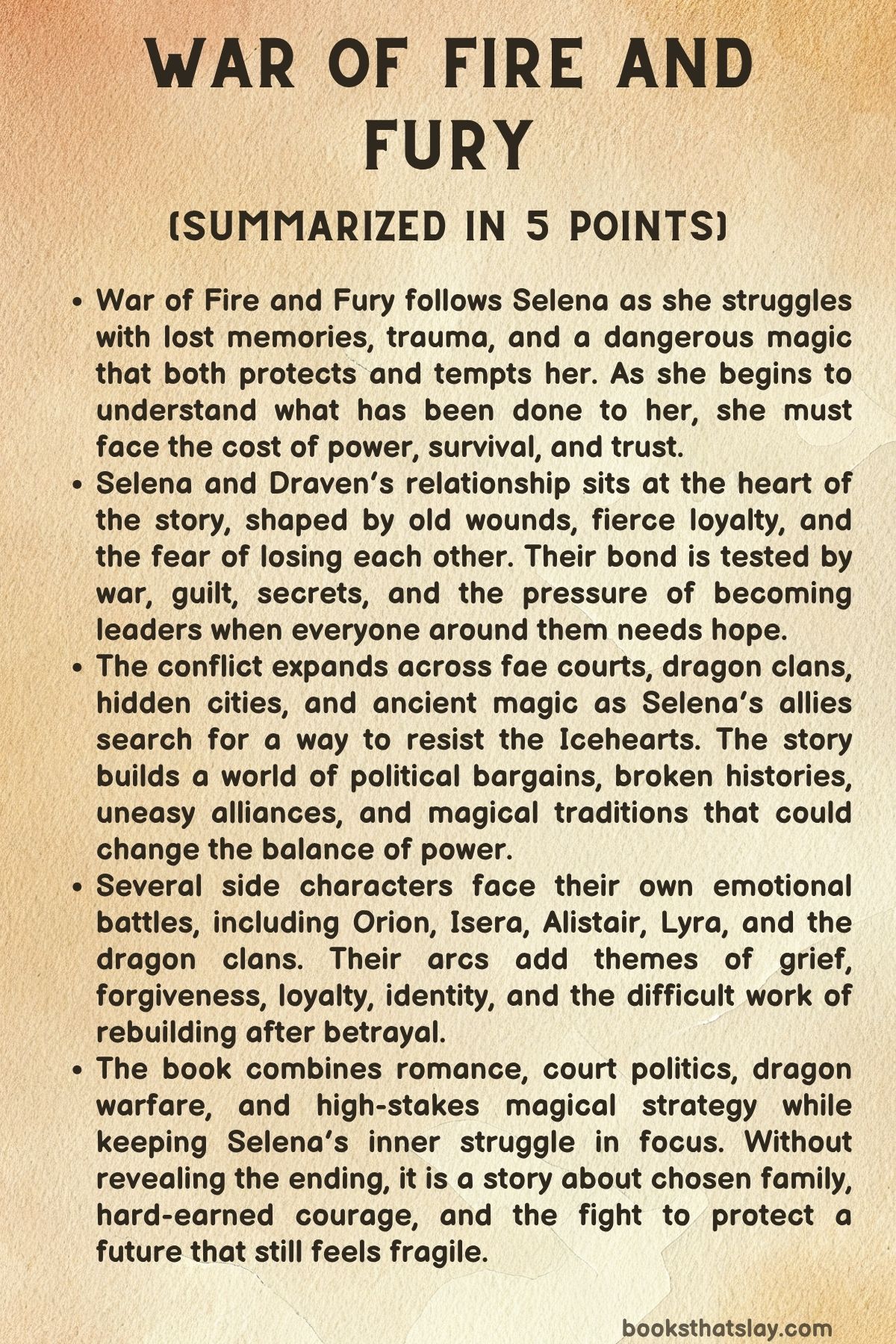
War of Fire and Fury by Marion Blackwood is a fantasy romance about war, memory, power, grief, and the cost of survival. The story follows Selena as she faces the damage left by stolen memories, brutal enemies, and the dangerous pull of her own emotion magic.
Around her are dragon shifters, fae courts, dryads, ancient clans, and fragile alliances built under threat. At its center, the book is about Selena and Draven trying to protect each other while a larger war forces every character to choose what they are willing to risk, forgive, and become. It’s the 5th book in the Flame and Thorns series.
Summary
Selena begins the story imprisoned in Orion Nightbane’s dungeon with her memories gone. Orion uses magic to force her through broken pieces of her past, but at first she refuses to believe the memories belong to her.
She sees people calling her Selena, hears her own voice, remembers her parents, Draven, and battles she does not understand. Orion makes her face the cruelest moments again and again: Draven’s wings being whipped, her parents being murdered by Jessina, and Draven looking at her with hatred after Selena used emotion magic on him to keep him alive.
The emotional force eventually breaks Kander’s memory magic, and Selena remembers everything. The return of her memories leaves her shattered.
Orion then gives her a condemned criminal and allows her to use her emotion magic on him. Selena pushes fear, despair, and other emotions into the man until he dies.
She realizes that creating emotions gives her pleasure and briefly dulls her pain, which frightens her because the relief feels addictive.
Selena reunites with Draven and their allies in the Unseelie Court. Draven has recovered from the battle with the Silver Clan, but Selena hides how badly Orion’s method affected her.
The group learns that the Icehearts wanted the Green Clan’s archives because they can reveal the location of the missing Gold Clan. Since the Gold Clan’s shield and ward magic could protect them from Kander’s memory magic, the allies decide they must find the Gold Clan before their enemies do.
Orion’s spy, Nysara, reports that Bane and Jessina are heading to the ruined Silver Clan homeland, where the Gold Clan is believed to be hidden in a pocket reality. Orion brings Hana, a fae who can open such spaces, and Grey transports the group close to the location.
Draven carries Selena, Isera, Orion, Grey, and Hana on his dragon back, but when they arrive, Bane, Jessina, Kander, and silver dragon scouts appear. Draven kills Kander, ending the immediate danger of memory magic, but the Icehearts reveal that the information was a trap meant to bring Grey and Hana to them.
Bane and Jessina force the group onto hidden melted iron, weakening them and blocking their magic. They collar Selena and Isera with iron, threaten Draven through Selena, and try to make Orion surrender the Unseelie Court.
Orion pretends to yield so he can attack Jessina, but Bane stops him. As punishment, Jessina cuts out and destroys Orion’s left eye.
The Icehearts then force Grey to open a portal to the true location and take Selena, Isera, Orion, Grey, and Hana prisoner.
In captivity, Bane and Jessina reveal their plan. Hana must open the Gold Clan’s pocket reality, while Selena, Isera, and Orion must enter, place dragon steel on the Gold Clan’s leader, and bring him out.
After days of torture, Hana succeeds. Selena, Isera, and Orion enter the hidden Gold Clan city and meet Severin Godblessed, its pacifist leader.
Severin claims his people cannot fight because they have no dragon fire. Orion persuades him that helping them could restore his clan’s honor.
Severin agrees, but when they return, Hana has been broken by torture and forced to command Severin to obey the Icehearts.
Draven arrives as a black dragon and attacks, giving Grey a chance to escape control. Draven removes Isera’s iron collar while Selena and Orion, still collared, distract Jessina.
Isera gives up the chance to kill Bane in order to save Selena and Orion. Lavendera and the Dryad Queen arrive, using trees and vines to disrupt the fight long enough for Draven to remove Grey’s collar.
Grey opens a portal to the Unseelie Court, and everyone escapes except Hana, who chooses to remain with the Icehearts.
Back in Orion’s throne room, Selena reunites with Draven but slips away before seeing a healer. Desperate after days without using her magic, she goes to the dungeons and uses her power on three condemned prisoners.
The relief is intense, but she loses control and kills them. Horrified, she promises herself it will not happen again.
Soon after, she sees Orion break down over the permanent loss of his eye, and Isera comforts him. Selena later collapses emotionally with Draven, who tends to her with patience and assures her they will survive together.
Galen, Lyra, and Diana return with news that the Blue and Orange Dragon Clans will join them, while the Brown Clan will remain neutral. Lavendera explains that fae and dragon shifters can form ancient union bonds, but she refuses to teach the method until the stolen Soul of Trees is recovered.
Before they can act, Grey warns that the Icehearts are approaching the Unseelie wards with silver dragons, Hana, and Severin.
A battle erupts outside the Unseelie Court. Hana appears to obey the Icehearts but secretly helps lure Bane inside the wards, where dragon shifters cannot shift.
Isera, Selena, and Orion fight him. Selena and Orion distract Bane while Isera overpowers him with ice magic.
Selena stops Isera from killing him long enough for Orion to search Bane’s memories and locate the Soul of Trees. Then Isera kills Bane.
Jessina, enraged by his death, eventually retreats with the surviving silver dragons.
Selena later forces Severin, through a dragon steel bracelet, to raise protective wards around the Seelie Court to prevent Jessina from destroying it. Draven supports her choice, even though Severin condemns her.
Draven then brings Selena, Alistair, Galen, and Lyra to the Western Isles, homeland of the Black Dragon Clan. His people believed for two hundred years that he betrayed them, but when he returns, they kneel, apologize, and welcome him home.
Draven forgives them.
During their time there, Selena sees Draven’s family memorials and is hit by grief over her own parents. She hides her pain and the growing addiction tied to her magic.
Later, Draven asks Orion and the Unseelie Court to form union bonds with the Black Dragon Clan instead of seeking bonds from the Seelie Court. Orion accepts.
Galen bonds with Orion, and Lyra bonds with Alistair, giving them black wings in human form. Selena’s grief worsens, and she secretly uses her magic on a guard for relief.
At the Seelie Court, Selena secretly uses courage magic to make respected fae volunteer for union bonds, which encourages others to step forward. When she later visits her parents’ empty house, her grief overwhelms her.
She finds the people who hurt Alistair and loses control, forcing emotions into them until all five die. Orion tells Draven, and Draven helps Selena admit she needs help.
Through their mate bond, Selena attaches half of the addictive need to him, easing the cravings and helping her think clearly again.
At a war council, Selena leads the planning. The armies will draw Jessina away from Frostfell while Selena, Isera, Orion, Alistair, and Lyra go beneath the Ice Palace to destroy it and recover the Soul of Trees.
After the palace falls, the group survives the rubble and finds the Soul, a golden orb trapped in ice. They also find records proving Isera’s mother died before the Atonement Trials, giving Isera painful closure.
Instead of returning the Soul immediately, they fly to the battlefield to help Draven. A vast dragon war is underway.
Selena joins Draven through their union bond, and her emotion magic, strengthened by him, terrifies enemy dragons. Mithran Sunweaver wounds Draven and helps the enemy attack Rin Tanaka’s healing station.
Draven, Selena, Lyra, and Alistair rush to defend the wounded. Gremar Fireclaw, who once had Alistair tortured with fire, attacks with lava.
With Lyra’s bond strengthening him, Alistair unleashes blue fire and kills Gremar, though the effort leaves him unconscious.
The allies realize Jessina must die to end the battle. Their first assault fails when she causes an avalanche.
Selena then leads a fae strike team through a mountain tunnel. Several allies die when Silver dragons discover them, but Draven and the others arrive in time to save the survivors.
The plan shifts into a direct side attack.
In the final assault, dryads trap enemy dragons, and Fenriel’s hawk steals Jessina’s magical shield. Jessina tries to escape, but Selena closes her bond with Draven, leaps from his back, cuts Jessina’s wings, and falls with her.
As they drop, Selena floods Jessina with pain, fear, and despair before stabbing her in the heart. Jessina dies, but Selena is nearly killed in the crash.
Rin cannot save her alone, so Isera forms a temporary union bond with Rin, giving her enough power to heal Selena.
Jessina’s death breaks the enemy army, and the Silver Clan surrenders. Orion returns the Soul of Trees to Lavendera and the Dryad Queen, restoring the Mother Dryad.
Lavendera’s final gift returns the forgotten history and culture of the Seelie Court to its people. Isera becomes Seelie Queen, Orion remains Unseelie King, and they finally accept their bond.
The story ends with the surviving friends gathered together, marked by loss but surrounded by freedom, loyalty, and the family they have chosen.
Characters
Selena
Selena is the emotional center of War of Fire and Fury, and her character is built around memory, grief, power, guilt, and survival. She begins in a state of terrifying confusion, imprisoned by Orion Nightbane while being forced to relive fragments of a past she does not believe belongs to her.
This loss of memory makes her vulnerable, but it also shows how deeply her identity depends on the people and pain she has forgotten. Once Kander’s memory magic breaks and Selena remembers everything, she is not simply restored; she is shattered.
Her memories bring back love, trauma, betrayal, and the unbearable sight of her parents’ murder. This makes her one of the most psychologically complex figures in the book because her journey is not only about defeating enemies but also about surviving the damage left inside her.
Selena’s emotion magic is both her greatest weapon and her greatest danger. At first, it seems like a powerful ability that can help protect others, but the book gradually reveals its darker cost.
When she uses it on condemned prisoners, the pleasure she feels becomes addictive, giving her temporary relief from grief and fear. This turns her power into a form of temptation.
Selena is not evil, but she becomes capable of terrible acts when pain overwhelms her. Her killing of prisoners and later the people who hurt Alistair shows how revenge, trauma, and magical craving can blur her sense of control.
What makes her compelling is that she remains horrified by herself. She does not excuse what she does, and her shame proves that her conscience is still alive even when her control fails.
Her relationship with Draven is one of the most important stabilizing forces in her arc. Draven does not treat her as a monster when she confesses what is happening to her.
Instead, he helps her admit that she needs help, and their mate bond becomes a way for her to share the burden of her addiction. Through this, Selena’s strength becomes more honest.
She is not strong because she never breaks; she is strong because she accepts help after breaking. By the end, Selena becomes a battlefield leader who can make ruthless decisions, such as forcing Severin to protect the Seelie Court, while still carrying the emotional weight of those choices.
Her final act against Jessina is both heroic and deeply personal: she kills the woman responsible for so much of her suffering, but she does so at the cost of nearly losing her own life. Selena’s journey in the novel is ultimately about learning that power without control can destroy, but love, trust, and chosen family can help a wounded person become whole enough to keep fighting.
Draven
Draven is one of the noblest and most emotionally restrained characters in the book. He carries immense pain from being falsely believed a traitor by the Black Dragon Clan, from being tortured by the Icehearts, and from the guilt tied to what happened between him and Selena.
His early connection to Selena is complicated by the fact that her emotion magic once affected him, leaving behind anger, hurt, and distrust. Yet when he returns to himself, Draven consistently proves that his love is not fragile.
He does not abandon Selena when her magic becomes frightening, nor does he judge her when she loses control. Instead, he becomes the person who holds her through collapse, helps her face the truth, and shares part of her burden through their bond.
As a dragon leader, Draven is defined by honor rather than pride. His return to the Western Isles could have been a moment of vengeance against the people who believed the worst of him for two hundred years.
Instead, when Finlay and the Black Clan kneel and ask forgiveness, Draven forgives them. This does not mean he was not hurt; it means he chooses restoration over bitterness.
His forgiveness makes him different from characters who are consumed by revenge. He has suffered deeply, but he refuses to let suffering become his identity.
That moral steadiness is one of his greatest strengths.
Draven’s relationship with Selena also reveals his tenderness. He comforts her after nightmares, cares for her physically and emotionally, and places her on his throne rather than beneath it, symbolizing that he sees her as his equal.
In battle, he is fierce, protective, and devastatingly powerful, but his real greatness lies in the balance between strength and gentleness. He can tear through enemies as a black dragon, yet he can also brush Selena’s hair and reassure her when she is terrified.
By the end, Draven stands as a restored king, mate, warrior, and survivor. His arc is about reclaiming home, love, reputation, and leadership without losing the compassion that makes him worthy of all four.
Orion Nightbane
Orion Nightbane is one of the most morally layered characters in the story. At first, he appears dangerous, manipulative, and cruel because he imprisons Selena and forces her through traumatic memories.
His methods are harsh, and his willingness to use pain as a tool makes him difficult to fully trust. Yet the book slowly reveals that Orion is not a simple villain.
He is a ruler shaped by survival, strategy, and the brutal politics of the Unseelie Court. He often acts with cold calculation, but he is also capable of loyalty, sacrifice, grief, and love.
Orion’s loss of his eye is one of the defining moments of his character. Jessina’s mutilation is not only physical torture but also an attack on his pride, beauty, authority, and sense of self.
The fact that he breaks down afterward shows the vulnerability beneath his controlled exterior. His scene with Isera, where he begs her not to leave and allows himself to be comforted, reveals how much he fears being seen as ruined or weakened.
Isera’s reassurance that he is still powerful and beautiful becomes important because it reaches the part of him that no political victory could heal.
As a strategist, Orion is brilliant but not infallible. He is deceived by the Icehearts’ trap through Nysara, and his attempted surrender trick fails when Bane blocks his attack.
These failures humanize him. He is dangerous, clever, and powerful, but he is not untouchable.
His later actions show growth: he helps recover the Soul of Trees, returns it to the dryads, and accepts a union bond between the Unseelie Court and the Black Dragon Clan. His bond with Galen also shows that he is capable of forming new alliances based on trust rather than manipulation.
Orion’s relationship with Isera becomes one of the most emotionally satisfying developments in the book because both characters are guarded, wounded rulers who slowly learn to let themselves need someone else.
Isera
Isera is a character shaped by grief, duty, rage, and the painful search for closure. She begins as someone who carries the burden of her mother’s death and the damage caused by the Icehearts.
Her hatred for Bane is personal, but it is also tied to justice. When she finally defeats him, the moment does not give her the peace she expected.
This is one of the most important emotional truths in her arc: revenge can end an enemy, but it cannot restore the person who was lost. Her breakdown after Bane’s death shows that she is not a cold avenger.
She is a daughter who wanted pain to have an answer and discovers that death alone cannot provide one.
Isera’s strength is not only magical but moral. In battle, she has chances to pursue vengeance, yet she chooses to save Selena and Orion when Bane nearly kills them.
That choice reveals the heart of her character. She wants justice, but she is not willing to sacrifice the people she loves for revenge.
Her ice magic makes her formidable, especially when she overwhelms Bane, but her true power lies in her ability to choose compassion even when rage is justified.
Her relationship with Orion is built on tension, vulnerability, and recognition. She sees him at his lowest after the loss of his eye, and instead of turning away, she comforts him.
Later, when she realizes he protected her with his own body during the destruction of the Ice Palace, their connection deepens. By the end, Isera becomes Seelie Queen, a role that suits her because she understands both suffering and responsibility.
Her leadership is not innocent or untouched by darkness; it is made stronger by the fact that she has suffered, chosen mercy, and survived grief without allowing it to empty her of love.
Alistair
Alistair is one of the most wounded yet quietly resilient characters in the book. His past is marked by betrayal and torture, especially by people he once considered friends.
This history makes him guarded and suspicious, particularly when it comes to accepting love from Lyra. He does not lack feeling; rather, he feels deeply but does not know how to trust that affection will not become another form of pain.
His conversation with Selena about Lyra reveals this clearly. Selena helps him understand that he is seeing Lyra through the injuries others left behind, not through who Lyra actually is.
Alistair’s trauma becomes especially significant when he identifies people in the Seelie Court who once burned him. Selena is tempted to punish them, and later her loss of control leads to their deaths.
This connects Alistair’s pain to Selena’s darker arc, showing how one person’s suffering can awaken another person’s rage. Yet Alistair himself is not portrayed as someone who lives only for revenge.
His relationship with Lyra allows another side of him to emerge: embarrassed, uncertain, loyal, and capable of deep attachment.
In battle, Alistair proves both brave and self-sacrificing. He gives too much of his magic to heal Lyra and nearly destroys himself in the process.
His confrontation with Gremar Fireclaw is especially important because Gremar represents the fire-based torture of Alistair’s past. When Alistair defeats him with a massive blue firestorm, it is not just a physical victory but an emotional one.
He faces the symbol of his suffering and survives it, though at great cost. Alistair’s arc is about learning that survival does not mean shutting everyone out.
Through Lyra, Selena, and the others, he begins to find a form of belonging that his past tried to make impossible.
Lyra
Lyra brings warmth, courage, humor, and emotional directness into the story. She is a dragon warrior, but she is also a character who softens the people around her without becoming weak herself.
Her teasing of Alistair about meeting her grandmother and five older brothers shows her playful confidence, while her battlefield actions prove her bravery. Lyra is especially important because she offers Alistair a kind of love he does not know how to accept.
She does not erase his trauma, but she challenges the fear it created.
Her union bond with Alistair is a major turning point for both characters. The bond gives her black wings in human form, showing how deeply the fae-dragon connection can transform those who enter it.
More importantly, the bond allows her and Alistair to strengthen each other in battle. When Alistair destroys Gremar, Lyra’s support through the bond is essential.
Their partnership is therefore not only romantic but also magical and martial. They become stronger together than they are alone.
Lyra also represents the loyal friend who stays present through chaos. She fights beside Draven, Selena, Galen, and the others in the final war, carries people into danger, and remains part of the found family that survives at the end.
Her character does not rely on darkness to be meaningful. Instead, she shows that joy, teasing, loyalty, and romantic courage can exist even in a brutal war story.
In a book filled with grief and trauma, Lyra’s brightness matters because it gives wounded characters a reason to believe life can still hold happiness.
Galen
Galen is a loyal and dependable figure whose importance grows through action rather than dramatic confession. He returns with news from the dragon clans, fights in the war, and becomes part of the alliance-building that makes victory possible.
His union bond with Orion is especially significant because it creates a connection between the Black Dragon Clan and the Unseelie Court. This bond is politically meaningful, but it also shows Galen’s courage.
Bonding with Orion requires trust in a ruler many would fear or distrust.
Galen’s role often places him beside stronger emotional arcs, but that does not make him insignificant. He is part of the trusted inner circle, someone Draven and Selena rely on in dangerous moments.
His presence during the Western Isles celebration and later battles shows that he belongs within the central found family. Unlike characters driven by revenge, addiction, or political ambition, Galen represents steady loyalty.
His bond with Orion also helps soften the divisions between courts and clans. The lingering wings created by the bond symbolize a new era, one in which fae and dragons are no longer separated by old assumptions.
Galen’s character therefore serves as a bridge between communities. He may not dominate the emotional center of the book, but he contributes to one of its most important themes: survival depends not only on powerful individuals but on alliances built through trust.
Diana
Diana is a capable warrior and loyal ally whose role becomes especially important in the larger military conflict. She returns with Galen and Lyra carrying news from the dragon clans, then fights with Draven, Selena, and the others against the silver dragons.
Her presence reinforces the sense that the resistance is not built around one hero alone. It requires a circle of fighters who can endure danger and continue standing together.
Diana’s character is defined by reliability. She is present in major battle scenes, helps confront Jessina’s forces, and joins the final pursuit.
She does not receive the same emotional focus as Selena, Isera, or Orion, but she is still part of the backbone of the war effort. Characters like Diana make the victory feel earned because the final battle is not won by a single dramatic act alone.
It is won through many people fighting, holding lines, protecting each other, and refusing to retreat.
Her role also strengthens the sense of chosen family that forms around Selena and Draven. Diana is one of the people who survives the brutal conflict and remains part of the circle that celebrates freedom at the end.
She represents loyalty in action: not loudly declared, but repeatedly proven.
Bane Iceheart
Bane Iceheart is one of the central antagonists of the book and represents calculated cruelty, domination, and strategic deception. He is not merely physically powerful; he is patient and manipulative.
His trap at the ruined Silver homeland proves that he understands his enemies well enough to predict their movements. By feeding false information to Nysara, he draws Orion, Grey, Hana, Selena, and the others into a carefully prepared ambush.
This makes him dangerous not only as a fighter but as a planner.
Bane’s use of iron, collars, torture, and leverage reveals his need to control others completely. He does not simply want victory; he wants his enemies weakened, humiliated, and forced to cooperate.
His treatment of Hana, Grey, Selena, Isera, and Orion shows that he views people as tools to be broken and used. His relationship with Jessina is also significant because the two of them function as a united force of cruelty.
Together, they represent the old violent order that the protagonists must destroy.
His death at Isera’s hands is emotionally important because he is tied to her grief over her mother. Yet the aftermath of his death reveals the emptiness of revenge.
Isera kills him, but her grief remains. This makes Bane more than a villain who must be defeated; he becomes part of the book’s exploration of justice and emotional aftermath.
His death removes a major threat, but it does not magically heal the wounds he helped create.
Jessina Iceheart
Jessina Iceheart is the most vicious and personally hated antagonist in the story. She murders Selena’s parents, tortures enemies, destroys Orion’s eye, and leads the Silver Clan with a cruelty that feels both political and intimate.
Her violence is not distant or impersonal. She enjoys making people suffer, especially when she can use that suffering to break others emotionally.
The murder of Selena’s parents makes Jessina a permanent source of trauma in Selena’s life, and the destruction of Orion’s eye shows how far she will go to punish defiance.
Jessina’s power as a silver dragon and ice wielder makes her terrifying in battle, but her emotional instability becomes more visible after Bane dies. His death sends her into a berserk state, showing that even her cruelty is attached to something she values.
However, this does not soften her. Instead, it makes her more dangerous, because grief turns her into a force of destruction aimed at everyone around her.
Her attempt to continue devastation after Bane’s death confirms that she cannot be reasoned with or redeemed.
Her final confrontation with Selena is one of the most personal moments in War of Fire and Fury. Selena’s attack on Jessina is not only a military act but also the culmination of grief, rage, and survival.
By flooding Jessina with pain, fear, and despair before killing her, Selena turns her own dangerous magic against the person who caused much of her suffering. Jessina’s death breaks the enemy’s will, which shows how central she was to the war.
As a character, Jessina embodies cruelty so extreme that her defeat becomes necessary for the world to begin healing.
Kander
Kander is a terrifying figure because his power attacks identity itself. His memory magic strips Selena of her past and leaves her unable to trust her own mind.
Unlike enemies who wound the body, Kander wounds the self. His magic makes Selena doubt her name, her relationships, her memories, and her history.
This makes him especially dangerous because memory is the foundation of emotional truth in the book.
His role is crucial even though he does not survive as long as Bane or Jessina. The damage he causes shapes Selena’s entire arc.
Without her memories, she is trapped in confusion; when they return, she is nearly destroyed by the full force of grief. Kander’s magic therefore creates both emptiness and overload.
He takes Selena’s past away, and when it returns, it returns as trauma.
Draven’s killing of Kander is important because it removes the immediate threat of memory manipulation. It also symbolically restores the possibility of truth.
Once Kander is gone, the characters can no longer be controlled through erased memory in the same way. However, the emotional damage remains.
Kander’s significance lies in showing that some forms of violence do not end when the villain dies; they continue inside the victim’s mind.
Grey
Grey is a character caught between usefulness, vulnerability, and loyalty. His portal magic makes him essential to both the heroes and the villains, which is why the Icehearts target and control him.
Because he can open paths between places, he becomes a living strategic resource. This makes his captivity especially painful, as his gift is turned into a weapon against his friends.
Grey’s escape from the Icehearts’ control is an important moment because it allows the group to return to the Unseelie Court. His power repeatedly makes survival possible.
Without Grey, many escapes, movements, and strategic maneuvers would fail. Yet the book also shows the cost of being valuable in war: Grey is hunted, collared, and forced into service.
His character represents the danger of having a gift others want to exploit. He is not defined by physical dominance or political ambition, but by the importance of movement, rescue, and connection.
Grey’s loyalty matters because he continues helping even after being used and controlled. In a world where magic can make people targets, Grey shows how courage can exist in the act of continuing to open doors for others.
Hana
Hana is one of the most tragic supporting characters in the book. Her ability to open pocket realities makes her essential to the search for the Gold Clan, but it also makes her vulnerable to the Icehearts.
She is captured, tortured, and broken until she obeys them, causing Severin’s cooperation to fall into enemy hands. This makes her a painful example of how war can turn victims into instruments of harm.
Her choice to remain with the Icehearts after the group escapes is complicated. It suggests that torture and control have damaged her deeply, perhaps to the point where freedom no longer feels reachable.
Later, however, she plays a role in deceiving the Icehearts during the attack on the Unseelie Court, pretending to obey while helping set the trap. This shows that Hana is not simply broken beyond meaning.
Some part of her still resists.
Hana’s character carries the sorrow of someone whose agency has been repeatedly stolen. Her actions cannot be judged simply because much of what she does happens under extreme coercion.
She represents one of the book’s darker truths: not everyone who helps the enemy does so willingly, and not every victim can immediately return to themselves once the chance for rescue appears.
Severin Godblessed
Severin Godblessed, the leader of the hidden Gold Clan, is a pacifist whose ideals are tested by the violence outside his pocket reality. At first, his refusal to fight comes from the Gold Clan’s history and lack of dragon fire.
He believes his people’s separation protects them, and his moral position is rooted in avoiding bloodshed. However, his isolation has consequences.
By refusing involvement, the Gold Clan leaves others vulnerable to the Icehearts’ destruction.
Orion persuades Severin by appealing to ancestral guilt and honor, suggesting that helping could redeem the mistakes of the past. Severin’s agreement shows that he is not heartless; he can be moved by responsibility.
Yet once Hana is broken and forced to command him, his power becomes a tool for the Icehearts. This reveals the danger of neutrality in a world where evil actively seeks control.
Severin may wish to remain pure, but his magic can still be captured and misused.
His later condemnation of Selena for using dragon steel against him highlights his moral rigidity. Selena forces him to raise wards around the Seelie Court to prevent genocide, while Severin focuses on the violation committed against him.
Both perspectives matter, but the book places Selena’s decision in the context of emergency survival. Severin is therefore a character who raises difficult questions about pacifism, consent, duty, and whether moral purity can survive during war.
Lavendera
Lavendera is a mysterious and important figure tied to the ancient bond between fae, dragons, and dryads. She carries the trapped Mother Dryad inside her mind, making her both a person and a vessel for stolen history.
Her knowledge of the union bond is crucial, but she refuses to teach it until the Soul of Trees is recovered. This refusal shows that she is not simply an ally who gives help freely.
She has her own priorities, loyalties, and sacred responsibilities.
Her connection to the dryads gives the story a deeper historical and spiritual dimension. Through Lavendera, the conflict becomes more than a war between courts and dragon clans.
It becomes a struggle over stolen memory, broken alliances, and the restoration of a damaged world. Her explanation of the union bond helps the heroes reclaim an ancient partnership that changes the course of the war.
At the end, Lavendera’s final gift restores forgotten history and culture to the Seelie Court. This makes her role essential to healing after victory.
The war does not end only with Jessina’s death; it also requires the return of lost knowledge. Lavendera represents memory in a positive form, contrasting sharply with Kander’s destructive memory magic.
Where Kander erases identity, Lavendera helps restore it.
The Dryad Queen
The Dryad Queen is a powerful and solemn figure who represents natural justice. Her arrival during the battle against the Icehearts changes the fight by using trees and vines to interrupt the enemy.
She does not merely assist physically; she also confronts Bane and Jessina over their theft of the Soul of Trees and the imprisonment of the Mother Dryad. Her curse-like promise that no afterlife will accept them gives her presence a spiritual weight.
She is not driven by ordinary revenge but by the violation of sacred natural order. The Icehearts’ crimes against the dryads are not only political thefts but acts of desecration.
The Dryad Queen’s anger therefore feels ancient and righteous. She speaks for a realm of life that has been wounded by greed and cruelty.
Her role in the final restoration confirms that the war’s resolution depends on more than military success. The Soul of Trees must be returned, and the Mother Dryad must be restored.
The Dryad Queen embodies the idea that nature remembers harm and demands balance. Her presence gives the story a mythic quality, reminding the characters that their choices affect not only courts and clans but the living world itself.
The Mother Dryad
The Mother Dryad is more symbolic than active for much of the story, but her importance is immense. She is trapped inside Lavendera’s mind because the Icehearts stole the Soul of Trees.
Her imprisonment represents the damage done to nature, memory, and ancient magic. As long as she remains trapped, something foundational in the world remains broken.
Her restoration at the end marks one of the most meaningful forms of healing in the book. Jessina’s death ends the war, but the Mother Dryad’s return restores spiritual balance.
Her presence also connects to Lavendera’s final gift, which returns forgotten culture and history to the Seelie Court. This suggests that the Mother Dryad is tied not only to trees and dryad life but also to memory, continuity, and the roots of civilization.
Though she is not a conventional character with many direct actions, she functions as a sacred center of the story. Her captivity reveals the Icehearts’ corruption, and her freedom signals that the world can begin to recover from what was stolen.
Nysara
Nysara is Orion’s spy in Frostfell, and her role shows both the usefulness and danger of intelligence work. She reports that Bane and Jessina are heading to the ruined Silver Clan homeland, where the Gold Clan is supposedly hidden.
This information leads Orion and the others into a trap because the Icehearts deliberately fed her false intelligence. Nysara’s mistake does not necessarily make her disloyal; it shows that even skilled spies can be manipulated by enemies who understand how information will be used.
Her character is important because she demonstrates how war is fought through deception as much as through magic and claws. The heroes do not lose that encounter because they are weak; they lose because the enemy controls the story they receive.
Nysara’s role therefore exposes the limits of trust in espionage. Even true information networks can become dangerous when enemies know how to poison them.
Although she does not dominate the book emotionally, her function is crucial to the plot. She becomes the channel through which the Icehearts lure Orion, Grey, Hana, Selena, and Isera into captivity.
Her presence reminds readers that in political fantasy, a single report can change the fate of courts and clans.
Rin Tanaka
Rin Tanaka is the healer of the Orange Clan and one of the most important lifesaving figures in the final stages of the war. His healing station becomes a target when Mithran Sunweaver’s battlefield attack creates a distraction for Silver Clan soldiers.
This shows that the enemy understands how important healers are to the survival of an army. Rin’s role is not glamorous in the same way as dragon combat, but it is essential.
Rin’s greatest moment comes when Selena is mortally injured after killing Jessina. He cannot heal her quickly enough on his own, but Isera forms a temporary union bond with him, strengthening his ability and allowing him to save Selena.
This moment reinforces one of the book’s major themes: bonds create power that individuals alone may not possess. Rin is skilled, but through connection, his skill becomes enough to pull Selena back from death.
His earlier conversation with Orion about a deal to restore Orion’s missing eye also establishes him as someone whose abilities are deeply valued. Rin represents healing as a form of power equal to battle magic.
In a story filled with wounds, torture, and grief, his gift makes survival possible.
Finlay
Finlay represents the conscience of the Black Dragon Clan when Draven returns to the Western Isles. For two hundred years, Draven’s people believed he betrayed them, and Finlay publicly apologizes on behalf of the clan.
This apology is important because it gives Draven the recognition he was denied for so long. Finlay’s willingness to kneel, admit wrong, and ask forgiveness shows humility and moral courage.
His role also allows Draven’s character to shine. If Finlay had defended the clan’s mistake or minimized Draven’s suffering, the return home would have deepened the wound.
Instead, Finlay helps make restoration possible. His apology does not erase the past, but it creates a path toward healing.
Finlay’s importance lies in showing that communities, like individuals, must take responsibility for harm. The Black Clan’s welcome is not meaningful simply because they cheer Draven’s return; it is meaningful because they acknowledge their failure first.
Finlay becomes the voice of that accountability.
Haldia
Haldia is the healer associated with Orion’s damaged eye, and her role is important because she confirms a painful limitation: Orion’s eye cannot be restored. In a world filled with magic, this matters deeply.
Not every wound can be undone. Haldia’s presence gives weight to Orion’s suffering because the damage is not quickly reversed by convenient healing.
Her house becomes the setting for one of Orion’s most vulnerable moments. Selena discovers the truth about his eye there and witnesses him breaking down outside.
Haldia’s role is therefore connected to emotional truth. The healer cannot fix everything, but her inability to restore Orion forces the characters to confront grief, change, and acceptance.
Though Haldia is a minor character, she helps ground the story’s treatment of injury. Magic may be powerful, but consequences remain.
Her role makes Orion’s loss feel permanent enough to shape his identity and his relationship with Isera.
Mithran Sunweaver
Mithran Sunweaver, leader of the White Clan, is a battlefield antagonist whose power creates chaos and danger. His use of blinding light wounds Draven and helps disguise the Silver Clan’s attack on Rin Tanaka’s healing station.
This makes him tactically dangerous because he uses spectacle as cover for a more vulnerable target. He understands that war is not only about striking the strongest warrior but also about disrupting the support systems that keep an army alive.
His role also expands the conflict beyond the Icehearts and the Silver Clan. The White Clan’s alliance with Jessina shows that the enemy force is broader and more politically complicated.
Mithran’s presence makes the final battle feel like a true war among multiple dragon factions rather than a simple confrontation with one villainous family.
Although he does not receive the same personal focus as Bane or Jessina, Mithran functions as a serious threat. His attack forces the heroes to divide their attention and protect the wounded.
He represents the danger of power used strategically and without honor.
Gremar Fireclaw
Gremar Fireclaw, leader of the Red Clan, is one of the most personally significant enemies for Alistair. He attacks with lava, making his fire-based power destructive on a massive scale.
More importantly, he is tied to Alistair’s past torture, which makes their battle emotionally charged. Gremar is not just another enemy commander; he is a living reminder of the pain Alistair endured.
Alistair’s defeat of Gremar is one of the most cathartic moments in the book. With Lyra’s union-bond boost, Alistair unleashes blue fire powerful enough to burn Gremar down to bones.
This victory allows Alistair to confront the source of his trauma directly. However, the cost is severe, as he drains himself and falls unconscious.
The moment shows that overcoming the past can require immense strength and can leave a survivor exhausted rather than instantly healed.
Gremar’s death also affects the battlefield by enraging the Red Clan. This makes him strategically important as well as emotionally important.
His defeat is a victory, but it also escalates the chaos of war. As a character, Gremar embodies cruelty through fire, and his fall marks a turning point in Alistair’s struggle against the people who tried to break him.
Kevlin
Kevlin is a character whose importance comes through apology, memory, and final courage. In the mountain tunnel, he tells Isera that her mother loved her, giving Isera a piece of emotional truth she desperately needs.
He also apologizes to Selena, which suggests he carries guilt or regret connected to past events. These moments make him significant because he helps bring emotional closure in the middle of danger.
His death during the attack by the Silver dragons adds sorrow to the final battle. Kevlin is not simply a casualty; he is someone who uses his last stretch of the story to repair what he can.
His words to Isera matter because they help soften the uncertainty around Elena Shaw’s love. For a character like Isera, who has carried grief for so long, that truth is precious.
Kevlin represents the possibility of late redemption. He cannot undo everything, and he does not survive the war, but he chooses honesty and apology before the end.
That makes his death painful but meaningful.
Juliette
Juliette is part of Selena’s fae strike team and dies during the desperate valley confrontation with the Silver dragons. Her role is brief but important because she represents the ordinary courage required in the final war.
Not every fighter has dragon strength, royal blood, or legendary magic. Some characters follow Selena into danger knowing the odds are terrible.
Her death underscores the cost of Selena’s leadership. When Selena rallies the fae to charge and die fighting because there is no escape, Juliette becomes one of the people who pays that price.
This does not make Selena wrong; it shows the brutality of command during war. Leaders make choices that may be necessary but still devastating.
Juliette’s character gives emotional weight to the battle. She reminds readers that victory is built on losses, including the deaths of people who do not receive long arcs but still matter within the world of the story.
Trevor
Trevor is vital to the mountain tunnel plan because his ability opens the path that allows Selena’s team to reach the far side. By the time the group is trapped in the barren valley, he is exhausted, which removes their escape option.
This makes his power useful but limited, emphasizing that even important magic has costs.
His death is especially painful because Fenriel mourns him. That grief gives Trevor’s loss a personal echo beyond the battlefield.
He is not just one of many fallen fighters; he is someone loved and remembered. His exhaustion before the ambush also shows that he gave everything he could to the mission before he died.
Trevor represents sacrifice in practical form. He helps create the opportunity for the final assault, even though he does not survive to see the victory.
His contribution matters because the adapted side assault depends on the path he helped make possible.
Fenriel
Fenriel is a fae fighter whose emotional significance becomes clear through his grief for Trevor and his role in the final assault. His mourning shows the personal cost of the war among the resistance fighters.
He is not simply a background soldier; he is someone who loves, loses, and continues forward despite that loss.
His hawk, Talon, performs one of the most important tactical actions in the final pursuit by stealing Jessina’s magical hourglass shield. This act helps make Jessina vulnerable and contributes directly to her defeat.
Fenriel’s partnership with Talon therefore becomes a meaningful part of the final victory. Their contribution shows that not all decisive actions come from the most powerful warriors.
Fenriel represents loyalty under grief. Even after losing Trevor, he remains part of the fight.
His character adds emotional texture to the final battle by showing how personal sorrow and collective duty exist side by side.
Talon
Talon, Fenriel’s hawk, plays a small but crucial role in the defeat of Jessina. By stealing Jessina’s magical hourglass shield, Talon removes a key protection and creates the opening the heroes need.
This makes Talon far more than a decorative animal companion. The hawk’s action has real consequences in the battle.
Talon also reflects Fenriel’s value as a character. Their partnership shows that bonds between humans, fae, animals, and magical beings can shape the outcome of war.
In a story where union bonds are central, Talon offers another kind of bond: instinctive, loyal, and decisive.
His role is memorable because it proves that victory can turn on a swift, unexpected act. Talon’s courage and timing help bring down one of the most dangerous villains in War of Fire and Fury.
Ejnare
Ejnare is part of the allied dragon effort in the final battle, helping hold off Jessina’s forces while Draven, Diana, and the others pursue her. His role is primarily martial and strategic.
He helps create the space needed for the central characters to go after Jessina directly.
Although he does not receive a deeply personal arc, Ejnare’s contribution matters because the final victory depends on coordinated pressure. The allied dragons must hold the enemy forces back, or Jessina would never be isolated.
Ejnare represents the disciplined strength of the broader alliance.
His character helps show that the war is won by cooperation among many clans and fighters. The pursuit of Jessina succeeds because others, including Ejnare, keep the larger battlefield from collapsing.
Kath
Kath appears after the destruction of the Ice Palace, arriving with Kyler and Peter in joy because Stonehollow has been freed. This moment gives Kath’s character symbolic importance.
She represents the people who were trapped under the Icehearts’ control and are finally able to celebrate liberation.
Her joy helps widen the emotional scope of the victory. The destruction of the Ice Palace is not only a tactical success for Selena’s group; it changes the lives of people in Stonehollow.
Kath’s reaction reminds readers that the heroes’ actions affect ordinary communities.
Though Kath is a minor character, she helps make freedom feel real. Through her, the story shows the immediate human response to the fall of a place associated with fear and oppression.
Kyler
Kyler, like Kath and Peter, is connected to the liberation of Stonehollow after the Ice Palace falls. His arrival in the aftermath gives the scene a sense of relief and communal joy.
The heroes have endured rubble, injury, and danger, and Kyler’s happiness shows that their suffering has produced meaningful change.
His character functions as a witness to liberation. He helps confirm that the destruction of the Ice Palace has consequences beyond the central group’s mission.
Stonehollow’s freedom gives the victory emotional and social weight.
Kyler may not have a large individual arc, but his presence matters because he stands among those who benefit from the heroes’ courage. He represents the freed people whose lives can begin again after tyranny.
Peter
Peter appears with Kath and Kyler after Stonehollow is freed, sharing in the joy that follows the Ice Palace’s destruction. His role is small, but he contributes to the sense that the Icehearts’ power has been broken in a real and visible way.
Through Peter and the others, the book shows that liberation is not an abstract idea.
Peter’s presence also gives the aftermath of destruction a hopeful tone. The palace lies in ruins, Alistair is unconscious, and the heroes are still in danger, yet Peter’s joy reminds them that the mission mattered.
His reaction becomes part of the emotional reward for the risks they took.
As a minor character, Peter helps represent the ordinary people affected by the larger conflict. His freedom is one of the reasons the war is worth fighting.
Elena Shaw
Elena Shaw, Isera’s mother, is absent in the present action but deeply important to Isera’s emotional life. Her death before the Atonement Trials leaves Isera with grief, uncertainty, and a longing for closure.
For much of the story, Isera’s pain is sharpened by not fully knowing the truth about her mother.
The discovery of records confirming Elena’s death gives Isera painful but necessary closure. Kevlin’s statement that Elena loved her adds emotional tenderness to that closure.
Together, these revelations help Isera understand that her mother’s story did not end in rejection or abandonment. It ended in tragedy, but not lovelessness.
Elena’s character matters because her memory shapes Isera’s choices, rage, and eventual healing. She represents the dead who continue to influence the living.
Isera’s rise as Seelie Queen carries Elena’s memory forward, turning private grief into part of a larger legacy.
Selena’s Parents
Selena’s parents are central to her trauma even though they are dead for most of the story. Their murder by Jessina is one of the memories Orion forces Selena to relive, and it becomes one of the emotional wounds that drives her instability.
Selena’s grief is made worse by uncertainty over their feelings toward her, leaving her with questions that can never be fully answered.
Their deaths shape Selena’s relationship with her own power. Whenever grief overwhelms her, she becomes more vulnerable to the addictive relief of emotion magic.
The memory of their murder resurfaces during battle and contributes to her loss of control. This makes them important not only as victims but as emotional anchors for Selena’s pain.
They also represent what Jessina stole from Selena: family, certainty, and a sense of safety. Selena’s final defeat of Jessina is therefore tied directly to them.
By killing Jessina, Selena avenges them, but the book makes clear that revenge does not erase grief. Their memory remains part of who Selena is.
Draven’s Parents
Draven’s parents are remembered through the stone pyramids near his home in the Western Isles. The Black Clan’s custom of scattering ashes into the sea wind and building stone pyramids for remembrance gives their memory a quiet dignity.
Their presence in the story is brief, but the scene is emotionally important because it connects Draven’s grief to Selena’s.
When Selena sees the memorials, her own grief over her parents resurfaces. This moment shows how mourning can echo between people who have suffered similar losses.
Draven’s remembrance of his parents is stable and ritualized, while Selena’s grief is raw and unresolved. The contrast deepens both characters.
Draven’s parents also help define his bond with home. The Western Isles are not only a political homeland; they are the place where his family is remembered.
Their memorials symbolize the life Draven lost, the clan he returns to, and the history he must reclaim.
Lyra’s Brothers
Lyra’s five older brothers bring humor and family energy into the Western Isles section of the book. Their arrival embarrasses Alistair and allows Lyra to tease him, creating a lighter moment amid the larger war.
This matters because the story is filled with torture, grief, and battle, so scenes of playful discomfort help make the characters feel alive outside crisis.
They also reveal more about Lyra’s background. She is not isolated; she comes from a family strong enough to intimidate Alistair simply by existing.
Their presence helps explain Lyra’s confidence and warmth. She is shaped by family bonds, and those bonds contrast with Alistair’s history of betrayal.
Though they are minor characters, Lyra’s brothers support the romantic development between Lyra and Alistair. By forcing Alistair into an awkward family situation, they push him toward a kind of normal intimacy he is not used to.
They represent the ordinary, teasing side of love that survives even during war.
Themes
Memory, Identity, and the Pain of Truth
Selena’s erased memory creates a crisis of identity because she is forced to confront a life she cannot initially accept as her own. Her denial is not simple confusion; it is a form of self-protection against unbearable pain.
Orion’s magic makes her relive scenes of loss, guilt, love, and violence until the false protection around her mind breaks. Once her memories return, truth does not heal her immediately.
It destroys the comfort of ignorance and leaves her carrying the full weight of what happened to her parents, Draven, and herself. In War of Fire and Fury, memory becomes more than a record of the past; it becomes the foundation of personhood.
Selena cannot fully choose, love, grieve, or take responsibility while her past is hidden from her. Yet the restoration of memory also shows that truth has a cost.
Knowing who she is means accepting the damage she has suffered and the damage she has caused, even when that knowledge threatens to break her.
Power, Temptation, and Self-Control
Selena’s emotion magic is both a weapon and a temptation, making power one of the most morally difficult forces in the story. Her ability to create fear, despair, courage, and other emotions allows her to save allies, influence battles, and protect entire courts.
At the same time, the pleasure she feels when using it exposes the danger of power becoming addictive. Her victims are often criminals or enemies, but the story does not allow that fact to erase the horror of losing control.
Selena’s repeated collapse into using magic for relief shows how trauma can twist even useful abilities into something destructive. The theme becomes especially powerful because her struggle is not framed as simple evil.
She is grieving, afraid, and desperate to numb herself. Draven’s support helps her admit the truth rather than hide behind shame.
Self-control, therefore, is not presented as denial of power, but as learning to carry it honestly, with help, restraint, and responsibility.
Grief, Revenge, and the Limits of Justice
Grief drives many of the characters, but the story repeatedly shows that revenge cannot fully answer loss. Isera’s hatred of Bane is understandable because his actions are tied to her mother’s death and years of suffering.
When she finally kills him, the moment does not give her the peace she expected. Instead, she breaks down because justice has not restored what was taken from her.
Selena faces a similar struggle through the deaths of her parents. Her grief turns into rage, nightmares, secrecy, and dangerous uses of magic.
Even when she punishes people who have done terrible things, the violence does not heal the wound beneath it. Draven’s return to the Black Clan offers a contrast: he chooses forgiveness where bitterness would be easy.
That forgiveness does not erase the harm done to him, but it allows him to reclaim home without being ruled by old pain. The theme suggests that justice may be necessary, but grief still demands mourning, honesty, and connection.
Alliance, Trust, and Chosen Family
Survival depends on people who were once divided learning to trust one another. Fae courts, dragon clans, dryads, spies, healers, and former enemies are forced to cooperate because no single group can defeat the Icehearts alone.
The union bonds make this theme literal, turning partnership into shared strength, but the emotional meaning is even deeper. Draven asks the Unseelie Court to bond with the Black Dragon Clan, choosing trust over old political expectations.
Selena’s circle also becomes a chosen family built through loyalty, forgiveness, sacrifice, and shared danger. Characters repeatedly save one another not because duty alone demands it, but because their bonds have become real.
In War of Fire and Fury, alliance is not easy or sentimental. It requires risk, vulnerability, and the willingness to depend on people who may carry their own wounds.
By the end, victory comes not only from killing Jessina, but from restoring broken communities and building a future where power is shared rather than hoarded.