Until the Clock Strikes Midnight Summary, Characters and Themes
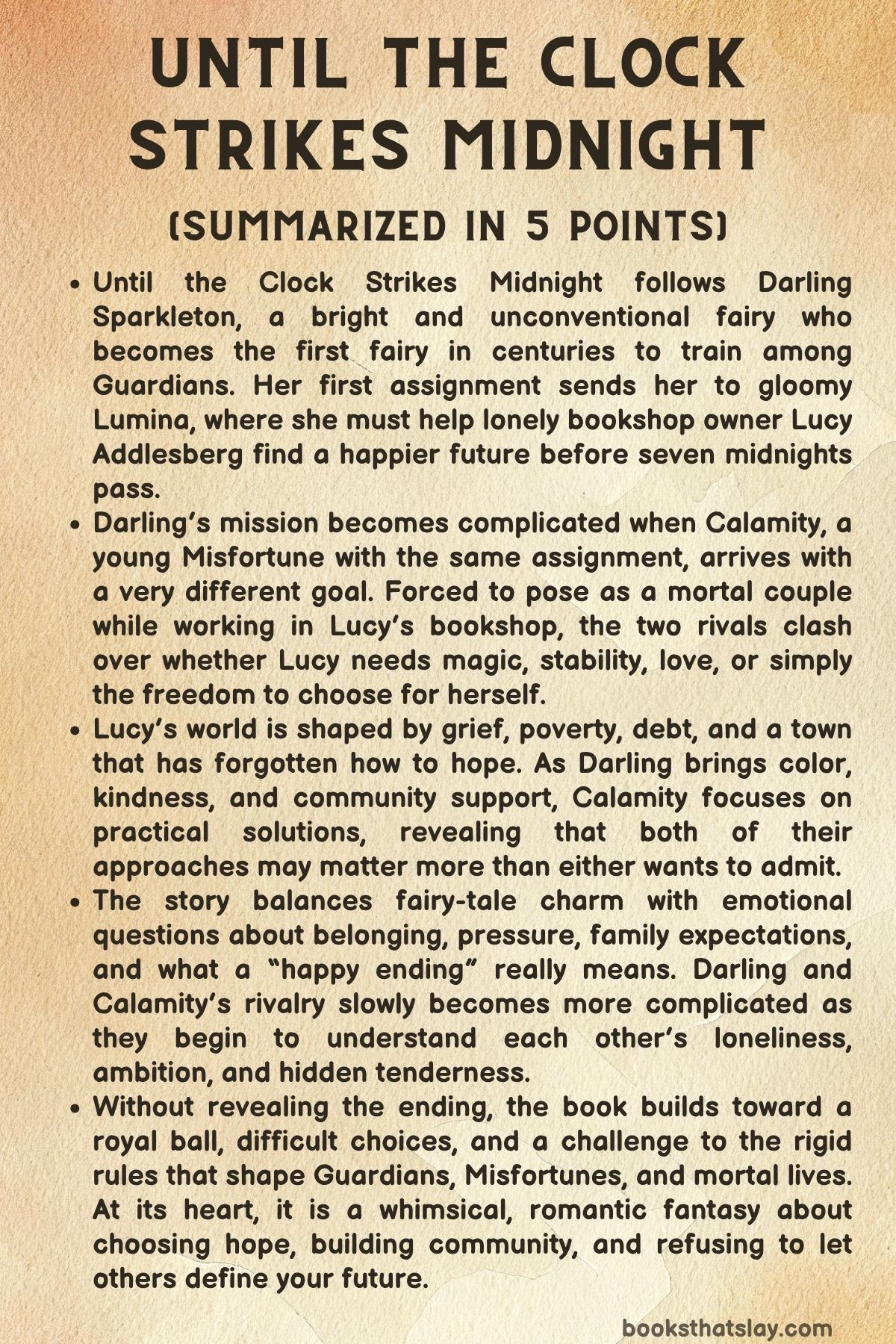
Until the Clock Strikes Midnight by Alechia Dow is a magical young adult fantasy about choice, love, and the messy work of building a future. The story follows Darling Sparkleton, a bright fairy determined to prove herself among doubtful Guardians, and Calamity, a Misfortune raised to believe that ordinary lives are safer than happy ones.
Both are assigned to the same mortal girl, Lucy Addlesberg, whose future hangs in the balance. With humor, romance, fairy magic, and a tender focus on community, the book asks whether happiness is something granted by fate or something people claim for themselves.
Summary
Darling Sparkleton begins Until the Clock Strikes Midnight at her graduation from Mortal Outcome Academy. She is a fairy who has been studying among Guardians, and she knows she does not fit in.
The ceremony is dull, stiff, and far from the bright celebration she would have chosen. Her clothes, purple boots, and fairy magic make her stand out, and many Guardians treat her as if she has no right to be there.
Even so, Head Guardian Honour announces that Darling has earned the highest cumulative score in her class. As the first fairy admitted to the Guardian side in centuries, she has already made history.
Now she has a chance to earn a coveted mentorship with the Mortal Outcome Council, but only if she succeeds in her first independent case.
Darling receives her provisional license and learns her assignment: Lucy Addlesberg, a mortal girl in the Kingdom of Lumina. Darling has only seven midnights to guide Lucy toward her Happily Ever After.
She accepts the mission with hope and determination, believing this is her chance to prove that she belongs.
At the same time, Calamity, a young Misfortune, is completing his own work in the nether realm of Barfaris. He manipulates a reckless noble boy named Phred into gambling away his money.
Calamity does not see this as cruelty. He believes mortals sometimes need consequences before they ruin themselves completely.
By making Phred lose everything now, he hopes the boy will face the truth before his life becomes far worse. Afterward, Calamity returns to Malespero, where his father, Blight, gives him a provisional license.
Calamity has also qualified for the mentorship, and his assignment is the same as Darling’s: Lucy Addlesberg.
Blight makes it clear that Calamity’s success matters beyond personal ambition. If Calamity can steer Lucy toward an Ordinary Ever After, Misfortunes may gain more influence on the Mortal Outcome Council.
Calamity wants freedom from his father’s cold world, and the mentorship seems like his best chance.
Darling studies Lumina before leaving and finds little to admire. The kingdom is gloomy, poor, rainy, unlucky, and without magic.
Crops fail, people struggle, and joy seems scarce. When she arrives, she makes herself invisible and finds Lucy’s bookshop, An Enchanted Story.
Lucy is seventeen, grieving her mother, hungry, lonely, and nearly crushed by debt. Darling finds her collapsed among fallen books and immediately wants to help her with warmth, food, kindness, and magic.
But Calamity is already there. Darling and Calamity quickly realize why they have both been assigned to Lucy.
Lucy stands at a crossroads. Darling must help her reach a Happily Ever After, while Calamity must guide her toward an Ordinary Ever After.
Their private conflict becomes complicated when Darling exposes Calamity to Lucy, and he responds by exposing both of them.
To cover their sudden appearance, Calamity claims that he and Darling are a young couple looking for work. Lucy, who is kind despite having almost nothing, lets them stay in exchange for help around the shop.
Darling and Calamity agree to compete while pretending to be mortal lovers. They also set rules.
They will not reveal what they truly are, they will both spend time with Lucy, and any changes they make should be lasting rather than dependent on fairy magic.
As they settle in, Lucy’s troubles become clearer. Her mother’s death left her alone with the bookshop, but the business is failing.
She has little food, poor heat, and heavy debt. She loves romance stories and secretly paints, but grief has made her bury much of herself.
She also seems drawn to Andi, a girl who visits the shop and buys romance books, especially stories about women in love.
Darling throws herself into improving Lucy’s world. She works with Minerva the seamstress, arranges repairs, buys food, plans a bookstore party, and partners with Baxter the baker to sell chocolate cookies in the shop.
Calamity focuses on practical survival. He suggests a disguised romance book club called the Practical Arts Club so people in town can gather, read, and support the shop without embarrassment.
Their efforts bring them into conflict with powerful townspeople, especially Mrs. Arconia, whose family controls book distribution in Fulhorn. Mrs. Arconia is sharp, cruel, and determined to see Lucy’s shop fail.
Her son Dynnis is attracted to Darling, which adds another complication. Calamity senses something wrong and dangerous about Mrs. Arconia and warns Darling not to touch her.
He also senses strange emotions around Andi: love, fear, family pressure, and hints of palace life. This makes him suspect that Andi is far more important than she appears.
As Darling and Calamity work together, their rivalry begins to shift. They argue, tease, and try to outsmart each other, but they also start to respect one another.
While walking together under an umbrella after leaving Minerva’s, they discuss their fake relationship and admit that neither of them has much real romantic experience. Calamity thinks about his childhood, his mother leaving, his father’s harsh beliefs, and his hunger for a different future.
He also realizes that he genuinely likes Darling, even though they are supposed to be opponents.
Their visit to the Arconia mansion confirms that Mrs. Arconia is a serious threat. She insults Darling, dismisses books as useless, and reveals that she wants Lucy’s shop gone.
Mr. Arconia is far kinder and insists Lucy’s debt is not as serious as his wife claims, but Mrs. Arconia’s goal is control, status, and money. She is especially focused on helping Dynnis impress Princess Marguerite at the royal ball.
When her cruelty grows worse, Calamity freezes time to think. Darling acts first and transforms Mrs. Arconia into an orange housecat.
Calamity is furious. Turning a mortal into an animal is dangerous and reckless.
Darling insists that it protects Lucy and may teach Mrs. Arconia compassion. As a cat named Dori, Mrs. Arconia is cared for by Lucy and the village children.
Darling then tries to push Lucy toward happiness by asking about the ball, her painting, and whether a mural might help. But Lucy feels violated when she realizes Darling saw her hidden paintings.
She tells Darling they are not friends, and Darling leaves in despair, convinced she has ruined everything.
Calamity stays with Lucy and finds her breaking down among her paintings. Lucy admits that her mother’s death destroyed every future she had imagined: the bookshop, travel, painting, love, and friendship.
Calamity listens, and for the first time he sees that Darling is right about one thing. Lucy’s happiness depends not only on money or safety, but also on community, art, love, and the courage to want more.
He also learns Lucy likes Andi, but he suspects Andi may be Princess Marguerite. Fearing that a romance with a princess could wreck Lucy’s stable future, he decides to stop it.
Meanwhile, Darling wanders into the woods and considers giving up. There she meets her brother Favie, who tells her that her family still loves her and has been watching over her.
He explains that their father was punished for driving her away. Favie comforts her, gives her cocoa, and reminds her that she belongs in Whimsia.
He urges her not to make herself smaller for celestials or for anyone else. Darling returns to Fulhorn with renewed confidence.
Darling then tells Lucy the truth. She is a fairy from Whimsia, and she has been using magic to help.
Lucy is shocked but also delighted, and she hugs Darling. Hoping to repair things, Darling prepares a romantic dinner for Lucy and Andi.
During the dinner, Calamity pushes Andi toward admitting who she really is. Mrs. Arconia, still a cat, confirms to Darling that Andi is Princess Marguerite.
Andi admits she has been sneaking out because she cares for Lucy. Lucy panics over the difference between them and rejects her, causing Andi to leave hurt.
Darling blames Calamity for ruining the evening. They argue, but the fight also brings their feelings into the open.
Calamity admits he likes her and kisses her cheek. The next day, he and Darling reveal their true identities to Lucy and explain the choice before her.
She can choose stability or take a chance on happiness, but the decision must be hers before midnight.
Lucy decides she wants to go to the royal ball, apologize to Andi, and try to make space for both safety and joy. Darling transforms her into a beautiful flower-like vision for the ball.
At the palace, Mrs. Arconia, restored to human form, publicly apologizes and supports Lucy. Lucy and Andi speak honestly, introduce themselves without disguises or assumptions, admit their feelings, and walk away together.
After midnight, Darling and Calamity are brought before the Mortal Outcome Council. They learn that, by the council’s old rules, they both technically failed almost immediately.
But the council itself is outdated and disorganized. Two councilors resign, leaving openings, and Darling and Calamity are made mentors together.
By the end, Lucy and Andi are together and moving toward a royal future, Darling’s family supports her, and Calamity has gained freedom from Blight. Darling and Calamity leave as partners, ready to help change the realms.
Characters
Darling Sparkleton
Darling Sparkleton is the central force of hope, color, and emotional transformation in Until the Clock Strikes Midnight. As a fairy studying among Guardians, she begins the story as an outsider in a system that does not fully welcome her.
Her bright clothes, purple boots, fairy magic, and open-hearted nature make her stand apart from the rigid, suspicious atmosphere of the Mortal Outcome Academy. Darling’s greatest strength is her belief that happiness is worth fighting for, but the book also shows that her kindness can become impulsive when she rushes to fix pain before fully understanding it.
Her treatment of Lucy reveals both sides of her character: she genuinely wants Lucy to feel loved, supported, and free, yet she sometimes crosses boundaries, such as when she looks through Lucy’s private paintings and assumes she knows what Lucy needs. Darling’s journey is not simply about proving that she deserves a place among Guardians; it is about learning that helping someone find joy requires listening, humility, and respect.
By the end of the story, she becomes more than a magical problem-solver. She becomes someone capable of challenging unfair systems while also accepting that happiness must be chosen by the person living the life.
Calamity
Calamity is one of the most morally layered characters in the book because he does not represent evil, even though he is a Misfortune. His role is built around the belief that bad luck, discomfort, and consequences can sometimes protect mortals from worse futures.
This makes him practical, cautious, and emotionally guarded. Unlike Darling, who often wants to create immediate joy, Calamity looks for stability, sustainability, and long-term survival.
His early manipulation of Phred shows how he views misfortune as a necessary correction rather than cruelty. However, his assignment with Lucy forces him to question the limits of that belief.
As he watches Darling improve not only Lucy’s shop but also the community around her, he begins to understand that an Ordinary Ever After may not be enough if it requires someone to abandon love, art, and hope. Calamity’s personal background deepens his character: his mother’s absence, Blight’s cold expectations, and his desire to escape Malespero all make him someone who longs for freedom but has been taught not to trust tenderness.
His growing affection for Darling reveals his softer side, and by the end, he becomes a partner in change rather than merely an agent of controlled misfortune.
Lucy Addlesberg
Lucy Addlesberg is the emotional heart of the story. She is a seventeen-year-old bookshop owner weighed down by grief, poverty, loneliness, and responsibility after her mother’s death.
At first, Lucy seems trapped by survival. Her shop is failing, she has little food or heat, and her dreams have been buried beneath debt and exhaustion.
Yet the book gradually reveals that Lucy is not empty of desire; she has simply stopped believing that desire is safe. Her love of romance stories, her hidden paintings, and her feelings for Andi show that she still longs for beauty, love, creativity, and companionship.
Lucy’s pain comes from having lost not only her mother, but also the future they imagined together. This makes her defensive when Darling pushes too far, because her paintings and dreams are deeply private parts of herself.
Lucy’s growth lies in realizing that choosing happiness does not mean abandoning practicality. Her final decision to go to the ball and speak honestly with Andi shows that she is ready to claim a future that includes both stability and joy.
She becomes a character who proves that a Happily Ever After is not handed to someone; it must be chosen with courage.
Andi / Princess Marguerite
Andi, later revealed to be Princess Marguerite, represents hidden identity, longing, and the pressure of social expectation. When she first appears as a girl visiting Lucy’s bookshop, she seems gentle, mysterious, and emotionally connected to Lucy through their shared love of stories.
Her secret identity adds tension because her affection for Lucy is not simple; it is complicated by class difference, royal duty, and fear of being truly known. As Princess Marguerite, Andi lives under expectations that likely require her to perform a certain version of herself in public.
As Andi, she can seek honesty, romance, and freedom. Her connection with Lucy is important because both girls are hiding parts of themselves.
Lucy hides her art, grief, and desire for love, while Andi hides her royal identity and emotional vulnerability. When the truth is revealed, Lucy’s fear is understandable because Andi suddenly becomes someone tied to power, status, and a world far beyond the bookshop.
Still, Andi’s honesty at the ball shows that her feelings are sincere. She is not simply a princess offering rescue; she is a young woman trying to be loved for who she truly is.
Mrs. Arconia
Mrs. Arconia is the clearest antagonist in Until the Clock Strikes Midnight, but she is not just a cruel obstacle placed in Lucy’s way. She represents social control, greed, class arrogance, and the kind of respectability that crushes imagination.
Her hostility toward Lucy’s bookshop shows that she sees stories, romance, and independent dreams as useless unless they serve power or profit. She wants Lucy’s shop gone not because it is truly dangerous, but because it stands outside her control.
Her obsession with status is also visible in her hopes for Dynnis and Princess Marguerite, suggesting that she treats people as pieces in a social strategy. Darling’s decision to turn her into a cat is extreme, but it also symbolically strips Mrs. Arconia of the authority she abuses.
As Dori, she is placed in a position where she must experience dependence, attention, and vulnerability. Her later public apology suggests that she is capable of change, even if that change comes through humiliation and magical intervention.
Mrs. Arconia’s arc reinforces one of the story’s major ideas: power without empathy becomes destructive.
Mr. Arconia
Mr. Arconia is a lighter and more pleasant contrast to Mrs. Arconia. While she is severe, calculating, and cruel, he appears cheerful and much less concerned with punishing Lucy over the shop’s debt.
His attitude suggests that the financial threat hanging over Lucy may be driven more by Mrs. Arconia’s desire for control than by genuine necessity. However, his cheerfulness also has limits.
He does not seem to actively challenge his wife’s cruelty in a meaningful way, which makes him a passive figure within the Arconia household. His character helps expose the imbalance of power in the family: Mrs. Arconia dominates the social and moral atmosphere, while Mr. Arconia’s kindness remains too soft to protect those being harmed.
He is not villainous, but he is also not heroic. His role in the story shows that good nature alone is not enough when injustice requires resistance.
Dynnis Arconia
Dynnis Arconia is a minor but useful character because he reflects the social ambitions of his mother and the shallow expectations of Fulhorn’s upper class. His attraction to Darling adds tension and humor, especially because Darling and Calamity are pretending to be a couple.
Dynnis seems less actively malicious than Mrs. Arconia, but he is still connected to the world of privilege, appearances, and arranged social advancement. His mother’s hope that he will impress Princess Marguerite at the royal ball shows that he is part of her plan to climb or secure status.
In this sense, Dynnis functions less as an independent emotional force and more as an example of how young people can be shaped by family ambition. His presence also helps contrast false romantic possibility with genuine emotional connection.
Where his interest in Darling feels superficial, Lucy and Andi’s bond feels sincere, and Darling and Calamity’s growing affection develops through conflict, trust, and shared purpose.
Head Guardian Honour
Head Guardian Honour represents institutional authority within the Guardian world. Honour’s announcement that Darling has achieved the highest cumulative score is important because it confirms Darling’s talent in a space where many people doubt or resent her.
At the same time, Honour also belongs to a system that treats Darling as an exception rather than as someone who fully belongs. The provisional license and mentorship opportunity seem like rewards, but they are also tests shaped by centuries of division between fairies, Guardians, and Misfortunes.
Honour’s role in the book is therefore connected to recognition, competition, and bureaucracy. Honour helps set the plot in motion by giving Darling her assignment, but the later disorder of the Mortal Outcome Council suggests that the authority figures behind these systems are not as wise or organized as they appear.
Through Honour, the story shows how institutions can acknowledge talent while still being limited by old prejudices and outdated structures.
Blight
Blight is Calamity’s father and one of the strongest influences on Calamity’s emotional conflict. He is cold, ambitious, and deeply invested in Misfortunes gaining greater power on the Mortal Outcome Council.
To Blight, Calamity’s assignment is not simply a chance for personal success; it is a political opportunity. This makes his relationship with Calamity feel conditional, as if his son’s value depends on whether he can advance Misfortune influence.
Blight’s worldview teaches Calamity that hardship is necessary, softness is weakness, and ordinary outcomes are preferable to risky happiness. Because of this, Calamity begins the story carrying his father’s beliefs even when they do not fully satisfy him.
Blight also represents the life Calamity wants to escape. His presence helps explain why the mentorship matters so much to Calamity: it is not only professional advancement, but also a path toward freedom.
By the end of the novel, Calamity’s separation from Blight signals his emotional growth and his rejection of a future defined by fear and control.
Favie
Favie is Darling’s brother and an important source of comfort, belonging, and emotional renewal. He appears when Darling is at one of her lowest points, after she believes she has failed Lucy and ruined her chance to help.
His role is significant because he reconnects Darling with the love and support she thought she had lost. Favie reveals that her family still cares for her, has been watching over her, and that their father faced consequences for driving her away.
This matters because Darling’s confidence has been shaped by rejection, both from her family situation and from the Guardian world. Favie reminds her that she does not have to shrink herself to be accepted by celestials or anyone else.
His warmth, cocoa, and reassurance restore Darling’s sense of self. As a character, Favie represents the healing power of family when family chooses love over judgment.
Minerva
Minerva, the seamstress, is one of the townspeople who helps show that Lucy’s future depends on community as much as individual rescue. Through Darling’s work with Minerva, the story widens beyond the bookshop and reveals Fulhorn as a place where small acts of cooperation can create meaningful change.
Minerva’s role may be practical, but she represents something emotionally important: the possibility that Lucy does not have to survive alone. In a gloomy kingdom marked by poverty, rain, and bad luck, Minerva helps create a network of support around Lucy.
Her presence also supports Darling’s broader vision of a Happily Ever After, which is not limited to romance or magic. It includes repaired relationships, local business, shared effort, and a town becoming kinder to one of its own.
Baxter
Baxter the baker is another community-based character whose importance lies in practical kindness. His partnership with Darling to sell chocolate cookies at Lucy’s shop helps turn the bookshop into a warmer and more inviting place.
Baxter’s role shows how ordinary people can contribute to someone’s recovery without grand gestures or magical power. Food, business cooperation, and neighborly support become part of Lucy’s path toward stability.
Baxter also helps balance Darling’s magic with sustainable change, because the improvements around Lucy cannot depend only on spells. His character reinforces the idea that a better future is built through both imagination and everyday care.
Phred
Phred appears early in the story as a reckless noble boy whom Calamity manipulates into gambling away his money. Although he is not a major character, he is important because he introduces Calamity’s philosophy of misfortune.
Phred’s bad decision becomes, in Calamity’s view, a necessary disaster that prevents an even worse future. Through Phred, the reader sees that Calamity does not cause trouble simply for pleasure.
He believes consequences can correct a dangerous path before it becomes irreversible. Phred therefore functions as an example rather than a deeply developed figure.
His brief role helps establish the moral debate that runs through Until the Clock Strikes Midnight: whether people are better served by protection, hardship, happiness, stability, or some difficult combination of all four.
Dori
Dori is the name given to Mrs. Arconia after Darling transforms her into an orange housecat. Even though Dori is not a separate person, this form is important enough to analyze because it reveals a different stage of Mrs. Arconia’s character.
As Dori, Mrs. Arconia loses the social power, voice, and intimidation she uses to control others. She becomes dependent on the very people she would normally dismiss, including Lucy and the village children.
This transformation creates a comic situation, but it also carries moral meaning. In cat form, Mrs. Arconia is forced into vulnerability and observation.
She can no longer dominate every room, which gives her the chance to experience care without command. Dori’s presence softens the story’s conflict while also preparing for Mrs. Arconia’s later apology.
The transformation suggests that empathy sometimes begins when a powerful person is made powerless enough to see others clearly.
Themes
Self-Determination and the Right to Choose One’s Future
Lucy’s future becomes the center of a contest between magical forces, yet the story gradually makes clear that no outside power should decide her life for her. Darling wants to lead Lucy toward a Happily Ever After, while Calamity wants to protect her through an Ordinary Ever After, but both approaches risk treating Lucy as a case rather than a person.
Lucy is grieving, poor, isolated, and frightened, so it would be easy for others to assume they know what is best for her. The real growth comes when she is allowed to name her own desires: keeping the bookshop, pursuing painting, loving Andi, and imagining a life larger than survival.
Her choice is not simple fantasy or plain practicality; it is a future that includes risk, responsibility, love, and hope. Until the Clock Strikes Midnight shows that happiness cannot be handed to someone like a prize.
It must be chosen with honesty, even when the choice is uncertain.
Prejudice, Belonging, and Being Seen Fully
Darling’s presence among the Guardians exposes a world shaped by suspicion and old divisions. She is judged before she acts because she is a fairy, and her brightness, magic, clothes, and personality make her seem out of place in a system that values control and tradition.
Calamity faces a different kind of expectation as a Misfortune, pressured by his father and his realm to prove that misfortune is necessary and powerful. Both characters carry labels that others use to limit them.
Darling is expected to be unserious or dangerous; Calamity is expected to be cold and manipulative. Their bond grows because they begin to see beyond those inherited roles.
Lucy also suffers from being unseen, reduced by the town to a struggling shopkeeper rather than understood as an artist, a grieving daughter, and a young woman in love. The theme suggests that belonging begins when people are recognized in their full complexity, not forced into old categories.
Grief, Healing, and the Need for Community
Lucy’s hardship is not only financial; it is emotional. Her mother’s death has taken away the future they imagined together, leaving the bookshop as both a treasured memory and a painful burden.
Her loneliness makes the shop feel colder, poorer, and smaller than it truly is. Darling initially tries to solve Lucy’s problems through cheerful action, food, repairs, parties, and magic, while Calamity focuses on stability and consequences.
Over time, both understand that Lucy’s healing depends on more than one dramatic rescue. She needs friendship, honest conversation, creative freedom, and a community that supports her business instead of watching it fail.
The bookshop party, the reading club, the bakery partnership, and the help from townspeople all show that recovery is built through shared care. Until the Clock Strikes Midnight presents grief as something that cannot be erased, but it can become livable when love and community return to the spaces where loss once ruled.
Love as Courage, Not Escape
Romance in the story is not treated as a simple reward that solves every problem. Lucy and Andi care for each other, but their relationship is complicated by secrecy, class difference, fear, and public responsibility.
Lucy’s panic after learning Andi’s royal identity shows that love can feel frightening when it threatens a fragile sense of safety. Andi must also be honest about who she is, because affection built on hiding cannot fully grow.
Darling and Calamity’s relationship develops through conflict, competition, and reluctant trust. Their feelings matter because they challenge each other’s assumptions: Darling learns that happiness needs grounding, and Calamity learns that safety without joy can become another kind of loss.
Love becomes an act of courage because each character must risk rejection, change, and vulnerability. The story argues that love is not an escape from real life.
It is a force that asks people to face real life more honestly, with someone beside them.