The Arachnid Summary, Characters and Themes
The Arachnid by I.V. Ophelia is a dark gothic fantasy about survival, power, violence, and the cost of building a life outside cruel systems. Set mainly in present-day Buffalo, the novel follows Alina, a brilliant and dangerous Host who runs a female-led Nest of Vipera and Hosts from a farmhouse and laboratory.
Her fragile refuge depends on consent, shared labor, medicine, and ruthless defense. When Silas, a powerful Vipera from her past, tracks her down, Alina must protect her chosen family while confronting old trauma, new betrayals, and a growing threat from corrupted creatures.
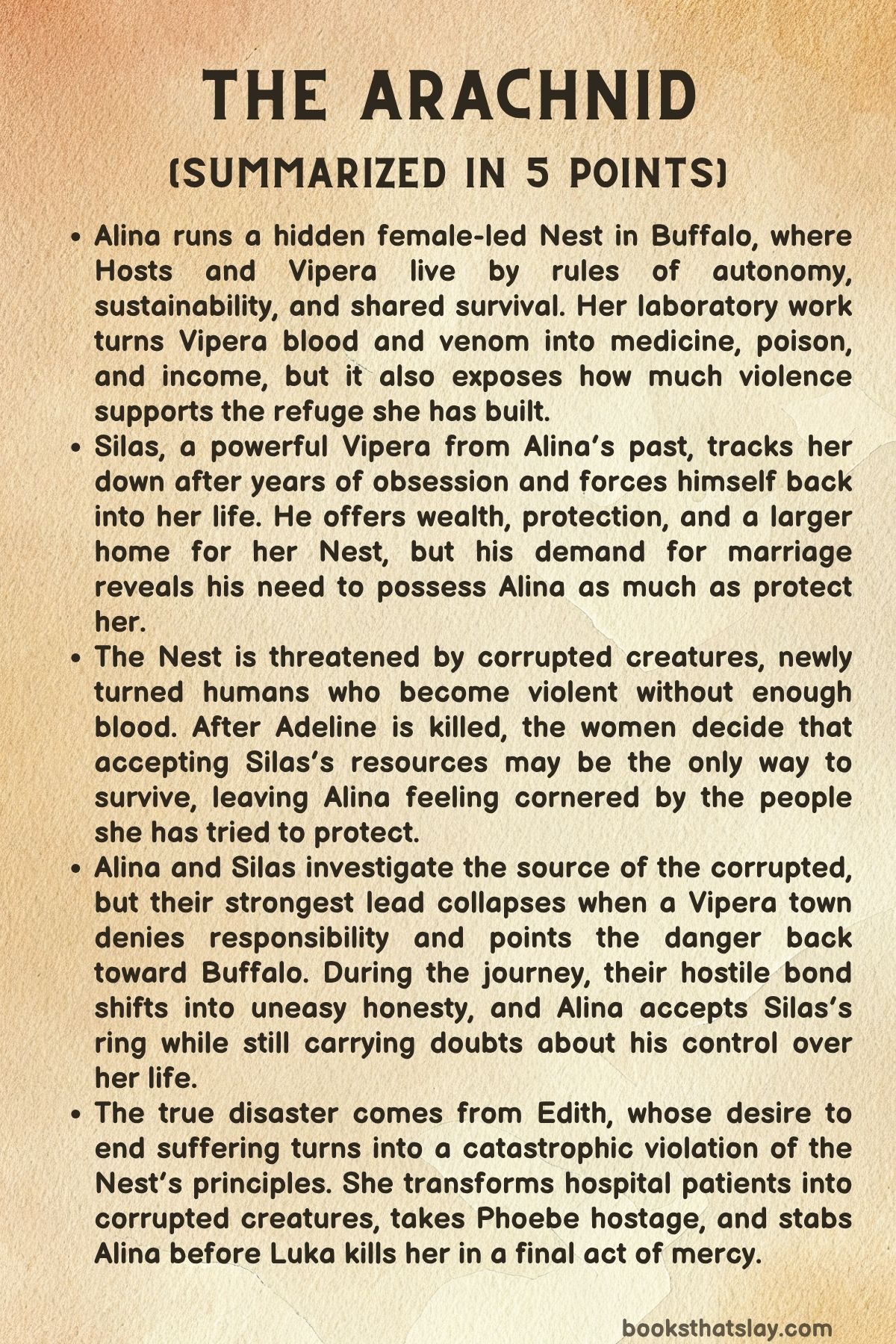
Summary
The Arachnid begins in Buffalo, where Alina works in a hidden laboratory above an apothecary. She kills Vipera men, drains their black blood, and extracts venom for medical and practical use.
Her work is brutal, precise, and emotionally controlled. Edith, a young Vipera nurse who lives with Alina and Phoebe, collects venom from the lab for use at the hospital.
She wants to keep victims alive longer to gather more supplies, but Alina refuses because the work requires too much supervision. Even so, Alina p
romises to gather better samples and equipment for Edith.
Alina returns to the farmhouse outside Buffalo, where she lives with Phoebe and a growing group of women known as their Nest. The household is built on rules very different from traditional Vipera society.
Vipera cook for Hosts, Hosts feed Vipera, and everyone contributes to survival. Phoebe has forged marriage papers to buy the property, and the fields and woods make it easy to dispose of bodies.
The Nest’s central principles are autonomy, sustainability, and utilitarianism. Alina’s income comes partly from harvesting Vipera fluids for pharmaceuticals, and her laboratory work supports both the household and the hospital.
The story also reaches into the past. Two years earlier, Luka survives a violent encounter with Alina and attends a banquet in a wealthy Vipera Nest.
The feast is meant to honor Elanor, a Host who has been killed and turned into food and wine after years of service. During the banquet, Silas, the estranged son of the Sire, reveals that he has poisoned the wine.
Almost everyone dies as the poison burns through the Vipera. Luka survives only because a decorative sword pins him to the wall.
Silas finds him afterward, cuts his face, marks him as a kin killer, and forces him into service. Silas claims both of them will be blamed, leaving Luka with nowhere else to go.
He then announces his plan to build a new kind of Nest in New York, one based on skill and power rather than pedigree.
In Buffalo, Alina is troubled by nightmares, sleeplessness, and old memories. Her domestic life with Phoebe offers comfort, but it is unstable beneath the surface.
Phoebe feeds from Alina gently and anxiously, while Alina guides her through it. Their bond is intimate, but Phoebe is jealous of Edith, who is also one of Alina’s feeding partners.
The household functions with warmth and routine, yet Alina carries the weight of constant vigilance. John, an older handyman affectionately called Pops, offers her a rare paternal comfort when he inspects the farmhouse roof and reassures her about repairs she cannot immediately fix.
Alina continues hunting Vipera men in Buffalo’s exclusive establishments. At the Northern Guild, she lures a suspicious Vipera detective into an alley, where Edith knocks him unconscious.
Back in the lab, Alina develops a harsher method of extracting venom by dislocating captives’ jaws so their fangs can be milked more effectively. The detective warns her that someone called her a black widow and a poisoner, and that killing him will lead that person to her.
Alina realizes someone from her past may have found her. Phoebe worries that Alina is becoming reckless and reminds her that fame once nearly destroyed them.
In New York City, Silas has become wealthy and powerful. He has built a new Nest on Fifth Avenue using money from oil and steel, but he has no Hosts because Host unions refuse to work with him.
Although outwardly successful, he remains obsessed with Alina. Luka discovers her location through an invoice for pink aniline-dyed silk sent to Buffalo, evidence tied to Phoebe’s expensive tastes.
Luka admits he sent Detective Moore to confirm the information. He and Silas make a wager: if Alina accepts Silas, Luka dies; if she rejects him, Luka gains a stake in Silas’s company.
Meanwhile, Alina’s Nest finds more corrupted corpses near their property. The corrupted are newly turned humans who become violent without enough blood, and their increasing numbers suggest a wider danger.
Alina chooses to keep the problem quiet until after the holidays, but the threat grows. Edith believes the corrupted deserve guidance, while Phoebe considers them too dangerous.
Alina refuses to take in more people because the Nest lacks space and resources.
Silas and Luka travel to Buffalo. At a hotel bar, Silas meets Edith and quickly recognizes her as Vipera.
He questions her while pretending to be a lost outsider. Edith, nervous and eager to be helpful, reveals too much.
She tells him about the female-led household, Alina’s role as Dam, the Nest’s rules, and their planned visit to Spaulding Club. Silas now has a path to Alina.
Alina continues her ordinary work while Silas watches from the edges of her life. She visits the hospital, helps Edith with medical supplies, studies bodies with Henry at the mortuary, gathers plants, manages chores, and prepares for Christmas with the Nest.
The household’s warmth contrasts sharply with the threat stalking it. Silas follows her to the apothecary, hospital, mortuary, blacksmith, and home.
He sees the scope of what she has built, though he does not fully understand its strength.
At Spaulding Club, Silas finally confronts Alina. Their reunion is tense, bitter, and dangerous.
Alina approaches him and secretly stabs him with a small blade as they speak. Silas claims she belongs to him, while Alina insists she hates him and wants nothing from him.
Edith realizes Silas used her information to reach Alina, and Silas cruelly exposes her role. Edith flees in guilt and horror.
Silas allows Alina one more night of peace.
That peace ends quickly. Silas and Luka appear inside the farmhouse.
Silas attacks Alina, bites her wrist, and fights her down the stairs before Phoebe strikes him with a rifle. The girls capture Silas and Luka at gunpoint.
Alina threatens them with an axe and poison, reminding Luka of the damage she once caused. Silas reveals that the London Nest is gone and offers Alina a bargain: her Nest can join his wealthy New York Nest and gain money, safety, and influence, but Alina must marry him.
Alina refuses because she knows he wants possession more than partnership.
After Edith apologizes for revealing information to Silas, Alina explains why she forbids speaking to men about the Nest. She later meets Silas while running errands, and they argue about the terms of his offer.
Alina demands that there be no marriage, that his Nest accept her rules, and that he fund her work. He accepts almost everything except removing marriage.
He then corners and kisses her against her will, revealing how easily his desire for her becomes control.
Alina later sneaks into Silas’s hotel room intending to kill him. He knows she is there, and their confrontation becomes violent and emotionally tangled.
They argue about the past, especially Luka’s attack on Alina and whether Silas failed to protect her. Silas says he never fed from her and claims he sedated her because it was the only way to keep her alive.
Alina believes he betrayed her, while Silas insists he wanted her to survive even when he lacked the power to save her cleanly.
The Nest’s situation worsens when corrupted creatures attack the farmhouse. Alina and Phoebe kill one, while Rebecca and Mary kill another, but Adeline is found dead in the snow.
Rebecca’s grief devastates the household. That night, the Nest decides Alina should accept Silas’s deal for their safety.
Alina feels betrayed, but Phoebe tells her they have no better option. Alina goes to Silas with a gun and renegotiates.
She demands that he and Luka live with them, that he support the Nest financially, that she keep her own room and allowance, and that her rules be respected. Silas accepts everything except canceling the marriage.
Silas then shows Alina a large tenement building he bought for her and the Nest. It has many rooms and a top-floor flat with a glass observatory.
Alina is shocked that he anticipated her needs and gave her a place where the Nest could grow. After Adeline’s funeral, the women move into the new building and begin turning it into a home.
Silas has furnished Alina’s flat with dark wood, green details, poisonous plant illustrations, books, plants, and thirteen oranges, honoring one of her half-joking demands. The gift overwhelms her because it is both generous and binding.
As the Nest adjusts, Alina confronts Luka and forbids him from feeding on or touching the girls. Luka agrees and offers to help investigate the corrupted.
He begins to understand that Alina leads not merely through affection but because she is the person most capable of keeping everyone alive. Alina, meanwhile, continues working in the lab, studying bodies, blood, venom, and corrupted corpses.
She also revisits her father’s research, which shows that he suspected the existence of Vipera but saw them as afflicted people who might be helped. His hopefulness makes her feel lonelier because her own knowledge has been shaped by violence.
A lead suggests the corrupted may be coming from a Vipera town led by Cormac McCallister. Before Alina can investigate, she is attacked in an alley by a corrupted man and badly injured.
Edith finds her, and Silas, furious that he was not told immediately, removes Alina from the hospital and takes her home. When Alina wakes, she insists on traveling to the town despite her wounds.
Silas goes with her, while Luka and Phoebe stay behind to protect the Nest.
During the journey, Alina and Silas speak more honestly about their families and pasts. Alina explains that poisoning her father was accidental, tied to an attempt to poison his assistant.
Silas reveals fragments of his own family history and his connection to Phoebe. At an inn, he tends Alina’s wounds and explains more about the violent world that shaped him.
He says he no longer wants to continue his father’s legacy. In Cormac’s town, Alina learns that the corrupted are not coming from there.
Cormac even reports that one arrived from Buffalo’s direction, destroying Alina’s strongest lead. At a bonfire, Silas asks Alina properly to be his and offers his mother’s ring.
She asks whether he will demand that she turn, and he says he knows she would have asked if she wanted that. She accepts the ring.
Back in Buffalo, Luka discovers a forgotten bottle of Alina’s blood in the saddlebag of Phoebe’s dead horse, explaining why the corrupted attacked. He then realizes Edith has not returned from the hospital.
When he calls, Edith answers and speaks with frightening calm about ending suffering and making people “wake.” Luka understands that she has turned patients.
Alina and Silas return to find Buffalo nearly deserted, with blood in the snow and bodies in the mortuary. At the hospital, they find dead nurses and slaughtered patients.
Edith holds Phoebe hostage with a knife while Luka stands nearby. Edith believes she saved the sick by turning them and claims corrupted people can be guided, even used as an army.
She argues that utilitarianism justifies what she has done, while Alina reminds her that autonomy is one of their core tenets. Edith says she did it for Alina and believes she and Luka should lead the Nest.
When Edith looks to Luka for support, Alina pushes Phoebe away, but Edith stabs Alina in the struggle. Luka gently touches Edith’s face and snaps her neck, killing her as an act of mercy.
Alina collapses, bleeding heavily, surrounded by the people who truly know her as betrayal and survival meet in one devastating moment.
Characters
Alina
At the center of The Arachnid, Alina is a brilliant, frightening, wounded, and deeply protective figure. She is a Host, but she refuses the passive role that traditional Vipera society assigns to people like her.
Instead of being consumed, controlled, or used, she becomes a hunter, chemist, leader, provider, and executioner. Her laboratory work shows both her intelligence and her moral severity.
She kills Vipera men, processes their black blood, studies venom, and turns the materials of predation into medicine, poison, income, and defense. This makes her both healer and killer, and the tension between those roles defines much of her character.
She wants to build a better system, but the tools available to her are violent ones.
Alina’s leadership is rooted in care, yet it is not soft care. She feeds her Vipera, protects her Hosts, manages money, studies bodies, buries threats, and keeps everyone alive through force of will.
Her Nest trusts her because she is useful, loyal, and willing to do terrible work so others can survive. At the same time, she is exhausted by the burden of being indispensable.
Her nightmares, sleepwalking, venom tolerance, and emotional outbursts show a woman living under constant strain. She has built a home, but she has not fully escaped the terror that formed her.
Her relationships reveal different sides of her. With Phoebe, Alina can be teasing, tender, irritated, and dependent.
With Edith, she is protective but also blind to the danger growing inside the younger woman. With John, she becomes almost childlike in her need for paternal reassurance.
With Luka, she is defensive and calculating. With Silas, she is at her most conflicted.
She fears him, hates him, understands him, wants to control him, and is unwillingly drawn to the parts of him that know her too well. Alina’s greatest struggle is not simply survival; it is the question of whether she can remain decent while using violence as the foundation of safety.
Silas
In The Arachnid, Silas is a powerful Vipera shaped by aristocratic cruelty, family violence, and obsession. His first major act is the destruction of a wealthy Nest during a banquet, a massacre that exposes his hatred for the old Vipera order.
He rejects a society built on pedigree, ritualized abuse, and the elegant consumption of Hosts, but his rebellion does not make him humane. He replaces one form of domination with another, building a new Nest around money, talent, and force.
His dream of reform is tied to control, and that makes him both visionary and dangerous.
Silas’s obsession with Alina is central to his character. He believes she betrayed and abandoned him, and his longing for her is mixed with resentment, possessiveness, and wounded pride.
When he finds her in Buffalo, he does not simply ask to return to her life; he stalks her, manipulates Edith, invades her home, attacks her, and uses the safety of her Nest as leverage. His demand for marriage is not just romantic.
It is a claim of ownership, a way to bind Alina to him in a form he can recognize and enforce.
Yet Silas is not written as a simple monster. He is capable of attention, generosity, and emotional vulnerability.
The tenement he buys for Alina is not a careless display of wealth; it shows that he has studied her needs and wants to support the world she is creating. His care for her wounds, his loneliness, and his willingness to accept many of her terms suggest that he can change, though not without resistance.
The danger in Silas is that his love and violence are too close together. He wants to be chosen, but often behaves as though he can force choice into existence.
His character asks whether someone raised in brutality can learn partnership without first trying to possess the person he loves.
Phoebe
Phoebe is one of the emotional anchors of the book. She is practical, domestic, anxious, jealous, loyal, and far more politically capable than she may first appear.
Her forged marriage papers allow the women to buy property, which means the Nest’s physical survival begins partly with her cleverness. In the farmhouse, she cooks, organizes, tends to routines, and helps maintain the sense of home that makes the group more than a defensive arrangement.
Her care is essential because Alina’s strength often takes harsher forms.
Phoebe’s relationship with Alina is intimate and complicated. She feeds from Alina with shyness and fear of causing pain, but she also wants a special place in Alina’s life.
Her jealousy of Edith comes from insecurity as much as possessiveness. Phoebe has seen Alina love, feed, protect, and need others, and she struggles with the fear that she may not be enough.
This emotional hunger occasionally turns cruel, especially in her treatment of Edith. Her conflict with Luka exposes how much of her identity depends on being close to Alina and being approved by her.
Despite her softness in domestic scenes, Phoebe is not helpless. She shoots Silas, threatens Luka, participates in Nest defense, and helps hold the household together after Adeline’s death.
Her humor can be grim and sharp, especially when she suggests ways to manage Silas and Luka if they become problems. Phoebe’s strength lies in adaptation.
She can nurture, scheme, grieve, threaten, and negotiate the emotional weather of the Nest. Her loyalty to Alina is genuine, but it also blinds her at times, making her both a stabilizing force and a source of pressure.
Luka
Luka begins as an enemy, a survivor, and a man trapped by consequences. Scarred by Alina’s poison and marked by Silas as a kin killer, he is forced into Silas’s service after the massacre of the London Nest.
His sarcasm, cruelty, and opportunism make him difficult to trust, but they also come from a long history of survival in violent systems. Luka understands Vipera politics, power, and weakness better than most characters, and he uses that knowledge with precision.
His relationship with Silas is bitter and transactional. Luka resents being controlled, but he also knows Silas’s weaknesses and challenges his delusions about Alina.
Their wager shows Luka’s pragmatic nature: he is willing to risk death for a chance at independence and profit. Once he enters Alina’s world, however, he begins shifting from reluctant servant to uneasy ally.
He recognizes that the Nest’s survival matters to his own position, and he offers to investigate the corrupted not from pure kindness but from aligned interest.
Luka’s background as a former Host adds depth to his understanding of transformation, hunger, and pain. He knows what it means to be remade by Vipera existence, and that memory gives him insight into the corrupted.
His interactions with Edith reveal a sharper moral awareness than expected. He sees the danger in her religious and utilitarian reasoning before others do.
His final act toward her, snapping her neck after she stabs Alina, is both merciful and terrible. Luka’s character is defined by hard-earned realism.
He is not innocent, but he is perceptive, useful, and capable of choosing mercy when no clean option remains.
Edith
Edith is one of the most tragic figures in the book because her kindness, insecurity, ambition, and instability lead to disaster. At first, she appears as a young Vipera nurse who wants to help patients.
She collects venom from Alina’s lab, uses it in medical work, and dreams of doing more. Her disappointment when Alina refuses to keep victims alive longer suggests an early warning sign: Edith’s desire to heal is already bending toward experimentation without consent.
Her position in the Nest is emotionally fragile. She is timid, easily embarrassed, and desperate to be useful.
The others tease her for being quiet, and Phoebe’s jealousy isolates her further. Alina protects and encourages her, but she also fails to see how deeply Edith needs approval.
Silas exploits exactly that weakness. By pretending to be a lost lover and outsider, he makes Edith feel trusted and important.
Her mistake in revealing information about the Nest is not born from malice, but it has severe consequences.
Edith’s later turn toward dangerous ideology grows from her hospital work and her inability to bear suffering. She begins to imagine Vipera transformation as salvation, a way to end human pain.
Her religious language and belief that corrupted people can be guided show a mind trying to turn horror into purpose. She claims to act for Alina and uses the Nest’s principle of utilitarianism to justify violating autonomy.
This is what makes her betrayal so painful: she uses the language of Alina’s world while destroying its moral core. Edith wants to heal, belong, and matter, but her need to be useful becomes catastrophic.
Rebecca
Rebecca is one of the Nest’s steadier and more physically capable members. She is trusted with difficult work, including disposing of bodies and helping manage threats around the property.
Her presence gives the household a sense of practical strength. She does not occupy the same emotional center as Alina or Phoebe, but her reliability makes her important to the Nest’s daily survival.
Her bond with Adeline gives her character emotional weight. Their close feeding partnership suggests trust, intimacy, and routine, and Adeline’s death breaks something in Rebecca.
When she finds Addie’s body in the snow, her desperate search for a fixable wound shows how unprepared even hardened survivors can be for sudden personal loss. Her grief is raw, physical, and devastating.
Later, at the grave, her calmness feels almost more frightening than her earlier wailing because it suggests emotional shock rather than peace.
Rebecca represents the cost paid by those who live under constant threat. She is not a passive background member of the Nest; she is someone whose labor supports the entire community.
Yet the book reminds readers that practical strength does not protect a person from grief. Her loss becomes one of the turning points that forces the Nest to accept Silas’s offer.
Through Rebecca, the story shows how private grief can reshape collective decisions.
Adeline
Adeline, often called Addie, is most important through the effect she has on the Nest and especially on Rebecca. Her close feeding partnership with Rebecca suggests a relationship built on trust and mutual need.
In a household where feeding is regulated by consent, care, and routine, that bond matters. It places Adeline within the emotional structure that Alina has worked to protect.
Her death marks a decisive shift in the story. Before Addie is killed, the corrupted are a frightening but partly manageable threat.
After her body is found in the snow, the danger becomes personal and undeniable. The Nest can no longer pretend the attacks are distant or containable.
Rebecca’s grief, Alina’s panic, and the household’s decision to accept Silas’s protection all follow from Addie’s death.
Adeline’s role is brief but meaningful because she represents the vulnerability of the community. The Nest may have weapons, rules, resources, and Alina’s leadership, but it can still lose one of its own in an instant.
Addie’s death turns strategy into mourning. It forces every survivor to measure safety against freedom and to ask whether accepting Silas’s wealth is a betrayal or a necessity.
Mary
Mary is a voice of collective reality within the Nest. She is not as central as Alina or Phoebe, but she speaks for the household at crucial moments.
After Adeline’s death, Mary tells Alina that the Nest has discussed the situation and believes Alina should accept Silas’s deal. This moment is painful because it makes clear that Alina’s authority, though strong, is not absolute.
The women love her, but they also have their own fear, judgment, and survival instincts.
Mary’s position shows that the Nest is not merely Alina’s project. It is a community of people who must live with the consequences of her choices.
By urging acceptance of Silas’s protection, Mary does not betray Alina in a simple sense. She voices the terrifying practical truth that ideals may not be enough against corrupted attacks, poverty, and exposure.
Her role adds tension to the politics of the household because she forces Alina to face the fact that leadership includes listening when the community chooses something she hates.
Mary also challenges Luka later by asking him to promise that the girls will not be kept helpless or uninformed if they move to New York. This shows her concern with power, education, and agency.
She wants safety, but not at the price of ignorance. Mary’s strength is her willingness to say what others may fear to say aloud.
John
John, known affectionately as Pops, brings warmth and grounded humanity to the book. As an older handyman and blacksmith figure, he offers Alina a kind of paternal steadiness she rarely receives.
His inspections, repairs, and practical advice may seem ordinary beside laboratories, poison, and corrupted attacks, but that ordinariness is exactly why he matters. He represents a safer, simpler form of care.
Alina’s interactions with John reveal her need for comfort. She is often terrifying to others, but with him she allows herself to be reassured.
When the roof needs repair and she cannot immediately fix the problem, John calms her instead of demanding more from her. Their hug shows how badly she needs someone who is not feeding from her, bargaining with her, hunting her, or depending on her leadership.
John also becomes a link to Alina’s grief over her father. When she rereads her father’s papers and feels lonelier than usual, she goes to John.
He listens, asks about Silas, and responds to the possibility of marriage with delight rather than suspicion. His reaction is innocent compared with the darker reality of Alina and Silas’s relationship, but it shows his sincere wish for her happiness.
John’s role is modest but emotionally important: he gives Alina a place to be cared for without being consumed.
Henry
Henry, the coroner’s son, helps connect Alina’s scientific interests with the public world of bodies, death, and official explanations. Alina apprentices with him while pretending to prepare for work as an undertaker, but her reasons are more complex.
Through Henry, she gains access to corpses, symptoms, and cremation, all of which help her study Vipera biology and the corrupted without exposing her secrets.
Henry’s importance lies partly in what he does not know. He sees strange bodies and possible causes such as poisoning, allergies, or rabies-like illness, but he lacks Alina’s hidden knowledge of Vipera blood and transformation.
This creates a quiet dramatic tension around his scenes. He is close to the truth without being able to name it.
His professional observations help Alina confirm patterns, yet she withholds the real explanation.
His death at the mortuary is one of the signs that Edith’s actions have spread beyond private betrayal into public disaster. When Alina glimpses Henry’s mutilated body, the loss hits her hard because he belonged to one of the few ordinary structures she had used to understand and manage the crisis.
Henry represents civic order, professional curiosity, and the fragile line between hidden supernatural violence and public catastrophe. His death shows that the crisis has broken through that line.
Cormac McCallister
Cormac McCallister is the leader of the Vipera town that Alina and Silas investigate during their search for the source of the corrupted. He appears as a possible answer to the crisis, but his role complicates the investigation instead.
Because his town is entirely Vipera, it seems reasonable to suspect that the corrupted may be coming from there. Alina arrives hoping to solve the problem through conversation rather than immediate violence.
Cormac’s response is significant because he denies responsibility and offers a different clue: his town has also seen corrupted movement from the direction of Buffalo. This reverses Alina’s expectations and collapses her lead.
He is not presented as the mastermind behind the attacks, but as another leader dealing with the same spreading threat. His sympathy for Alina’s losses shows that not every Vipera authority figure is openly predatory or hostile.
The bonfire scene in Cormac’s town also serves another purpose. It gives Alina and Silas a temporary space away from Buffalo, the Nest, and the immediate pressure of survival.
Around the fire, Alina is able to participate in a communal moment that is not defined by her leadership duties. Cormac’s town therefore functions as both false lead and emotional pause, allowing the story to shift before the horror waiting back in Buffalo is revealed.
Cordelia
Cordelia appears as one of the women in the Nest, associated with domestic work and care, including Alina’s request that she make mittens for Phoebe. Her role is small, but it contributes to the book’s portrait of the Nest as a functioning household rather than only a militant refuge.
The women do not simply fight, feed, and hide; they sew, cook, decorate, prepare for Christmas, and build routines that make their lives livable.
Cordelia’s presence helps show how Alina’s leadership depends on many forms of labor. Some work is violent, like harvesting venom or killing corrupted creatures.
Some work is practical and domestic, like making clothing, preparing food, or arranging comfort. The book treats these forms of work as connected because survival requires all of them.
Cordelia belongs to that quieter structure of care.
Though she is not given the same dramatic focus as Phoebe, Edith, or Rebecca, Cordelia helps fill out the social world Alina is trying to defend. Minor members like her matter because the Nest is not an abstract cause; it is a collection of individual women with habits, skills, preferences, and needs.
Cordelia represents the ordinary life that exists inside extraordinary danger.
Detective Moore
Detective Moore is a minor but important catalyst. As the Vipera detective watching Alina’s Nest, he brings outside suspicion directly into her hunting life.
When Alina captures him at the Northern Guild, he reveals that someone warned him about her and called her a black widow and a poisoner. That warning confirms that Alina’s past is catching up with her.
His role is less about personal depth and more about pressure. He forces Alina to recognize that her methods, however effective, are making her visible.
Phoebe’s concern about Alina becoming reckless is sharpened by Moore’s presence. He also serves Luka’s plan, since Luka sent him to confirm Alina’s location for Silas.
In that sense, Moore is both hunter and bait.
Alina’s decision that Moore must never be found shows how quickly she moves from calculated violence to total erasure when the Nest is threatened. He exposes the danger of reputation.
Alina can survive as long as she remains hidden, but once men like Moore begin following rumors, the boundary between her private system and the wider Vipera world begins to fail.
Elanor
Elanor appears only through the banquet in the past, but her role is symbolically powerful. She is a Host who has been “retired” after years of service and transformed into food and wine for the Vipera Nest.
Her fate reveals the refined cruelty of the old system more clearly than any speech could. The banquet treats her death as ceremony, honor, and consumption, exposing a culture that turns exploitation into elegance.
Elanor’s presence helps explain Silas’s hatred of the old Vipera order, even if his response is itself murderous. The poisoned toast that destroys the Nest takes place during the ritualized consumption of a Host.
Her body becomes the site where old violence and new violence meet. The Vipera intend to consume her; Silas uses the occasion to consume them through poison.
Though Elanor is not active in the present story, she casts a long shadow over its moral world. Alina’s Nest is built in opposition to the kind of system that destroyed Elanor.
Consent, payment, autonomy, and medical supervision matter because the alternative is a society where Hosts can be used until they are no longer useful and then turned into a feast.
Silas’s Father
Silas’s father is mostly offstage, but his influence is severe. He represents the older aristocratic Vipera structure built on violence, obedience, sacrifice, and lineage.
Silas’s rebellion against him shapes much of the wider conflict. The London Nest, the pressure to marry Phoebe off, the telegrams, and the fear of consequences all suggest a family system where power is enforced through tradition and threat.
His importance lies in how he formed Silas. Silas’s possessiveness, strategic cruelty, and difficulty separating love from control are not random traits.
They come from a world where domination is normal and tenderness is dangerous. Silas rejects his father’s legacy intellectually, yet he continues to act through many of its habits.
He wants a different Nest, but his first instincts are still coercive.
Silas’s father also helps explain Phoebe’s flight and the stakes of Alina’s refuge. The women are not merely avoiding individual men; they are escaping systems that treat them as assets, food, wombs, labor, or bargaining tools.
Even when absent, Silas’s father embodies the patriarchal and predatory order that Alina’s household is trying to survive.
Alina’s Father
Alina’s father is dead before the central events, but his memory shapes Alina’s grief, guilt, and scientific identity. His research into blood disease and bodily adaptation suggests that he came close to understanding Vipera existence without seeing them only as monsters.
Unlike Alina, he seemed to hold some hope that the afflicted could be helped. This difference pains her because she has learned through experience to expect violence first.
Alina’s accidental poisoning of her father is one of her deepest wounds. She intended to poison his assistant, not him, but the outcome left her carrying guilt that affects how she understands her own intelligence.
Her knowledge saves people and destroys them. Her father’s death becomes an early example of the danger in her work: precision can fail, and good intentions do not erase consequences.
When Alina reads his papers, she feels both connected to him and distant from him. She knows more than he did, but she has lost the optimism he seemed to have.
His memory reminds readers that Alina’s scientific drive did not emerge only from cruelty or revenge. It also comes from inheritance, grief, curiosity, and a desire to understand what has harmed her world.
Themes
Autonomy Under Pressure
Autonomy is not treated as a simple ideal but as a rule that must survive fear, hunger, money, grief, and danger. Alina builds her Nest around consent because the old Vipera order depends on taking: taking blood, bodies, labor, obedience, and eventually life itself.
Her system tries to reverse that by regulating feeding, compensating Hosts, setting medical standards, and allowing members to participate in shared decisions. Yet the book repeatedly tests how strong that principle remains when survival becomes uncertain.
After Adeline’s death, the Nest chooses Silas’s protection even though Alina feels trapped by what the bargain demands of her. Edith’s betrayal sharpens the theme further.
She claims that turning suffering patients serves a greater good, but she violates the very autonomy that gives Alina’s cause moral force. In The Arachnid, autonomy is most meaningful when it is hardest to honor.
The story shows that a community cannot call itself ethical if it protects people by taking away their right to choose. Alina’s tragedy is that she understands this clearly, yet her own life is full of bargains where choice is narrowed by danger.
Survival and Moral Compromise
Survival in the book is never clean. Alina’s Nest exists because its members are willing to do things that would horrify outsiders.
They kill men, harvest venom, drain blood, hide bodies, lie to authorities, and turn predatory biology into medicine and income. These acts are not presented as harmless, but they are placed inside a world where traditional power structures are already violent.
Alina’s moral position is therefore difficult: she wants to create a better order, but she must use the materials of the old one to build it. The book repeatedly asks what happens when decency requires brutality.
Alina tries to be honorable, yet honor costs her sleep, safety, and eventually members of her household. Silas offers another form of compromise through wealth and protection.
Accepting his help saves the Nest but binds Alina to a man who has repeatedly violated her boundaries. The story refuses easy purity.
Safety requires money, weapons, bodies, labor, secrecy, and alliances with dangerous people. The question is not whether the characters can remain innocent, because innocence is already gone.
The harder question is whether they can remain accountable.
Chosen Family and Collective Responsibility
The Nest is the emotional and political heart of the story. It is not just a shelter; it is a chosen family built through rules, labor, feeding, grief, and shared risk.
The women cook, clean, harvest, nurse, decorate for Christmas, bury bodies, tend horses, and defend one another. These ordinary routines matter because they prove that survival is not only about resisting death.
It is also about creating a life worth protecting. Alina may be the leader, but the Nest is not hers alone.
Phoebe secures property, Rebecca disposes of threats, Edith brings medicine into the hospital, Mary speaks for the group, Cordelia contributes domestic skill, and others help make the house a living community. This collective structure becomes painful when members disagree.
After Adeline dies, the women push Alina toward Silas’s deal because their fear is real and their judgment matters. Chosen family does not erase conflict; it creates responsibility.
Alina must protect the Nest, but she must also listen when the Nest chooses survival in a way that hurts her. The book treats family as a living system, one that requires care, argument, sacrifice, and constant renegotiation.
The Corruption of Mercy
Edith’s downfall gives the book one of its darkest themes: mercy can become monstrous when it is separated from consent and humility. At the hospital, Edith sees pain, sickness, poverty, and death every day.
Her desire to help is real, but she begins to treat suffering as a problem she has the right to solve by force. Turning patients into corrupted creatures becomes, in her mind, a form of rescue.
She convinces herself that a transformed life, even a violent and unstable one, may be better than continued human suffering. This logic is terrifying because it borrows the language of compassion.
Edith does not think of herself as cruel. She thinks she is brave enough to do what others will not.
That belief makes her more dangerous. Her misuse of utilitarianism shows how easily a principle meant to protect the group can justify atrocity when one person decides that outcomes matter more than choice.
Alina’s confrontation with Edith makes the moral contrast clear. To heal someone, one must still respect the person being healed.
Without that respect, mercy becomes another form of domination.