The Art of Public Speaking Summary and Analysis
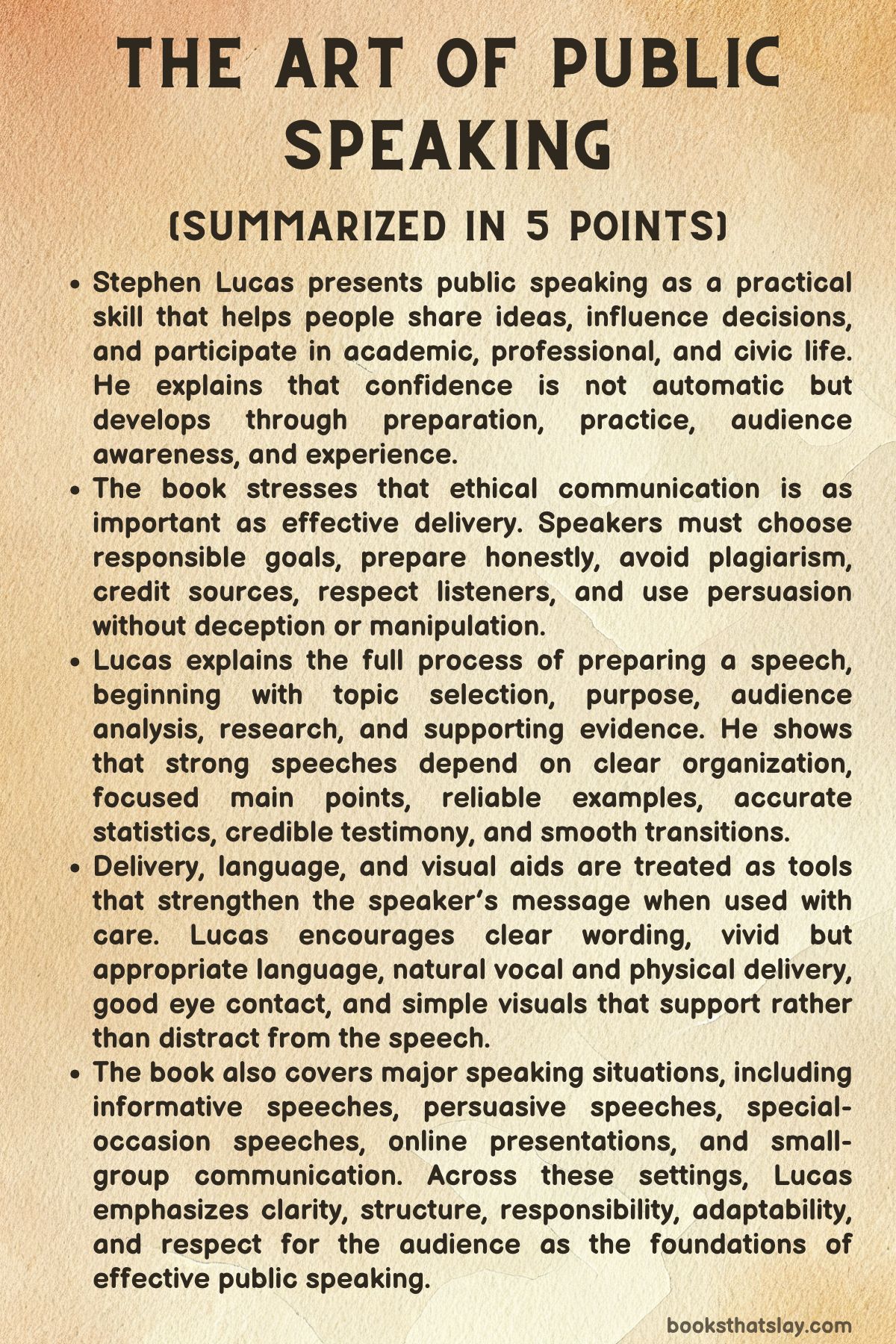
The Art of Public Speaking by Stephen Lucas is a practical guide to becoming a clear, ethical, confident, and audience-centered speaker. The book treats public speaking not as a natural talent reserved for a few people, but as a learnable skill shaped by preparation, research, organization, language, delivery, listening, and ethical judgment.
It explains how speakers choose topics, analyze audiences, gather evidence, structure ideas, use visual aids, persuade responsibly, speak online, and work in groups. Its central purpose is to help readers communicate ideas with clarity, credibility, and social responsibility.
Summary
Stephen Lucas presents public speaking as a core skill for academic, professional, civic, and personal life. The book begins by showing that speaking before others is not simply a classroom assignment or a performance exercise; it is a way of making ideas public, influencing decisions, and participating in society.
Lucas connects public speaking to leadership, employment, citizenship, and self-confidence. He explains that although many people fear speaking in front of an audience, nervousness is normal and can be managed through preparation, practice, visualization, and experience.
Rather than treating anxiety as a weakness, he treats it as energy that can be directed toward a stronger presentation.
The book also places public speaking within a long rhetorical tradition. Lucas traces the practice back to ancient Greece and Rome, where thinkers such as Aristotle and Cicero treated speech as a tool of civic life.
This historical background helps establish public speaking as both a practical skill and an intellectual discipline. At the same time, Lucas makes the subject approachable by comparing public speaking with conversation.
Both require organization, responsiveness, audience awareness, and clear language. Public speaking, however, requires more formal structure, more careful wording, and stronger preparation because the speaker addresses a larger audience under more fixed conditions.
Ethics becomes one of the book’s central concerns. Lucas argues that effective speaking cannot be separated from moral responsibility.
A speaker has power over listeners and must use that power honestly. This means choosing ethical goals, preparing fully, presenting evidence fairly, avoiding abusive language, and crediting sources.
Plagiarism receives special attention because it damages trust and violates intellectual honesty. Lucas also extends ethics to listeners, arguing that audiences have a duty to pay attention, avoid prejudgment, and respect free expression.
Communication, in his view, is a shared responsibility between speaker and audience.
Listening is treated as an active skill rather than passive hearing. Lucas explains that people often think they are listening when they are only receiving sound.
Good listening requires concentration, interpretation, and critical evaluation. The book identifies several causes of poor listening, including distraction, premature judgment, excessive focus on delivery, and the tendency to listen only for familiar ideas.
Lucas shows that strong listeners identify main points, assess evidence, separate fact from opinion, and remain open long enough to understand a speaker’s message before evaluating it. This makes listening an essential partner to speaking.
As the book moves into preparation, Lucas explains how speakers choose topics and purposes. A good speech begins with a topic that is suitable for the speaker, the audience, the occasion, and the time limit.
Lucas encourages speakers to draw from personal knowledge, interests, and experiences, while also exploring subjects they want to learn more about. After selecting a topic, the speaker must clarify the general purpose, usually to inform or persuade.
The specific purpose then narrows the speech into a clear goal, and the central idea condenses the message into a single statement that guides the entire presentation.
Audience analysis is presented as the foundation of successful speaking. Lucas argues that public speaking must be audience-centered because listeners interpret messages through their own interests, beliefs, experiences, and needs.
Speakers must consider demographic factors such as age, culture, religion, gender, and group identity without reducing people to stereotypes. They must also consider situational factors, including audience size, occasion, setting, attitude toward the topic, and attitude toward the speaker.
Audience adaptation happens before the speech through planning and during the speech through attention to feedback.
Research is another major element of the book. Lucas encourages speakers to use personal knowledge and experience, but he warns against relying on them alone.
Effective speeches require reliable supporting material gathered from libraries, databases, credible websites, and interviews. He stresses the need to evaluate sources for authorship, sponsorship, accuracy, recency, and relevance.
Research is not presented as a mechanical task but as a process that can sharpen the speaker’s understanding and reshape the direction of the speech.
Support gives speeches credibility and substance. Lucas discusses examples, statistics, and testimony as key forms of evidence.
Examples make ideas concrete, statistics show scale and patterns, and testimony brings in expert or peer perspectives. He repeatedly warns that evidence must be representative, accurate, and explained clearly.
Numbers can mislead if they are presented without context, and testimony can distort truth if quoted unfairly. Oral citation becomes an important ethical and practical habit because listeners need to know where information comes from in order to judge its reliability.
Organization is shown as essential to audience understanding. Lucas explains that speeches should usually have a limited number of main points, arranged in a logical order that fits the topic and purpose.
Common patterns include chronological, spatial, causal, problem-solution, and topical organization. Supporting materials must be placed under the points they actually support.
Transitions, previews, summaries, and signposts help listeners follow the speech because spoken language disappears as soon as it is heard. A well-organized speech gives audiences a path to follow and helps the speaker remain confident.
The beginning and ending of a speech receive special attention. The introduction must gain attention, reveal the topic, establish credibility and goodwill, and preview the main points.
Lucas offers many ways to open a speech, including stories, questions, quotations, visual aids, and statements of importance. The conclusion must signal closure and reinforce the central idea.
Rather than stopping abruptly, the speaker should leave listeners with a clear final impression. Lucas treats the opening and closing as moments that shape how audiences receive and remember the message.
Outlining is presented as the bridge between preparation and delivery. The preparation outline helps the speaker build the full structure of the speech, including purpose, central idea, introduction, body, conclusion, connectives, and sources.
The speaking outline is shorter and designed for use during delivery. It includes key words, brief phrases, important statistics, quotations, and delivery reminders.
Lucas warns that overly detailed notes can trap a speaker into reading, while too little structure can lead to confusion. The goal is controlled flexibility.
Language is treated as the speaker’s main tool. Lucas distinguishes between denotative meaning, which is literal, and connotative meaning, which carries emotional and cultural associations.
Speakers must use language accurately, clearly, vividly, appropriately, and inclusively. Clear language avoids clutter, jargon, and vague phrasing.
Vivid language uses imagery, rhythm, comparison, repetition, and contrast to make ideas memorable. Inclusive language shows respect by avoiding stereotypes and using terms that groups prefer for themselves.
Word choice, in Lucas’s view, is both a practical and ethical matter.
Delivery is presented as the visible and audible expression of the speaker’s ideas. Good delivery should direct attention to the message rather than to distracting habits.
Lucas discusses manuscript, memorized, impromptu, and extemporaneous delivery, with special emphasis on extemporaneous speaking because it balances preparation with natural communication. Voice, posture, gestures, facial expression, eye contact, appearance, and movement all shape audience perceptions.
Practice is necessary because delivery improves when speakers rehearse aloud, refine timing, reduce distractions, and learn to handle questions calmly.
Visual aids are described as tools that clarify, simplify, and strengthen spoken ideas. Objects, models, photographs, drawings, graphs, charts, video, and presentation slides can help audiences understand information more easily.
Lucas cautions that visual aids should support the speech, not replace it. They must be simple, visible, relevant, and well timed.
Speakers should rehearse with their visual aids, avoid cluttered slides, and maintain eye contact with the audience rather than speaking to the screen.
The later parts of the book address different speaking situations. Informative speaking aims to increase understanding, whether the subject is an object, process, event, or concept.
Persuasive speaking aims to influence beliefs, values, or actions through ethical reasoning, credible evidence, and emotional appeal. Lucas distinguishes questions of fact, value, and policy, showing that each requires different kinds of support and organization.
He also explains credibility, reasoning, fallacies, and emotional appeals as methods of persuasion.
The book concludes by broadening public speaking beyond traditional speeches. Special-occasion speeches require attention to ritual, audience expectation, tone, and brevity.
Online speeches require control of technology, visual setting, pacing, camera presence, and backup plans. Small-group communication requires shared responsibility, leadership, cooperation, problem-solving, and clear presentation of recommendations.
Across all of these situations, Lucas’s central message remains consistent: strong speaking depends on preparation, ethics, audience awareness, organization, evidence, language, and delivery.
Key Figures
Stephen Lucas
Stephen Lucas functions as the guiding voice of the book. Since The Art of Public Speaking is a nonfiction textbook, he plays the central role of teacher, organizer, and interpreter in the very book itself.
His presence is steady, practical, and instructional. He does not simply tell readers to speak confidently; he breaks confidence into habits that can be practiced, such as choosing a focused topic, preparing evidence, rehearsing aloud, adapting to the audience, and handling nervousness.
Lucas’s character as an author is built around trust. He presents public speaking as a skill with moral consequences, not just a technique for gaining attention.
His repeated concern with ethics, evidence, listening, and audience respect shows that he values responsible communication over performance alone. He also acts as a bridge between classical rhetoric and modern speaking situations, connecting Aristotle, Cicero, classroom speeches, workplace communication, online presentation, and group discussion into one practical system.
The Student Speaker
The student speaker is one of the most important recurring figures in the book because the material is designed around the experience of someone learning to speak in public. In The Art of Public Speaking, this figure begins with anxiety, uncertainty, and limited experience, but gradually learns how to control the speaking process.
The student speaker represents the reader’s possible growth. At first, this person may worry about forgetting words, being judged, choosing the wrong topic, or failing to hold attention.
Lucas responds by giving the student speaker concrete methods: narrow the topic, define the purpose, build a central idea, research carefully, organize clearly, practice delivery, and use notes wisely. This figure is not idealized as naturally talented.
Instead, the student speaker improves through discipline. The book’s treatment of this figure is encouraging because it suggests that effective speaking is not a gift but a craft.
The Audience
The audience is treated almost like a living presence throughout the book. It is not a passive group waiting to receive information, but an active force that shapes the speech from beginning to end.
Lucas repeatedly reminds speakers that audiences bring their own beliefs, experiences, interests, biases, attention limits, and emotional responses into the speaking situation. This makes the audience one of the most powerful figures in the story of the book.
A speech succeeds only when it connects with listeners in terms they can understand and value. The audience also represents ethical responsibility.
Speakers must not stereotype listeners, manipulate them unfairly, mislead them with weak evidence, or ignore their needs. At the same time, audiences must listen responsibly, avoid prejudgment, and evaluate messages carefully.
This two-way responsibility gives the book its democratic character.
The Ethical Speaker
The ethical speaker is a central model in the book and represents what Lucas believes public communication should become. This figure does not use speaking skill merely to win approval, defeat opponents, or create a powerful impression.
Instead, the ethical speaker chooses honest goals, prepares carefully, credits sources, avoids plagiarism, respects opponents, and speaks with a sense of public responsibility. The ethical speaker understands that persuasion is powerful and therefore dangerous when separated from truth.
Lucas uses this figure to argue that communication cannot be judged only by results. A speech that persuades people through lies, fear, distortion, or personal attack may be effective in a narrow sense, but it fails as ethical public speaking.
The ethical speaker stands for discipline, fairness, restraint, and respect for listeners as thinking people.
The Listener
The listener is another major figure in the book because Lucas treats listening as an active skill. The listener is not just someone sitting quietly while another person talks.
A good listener concentrates, identifies main ideas, evaluates evidence, watches for bias, and resists distractions. This figure matters because the quality of public discourse depends on listeners as well as speakers.
Lucas shows that listening failures often come from habits that seem ordinary: checking phones, judging too early, focusing on appearance, or assuming one already knows what the speaker means. The listener’s role is therefore both intellectual and ethical.
A responsible listener gives the speaker a fair chance while still thinking critically. In this sense, the listener becomes a partner in communication rather than a silent observer.
Josh Shipp
Josh Shipp appears as an example of how public speaking can turn personal experience into public influence. His role in the book is to show that speech can carry real social meaning when a speaker uses personal narrative with purpose.
He represents the idea that public speaking is not limited to formal classrooms, political stages, or business settings. It can also emerge from lived experience and become a form of advocacy.
Through this example, Lucas shows that personal stories can connect with audiences when they are shaped clearly and directed toward a larger message. Josh Shipp’s importance lies in demonstrating that a speaker’s background can become a source of credibility when it is used thoughtfully rather than casually.
Brian Pertzborn
Brian Pertzborn serves as a cautionary figure in the book. His example shows how persuasive communication becomes harmful when separated from honesty.
Lucas uses him to demonstrate that unethical speech can damage others, destroy credibility, and worsen the speaker’s own situation. Pertzborn’s role is important because he gives moral weight to the book’s discussion of ethics.
He shows that public speaking is not just about style, fluency, or audience impact. It also involves consequences.
When a speaker misleads an audience, the harm is not limited to words; trust, decisions, reputations, and public understanding can all be affected. Pertzborn therefore represents the danger of using communication as concealment rather than truth.
Melissa
Melissa represents ethical choice under pressure. Her refusal to work for the tobacco industry shows that communication ethics begins before the speech itself.
The speaker’s responsibility is not limited to accurate wording or proper citation; it also includes the decision of what causes one is willing to support. Melissa’s role in The Art of Public Speaking is to show that public communication often involves conflict between personal advancement and moral principle.
She is significant because her example shifts ethics from abstract rules to real decisions. Her character shows that speakers must ask not only “Can I make this argument?” but also “Should I make this argument?” Through Melissa, Lucas presents ethical speaking as a matter of conscience as well as technique.
Victoria
Victoria represents careful preparation joined with social responsibility. Her speech on suicide prevention shows how a sensitive topic must be handled with research, care, and awareness of audience impact.
She is important because she demonstrates that ethical speaking does not mean avoiding difficult subjects. Instead, it means approaching them with accuracy, compassion, and seriousness.
Victoria’s example shows how public speaking can serve others when a speaker prepares responsibly and understands the possible emotional weight of the subject. Her role also supports Lucas’s belief that speeches can affect real behavior.
A well-prepared speech can inform, support, warn, and possibly help listeners respond differently to serious problems.
Oprah Winfrey
Oprah Winfrey appears as an example of audience adaptation and powerful public presence. Her role in the book is to show how an effective speaker can address a specific occasion while also reaching broader audiences.
She represents control of tone, timing, credibility, and audience awareness. Lucas uses her example to demonstrate that successful public speaking depends on understanding the moment and shaping language to fit it.
Winfrey’s significance comes from her ability to speak with authority while connecting emotionally and socially with listeners. She also shows that a speaker’s existing credibility can strengthen a message, but only when the message is delivered with clarity, purpose, and awareness of audience expectations.
Adolf Hitler
Adolf Hitler appears as a negative example of persuasive power without ethical responsibility. His presence in the book is not meant to admire skill, but to warn against the idea that effective persuasion is automatically good.
He represents the moral danger of separating rhetoric from truth, justice, and human dignity. Lucas’s use of this figure reinforces one of the book’s strongest claims: public speaking has consequences, and those consequences can be destructive when speech is used to manipulate, inflame, or dehumanize.
Hitler’s role is therefore central to the ethical argument of the book. He shows that eloquence, emotional force, and mass persuasion must always be judged by moral standards.
Aristotle and Cicero
Aristotle and Cicero represent the classical foundation of public speaking. Their role in the book is to connect modern speech education with older traditions of rhetoric, citizenship, argument, and civic responsibility.
Aristotle stands for systematic thinking about persuasion, especially the relationship among credibility, evidence, reasoning, and emotion. Cicero stands for the disciplined practice of public expression in civic life.
Together, they show that public speaking has long been treated as more than performance. It has been understood as a method of reasoning, leadership, and public participation.
Their presence gives the book historical depth and suggests that modern speakers are part of a long tradition of learning how to address others responsibly.
Plato and Quintilian
Plato and Quintilian appear in connection with the ethical concerns of rhetoric. Plato represents suspicion toward persuasion when it becomes detached from truth, while Quintilian represents the ideal of the good person speaking well.
Their roles help frame public speaking as a moral practice rather than a neutral skill. Through these figures, Lucas shows that debates about speech, power, truth, and character are ancient and still relevant.
They remind readers that the speaker’s character matters because audiences place trust in the person delivering the message. Their importance lies in giving philosophical support to Lucas’s argument that ethical character and effective communication should not be separated.
John Dewey
John Dewey appears through the reflective-thinking method used for small-group problem-solving. His role in the book is to represent structured inquiry, cooperative reasoning, and disciplined decision-making.
Dewey’s influence shifts attention from individual performance to group communication. He shows that good communication also happens when people define problems clearly, analyze causes, set criteria, generate options, and choose solutions responsibly.
In the book, Dewey’s presence helps Lucas argue that speaking is not only about presenting finished ideas but also about participating in shared thinking. His contribution supports the idea that democratic communication requires process, patience, and careful reasoning.
The Small-Group Member
The small-group member represents communication as collaboration. This figure differs from the individual speaker because the focus is not personal delivery but shared responsibility.
A strong group member contributes ideas, listens to others, completes assigned work, manages disagreement respectfully, and keeps the group focused on its goal. Lucas presents this figure as essential to effective decision-making because groups succeed only when members balance task needs with relationship needs.
The small-group member also reveals the ethical side of teamwork. Hidden agendas, laziness, hostility, and poor listening can damage the entire group.
Through this figure, the book expands public speaking into cooperative problem-solving.
The Online Speaker
The online speaker represents the modern extension of public speaking into digital spaces. This figure must manage not only message, audience, voice, and visual aids, but also camera framing, lighting, background, software, pacing, and technical problems.
Lucas treats the online speaker as someone who must work harder to hold attention because digital audiences are easily distracted. This figure’s challenge is to create credibility through a screen while maintaining clarity and professionalism.
The online speaker shows that public speaking changes with technology, but its core principles remain consistent. Preparation, audience awareness, clear organization, ethical purpose, and strong delivery still matter, even when the speaking situation is mediated by a camera.
Themes
Public Speaking as a Learnable Skill
The book repeatedly rejects the idea that strong speakers are simply born with confidence, charm, or natural authority. Speaking is presented as a skill built through repeated practice, structured preparation, and self-awareness.
This theme is especially important because fear of public speaking often comes from the belief that one must be perfect or naturally gifted to succeed. Lucas breaks that belief down by showing that every part of speaking can be learned.
Topic selection, audience analysis, research, organization, outlining, delivery, and visual support are all teachable habits. Nervousness is not treated as failure; it is treated as a normal physical and mental response that can be managed.
This makes the book practical and encouraging. The speaker’s growth comes not from eliminating fear completely but from gaining control over the process.
By turning speechmaking into a sequence of manageable decisions, Lucas gives readers a method for improvement. Public speaking becomes less mysterious and more disciplined, less about performance alone and more about preparation, judgment, and practice.
Ethics and Responsibility in Communication
Ethics is one of the strongest themes in The Art of Public Speaking because Lucas insists that speaking skill must be guided by moral judgment. A speaker can be organized, confident, and persuasive while still being harmful if the message is dishonest, manipulative, plagiarized, or abusive.
The book treats public speaking as a form of power, and power requires responsibility. Ethical speaking begins with the speaker’s goals and continues through research, evidence, language, citation, and delivery.
Lucas’s discussion of plagiarism shows that honesty is not limited to avoiding outright lies; it also includes giving proper credit and representing sources fairly. His treatment of persuasion adds another layer, because speakers must avoid distorting evidence or exploiting emotion.
This theme also includes ethical listening. Audiences are responsible for attention, openness, and fair evaluation.
Communication becomes a shared moral act. Lucas’s broader point is that trust is the foundation of public discourse.
Without truthfulness and fairness, public speaking loses its civic value.
Audience-Centered Communication
Audience-centeredness shapes nearly every part of the book. Lucas makes it clear that a speech is not successful simply because the speaker understands the topic or feels strongly about it.
Success depends on whether listeners can understand, care about, and respond to the message. This theme changes the speaker’s role from self-expression to adaptation.
The speaker must consider the audience’s knowledge, values, expectations, cultural background, attitudes, and reasons for listening. Audience analysis is not about reducing people to categories; it is about preparing responsibly for real human differences.
Lucas also emphasizes that audiences are selective. They pay attention to what seems relevant to their lives, needs, and concerns.
This means the speaker must answer the silent question of why the topic matters. The theme is important because it balances confidence with humility.
Speakers must know their material, but they must also respect the people receiving it. Strong public speaking is therefore relational.
It is shaped by the audience before the speech begins and adjusted as the speech unfolds.
Clarity, Structure, and Evidence as Foundations of Trust
Clear structure and strong evidence are treated as the foundation of credible speech. Lucas shows that audiences cannot reread a spoken message, so speakers must organize ideas in a way listeners can follow in real time.
Main points, transitions, previews, summaries, and signposts are not decorative features; they are tools that protect the audience from confusion. Structure also helps the speaker think more clearly.
A well-organized speech reveals whether the argument has gaps, whether the evidence fits, and whether the message can be remembered. Evidence performs a related function.
Examples, statistics, and testimony turn claims into supportable ideas. Lucas does not treat evidence as automatically persuasive; it must be accurate, representative, current, and explained.
This theme matters because it connects communication with intellectual honesty. A speaker earns trust by making ideas understandable and by showing the basis for those ideas.
Clarity without evidence can become empty confidence, while evidence without structure can become overwhelming. The strongest speeches combine both.