The Art of Thinking Clearly Summary and Analysis
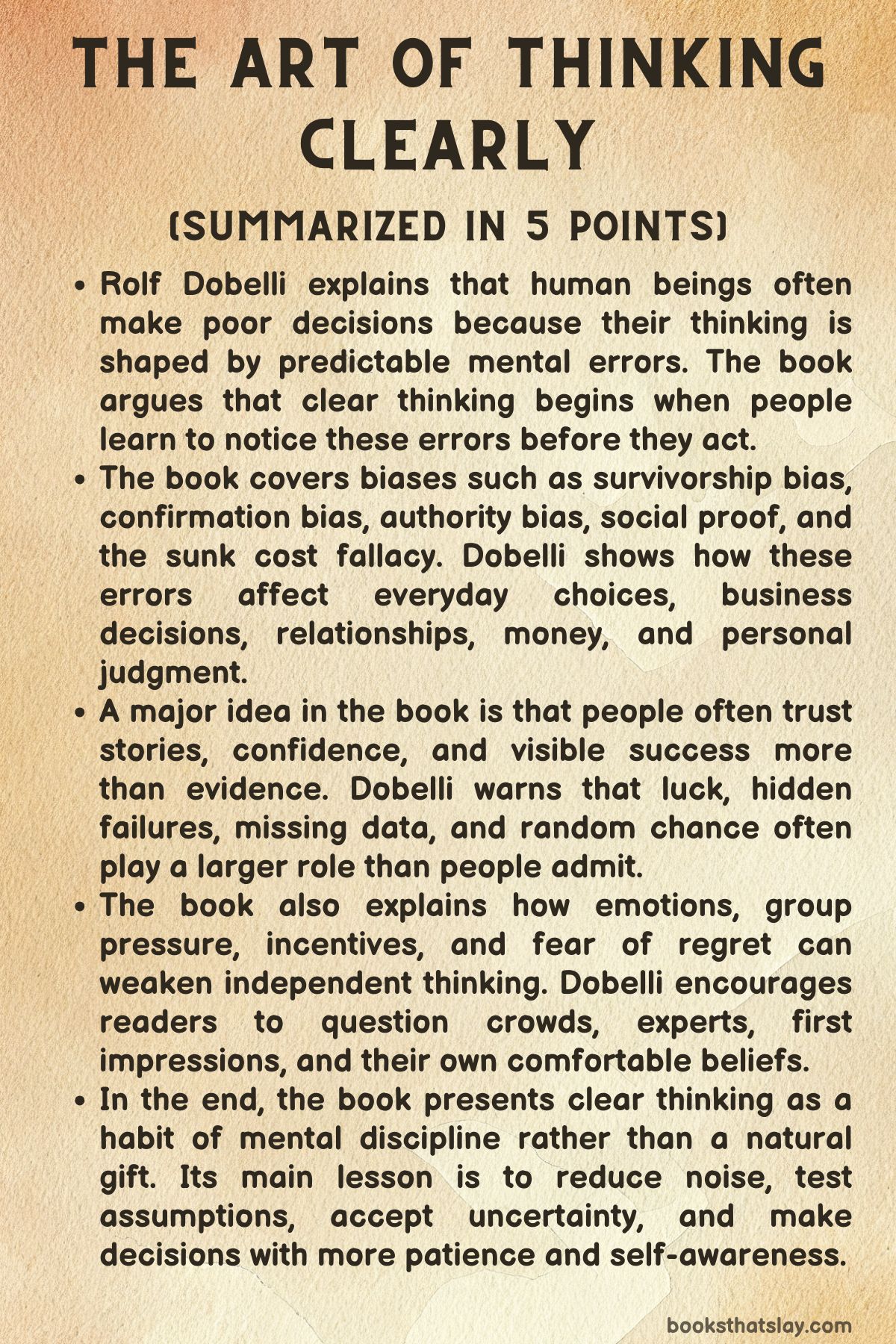
The Art of Thinking Clearly by Rolf Dobelli is a nonfiction guide to the mental errors that distort human judgment. Rather than presenting clear thinking as a natural talent, Dobelli treats it as a discipline built through awareness, restraint, and repeated self-correction.
The book gathers many cognitive biases from psychology, economics, statistics, and behavioral science, then explains how they appear in everyday life, business, relationships, investing, politics, and personal decision-making. Its purpose is practical: to help readers notice faulty reasoning before it turns into costly action, misplaced confidence, or self-deception.
Summary
The Art of Thinking Clearly is not a story-driven book in the usual fictional sense. Its movement is argumentative rather than dramatic: it begins with the idea that human beings are naturally prone to repeated mistakes in thinking, then builds a catalog of those mistakes so that readers can recognize them in daily life.
Dobelli presents cognitive errors as predictable habits of the mind. People do not simply make poor decisions because they lack intelligence.
They often make poor decisions because their brains rely on shortcuts, emotions, social cues, memory distortions, and false patterns. The book’s central promise is that people may not be able to remove these biases completely, but they can learn to notice them and reduce their damage.
Dobelli begins by defining cognitive errors as systematic departures from rational thought. This framing is important because it removes the illusion that clear thinking happens automatically.
Instead, the mind has to be trained to pause, test, and question itself. Early in the book, he shows how people focus too heavily on visible success while ignoring the many failures hidden from view.
This creates false hope in areas such as business, art, investing, and personal ambition. A person may look at a successful novelist, entrepreneur, or athlete and assume the path is easier than it is, because the failed attempts are absent from public memory.
This is one of Dobelli’s recurring lessons: what is missing from the evidence often matters more than what is present.
He then turns to the way people mistake causes, patterns, and selection effects. A school, company, or training program may appear to create excellence, when it may simply be selecting people who were already likely to succeed.
Likewise, the human mind is eager to see patterns in random events. A cluster of wins in the stock market, a lucky sequence, or a strange coincidence can feel meaningful even when chance is enough to explain it.
Dobelli repeatedly warns that the mind prefers order to randomness, even when the order is invented.
Social influence becomes another major source of faulty judgment. People often treat the behavior of a crowd as evidence that something must be true or wise.
If many people buy a product, follow a trend, praise a leader, or panic at the same time, the individual feels pressure to follow. Dobelli argues that this instinct may have helped human beings survive in groups, but it can also lead to collective error.
The same is true of authority. Experts, leaders, institutions, and confident public figures can overpower personal judgment.
The book does not claim that expertise is worthless; rather, it warns that respect for authority should not replace independent checking.
Several sections focus on how people protect beliefs they already hold. Confirmation bias receives special attention because it quietly filters reality.
People search for, remember, and trust evidence that supports their existing views, while dismissing evidence that challenges them. Dobelli presents this as one of the most powerful obstacles to clear thought.
A belief becomes dangerous not only when it is wrong, but when the person holding it stops testing it. The antidote is active opposition to one’s own certainty: looking for facts that would prove one wrong, listening to dissent, and setting conditions in advance for changing one’s mind.
The book also examines how memory and storytelling distort reality. People turn events into neat stories because stories are easier to understand than complexity.
Hindsight makes past events seem more predictable than they were, and narrative bias gives random events an artificial sense of meaning. After something happens, people often believe they “knew it all along,” even if their earlier predictions were vague or wrong.
Dobelli suggests that writing things down, reviewing past assumptions, and comparing predictions with outcomes can help expose this illusion.
Overconfidence is another repeated target. People overestimate what they know, how well they can predict the future, and how much control they have over events.
This can affect investors, doctors, consultants, managers, and ordinary decision-makers. Dobelli distinguishes real knowledge from polished performance.
A person who speaks confidently may not understand the subject deeply, while a true expert is often aware of limits and uncertainty. The book urges readers to distrust excessive confidence, especially in fields shaped by randomness, complexity, and incomplete information.
Dobelli also explains that outcomes are not always reliable measures of decision quality. A reckless decision can end well through luck, and a careful decision can end badly because of outside forces.
Judging by results alone leads people to reward foolish risks and condemn sound reasoning. This is especially relevant in business, finance, sports, and leadership, where success often attracts admiration even when the process behind it was weak.
Dobelli advises readers to judge decisions by the information available at the time and the quality of the reasoning, not only by the final result.
The book then shifts toward consumer behavior, desire, and choice. More options do not always create greater freedom; they can create paralysis, dissatisfaction, and regret.
Dobelli recommends deciding on clear criteria before choosing and accepting an option that is good enough rather than endlessly chasing perfection. Human beings also overvalue what they already own, desire things more when they seem scarce, and let first numbers or first impressions anchor later judgment.
Marketers, negotiators, and sellers can exploit these tendencies by shaping context before the buyer realizes what is happening.
Probability and risk form another major strand of the book. People often neglect base rates, misread rare events, and misunderstand randomness.
They may focus on a dramatic possibility while ignoring its low likelihood, or they may expect chance to “balance out” after a streak. Dobelli argues that clear thinking requires looking beyond vivid examples and asking how often something actually happens.
Rare events are possible, coincidences are inevitable, and past random outcomes do not control future random outcomes.
The book also studies group behavior. Teams can suffer from conformity, laziness, shared blindness, and fear of dissent.
A group may appear strong because everyone agrees, but that agreement may hide pressure, silence, or fear. Dobelli values disagreement when it improves judgment.
He also warns that people often compare themselves with others in ways that damage honesty and growth. Envy, status anxiety, and fear of being outshone can lead people to reject talent, ignore better ideas, or defend weak positions.
Another recurring concern is the confusion between action and wisdom. People often act because waiting feels uncomfortable, not because action is useful.
At other times, they excuse harmful inaction because doing nothing feels less blameworthy than doing something wrong. Dobelli shows that both action and inaction can be irrational depending on the situation.
The point is not to act more or less, but to act for the right reasons. Similar logic applies to information.
More data does not always improve decisions. Sometimes extra information distracts, delays, or creates the illusion of intelligence without improving the choice.
Dobelli’s later discussions focus on self-deception, motivation, and emotional distortion. People justify weak reasons, protect their egos, adapt quickly to pleasures, and rewrite their memories to preserve self-respect.
They overvalue hard-won achievements simply because effort was invested. They also discount the future too heavily, preferring immediate pleasure over long-term benefit.
Dobelli’s advice is often structural: reduce unnecessary choices, design better defaults, create routines, close unimportant options, and build systems that make better behavior easier.
The final movement of the book becomes more philosophical. Dobelli argues that clear thinking often comes from subtraction rather than accumulation.
The task is not always to learn more, consume more news, gather more opinions, or open more possibilities. Often, it is to remove noise, reduce distraction, question flattering evidence, and accept uncertainty.
Planning should include failure scenarios. Expertise should be balanced with models from other fields.
Success should be examined for luck, hidden alternatives, and missing data. In the end, the book presents clear thinking as mental hygiene: a steady practice of noticing bias, resisting emotional shortcuts, and refusing to trust the first story the mind offers.
Key Figures
Rolf Dobelli
Rolf Dobelli is the central guiding presence in The Art of Thinking Clearly, not as a fictional protagonist but as the organizing intelligence behind the book. He appears as a translator of behavioral science for ordinary readers, taking ideas from psychology, economics, statistics, and philosophy and turning them into short practical lessons.
His voice is direct, skeptical, and often corrective. He is not trying to comfort the reader or celebrate intuition; he is trying to expose how easily intuition misleads.
Dobelli’s role in the book is that of a disciplined observer who repeatedly asks readers to distrust easy explanations, emotional reactions, and confident predictions. His character is defined by intellectual restraint.
He does not promise perfect rationality, and he does not present clear thinking as a heroic achievement. Instead, he frames it as a modest but necessary habit: learn the error, notice the situation, and pause before acting.
Nassim Nicholas Taleb
Nassim Nicholas Taleb functions as one of the strongest intellectual influences in The Art of Thinking Clearly. His importance lies less in personal action and more in the kind of worldview his ideas bring into the book.
Through Taleb’s influence, the reader is encouraged to respect randomness, rare events, hidden failures, and the limits of prediction. Taleb represents a challenge to neat stories of success and expertise.
He reminds the book’s world that many outcomes people call skill, genius, or destiny may actually be shaped by luck, survival, and unseen alternatives. His presence strengthens Dobelli’s repeated warning against overconfidence, especially in fields such as finance, forecasting, business, and public commentary.
Taleb’s role is that of a severe intellectual counterweight to human arrogance. He stands for uncertainty, skepticism, and the uncomfortable truth that the future often refuses to follow the past.
Daniel Kahneman and Amos Tversky
Daniel Kahneman and Amos Tversky appear as foundational figures behind many of the book’s ideas about judgment, probability, framing, and decision-making. They are not developed like fictional characters, yet their work gives the book much of its scientific backbone.
Their importance comes from showing that human irrationality is not random chaos but follows recognizable patterns. Through their influence, the book explains why wording can change choices, why people fear losses more than they value equal gains, why plausible stories can overpower statistical truth, and why people often mishandle risk.
Kahneman and Tversky represent the disciplined study of human error. They give Dobelli’s arguments a research-based foundation and show that even intelligent people can make predictable mistakes.
Their role in the book is to make bias visible, measurable, and harder to dismiss as mere weakness or stupidity.
Charles Darwin
Charles Darwin appears as an example of intellectual discipline rather than as a major biographical figure. Dobelli uses him as a model for how a serious thinker handles his own beliefs.
Darwin’s importance lies in his habit of actively seeking evidence that might weaken or disprove his ideas. In the moral world of the book, this makes him an example of clear thinking.
He represents the opposite of confirmation bias. Instead of collecting only friendly evidence, Darwin shows that a belief becomes stronger when it survives genuine challenge.
His presence teaches that intelligence is not simply having ideas, but testing them honestly. In a book filled with examples of self-protection and rationalization, Darwin stands as a figure of disciplined doubt.
He shows that clear thought requires courage because it asks people to threaten their own favorite conclusions.
Stanley Milgram
Stanley Milgram appears through the book’s discussion of obedience and authority. His role is to reveal how easily ordinary people can submit to perceived authority, even when that authority conflicts with conscience or independent judgment.
Milgram’s presence gives the discussion of authority bias a darker psychological force. He represents the uncomfortable truth that people may not be as independent as they imagine.
In the book’s larger argument, Milgram matters because he shows that bad thinking is not only private; it can become social, institutional, and morally dangerous. People can surrender judgment because someone with status, a title, or official confidence tells them what to do.
Milgram’s role is therefore cautionary. He reminds the reader that clear thinking sometimes requires resistance, not rebellion for its own sake, but the refusal to let authority replace moral and rational responsibility.
The Reader as Decision-Maker
The reader is one of the most important implied figures in The Art of Thinking Clearly. Dobelli writes as though the reader is intelligent but vulnerable, capable of better judgment yet constantly exposed to traps.
This implied reader buys products, joins groups, makes plans, trusts experts, regrets losses, envies others, overvalues possessions, postpones difficult work, and explains away mistakes. The reader is not mocked for these weaknesses; instead, the book treats them as normal human tendencies.
This makes the reader both subject and student. The book’s lessons matter because they are meant to be applied to ordinary choices rather than admired from a distance.
The reader’s character develops through recognition. Each bias asks the reader to see a private habit more clearly and to replace automatic reaction with a more careful pause.
Experts, Authorities, and Forecasters
Experts, authorities, and forecasters form a recurring group of figures in the book. They are not presented as useless or dishonest by default, but they are treated with caution.
Dobelli shows that people often give too much weight to confident specialists, public commentators, managers, doctors, consultants, financial analysts, and professional predictors. These figures can offer valuable knowledge, yet they can also become symbols of misplaced certainty.
Their danger lies in the way they appear to reduce uncertainty. A confident expert can make a weak claim feel solid simply by speaking from a position of status.
Forecasters are especially important because they reveal how little people can know about complex future events. In the book, these figures teach readers to separate real expertise from performance, to ask for evidence, and to remember that professional confidence is not the same as truth.
The Crowd and the Group
The crowd appears as a powerful pressure on individual judgment. It can take the form of consumers, voters, teams, committees, organizations, markets, or social circles.
Dobelli presents the group as both useful and dangerous. Human beings need groups, but groups can create conformity, laziness, shared error, and silence.
When everyone seems to agree, the individual may stop questioning. When many people desire the same product, support the same idea, or fear the same threat, the crowd can make a weak belief feel safe.
The group also encourages people to hide effort, avoid responsibility, or suppress dissent in order to preserve harmony. In the book, the crowd is not evil; it is seductive.
Its power comes from comfort, belonging, and the fear of standing alone. Clear thinking often begins when a person is willing to step outside that comfort.
Marketers, Consultants, and Incentive-Driven Professionals
Marketers, consultants, lawyers, executives, and other incentive-driven professionals appear throughout the book as figures who either exploit bias or become trapped by it. They understand, sometimes deliberately and sometimes instinctively, that human judgment can be shaped by framing, scarcity, anchors, contrast, reciprocity, and social proof.
A price can look attractive beside a higher price. A product can seem more desirable when it appears limited.
A small favor can create obligation. An expert can defend failure by saying improvement will come later.
These figures matter because they show that cognitive errors do not remain inside the mind; they are built into systems, sales methods, contracts, offices, and institutions. Dobelli’s treatment of them encourages readers to ask who benefits from a decision structure.
When incentives are misaligned, even intelligent people may behave irrationally.
The Human Mind
The human mind is the book’s most constant figure, almost like an unseen central character. It wants certainty, comfort, meaning, speed, and self-protection.
It dislikes ambiguity, loss, regret, and contradiction. It creates stories, sees patterns, follows crowds, obeys authority, protects ego, and mistakes vivid examples for reliable data.
Yet the mind is not portrayed as hopeless. Its flaws are predictable, which means they can be anticipated.
In The Art of Thinking Clearly, the human mind is both the source of error and the tool that can reduce error. This tension gives the book its main energy.
Dobelli does not ask the mind to become perfectly rational; he asks it to recognize its own habits. The mind becomes wiser not by trusting itself more, but by learning when not to trust itself too quickly.
Themes
Clear Thinking as a Practice of Subtraction
Clear thinking in The Art of Thinking Clearly often depends on removing what distorts judgment rather than adding more information. Dobelli repeatedly shows that people are not confused only because they know too little.
They are also confused because they carry too much noise: irrelevant data, emotional pressure, social influence, old investments, dramatic stories, weak explanations, and unnecessary choices. The book’s repeated advice is to simplify the field of thought.
Remove options that do not matter. Ignore information that will not change the decision.
Step away from constant news. Close doors that drain attention.
Question evidence that flatters existing beliefs. This theme becomes especially powerful because it challenges a common modern assumption that more is always better.
More data, more opinions, more options, and more speed can make people feel informed while making them less wise. Dobelli’s model of clear thinking is quieter and stricter.
It asks the reader to build mental filters, not just mental libraries. A clear mind is not one that reacts to everything, but one that knows what to exclude.
Bias as a Normal Feature of Human Judgment
Bias is presented not as a rare failure of foolish people, but as a normal feature of human judgment. This theme gives the book much of its practical force.
Dobelli’s examples show that intelligence, education, status, and experience do not protect people from distorted thinking. Experts can overpredict, successful people can confuse luck with skill, groups can silence dissent, and ordinary individuals can reshape facts to protect pride.
The mind has shortcuts because shortcuts are useful, but those same shortcuts create predictable errors. This view is both humbling and useful.
It prevents the reader from treating bias as someone else’s problem. The more dangerous belief is not “I may be biased,” but “I am rational enough to be safe.” Dobelli’s treatment of bias also shows why self-awareness must be active.
It is not enough to value truth in theory. People must test their own beliefs, seek disconfirming evidence, compare decisions with base rates, and ask what information is missing.
Bias becomes manageable only when it is expected.
Social Pressure and the Loss of Independent Judgment
Social pressure appears as one of the strongest forces against independent thought. People imitate crowds, obey authorities, protect group harmony, favor their own circles, and assume that others share their views.
These habits can feel harmless because they often appear as politeness, loyalty, confidence, or common sense. Dobelli shows that they can quietly replace judgment.
Social proof makes popularity look like truth. Authority bias makes status look like evidence.
Groupthink makes agreement look like wisdom. In-group bias makes loyalty look like fairness.
The book’s treatment of social pressure is important because it expands clear thinking beyond private logic. A person may reason well alone and still make poor decisions inside a group, workplace, market, or political environment.
Independent judgment requires more than intelligence; it requires the courage to tolerate discomfort. Speaking against a group, doubting a leader, questioning a trend, or hiring someone more talented can all threaten the ego.
Dobelli suggests that clear thought often begins at the point where belonging stops being the highest priority.
Humility in the Face of Chance and Uncertainty
Chance and uncertainty repeatedly weaken human confidence throughout the book. Dobelli shows that people are quick to explain success, failure, coincidence, streaks, and future events as though the world were more orderly than it is.
They turn lucky outcomes into proof of skill, treat past patterns as guarantees, and trust forecasts in areas where prediction is fragile. This theme is central because it attacks one of the mind’s deepest comforts: the belief that events are more controllable and knowable than they really are.
Humility becomes a practical tool, not a decorative virtue. It encourages people to ask how often an outcome normally occurs, what alternative paths were possible, what failures are hidden, and whether a result came from good reasoning or luck.
Such humility does not mean passivity. It means planning with margins, diversifying risk, judging processes carefully, and resisting the charm of certainty.
Dobelli’s view of uncertainty is demanding but useful. The person who admits limits is less likely to be fooled by confidence, less likely to overpromise, and better prepared when reality refuses to match expectation.