The Atlas of Us Summary, Characters and Themes
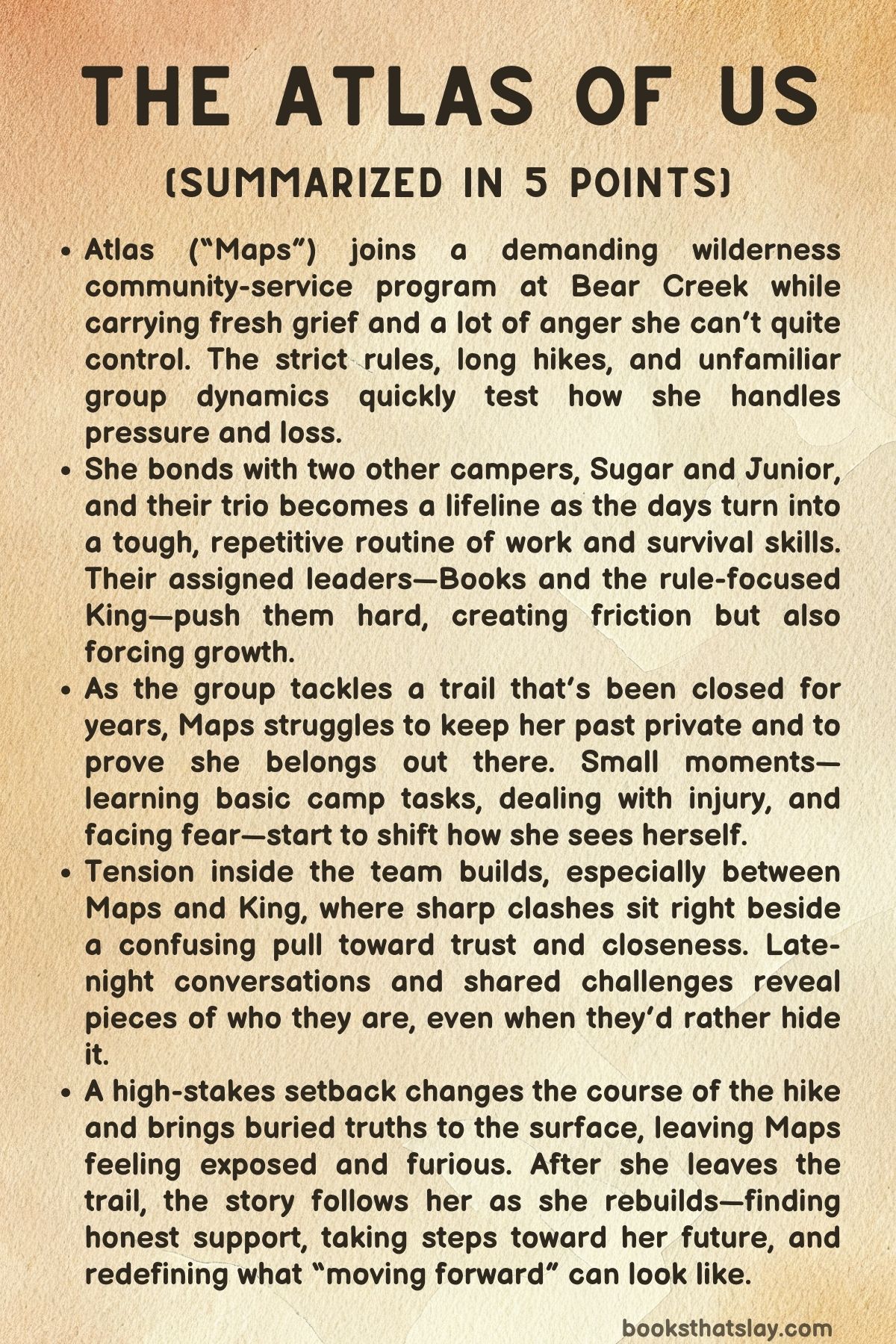
The Atlas of Us by Kristin Dwyer is a contemporary young-adult novel about grief, identity, and the strange ways new connections can form when life has already cracked open. Atlas “Maps” James arrives at a wilderness community-service program after her father’s death, carrying anger, secrets, and a deadline she won’t explain.
Assigned to reopen a long-closed trail, she’s forced into exhausting work, constant proximity with strangers, and rules that leave no room to hide. In the mountains, she begins rebuilding herself—through friendship, hard-earned honesty, and a complicated bond with a boy who knows more about her than she realizes.
Summary
Atlas James shows up at Bear Creek Campgrounds with her mother and a suitcase that immediately marks her as an outsider. She’s there for a four-week community service hiking program, though she doesn’t feel like the kind of person who belongs in the woods anymore.
Her father died of cancer, and since then her life has been sliding: she quit school, lost her job, and has been living with an anger that keeps bursting out. Her mother is convinced Bear Creek will help, but Atlas agreed for a different reason.
Before he died, her dad wrote down a list of things he still wanted to do, and one of them was hiking the Western Sierra Trail with her. Atlas also has a date hanging over her head—August 30—and she won’t say why she needs to be somewhere right after the program ends.
At check-in, she learns that everyone in the program goes by a trail nickname. Her paperwork assigns her “Maps,” and she decides to take it as a way to be someone else for a while.
She’s told to meet Joe, the program director, who turns out to be her father’s best friend. Joe is rough with her from the start.
He calls her Atlas and “Outlaw,” refuses to coddle her, and warns her not to tell anyone she’s connected to him or to her dad. Atlas insists on being Maps in front of everyone, both to protect herself and to avoid becoming “the dead guy’s daughter.”
She tries to fade into the group but keeps getting hit by waves of panic and grief. Behind an outhouse building, she pulls out a crushed pack of cigarettes she found in her father’s truck, treating them like contraband and comfort at once.
A tan blond boy without a name tag appears, takes the cigarettes, crushes them, and warns her about rules. Atlas is furious, embarrassed, and shaken by how easily he corners her.
During orientation, Atlas meets two other participants who become her first real anchors: Sugar, bold and stylish with green hair, and Junior, tall and expressive with glittery nails and a septum piercing. They form a quick trio, bonded by their shared “blue dot” team marking and their mutual need for someone to talk to.
Two older boys hand out Popsicles each day—King and Books—and the group treats them like minor celebrities. King seems untouchable and strict, while Books has a reputation for harsh consequences.
Atlas learns their assignment: her team will work on the Western Sierra Trail, closed for years after a fire. That hits her hard, because it’s the exact trail from her father’s list, and she immediately suspects Joe arranged it.
The punchline arrives right after: their leaders will be King and Books, which means she’ll be stuck with the boy who crushed her cigarettes.
Before they leave, the staff strip everyone down to the essentials. Sugar loses her extra toiletries, Junior loses most of his clothes, and Atlas is forced to hand over her phone and anything labeled a “weapon.” Joe delivers a brutal talk about long days, heavy packs, and hard labor.
When he gives Atlas a compass, the gesture cracks her open. She runs to the outhouse and cries until she can breathe again.
Outside, she hears Books demanding to know where she went, and King covers for her, buying her privacy without making a show of it.
The team hikes into a section of wilderness marked with signs warning them the trail is closed and that they’re trespassing. Books and King take their roles seriously: Books focuses on efficiency and consequences, King tracks details in a notebook and criticizes mistakes.
Atlas struggles under her pack and tries to keep up without revealing how fragile she feels. Her assigned job is tents, and the first night becomes a disaster when she can’t figure them out.
Books refuses to help and threatens they’ll sleep without shelter if she can’t do what she’s responsible for. King steps in briefly, showing her the basic approach, but Atlas still fumbles and earns ridicule.
Sugar makes it clear that if Atlas keeps putting them at risk, friendship won’t save her.
By morning, the tent has collapsed, leaving them damp and annoyed. Atlas is humiliated, but she keeps moving.
The days settle into a punishing pattern: hike, work, clear brush, haul debris, cut down hazards, and repeat. Junior tries to keep conversation alive.
Atlas lies about who she is and where she’s from, inventing a neat version of her life that doesn’t include loss, dropping out, or the way her grief makes her feel dangerous. King stays mostly guarded, but he also notices practical things—like Atlas’s feet—and offers advice that feels strangely gentle coming from someone so strict.
A turning point comes when the team finally reaches a calmer stretch of river and asks to swim. King hesitates and lectures them about safety, but he allows it under strict rules.
The water changes the mood. Even King laughs when Books and Junior splash him and drag him in.
Atlas wades in to wash and ends up talking with King more openly than she has so far. He tells her he’s twenty and shares pieces of his family situation: he has siblings, he’s been cut off, and he’s not allowed to contact his younger sister.
When pressed about why, he claims it was “poor decisions,” then admits he smoked cigarettes. He says the program saved him and Joe believes in him.
He wants a conservation internship and dreams of going to Alaska.
Not long after, Junior gets hurt while gathering firewood. The cut looks bad, and Atlas scrambles to bring the first aid kit while Books and King handle the wound.
It doesn’t need stitches, but it will scar. The incident pulls them into a more unified rhythm, at least briefly.
That night, Books finds an old bottle of whiskey and intends to toss it because alcohol is forbidden. Junior argues they should drink it so it won’t be left on the trail, and King reluctantly goes along.
The shared swigs loosen everyone’s edges. They sprawl in close quarters and confess half-truths.
Atlas doubles down on her invented life, claiming she skipped a European vacation and is headed to college. When they fall asleep crowded together, she’s sharply aware of King beside her.
The next morning, everything falls apart. The fire wasn’t properly extinguished, and their camp looks rummaged through and trashed.
King explodes, accusing Atlas of leaving embers and risking a forest fire. Sugar and King clash, and Sugar throws a jealous accusation into the fight—hinting that King’s attention toward Atlas isn’t just about rules.
Atlas lashes back at Sugar, and Books forces a separation to cool things down.
They soon meet another team that camps with them for a night, which lightens the atmosphere. Games and laughter return.
Atlas tries to bluff in a card game and gets caught, and King’s sharp focus on her makes her feel exposed. Later, King pulls back again, telling her he isn’t interested in friendship.
The mixed signals leave Atlas spinning between annoyance and attraction.
A new conflict ignites when Atlas can’t find her gloves. Sugar refuses to unpack again, King refuses to delay the schedule, and Atlas refuses to go back alone.
Stubbornness wins. She works without gloves until her hands are torn and bleeding.
When Joe arrives for resupply, he’s furious that they let it happen and says Atlas has to leave. Then Sugar finds the gloves—rolled inside her own sleeping bag—and admits she hid them by accident and then panicked and doubled down.
She apologizes, and she and Atlas repair their friendship, but the distrust has already left a mark.
Joe stays long enough to see how silent and hostile the team has become. He pushes them to talk, reminding them the trail matters to him.
After he leaves, the tension between Atlas and King keeps sparking until a dangerous task nearly turns into an accident. King saves Atlas at the last second, but they argue right afterward anyway.
Books finally gets fed up and sends Atlas and King down a separate route alone, hoping space will reset the group.
That forced isolation leads to the first real honesty between them. They have to squeeze through a narrow rock crack, and Atlas panics, gets stuck, and can’t breathe.
King tells her to drop her pack and talks her through it, guiding her with steady instructions and touch. Once she’s free, he holds her and matches her breathing until the panic passes.
Atlas finally tells the truth: her father died, and small spaces scare her because of the way death made the world feel like it could close in at any moment. She admits she’s been lying about her life because truth is exhausting.
King listens without pity. In return, he admits he wasn’t originally in the program by choice; the year before it was court-ordered.
He calls himself trouble, and Atlas quietly agrees she is too.
After that, the team feels closer, but attraction between Atlas and King becomes harder to ignore. At a waterfall, they swim again, and Atlas impulsively climbs up to jump.
She launches herself without warning and hits the water hard, getting pulled by the current before she fights back to shore. King swims after her, furious and scared.
Their argument is full of heat that isn’t only anger, and for a moment Atlas almost asks the question hanging between them. Before she can, the others interrupt.
They reach a busy basecamp with showers and other hikers, and the atmosphere turns into something like a party. King’s friends are there, including Pidgeon, who is beautiful and confident.
Atlas feels jealousy so sharp it embarrasses her. She drinks, gets moody, and acts rude.
King steers her back toward their tents, gives her water, stays with her while she cleans up, and helps her settle down. In the tent, Atlas admits she wanted to ask about kissing him, then asks directly if he thinks about kissing her.
She kisses him first, and he kisses her back. It escalates until Atlas pushes for more, and King stops, telling her she’s too drunk and he can’t.
He insists they’ll talk when she’s sober.
The next morning, Atlas wakes with a hangover and shame. She runs into Pidgeon, who surprises her by being blunt and kind rather than competitive.
Atlas admits her father died, and Pidgeon doesn’t offer polished comfort. She simply agrees it’s awful and stays with Atlas while she breaks apart.
When the group leaves basecamp, King tries to talk, but Atlas shuts him down, insisting it meant nothing. King agrees it can’t happen again, setting boundaries that feel like rejection even though Atlas is the one who demanded distance.
Not long after, disaster hits. A fire starts near their camp and spreads fast.
They panic and fight it with whatever they have until it’s out. Sugar breaks down and admits she started it.
Terrified of the consequences, the team takes collective blame when Joe arrives. Joe is shaken and furious, and he forces them onto a detour through a burned-out section of forest, making them work in a harsh landscape that shows what fire can do when it gets away.
Later, Joe leads them to a place with showers and a gas station, and they’re allowed to call home. Atlas can’t bring herself to call her mother, and Joe covers for her.
He also shares his own story of loss and warns Atlas that the mountains can become a hiding place rather than a cure. In the store, Atlas runs into boys from her old life.
One of them repeats rumors that Atlas dropped out and got caught with drugs. Atlas denies it, but the interaction shakes her sense of control.
She finally admits to King that she dropped out after her dad died and lied about college because she wanted to seem normal.
Soon after, Atlas is jolted awake by Books shouting that a car is waiting and Joe is outside. As they scramble, King stops Atlas and hands her his journal, insisting he has to explain something.
Inside, Atlas finds entries about the hike and drawings, but also her name written again and again. Then she sees the first page: a note addressed to King and signed by Patrick—her father.
Atlas recognizes the handwriting instantly.
King admits he knew her father. While King was doing previous conservation work with Joe, Patrick often visited, brought food and water, and talked with them.
King knew about Patrick’s daughter. He knew who Atlas was almost immediately, especially when he saw her holding cigarettes that had once been his.
He reveals that Patrick took King’s cigarettes at the river while he was dying and told him to be better because time runs out. King says he wanted to tell Atlas sooner but didn’t.
Atlas feels betrayed and humiliated. It’s not just that King knew; Books knew too, and both of them were at her father’s funeral.
Atlas explodes, refusing to let anyone use her real name and accusing them of treating her grief like a story they shared without her consent. Overwhelmed, she storms away from the trail and from the people she’d started to trust.
Her mother picks her up. Back home, Atlas sees how the house has changed—medical equipment gone, grief still everywhere.
She finds some of her father’s ashes stored in her closet, separate from what her mother buried. Atlas decides to complete one item from her father’s list and flies to Florida with the ashes.
She goes to a protected island where her parents got engaged, struggles to reach it by rowboat, and buries the ashes in a way that’s messy and uncertain. She expects to see birds migrating at dusk, but instead the sky fills with bats.
The absurd surprise makes her laugh through tears, and she accepts that goodbye can be imperfect and still real.
Over time, Atlas begins rebuilding. She attends grief group, tells her mother she wants to get her GED, and slowly shifts their relationship from constant tension toward shared understanding.
She gets a job at a coffee shop and starts telling the truth about her life without trying to make it sound pretty. Joe visits, and Atlas accuses him of tricking her into the program and the trail assignment.
Joe pushes back, reminding her that her father was loved by more people than just her and that Atlas is embarrassed as much as she is angry. She asks about King, and Joe confirms King went to Alaska.
Books shows up at Atlas’s job and invites her to the movies. They begin a weekly ritual of watching multiple films with minimal talking, sharing snacks and quiet company.
Books eventually tells her Junior is his boyfriend. Atlas is invited into Books’s loud, chaotic family gathering for Thanksgiving and is surprised by how good it feels to be included.
She reconnects with Sugar and Junior through Books, and the friend group rebuilds around her.
As months pass, Atlas admits what she’s been dodging: she misses King. On New Year’s Eve, she’s at Junior’s party when Books and Junior get messages and rush inside.
Atlas follows and finds King at the door. Panic hits and she tries to run, but he follows her outside and stops her.
They argue. King claims he didn’t come for her, but admits he tried to find her after she left.
He reveals his real name is Henry and explains why he goes by King. He confesses he liked her since seeing her at her father’s funeral and that he’s scared she’ll walk away again.
They exchange numbers. Atlas texts him “Hi,” and he answers, asking to hang out.
They move slowly. A rainy drive becomes a careful restart.
When King returns to Alaska, their connection becomes daily texts and then phone calls. On the anniversary of her father’s death, Atlas struggles and reaches out, and King shows up unexpectedly because he wants to hug her.
He takes her to the cemetery, where Sugar, Books, and Junior arrive too, carrying drinks and a candle. One by one, they talk directly to her father’s grave, telling him Atlas is doing well and that he would be proud.
Together, they share a toast in the cold.
Later, Atlas flies to Alaska to see King. They spend nearly all their time together, finally letting their feelings become real.
King tells her he loves her. Atlas reads more of his journal and sees his guilt over keeping the truth, along with his hope that meeting her wasn’t an accident.
When she leaves Alaska, she understands how deeply she’s attached to him.
By the end, Atlas has her own small apartment by a river and is back in school. Junior is her roommate, Books is around often, Sugar visits, and King is back too.
Their nights are filled with pizza runs, jokes, and the kind of steady warmth Atlas once thought she’d lost forever. Looking at the life she’s built, Atlas realizes she wouldn’t erase the pain that started it, because it led her to people who chose her, stayed, and helped her feel safe again.
Characters
Atlas “Maps” James
Atlas enters The Atlas of Us carrying two kinds of weight: the physical burden of a trail pack she isn’t prepared for, and the emotional burden of her father’s death that has stalled her life and warped her sense of self. The nickname “Maps” becomes more than a camp label; it is a deliberate attempt to step out of “Atlas James, the girl who fell apart” and into a blank slate that doesn’t come with expectations, pity, or a history she can’t control.
Her early behavior—hiding, lying, snapping, refusing help, clinging to cigarettes as a secret relic—reads like defiance, but it’s really grief trying to protect itself. She performs normalcy with invented stories about suburban ease and college plans because the truth feels like an open wound she can’t keep explaining, and because being seen accurately is terrifying when she’s ashamed of how far she’s fallen.
Atlas’s arc is a steady movement from avoidance to ownership: she learns competence in small, humiliating increments (tents, tools, fire), and that competence slowly builds a bridge back to self-respect. What makes her growth convincing is that it isn’t neat—she backslides into jealousy, lashes out at friends, and tries to reduce intimacy to “it meant nothing” the moment it becomes real.
Her ultimate shift happens when she stops treating grief as something to outrun and instead treats it as something to carry honestly, whether that is telling people the truth about dropping out, choosing a GED, going to group, or redefining “goodbye” to her father on her own terms. By the end of The Atlas of Us, Atlas has not erased her pain; she has built a life sturdy enough to hold it.
Henry “King”
King presents as rule-bound, sharp-edged, and sometimes cruelly practical, but his rigidity is a coping mechanism shaped by fear and stakes: he needs control because he believes one mistake can destroy the future he is trying to earn. In the group dynamic, he functions like a pressure system—tightening standards, cutting off detours, refusing softness—yet the story repeatedly shows that beneath the severity is a person who notices details and quietly protects others.
His most telling moments are not the lectures but the silences: waiting outside the stall while Atlas cries, stepping in just enough to teach without rescuing, checking her feet, steadying her in the river, and later turning away from physical escalation because consent and sobriety matter more to him than desire. King’s internal conflict is that he wants to be good, but he also believes his past has defined him as “trouble,” so he clings to Joe’s approval and the Alaska internship as proof he can become someone else.
His relationship with Atlas is charged partly because she threatens the persona he uses to survive; she makes him feel, and feeling complicates his clean rulebook. The reveal that he knew her father and knew her identity reframes him as both deeply connected and deeply afraid—his secrecy is not only self-preservation but guilt and reverence, because Patrick’s words challenged him to change and he took them seriously.
When he finally admits his name is Henry and explains why he hides behind “King,” it completes his thematic role: he is a person practicing redemption in real time, learning that honesty is not a luxury you earn after you’re better, but part of becoming better.
Declan “Books”
Books is outwardly the harsh enforcer, the one associated with punishment and intimidation, and he initially seems like the antagonist within the leadership pair. Yet his severity is more complicated than cruelty; it is competence built from experience and an understanding that the wilderness doesn’t care about feelings.
He uses pressure as a teaching tool, sometimes crossing into needless humiliation, but he also consistently performs the unglamorous labor of responsibility: medical decisions, risk assessment, and holding the group together when emotions threaten to splinter it. Books’s most humanizing trait is that he doesn’t chase closeness with Atlas—he lets her earn trust through endurance—and once she’s gone, he becomes the unlikely bridge that reconnects her to the life she almost found on the trail.
The quiet movie ritual is a perfect expression of who he is: intimacy without performance, loyalty without speeches, presence without demanding emotional exposure. His relationship with Junior reveals a tenderness he doesn’t advertise, and his family gathering shows that the “hard” persona is only one context for him, not his whole identity.
Books represents the idea that care can look blunt, that love can be steady rather than soft, and that chosen family often arrives through the people you least expect.
Sugar
Sugar arrives like a spark—confident, visually loud, socially fearless—and she gives Atlas something essential: friendship that doesn’t require a long explanation. Her green hair and sharp commentary signal independence, but her deeper function in the story is as a mirror for Atlas’s emotional volatility.
Sugar is the first to draw boundaries (“fix the tent situation or our friendship won’t survive”), which forces Atlas to confront the fact that grief doesn’t excuse everything when other people are also tired, scared, and carrying weight. Sugar’s arc is especially compelling because she is not simply the “fun friend”; she is impulsive, prideful, and capable of spiraling into stubbornness, as seen in the gloves incident where her refusal to unpack becomes a moral stance that endangers someone else.
The wildfire confession is the moment her bravado collapses into raw accountability, and the group’s decision to take collective blame becomes an act of communal love that includes her rather than exiling her. Sugar’s willingness to apologize, to admit she got irrational, and to repair what she damaged makes her an emotional counterpoint to Atlas’s earlier avoidance.
Sugar embodies messy growth: the kind where you learn you can be strong and still be wrong, and where being loved sometimes means being corrected.
Junior
Junior is the social engine of the group, constantly trying to pull people into conversation, jokes, rituals, and shared meaning. His bright style—piercing, glittery nails—signals someone comfortable performing a self that stands out, and that comfort becomes a quiet invitation for others to stop hiding.
Junior’s obsession with Popsicle colors and romantic symbolism seems silly on the surface, but it reveals how he copes: by turning discomfort into play and loneliness into narrative. He is also the clearest embodiment of vulnerability that isn’t ashamed of itself—he asks questions, tries to connect, and doesn’t punish people for being awkward.
His injury on the trail becomes a test of the group’s cohesion and exposes how quickly chaos can become care, and later his reveal as Books’s boyfriend reframes earlier dynamics with warmth and stability. By the end, Junior’s role expands from comic relief to anchor; he becomes part of Atlas’s rebuilt life, even living with her, which signals that the trail didn’t just change her mood but changed her concept of home.
Junior represents chosen kinship and the courage of being openly yourself even when everyone else is armored.
Joe
Joe operates as both catalyst and complication: the program director who imposes rules and consequences, and the grieving friend who carries his own private history with Atlas’s father. His early hostility toward Atlas is partly professional posture and partly personal pain; he cannot be purely gentle with Patrick’s daughter because Patrick’s death made gentleness feel like collapse.
Joe’s insistence on secrecy—don’t tell people you know him, don’t trade on your father’s connection—suggests his fear of favoritism and his fear of grief contaminating the program’s structure. Yet Joe repeatedly shows a protective tenderness in the moments that matter: confiscating the phone while still handing her the compass, noticing her hands and intervening, covering for her when she can’t call home, and later visiting her to force a confrontation with the truth of what he did and why.
His story about losing a boy he loved reframes him as someone who understands how easily the mountains can become avoidance disguised as healing. That confession is one of the book’s clearest statements about grief: the scenery doesn’t fix you, it just gives you space to hide or to face yourself.
Joe represents adult grief—longer, quieter, often disguised as responsibility—and he pushes Atlas toward the hard lesson that her father belonged to a whole web of love, not only to her.
Pidgeon
Pidgeon initially appears as a threat through Atlas’s eyes, not because she does anything wrong, but because Atlas is primed to interpret her as competition for King’s attention and as proof that Atlas doesn’t belong. What makes Pidgeon memorable is how quickly she subverts that role: she is blunt without being cruel and kind without being patronizing.
Their dawn conversation is a pivotal emotional reset for Atlas because Pidgeon refuses the scripted sympathy Atlas has likely been drowning in; instead, she validates the ugliness of grief in plain language, which gives Atlas permission to stop performing composure. Pidgeon’s presence also highlights Atlas’s insecurity and how grief can distort perception, turning neutral people into enemies simply because they reflect what you fear losing.
In The Atlas of Us, Pidgeon is a small but crucial instrument of healing, showing that support sometimes comes from the person you were determined to dislike, and that relief can arrive through honesty rather than comfort clichés.
Ivy
Ivy functions as part of the wider social ecosystem of the program and as a stabilizing counterpart to the intensity of the Blue group. As a leader of Yellow and a friend to King and Books, she represents continuity—people who have history with them beyond Atlas’s perspective—which reinforces Atlas’s feeling of being an outsider.
At the same time, Ivy’s presence helps normalize the idea that King and Books are not monsters; they are people with friendships, inside jokes, and lives that are not centered on enforcing rules. Ivy is less about plot and more about context, expanding the world so it feels lived-in and reminding the reader that Atlas is stepping into a network that existed before she arrived.
Key
Key’s brief appearance early on works like a tonal marker: Atlas is surrounded by strangers who already understand the rhythm of Bear Creek, and even a small interaction can feel overwhelming. Key’s role is to emphasize Atlas’s disorientation and social fragility at the start, when she is trying to disappear behind a sticker and a nickname.
Key is a minor character whose main purpose is to sharpen Atlas’s isolation and the sense that everyone else has a map she doesn’t.
Conner Washington
Conner is a late-arriving embodiment of Atlas’s “old life” and the social narrative she has been trying to outrun. His casual cruelty—spreading rumors about drugs, treating her collapse as gossip—shows exactly why Atlas lies: because people like Conner turn pain into entertainment and shame into identity.
He appears at a moment when Atlas is already emotionally exposed after the fire and the detour, and his presence threatens to drag her back into the version of herself she despises. Conner represents the external voice of judgment that grief sufferers internalize, and his appearance helps push Atlas toward a turning point: admitting the truth to King and, later, choosing to live truthfully without flinching.
Joshua Yoon
Joshua appears alongside Conner as part of the same social memory trigger, reinforcing how suddenly the past can intrude and how little control Atlas has over what people think they know about her. Even without extensive characterization, his presence matters because it makes the encounter feel real—gossip is rarely carried by one person alone, and humiliation often comes with an audience.
Joshua functions as the echo that makes Conner’s voice louder, intensifying Atlas’s need to reclaim her own story.
Patrick James
Although Patrick is absent in the present tense of the plot, he is one of the most active forces in The Atlas of Us because nearly every choice Atlas makes is an argument with him, a tribute to him, or a refusal to accept the shape of life without him. He is portrayed through Atlas’s memories, his hiking list, and the way other characters speak about him, which gradually reveals that he was not only “Atlas’s dad” but a person who built community and left fingerprints on people’s lives.
The trail assignment, the compass, the cigarettes, and King’s journal all thread back to Patrick, turning him into a kind of quiet architect of the story’s connections. His note to King and his sharp line about time and being better show him as someone who could be gentle and direct at once, even while dying.
Patrick also complicates Atlas’s grief because he made promises—explicit or implied—that death broke, and Atlas’s Florida journey exposes the rage beneath her sadness. In the end, Patrick’s role shifts from idolized lost parent to something more human: a loved person who is gone, whose absence hurts, but whose love can still guide without controlling.
Themes
Grief as a Daily Force That Reshapes Identity
Atlas arrives at Bear Creek already split in two: the person she used to be with her father alive, and the person she has become after his death. What follows is not a neat journey from sadness to acceptance, but a long stretch of living with grief in the body—tight chest, sudden panic, anger that snaps out at the wrong people, and exhaustion that shows up as shutdown and avoidance.
In The Atlas of Us, grief keeps changing form depending on what the day demands: sometimes it looks like Atlas refusing help and pretending competence, sometimes like lying because the truth feels too heavy for casual conversation, and sometimes like needing to run to the outhouse to cry where nobody can watch. Her father’s presence is also constant through objects and rituals: the cigarettes found in his truck, the list of experiences he wanted, the compass she’s handed, the ashes hidden in a closet.
Those items don’t provide comfort by default; they trigger a fight between memory and reality, between what should have been and what is. The trail becomes a pressure chamber that exposes how grief has stalled her life—dropping out, losing work, isolating herself—while also forcing her into routines that keep her moving even when she doesn’t want to.
The most revealing moments are when Atlas stops performing and admits what she’s afraid of: the claustrophobic panic tied to loss, and the humiliation of being “behind” in a world that expects her to be fine by now. Healing begins only when she stops trying to present a polished story and allows grief to be messy in front of others, like the laughing-crying with Pidgeon and the quiet honesty she practices later at home.
The book treats grief as something that doesn’t disappear; it becomes something Atlas learns to carry without letting it decide every choice.
Reinvention Through Names, Roles, and Chosen Narratives
The nickname “Maps” is not a cute camp detail; it is a survival tactic. Atlas accepts it because it lets her step away from the version of herself defined by her father’s death and her recent failures.
The program’s rules and labels offer her a structure where nobody knows the “before,” and where she can imagine starting over without explaining anything. At the same time, the name also becomes a mask that she hides behind.
She tells stories about a different upbringing, invents future plans, and uses a glossy version of herself to avoid the pity and awkwardness she expects from the truth. That performance is fragile, though, because the trail demands real competence—setting tents, carrying weight, managing blisters—and reality keeps poking holes in her invented identity.
The tension grows when other people mirror back versions of her that she doesn’t control: “Homecoming Queen” as a mocking label, “Outlaw” as a provocation, and later “Atlas” as a name she refuses because it feels like someone else’s claim on her. The turning point is not simply that she admits the truth; it’s that she starts accepting an identity that includes contradiction.
She can be grieving and still funny, behind in school and still capable, angry and still deserving of care. Even the ending reinforces this: she doesn’t “return” to the person she was.
She becomes someone new—working, studying, living with friends—without needing a fake storyline to be worthy of respect. The movement from invention to honesty is gradual and earned, showing that reinvention works best when it grows from reality rather than escaping it.
Rules, Control, and the Struggle for Agency
Bear Creek’s strict structure creates an immediate power imbalance: the staff decides what Atlas can carry, what she can keep, how she is addressed, and even when she can rest. The rules are meant to build safety and discipline, but for Atlas they also echo her deeper fear of having no control after losing her father.
That is why she reacts so strongly to confiscations and rigid expectations: she experiences them as another trap layered onto the one grief already built. Books and King embody two versions of control.
Books uses authority bluntly, often treating struggle as a lesson that must be endured without comfort, while King uses control as a way to prevent risk and protect outcomes—his own future and the group’s safety. Atlas keeps pushing against both, not always because the rules are unreasonable, but because obeying can feel like surrendering her last bit of autonomy.
The missing-gloves incident makes this theme unavoidable: her refusal to walk back alone and her decision to work without gloves is a harsh attempt to prove she cannot be forced into vulnerability. The result—bleeding hands and Joe’s anger—shows how agency can become self-destruction when it’s driven by pride and fear rather than choice.
The wildfire escalates this into real danger, and the group’s decision to share blame becomes a complicated act of agency too: they protect each other, but they also accept consequences together. Later, at home, agency becomes quieter and healthier: choosing grief group, choosing a GED, choosing a job, choosing truth over image.
The book contrasts external control with internal control and argues that real agency is not about defiance for its own sake; it’s about making decisions that move you toward the life you want, even when that life includes pain.
Accountability, Redemption, and Becoming “Better” Through Action
The story places multiple characters in situations where they are defined by past mistakes: Atlas with dropping out and spiraling after her father’s death, King with being court-ordered into the program, Sugar with impulsive choices, Books with harshness and secrecy. Redemption here is not about being declared “good” by someone else; it is about taking responsibility and continuing anyway.
The fire incident is the clearest test of accountability. Sugar admits she started it, but the group chooses collective responsibility, and that choice reshapes them into something like a unit rather than five individuals protecting themselves.
The consequences are real—Joe’s fury, the dangerous detour, the fear of what could have happened—and the group must carry that weight without excuses. King’s arc is also built on action: he wants a future in conservation, but his growth is shown in how he treats people, how he stops when boundaries matter, how he shows up on the anniversary just to offer comfort, and how he admits his fear of Atlas leaving again.
Atlas’s redemption is the quietest and most central. She does not “win” by finishing a trail; she wins by returning to her life and rebuilding it: grief group, GED plans, work, honesty.
The message her father wrote—about there being no time to wait to be better—echoes through these choices without needing grand speeches. The book suggests that becoming better is rarely a single breakthrough; it is a series of decisions made when nobody is applauding, repeated until they form a new life.