The Bones Beneath My Skin Summary, Characters and Themes
The Bones Beneath My Skin by TJ Klune is a science-fiction and found-family novel set in the mid-1990s, grounded in grief, distrust of authority, and the quiet hope of human connection.
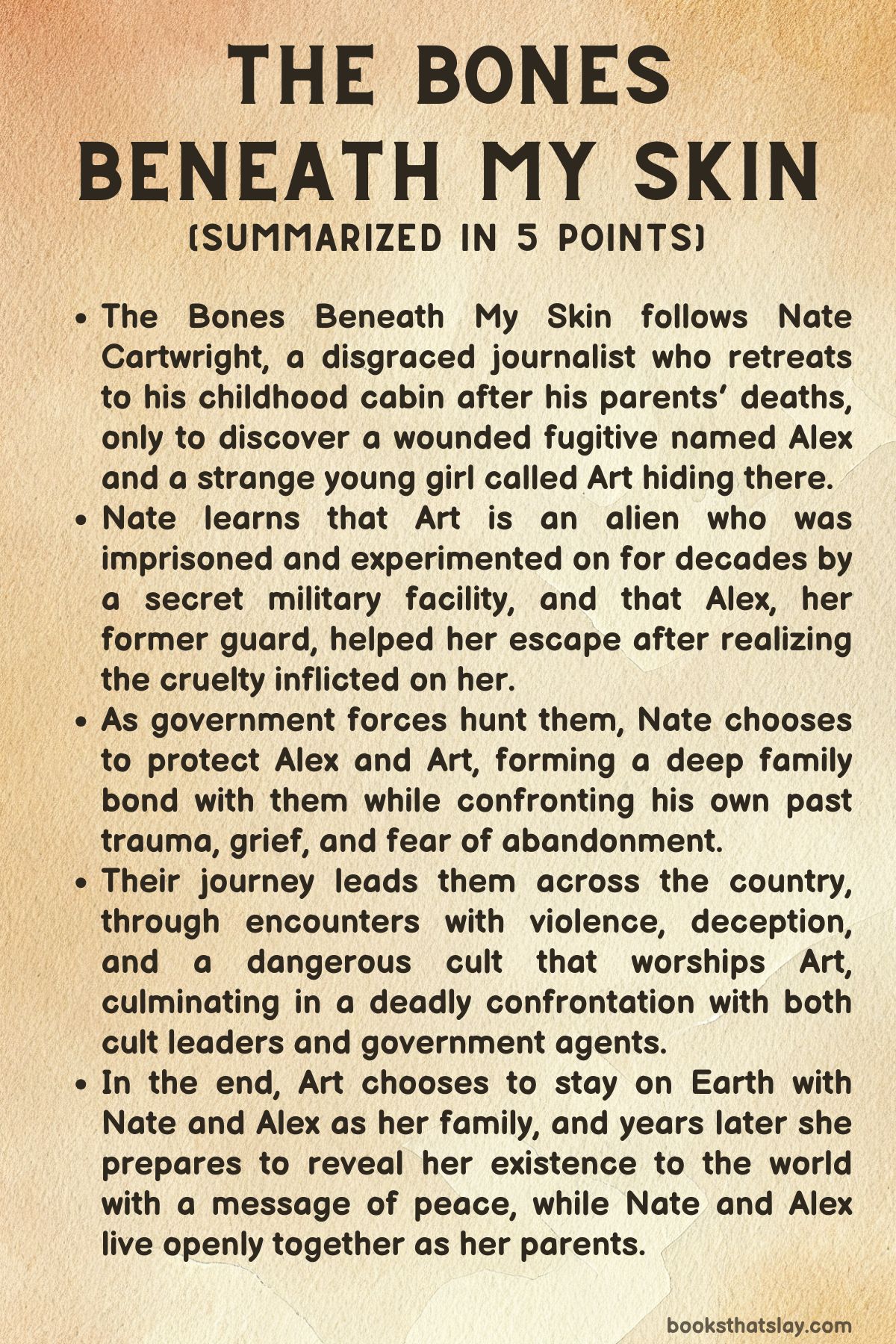
The story follows Nate Cartwright, a disgraced journalist returning to his childhood cabin in rural Oregon after his parents’ violent deaths. What begins as an attempt to hide from the world turns into an unexpected responsibility when Nate encounters a wounded stranger and a strange, brilliant child. Blending road-trip tension with speculative ideas, the book examines love chosen rather than inherited, and how safety, truth, and home can be built from broken beginnings.
Summary
Nate Cartwright returns to Roseland, Oregon, in March 1995 after years of estrangement from his family. His parents are dead—his father killed his mother and then himself—and Nate has inherited their remote lakeside cabin. Once a respected journalist in Washington, D.C., Nate has lost his job and reputation after an unethical affair with a political source. Emotionally exhausted and isolated, he retreats to the cabin hoping for quiet and anonymity.
Soon after arriving, Nate discovers that he is not alone. In the boat shed, he is confronted at gunpoint by an injured man named Alex and a young girl who calls herself Artemis Darth Vader, or Art. Alex collapses from his injuries, and despite fear and confusion, Nate helps get him inside. When Nate wakes later, he finds himself effectively trapped between sympathy and threat. Alex is armed, defensive, and clearly hiding something, while Art behaves in ways that make little sense for a child her apparent age. Nate considers calling the police, but isolation, lack of phone service, and Art’s unsettling confidence complicate every decision.
Over the next several days, an uneasy truce forms. Nate provides food and shelter, while Alex and Art remain secretive but nonviolent. Nate notices details that raise questions: Alex’s wound shows no broken skin, Art has never heard of common foods, and she speaks with certainty far beyond her years. Despite this, Art shows warmth and curiosity, and Alex, though guarded, displays genuine care for her. Nate, still processing his parents’ rejection of him for being gay, is struck by the devotion Alex shows Art.
A visit from a man claiming to be a county water worker rattles the fragile calm. Alex reacts with fear, searching the cabin for surveillance devices. Nate demands that they leave, but Art’s quiet sadness persuades him to let them stay one more day. Nate begins to suspect they are fugitives, possibly dangerous ones, yet he cannot bring himself to abandon them.
Seeking answers, Nate contacts an old colleague, Ruth, from his journalism days. She uncovers alarming information: Alex is actually Alex Weir, a soldier who went missing years earlier and recently reappeared only to go absent without leave from a secret military base known internally as the Mountain. Government agents are searching for him—and now for Nate as well. Before Nate can act on this information, he learns that the supposed water worker never existed and that the real technician has been murdered.
When armed men block the road near the cabin, Alex, Art, and Nate attempt to escape. During the confrontation, Art reveals the truth: she is not human. She uses her abilities to protect them, stopping bullets midair and destroying military vehicles with ease. There is no longer any doubt that she is the reason the government is hunting them.
They flee across multiple states, abandoning Nate’s truck, stealing another vehicle, and staying in cheap motels. Nate struggles with panic attacks and the sudden collapse of his understanding of reality. Art explains that she is an alien who was imprisoned for decades at the Mountain after being discovered on Earth. Scientists used her as an experiment, forcing her into the body of a comatose girl to see if she could heal it. Alex was assigned as her guard. Over time, he realized the cruelty of what was being done to her and helped her escape, knowing it would cost him his career and safety.
As they travel, Nate learns more about Alex’s past, including the grief that made him vulnerable to the military’s manipulation. Nate also confronts his own history—his father’s violence, his mother’s silence, and the cost of living honestly in a world that punished him for it. The bond among the three deepens into something resembling family, and Nate and Alex acknowledge their growing attraction to each other.
Their journey leads them to a secluded religious compound run by a man named Peter, who was once connected to Art’s earliest time on Earth. Peter believes Art is a divine being and has built a following around that belief. At first, the compound seems peaceful, but Nate senses danger. He later discovers that Peter has planned a mass suicide, convinced that death will reunite his followers with Art’s supposed celestial origin.
Peter poisons Nate and Alex and restrains Art using a device that suppresses her abilities. He forces Nate and Alex into a deadly game meant to prove faith. Art manipulates events just enough to regain control, freeing them and enabling Alex to kill Peter. Before they can escape, government forces surround the compound. Art shields Nate and Alex from gunfire, halting bullets in the air. In the chaos, Alex kills the government agent leading the operation, and the authorities later blame the entire incident on Peter’s cult.
Afterward, the three escape once more. Art reveals that her family is calling her home and that she cannot resist them much longer. In West Virginia, she opens a passage through space. Nate and Alex expect to lose her, but she makes a different choice. Art decides to stay on Earth, choosing Nate and Alex as her family. From that moment on, she begins to age like a human child.
Years later, Nate and Alex, now living under new names, are married and raising Art—now called Ellie—in quiet obscurity. When Ellie tells them her family is returning again, it is not to take her away, but to introduce themselves to humanity. The story ends as Ellie addresses the world, claiming both her name and her desire for peace, with Nate and Alex standing beside her as her chosen parents.
Characters
Nate Cartwright
Nate Cartwright is the emotional and moral center of The Bones Beneath My Skin. He begins the story deeply fractured by grief, shame, and anger—toward his parents, toward institutions that failed him, and toward himself. His return to Roseland is not an act of healing but of retreat; he wants isolation more than closure. Nate’s background as a journalist shapes how he initially approaches Alex and Art: suspicious, analytical, always searching for the hidden truth.
At the same time, his personal history of being rejected for his sexuality makes him unusually sensitive to vulnerability and cruelty, especially when authority is involved. Over the course of the story, Nate evolves from a passive observer of injustice into an active protector.
His choice to stay with Alex and Art, even when escape is possible, reflects his growing belief that family is something you build through care and sacrifice rather than blood. By the end, Nate becomes someone capable of love without fear, creating a stable, quiet life that directly contrasts with the violence and neglect of his childhood.
Alex Weir
Alex Weir is defined by restraint, loyalty, and long-buried grief. A former Marine and later a soldier at the Mountain, Alex has been trained to obey orders and suppress emotion, yet those very qualities are what make his eventual rebellion so meaningful. When he meets Art, he is still raw from personal loss, which leaves him emotionally exposed in a system that exploits trauma for control.
His bond with Art develops slowly, moving from resentment and fear to protectiveness and devotion, until she becomes the moral anchor of his life. Alex’s guarded nature often puts him at odds with Nate, but beneath his suspicion lies a strong ethical core. His bisexuality, revealed later in the story, adds depth to his internal conflict, particularly given his background in rigidly masculine environments. Alex’s love for Nate grows from trust rather than impulse, and his eventual domestic life shows how far he has moved from survival mode into genuine peace.
Artemis Darth Vader (Art / Ellie)
Art is the most complex and unconventional character in The Bones Beneath My Skin, existing at the intersection of alien intelligence and childlike wonder.
Although she appears as a young girl, Art is decades old, with memories shaped by imprisonment, experimentation, and isolation. Her strange habits, literal interpretations of language, and lack of familiarity with human norms reflect both her nonhuman origins and the deprivation of her upbringing. Despite immense power, Art is not driven by domination or revenge; instead, she seeks safety, curiosity, and connection. Her attachment to Alex is rooted in shared captivity and mutual protection, while her bond with
Nate grows from his willingness to treat her as a person rather than an object or a miracle. Art’s ultimate decision to remain on Earth and age as a human is not an act of sacrifice but of choice. She rejects the idea of destiny imposed by others and claims her own definition of family, identity, and belonging.
Big Eddie
Big Eddie serves as a quiet symbol of stability and decency in Roseland. Though physically imposing, he is gentle, observant, and emotionally grounded, providing a sharp contrast to the violence in Nate’s family history. His kindness toward Nate is uncomplicated and sincere, offering condolences without judgment and help without obligation.
Big Eddie’s presence emphasizes what Nate lacked growing up: an adult who shows care through consistent, everyday actions. His role as a father to his son Benji subtly reinforces the theme of chosen versus biological family. Though he remains on the margins of the plot, Big Eddie represents the possibility of small-town goodness without bigotry, challenging Nate’s assumption that returning home must mean returning to harm.
Ruth Silver
Ruth Silver embodies professional integrity mixed with personal regret. As Nate’s former colleague, she initially appears brusque and judgmental, reflecting the rigid ethics of journalism and her disappointment in Nate’s downfall. However, when Nate reaches out, Ruth becomes one of his most important allies, risking her own safety to uncover the truth about Alex and the Mountain.
Her investigation reveals both her courage and her lingering sense of responsibility toward Nate, despite his past mistakes. Ruth’s role highlights the cost of truth-seeking in a system designed to bury inconvenient realities. Her eventual silence in the public record underscores the novel’s critique of institutional power and the ease with which narratives are manipulated.
Randy
Randy represents the banality of state violence. Unlike overtly cruel antagonists, he presents himself as polite, reasonable, and procedural, which makes him more dangerous. His calm demeanor masks a willingness to lie, surveil, and kill in the name of control.
Randy’s insistence that Art is manipulating Nate and Alex reflects a broader institutional refusal to acknowledge autonomy in those deemed abnormal or threatening. He is not driven by personal hatred but by obedience and belief in hierarchy, making him a chilling example of how systems perpetuate harm through ordinary people doing their jobs.
Peter (Oren / Peter Williams)
Peter is a distorted mirror of devotion and belief. Once connected to Art through her earliest contact with humanity, he twists that experience into a theology that centers himself as chosen and enlightened.
His cult is built on emotional dependency, fear of the outside world, and the promise of transcendence through obedience. Peter’s reverence for Art strips her of agency, reducing her to a symbol rather than a being with desires and boundaries. His manipulation escalates from ideological control to physical violence, culminating in mass suicide and attempted murder. Peter’s downfall illustrates the danger of faith divorced from empathy and the human tendency to turn the unknown into justification for domination.
Ricky Cartwright
Ricky Cartwright, Nate’s older brother, appears briefly but plays an important symbolic role. He represents the path Nate might have taken had he stayed silent and compliant within his family. Ricky’s emotional distance and apparent acceptance of their parents’ legacy contrast sharply with Nate’s refusal to forget or forgive without accountability.
Nate’s phone call to Ricky, in which he expresses love without expectation of return, marks a turning point in Nate’s emotional arc. It is not reconciliation but release, allowing Nate to move forward without needing validation from a past that harmed him.
Themes
Chosen Family and the Meaning of Home
Safety, loyalty, and care are shown not as products of blood ties but as deliberate choices made under pressure. The Bones Beneath My Skin places Nate, Alex, and Art together not because they are related or even initially trusting, but because circumstance forces them into proximity. What develops between them is not sentimental or automatic; it is built through shared risk, protection, and repeated decisions to stay when leaving would be easier. Nate’s childhood home represents the failure of his biological family.
It is a place where silence enabled cruelty and love was conditional. In contrast, the cabin becomes a new kind of home once Alex and Art enter it. The space shifts from isolation to responsibility, and later to refuge, because of how the characters treat one another inside it.
Art’s presence reframes what family can mean. She is neither Nate’s child nor Alex’s responsibility in any legal or social sense, yet both men repeatedly choose her well-being over their own safety. That choice defines them more clearly than their past identities as journalist or soldier. Alex’s role as protector grows into something closer to parenthood, shaped by care rather than ownership. Nate’s role evolves from reluctant host to emotional anchor, offering stability Art has never known. Home, in this context, is not geography but behavior: cooking meals, listening without interrogation, standing in front of danger when it matters.
The epilogue confirms that family, once chosen, can be sustained across time without needing validation from society. Nate and Alex live quietly, raise Art, and change their names not out of shame but out of self-preservation.
Their family exists because they commit to one another daily, not because they are recognized by institutions. The novel argues that belonging is created through mutual protection and trust, and that a home can be built even after every inherited structure has failed.
State Power, Surveillance, and the Violation of the Body
Control over bodies and minds is a central source of conflict, embodied in the Mountain and the government forces pursuing Art. The state is presented not as a distant abstraction but as an invasive presence that claims authority through secrecy, fear, and manufactured necessity.
Art’s imprisonment is justified under the language of research and security, yet the reality is prolonged captivity, pain, and the denial of consent. Her body becomes property, and her consciousness a resource to be exploited. The scientific framing does not soften the violence; it disguises it.
Alex’s history with the military reveals how grief and vulnerability are used as entry points for control. He is selected because his losses make him pliable, and when he refuses to comply with abuse, he is labeled a traitor.
Nate’s experience as a journalist mirrors this theme from another angle. His career collapse shows how institutions punish those who step outside acceptable boundaries, even when the official language focuses on ethics rather than power. In both cases, authority is less concerned with justice than with maintaining dominance.
The pursuit of Art is relentless because she represents something the state cannot fully own. Her abilities expose the limits of institutional control, which is why surveillance intensifies rather than recedes. The willingness to kill Nate and Alex while preserving Art underscores how the system values assets over lives.
The novel critiques this logic by contrasting it with the personal ethics of its characters. Protection becomes meaningful only when it is voluntary. Resistance, in this story, is not ideological posturing but the refusal to surrender another being to a system that treats life as expendable.
Queer Identity, Shame, and Conditional Love
Nate’s sexuality is not treated as a subplot but as a shaping force in how he understands trust, rejection, and risk. His father’s response to discovering he is gay establishes a pattern of conditional love that follows Nate into adulthood. Silence from his mother deepens the wound, teaching him that harm does not always arrive through shouting or violence.
It can also arrive through absence and refusal to act. This history informs Nate’s instinct to keep distance from others, to expect abandonment, and to believe that care will eventually be withdrawn.
Alex complicates Nate’s assumptions. As a man shaped by military culture, Alex initially appears to fit the same category as those who once threatened Nate at protests and in public life. The fear is not irrational; it is grounded in experience. When Alex later names his bisexuality without spectacle or apology, it disrupts Nate’s internal expectations. Queer identity here is not framed as a revelation scene meant to reassure the reader. It is offered plainly, as fact, and allowed to exist alongside strength, protectiveness, and emotional restraint.
The relationship that develops between Nate and Alex is careful because both understand how easily intimacy can be punished. Their connection grows through shared vulnerability rather than conquest or dominance. In choosing each other, they reject the idea that love must be earned through conformity.
The novel places queer love not in opposition to family or stability, but as a foundation for both. By the end, their partnership is not marked by secrecy born of shame, but by privacy chosen for survival. That distinction is critical. Love, the story argues, is not diminished by caution when the world has proven itself dangerous.
Otherness, Humanity, and Moral Recognition
Art’s alien identity forces the characters, and the reader, to confront what defines personhood. She is visibly different, cognitively unfamiliar, and biologically unknowable, yet the narrative insists on her moral clarity.
The people who deny her humanity do so not because she lacks empathy or consciousness, but because acknowledging her as a person would limit their ability to use her. The scientists, soldiers, and cult leader all construct narratives that reduce her to a symbol, a tool, or a god. Each reduction serves their need for control.
In contrast, Nate and Alex recognize Art as a person long before they understand what she is. They respond to her curiosity, fear, humor, and need for safety. Their ethical stance is grounded in interaction rather than classification. The question of where Art comes from matters less than how she is treated.
This approach challenges frameworks that tie moral worth to origin, species, or utility. Art’s powers do not grant her value; her experiences do.
The cult storyline sharpens this theme by showing how reverence can be as dehumanizing as exploitation. Peter’s followers erase Art’s agency by elevating her beyond accountability or choice.
By refusing that role, Art asserts her right to define herself. Her eventual decision to stay on Earth is not framed as assimilation, but as preference. She chooses connection over abstraction.
Through Art, the novel suggests that humanity is not a biological category but an ethical practice. To be human is to recognize another being’s right to safety, autonomy, and belonging. Those who fail to do so, regardless of their species, align themselves against that definition.