The Book of Fallen Leaves Summary, Characters and Themes
The Book of Fallen Leaves by A. S. Tamaki is a historical fantasy about hidden heirs, political revenge, sacred violence, and the long shadow of a massacre. Set in a world of rival clans, temple factions, court intrigue, and mountain monasteries, the story follows Sen Hoshiakari, an adopted young noble who learns that his lost Gensei bloodline may still carry power and danger.
As monks, warriors, peasants, and court figures circle around buried secrets, the novel builds a world where identity is both a burden and a weapon, and survival depends on courage, memory, and difficult choices. It’s the first book of the Autumn Empire series.
Summary
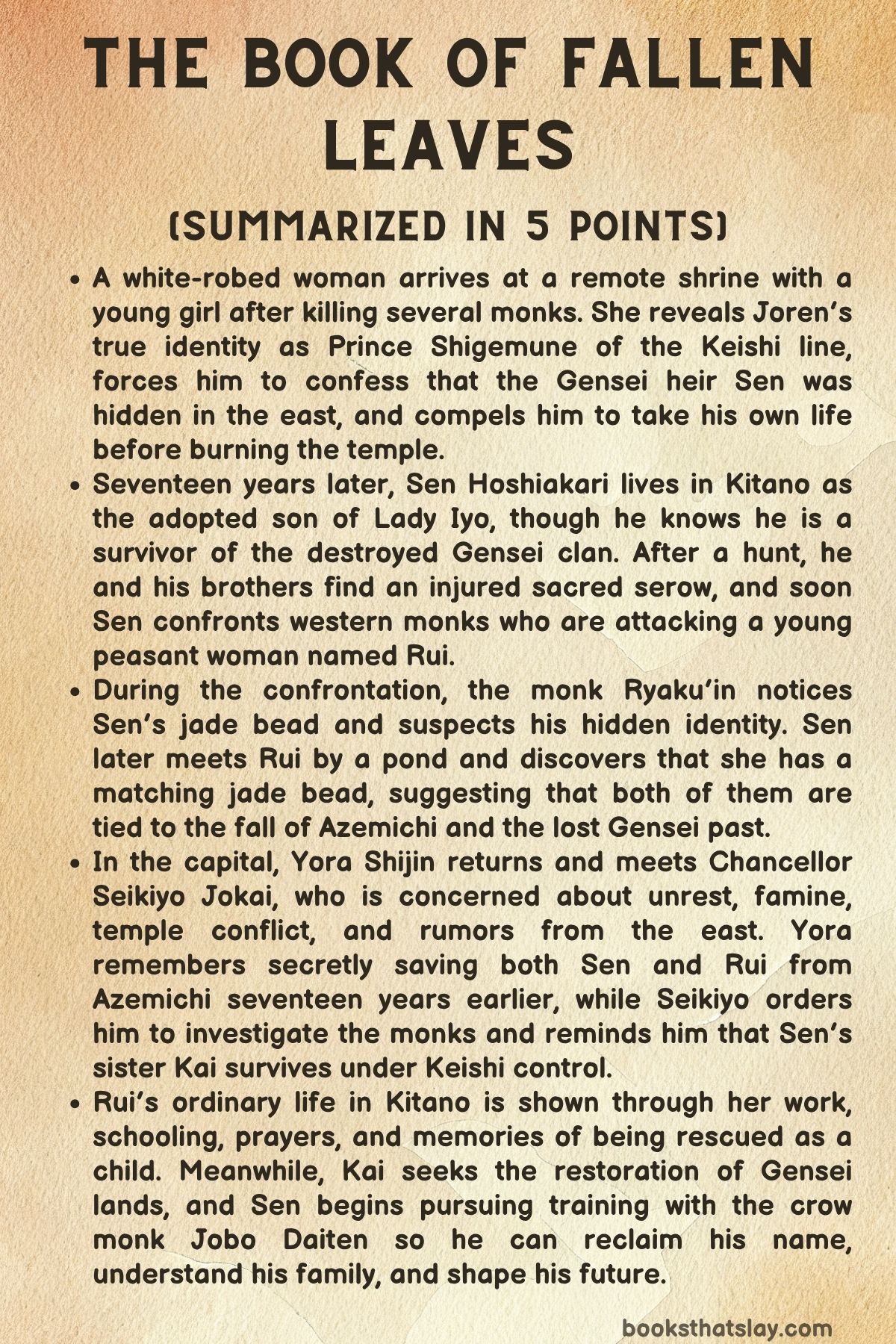
The Book of Fallen Leaves opens on a violent and mysterious night at a remote shrine. A woman dressed in white arrives during a storm with a young girl beside her.
Before reaching the shrine, she and the girl have killed several monks, making it clear that they are not ordinary travelers seeking shelter. Inside the temple, the woman confronts a young monk named Joren, but she quickly reveals that she knows who he really is.
His true name is Shigemune, a prince of the Keishi line.
The woman claims to be a ghost and a messenger of the gods. She says she has been sent to punish the children of three powerful families: Gensei, Keishi, and Ten’in.
Her purpose is not simple revenge alone; she speaks as though she is carrying out a divine sentence tied to old crimes and the fate of the realm. She forces Shigemune to admit a secret: an infant heir of the destroyed Gensei clan, named Sen, was hidden somewhere in the east.
Once she has the truth, she uses strange mirror-like magic to take control of him. Under her power, Shigemune kills himself with his own sword.
The woman then leaves with the girl as the temple burns behind them. Her final words suggest that their next act is meant “to end a war.”
Seventeen years later, the story moves east to the city of Kitano, where Sen Hoshiakari lives as the adopted son of Lady Iyo of Kitanohara. He has grown up alongside Iyo’s sons, Nihira and Hakaru, but he knows he does not truly belong to their bloodline.
He is a surviving child of the Gensei clan, whose fall still shapes the politics and fears of the country. Sen’s life is comfortable in some ways, but it is marked by uncertainty.
He has a noble bearing, yet his real name and inheritance remain hidden.
During a hunt, Sen fails at a mounted archery shot and is mocked by Hakaru. The moment shows his insecurity and his uneasy place among the young men around him.
On the way back, the brothers find a sacred serow wounded in the forest. The animal has been shot and left to suffer.
Sen and the others try to help, but the creature escapes, still badly hurt. The incident hints at a wider disorder: sacred boundaries are being broken, and people who should show reverence are acting with cruelty.
Soon after, Sen and his companions find western monks beating a young no’in peasant woman. She had tried to stop them from killing another sacred serow.
Sen steps in, angered by their violence, and challenges the monks. Their leader, Ryaku’in, proves dangerous and watchful.
During the confrontation, Ryaku’in notices Sen’s jade bead necklace. The sight changes his manner, because he seems to understand that Sen may be more than a young eastern noble.
He warns Sen that he knows who he is and leaves with his men.
The encounter shakes Sen. He rides alone into the woods and finds the young woman from the attack beside a pond, mourning the dying serow.
Her name is Rui Misosazai. She is poor and lowborn, but she has a quiet strength and deep respect for the sacred animals.
Sen notices that Rui possesses a jade bead just like his own. This discovery links them to the same buried past and suggests that her life, like his, may have begun in the ruins of the Gensei tragedy.
The story then shifts to the capital, where Yora Shijin, known as the Poet, returns after traveling through the provinces. He meets Chancellor Seikiyo Jokai, the powerful leader of the Keishi faction.
Their conversation reveals the larger troubles facing the country: famine, unrest, rebellious estates, weak control over land, and conflict among religious groups. Seikiyo is especially concerned that Ryaku’in has been seen in the east.
He suspects the monk may be searching for someone tied to the Gensei line.
Seikiyo questions Yora about the burning of Azemichi seventeen years earlier. Yora remembers the truth.
In the ruins, he found two surviving children: Sen and a lowborn girl, Rui. Instead of handing them over, he secretly saved both of them and hid what he knew.
This decision still carries danger. Seikiyo orders Yora to investigate the monks quietly and discover what they know.
He also reminds Yora that Kai, Sen’s older sister and another surviving Gensei heir, remains alive only because the Keishi allow it. The threat is clear: mercy can be withdrawn.
Rui’s life in Kitano is then explored more closely. Now nineteen, she works as a stable girl and lives with the knowledge that her past is incomplete.
After the clash with Ryaku’in’s monks, she feels exposed and unsafe. She asks old Goro for advice and thinks about seeking work at the fortress, where she may have more protection.
Her days are filled with labor and small acts of care. She tends horses, attends the mountain school, gathers herbs, prays at shrines, and tells stories to village children.
These details show that Rui’s life is humble but rich with discipline, imagination, and loyalty.
Although Rui remembers little about Azemichi, she knows that Yora saved her and Sen. She keeps her jade bead hidden in a medicine box, treating it as a clue to her origins.
She wonders who her parents were and why she survived. That night, Ryaku’in and his monks come to the home of Koroku and Otsu, asking questions about Rui’s origins in Azemichi.
Rui overhears them and realizes that their real target is Sen. Before they leave, Ryaku’in spots her watching from the barn.
This moment makes her position even more dangerous, because the monks now know she is connected to the secret they are hunting.
Meanwhile, Kai Gekko’in, Sen’s older sister and the surviving Gensei heir, tries to act within the dangerous world of the court. She visits retired-emperor Goshira in the capital to seek the restoration of her family lands.
Kai is nervous about court manners and the risks of speaking too boldly, but she offers Goshira a poem. He praises her and treats her with interest, yet he also warns her that asking Chancellor Seikiyo for reinstatement could be dangerous.
Goshira suggests that she meet his son Nioh and hints at larger political plans. These plans involve provincial warriors, revenue, land rights, and the weakening structure of the current order.
Kai’s request is not only personal; it could become part of a broader struggle for power.
As autumn arrives, Sen continues his studies with Tutor Yozora, but he is restless. He has begun to understand that his life has been shaped by decisions made before he could remember them.
Learning more about Rui and their shared rescue from Azemichi deepens his need for answers. He asks Lady Iyo about training with Jobo Daiten, the famous crow monk.
Jobo is known as a legendary fighter and spiritual figure, someone who might offer both protection and discipline.
Lady Iyo is worried by the monks’ growing interest in Sen. She understands that his hidden identity may no longer be safe.
For this reason, she sends him to seek Jobo’s protection and training. Sen approaches Jobo, but the crow monk refuses him again and again.
Jobo tests him, questions him, and asks why he wants to learn to fight. Sen’s answers show that he is not seeking violence for its own sake.
He wants to reclaim his name, understand his family, and stop being ruled by a fate chosen by others.
Even when Jobo rejects him, Sen refuses to give up. He follows the crow monks to their mountain monastery and waits outside the gate for days.
His decision marks an important change in him. He is no longer only the hidden child of a ruined clan or the adopted son of another house.
He is beginning to choose hardship in order to become someone capable of facing the forces gathering around him. By this point, The Book of Fallen Leaves has set its central conflict in motion: Sen and Rui’s hidden past has resurfaced, Kai is seeking political restoration, Yora’s old secrets are under threat, and Ryaku’in’s monks are closing in.
The old massacre is no longer buried. Its survivors are being drawn toward a reckoning that may reshape families, temples, and the realm itself.
Characters
In The Book of Fallen Leaves, A. S. Tamaki presents characters shaped by hidden lineage, political fear, spiritual violence, and the burden of memory. Each major figure carries a different relationship to the past: some try to uncover it, some try to bury it, and others use it as a weapon.
Sen Hoshiakari
Sen Hoshiakari is the central figure of the story’s surviving Gensei legacy. Raised in Kitano as the adopted son of Lady Iyo, he grows up with protection, education, and noble surroundings, yet he never fully belongs to the world that shelters him.
His awareness that he is a surviving child of the destroyed Gensei clan gives him a divided identity: outwardly, he is part of the Kitanohara household, but inwardly, he is tied to a fallen family whose history remains dangerous. Sen’s early struggles, especially his failure during the hunt and Hakaru’s mockery, show that he begins the story insecure and unproven.
However, his intervention when the monks attack Rui reveals that beneath his uncertainty lies courage, moral instinct, and a willingness to oppose cruelty even when doing so places him at risk. His jade bead becomes a symbol of the life stolen from him and the truth he must eventually face.
Sen’s desire to train under Jobo Daiten is not merely about learning to fight; it reflects his deeper need to reclaim agency over a life shaped by secrecy, survival, and inherited conflict.
Rui Misosazai
Rui Misosazai is one of the most emotionally significant characters in the book because she represents the hidden human cost of Azemichi’s destruction. Unlike Sen, Rui does not grow up as an adopted noble son, but as a lowborn stable girl whose life is built around labor, animals, village routines, and quiet endurance.
Her connection to the sacred serow reveals her compassion and spiritual sensitivity, while her willingness to confront violence shows that she possesses courage despite her vulnerable social position. Rui’s jade bead links her to the same buried past that surrounds Sen, suggesting that her identity is more important than she herself understands.
Her memories are incomplete, which makes her character deeply tied to themes of lost origin and fragmented truth. Rui’s life among horses, herbs, shrines, and village children gives her a grounded warmth that contrasts with the dangerous politics of the capital.
She is not simply a victim of history; she is a survivor whose ordinary life becomes extraordinary once the forces searching for Sen begin to notice her.
Kai Gekko’in
Kai Gekko’in is Sen’s older sister and a surviving Gensei heir, making her one of the most politically important characters in the story. While Sen’s struggle is tied to hidden identity and personal awakening, Kai’s struggle is more public and strategic.
Her attempt to seek restoration of her family lands shows that she is willing to step into the dangerous world of court politics in order to recover what was taken from the Gensei line. Her nervousness before retired-emperor Goshira makes her human and sympathetic, but her decision to present a poem also shows intelligence, refinement, and awareness of courtly expectations.
Kai lives under Keishi mercy, which means her survival is conditional and politically fragile. This makes her both a symbol of the fallen Gensei house and a possible threat to those who benefit from its ruin.
Her character brings together dignity, vulnerability, and ambition, and she stands as a reminder that survival in the capital requires not only courage, but also careful performance.
Yora Shijin
Yora Shijin, known as the Poet, is one of the most morally layered figures in the story. His public identity as a cultured traveler and observer hides the fact that he once made a decisive choice that changed the future: he found Sen and Rui alive in the ruins of Azemichi and secretly saved them.
This act suggests compassion and quiet defiance, especially because the survival of these children could endanger powerful political interests. Yora’s conversations with Chancellor Seikiyo show that he moves within dangerous circles and understands the language of power, secrecy, and consequence.
He is not presented as a simple hero, because he has spent years hiding truths and navigating compromises. Yet his protection of Sen and Rui suggests that he carries guilt, loyalty, and perhaps a hope that the past can still be corrected.
As a character, Yora functions as a bridge between memory and politics: he knows what happened, he knows what was concealed, and he understands that revealing the truth could reshape the future.
Chancellor Seikiyo Jokai
Chancellor Seikiyo Jokai is the powerful Keishi leader whose authority dominates the political atmosphere of the capital. He is calculating, controlled, and deeply aware of the dangers posed by surviving members of the Gensei line.
His questioning of Yora about the burning of Azemichi shows that he suspects hidden truths and understands that the past is not fully settled. Seikiyo’s power lies not only in his position but also in his ability to pressure others through fear, obligation, and political leverage.
His reminder that Kai lives only by Keishi mercy exposes his ruthlessness; he uses her survival as both a warning and a tool of control. At the same time, he is not careless.
He orders Yora to investigate quietly, which shows that he prefers information, secrecy, and strategy over open panic. Seikiyo represents the ruling order that depends on suppression, and his presence makes the survival of Sen, Rui, and Kai feel increasingly dangerous.
Ryaku’in
Ryaku’in is a threatening religious figure whose violence reveals the corruption and extremism within the temple factions. His attack on Rui and his killing of sacred serow show a disturbing disregard for both human suffering and spiritual reverence.
He is not merely cruel; he is dangerous because he is observant. When he notices Sen’s jade bead, he quickly understands that Sen may be connected to the Gensei line.
This makes him a direct threat to Sen’s hidden identity. Ryaku’in’s later appearance at Koroku and Otsu’s home shows persistence and calculation, as he searches for information while hiding the full purpose of his inquiry.
His character embodies the way religion can become entangled with power, violence, and political hunting. He is frightening because he combines fanaticism with intelligence, and because his interest in Sen and Rui suggests that the secrets of Azemichi are beginning to surface.
Joren / Shigemune
Joren, whose true identity is Shigemune of the Keishi line, is a brief but important character because his death opens the story with secrecy, guilt, and divine punishment. As a young monk, he appears to have hidden from his former identity, but the white-robed woman exposes him as a prince and forces him to confess what he knows about the hidden Gensei heir.
His suicide under mirror-like magic is horrifying because it strips him of control over his own body and fate. Shigemune’s role shows that the conflict among the great families has already produced betrayal, concealment, and spiritual terror before the main events begin.
He is important not because of how long he remains in the story, but because his death confirms that the past has not ended. His hidden identity also mirrors Sen’s situation, though in a darker form: both are living under names shaped by danger, but Shigemune’s secret is dragged into the open with fatal consequences.
The White-Robed Woman
The white-robed woman is one of the most mysterious and terrifying figures in the opening of the book. She arrives after killing monks, speaks with supernatural authority, and claims to be a ghost and messenger of the gods.
Whether she is truly divine, dead, or using the language of spirits to create fear, she immediately establishes herself as a force of judgment. Her mission to punish the children of the Gensei, Keishi, and Ten’in families makes her more than a personal enemy; she appears connected to a larger cycle of revenge and historical reckoning.
Her mirror-like magic gives her an otherworldly power, especially when she compels Shigemune to kill himself. Yet her statement that she is going “to end a war” suggests that she may see her violence as purposeful rather than chaotic.
She represents vengeance disguised as divine justice, and her presence casts a shadow over the entire story.
The Young Girl
The young girl who accompanies the white-robed woman is quiet but significant because her presence beside such violence creates unease and mystery. She is not developed through speech or action in the same way as the woman, but her role invites questions about innocence, inheritance, and indoctrination.
A child walking beside a killer on a stormy night suggests that the story’s conflicts are not limited to adults or rulers; the younger generation is also being drawn into cycles of revenge and punishment. Her silence makes her difficult to understand, but that silence is meaningful.
She may be a witness, a follower, a victim, or a future instrument of the woman’s mission. As a character, she deepens the unsettling atmosphere of the opening and suggests that the consequences of the old war are still being passed down.
Lady Iyo of Kitanohara
Lady Iyo is Sen’s adoptive mother and one of the most protective figures in his life. By raising him among her own sons, she gives him a home and shields him from the dangers attached to his Gensei identity.
Her care is practical as well as emotional; when she realizes that the monks’ interest in Sen could threaten him, she sends him toward Jobo Daiten for protection and training. This decision shows wisdom, urgency, and an understanding that shelter alone will no longer be enough.
Lady Iyo’s character is shaped by maternal responsibility, but she is not passive. She makes difficult choices in response to political danger and understands that Sen must eventually become stronger if he is to survive.
Her love for him exists within a world where affection must be matched by strategy.
Nihira
Nihira is one of Lady Iyo’s sons and part of the household in which Sen has been raised. Although he receives less attention than Sen or Hakaru, his presence helps define Sen’s adoptive family environment.
He represents the domestic world that Sen has grown up within, a world of brothers, training, hunting, and noble expectations. Nihira’s role is important because it shows that Sen’s life is not only defined by tragedy and bloodline; he has also been shaped by everyday relationships within Kitanohara.
Through characters like Nihira, the story gives Sen a sense of belonging that is real, even if it is complicated by his hidden origins. Nihira helps establish the contrast between Sen’s adopted life and the dangerous inheritance that begins to reclaim him.
Hakaru
Hakaru is Sen’s adoptive brother and a source of pressure, mockery, and rivalry. His teasing after Sen misses the mounted archery shot reveals the competitive expectations surrounding young noblemen and warriors.
Hakaru’s behavior may seem minor compared with the larger threats of monks and chancellors, but it plays an important role in shaping Sen’s insecurity. Through Hakaru, the story shows that Sen’s struggle begins not only with political danger, but also with ordinary humiliation and the desire to prove himself.
Hakaru represents the kind of household rivalry that can sharpen a character’s self-awareness. His mockery pushes Sen’s sense of inadequacy into the open, making Sen’s later determination to train and reclaim his name feel more personal.
Jobo Daiten
Jobo Daiten, the legendary crow monk, is a stern mentor figure whose refusals test Sen’s sincerity. He does not immediately accept Sen, which makes him different from characters who protect Sen because of love, loyalty, or political obligation.
Jobo demands that Sen understand why he wants to fight, forcing him to confront whether his desire comes from pride, revenge, fear, or purpose. His repeated rejection is a form of instruction before formal training even begins.
By making Sen wait outside the monastery gate for days, Jobo tests endurance, humility, and commitment. As a character, he represents discipline and transformation.
He is not simply a teacher of combat; he is a gatekeeper to a harder way of life, one that may allow Sen to turn his hidden identity into conscious strength.
Tutor Yozora
Tutor Yozora represents the intellectual and disciplined side of Sen’s upbringing. His presence shows that Sen has been educated and prepared within a structured noble environment, even though Sen remains restless.
Yozora’s role also highlights the difference between study and action. Sen can learn from books, lessons, and tutors, but his circumstances demand something more dangerous and physical.
Through Yozora, the story contrasts formal education with the harsher training Sen seeks from Jobo Daiten. The tutor’s presence helps show that Sen is not ignorant or neglected; rather, he has reached a point where ordinary instruction cannot answer the questions raised by his hidden past.
Retired-Emperor Goshira
Retired-emperor Goshira is a politically perceptive figure who recognizes both Kai’s potential and the danger surrounding her request. His praise of her poem shows that he understands courtly refinement, but his warning about Chancellor Seikiyo shows that he also sees the brutal realities beneath court manners.
Goshira’s conversation with Kai suggests that he may be thinking beyond personal sympathy and toward larger political change. His references to Nioh, provincial warriors, revenue, land, and the weakness of the current system reveal a mind concerned with the structure of power itself.
He is not simply an elder statesman offering advice; he appears to be someone who understands that the existing order is becoming unstable. His character introduces the possibility that Kai’s restoration may be part of a broader political realignment.
Nioh
Nioh is the son of retired-emperor Goshira and, though he is only hinted at, his mention carries political importance. Goshira’s suggestion that Kai meet him implies that Nioh may become connected to plans involving the Gensei restoration, provincial forces, or a challenge to the current balance of power.
Because he is introduced through political suggestion rather than direct action, Nioh functions as a figure of possibility. He may represent alliance, marriage, patronage, or future influence.
His character is important less for what he has done so far and more for what he may come to represent. Through Nioh, the story opens a path between Kai’s personal claim and larger court strategy.
Goro
Goro is an older, grounded presence in Rui’s life, someone she turns to when she feels unsafe after the encounter with Ryaku’in’s monks. His role suggests wisdom drawn from experience rather than rank or political power.
In a story filled with nobles, monks, heirs, and chancellors, Goro represents the practical guidance of ordinary community life. Rui’s trust in him shows that she is not isolated, even though her origins are mysterious and dangerous.
Goro’s importance lies in the way he anchors Rui’s world before it is overtaken by the larger conflict. He belongs to the quieter social fabric of Kitano, where advice, work, and survival matter as much as bloodlines and titles.
Koroku and Otsu
Koroku and Otsu are part of Rui’s domestic world, and their home becomes important when Ryaku’in and his monks arrive asking about Rui’s origins. Their presence helps show how danger enters ordinary spaces.
The search for Sen and the secrets of Azemichi does not remain confined to palaces, shrines, or battlefields; it reaches into households, barns, and village life. Koroku and Otsu also help define Rui’s position as someone embedded in a local community despite her unknown past.
Their home becomes a place where hidden history and present danger meet. As characters, they may not drive the plot directly, but they show how the consequences of old violence spread into the lives of common people.
The Sacred Serow
The sacred serow functions almost like a symbolic character in the story. Its suffering reveals the moral condition of the people around it.
Sen and his brothers try to help the wounded animal, while Rui mourns it and attempts to protect another serow from the monks. Ryaku’in and his followers, by contrast, treat the sacred creature with cruelty and disregard.
The serow therefore becomes a measure of reverence, compassion, and corruption. Its wounded body reflects a world where sacred boundaries have been violated, and its connection to Rui especially highlights her tenderness and spiritual awareness.
Although not human, the serow plays an important role in revealing character and theme.
The Monks
The monks who follow Ryaku’in act as a collective force of intimidation, violence, and religious disorder. Their beating of Rui and their role in killing sacred serow show that they have abandoned the compassion and reverence expected of spiritual figures.
As a group, they represent the dangerous factionalism spreading through the religious world. They are also instruments of investigation, helping Ryaku’in search for information about Azemichi and the surviving Gensei line.
Their presence makes the countryside feel unsafe and shows that violence is not limited to soldiers or political rulers. In The Book of Fallen Leaves, the monks reveal how institutions meant to protect spiritual order can become agents of fear when tied to power and fanaticism.
Themes
Identity and Hidden Lineage
Sen’s life is shaped by the gap between who he has been raised to be and who he truly is. Living as Lady Iyo’s adopted son gives him safety, education, and family bonds, but it also keeps him suspended between belonging and secrecy.
His Gensei bloodline is not simply a private fact; it carries political danger, ancestral grief, and expectations he has not chosen. The jade bead becomes a quiet symbol of this hidden identity, linking him to Rui and to the ruined past of Azemichi.
Sen’s uncertainty is not only about family history, but about whether identity is inherited, protected, earned, or claimed. His desire to train with Jobo shows that he no longer wants to remain a passive survivor of decisions made by others.
In The Book of Fallen Leaves, identity becomes a force that pulls characters toward truth, danger, and self-definition, especially when powerful people would rather keep certain names buried.
Power, Fear, and Political Control
Power in the story operates through secrecy, intimidation, religious authority, and control over inheritance. The great families are not presented only as noble houses, but as forces locked in conflict over legitimacy, land, memory, and survival.
Seikiyo’s conversations show how politics depends on information: who is alive, who knows the truth, and who can be used as leverage. Kai’s position reveals the cruelty of court power, because her survival depends on the mercy of the very system that helped destroy her family.
Even religious figures become political actors, as Ryaku’in’s monks use violence and fear while hiding behind sacred authority. The white-robed woman’s punishment of Shigemune also suggests that violence often claims moral purpose while creating more terror.
The theme shows a society where public order is fragile because the people in power protect stability through threats, concealment, and selective mercy rather than justice.
Survival, Memory, and the Burden of the Past
The past is never truly gone for the survivors of Azemichi. Sen, Rui, Kai, and Yora all carry different pieces of the same catastrophe, and each person’s life has been shaped by what was saved, hidden, or forgotten.
Sen knows enough to feel the weight of his bloodline, but not enough to understand the full truth. Rui remembers little, yet her bead, her instincts, and Yora’s protection keep her connected to a history she cannot fully name.
Yora’s burden is especially heavy because he chose to save children while hiding facts from dangerous rulers. Survival in this story is not simple escape; it becomes a long responsibility.
The survivors must live with unanswered questions, political risk, and the pressure of names that others fear. Memory functions like an inheritance, even when incomplete, because it pushes the characters toward choices that may expose old wounds and reshape their futures.
Compassion Against Violence
Acts of compassion stand in sharp contrast to the repeated cruelty shown by monks, nobles, and armed men. The wounded serow becomes more than an injured animal; it reveals the moral divide between those who harm sacred life for power or pride and those who still respond with care.
Sen’s defense of Rui and the serow shows that his sense of justice is not limited to clan loyalty or noble identity. Rui’s grief by the pond deepens this theme because her compassion comes from humility, closeness to nature, and respect for vulnerable life.
The violence of Ryaku’in’s monks exposes how easily sacred language can be corrupted when people use religion to dominate others. Against this, small acts of mercy become meaningful forms of resistance.
The story suggests that true strength begins not with revenge or status, but with the ability to protect what is wounded, powerless, and easily dismissed.