The Book Tour Summary, Characters and Themes
The Book Tour by Emily Ohanjanians is a contemporary romance about ambition, public image, family pressure, and the cost of trying to make everyone proud. The story follows Ana Movilian, a popular podcaster and new author, as she begins a promotional tour for her debut book while carrying old grief and fresh insecurity.
What starts as a tense professional arrangement with Ryan Grant, the publicity director assigned to her tour, slowly becomes a relationship that challenges Ana’s guarded ideas about love, success, and belonging. The novel blends career drama, emotional growth, and romance with a strong focus on self-acceptance.
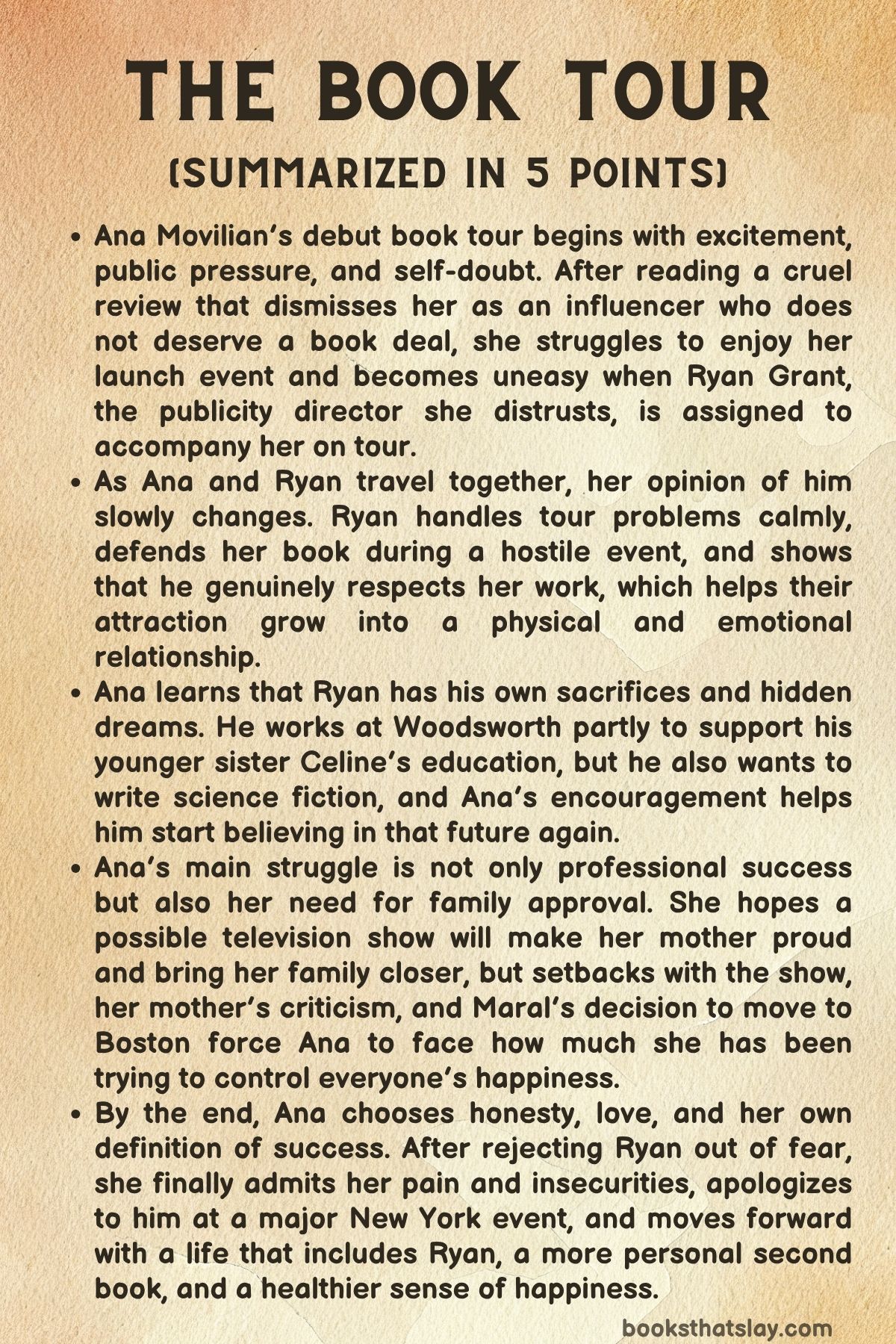
Summary
Ana Movilian has built a successful career as a podcaster, influencer, and media personality, and she is now celebrating the publication of her debut book, So Proud of You. On the surface, this should be one of the happiest moments of her life.
She has a strong audience, a full launch event ahead of her, and a team working hard to support her. Yet her confidence is shaken when she reads a harsh review that dismisses her as just another internet celebrity who has been handed a book deal without earning it.
The criticism cuts deeply because Ana already fears that people do not take her seriously as an author.
Before the launch event, Ana tries to focus on work. She records with Maral, her cousin, cohost, and brand manager.
Maral is one of the closest people in Ana’s life, and their professional bond is tied to a long history of family connection. Ana depends on Maral not only for strategy and support but also for emotional grounding.
Even so, Ana is under pressure. Her book is personal, her career is public, and she feels watched by people who are ready to judge her.
At the launch event at the Strand, Ana is surrounded by the people who helped make the book happen. Her agent Nadia, editor Laura, publicist Meredith, assistant Alison, content manager Shanthi, and Maral are all there.
The event is crowded and successful, but Ana’s mood changes when she notices Ryan Grant, the publicity director at Woodsworth Press. Ryan has a serious, controlled manner, and Ana distrusts him.
She believes his publicity choices led to several media appearances and reviews that made her look shallow or unworthy.
During the signing, Ryan asks Ana to sign his copy of the book. He tells her he has read it and enjoyed it.
Ana is surprised, but she is not ready to trust him. Soon after, another problem arrives.
Meredith has accepted a new job and will not be able to join Ana on the book tour. Ryan is assigned as her replacement.
Ana is horrified at the idea of traveling with someone she blames for some of the worst parts of her publication experience.
The tour begins with immediate trouble. A bookstore event in Chicago has to be moved because a nearby fire causes smoke damage.
Ryan handles the problem quickly and finds a new venue. His competence is obvious, but Ana remains wary.
She assumes his polished efficiency hides the same cold professional judgment she has already assigned to him. Still, as the tour continues, they are forced into close contact through travel, events, delays, and private conversations.
At a Chicago event, Ana is confronted by a rude audience member who attacks her book and suggests it has no real value. The comment embarrasses and hurts her, especially because it echoes the criticism she has already been reading online.
Ryan steps in and defends her work in public. He speaks with real conviction about the importance of her book and the impact it can have.
Ana is startled because his defense does not sound like empty publicity talk. For the first time, she begins to wonder whether Ryan may actually understand what she was trying to do.
Later, Ryan checks on Ana at her hotel room. Their conversation is more honest than their earlier exchanges.
Ana realizes that Ryan respects her work and may not be the enemy she imagined. The tension between them shifts.
Their professional relationship is still awkward, and Ryan keeps trying to maintain boundaries, but their attraction grows through each stop of the tour. Shared flights, hotel encounters, drinks in Seattle, and a charged moment in an elevator make it harder for them to ignore what is happening.
Eventually, they kiss, and the relationship becomes physical.
As Ana gets to know Ryan, she learns that his life is more complicated than she assumed. In San Francisco, she meets Celine and first thinks she may be Ryan’s girlfriend.
Ana then discovers that Celine is his younger sister. Ryan has stayed at Woodsworth partly because the company helps pay Celine’s tuition.
His responsibilities have shaped his choices, limiting his freedom in ways Ana had not expected. He also admits that he writes science fiction, though he has placed his own creative ambitions aside for practical reasons.
Ana encourages him to take his writing seriously, and their connection becomes more intimate and meaningful.
While her relationship with Ryan grows, Ana remains focused on a possible television opportunity in Los Angeles. Producer Craig Waters is considering a show connected to her brand, and Ana sees this as a chance to prove herself on a larger stage.
More than that, she imagines the show as a way to make her mother proud and bring her family closer together. She pictures a future where success in Los Angeles allows everyone she loves to gather around her in a neat, happy arrangement.
The fantasy gives her hope, but it also shows how much of her ambition is tied to other people’s approval.
When the meeting with Craig is postponed indefinitely, Ana is devastated. She feels as though the future she imagined has been taken away before it could begin.
In Los Angeles, she and Maral visit Maral’s parents, and Ana keeps thinking about the life she wanted to create. Maral, however, becomes increasingly uneasy.
She can see that Ana is trying to manage not only her own success but everyone else’s happiness too. Ana wants the people around her to fit into the future she has designed, but she is not fully listening to what they want for themselves.
In Boston, Ana’s mother attends one of her events. Instead of offering the approval Ana longs for, her mother continues making dismissive comments about Ana leaving medicine.
This touches one of Ana’s deepest wounds. She had once been on a medical path, but after her father’s death, grief made that life unbearable.
Ana breaks down after the event, and Ryan comforts her. She finally tells him more about her father, the pain of losing him, and how writing So Proud of You helped her survive a period when she felt lost.
The book was not a shallow career move. It was a lifeline.
This moment brings Ana and Ryan closer emotionally, but Ana is still afraid of wanting a real relationship. She insists she cannot need that kind of love, partly because she believes love leads to abandonment.
Her father’s death has left her with a fear that happiness can disappear without warning. Ryan, however, wants more than a temporary tour romance.
After the tour ends, Ana learns that her book has become a bestseller, which should bring joy and relief. At the same time, Ryan resigns from Woodsworth to pursue a healthier path with more room for his own writing.
He tells Ana he wants something real with her, but she panics and rejects him.
Ana’s personal life becomes even more unsettled when she learns that Maral has accepted a job in Boston. Ana feels betrayed because she had imagined Maral staying close and being part of the future Ana had planned.
Maral finally confronts her. She points out that Ana has been trying to control everyone’s happiness instead of facing her own fears.
This argument forces Ana to see that her love for her family has become tangled with control. She wants everyone safe, near, and proud of her, but she has not allowed them to choose their own lives.
Ana begins to break down the beliefs that have been guiding her. She meets with Scope about a possible television show, but she is no longer certain that Los Angeles is what she truly wants.
The dream that once seemed like proof of success now feels more complicated. Ana starts to understand that she has been chasing approval instead of asking what would actually make her happy.
Celine also helps Ana see Ryan more clearly. She tells Ana that Ryan left Woodsworth partly because Ana inspired him to believe in his own dreams again.
This makes Ana realize that her connection with Ryan was not only about attraction or comfort during the tour. They had changed each other.
He helped her trust her own voice, and she helped him return to his.
At a major speaking event in New York, Ana reaches a turning point. Instead of staying safely on script, she speaks honestly about her fear of disappointing her family and the pressure she has placed on herself.
She admits the truth in front of the audience: she has spent too long trying to earn pride from others instead of choosing herself. When Ryan arrives, Ana leaves the stage to meet him.
She apologizes for pushing him away and chooses the relationship she was too afraid to accept.
In the end, Ana and Ryan build a life together. Ryan’s science fiction novel sells, giving him the creative future he had delayed for years.
Ana writes a more personal second book and continues her work with a stronger sense of who she is. Maral thrives in Boston, proving that distance does not mean abandonment.
Ana learns that love does not require control and that success does not have to be measured by someone else’s approval. The Book Tour closes with Ana moving toward a life shaped by honesty, chosen love, and a clearer understanding of her own happiness.
Characters
In The Book Tour by Emily Ohanjanians, the characters are shaped by ambition, grief, family expectations, creative insecurity, and the desire to be seen as more than the roles other people assign to them. The book presents its characters through moments of public pressure and private vulnerability, allowing their relationships to reveal what they fear, what they want, and what they must finally admit to themselves.
Ana Movilian
Ana Movilian is the emotional center of the book and one of its most layered characters. At the beginning, she appears successful, polished, and admired: she is a popular podcaster, influencer, and newly published author celebrating the release of her debut work, So Proud of You.
However, beneath this public confidence, Ana is deeply insecure about whether she deserves her success. The harsh review she reads at the start affects her so strongly because it touches a fear she already carries: that people will dismiss her as an internet personality rather than respect her as a serious writer.
Her outer life is filled with attention, events, interviews, and professional achievement, but her inner life is marked by doubt, grief, and the need for validation.
Ana’s relationship with her career is complicated because her success is tied to both freedom and guilt. She left medicine after her father’s death because grief made that path unbearable, and writing became a way for her to survive emotionally.
Yet she still feels haunted by the belief that she has disappointed her family, especially her mother. This makes Ana’s ambition more painful than simple career drive.
She does not only want success for herself; she wants success to prove that her choices were not selfish or wrong. Her dream of a television show in Los Angeles shows this clearly.
She imagines it as a way to bring her family together and make her mother proud, but the dream also reveals how much she has been trying to organize everyone else’s happiness instead of honestly asking what she wants.
Ana is also a character who struggles with love because she associates attachment with loss. Her father’s death has left her afraid that loving someone deeply will eventually lead to abandonment or devastation.
This fear explains why she resists a real relationship with Ryan even after their emotional connection becomes undeniable. She wants closeness, comfort, and understanding, but she also tries to keep control by insisting that she cannot want anything serious.
Her rejection of Ryan is not caused by indifference; it comes from panic. She pushes him away because choosing love would require her to accept vulnerability without guarantees.
By the end of the story, Ana’s growth comes from learning to stop performing certainty. Her public honesty at the New York speaking event is important because she finally stops hiding behind the image of the confident, successful woman who has everything figured out.
She admits her fear of disappointing her family and begins choosing herself rather than chasing approval. Her decision to apologize to Ryan and choose him shows that she has become willing to risk emotional openness.
Ana’s journey is ultimately about self-definition. She learns that success is not meaningful if it is only a performance for others, and love is not a weakness simply because it involves fear.
Ryan Grant
Ryan Grant is one of the most important characters in the book because he challenges Ana’s assumptions and becomes both a romantic partner and a mirror for her emotional growth. At first, Ana sees him as stern, cold, and responsible for some of the negative publicity surrounding her debut.
His position as the publicity director at Woodsworth Press makes him seem like part of the professional machinery that has made her feel exposed and misunderstood. Because Ana is already sensitive to criticism, she interprets Ryan’s presence as threatening rather than supportive.
This initial tension creates the foundation for their slow shift from distrust to intimacy.
Ryan’s true character is revealed through competence, restraint, and quiet loyalty. When the Chicago bookstore event has to be relocated because of smoke damage, he handles the crisis efficiently.
Even though Ana remains suspicious, the moment shows that Ryan is dependable under pressure. His defense of Ana during the Chicago event is even more revealing.
When an audience member attacks her work, Ryan publicly praises the book’s importance and impact. This matters because Ryan is not merely managing publicity; he genuinely respects Ana’s writing.
His support helps Ana realize that he understands the value of her work in a way she had not expected.
Ryan is also defined by sacrifice. His relationship with his younger sister Celine shows a softer and more responsible side of him.
He has stayed at Woodsworth partly because the job helps pay for Celine’s tuition, even though it limits his own creative ambitions. His private dream of writing science fiction adds depth to his character because it shows that he, like Ana, has a creative self that has been pushed aside by obligation and fear.
Unlike Ana, Ryan is more emotionally steady, but he still has his own struggle: he must learn to prioritize his own life instead of only being responsible for others.
As a romantic figure, Ryan is patient but not passive. He tries to maintain professional boundaries during the tour, which shows that he understands the seriousness of their work situation.
At the same time, his growing connection with Ana becomes impossible to ignore because it is based on emotional recognition as much as attraction. He sees Ana beyond her public image, and he offers comfort without trying to control her.
When he eventually tells her he wants something real, he is asking for honesty rather than fantasy. His resignation from Woodsworth marks his own turning point, as he chooses better balance, writing time, and a future shaped by his own desires.
Ryan’s development makes him more than a love interest; he is a character learning to claim his own dreams while helping Ana believe she can do the same.
Maral
Maral is Ana’s cousin, cohost, brand manager, and one of the most emotionally significant people in Ana’s life. Her role goes far beyond professional support.
She is part of Ana’s family world, creative life, and public identity, which makes their relationship especially close but also complicated. Because Maral works with Ana and is related to her, the boundaries between love, loyalty, career, and emotional responsibility become blurred.
She supports Ana during the launch and throughout the tour, but she also carries her own needs, ambitions, and discomforts.
Maral’s importance lies in the way she exposes Ana’s habit of managing other people’s happiness. Ana imagines a future in which her television show succeeds, everyone relocates happily, and the family becomes emotionally whole.
This imagined future may seem loving, but it also puts pressure on Maral to fit into Ana’s dream. Maral grows uneasy because Ana is not fully seeing her as an independent person.
Instead, Ana is treating her as part of a plan that will repair old wounds and create the family approval Ana desperately wants. This makes Maral’s eventual decision to accept a job in Boston feel like a betrayal to Ana, but it is actually an act of self-definition.
Maral’s confrontation with Ana is one of the most important emotional moments in the book. She forces Ana to recognize that love does not mean controlling the lives of the people around her.
Maral understands that Ana’s intentions are not cruel, but she also knows that Ana’s fear has made her cling to an imagined version of everyone’s future. By choosing Boston, Maral proves that she has her own path.
She refuses to remain only a supporting figure in Ana’s life, and this helps Ana begin to face the truth about her own fears.
Maral is a grounded and necessary character because she represents the kind of love that tells the truth. She is supportive, but she is not willing to disappear into Ana’s needs.
Her growth is quieter than Ana’s, but it is still meaningful. By the end, Maral thrives in Boston, showing that her decision was not rejection but independence.
Her relationship with Ana becomes healthier because it is no longer based on Ana trying to hold everything together. Maral helps show that family love becomes stronger when each person is allowed to choose their own happiness.
Celine
Celine is Ryan’s younger sister and an important supporting character because she reveals the private side of Ryan that Ana does not initially understand. When Ana first meets her, she mistakes Celine for Ryan’s girlfriend, which creates a moment of confusion and jealousy.
Once Ana learns the truth, Celine becomes a key figure in helping Ana see Ryan more clearly. Through Celine, the book shows Ryan as a brother who has made significant sacrifices for someone he loves.
Celine’s presence deepens Ryan’s character by showing that his seriousness is not coldness. He has been working at Woodsworth partly because the company helps pay for her tuition, which explains some of his professional choices and emotional restraint.
Celine represents the responsibilities Ryan carries quietly. She also helps Ana understand that Ryan’s life has not been built around ambition alone, but around duty, loyalty, and care.
This makes Ryan’s later decision to leave Woodsworth more meaningful, because it shows that he is beginning to balance responsibility with personal fulfillment.
Celine also plays a role in Ana’s emotional realization. When she tells Ana that Ryan left Woodsworth partly because Ana helped him believe in his own dreams, she gives Ana a new way to understand her influence on him.
Ana often sees herself through fear and failure, but Celine shows her that she has also been a source of courage for someone else. This matters because Ana needs to understand that love is not only a risk of loss; it can also help people become more honest and alive.
Although Celine is not one of the central characters, she functions as a warm and clarifying presence in the story. She helps remove Ana’s misunderstandings, reveals Ryan’s tenderness, and quietly pushes Ana toward recognizing the depth of what she and Ryan share.
Her character adds emotional texture to the book by showing how family responsibility can shape a person’s choices and how love between siblings can be just as important as romance.
Ana’s Mother
Ana’s mother is a powerful figure in the book because her approval carries enormous emotional weight for Ana. Even when she is not physically present, her influence shapes Ana’s choices, ambitions, and insecurities.
Ana’s mother represents the family expectations Ana has struggled against since leaving medicine. Her dismissive comments about Ana’s career change show that she does not fully understand the emotional reasons behind Ana’s decision.
To Ana, this lack of understanding feels like rejection.
The relationship between Ana and her mother is painful because it is tied to grief. After Ana’s father dies, medicine becomes unbearable for Ana, but her mother seems unable or unwilling to fully recognize that leaving medicine was a survival choice rather than a careless abandonment of responsibility.
This creates a deep wound. Ana wants her mother to see that writing is not a lesser path, but a meaningful one that helped her continue living after loss.
Her need to make her mother proud drives much of her ambition, including her desire for the television show.
Ana’s mother is not presented simply as a villain. Her dismissiveness is hurtful, but it also reflects the difficulty some parents have in accepting a child’s life when it does not match their hopes or sacrifices.
She becomes a symbol of the approval Ana keeps chasing. The problem is not only what Ana’s mother says, but how deeply Ana has allowed those judgments to define her worth.
Ana’s emotional breakdown after the Boston event shows how raw this wound remains.
By the end, Ana’s growth requires her to loosen the hold her mother’s approval has over her. She does not stop loving her mother, but she begins to understand that her life cannot be built only around being understood by her.
Ana’s mother is important because she represents the emotional standard Ana has been trying to satisfy. The story suggests that healing does not always come from receiving perfect approval from family; sometimes it comes from learning to choose oneself even when that approval remains incomplete.
Nadia
Nadia, Ana’s agent, is part of the professional support system surrounding Ana at the launch of So Proud of You. Her role shows that Ana’s career is not accidental or unsupported; she has people who believe in her work and are invested in helping her succeed.
As an agent, Nadia represents the business side of Ana’s authorship, where talent, marketability, timing, and opportunity all intersect.
Although Nadia is a minor character, her presence helps establish Ana as someone who has reached a significant professional milestone. A debut book launch at a major venue is not just a personal celebration; it is the result of many people’s labor and belief.
Nadia’s presence reinforces the idea that Ana’s writing has value in the publishing world, even when Ana herself is shaken by criticism. This contrast is important because Ana is surrounded by signs of success but still struggles to feel worthy of them.
Nadia also represents the distance between public achievement and private insecurity. From the outside, Ana appears to have everything a debut author could want: an agent, an editor, a publicist, an audience, and a full tour.
Yet none of these things fully protect her from self-doubt. Nadia’s role therefore helps highlight one of the book’s central tensions: external validation can support a person, but it cannot replace inner confidence.
Laura
Laura, Ana’s editor, represents the creative and literary support behind Ana’s debut book. As an editor, she is connected to the part of Ana’s work that involves craft, revision, and shaping personal experience into something meaningful for readers.
Her presence at the launch shows that Ana’s book is not simply a product of internet fame, but a serious publishing project that has gone through professional development.
Laura’s role is important because the criticism Ana receives tries to reduce her to an undeserving influencer. The presence of an editor quietly contradicts that idea.
Laura stands for the fact that Ana’s book has been read, worked on, and taken seriously by people in publishing. Even though Laura does not dominate the action, she belongs to the circle of people who validate Ana’s work through professional commitment.
As a minor character, Laura also helps show how many forms of support surround an author. Ana may feel alone when facing public criticism, but her career exists within a network of people who have contributed to the book’s journey.
Laura’s significance lies in the way she represents belief in Ana’s voice at the level of craft and storytelling.
Meredith
Meredith is Ana’s original publicist and an important figure because her departure creates one of the central professional conflicts of the story. At first, she is part of Ana’s familiar team, someone Ana expects to accompany her through the launch and tour process.
When Meredith accepts a new job and cannot come on the tour, her absence forces Ana into close proximity with Ryan, the person she distrusts most at that point.
Meredith’s character matters less for her individual development and more for the change her decision creates. Her departure disrupts Ana’s sense of control.
Ana wants the tour to feel safe, predictable, and professionally managed by people she trusts. Losing Meredith unsettles that expectation and pushes Ana into a situation where she must deal with Ryan directly.
In this way, Meredith becomes a catalyst for the relationship at the heart of the book.
Meredith also reflects the realities of professional life. People move jobs, plans change, and carefully arranged expectations can collapse quickly.
Her decision is not presented as malicious; it is simply a career move. But for Ana, it feels like another destabilizing event during a period when she already feels exposed.
Meredith’s exit helps set the story’s emotional and romantic movement in motion.
Alison
Alison, Ana’s assistant, is part of the team that supports Ana during the launch of So Proud of You. Her role shows the practical demands of Ana’s career.
Ana’s public image may seem glamorous, but behind that image are schedules, events, logistics, communication, and constant coordination. Alison represents the behind-the-scenes labor that helps Ana’s professional life function.
Although Alison is a minor character, her presence contributes to the sense that Ana’s career has become large and complex. Ana is not only a writer; she is also a public figure with a brand, a media presence, and a team.
This makes her insecurity even more interesting because her success is visible and organized, yet emotionally fragile. Alison’s role helps create the world of professional pressure around Ana.
Alison also helps show how public success depends on collaboration. The book does not present Ana’s career as something she manages entirely alone.
Instead, it places her within a group of people whose work supports her visibility. Alison may not shape the emotional conflict directly, but she helps define the environment in which Ana’s anxieties and achievements unfold.
Shanthi
Shanthi, Ana’s content manager, represents the digital and public-facing side of Ana’s career. Because Ana is a podcaster and influencer as well as an author, her work depends not only on writing but also on presentation, audience engagement, and online identity.
Shanthi’s role shows that Ana’s success exists across multiple platforms, where personal voice and public image are constantly connected.
Shanthi is important because the criticism Ana receives is specifically tied to her identity as an internet personality. The harsh review dismisses her as another influencer turned author, and that insult strikes at the tension between digital fame and literary legitimacy.
As content manager, Shanthi belongs to the part of Ana’s world that some critics might undervalue, but the book treats this world as real work. Her presence helps show that Ana’s career is modern, multifaceted, and demanding.
Even though Shanthi remains a supporting figure, she helps build the professional landscape around Ana. She represents the careful management of image and content that allows Ana to connect with her audience.
Her role also reminds readers that Ana’s public life is not effortless. It is built through planning, strategy, and constant visibility, all of which intensify Ana’s fear of being judged.
Craig Waters
Craig Waters is the producer connected to Ana’s possible television show, and he represents the dream of expansion that Ana believes will solve many of her emotional problems. The opportunity with him in Los Angeles appears to Ana as more than a career milestone.
She sees it as the key to making her mother proud, bringing her family closer, and proving that her choices have led to something undeniably successful.
Craig’s importance comes from what he symbolizes rather than who he is personally. He represents the glamorous possibility of a bigger platform and a more impressive future.
For Ana, the television show becomes a fantasy of emotional repair. If it succeeds, she imagines that everything else might fall into place: her family’s approval, her sense of legitimacy, and her hope for togetherness.
When the meeting is postponed indefinitely, Ana feels crushed because the delay threatens not only a professional goal but the emotional meaning she has attached to it.
Craig’s role helps reveal Ana’s mistaken belief that a single achievement can resolve grief, insecurity, and family tension. The postponed meeting forces Ana to confront the possibility that external success may not deliver the peace she wants.
Later, when Ana meets with Scope and realizes she is no longer sure Los Angeles is what she wants, the dream associated with Craig begins to lose its power. His character functions as a symbol of ambition that must be reexamined before Ana can choose a more honest life.
Ana’s Father
Ana’s father is not physically present in the main events, but he is one of the most emotionally important figures in the book. His death shapes Ana’s life, career, and fear of love.
The loss makes medicine unbearable for her and becomes the turning point that leads her away from the path her family expected. Because of this, Ana’s grief is tied directly to her identity.
She is not simply mourning her father; she is also trying to understand who she is after losing him.
Ana’s father represents love, loss, and the danger of attachment in Ana’s mind. His death teaches her, painfully, that loving someone deeply can lead to devastating grief.
This is one reason she struggles with Ryan. Her fear of abandonment is not abstract; it is rooted in the experience of losing someone central to her life.
She tries to protect herself by refusing to fully want a relationship, but this protection also keeps her from happiness.
His influence also explains why So Proud of You matters so much to Ana. The book becomes a lifeline after grief, a way for her to transform pain into meaning.
Her writing is therefore not a shallow career move or a simple brand extension. It is connected to survival.
Ana’s father remains important because his absence drives the emotional truth beneath her choices. He is the loss that Ana must learn to live with without allowing it to close her off from love.
Maral’s Parents
Maral’s parents appear during the Los Angeles section and help reveal Ana’s longing for family closeness. When Ana and Maral visit them, Ana keeps imagining a future where the television show succeeds and everyone relocates happily.
Maral’s parents therefore become part of Ana’s dream of a repaired, united family life. Their presence makes Ana’s fantasy feel warmer and more concrete, but it also exposes how much she is projecting her wishes onto others.
They are important because they help show the contrast between Ana’s imagined future and the reality of other people’s independent lives. Ana sees family togetherness as something that can be arranged if the right opportunity appears.
Maral’s increasing unease suggests that this vision is not as simple or universally desired as Ana wants it to be. Maral’s parents are not central decision-makers in the story, but their home becomes a setting where Ana’s emotional assumptions become visible.
As minor characters, Maral’s parents contribute to the book’s exploration of family, belonging, and expectation. They help reveal that Ana’s desire for closeness comes from a genuine place, but also from fear.
She wants to gather everyone into a future that feels safe. Their role helps prepare for Maral’s later confrontation, where Ana must accept that love cannot be built by planning other people’s lives for them.
Themes
Public Success and Private Insecurity
Ana’s public image is built on confidence, influence, and achievement, but her private experience is marked by doubt and fear of being exposed as unworthy. The harsh review wounds her because it repeats what she already fears: that people see her as a shallow internet figure rather than a serious writer.
Her launch event is full of support, yet she cannot fully rest in that success because criticism feels louder than praise. This theme becomes stronger during the tour, where every event forces her to perform certainty while carrying insecurity underneath.
Ryan’s defense of her work matters because he sees value in what others dismiss, and that recognition helps Ana slowly separate genuine accomplishment from public approval. In The Book Tour, success is not shown as a cure for self-doubt; instead, it becomes a place where old fears surface more clearly.
Ana’s journey suggests that confidence is not about being universally admired, but about learning whose judgment deserves weight and whose does not.
Grief and the Pressure to Become Someone Else
Ana’s decision to leave medicine is tied to grief, but her family treats it as failure rather than survival. After her father’s death, the path that once seemed meaningful becomes emotionally unbearable, and writing becomes a way for her to keep moving.
Her mother’s repeated disappointment keeps Ana trapped between who she is and who she was expected to become. This pressure makes her achievements feel conditional, as though nothing will truly count unless it fits her family’s original idea of success.
Her breakdown after her mother’s comments shows how grief is made heavier when it is judged from the outside. Ana does not simply change careers; she changes the story she has been told about duty, pride, and worth.
By speaking honestly about her fear of disappointing her family, she begins to stop performing strength for others. The theme shows that healing requires more than professional success; it requires permission to choose a life that grief has reshaped.
Love, Fear, and Emotional Risk
Ana’s relationship with Ryan develops through attraction, respect, and emotional honesty, but her fear of abandonment keeps her from accepting it fully. She wants closeness, yet she treats love as something dangerous because losing someone has already shaped her deepest pain.
This makes her rejection of Ryan less about a lack of feeling and more about self-protection. Ryan represents a kind of love that asks for trust rather than performance.
He sees her ambition, insecurity, grief, and tenderness without demanding that she become simpler or easier to understand. Their bond also grows because they both recognize each other’s hidden dreams: Ana wants emotional safety and family approval, while Ryan wants a life that leaves room for writing.
The conflict between them shows that love cannot become real unless Ana stops confusing vulnerability with weakness. Her eventual apology is meaningful because it comes after she understands that avoiding love does not prevent loss; it only prevents connection.
Choosing Personal Happiness Over Managed Expectations
Ana spends much of the story trying to arrange a future that will make everyone else happy. The possible television show becomes more than a career opportunity; it becomes a fantasy in which her family is proud, Maral stays close, and Ana finally feels secure.
This dream begins to fall apart when the meeting is postponed and Maral chooses her own path in Boston. Ana’s sense of betrayal reveals how much she has been depending on other people to confirm her happiness.
Maral’s confrontation forces Ana to see that caring for others has turned into controlling outcomes. The theme is not selfishness versus family, but the difference between love and emotional management.
Ana has to learn that people can love each other while still wanting different lives. Her public honesty near the end marks a turning point because she stops shaping herself around imagined expectations.
She begins choosing from self-knowledge rather than fear, which allows her relationships to become freer and more honest.