The Book of Lost Hours Summary, Characters and Themes
The Book of Lost Hours by Hayley Gelfuso is a sweeping historical fantasy that explores humanity’s fragile relationship with memory, time, and truth. It traces generations of “timekeepers” — individuals capable of stepping into the realm where all human memories reside — as they navigate war, love, and betrayal across decades.
From the horrors of 1938 Nazi Germany to the secret Cold War programs of 1960s America, the novel unravels how power over memory can shape history itself. Both haunting and thought-provoking, it questions whether altering the past can ever truly heal the present, or if remembering — even the painful parts — is the only way forward.
Summary
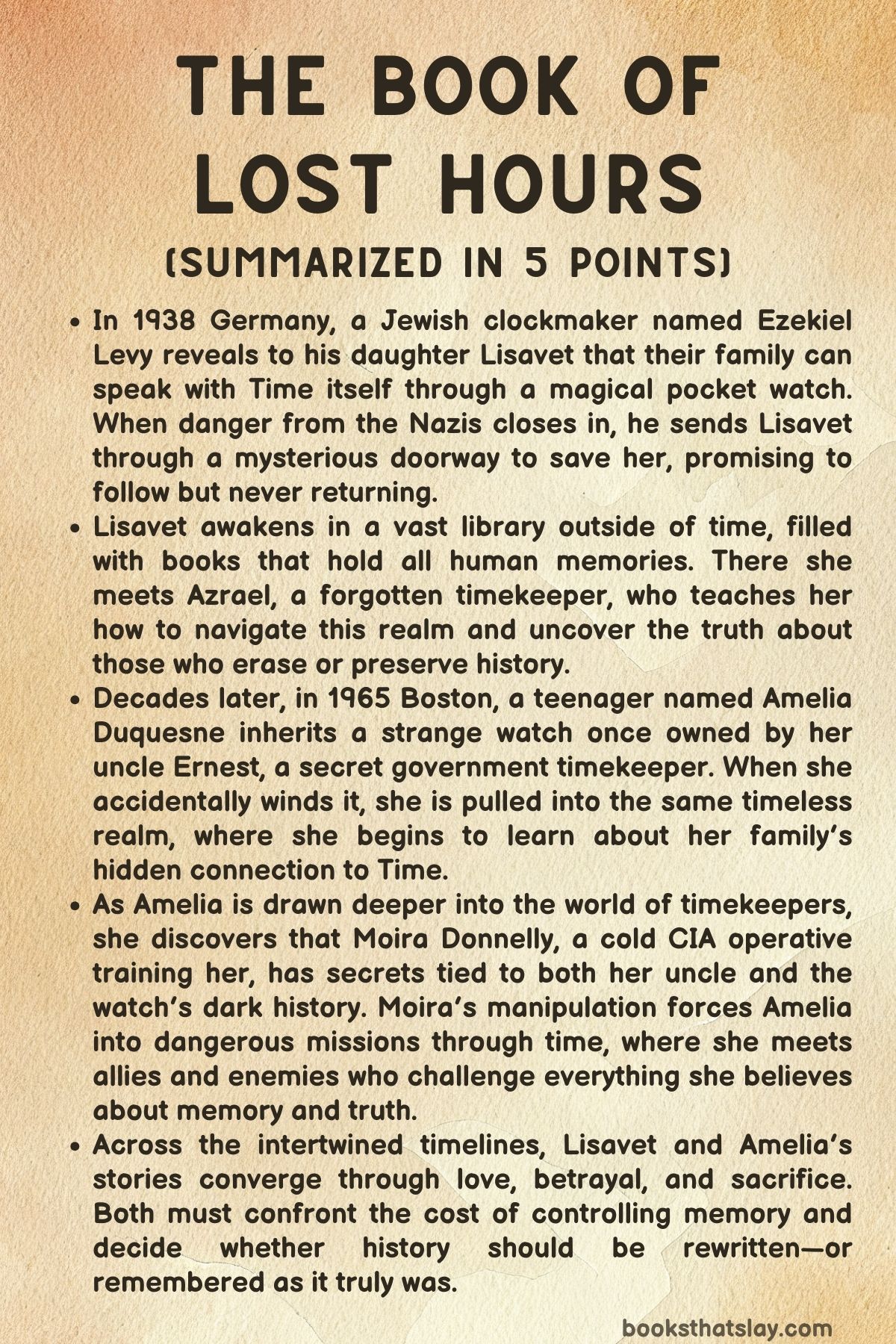
The story begins in 1938 Nuremberg, where Jewish clockmaker Ezekiel Levy tells his daughter Lisavet a bedtime story about their family’s secret lineage as “timekeepers” — watchmakers who can commune with Time through a special brass pocket watch. As Nazi persecution rises, Ezekiel realizes that the regime is seeking the magical watch.
He tricks his pursuers with a fake but knows their safety is fleeting. On Kristallnacht, as the city erupts in violence, Ezekiel hides letters, burns others, and activates the true watch, sending Lisavet through a temporal doorway with a promise to follow with her brother.
He never returns.
Lisavet awakens in a vast celestial library — the liminal space between all human memories. Time moves differently here; she neither ages nor hungers.
In this strange realm, she meets spectral figures, including a man known as “Forgotten,” who teaches her to “time walk” — to traverse memories stored within the books of this endless library. He reveals that this is the repository of all human existence, and that timekeepers can alter or erase history by destroying or rewriting these memory-books.
As Lisavet learns to navigate the space, she discovers that timekeepers, including those aligned with the Nazis, are burning memories to erase entire lives and events. When she encounters her father’s voice in a half-burned memory, she realizes he died protecting the watch.
The narrative shifts to Boston in 1965, where a teenage girl named Amelia Duquesne mourns her uncle Ernest, accused of communist espionage. At his funeral, a mysterious woman, Moira Donnelly, approaches her asking about a missing Glashütte watch.
Amelia has secretly received it in the mail and, out of curiosity, winds it — stopping time and accidentally entering the same memory realm Lisavet once inhabited. Terrified, she encounters Moira again, who reveals that the watch grants access to the “time space.
” Moira, claiming to have worked with Ernest, tells Amelia that her uncle was a timekeeper for a secret government agency researching time manipulation. After threatening her into compliance, Moira recruits Amelia to help recover a missing “book of memories” — one capable of creating new timepieces.
Meanwhile, within the time space, Lisavet has survived for years, traveling through eras under the guidance of Forgotten — now known as Azrael. She rescues burned books, saving erased memories of persecuted lives, particularly those of her own Jewish community.
Over time, she discovers that historical truths are being rewritten by human hands. During one journey, she meets Ernest Duquesne, an American timekeeper who, unlike others, preserves rather than destroys memories.
Their encounter sparks mutual curiosity and a fragile trust.
In 1946, Lisavet and Ernest meet again amid Cold War tensions inside the time space. Initially cautious, they develop a bond rooted in shared ideals about truth and history.
Their conversations expose their philosophical conflict: Ernest believes controlling dangerous memories can protect humanity, while Lisavet argues that erasing truth is the ultimate violence. When Ernest is shot during a confrontation with a Russian timekeeper, Lisavet saves him by carrying him through multiple eras — even performing emergency surgery in a wartime memory.
Their time together deepens into affection and respect. Eventually, Ernest returns to his duties, while Lisavet continues her lonely mission to preserve memory.
Two decades later, Amelia’s training under Moira grows harsher. Moira, now a senior CIA officer, leads the Temporal Reconnaissance Program — a continuation of wartime timekeeper research.
She sends Amelia into the time space on a dangerous mission to retrieve the lost blue book. There, Amelia meets Anton Stepanov, a Russian timekeeper who helps her survive.
When she returns, she discovers Anton’s face in a dossier of her uncle’s supposed killers. Confused and enraged, she begins to question Moira’s version of events.
Parallel narratives reveal Moira’s past: she is Lisavet Levy herself, forced into a new identity by Jack Dillinger, a ruthless American official who captured and manipulated her after the war. Jack exploited her powers, coercing her into erasing memories for political gain.
Over years of psychological control, he reshaped her into “Moira Donnelly,” erasing traces of her former self while weaponizing her gifts. Eventually, she seized power by blackmailing Jack, using his dark secrets to secure her freedom and leadership within the TRP.
In 1965, Amelia’s search for answers brings her to James Gravel, a rebel timekeeper who tells her about Lisavet’s resistance movement. Lisavet’s blue book — filled with rescued memories — had become a symbol of defiance, and her followers mark themselves with a blue forget-me-not.
James reveals that Ernest had turned against his superiors and that Moira may have orchestrated his death. When government agents storm the meeting, chaos ensues.
Amelia freezes time, an ability that mirrors Lisavet’s, confirming her connection to the past. Moira saves her from capture but kills Jack in the aftermath, reclaiming her autonomy.
Moira’s story unfolds further: years before, she had manipulated Jack into giving her power and her own timepiece, while also protecting Ernest and their hidden child — Amelia. Decades later, Ernest confronts Moira after rediscovering Lisavet’s true identity through her salvaged book.
Their argument reignites buried love and resentment. Ernest reveals he is part of a global rebellion working to dismantle the timekeeper system and plans to destroy access to the time space forever.
Moira, torn between love and guilt, joins him.
Amelia, now aware of her lineage, encounters Ernest and Moira within the collapsing time space. Ernest intends to sacrifice himself to seal the realm and end manipulation of history.
Moira intervenes, realizing he means to die. She pulls a gun to stop him, but Anton — now allied with Moira — drags Ernest away through a time portal.
Moira decides to complete his mission herself. She gives Amelia her family’s original brass watch and pushes her through the chasm to safety.
Moira reenters the deepest layers of the time space, seeking Azrael. She travels thousands of years into the past, preventing him from revealing timewalking to the Romans.
Her act causes the entire library of memories to collapse. The time space implodes, sealing forever the power to edit history.
Amelia awakens in a transformed 1965 Boston. The Temporal Reconnaissance Program no longer exists; Ernest is alive, now openly her father, and Lisavet is his wife.
History has rewritten itself into a gentler world. The blue book and the time space are gone, replaced by a new order of floating memories that exist freely rather than in captivity.
Amelia resolves never to open a door through time again. Yet, at school, she meets a new exchange student — Anton — hinting that some connections, and perhaps the echoes of the past, still survive.
Above all, The Book of Lost Hours ends where it began — with the enduring question of whether remembering is a burden or a blessing, and whether love can truly survive the rewriting of time itself.
Characters
Ezekiel Levy
Ezekiel Levy stands as the moral and emotional foundation of The Book of Lost Hours, a Jewish clockmaker in prewar Nuremberg whose craftsmanship is imbued with mystical depth. He is both a man of science and of faith, bridging precision with prophecy as the bearer of his family’s secret: the art of communing with Time itself.
His relationship with his daughter, Lisavet, reveals his gentleness and his fierce devotion; his bedtime stories double as veiled lessons of survival. During Kristallnacht, Ezekiel’s character crystallizes — the loving father becomes the sacrificial guardian.
His decision to send Lisavet through the portal demonstrates courage and resignation, knowing he will never follow. He is both martyr and myth, his presence lingering throughout the novel not as a ghost but as the silent measure of morality.
His destruction of letters, his parting gift of the watch, and his final act of defiance transform him into the book’s first “timekeeper of truth” — one who preserves not through survival but through surrender.
Lisavet Levy / Moira Donnelly
Lisavet Levy is the novel’s emotional axis, embodying the evolution from innocence to immortality. As a frightened child thrust into the timeless void, she begins as a symbol of memory’s endurance.
Within the vast, otherworldly library, Lisavet matures intellectually and spiritually, her isolation transforming her grief into purpose. Through her mentorship under Azrael, she becomes a scholar of time, a rescuer of obliterated lives, and a quiet rebel who believes that no memory deserves erasure.
Her empathy is her power — she risks herself to preserve even fragments of forgotten souls.
Her later metamorphosis into Moira Donnelly is both tragic and profound.
The once-idealistic girl becomes an instrument of manipulation, molded by Jack Dillinger into a woman of control and survival. As Moira, she cloaks her past beneath bureaucracy and brutality, using cunning where compassion once reigned.
Yet beneath her composure flickers Lisavet’s conscience — a wounded longing for redemption and agency. Her story’s full circle, culminating in self-sacrifice to seal the time space, restores her humanity.
By becoming both destroyer and savior, she personifies the paradox of memory itself: that preservation sometimes demands erasure.
Azrael (“Forgotten”)
Azrael, the spectral guide of the time space, is an embodiment of loss and remembrance. Once a man erased from existence, he now haunts the library of human memory, his voice filled with melancholy wisdom.
His name, chosen by Lisavet, connects him to death yet redeems him through companionship. As mentor and confidant, Azrael bridges the mystical and philosophical threads of the novel — he teaches Lisavet that time is not linear but circular, that all histories intertwine.
His tragic awareness of being “Forgotten” gives him both humility and resignation, but through Lisavet, he rediscovers connection. In the novel’s end, when Lisavet alters his death to undo the origin of the time space, Azrael’s role comes full circle.
His erasure becomes creation, and his existence — paradoxically — restores balance. He stands as the eternal reminder that remembrance is both burden and grace.
Ernest Duquesne
Ernest Duquesne embodies the struggle between duty and conscience, a man of intellect ensnared in moral contradiction. Initially introduced through Amelia’s fragmented memories as a disgraced government agent, he later emerges as the compassionate yet conflicted timekeeper who straddles love and loyalty.
In his encounters with Lisavet, Ernest evolves from skeptic to believer, from soldier to savior. His fascination with her humanity — her defiance, her tenderness — ignites his transformation from destroyer of memories to their guardian.
Ernest’s intellectualism masks deep guilt; he knows the weight of what he erases. His eventual rebellion against the government’s control of time marks his redemption.
Yet his final plan — to sacrifice himself to seal the time space — is his atonement, a man seeking forgiveness through obliteration. Ernest’s tragedy is that love makes him human, but duty makes him doomed.
Amelia Duquesne
Amelia is the inheritor of generational trauma and power, the modern echo of Lisavet’s and Ernest’s intertwined legacies. Her youth and rebellion contrast sharply with the ancient solemnity of timekeeping, but she becomes its reluctant successor.
At first naive and reactive, Amelia’s journey mirrors the reader’s initiation into the mysteries of time and truth. The watch, thrust upon her like a curse, awakens both her lineage and her latent power.
Through her defiance of Moira and her connection with Anton Stepanov, she begins to question every authority — temporal, moral, and emotional. Her compassion links her to Lisavet; her courage ties her to Ernest.
By the end, Amelia becomes the living synthesis of both — a new timekeeper who chooses life over control, freedom over mastery. In the reimagined world where her parents live and the TRP no longer exists, Amelia represents the continuity of human memory cleansed of tyranny, the future born from reconciliation.
Jack Dillinger
Jack Dillinger is the novel’s antagonist and its darkest mirror of power. A man of control and cruelty, he sees time not as mystery but as machinery to be weaponized.
His relationship with Moira/Lisavet is an intricate web of dominance and dependency — he is her captor, mentor, and violator, molding her into his instrument while underestimating her resilience. Jack’s obsession with order, his belief that erasure is salvation, encapsulates the novel’s critique of authoritarianism.
Yet his complexity lies in his humanity: his charm, intellect, and occasional tenderness make his monstrosity believable. His death at Moira’s hand is not mere vengeance but justice — the collapse of an empire built on manipulation.
Through Jack, the novel explores the seduction of control and the corruption of memory, making him both villain and victim of his own ideology.
Anton Stepanov
Anton Stepanov serves as the bridge between enemies and heirs, a young Russian timekeeper whose compassion tempers the legacy of conflict. His role as Amelia’s guide in the time space reflects a new generation’s potential to reconcile what their predecessors destroyed.
Initially mysterious and skeptical, Anton evolves into a figure of empathy and intellectual curiosity. His revelation as the son of Vasily Stepanov — once an adversary of Ernest and Moira — deepens his emotional conflict, yet he resists vengeance.
Anton’s dynamic with Amelia grows into the novel’s quiet promise of hope, suggesting that understanding, not domination, is the true mastery of time. In the reimagined world, his reappearance as a schoolboy hints at renewal — the cycle of time resetting not through power, but through forgiveness.
Themes
Memory and the Preservation of Truth
In The Book of Lost Hours, memory operates not only as an emotional thread but as the moral backbone of the narrative. The preservation of memory becomes a form of defiance against oppression and falsification.
From Ezekiel Levy’s effort to protect his family’s history from Nazi destruction to Lisavet’s determination to save the burned pages of erased lives, memory symbolizes the persistence of truth in a world determined to manipulate it. The library between time functions as a metaphysical archive where every lived moment exists, suggesting that remembrance transcends death.
Yet this preservation is fragile; as timekeepers destroy books, entire existences vanish. This depiction transforms memory into a battleground, where ideological forces seek to control not only history but the essence of identity itself.
Lisavet’s rescue of the forgotten, Amelia’s discovery of her family’s past, and Ernest’s rebellion against institutional erasure all converge to affirm that memory carries moral weight — it demands responsibility, reverence, and courage. The novel implies that truth, once lost to censorship or political expediency, endangers humanity’s moral continuity.
By the end, when Amelia inherits the duty of remembrance, memory evolves into a living force — one that remakes the cosmos not through domination but through the collective act of remembering.
Power and Control over Time
Time in The Book of Lost Hours is not a passive flow but a manipulable force, reflecting the dangers of human ambition and political control. The timekeepers’ ability to enter and alter history exposes how power seeks to dominate not only the present but the very sequence of cause and effect.
Totalitarian regimes, whether Nazi, Soviet, or American, attempt to weaponize time to rewrite collective reality. The possession of the watch becomes a metaphor for mastery over truth, while its misuse mirrors the corruption inherent in institutional authority.
Lisavet’s evolution from a victim fleeing persecution to a woman who can stop time itself challenges the notion that control brings freedom. For her, mastery over time becomes a burden that isolates her from the natural rhythm of life.
Similarly, Moira’s transformation under Jack Dillinger reveals how power manipulates through dependency and fear, corrupting even the noble intent to protect history. The book ultimately questions whether humanity is mature enough to wield such control.
When Lisavet sacrifices herself to seal the time space, her act restores balance, suggesting that only the relinquishment of control — the acceptance of limits — can redeem both individuals and civilizations from the tyranny of mastery.
Identity, Transformation, and Survival
The question of identity in The Book of Lost Hours evolves through generations and incarnations. Lisavet’s transformation into Moira Donnelly epitomizes the human instinct to survive by adaptation.
Her shifting identity reflects not deceit but the fluid nature of selfhood when confronted by trauma, loss, and coercion. Each version of Lisavet — daughter, wanderer, timekeeper, agent, and finally Moira — embodies a survival strategy shaped by history’s violence.
Yet beneath every alias lies an unbroken thread of integrity: her reverence for truth and memory. Amelia’s own awakening mirrors this lineage of transformation.
Her reluctant inheritance of the watch and her eventual acceptance of its legacy demonstrate that identity is not inherited but continually forged in moral choice. The narrative also reveals how power exploits identity, particularly through gendered subjugation — Moira’s forced compliance under Jack’s control illustrates the erasure of womanhood within patriarchal systems.
But by reclaiming her agency and rewriting her fate, Lisavet turns victimhood into authorship. The novel thus portrays identity not as a fixed construct but as a continuum of endurance, shaped by remembrance and moral defiance rather than circumstance.
Love, Sacrifice, and Redemption
Amid the metaphysical vastness of time and memory, The Book of Lost Hours anchors itself in the profound emotional truth of love — between parent and child, between lovers, and between generations who inherit one another’s burdens. Ezekiel’s decision to send Lisavet through the time door begins a chain of sacrifices that span decades, culminating in Lisavet’s final act of erasing herself to protect Amelia and the integrity of history.
Her love is not romanticized but portrayed as fierce and self-annihilating, born of responsibility rather than sentiment. The relationship between Lisavet and Ernest deepens this theme, revealing love as both a refuge and a wound.
Their bond, built across lifetimes and moral conflict, becomes the site of redemption for both — she reclaims her humanity through compassion, and he escapes complicity through conscience. Even Amelia’s coming-of-age story, threaded with grief and defiance, carries echoes of inherited love that transcends time.
The novel closes not with tragedy but with renewal, as love reshapes the universe into a world where memory endures without manipulation. Through sacrifice, love reclaims time itself, proving that even in the face of annihilation, human connection is the most enduring form of salvation.