The One And Only Ivan Summary, Characters and Themes
The One and Only Ivan by Katherine Applegate is a children’s novel about captivity, memory, friendship, and the quiet strength needed to protect someone weaker.
Told through Ivan, a gorilla who has spent most of his life in a mall enclosure, the book uses simple language to carry deep emotional weight. Ivan begins as a lonely animal who has learned not to remember too much, but the arrival of Ruby, a baby elephant, changes what he believes he can do. The story is gentle, sad, hopeful, and clear-eyed about human cruelty and kindness.
Summary
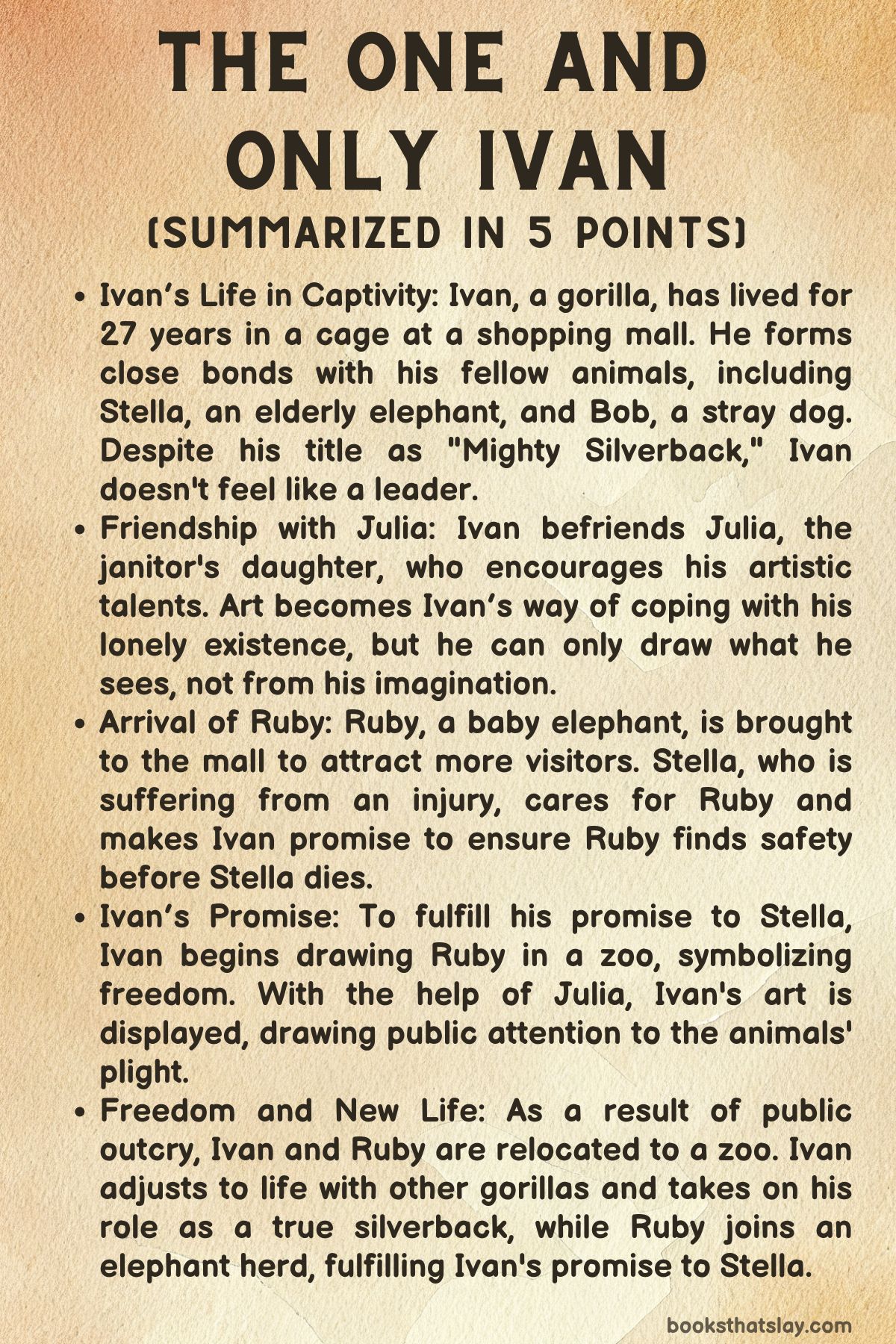
Ivan is a gorilla who lives at the Exit 8 Big Top Mall and Video Arcade. Humans call him many names, including the Freeway Gorilla and the One and Only Ivan, Mighty Silverback, but Ivan thinks of himself simply as Ivan.
He understands human language, although he does not always understand human behavior. He knows humans talk constantly, often without meaning much, while gorillas are patient and quiet.
Ivan is large, silver-backed, and strong, but he does not see himself as angry. He lives behind glass in what he first calls his domain, though that word will later change in his mind.
The mall is run by Mack, who owns Ivan and the other animals used in the small circus shows. Ivan’s enclosure has glass walls, a painted jungle scene, and a few objects that help him pass the time. Nearby lives Stella, an older elephant with a painful foot and a long memory. Bob, a small stray dog, often slips into Ivan’s space and sleeps on his stomach.
These two are Ivan’s closest friends. Stella is wise and sad, while Bob is sharp, funny, and distrustful of humans. Together, they form a small family inside a place built for display.
Ivan spends his days watching people watch him. He remembers that some animals live unwatched lives, but he has not lived that way for a long time. Visitors come to stare, laugh, throw things, or lose interest.
Ivan sometimes throws balls of dried dung at them, partly out of boredom and partly because humans can be cruel. His life changes a little when Julia, the daughter of George the janitor, gives him crayons and paper. Julia is an artist, and Ivan soon becomes one too. He draws what he sees: banana peels, candy wrappers, small objects, simple shapes.
Mack sells Ivan’s drawings to visitors, but Ivan draws because art makes him feel calm and awake.
Ivan once lived in the wild, but he has pushed those memories away. He remembers only bits at first: clouds, mud, his mother’s back, and his twin sister, Tag. Stella tells him that memories matter because they help a person understand who they are. Ivan resists remembering because his past hurts.
He has survived by forgetting, by accepting the mall as his world, and by refusing to think too much about what was taken from him.
Business at the mall begins to fail. Mack grows worried and angry because fewer people come to see the animals.
He threatens to sell them and acts harshly toward them. Then a new animal arrives: Ruby, a baby elephant. Stella hears Ruby crying before the others fully understand what is happening. Ruby has been taken from a bankrupt circus and brought to the mall to attract visitors.
She is frightened and refuses to leave the truck until Stella comforts her. Stella protects Ruby from Mack’s impatience and gently leads her inside.
Ruby brings energy, questions, and sorrow into Ivan’s life. She asks Ivan endless things about who he is, what art is, why humans act as they do, and where the other elephants are. She tells Ivan that humans killed her family, though she also remembers humans who once saved her after she fell into a hole.
Her experience shows that humans can be both cruel and kind, a truth that Ivan and Bob struggle to understand. Stella becomes a motherly figure to Ruby, caring for her, touching her, and giving her the comfort she never had the chance to give a child of her own.
Stella’s injured foot grows worse. George and Julia notice, but Mack refuses to pay for a vet quickly because money is tight.
Stella becomes too weak to perform, and Ruby has to appear in the circus alone. The audience loves Ruby, but Ivan is unsettled. Ruby’s success does not mean safety; it means Mack will keep using her.
One night, Stella, badly ill, asks Ivan to promise that he will protect Ruby. Ivan gives his word as a silverback, even though he has no idea how he can help anyone from behind glass. Soon after, Stella dies.
Stella’s death changes Ivan. Ruby is devastated, Julia cries, George is upset, and even Mack seems weighed down, though he avoids taking responsibility. Bob tells Ruby that Ivan will save her, but Ivan doubts himself.
He cannot even save himself. Yet Stella’s request begins to awaken something in him. Ruby asks Ivan to tell her a story about his childhood, and for her sake he finally begins to remember.
Ivan remembers being born in a rain forest in central Africa. He remembers his sister Tag, his mother, his father, and the troop that taught him how to live. His father was the silverback: guide, teacher, and protector.
Ivan and Tag played, learned, climbed, made nests, and lived as young gorillas should. Ivan was called Mud because he loved drawing with mud and other natural colors. For a while, his life was full, free, and right.
Then humans came. They killed his parents and captured Ivan and Tag. The twins were placed in a crate. Ivan understood, in some instinctive way, that he had to forget his old life in order to survive.
Tag could not forget, and she died in the crate. Mack bought Ivan and first raised him like a human child. Ivan wore diapers, drank from bottles, went to public places, and lived in Mack’s home. Mack’s wife, Helen, grew angry when Ivan broke things, and as Ivan became bigger, the arrangement fell apart. Eventually, Ivan was moved to the mall enclosure.
At first, it seemed easier because he would no longer break human belongings, but he did not understand that he would remain there for years.
Back in the present, Ivan now sees his enclosure differently. It is not a domain. It is a cage. He marks the many days he has spent with humans and feels the weight of his stolen life.
Mack begins training Ruby harshly for performances. He uses a claw-stick to frighten her, and Ruby becomes tired, thin, and resigned. Ivan knows he must act, but he has only art, memory, and patience.
Julia gives Ivan finger paints, and Ivan becomes fascinated by color and handprints. At first he paints what he knows, but then he realizes he must paint something that does not yet exist.
After seeing a television advertisement for a zoo with elephants living together in a safer, more natural setting, Ivan understands what he needs to show. He begins making many paintings at night, hiding them from Mack. Piece by piece, he creates a large picture of Ruby with other elephants, along with the word HOME. He wants Julia to understand that Ruby belongs somewhere safe.
Ivan struggles to make the image clear. When he finally shows Julia, she does not understand at first. Desperate, Ivan beats his chest in anger. For the first time, he feels like a protector. Julia looks again and sees the separate paintings as parts of one large picture.
She realizes Ivan has painted Ruby at a zoo and has written HOME. She understands that he wants the image placed on the mall billboard. George is afraid of losing his job, but Julia persuades him by reminding him what happened to Stella. Together, they put Ivan’s picture on the billboard.
The painting draws attention. A newspaper covers Ivan’s work, and soon more people come to the mall. At first, Mack profits from the attention and sells more of Ivan’s art. But the attention also brings questions. Reporters film the animals and the claw-stick used to train Ruby.
Protesters gather outside the mall demanding that Ruby be freed. Inspectors arrive. A zoo worker named Maya comes to evaluate the animals. Eventually, Ruby is prepared for transport, and more crates arrive for the other animals too. Ivan realizes that his plan is working, though he is frightened of entering a box because his last memory of a crate is tied to Tag’s death.
Julia and George say goodbye. Mack has fired George, but there is hope he may find work at the zoo. Julia presses her hand to Ivan’s glass, and Ivan notices how similar their hands are.
She gives him a drawing of Ruby with elephants and Ivan with a gorilla companion, and in that picture Ivan is smiling. Maya patiently trains Ivan to enter his transport crate. Ruby will not go unless Ivan does, so he steps inside for her sake. Before leaving, Ivan says goodbye to Bob and gives him the stuffed gorilla toy he had named Not-Tag.
Ivan is taken to the zoo. At first, he is lonely and confused. His new space is cleaner, but he does not see Ruby or the open life he expected. He misses Bob, Julia, his art, and even parts of the mall.
Maya gives him a television showing gorillas, and then, one day, Ivan sees real gorillas on the other side of the glass. He is nervous and unsure because he has not lived as a true gorilla for so long. He watches them, especially Kinyani, a strong and intelligent female gorilla.
When he first enters the outdoor space, he struggles and is tested. He does not immediately know how to be a silverback.
Slowly, Ivan learns. He remembers the wild, practices gorilla behavior, makes a nest, plays, courts Kinyani awkwardly, and earns a place in the troop. He tells the other gorillas about his life, his childhood, and the mall.
He begins to think of them as his family. He also discovers that he can still make art, using mud on a zoo wall. From a high spot, he sees the elephants and finally sees Ruby among them. She is safe, living with other elephants as Stella had wanted. Ivan knows he has kept his promise.
At the end, Julia and George visit the zoo, and Bob appears in Julia’s backpack. Bob now lives with Julia and George, and Julia has found a way to help pay for his care. She shows Ivan a photo of Ruby with other elephants and tells him it happened because of him.
Ivan returns to his gorilla family with a new understanding of himself. He is no longer only a lonely animal behind glass. He is Ivan, an artist, a friend, a protector, and at last, a mighty silverback.
Characters
Ivan
Ivan is the central figure of The One and Only Ivan, and his growth gives the book its emotional shape. At the beginning, he is calm, observant, and deeply lonely, though he does not always admit the depth of that loneliness. He has survived captivity by limiting his memories and lowering his expectations.
His habit of calling his cage a domain shows how he has learned to soften the truth of his situation. Ivan is not foolish or passive; he is patient, watchful, and sensitive, but his long captivity has made him unsure of what power he still has. He believes anger exists to protect others, and because he thinks he has no one to protect, he sees no reason to be angry.
This changes after Ruby arrives and Stella dies. Ivan’s promise to protect Ruby forces him to recover the parts of himself he has buried: his childhood, his family, his grief, and his identity as a silverback. His art becomes more than entertainment or a way to pass time. It becomes language, protest, and rescue. Ivan’s character is powerful because his heroism is not loud at first. It grows from care, memory, and a slow decision to act even when success seems impossible.
Ruby
Ruby is a baby elephant whose arrival changes the lives of everyone at the mall. She is curious, talkative, frightened, and emotionally open in a way Ivan is not. Her constant questions make her seem innocent, but she has already suffered greatly. She has lost her family, endured captivity, and been moved from one human-controlled place to another.
Ruby still remembers both good and bad humans, which gives her a more complicated view of people than Bob’s harsher judgment. She knows cruelty, but she also remembers being saved by villagers who returned her to her family after she fell into a hole.
In the book, Ruby represents the future that can still be saved. Stella sees this clearly and wants Ruby to escape the fate that trapped her. Ruby’s vulnerability awakens Ivan’s protective instinct, but she is not only a helpless figure. Her fear, sadness, trust, and resilience all matter.
She carries the pain of a stolen life, yet she can still laugh, ask questions, and imagine safety. Her eventual life with other elephants becomes proof that rescue is possible.
Stella
Stella is one of the wisest and most painful figures in the story. She is an older elephant whose body shows the cost of years of performance and neglect. Her injured foot is not only a physical wound; it is a sign of the long abuse she has endured in circuses and at the mall.
Stella remembers her past more clearly than Ivan remembers his, and her relationship with memory is central to her character. She believes memories help beings know who they are, even when those memories hurt. Unlike Ivan, who has survived by forgetting, Stella has survived by remembering and by holding onto a moral understanding of what life should be.
She knows the difference between a bad cage and a good zoo, and she knows Ruby cannot remain where she is. Her tenderness toward Ruby reveals her unfulfilled longing to protect a child.
Stella’s death is the story’s turning point because it transfers responsibility to Ivan. Her trust in him becomes the force that pushes him from endurance into action.
Bob
Bob is a small stray dog with a sharp tongue, quick instincts, and a guarded heart. He presents himself as wild, independent, and uninterested in belonging to humans, but much of that attitude comes from being abandoned as a puppy.
His early suffering has made him distrustful, especially toward people. Bob often uses humor and sarcasm to protect himself from tenderness, but his actions reveal deep loyalty. He sleeps on Ivan’s stomach, watches over Ruby when Ivan asks, comforts his friends in his own rough way, and ultimately becomes part of Julia and George’s household.
In The One and Only Ivan, Bob often voices the practical and cynical view of the world. He sees danger quickly and rarely expects goodness from humans.
Yet he is not closed off completely. His bond with Ivan is one of the warmest relationships in the book, and his eventual acceptance of a home shows that even the most guarded character can choose trust when care is real.
Julia
Julia is a young artist who understands Ivan in a way most humans do not. She does not treat him as a spectacle or a product. She watches carefully, gives him art supplies, studies his drawings, and believes his marks may have meaning even when adults dismiss them as blobs.
Julia’s artistic sensitivity allows her to become the bridge between Ivan’s silent message and the human world. She is also compassionate toward the animals, especially Stella and Ruby. Her grief after Stella’s death is honest and active; she does not simply feel sad, she challenges what has happened.
Julia’s role is important because she shows how attention can become responsibility. She sees what others overlook, and because she sees it, she acts. Her connection with Ivan is based on shared creativity, and this shared language allows Ivan’s plan to succeed.
Julia is young, but she has moral courage that many adults around her lack.
George
George, Julia’s father, is a kind but cautious man. He works as the mall janitor and depends on the job, especially because his wife is ill and the family needs money. This makes his position difficult.
He sees the animals’ suffering and cares about them, but he is afraid of the consequences of challenging Mack. George’s hesitation is not simple weakness; it comes from financial pressure, parental responsibility, and fear of losing stability. Still, his conscience is alive.
When Julia asks him to help put Ivan’s painting on the billboard, he resists at first, but he eventually chooses what is right. George represents ordinary goodness under pressure.
He is not fearless, but he can be moved by truth and by his daughter’s moral clarity. His choice helps turn Ivan’s art into public action, and that decision changes the future for Ruby and Ivan.
Mack
Mack is the owner of the mall circus and one of the most complicated human characters in the book.
He is responsible for keeping Ivan, Stella, Ruby, and the other animals in harmful captivity, and his decisions cause real suffering. He refuses timely care for Stella, uses fear in training Ruby, profits from Ivan’s art, and sees the animals mainly through the lens of business.
At the same time, the book does not present him as a flat villain. He once raised Ivan in his home, shares memories with him, and seems genuinely sad when Ivan is about to leave. His problem is that whatever affection he has is weaker than his need for control and income.
Mack can feel attachment, but he does not turn that feeling into ethical care. In The One and Only Ivan, he shows how people can become cruel not only through hatred, but also through selfishness, denial, and the habit of treating living beings as possessions.
Maya
Maya is the zoo worker who helps move Ruby and Ivan into safer lives. Her role is calm but important because she represents a better kind of human authority. Unlike Mack, she does not rely on fear or force.
She uses patience, training, rewards, and observation. She respects the animals’ fear and works with them instead of simply trying to dominate them. Maya’s presence helps the book distinguish between captivity built for profit and care built around safety.
She cannot erase what Ivan and Ruby have suffered, and the zoo is still not the wild, but she offers them a life with more space, companionship, and dignity. Her gentleness with Ivan matters because his fear of boxes is connected to deep trauma. Maya gives him the time and structure he needs to step forward.
Kinyani
Kinyani is the female gorilla Ivan meets at the zoo, and she plays a key role in his return to gorilla life. She is intelligent, strong, alert, and not easily impressed.
When Ivan enters the gorilla space, she tests him, and her reaction shows that Ivan cannot simply claim the role of silverback because of his size. He must learn how to belong. Kinyani’s testing is not cruelty; it is part of the social world Ivan has been separated from for most of his life.
Through her, Ivan begins to understand that being a gorilla requires practice, courage, play, and connection.
Her later willingness to play, groom, and sit with him marks his gradual acceptance into the troop. Kinyani helps Ivan move from performance-based identity to living identity.
Tag
Tag, Ivan’s twin sister, appears mainly through memory, but her presence shapes Ivan’s emotional life. She represents the childhood Ivan lost and the cost of human violence.
Tag loved chasing Ivan, and her name itself carries the joy of play, movement, and family.
Her death in the crate is one of the reasons Ivan learns to forget. He survives by cutting himself off from the past, while Tag is unable to do the same. This does not make her weak; it shows how unbearable the loss was. Tag becomes a symbol of the life Ivan was supposed to have.
When Ivan later gives the stuffed gorilla named Not-Tag to Bob, it is a quiet act of farewell, love, and healing. He is no longer only clinging to the past; he is choosing to protect the living.
Stella’s Memory of Jambo
Jambo is not a major active character, but the story Stella tells about him has a strong effect on Ivan’s understanding of what a silverback can be. Jambo, the zoo gorilla who protects a fallen child instead of harming him, challenges the human assumption that strength must mean violence.
For Ivan, the story confirms something he already knows: a frightened child is not an enemy. Jambo becomes an example of protective power, the kind Ivan later tries to claim for Ruby. His importance lies in the idea he represents. A true protector does not need to destroy in order to be strong. He guards the vulnerable.
Themes
Captivity and the Meaning of Home
Home is treated as more than a place where someone happens to live. Ivan begins by calling his glass enclosure a domain, a word that makes his captivity sound almost acceptable.
Over time, that illusion breaks down. Stella’s suffering, Ruby’s arrival, and Ivan’s recovered memories force him to admit that a space can contain food, routine, and familiar faces while still being a prison. Ruby calls the mall home because Ivan, Stella, Bob, and Julia are there, but Ivan understands that affection alone cannot turn a harmful place into a safe one.
A true home must allow dignity, companionship, and the chance to live according to one’s nature. The zoo is not presented as perfect or equal to the wild; Ivan notices that walls still exist. Yet it offers Ruby other elephants and Ivan other gorillas, and that difference matters.
The One and Only Ivan asks readers to think carefully about the gap between shelter and freedom. A home is not simply where someone is kept. It is where they can become more fully themselves.
Memory, Trauma, and Identity
Ivan’s survival depends for many years on forgetting. His childhood in the forest, the death of his family, the loss of Tag, and the shock of being turned into a human-owned attraction are too painful to hold in daily thought.
By refusing memory, Ivan creates a smaller emotional world in which he can endure captivity. Stella challenges this habit by telling him that memory helps beings know who they are. Her words become more important after Ruby needs comfort and asks Ivan for a story. When Ivan begins to remember, the past hurts him, but it also restores him.
He remembers that he was born into a troop, that his father was a protector, that he once made art with mud, and that he belonged to a world larger than glass walls.
Memory gives him grief, but it also gives him direction. Without memory, Ivan can survive; with memory, he can act. The book shows trauma not as something easily overcome, but as something that can be faced when love gives a reason to do so.
Art as Communication and Resistance
Art begins as a private comfort for Ivan. Drawing gives him relief from boredom and helps him feel quiet inside.
At first, his pictures are treated as novelties by Mack, who sells them for money without understanding their meaning. Julia, however, sees Ivan as a fellow artist, and that recognition changes what art can do in the story. Ivan’s drawings are not random marks; they are his way of noticing, thinking, and speaking across the barrier between animal and human.
When words fail him, images become his language. His great painting of Ruby, other elephants, the zoo, and the word HOME turns art into action. It carries a message no one at the mall can ignore once Julia understands it. The painting moves from Ivan’s cage to the billboard, then into public attention, then into protest and inspection.
Art does not free Ruby by magic; it makes truth visible. The theme suggests that creative expression can challenge systems that depend on silence, especially when someone is willing to look closely enough to understand.
Protection, Responsibility, and Moral Courage
Ivan’s idea of anger changes as his sense of responsibility grows. Early in the story, he says anger is meant for protecting others, and since he believes he has no one to protect, he does not think of himself as angry.
Ruby’s arrival proves otherwise. Stella’s final request gives Ivan a duty he cannot escape, even though he feels powerless. His courage is not immediate confidence. He doubts himself, fears failure, and does not know how a gorilla behind glass can save a baby elephant. Still, he keeps working. Protection in the book is not shown only through physical strength.
Stella protects Ruby with tenderness. Julia protects the animals by paying attention and speaking up. George protects them by taking a risk despite his fear. Maya protects them through patient care.
Ivan protects Ruby through memory, art, and persistence. Moral courage means accepting responsibility even when the outcome is uncertain. Ivan becomes a true silverback not because he defeats an enemy by force, but because he chooses another creature’s safety over his own comfort.