Bee Season Summary, Characters and Themes
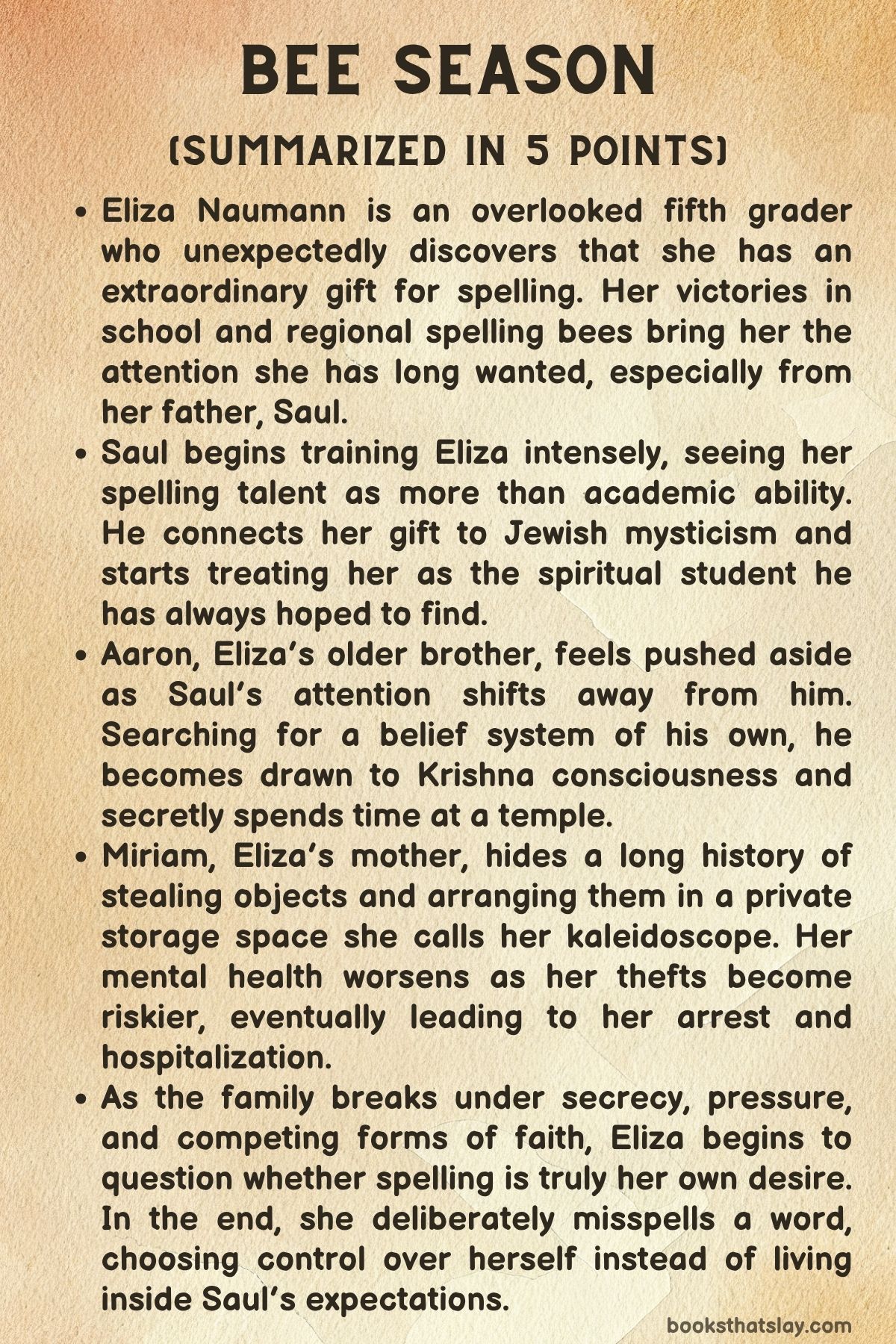
Bee Season by Myla Goldberg is a family and coming-of-age novel about Eliza Naumann, an overlooked young girl whose sudden spelling talent changes the balance of her household. What begins as a school spelling bee becomes a study of faith, ambition, mental illness, parental attention, and the cost of being seen only through talent.
The novel follows Eliza, her father Saul, her mother Miriam, and her brother Aaron as each searches for order, meaning, or spiritual certainty. Goldberg presents a family that appears educated and stable from the outside but is quietly coming apart within.
Summary
Eliza Naumann begins as a fifth grader who has learned to expect very little from herself because the adults around her expect very little from her. She is not in the gifted program, she has been placed in lower academic groups, and even her father’s reactions to her report cards have taught her that she is ordinary at best.
During a classroom spelling bee, however, she discovers an ability she did not know she possessed. As her classmates make mistakes, Eliza silently spells each word correctly in her mind.
Her confidence grows word by word, and she eventually wins her class bee, then the school bee. This victory is her first public achievement, yet when she slips the notice of the next competition under her father Saul’s study door, it is lost among his papers.
Saul Naumann is a cantor and scholar of Jewish mysticism whose study has long been the emotional center of the house, but not everyone is invited into it equally. His son Aaron has enjoyed Saul’s attention for years because of his skill with Hebrew and synagogue life, while Eliza has stood outside that special bond.
When Aaron discovers that Saul never saw the notice, he helps bring Eliza’s achievement to light. Saul is delighted and surprised, and Aaron drives Eliza to the district bee because their parents are unavailable.
At the bee, Eliza learns that her spelling gift is not only memory or practice. Words appear to her as visible, almost physical arrangements of letters, and she can sense when they are right.
She wins again, shocking Aaron and changing the structure of the family.
Eliza’s success draws Saul toward her with sudden intensity. He regrets missing the district bee and insists that the whole family attend the next round.
At the area finals, Eliza experiences something rare for her: the presence of both parents and her brother focused on her. She feels almost like the family has gone on a vacation together.
Onstage, she settles into her method of closing her eyes and allowing words to appear in her mind. Saul watches and begins interpreting her gift through the lens of Jewish mystical practice.
To him, Eliza is not merely a talented speller. She may be the spiritual student he has long imagined finding.
Eliza wins the area finals and becomes a public success. Newspapers print her name and photograph, her school celebrates her, and Saul begins preparing her for the national competition.
He buys a massive dictionary and turns part of his study into a training space. Their sessions become intense and absorbing.
Eliza learns roots, origins, and patterns, but Saul gradually shifts the work from ordinary spelling practice toward mystical discipline. He connects spelling to sacred language, concentration, and the possibility of divine access.
Eliza, hungry for his approval and fascinated by her own abilities, enters this new world willingly.
Aaron, meanwhile, feels displaced. He once occupied the special place beside Saul, especially through Hebrew, music, and synagogue performance.
Their bond began after a painful childhood bullying incident, when Saul offered the study as a refuge and made Aaron feel chosen. Now the study door closes for Eliza, and Aaron finds himself outside it.
His guitar practice falters, and his connection to Judaism begins to feel inherited rather than personally chosen. He starts visiting churches and reading about other religions, searching for a form of spiritual life that belongs to him rather than to his father.
Miriam Naumann, Eliza and Aaron’s mother, is also moving through a private crisis. A brilliant lawyer from a wealthy but emotionally pressurized background, Miriam has always needed order, precision, and control.
Her childhood was marked by obsessive routines and a desire for perfect arrangement. In adulthood, this need has taken a hidden form: for years she has stolen objects and stored them in a rented unit, arranging them into an elaborate private structure she calls her kaleidoscope.
Her actions are not motivated by greed. She believes she is restoring missing pieces to herself and to the world, misusing Saul’s old explanation of Tikkun Olam as a justification for theft.
As Eliza prepares for the national bee in Washington, DC, her bond with Saul becomes more complicated. Saul pushes her to stop thinking and allow letters to guide her, but his faith in the method creates pressure.
At the national competition, Eliza performs well for a time but eventually misspells a word and is eliminated. The loss does not end Saul’s ambitions for her.
Instead, he tells himself that with further training she can return stronger. Eliza, still wanting his belief in her, resumes practice after they come home.
Aaron’s religious search leads him to Chali, a young man connected with the International Society for Krishna Consciousness. Chali introduces Aaron to Krishna devotion, chanting, sacred texts, and the idea of God consciousness.
Aaron begins chanting secretly, first in his closet and then more regularly throughout his life. The discipline gives him a sense of containment and spiritual purpose.
He adopts vegetarianism and becomes increasingly committed to the temple, even as he hides his involvement from his family. For Aaron, Krishna devotion offers an identity separate from Saul’s expectations and from the old synagogue world where he once felt both special and trapped.
At the same time, Miriam’s hidden life becomes more reckless. Her thefts move from stores to private homes.
She enters unfamiliar houses, steals small objects, and is disturbed by filth, disorder, animals, and signs of other people’s lives. Her behavior becomes harder to control and more dangerous.
Saul and Miriam’s marriage also deteriorates in disturbing ways. Their sexual relationship, long dormant, returns in a confusing and damaging form, marked by disconnection, shame, and failed attempts at closeness.
Saul begins sleeping in his study, while the children gradually sense that something has changed between their parents.
Saul’s mystical training with Eliza grows more extreme. He introduces her to Abraham Abulafia, a Jewish mystic whose practices involve letters, names of God, breath, movement, and altered states of awareness.
Eliza appears to respond naturally to these exercises, sometimes performing movements or entering states that Saul believes confirm her rare spiritual gift. He gives her access to mystical ideas but also places enormous symbolic weight on her ability.
Winning spelling bees is no longer just winning; it becomes proof of spiritual readiness.
Eliza begins secretly reading Saul’s advanced mystical books and practicing techniques on her own. Her school life starts to suffer as she becomes absorbed in letters and inner visions.
Teachers and school officials grow concerned about her ability to separate imagination from reality. While Saul is focused on her mystical potential, he fails to see how much pressure and confusion she is carrying.
The very talent that brought her attention now threatens to consume her.
The family crisis becomes public when Miriam is arrested after being found inside a stranger’s house with a stolen object. Saul learns the full extent of her secret life when the police show him the storage unit she has maintained for eighteen years.
Inside is a vast installation of stolen items arranged with great care and private logic. Saul is overwhelmed by its beauty, order, and evidence of illness.
Miriam is placed in psychiatric care, and Saul must tell Eliza the truth: her mother has been stealing for years and is mentally ill.
Aaron also reveals his secret more fully. Saul discovers his connection to the Krishna temple and reacts with anger, fear, and accusations of brainwashing.
Aaron refuses to abandon the temple and insists that his new faith matters to him. When Eliza visits him, he warns her to ask whether spelling is truly what she wants or whether it is only what Saul wants for her.
This warning matters because Aaron recognizes in Eliza a version of his own earlier dependence on Saul’s approval.
In the final movement of the story, Eliza reaches a breaking point. She secretly practices advanced letter permutations and experiences an overwhelming vision in which words, bodies, sensations, and faces seem to merge into a vast presence.
The experience is powerful but frightening, leaving her physically shaken and emotionally changed. The next morning, during another class spelling bee, she is given a word she can spell.
Instead of continuing the path Saul has laid out for her, she deliberately misspells it. Saul is shocked, but Eliza’s choice is clear.
By failing on purpose, she claims control over her gift and refuses to let spelling become another form of family possession. Her mistake is not a collapse but an act of resistance, a way of stepping out of the role her father has created for her and protecting what remains of herself.
Characters
Eliza Naumann
Eliza Naumann is the emotional center of Bee Season, a girl who begins the book convinced that she is ordinary because everyone around her has treated her that way. Her early exclusion from the gifted program shapes her self-image, and her father’s quiet disappointment over her average grades teaches her to expect neglect rather than praise.
Her spelling talent changes this pattern because it gives her access to attention, especially from Saul. Eliza’s ability is presented as both natural and mysterious: words become visible to her, their letters arranging themselves until they feel complete.
This gift gives her confidence, but it also makes her vulnerable to being interpreted by others. Saul sees mystical significance in her talent and gradually turns it into a spiritual project.
Eliza wants his love and recognition, so she follows him deeply into this world before recognizing its danger. Her final deliberate misspelling is one of the most important acts in the book because it shows that she is no longer willing to be defined only by achievement or by her father’s hunger for revelation.
She chooses agency over performance.
Saul Naumann
Saul Naumann is a father, cantor, and scholar whose spiritual ambition shapes the household more than he realizes. His past explains much of his hunger for meaning.
Born into a family marked by religious rupture, grief, and rejection, Saul turns to Jewish mysticism as a way of repairing his own fractured inheritance. His study becomes his sanctuary, but it is also a place of exclusion.
For years, Aaron is invited into Saul’s inner world while Eliza remains outside it. When Eliza’s spelling talent appears, Saul’s attention shifts with great force.
He loves his daughter, but his love becomes mixed with projection. He sees in her the mystical student he always wanted and begins to treat her ability as proof of sacred potential.
Saul is not cruel in a simple sense; he is attentive, enthusiastic, and sincere. Yet his sincerity is dangerous because he cannot separate Eliza’s needs from his own spiritual dreams.
His failures as a husband and father come from blindness rather than indifference. He notices gifts when they fit his private theories, but he misses pain when it does not.
Miriam Naumann
Miriam Naumann is one of the most complex figures in the novel, a brilliant woman whose need for order hides a severe mental and emotional disturbance. Her childhood is defined by pressure, isolation, and obsessive habits that adults mistake for signs of exceptional intelligence.
She learns to protect herself through control: objects must be arranged properly, personal space must remain untouched, and concentration becomes a refuge from human unpredictability. As an adult, she appears functional because she is educated, married, and professionally accomplished, but this appearance is false.
Her long history of theft reveals a private logic in which stolen objects become missing pieces she believes she must restore. The storage unit she calls her kaleidoscope represents both artistic order and psychological collapse.
Miriam’s distance from her children is painful, especially for Eliza, yet the book does not reduce her to a cold mother. She is someone whose inner life has become so consuming that ordinary intimacy feels almost impossible.
Her illness damages the family, but it also exposes how little the family has truly understood her.
Aaron Naumann
Aaron Naumann is Eliza’s older brother, and his story runs parallel to hers as another search for spiritual identity under Saul’s influence. In childhood, Aaron is bullied, ashamed, and socially isolated.
Saul responds by bringing him into the protected world of the study, making Aaron feel chosen and safe. Aaron becomes skilled in synagogue life, especially Hebrew recitation, and his bar mitzvah gives him a powerful experience of unity that he interprets as contact with God.
Yet this early spiritual life is tied closely to Saul’s approval. When Saul’s attention shifts to Eliza, Aaron feels abandoned and begins questioning beliefs he had accepted without examination.
His movement toward Krishna devotion is not only rebellion; it is an attempt to find a spiritual path that belongs to him. In Bee Season, Aaron’s conflict shows how a child can mistake parental closeness for personal conviction until that closeness disappears.
His warning to Eliza near the end shows his growth. He understands the danger of living inside someone else’s vision and urges her to ask what she truly wants.
Chali
Chali serves as Aaron’s guide into Krishna consciousness and gives language to Aaron’s spiritual restlessness. He appears at a moment when Aaron is searching beyond Judaism but has not yet found a path that feels open to him.
Chali is calm, persuasive, and welcoming, and he presents his faith not as a rejection of other religions but as a broader form of God consciousness. His explanations make Aaron feel that he does not have to abandon his longing for God in order to leave Saul’s religious world.
Chali’s influence is important because he offers Aaron structure: chanting, sacred texts, precepts, community, and the possibility of initiation. At the same time, his role raises questions about vulnerability.
Aaron is lonely and displaced when he meets him, so the temple’s certainty becomes especially attractive. Chali is not portrayed simply as a villain or rescuer.
He is a believer whose presence helps Aaron imagine another life, even while that new life intensifies the conflict at home.
Sinna Bhagudori
Sinna Bhagudori is one of Eliza’s classmates and early spelling rivals. She represents the world of students who have long been recognized as academically strong, the kind of world from which Eliza has been excluded.
When Sinna competes in the school bee and later shows interest in Eliza’s studying, she becomes a marker of Eliza’s shifting social position. Eliza’s success briefly gives her access to students who once seemed separate from her, but that access is uneasy.
Sinna is not developed as deeply as the Naumann family, yet she matters because she helps show how achievement changes Eliza’s place at school. Eliza is no longer invisible, but visibility brings new pressures.
Sinna’s presence also reminds readers that spelling competitions are not only private spiritual events for Eliza and Saul; they are public academic contests where status, reputation, and peer judgment matter.
Rachel
Rachel is the contestant who eventually wins the national bee after Eliza is eliminated. Her role is brief but meaningful because she represents the level of discipline, tension, and emotional strain surrounding national competition.
Eliza watches the other contestants closely, noticing their habits and nervous behaviors, and Rachel becomes part of that charged atmosphere. Her victory with the final word underscores the difference between Eliza’s private experience of spelling and the public structure of the bee.
For Saul, Eliza’s loss is not the end of possibility, but Rachel’s win reminds the reader that the competition continues without regard for Saul’s mystical interpretations. Rachel’s presence also helps mark the moment when Eliza’s talent is no longer enough to protect her from pressure.
Winning and losing become less important than what the process is doing to her mind and sense of self.
Matthew Harris
Matthew Harris is Eliza’s final opponent at the district bee, and his presence helps establish the seriousness of her gift. He is described as a small boy with a medical condition, and he appears to be the expected kind of contestant: prepared, unusual, and suited to the spelling world.
Eliza’s victory over him surprises both Aaron and the adults around her because it challenges their assumptions about who belongs in such competitions. Matthew also functions as a reminder of replacement and pressure.
Organizers tell Eliza that if she cannot attend the next stage, Matthew will take her place. This detail shows how quickly Eliza’s achievement becomes part of a larger system in which children are ranked and substituted.
For Eliza, who has just discovered a source of pride, the idea of being replaceable sits uneasily beneath the excitement of winning.
Dr. Morris
Dr. Morris, the principal, represents institutional judgment and the harm caused by fixed expectations. He knows Eliza but is surprised to see her among the school’s best spellers, which reveals how fully the school has accepted the idea that she is not gifted.
His earlier dismissal of Saul’s concern about Eliza’s exclusion from the talented program shows a bureaucratic kind of authority: polite, final, and damaging. He does not appear malicious, but his confidence in the school’s categories affects Eliza’s life.
Because she is passed over, she internalizes a sense of mediocrity and is placed in lower-level academic groups. Dr. Morris matters because the book shows that children are shaped not only by family but also by institutions that label them early.
His surprise at Eliza’s success is less about her and more about the failure of the adults who thought they had already measured her.
Ms. Bergermeyer
Ms. Bergermeyer is Eliza’s classroom teacher and the person who unknowingly creates the first public setting for Eliza’s transformation. Her classroom bee begins as an ordinary school activity, but it becomes the moment in which Eliza discovers that she can do something extraordinary.
Later, Ms. Bergermeyer’s response to Eliza’s constant studying is more practical and disciplinary. She confiscates Eliza’s spelling sheets and sends notes home, trying to keep classroom order.
Her role shows the contrast between ordinary educational routines and the intense private meaning spelling has taken on for Eliza. To the school, spelling is an activity, a contest, or a disruption.
To Eliza and Saul, it becomes a path toward recognition and possibly revelation. Ms. Bergermeyer helps show how far Eliza’s inner experience has moved beyond what the adults at school can understand.
Ms. Lodowski
Ms. Lodowski is important because her decision not to select Eliza for the gifted program becomes one of Eliza’s defining memories. Eliza remembers being skipped while other students are called out, and this moment contributes to her belief that she is not special.
Ms. Lodowski’s role is small, but the emotional effect of her action is large. She represents the first official exclusion that the novel highlights.
The incident also shapes Saul’s later frustration with the school and Eliza’s own uncertainty about her abilities. Because the book later reveals Eliza’s extraordinary talent, Ms. Lodowski’s oversight becomes part of a larger criticism of how adults classify children too early and too narrowly.
Her presence lingers not because she continues to act in the story but because Eliza continues to live under the shadow of being overlooked.
Ms. Paul
Ms. Paul appears when Eliza enters sixth grade, after spelling and mystical practice have begun affecting her ability to function normally at school. In her classroom, Eliza’s focus on letters causes visible problems, especially when she struggles with reading aloud and with separating inner experience from ordinary reality.
Ms. Paul’s role is connected to the school’s growing concern for Eliza’s mental state. Unlike Saul, who interprets Eliza’s experiences through mysticism, the school sees warning signs.
Ms. Paul therefore represents the outside world’s attempt to read Eliza’s behavior in practical terms. Her presence is important because it reminds the reader that Eliza’s gift, when intensified by Saul’s expectations, has consequences beyond the study.
It follows her into school, language, reading, and daily life.
Carrie Waxham
Carrie Waxham is a classmate whose cruelty shows the social cost of Eliza’s sudden recognition. After Eliza becomes known for spelling, Carrie calls her a snob and pokes her, reducing Eliza’s achievement to a reason for resentment.
This moment matters because Eliza’s success does not simply solve her loneliness. Instead, it changes the form of her isolation.
She is no longer ignored, but she becomes a target of envy and hostility. Eliza’s reaction is especially revealing because she repeats the kind of coping language Aaron uses when dealing with bullying.
This connection shows that the siblings share more pain than they openly admit. Carrie is a minor character, but her action helps expose the emotional price of visibility for a child who has not yet learned how to hold public attention safely.
Marvin Bussy and Billy Mamula
Marvin Bussy and Billy Mamula are the bullies who attack Aaron when he is young, and their violence helps explain the later shape of Aaron’s life. The attack is not only physically painful; it is humiliating, especially because Eliza sees it and does not intervene.
Aaron’s refusal to identify them afterward shows his shame and fear. Saul responds by drawing Aaron into the study, turning private scholarship and religious practice into a refuge from the outside world.
In that sense, Marvin and Billy indirectly help create Aaron’s dependence on Saul. They are not developed as full inner characters, but they serve an important structural purpose.
Their cruelty pushes Aaron toward isolation, secrecy, and the need for a protected identity. The emotional effect of their violence remains long after the event itself.
Henry Newman
Henry Newman, Saul’s father, stands behind Saul’s adult hunger for religious meaning and paternal recognition. Henry renounces his Jewish faith after being rejected by his own father for marrying Lisa, and this rejection creates a broken inheritance that Saul later tries to repair.
Henry’s relationship with Saul becomes strained, especially after Lisa’s death and Saul’s choices during the Vietnam era. For Saul, the loss of a stable religious and family lineage becomes a wound.
Henry is important because he helps explain why Saul is so drawn to tradition, mysticism, and the idea of spiritual restoration. Saul’s need to recover what was lost in his family history shapes how he raises Aaron and later how he interprets Eliza’s talent.
Henry’s absence and bitterness are therefore present in the Naumann household even when he is not physically there.
Lisa Newman
Lisa Newman, Saul’s mother, is significant because her death and identity shape Saul’s early understanding of family, Jewishness, and loss. She reveals the family’s Jewish heritage to Saul when he is young, opening a door to a history that had been hidden from him.
Her marriage to Henry is the reason Henry is rejected by Yehudah, making Lisa central to the rupture in the family line. Her death from cancer deepens the emotional fracture between Henry and Saul.
Although Lisa is not present in the main action, she is connected to Saul’s longing for origin and belonging. Her memory helps explain why Saul later treats religious knowledge as something that can restore broken connections.
She is part of the hidden past that Saul keeps trying to answer through study.
Yehudah
Yehudah, Saul’s grandfather, represents religious rigidity and ancestral rejection. His refusal to accept Henry’s marriage to Lisa fractures the family and leads Henry to turn away from Jewish identity.
Yehudah’s judgment has consequences that reach far beyond his own generation. Saul inherits not a continuous tradition but a broken one, and that break fuels his later obsession with Jewish mysticism.
Yehudah is important because the novel shows how family exclusions can echo across decades. His narrow definition of belonging helps create the very spiritual hunger that later defines Saul.
Although Yehudah is distant from the main action, his rejection stands at the beginning of Saul’s lifelong effort to reclaim and reinterpret the faith his father abandoned.
Melvin and Ruth Grossman
Melvin and Ruth Grossman are Miriam’s parents, and their long struggle to have a child shapes the way they raise her. Because Miriam is born after years of pregnancy loss, she becomes the focus of intensified expectation.
Her unusual habits are treated less as warning signs and more as evidence of intelligence or specialness. This response matters because it teaches Miriam that her isolation and obsessive control are acceptable, even admirable, as long as they are linked to achievement.
Their wealth and expectations provide material privilege but not emotional understanding. Their deaths in a car accident leave Miriam without family ties, making Saul attractive as a partner who seems willing to respect her independence.
Melvin and Ruth help explain why Miriam becomes both highly capable and deeply alone.
Madge Turner
Madge Turner is an acquaintance from Aaron’s Scout days who interrupts Miriam during one of her attempts to approach a house. Her appearance is brief, but it is important because it brings the ordinary social world into contact with Miriam’s secret behavior.
Miriam must quickly invent an excuse, showing how practiced she is at maintaining a surface of normalcy. Madge represents the kind of casual community connection that might expose Miriam if her control slips.
The encounter also marks a change in Miriam’s theft pattern. After being interrupted, she tries to return to shoplifting but finds that old habit empty and unsatisfying.
Madge’s presence therefore helps signal Miriam’s movement toward riskier and more unstable actions.
Adam Lubinsky
Adam Lubinsky is one of Saul’s bar mitzvah students, and his role helps define Saul’s identity outside the home. Saul is a cantor and teacher, someone trusted to guide young people through religious preparation.
Adam’s lessons also create moments when Saul is unavailable to his own children, including the day Aaron drives Eliza to the bee and later when Eliza secretly accesses Saul’s mystical books. Adam matters less as an individual personality and more as part of Saul’s public religious role.
Through him, the book contrasts Saul’s authority in the synagogue community with his failures of attention inside the family. Saul can guide other children through structured religious milestones while missing the emotional disorder growing in his own household.
Brad Fry
Brad Fry is one of the final contestants in Eliza’s school bee. His misspelling helps clear the path for Eliza’s first major victory, and his presence contributes to the competitive environment in which she first becomes visible.
Brad is not developed deeply, but he represents the ordinary school hierarchy Eliza unexpectedly disrupts. Before the bee, she does not imagine herself as someone who could outlast students who appear more suited to academic recognition.
Brad’s elimination helps make her win real, not accidental. His role is small, but it belongs to the first stage of Eliza’s transformation from overlooked student to public competitor.
Themes
The Search for Recognition
Recognition in the novel is never simple because being seen often means being misunderstood. Eliza begins as a child who feels invisible in her own family and underestimated at school.
Her spelling gift finally brings attention, but that attention quickly becomes conditional. Saul values her talent because it fits his mystical hopes, the school values it because it produces public achievement, and classmates respond to it with either admiration or resentment.
Eliza’s deepest need is not merely to win spelling bees but to be known as a whole person. Aaron’s story reflects the same theme from another angle.
He once receives Saul’s attention through Hebrew and religious performance, then loses his place when Eliza becomes the chosen child. Miriam, too, creates her hidden kaleidoscope as a private form of recognition, arranging stolen objects into an order only she understands.
Bee Season shows that recognition can heal only when it respects the full person. When it turns into projection, labeling, or possession, it becomes another form of loneliness.
Faith, Mysticism, and Personal Ownership
Faith appears throughout the story as both a path toward meaning and a field of conflict. Saul approaches religion through scholarship, Jewish mysticism, sacred language, and the hope of contact with divine order.
Aaron first inherits Judaism through Saul, but his later turn toward Krishna devotion shows his desire to choose belief for himself. His chanting, vegetarianism, and temple visits are not only acts of rebellion; they are attempts to create a spiritual identity outside his father’s control.
Eliza’s relationship to mysticism is more dangerous because Saul frames her spelling gift as sacred potential before she fully understands what she wants. The novel raises a difficult question: when does guidance become control?
Saul believes he is helping Eliza access something holy, but he also places his own spiritual hunger upon her. Aaron’s warning to Eliza is crucial because he recognizes that faith must be personally claimed, not inherited under pressure.
Spiritual experience has value in the story, but only when it does not erase the self.
Order, Control, and Mental Illness
The desire for order shapes Miriam’s life most visibly, but it also affects every member of the family. Miriam’s childhood habits, her precise kitchen routines, and her hidden arrangement of stolen objects all point to a mind trying to manage inner chaos through external structure.
Her kaleidoscope is beautiful, disturbing, and tragic because it reveals both creativity and illness. She is not stealing for wealth or thrill; she is trying to repair an internal absence through objects.
Saul also seeks order through mystical systems, alphabets, sacred names, and theories of divine language. Eliza organizes words visually and physically, while Aaron uses chanting and religious rules to calm himself.
The novel does not treat order as inherently harmful. Structure can comfort, focus, and give meaning.
The danger comes when order becomes a substitute for human contact or a way to deny pain. Miriam’s collapse exposes how long the family has mistaken function for health.
Her public arrest forces hidden disorder into view, making denial impossible.
Family Silence and the Cost of Secrecy
The Naumann family is full of intelligence, ritual, and private intensity, but it lacks honest communication. Each family member keeps secrets: Eliza hides her fears and later her mystical practice, Aaron hides his religious conversion, Miriam hides years of theft, and Saul hides from truths about his marriage and children until crisis forces him to look.
Their silence is not empty; it is active and protective. They avoid speaking because speech might disturb the fragile arrangements that keep the household moving.
Yet the cost is severe. Eliza and Aaron are left to interpret adult problems alone, often reaching mistaken or frightening conclusions.
Saul does not understand Miriam’s illness until the police reveal it, and he does not understand Aaron’s spiritual life until Aaron has already emotionally left home. The most moving moments between Eliza and Aaron occur when they briefly break through this isolation, sharing secrets or cleaning the kitchen together without words.
The story suggests that silence may preserve appearances, but it cannot protect a family from truth forever.