SPQR: A History of Ancient Rome Summary and Analysis
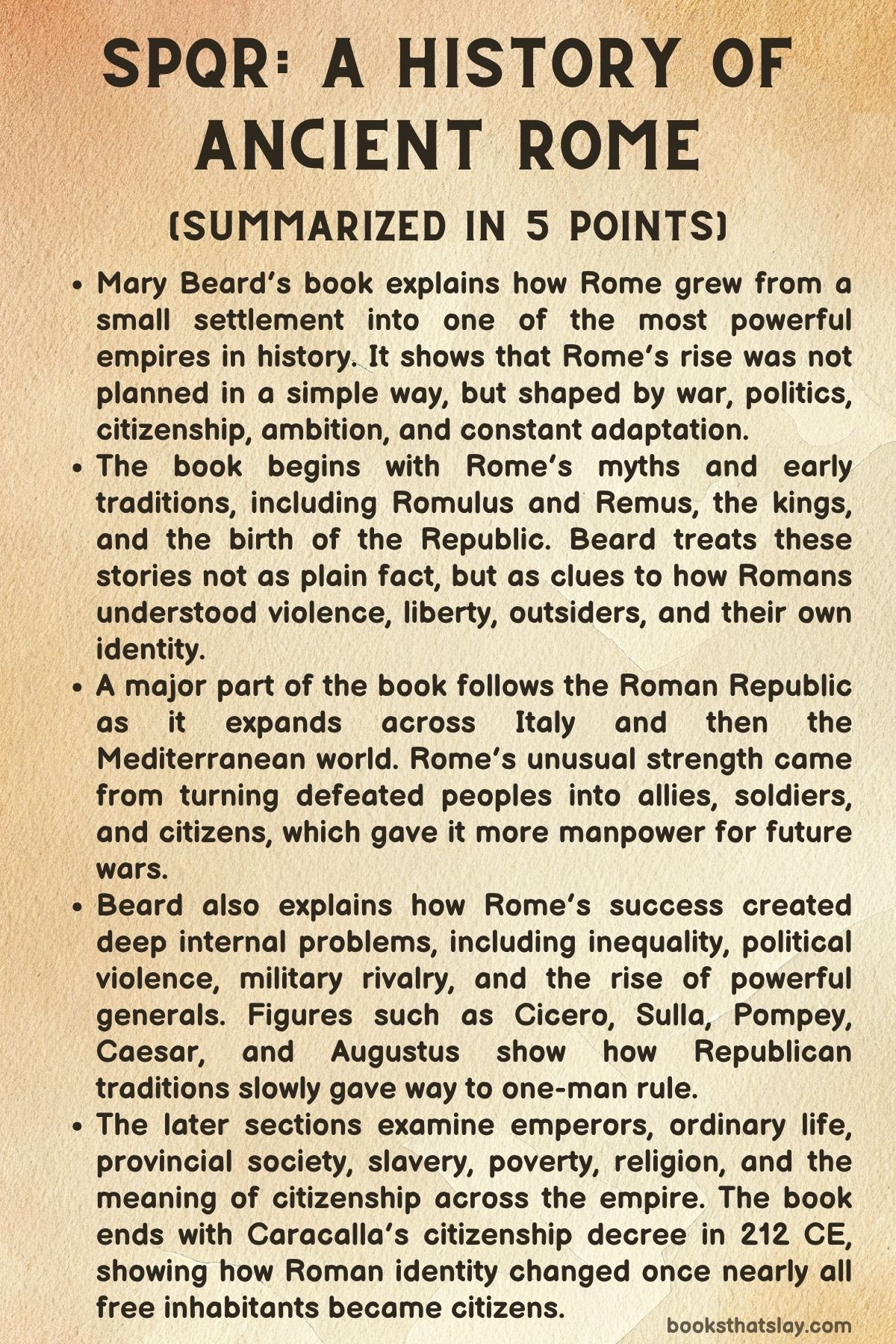
SPQR: A History of Ancient Rome by Mary Beard is a sweeping account of how Rome grew from a small settlement into the dominant power of the Mediterranean world. Rather than treating Roman history as a simple rise-and-fall story, Beard examines myths, politics, warfare, citizenship, class, empire, and everyday life.
The book questions familiar legends, tests ancient sources against archaeology, and shows how uncertain Roman history can be. It is also a study of why Rome still matters, because many modern ideas about power, liberty, citizenship, inequality, and empire remain shaped by Roman arguments and Roman examples.
Summary
Mary Beard’s SPQR begins with the claim that Rome is still active in the modern imagination. Roman terms for power and government, Roman ideas about citizenship, and Roman examples of liberty and oppression still influence political language and public debate.
Beard is less interested in repeating a heroic story of inevitable conquest than in asking how a small Italian community became a vast imperial power. The title comes from “Senatus Populusque Romanus,” meaning “The Senate and People of Rome,” a phrase that captured Rome’s own image of shared political identity.
The book follows Rome from its legendary beginnings to the early third century, when citizenship was granted to all free inhabitants of the empire.
The opening political drama centers on Cicero and Catiline. In the first century BCE, Cicero, a talented outsider who rose through public speaking, became consul and accused Catiline, a bankrupt aristocrat, of plotting violence against the state.
Cicero exposed the alleged conspiracy, delivered a famous denunciation, and ordered the execution of several conspirators without trial. At first he was celebrated as the savior of the Republic, but later he was exiled for violating citizens’ rights.
Beard uses this event to show that Roman history is often built from competing interpretations. Catiline may have been a real revolutionary threat, but Cicero may also have exaggerated the danger to strengthen his own authority.
The book then turns backward to Rome’s foundation myths. The story of Romulus and Remus is not presented as simple fact, but as a revealing Roman self-portrait.
The twins are born after Rhea Silvia is assaulted by Mars, abandoned, saved by a she-wolf, and raised by a shepherd. Romulus later kills Remus and founds the city.
To populate it, he welcomes outsiders and criminals, then abducts Sabine women to secure wives for the new community. These disturbing myths suggest that Romans saw their city as born from violence, migration, sexual coercion, and civil conflict.
At the same time, the myth of an asylum for outsiders anticipates Rome’s later habit of absorbing defeated peoples into citizenship.
Archaeology complicates these legends. Rome was not founded in one clean moment by one heroic figure.
It developed slowly from settlements into a larger town with regional contacts, institutions, religious spaces, and public works. The regal period, once doubted by some scholars, gains support from early inscriptions referring to a king, though these rulers were probably closer to local chiefs than later monarchs.
Roman tradition gave the kings great building projects and political reforms, but Beard stresses that later Romans often projected their own institutions back onto the distant past.
The monarchy ends in Roman memory with the rape of Lucretia by Sextus Tarquinius, son of the tyrant Tarquinius Superbus. Lucretia’s death and Brutus’s oath to expel the kings become the moral foundation of the Republic.
Liberty, or “libertas,” emerges as the central Republican ideal, though its meaning remains contested. The early Republic was not born fully formed.
Offices, political customs, and social divisions developed unevenly. The Twelve Tables show a simpler agricultural society concerned with family authority, debt, inheritance, property, and funerals.
The struggle between patricians and plebeians reshaped politics as common citizens demanded legal protection, representation, and access to office.
Rome’s expansion across Italy was equally improvised. Victories over nearby rivals, the capture of Veii, recovery from a Gallic attack, and wars against Latin and Samnite communities all helped Rome increase its land and manpower.
A key Roman innovation was not just defeating enemies, but turning them into allies, soldiers, and sometimes citizens. This made expansion self-reinforcing.
Every victory could create new resources for future wars. Rome’s idea of citizenship became detached from a single city and opened the way for a political identity that could spread across regions.
By the middle Republic, Rome moved into a wider Mediterranean world. The wars against Carthage, especially the conflict with Hannibal, tested Rome’s resilience.
Hannibal’s victory at Cannae was catastrophic, yet Rome continued fighting because of its manpower reserves and alliance system. The final defeat of Carthage, the conquest of Greek territories, and campaigns in Spain, North Africa, and the East brought wealth, enslaved people, art, literature, and new anxieties.
Greek culture transformed Roman writing and education, while Romans debated whether foreign influence strengthened or corrupted their society. The Scipio family symbolized this new age of conquest, ambition, and cultural change.
The Republic’s success also created internal strain. Wealth from empire enriched aristocrats, while many small farmers faced displacement.
Tiberius Gracchus tried to redistribute public land to poorer citizens, but his methods alarmed the elite and he was murdered. His brother Gaius developed a broader reform program, including subsidized grain, but he too was killed after political conflict turned violent.
Their deaths marked a dangerous shift: political disagreement could now be settled by force. The Social War followed, as Italian allies demanded fairer treatment and citizenship.
Rome eventually granted citizenship across much of Italy, but only after brutal conflict.
The late Republic became a period of generals, armies, and personal power. Marius changed military recruitment by accepting poorer volunteers, making soldiers more dependent on commanders for reward.
Sulla marched on Rome, used death lists against enemies, became dictator, and tried to restore senatorial control. Spartacus’s revolt exposed the violence and instability beneath Roman society.
Cicero’s prosecution of Verres showed the abuses of provincial government, while Pompey’s extraordinary commands revealed that Rome’s empire had outgrown traditional Republican offices.
Julius Caesar’s career pushed the crisis to its breaking point. Allied with Pompey and Crassus, he secured command in Gaul and gained enormous military prestige.
When his command ended and his enemies sought to bring him under control, he crossed the Rubicon with an army, beginning civil war. Pompey was defeated and killed, and Caesar became dictator.
He introduced reforms, extended citizenship, founded colonies, and promoted clemency, but his honors and lifetime power made him look like a king in all but name. His assassination by senators claiming to defend liberty did not restore the Republic.
Instead, it opened another round of civil war.
Augustus, originally Octavian, emerged from the violence after Caesar’s death. He defeated Brutus and Cassius, fought Antony and Cleopatra, and presented himself as restorer of order.
In practice, he created a new political system centered on one-man rule while preserving Republican language. He controlled armies, elections, public building, money, and succession politics.
He reshaped the senate into a body of service rather than competition and made the emperor the central figure of public life. His greatest difficulty was succession, and after many dynastic failures he left power to Tiberius.
The emperors who followed inherited Augustus’s system but never solved its central problems. Succession remained dangerous, the senate’s role stayed awkward, and the emperor’s relation to divinity was unclear.
Some rulers, like Caligula or Nero, became symbols of imperial excess, but Beard warns that hostile accounts often served later political purposes. The imperial household grew into a bureaucracy, the emperor’s image filled the empire, and Rome became both a city and a symbol of power.
The book also shifts attention to ordinary life. Elite letters reveal marriages, grief, property, debt, enslaved labor, and household management.
Women could own property but remained constrained by male control and arranged marriage. Childbirth, disease, and infant mortality shaped family life.
Enslavement was central to the economy and domestic life, though manumission allowed many formerly enslaved people to become citizens.
The empire outside Rome was vast, diverse, and lightly governed. Provincial elites, soldiers, towns, and local customs sustained Roman rule.
Romanization was not simply imposed; many provincial communities adopted Roman habits for advantage, identity, or prestige. Yet rebellion occurred when collaboration failed, as in Boudicca’s uprising.
Christianity introduced a new challenge because its exclusive worship clashed with Roman religious inclusiveness.
The endpoint comes when Caracalla grants citizenship to all free inhabitants of the empire. What had once been Rome’s great tool of inclusion became almost universal, and therefore less meaningful.
New divisions of class and status replaced the old divide between citizen and non-citizen. Beard closes by arguing that Rome should not be worshipped or condemned too simply.
Its history remains valuable because it forces modern readers to think harder about power, violence, belonging, empire, and political responsibility.
Key Figures
Mary Beard
Mary Beard functions as the guiding intelligence of the book rather than as a character within the historical action. Her presence is felt through her questioning method, her suspicion of easy answers, and her refusal to treat Roman history as a clean sequence of heroic achievements.
She repeatedly asks what evidence can prove, what ancient writers wanted their audiences to believe, and what archaeology changes about inherited stories. Her voice gives the book its energy because she treats uncertainty not as a weakness but as part of historical truth.
She is especially strong at showing how Roman myths, speeches, monuments, and laws reveal both what happened and what later Romans wanted to imagine about themselves. Her role is to challenge admiration and condemnation alike, asking readers to see Rome as strange, violent, creative, practical, and deeply influential all at once.
Cicero
In SPQR: A History of Ancient Rome, Cicero stands as one of the most revealing figures in Republican politics. He is brilliant, ambitious, insecure, principled, self-promoting, and often morally inconsistent.
His rise as a “new man” shows that Roman politics could reward talent outside the oldest aristocratic families, but his career also shows the limits of that openness. His confrontation with Catiline makes him appear as a defender of the state, yet his execution of citizens without trial exposes the fragility of Republican liberty in moments of fear.
Cicero’s later exile shows how quickly public glory could turn into political punishment. Beyond politics, his letters reveal grief, vanity, money troubles, domestic collapse, and dependence on enslaved labor.
He is not only a statesman in the book; he is a doorway into elite Roman life.
Catiline
Catiline is presented as a dangerous and uncertain figure, shaped as much by Cicero’s accusations as by recoverable fact. He appears as a bankrupt aristocrat whose political failures and debts made him a plausible leader for the desperate and discontented.
Yet Beard’s treatment complicates the simple image of Catiline as a villain. The social and financial pressures of the time suggest that his support may have come from broader distress, not merely criminal ambition.
He represents the kind of Roman noble who had status but lacked stability, a man whose personal ruin could become a public crisis. His final death in battle gives him a grim dignity, even though the details of his plans remain disputed.
In the book, Catiline matters because he shows how political fear, economic strain, and personal rivalry could create a crisis that later generations remembered as a struggle for Rome’s survival.
Romulus
Romulus is less a believable founder than a symbol of Roman self-understanding. His story contains victory, murder, openness, violence, and state-building in one figure.
By killing Remus, he gives Rome a founding act of civil bloodshed, suggesting that conflict among Romans was imagined as present from the beginning. By creating an asylum for outsiders, he represents Rome’s unusual capacity to absorb strangers, criminals, migrants, and defeated enemies.
By arranging the abduction of the Sabine women, he also embodies the brutality and coercion that stand beneath Roman claims of destiny. Romulus is therefore both founder and warning sign.
He allows the Romans to imagine their city as powerful because it was inclusive, but also cursed because its first political act was violence against kin. His legend gives the book a way to connect myth with later civil wars and imperial citizenship.
Remus
Remus is important because his death gives Roman history a shadow at the moment of origin. He is the twin who might have shared the foundation, but instead becomes the first victim of the new city’s internal violence.
His role is brief but powerful. He suggests that Rome’s greatness cannot be separated from rivalry, exclusion, and fratricide.
In a more conventional foundation myth, two brothers might represent harmony or divine favor. Here, one brother must die before the city can exist.
Remus also helps expose the strangeness of Roman mythmaking. The Romans did not hide the ugliness of their beginnings; they preserved a story in which their founder murders his own brother.
In the book, Remus matters because he turns Rome’s birth into a moral problem rather than a clean patriotic legend.
Aeneas
Aeneas offers a different kind of Roman origin. Unlike Romulus, he connects Rome to Troy, migration, divine destiny, and the wider Mediterranean world.
His story helps the Romans imagine themselves not as local villagers but as heirs to an ancient heroic past. He also reinforces the idea that Roman identity was never purely native or closed.
If the ancestor of Rome came from Troy, then Roman greatness began with displacement, survival, and settlement in a foreign land. Aeneas carries a more dignified and international image than Romulus, but Beard treats his legend as another act of retrospective meaning-making.
Romans used him to explain who they were and why outsiders belonged inside their history. In the book, he matters because his myth supports one of Rome’s central truths: Roman identity was repeatedly built by absorbing people and stories from elsewhere.
Lucretia
Lucretia is one of the most tragic figures in the Roman moral imagination. Her rape by Sextus Tarquinius and her death become the emotional and political trigger for the overthrow of monarchy.
Roman tradition turns her into a symbol of violated honor, but Beard’s account also exposes how women’s suffering was used to authorize male political action. Lucretia speaks, reveals the crime, and dies, yet the long-term consequences are controlled by men who transform her body and death into a revolutionary cause.
She is remembered as pure, noble, and decisive, but her story also shows the harsh values placed on women’s sexuality and reputation. In the book, Lucretia matters because the Republic’s language of liberty is born from an act of sexual violence.
Her story makes Roman freedom morally complicated from the start.
Lucius Junius Brutus
Lucius Junius Brutus is the figure who turns private outrage into public revolution. After Lucretia’s death, he vows to expel the kings and becomes associated with the birth of Republican liberty.
His character represents stern public virtue, resistance to tyranny, and the belief that political freedom requires sacrifice. Yet he also belongs to the world of Roman legend, where later values are projected backward to give the Republic a dramatic beginning.
Brutus matters less as a verifiable individual than as a model of anti-monarchical identity. Later Romans could use him as proof that true Roman character rejected kingship.
In the book, he stands behind later assassins of Caesar, especially those who imagined themselves as rescuers of liberty. He is a foundational example of how Roman politics turned memory into a weapon.
Tarquinius Superbus
Tarquinius Superbus represents monarchy as Romans wanted to remember it: arrogant, abusive, and incompatible with liberty. He is the tyrant whose household’s crimes justify the Republic’s creation.
Whether the details are historically reliable is less important than the moral function he performs in Roman memory. Through him, kingship becomes a negative category, something associated with domination, sexual violence, and contempt for citizens.
His expulsion gives later Romans a political myth that explains why they feared the title of king even when they tolerated forms of concentrated power. Tarquinius also shows how foundation stories simplify messy political change.
The transition from monarchy to Republic was likely gradual and confused, but Roman tradition condensed it into the fall of one bad ruler. In the book, he embodies the enemy that Republican Rome needed in order to define itself.
Appius Claudius Caecus
Appius Claudius Caecus represents the link between public works, elite ambition, and Rome’s growing power in Italy. Associated with the Via Appia and the Aqua Appia, he stands for a Rome becoming more organized, more expansive, and more capable of projecting authority beyond the city itself.
Roads and aqueducts were not only practical achievements; they announced a new scale of state action. Appius also carries the prestige and danger of aristocratic dominance.
His name connects to stories of elite arrogance, public service, and institutional change. In the book, he matters because he belongs to the period when Rome was no longer a small community governed by custom alone.
His achievements point toward the administrative and military systems that allowed expansion to accelerate. He is a reminder that Roman greatness was built through infrastructure as much as battle.
Lucius Cornelius Scipio Barbatus
Scipio Barbatus stands at the threshold between early Rome and a more recognizable Mediterranean power. His tomb and epitaph present an aristocrat proud of offices, military success, family prestige, and public memory.
He represents the Roman elite’s desire to turn achievement into lasting status. His career belongs to a period when Rome’s institutions had become more stable and its expansion across Italy had become dramatic.
The very survival of his tomb makes him a physical anchor for Beard’s reconstruction of this world. Through Barbatus, the book shows how Roman families advertised service to the state as family glory.
He also introduces the Scipios as a dynasty whose later members would help define Rome’s wider imperial identity. Barbatus is important because he marks Rome’s move from local power to a society increasingly conscious of its historical destiny.
Scipio Africanus
Scipio Africanus is the victorious general who defeats Hannibal and becomes one of Rome’s great military icons. His importance lies not only in winning a decisive war but in showing how individual commanders could become larger than ordinary Republican office.
His success against Carthage brought glory, prestige, and a new model of aristocratic greatness. Yet his career also raises questions about the balance between personal fame and collective Republican values.
Rome depended on commanders like him, but their victories made them dangerously exceptional. Scipio also represents the cultural confidence of the Roman elite as it moved across the Mediterranean world.
In the book, he is a figure of victory and transition. His triumph over Hannibal helps secure Rome’s survival, but it also contributes to the conditions that make later military strongmen possible.
Scipio Aemilianus
Scipio Aemilianus is one of the book’s most complex representatives of Roman imperial power. He destroys Carthage, witnesses the horror of conquest, and yet is associated with Greek literature, reflection, and elite culture.
His reported quotation from Homer as Carthage burns suggests a man capable of seeing Rome’s own possible future in the ruin he has caused. That moment gives him depth beyond the image of a brutal conqueror.
He also stands near the conflicts over reform, especially through his opposition to the Gracchan land program and his mysterious death. Aemilianus embodies the contradictions of Roman aristocracy: cultivated and ruthless, thoughtful and destructive, loyal to tradition yet living in a world transformed by empire.
In the book, he shows how Roman conquest created both cultural sophistication and moral catastrophe.
Polybius
Polybius is the outsider-insider who helps explain Rome’s rise with unusual clarity. As a Greek hostage living among Roman elites, he could observe Roman politics closely while still comparing it with Greek experience.
His idea of Rome’s mixed constitution gives the book a major framework for understanding Republican strength. He sees consuls, senate, and people balancing each other in ways that made the state resilient.
His admiration is serious but not blind. He is fascinated by Roman discipline, public rituals, family memory, and the way aristocratic competition served state power.
Polybius matters because he asks why Rome conquered so much so quickly. In the book, he also shows the value of foreign perspectives.
Sometimes outsiders understood Rome better because they could see what Romans themselves took for granted.
Cato the Elder
Cato the Elder represents Roman suspicion of luxury, Greek influence, and moral softness, although he himself was shaped by the culture he criticized. He stands for the ideal of the old-fashioned Roman: austere, disciplined, agricultural, blunt, patriotic, and hostile to excess.
Yet Beard’s treatment makes clear that this image is partly a performance. Cato used Greek rhetorical techniques even while warning against Greek corruption, which makes him a figure of contradiction rather than simple tradition.
He matters because Roman identity was often built through arguments about what counted as properly Roman. As wealth, art, literature, and foreign customs entered the city, Cato gave voice to anxiety that conquest might conquer the conquerors.
In the book, he embodies the fear that empire could change Rome from within.
Tiberius Gracchus
Tiberius Gracchus is a reformer whose career exposes the social costs of empire. He sees land concentrated in the hands of wealthy owners and worked by enslaved labor while poorer citizens lose their place in the agricultural order.
His land reform tries to restore balance, but his methods challenge elite control. By deposing a fellow tribune and seeking another term, he raises constitutional questions as serious as the economic problem he seeks to solve.
His murder marks a turning point because political violence enters the heart of Republican competition. Tiberius is not simply a hero of the poor or a reckless agitator.
He is a figure whose reforming energy reveals that Rome’s institutions could no longer manage the pressures created by conquest, inequality, and mass citizenship.
Gaius Gracchus
Gaius Gracchus is more systematic, forceful, and politically imaginative than his brother. His reforms address grain supply, public resources, legal power, and the relationship between leaders and ordinary citizens.
He understands politics as performance as well as policy, using public gestures to shift attention from the senate toward the people. His subsidized grain program changes the expectations of the Roman state, making citizen welfare a public responsibility in a new way.
Yet his fate mirrors his brother’s, showing that reform had become inseparable from violence. Gaius matters because he expands the scale of popular politics.
He is not only reacting to a land crisis; he is rethinking how Rome’s wealth should be shared. His death confirms that the Republic could kill reformers more easily than it could solve the problems they identified.
Sulla
Sulla is one of the clearest examples of Republican breakdown. He marches on Rome, uses military force against citizens, imposes proscriptions, and then claims to restore order.
His character is defined by revenge, discipline, aristocratic conservatism, and a cold belief that violence can reset politics. His dictatorship exposes the contradiction at the heart of late Republican power: he destroys constitutional norms in order to defend a version of the constitution.
His reforms strengthen the senate and weaken the tribunate, but they do not last because they fail to address the deeper forces that made military politics dominant. Sulla’s retirement is almost as unsettling as his rule, because it suggests he believed his violent intervention had completed its task.
In the book, he is a warning that temporary dictatorship could become a model for later autocracy.
Spartacus
Spartacus represents the fear beneath Roman slave society. His revolt begins with escaped gladiators but grows into a major challenge because enslaved people, dispossessed Italians, and other desperate groups could rally around armed resistance.
His story reveals the violence required to maintain Roman social order. The crucifixion of survivors along the Appian Way shows that Rome answered such rebellion with terror meant to be seen and remembered.
Spartacus is difficult to recover as an individual because Roman sources frame him through elite fear, but his impact is unmistakable. He exposes how dependent Rome was on coerced labor and how unstable that dependence could become.
In the book, Spartacus is not a romantic liberator in a modern sense; he is a sign that Rome’s victories created human suffering that could return as war inside Italy.
Gaius Verres
Verres is the face of provincial exploitation. As governor of Sicily, he is accused of theft, extortion, art robbery, cruelty, and abuse of Roman citizens and provincials alike.
His case matters because it shows that empire was not only armies and triumphs; it was also administration, taxation, legal vulnerability, and personal greed. Cicero’s prosecution makes Verres appear almost perfectly corrupt, though Beard remains alert to the fact that the evidence comes through a hostile advocate.
Still, Verres’s flight into exile strongly suggests that the accusations had force. In the book, he represents the danger of giving Roman officials power far from Rome with weak oversight.
He also reveals a central imperial question: could Rome rule others justly, or did empire create too many chances for legalized plunder?
Gaius Marius
Marius is a transformative military and political figure whose career shows how empire placed new demands on the Republic. As a “new man,” he challenges aristocratic assumptions and wins power through military success.
His recruitment of poorer volunteers changes the army’s social base and makes soldiers more dependent on commanders for land, booty, and future security. This shift helps Rome fight large wars, but it also weakens the connection between army and state.
Soldiers could begin to identify their hopes with a general rather than the Republic. Marius is not responsible alone for the fall of Republican politics, but he reveals how practical solutions could create long-term instability.
In the book, he stands for ambition, military adaptation, and the growing power of commanders whose resources exceeded ordinary political limits.
Pompey
Pompey is a Republican aristocrat with an imperial career before emperors officially exist. He rises through extraordinary commands, military success, and political rule-breaking.
His campaigns against pirates and Mithradates give him vast authority and make him a figure of order in a world of Mediterranean violence. His public honors, eastern settlements, theater complex, and personal prestige make him look like a preview of one-man rule.
Yet he remains caught between Republican forms and personal dominance. His alliance with Caesar and Crassus shows his willingness to bypass normal politics, while his later conflict with Caesar shows the danger of rival military giants sharing the same state.
In the book, Pompey matters because he demonstrates that the Republic had already created imperial habits before Augustus. His defeat by Caesar is not just personal failure; it marks the collapse of a political balance that could no longer hold.
Julius Caesar
Julius Caesar is the figure who makes the contradictions of the late Republic impossible to contain. He is a brilliant commander, reformer, writer, populist aristocrat, and destroyer of Republican norms.
His conquest of Gaul gives him wealth and soldiers, while his crossing of the Rubicon turns political conflict into civil war. As dictator, he advances practical reforms, extends citizenship, founds colonies, revises the calendar, and practices clemency toward defeated enemies.
Yet that clemency itself implies superiority: he can pardon because he stands above his peers. His honors, lifetime dictatorship, and royal atmosphere provoke fears that liberty has been replaced by monarchy.
His assassination is carried out in the language of freedom, but the act fails because the Republic’s problems are structural, not contained in one man. In the book, Caesar is both symptom and accelerator of Rome’s transformation.
Publius Clodius Pulcher
Clodius is a disruptive figure who shows how late Republican politics moved into streets, crowds, gangs, and public performance. His feud with Cicero makes him appear dangerous and immoral in Cicero’s hostile accounts, but his political program also includes serious popular measures, such as free grain.
He understands that power is not confined to senate debates. It can be built through assemblies, public spaces, religious controversy, and organized violence.
Clodius’s career exposes the blurred line between reform and intimidation in the late Republic. His death in a street fight confirms that Roman politics had become physically unsafe.
In the book, he matters because he reveals a Rome where formal institutions still existed but were increasingly overwhelmed by personality, faction, public anger, and force.
Mark Antony
Mark Antony is a soldier-politician whose career is shaped by loyalty to Caesar, rivalry with Octavian, and partnership with Cleopatra. After Caesar’s assassination, he acts decisively by using the funeral to turn public feeling against the assassins.
He later joins Octavian and Lepidus in a brutal triumviral regime, proving that vengeance and power mattered more than Republican restoration. Antony’s eastern identity, relationship with Cleopatra, and political choices allow Octavian to portray him as corrupted by foreign luxury and hostile to Rome.
Whether fair or not, that image becomes central to the winner’s story. Antony is a figure of charisma, military experience, and political miscalculation.
In the book, he matters because his defeat allows Octavian to turn civil war into a moral drama of Rome against Egypt, even though the real struggle is Roman power against Roman power.
Cleopatra
Cleopatra appears through Roman accounts shaped by hostility, fascination, and propaganda. She is queen of Egypt, partner of Antony, and a political threat because she stands near Roman civil conflict at the highest level.
Octavian’s victory depends partly on turning her into the symbol of eastern excess and danger, allowing him to disguise a Roman civil war as a foreign war. Beard’s treatment warns readers not to accept that image too easily.
Cleopatra was a ruler acting in a dangerous world, not merely a seductive figure in Roman fantasy. Her death clears the way for Octavian’s settlement and for Egypt’s absorption into Roman power.
In the book, she matters because she shows how gender, foreignness, monarchy, and propaganda could be used to define Roman virtue by contrast.
Augustus
Within SPQR: A History of Ancient Rome, Augustus is the architect of a new political order that pretends not to be new. He survives civil war, defeats rivals, and builds an autocracy while speaking the language of restoration.
His genius lies in patience, image-making, institutional control, and public benefaction. He does not simply seize power once; he normalizes it through armies, buildings, honors, elections, family strategy, and carefully managed tradition.
His youthful portraits, public inscriptions, and restored temples create the impression of renewal after chaos. Yet beneath the language of the Republic stands one-man rule.
Augustus is also limited by the succession problem, which he never truly solves. In the book, he is the most successful political performer in Roman history: a ruler who makes monarchy acceptable by refusing its name.
Livia
Livia is a crucial figure in the dynastic politics of Augustus’s regime. As his wife and Tiberius’s mother, she stands at the center of succession, family strategy, and imperial continuity.
Roman sources often treat powerful women with suspicion, and Livia is no exception, but Beard’s account encourages caution toward hostile traditions. What matters is her political position.
She helps manage the passage from Augustus to Tiberius, a transition that could easily have failed in a system with no settled rule of inheritance. Livia represents the hidden importance of imperial women, who could not openly hold the same offices as men but could shape marriage alliances, legitimacy, household politics, and succession.
In the book, she shows that imperial power was never only public and masculine; it was also domestic, dynastic, and managed through family survival.
Tiberius
Tiberius is the reluctant heir who proves both the strength and weakness of Augustus’s system. He inherits a structure powerful enough to survive its founder, yet his accession also shows that succession depends on adoption, family maneuvering, and elite acceptance rather than clear law.
Tiberius is not presented merely as a personality but as the first test of whether one-man rule can become routine. His reign belongs to the larger problem of imperial legitimacy: how does a ruler take power after the man who invented the system?
Ancient writers often judged emperors through character, suspicion, and scandal, but Beard’s broader argument suggests that the machinery of rule mattered more than personal temperament. In the book, Tiberius represents continuity without certainty, a ruler whose importance lies in proving that Augustus’s model could outlive Augustus.
Caligula
Caligula, also called Gaius, is remembered as one of the monstrous emperors, but Beard treats that reputation with caution. Stories about incest, cruelty, madness, and absurdity may reveal as much about later political justification as about his actual rule.
His assassination by members of the Praetorian Guard shows the danger of imperial power when succession and accountability remain unresolved. The killing of his wife and infant daughter exposes the dynastic logic of Roman violence: potential claims had to be eliminated.
Caligula’s character in the book is therefore partly a historical person and partly a constructed monster. He matters because he raises a key question about imperial history: were bad emperors truly exceptional, or did the system encourage later writers to demonize rulers who were violently replaced?
Claudius
Claudius becomes emperor through the Praetorian Guard rather than Republican choice, making his accession a revealing moment in imperial politics. The senate briefly speaks of restored liberty, but the soldiers decide the outcome.
Claudius’s scholarly image contrasts with his record of executions and his dependence on palace power. His rule shows that emperors could be mocked, underestimated, accepted, and feared at the same time.
He also expands the empire by conquering Britain, a decision with symbolic value as much as practical value. In the book, Claudius matters because his rise exposes the emptiness of Republican restoration under the empire.
Power no longer lies primarily with public debate or senatorial ideals; it rests with armed force, dynastic survival, and the acceptance of a system everyone has learned to inhabit.
Nero
Nero represents the imperial problem of reputation, spectacle, and elite hostility. He is remembered through stories of extravagance, artistic vanity, violence, and the vast Golden House that reshaped the city after fire.
Beard’s approach encourages readers to see such accounts as politically charged rather than neutral. Nero matters because he shows how emperors could become symbols onto which Romans projected anxieties about luxury, cruelty, performance, and the misuse of public space.
His scapegoating of Christians after the fire also shows how vulnerable minority groups could be used in moments of crisis. In the book, Nero is less important as a uniquely depraved ruler than as an example of how autocracy made personal behavior politically enormous.
When one man embodied the state, his tastes, fears, and excesses became public issues.
Hadrian
Hadrian is a ruler of consolidation rather than conquest. His wall in Britain becomes one of the clearest symbols of a changing empire, one increasingly concerned with boundaries, management, and definition.
He also changes the imperial image through his bearded portrait style and builds on a grand scale, including his vast villa at Tivoli. Hadrian’s importance lies in the shift from expansion as destiny to administration as reality.
While imperial art still presents conquest as endless, his policies suggest that the empire has become a territory to govern rather than a frontier to push without limit. In the book, Hadrian represents maturity and contradiction.
Rome still celebrates domination, but its rulers increasingly know that holding power is more urgent than constant expansion.
Pliny the Younger
Pliny the Younger offers a detailed view of elite life, provincial government, and the practical habits of imperial administration. His letters reveal a man careful, status-conscious, dutiful, wealthy, and deeply invested in presenting himself as moderate.
As governor of Bithynia, he writes to Trajan about finances, buildings, legal problems, fire brigades, and Christians. His uncertainty over Christian punishment shows both Roman administrative caution and Roman incomprehension toward exclusive religious commitment.
Pliny’s self-presentation is also important: he describes luxury modestly and frames public service as moral responsibility. In the book, he matters because he brings imperial rule down from grand theory to paperwork, petitions, local disputes, and anxious decisions.
Through him, readers see how the empire functioned day by day.
Trajan
Trajan is one of the emperors most associated with military success and good rule, yet Beard’s treatment places him within larger imperial structures. His conquest of Dacia and campaigns in the East briefly revive the language of expansion, but the abandonment of many gains after his death shows the limits of conquest.
His correspondence with Pliny presents him as practical, cautious, and reactive rather than as a ruler issuing grand policy from above. He advises against forming a fire brigade because organized groups could become politically dangerous, revealing how even useful civic institutions were judged through the lens of control.
In the book, Trajan matters because he combines the old ideal of the conquering Roman with the daily reality of administrative supervision. His rule shows both imperial ambition and imperial caution.
Boudicca
Boudicca is one of the strongest figures of resistance in the book, though her voice survives only through Roman writers. Her uprising follows Roman abuse after her husband’s death, including physical violence against her and sexual violence against her daughters.
She becomes the leader of a revolt that destroys Roman towns and reveals how fragile provincial collaboration could be when Roman power overreached. Yet because her speeches and motives are preserved by enemies, she is also a reminder that rebel voices are often filtered through imperial literature.
Boudicca matters because she forces readers to confront conquest from the side of the conquered. In the book, she is not only a rebel queen; she is a sign of what Roman order could look like to those who experienced it as humiliation, seizure, and brutality.
Caracalla
Caracalla is central to the book’s endpoint because his citizenship decree transforms the meaning of Roman identity. By granting citizenship to all free inhabitants of the empire, he completes a long process that began with Rome’s openness to outsiders and expanded through conquest, alliance, manumission, and provincial advancement.
His motives may have been financial rather than idealistic, and his reign was marked by violence, including the murder of his brother. This contrast is important.
A brutal emperor could still issue a decree with enormous historical consequences. Caracalla matters because he shows how Roman citizenship, once a privilege that separated insiders from outsiders, became almost universal and therefore less distinctive.
In the book, he marks the moment when class and legal status begin to matter more than the old boundary between citizen and non-citizen.
Constantine
Constantine belongs to the world after the book’s main endpoint, but he matters as a sign of Rome’s second transformation. His victory, Christian identity, and building program show how the imperial model created by Augustus could be adapted to a new religious and political age.
The Arch of Constantine is especially revealing because it reuses sculptures from earlier emperors, placing Constantine’s face onto the visual language of Rome’s past. This makes him both successor and recycler.
He does not erase Roman tradition; he claims it while changing its meaning. In the book, Constantine represents the distance between the first Roman millennium and the later empire.
Through him, readers see that Rome did not simply fall at one moment. It changed form, shifted centers, adopted Christianity, and continued under new assumptions.
Themes
Citizenship as Power, Belonging, and Control
In SPQR: A History of Ancient Rome, citizenship is never just a legal label. It is one of Rome’s most powerful tools for expansion and identity.
From the myth of Romulus welcoming outsiders to Caracalla’s decree granting citizenship to all free inhabitants of the empire, the Roman story repeatedly returns to the question of who belongs. Citizenship allowed Rome to do something unusual: turn defeated enemies into allies, soldiers, taxpayers, voters, and eventually Romans.
This helped explain Rome’s military success because conquered communities could become part of the system rather than remain permanent outsiders. Yet citizenship was not pure generosity.
It served Roman power by creating loyalty, organizing obligations, and expanding manpower. The Social War shows the violence that could erupt when allies wanted the status and protections that Rome withheld.
Later, once citizenship became almost universal, it lost much of its old force as a marker of privilege. New divisions between higher and lower status citizens replaced the older divide between citizen and non-citizen.
The theme is powerful because it shows Rome’s genius and its cruelty at once. Belonging could be expansive, but it was always tied to hierarchy, military need, taxation, and control.
Liberty and Violence in Roman Politics
Roman liberty is presented as an ideal born in violence and repeatedly defended through violence. The Republic’s founding memory centers on the expulsion of kings after Lucretia’s rape, making freedom depend on outrage, blood, and the rejection of tyranny.
Later Romans used “libertas” as one of their proudest political words, but Beard shows that its meaning was never settled. For some, liberty meant protection from kings.
For others, it meant the people’s right to pass laws, elect leaders, or hold elites accountable. For aristocrats, it often meant freedom from domination by a single rival.
These competing meanings created crises. Cicero violated citizen rights to protect the state.
The Gracchi used popular authority against senatorial resistance and were killed. Sulla claimed to restore the Republic through dictatorship and mass murder.
Caesar offered clemency but concentrated power so completely that opponents saw assassination as liberation. The theme reveals a disturbing pattern: Romans praised liberty while repeatedly suspending, narrowing, or weaponizing it.
Their political language was noble, but their political practice often turned disagreement into elimination. Beard’s Rome forces readers to ask whether a society can keep calling itself free when its institutions depend increasingly on emergency powers, armed followers, and public killing.
Empire’s Rewards and Moral Costs
Rome’s empire brings wealth, art, roads, cities, literature, public buildings, and new forms of identity, but it is built on conquest, enslavement, extraction, and fear. Beard refuses to separate Roman achievement from Roman brutality.
Military victory creates the resources that fund temples, aqueducts, theaters, libraries, and elite culture. At the same time, those victories produce mass death, the destruction of cities, the sale of survivors, and the forced movement of enslaved people into Italy.
The defeat of Carthage, the exploitation of Sicily under Verres, and the violence against provincial communities show that empire was not an abstract political structure. It was experienced through taxes, governors, soldiers, punishments, land seizure, and humiliation.
Yet the empire was not only imposed from above. Provincial elites often adopted Roman customs, used Roman citizenship, and benefited from collaboration.
This makes the moral picture more complicated. Rome ruled through both coercion and attraction.
People resisted, adapted, profited, suffered, and redefined themselves inside Roman power. The theme matters because it prevents a simple judgment.
Roman empire created astonishing cultural exchange and administrative reach, but those achievements cannot be detached from the violence that made them possible.
Inequality and Everyday Survival
The contrast between elite luxury and ordinary insecurity is one of the book’s strongest social themes. Roman history is often told through generals, senators, emperors, and laws, but Beard brings attention to renters, workers, enslaved people, freed people, women, children, shopkeepers, soldiers, and provincial residents.
The wealthy lived in villas, displayed imported art, sponsored public buildings, and cultivated leisure as a mark of status. The poor faced rent, hunger, dangerous housing, disease, insecure work, and limited access to justice.
Urban life placed rich and poor near each other, but proximity did not mean equality. The legal system was sophisticated, yet ordinary people often had little practical protection.
Fires, theft, illness, childbirth, child mortality, and violence shaped daily life. Enslaved people were central to households, agriculture, business, and literary production, while manumission created paths into citizenship without ending the brutality of the institution.
Women could own property but remained constrained by marriage arrangements, childbirth risks, and patriarchal expectations. This theme broadens Roman history beyond public power.
It shows that Rome’s grandeur rested on millions of lives marked by work, dependence, vulnerability, ambition, and endurance.