The Widow Clicquot Summary and Analysis
The Widow Clicquot is Tilar J. Mazzeo’s biographical account of Barbe-Nicole Clicquot Ponsardin, the woman behind one of the world’s most famous champagne houses. The book follows her life from Revolutionary France to her rise as a pioneering entrepreneur who transformed champagne from a troubled regional product into a global luxury symbol.
It is both a business history and a portrait of a woman who worked within the limits of her age while quietly changing an industry. Through war, widowhood, debt, invention, and ambition, Barbe-Nicole becomes a figure of commercial courage, discipline, and lasting influence.
Summary
The Widow Clicquot begins with the author’s personal curiosity about Barbe-Nicole Clicquot Ponsardin, sparked by a bottle of La Grande Dame champagne and a brief note about the woman who built the famous house after becoming a widow before the age of 30. That small story opens into a much larger search for a woman whose name became globally recognizable while her personal life remained strangely hidden.
The archives in Reims preserve mostly business records, not private thoughts, so the book reconstructs Barbe-Nicole’s world through commercial documents, family history, local memory, and the broader history of champagne.
Barbe-Nicole Ponsardin was born in Reims in 1777, into a wealthy textile family. Her father, Nicolas Ponsardin, was ambitious, practical, and skilled at surviving political change.
During the French Revolution, Reims became dangerous, especially for families linked to wealth, Catholicism, and the old social order. As a child, Barbe-Nicole was smuggled out of her convent school in disguise while violence filled the streets.
Her father publicly aligned himself with revolutionary forces, even while the family privately remained Catholic and royalist. This early world taught Barbe-Nicole that survival often required caution, flexibility, and a clear sense of timing.
In 1798, Barbe-Nicole married François Clicquot, the son of another prosperous family connected to textiles and wine brokerage. Their wedding took place secretly in a Catholic ceremony because public religious practice was still politically risky.
The marriage joined two significant commercial families and brought Barbe-Nicole into closer contact with vineyards, cellars, and the business of wine. François was educated, cultured, and full of ambition, but he was also emotionally unstable and often impractical.
He dreamed of expanding the family’s wine trade beyond France, especially into wealthy foreign markets, but he lacked the steadiness and technical mastery needed to make those dreams secure.
At the time, champagne was not yet the polished luxury drink known today. It was often cloudy, unstable, very sweet, and difficult to ship.
Its bubbles had once been considered a flaw, and the famous legend that Dom Pérignon invented sparkling champagne was later shaped by marketing rather than fact. The British had played an important role in developing sparkling wine because their stronger glass bottles could withstand the pressure created by secondary fermentation.
In France, champagne had known periods of fashion and decline, but by the late 18th century it needed reinvention.
François tried to move the family business from simple wine brokerage into production, blending, and bottling. Barbe-Nicole accompanied him through vineyards and cellars, learning the rhythms of harvest, pressing, fermentation, blending, and aging.
She proved to have a strong instinct for wine, especially in judging blends. The couple relied on technical knowledge from new scientific writings and the help of workers and salesmen, including the gifted Louis Bohne.
Yet the business faced constant problems: heat ruined harvests, bottles exploded, wine spoiled, and war made international trade uncertain.
François’s health and spirit declined under these pressures. By 1805, although the company had promising orders, the business was threatened by poor harvests and wartime disruption.
François fell gravely ill and died, leaving Barbe-Nicole a widow at 27. Rumors suggested that his depression and business failures may have contributed to his death, though the official explanation was illness.
His father, Philippe Clicquot, wanted to liquidate the company, but Barbe-Nicole refused to let the venture end. Widowhood, which brought grief and risk, also gave her a rare legal and social opening to act independently in business.
She entered a partnership with Alexandre Fourneaux, an older and more experienced wine merchant. Under this arrangement, she had capital, guidance, and a chance to prove herself.
The company abandoned textiles and focused more fully on wine. Yet war, blockades, failed shipments, poor storage, weak markets, and political instability damaged the business again and again.
When the partnership ended, Barbe-Nicole chose to continue alone, forming Veuve Clicquot Ponsardin and Company. She signed her name as the widow, using that identity as both legal status and brand identity.
Her position became increasingly dangerous during the Napoleonic Wars. International sales collapsed, Russia banned bottled French wines, and Napoleon’s disastrous invasion of Russia intensified the crisis.
Barbe-Nicole sent her daughter Clémentine away to school so she could work long hours managing accounts, correspondence, production, and survival. She sold domestic wines, tried to raise money through jewelry, protected her cellars, and waited for a chance to act.
Her prized 1811 vintage, associated with a great comet, became central to her hopes.
That chance came after Napoleon’s fall in 1814. Russian troops occupied Reims, but instead of destroying her cellars, some became eager customers.
Barbe-Nicole understood that these soldiers and aristocrats could become ambassadors for her champagne when they returned home. She secretly arranged to ship thousands of bottles to Russia before competitors could respond.
The first shipment arrived safely and sold immediately at exceptional prices. A second shipment, sent before she even knew the first had succeeded, also reached Russia in good condition.
This gamble made her famous in elite circles and established her champagne as a luxury brand in one of Europe’s most important markets.
Her success was not only commercial; it was technical. Demand for her wines grew, but the production process remained slow because sediment made sparkling champagne cloudy and difficult to prepare.
Barbe-Nicole became determined to solve the problem. Working privately with her cellar master Antoine Müller, she experimented with placing bottles upside down at an angle so sediment would collect near the cork.
By turning the bottles gradually, she discovered a faster and cleaner way to clarify champagne. This process, known as remuage or riddling, allowed clear sparkling wine to be produced more efficiently and affordably.
Her workers had doubted the idea, but the results gave her a major advantage over rivals. Competitors, especially Moët, struggled to understand how her wines achieved such clarity.
As her business grew, Barbe-Nicole also pursued social ambition through her family. Her daughter Clémentine married Louis de Chevigné, an aristocrat with a tragic family history and little money.
The marriage gave the family noble connections, while Barbe-Nicole supplied wealth, property, and support. Louis enjoyed luxury, influence, and attention, but he was not allowed to control the champagne business.
Barbe-Nicole remained firm about protecting the company from family interference.
The years after her greatest success brought new errors and losses. After the deaths of key family members and trusted colleagues, she made risky decisions outside champagne.
She entered banking, returned to textiles, bought expensive properties, and trusted partners whose judgment proved poor. These ventures left her heavily in debt and brought her close to disaster.
A bank collapse triggered panic, and only the intervention of Édouard Werlé, a young employee she had promoted rapidly, helped save her finances. After this crisis, she withdrew from banking and textiles and returned her focus to champagne.
Édouard Werlé became her major business partner and successor. Under his management and her continued oversight, the company recovered and expanded.
Barbe-Nicole’s sales climbed, her brand strengthened, and the house became one of the great names in champagne. She eventually retired formally, but she continued reviewing ledgers and involving herself in business affairs.
Her wealth also allowed her to build and decorate grand homes, support family ambitions, and make charitable gifts in Reims and Épernay.
In later life, Barbe-Nicole became known as La Grande Dame and the queen of Reims. Her portraits show both the stern industrialist and the respectable grandmother, but the book makes clear that business remained central to her identity.
She encouraged her great-granddaughter Anne to be bold and to lead rather than follow. Barbe-Nicole died in 1866 at the age of 89, leaving behind a company, a brand, and a transformed industry.
The final part of The Widow Clicquot reflects on how a woman so famous in commerce could become so faint in personal history. Barbe-Nicole was not the only businesswoman of her era, but she became one of the first women to run an international commercial empire and attach her identity to a global luxury brand.
She helped create the modern champagne industry through branding, export strategy, technical innovation, and industrial control. Yet the very system she helped build later became harder for outsiders and independent entrepreneurs to enter.
Her name survived on bottles around the world, while the woman behind it had to be recovered from fragments.
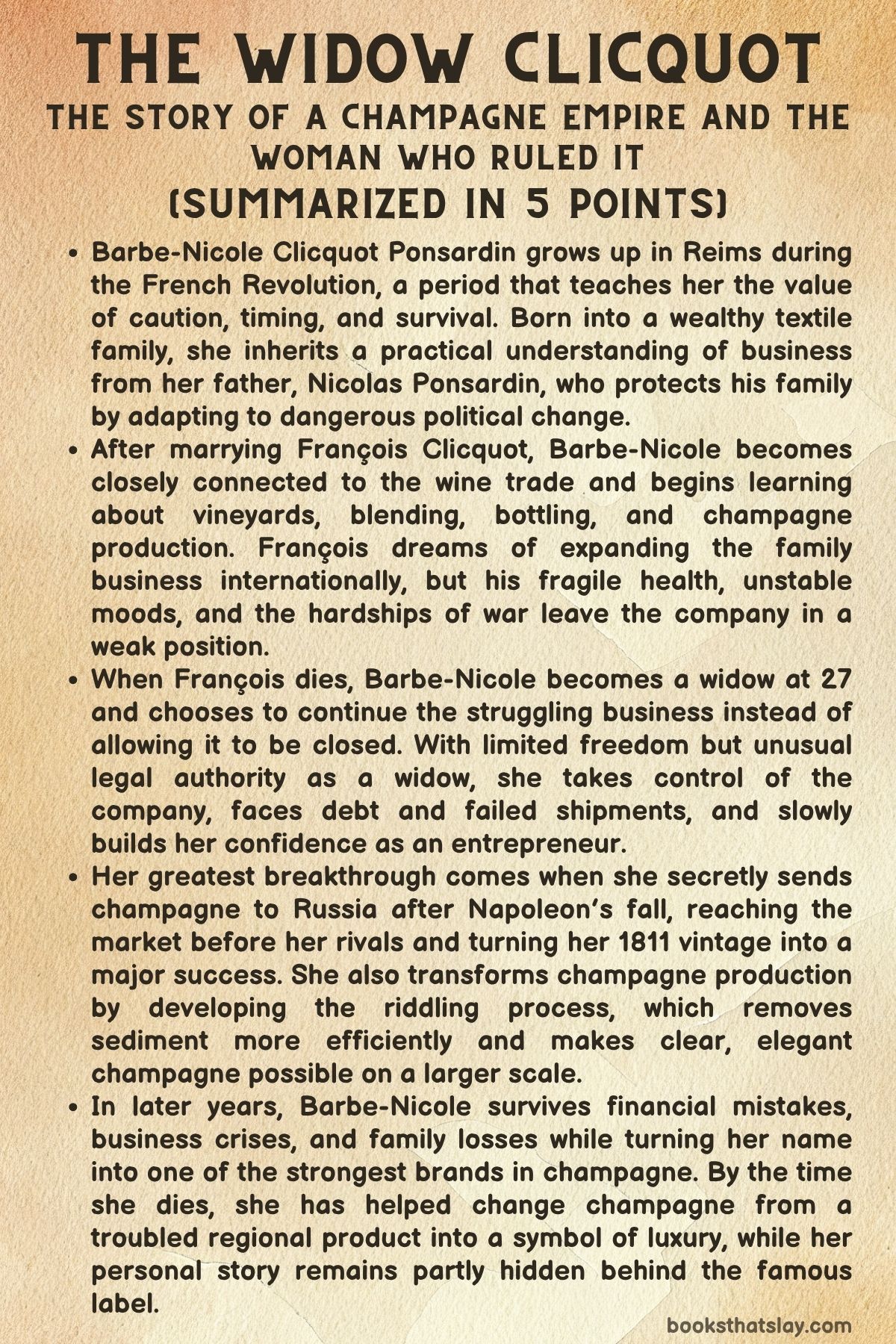
Key Figures
Barbe-Nicole Clicquot Ponsardin
Barbe-Nicole Clicquot Ponsardin stands at the center of The Widow Clicquot as a woman shaped by danger, discipline, family ambition, and commercial intelligence. Her childhood during the French Revolution teaches her early that public identity can be a form of protection, since her father survives by appearing loyal to the Revolution while privately preserving older loyalties.
As a young wife, she learns the wine trade beside François, but her gifts soon appear stronger than his. She has patience, taste, practical judgment, and the courage to act when others hesitate.
Widowhood gives her a rare opening to enter business independently, but the book never presents that freedom as easy. She sacrifices domestic closeness, sends her daughter away for schooling, works long hours, faces debt, resists male supervision, and risks ruin to build her company.
Her bold Russian shipments show her instinct for timing, while her invention of riddling shows technical imagination. She is not a modern feminist figure in a direct political sense, but her actions widen the space for women in champagne.
Her conservatism, Catholic identity, and eventual transfer of power to male partners make her complex rather than simple. She is both a product of her era and an exception to it.
François Clicquot
François Clicquot is important because his dreams help open the path that Barbe-Nicole later walks more successfully. He is cultured, musical, educated, and eager to make the family wine business international.
He wants champagne to reach foreign markets and imagines a future beyond the cautious brokerage model preferred by his father. Yet François is also emotionally fragile and often poorly suited to the pressures of commerce.
His ambitions are larger than his practical abilities, and his mood darkens as harvest failures, wartime barriers, and business disappointments accumulate. In the book, he is not merely a failed husband or a tragic obstacle; he is the person who brings Barbe-Nicole into serious contact with the vineyards, the cellars, and the dream of international sales.
His death leaves devastation, but it also creates the legal and social condition that allows her to act as a widow. François’s life shows the difference between vision and execution.
He can imagine expansion, but Barbe-Nicole possesses the steadiness needed to make that expansion real.
Nicolas Ponsardin
Nicolas Ponsardin, Barbe-Nicole’s father, is one of the strongest influences on her character. He is wealthy, ambitious, politically flexible, and deeply practical.
During the Revolution, he protects his family and fortune by joining the Jacobins and publicly supporting revolutionary gestures, even though his private loyalties remain Catholic and royalist. This ability to survive through adaptation becomes part of the world Barbe-Nicole inherits.
Nicolas teaches by example that business and politics cannot be separated, especially in a time of upheaval. His textile fortune also shapes his daughter’s understanding of industrial production, labor, capital, and status.
He wants aristocratic connections for his family, and that desire continues in Barbe-Nicole’s ambitions for her daughter and granddaughter. Nicolas is not portrayed as purely noble or purely opportunistic; he is a survivor who understands power.
His influence helps explain why Barbe-Nicole can move between old-world respectability and modern capitalism with such skill.
Jeanne-Clémentine Ponsardin
Jeanne-Clémentine Ponsardin, Barbe-Nicole’s mother, appears less prominently than Nicolas, but her presence helps define the domestic world from which Barbe-Nicole emerges. She belongs to the respectable Catholic bourgeois family structure that values marriage, reputation, household order, and social continuity.
Her role reflects the expectations placed on women of Barbe-Nicole’s class: to preserve family dignity, manage domestic life, and remain largely outside public commerce. Against this background, Barbe-Nicole’s later life becomes more striking.
Jeanne-Clémentine represents the conventional path that her daughter might have followed if widowhood, talent, and crisis had not pushed her into business leadership. Her long life also ties Barbe-Nicole to an older family order, one rooted in secrecy, religion, and careful social performance.
Through her, the book shows the emotional and cultural setting that Barbe-Nicole never fully abandons, even as she becomes an industrial leader.
Philippe Clicquot
Philippe Clicquot is cautious, paternal, and commercially conservative. As François’s father, he begins as a figure of stability in the family business, preferring the safer world of textiles and brokerage to the risky project of producing and exporting champagne on a larger scale.
After François dies, Philippe initially wants to liquidate the firm, a reaction that reflects both grief and business caution. Yet he eventually supports Barbe-Nicole, though not without conditions.
By requiring her to work with Alexandre Fourneaux, he reveals the limits of his trust in a young widow operating independently. At the same time, his financial backing makes her survival possible.
Philippe’s role is therefore double-edged. He restricts Barbe-Nicole, but he also gives her the capital and family legitimacy needed to continue.
He belongs to an older business culture that is not yet fully industrial, and his hesitation contrasts with Barbe-Nicole’s appetite for risk.
Louis Bohne
Louis Bohne is one of the most important figures in the growth of the champagne house because he serves as Barbe-Nicole’s eyes and voice in foreign markets. A German salesman with energy, courage, and loyalty, he travels through difficult and sometimes dangerous conditions to sell champagne abroad.
His letters from Russia and other markets carry news of opportunity, failure, political risk, and customer taste. He understands that champagne is not merely a drink but a luxury object that must reach aristocratic circles.
His partnership with Barbe-Nicole during the secret Russian shipments shows deep trust and shared daring. Louis is not the owner of the vision, but he is essential to its execution.
His death later leaves Barbe-Nicole emotionally and commercially shaken, which shows how dependent even a powerful entrepreneur can be on trusted agents. In the book, Louis represents the human network behind international luxury: travel, persuasion, risk, and loyalty.
Alexandre Fourneaux
Alexandre Fourneaux serves as Barbe-Nicole’s first formal business partner after widowhood. He is older, experienced, and acceptable to the men who doubt that she can run a wine company alone.
His presence gives her credibility and training, but it also shows the social limits placed on her independence. The partnership is meant to supervise her as much as support her.
Alexandre’s role is not defined by dramatic conflict; rather, he represents the transitional stage in Barbe-Nicole’s career, when she must prove her competence within structures designed by men. When the partnership ends, she is no longer merely an apprentice under male guidance.
She has endured losses, learned the trade, and gained the confidence to continue under her own name. Alexandre’s departure marks a turning point because it leaves her exposed but also free.
Clémentine Clicquot
Clémentine Clicquot, Barbe-Nicole’s daughter, reveals the emotional cost of her mother’s public success. As a child, she is sent away to convent school so Barbe-Nicole can devote herself fully to work.
Later, she becomes the center of marriage negotiations shaped by money, rank, and family ambition. Clémentine is socially anxious and sheltered, and her marriage to Louis de Chevigné is arranged within a world where affection, status, and financial calculation cannot be easily separated.
She benefits from her mother’s wealth, but she also lives under her mother’s powerful expectations. Her life is quieter and more conventional than Barbe-Nicole’s, which makes her an important contrast.
Through Clémentine, the book shows that Barbe-Nicole’s ambition does not simply liberate the women around her. It also places them inside new forms of pressure, especially the pressure to convert commercial wealth into aristocratic status.
Louis de Chevigné
Louis de Chevigné is charming, aristocratic, financially weak, and socially useful. His tragic childhood during the Terror gives him a dramatic personal history, and his restored title makes him attractive to the Ponsardin and Clicquot families.
His marriage to Clémentine is shaped by mutual advantage: he gains wealth, while Barbe-Nicole gains noble connection for her family and brand. Louis understands his own value in the marriage market and negotiates accordingly.
After marriage, he enjoys the lifestyle Barbe-Nicole funds, but he is not allowed to take control of the champagne business. His later scandals, including the publication of erotic poetry, embarrass the family and reveal the gap between aristocratic glamour and personal responsibility.
In the story, Louis represents the old social prestige that wealthy bourgeois families still desire, even when that prestige is financially dependent on modern commerce.
Édouard Werlé
Édouard Werlé becomes one of the most significant later figures in The Widow Clicquot because he represents both rescue and replacement. He enters the company as a young clerk and rises quickly, helped by Barbe-Nicole’s trust and perhaps by personal fascination.
Though rumors surround their relationship, his importance is ultimately commercial. During the banking crisis, he risks his personal fortune to secure the funds needed to save her from collapse.
Later, as partner and manager, he helps modernize the company and expand sales. His rise also marks a shift away from the informal world in which a bourgeois widow could build a business through family networks, instinct, and personal authority.
Édouard belongs to a more managerial age, one increasingly dominated by trained men and formal systems. He preserves Barbe-Nicole’s company, but his leadership also signals the fading of women’s unusual dominance in champagne.
Louise Pommery
Louise Pommery appears later in the book as an inheritor of the path Barbe-Nicole opened. Like Barbe-Nicole, she takes charge of a wine business after becoming a widow, but she responds to a different market moment.
When tastes begin shifting toward drier champagne, especially in England, Louise recognizes the opportunity and develops brut champagne. Her success shows that female leadership in champagne did not end with Barbe-Nicole, even if it remained exceptional.
Louise is important because she both follows and challenges the earlier model. Barbe-Nicole made champagne clearer, more international, and more strongly branded; Louise adapts it to changing taste.
Together, they show how widows could use a narrow social opening to make major commercial innovations. Louise’s presence also prevents the story from treating Barbe-Nicole as an isolated miracle.
She is extraordinary, but she is part of a broader, often overlooked history of women in business.
Themes
Widowhood as Power and Constraint
Widowhood gives Barbe-Nicole the legal and social space that marriage would not have allowed, but that freedom comes through loss rather than choice. As a married woman, she would have been expected to remain within the respectable domestic anonymity of her class.
As a widow, she can sign contracts, manage property, enter partnerships, and attach her own identity to a company. This status allows her to become Veuve Clicquot Ponsardin, a business figure whose public name carries authority.
Yet the same status also marks her vulnerability. Men around her question whether she can lead without supervision, and her first arrangement after François’s death places her under Alexandre Fourneaux’s guidance.
Widowhood opens the door, but it does not remove suspicion, grief, or financial danger. In The Widow Clicquot, widowhood becomes a narrow passage through which female ambition can move.
It is empowering because the law permits action, but it is limiting because society still treats that action as unusual and risky. Barbe-Nicole’s achievement lies in turning a socially acceptable identity of mourning into a commercial identity of strength.
Business, Risk, and Timing
Barbe-Nicole’s success depends not only on hard work but on her ability to act at the exact moment when others are afraid or slow. Her most famous commercial gamble comes after Napoleon’s fall, when she secretly sends champagne to Russia before competitors can organize themselves.
The plan could have ruined her if the wine had been seized, spoiled, or ignored by buyers. Instead, it reaches the market first and turns scarcity into triumph.
This pattern appears throughout her career. She survives by reading political change, customer desire, shipping conditions, harvest quality, and the weaknesses of rivals.
Her risks are rarely reckless in the simple sense; they are dangerous decisions made after careful observation. The same quality makes her technical innovation possible.
When workers insist that clarification cannot be sped up, she tests a new method privately rather than accepting inherited limits. The book presents business as a field where courage must be joined to timing.
Barbe-Nicole succeeds because she knows that waiting too long can be as dangerous as acting too soon.
Innovation and the Making of Luxury
Champagne becomes a luxury product not because it is naturally perfect, but because people like Barbe-Nicole solve its problems and teach the world how to desire it. Early champagne is unstable, cloudy, overly sweet, and difficult to transport.
Bottles break, sediment remains, and quality varies. Barbe-Nicole’s invention of riddling changes both the appearance and the scale of production.
Clear champagne looks more refined, and faster clarification allows more bottles to reach the market. Her work also strengthens brand identity.
The name Veuve Clicquot Ponsardin on a label becomes a promise of quality, status, and consistency. Luxury here is shown as the result of labor, science, marketing, and control.
It is not only about aristocratic taste; it is also about industrial discipline. The great irony is that champagne’s image depends on ease, celebration, and elegance, while its creation depends on pressure, secrecy, experimentation, and commercial struggle.
Barbe-Nicole helps turn a difficult regional wine into a global symbol by making it clearer, more reliable, and more recognizable.
Gender, Visibility, and Historical Memory
Barbe-Nicole becomes famous in commerce while remaining personally difficult to recover. Her name survives on bottles, labels, and dictionaries, but her private voice is faint because few personal letters and no diaries remain.
This absence reflects a larger historical pattern. Women often worked in commerce, banking, agriculture, manufacturing, and trade, but their records were less likely to be preserved or valued.
Barbe-Nicole’s life exposes the contradiction between influence and visibility. She helps build an international industry, yet later memory often reduces her to a brand name.
The book also resists making her a simple symbol of modern women’s rights. She does not campaign for political equality, and she remains socially conservative in many ways.
Still, her actions challenge the boundaries of her era. She leads workers, negotiates capital, manages exports, invents a production method, and shapes global taste.
Her story shows that history can forget women even when markets remember them. Recovering her life means looking beyond official heroic myths and paying attention to business records, material culture, and the quiet evidence of work.