The Shadow of What Was Lost Summary, Characters and Themes
The Shadow of What Was Lost is an epic fantasy novel by James Islington, set in a world where magic is burdened by fear, law, and the wounds of an old war. The story follows Davian, a young student marked as Gifted but unable to use Essence, as he discovers that his hidden powers connect him to the forbidden Augurs and to a threat thought long defeated.
Alongside friends, fugitives, royals, Shadows, and ancient figures with lost memories, the book explores loyalty, power, identity, fate, and the cost of trying to change a broken world. It’s the 1st book of the Licanius Trilogy.
Summary
The Shadow of What Was Lost begins with Tal’kamar fleeing a dark master at Taag’s Peak. After years of service, he rejects Aarkein Devaed and vanishes through a strange blue ring into the Waters of Renewal.
This opening image of escape, memory, and hidden identity sets the foundation for a story where the past never stays buried and where the truth is often more dangerous than a lie.
The main story follows Davian, a sixteen-year-old student at a school for the Gifted in Caladel. The Gifted can use Essence, a life force that grants them magical ability, but they live under harsh restrictions imposed after the fall of the Augurs, once-ruling seers who could Read minds and See the future.
The surviving Gifted are bound by the Four Tenets, which force obedience to the Administration and prevent them from using Essence freely. Davian bears the Mark of the Gifted but cannot use Essence, and if he fails his Trials, he will be turned into a Shadow, stripped of his power and social status.
His closest friend, Wirr, knows another secret: Davian can detect lies, a power associated not with the Gifted but with the outlawed Augurs.
Before Davian can face the Trials, Elder Ilseth Tenvar wakes him and tells him he is an Augur. Ilseth claims the Boundary, an ancient barrier holding back Aarkein Devaed’s creatures, is weakening and that Davian must travel north to help restore it.
He gives Davian a bronze box that will guide him. Wirr refuses to let Davian leave alone, and the two friends escape the school.
Soon after, the school is massacred. Asha, another student and Davian’s love interest, survives but is manipulated by Ilseth, who erases her memory of the event and turns her into a Shadow.
She is taken to Tol Athian, the Gifted stronghold in the capital, where she must navigate abuse, suspicion, and the hidden world of the Shadows.
Davian and Wirr travel through hostile lands, pursued by danger and forced to hide their identities. They meet smugglers, Hunters, and later a mysterious prisoner named Caeden, who has no memory beyond a few weeks.
Caeden had been accused of slaughtering a village, but Davian Reads him and confirms that his confusion is genuine. The group also reunites with Taeris Sarr, the Gifted Elder once believed to have died for saving Davian years earlier.
Taeris reveals that he escaped execution and has been investigating signs that the Boundary is failing. He joins Davian, Wirr, and Caeden, though he warns that Caeden’s missing memories may conceal something terrible.
Meanwhile, Asha is drawn into the politics of Tol Athian and the palace. She learns of the Shadow community living beneath the stronghold and first believes the Shadraehin, a rebel Shadow leader, might help her.
Instead, she encounters violence, intimidation, and a terrifying figure called the Watcher. Eventually she is taken under the protection of Duke Elocien Andras, the Northwarden and Wirr’s father.
Elocien reveals that Wirr is actually Prince Torin Wirrander Andras, heir to a bloodline capable of changing the Tenets. Asha also learns that several Augurs still live in secret, including Erran, Fessi, and Kol, who serve Elocien by recording visions of the future.
Their visions warn of an approaching attack on Ilin Illan by soldiers called the Blind.
Wirr’s royal identity is revealed during the journey when Princess Karaliene, his cousin, finds him at a festival. Wirr explains that his father sent him to the school to learn to control his Gift in secret, because a Gifted prince could one day change the Tenets.
Karaliene mistrusts Taeris and Caeden but allows Wirr to continue his mission with protection from Aelric and Dezia. The party travels toward Ilin Illan through the cursed city of Deilannis, pursued by sha’teth, deadly beings sent after Gifted criminals.
In Deilannis, Davian is separated from the others and caught in a temporal rift.
Davian awakens ninety years in the past, where he meets Malshash, an Augur living in Deilannis. Malshash teaches him about kan, the Augurs’ power, which is different from Essence and allows access to thought, time, and perception.
Davian learns that he survived the rift because he does not generate Essence of his own; instead, he draws it from outside himself. This discovery unsettles him because it means he can drain life from living things.
Malshash trains him quickly, partly by Influencing his mind, and Davian learns to shield himself, Read minds more deeply, and understand the theory of time. Malshash also reveals his own painful past, including the murder of his wife and his failed attempt to undo it.
Davian returns to his own time with new power, new knowledge, and greater doubts.
As the others continue to Ilin Illan, Caeden’s past begins to surface in fragments. He sees memories of ancient cities, old friends, a sword named Licanius, and a man named Alaris who calls him Tal’kamar.
Caeden fears that he may be connected to Aarkein Devaed or to the coming invasion. The sha’teth also recognize him and demand that he be surrendered.
Although he hides much from the group, he repeatedly acts to protect them, especially Karaliene, with whom he forms a growing bond. Taeris eventually learns enough to suspect that Caeden may be vital to defeating the enemy, even if his true identity remains dangerous.
Back in Ilin Illan, Asha regains her memory and exposes Ilseth’s crimes. She also discovers that Shadows still retain a faint Reserve of Essence and can activate Vessels, magical objects powered by Essence.
This gives her a new role in the defense of the city. When the King refuses to let the Gifted fight the invaders because of his hatred and paranoia, Asha convinces Elocien to arm the Shadows with confiscated Vessels.
She meets the real Shadraehin, a woman, and persuades her to gather Shadow fighters. Asha becomes a bridge between groups that have long distrusted one another.
Davian reaches Ilin Illan and reunites with Wirr and Asha. He Reads Ilseth and discovers that Ilseth was ordered by a hooded servant of Devaed to send Davian north with the bronze box, not to save the Boundary but to help bring Devaed back from exile.
This makes Davian suspicious of Caeden, especially when Caeden touches the box and vanishes through a fiery portal. Caeden arrives in another realm, where he finds Licanius guarded by Garadis ru Dagen.
There he learns that he is Tal’kamar, a four-thousand-year-old being who has done both good and evil. He is allowed to take the sword because, without his memories, he has come not for power but for identity and to help his friends.
The invasion of Ilin Illan begins with terrifying force. The Blind use black armor that resists normal weapons and grants them strange abilities.
The First Shield falls, and the defenders are pushed back. Asha leads the Shadows into battle with Vessels, temporarily turning the tide.
Betrayal strikes when possessed soldiers, called Echoes, attack from within the Andarran ranks. General Parathe is killed, and Elocien dies saving Wirr from an assassin.
In his final moments, Elocien passes the authority to change the Tenets to his son, and Wirr promises to fix what has long oppressed the Gifted.
Wirr, Davian, and the Elders enter the chamber containing the Vessel that binds the Tenets. Administrator Ionis tries to stop them and attempts to use the old obedience law to force the Gifted into destruction.
Davian kills Ionis by draining his Essence, a horrifying act that saves them but shows the danger of Davian’s power. With Davian’s help, Wirr changes the Tenets so the Gifted can defend themselves and are no longer bound to obey the Administration completely.
The change comes late, but it marks a turning point in Andarra’s treatment of the Gifted.
At the height of the battle, Caeden returns with Licanius and destroys the invading forces almost single-handedly. His victory saves Ilin Illan, but it also raises new fears.
Davian knows the bronze box was tied to Devaed’s plan, while Caeden insists it led him where he needed to go. Caeden leaves again, warning that the battle was only the beginning.
Davian decides to go to Tol Shen to help restore the Boundary, while Asha remains with Wirr in Ilin Illan. Their separation is quiet but painful, especially for Davian and Asha, whose feelings remain mostly unspoken.
The ending reveals deeper uncertainty. Asha overhears signs that Tol Shen may have used the invasion for political advantage and may possess an Augur of its own.
Taeris plans to return to Deilannis, still linked to Davian in a dangerous way. Caeden reaches the Wells of Mor Aruil and asks an old friend to restore only selected memories.
He learns that he himself had entered the Waters of Renewal to forget his past and change who he was. Most shocking of all, he remembers that he was the hooded man who gave Ilseth the bronze box, that he killed a young man named Caeden and took his identity, and that his true rejected name is Aarkein Devaed.
The book closes with victory shadowed by dread, as the characters face a future shaped by broken memory, uncertain fate, and the return of an enemy hidden in plain sight.
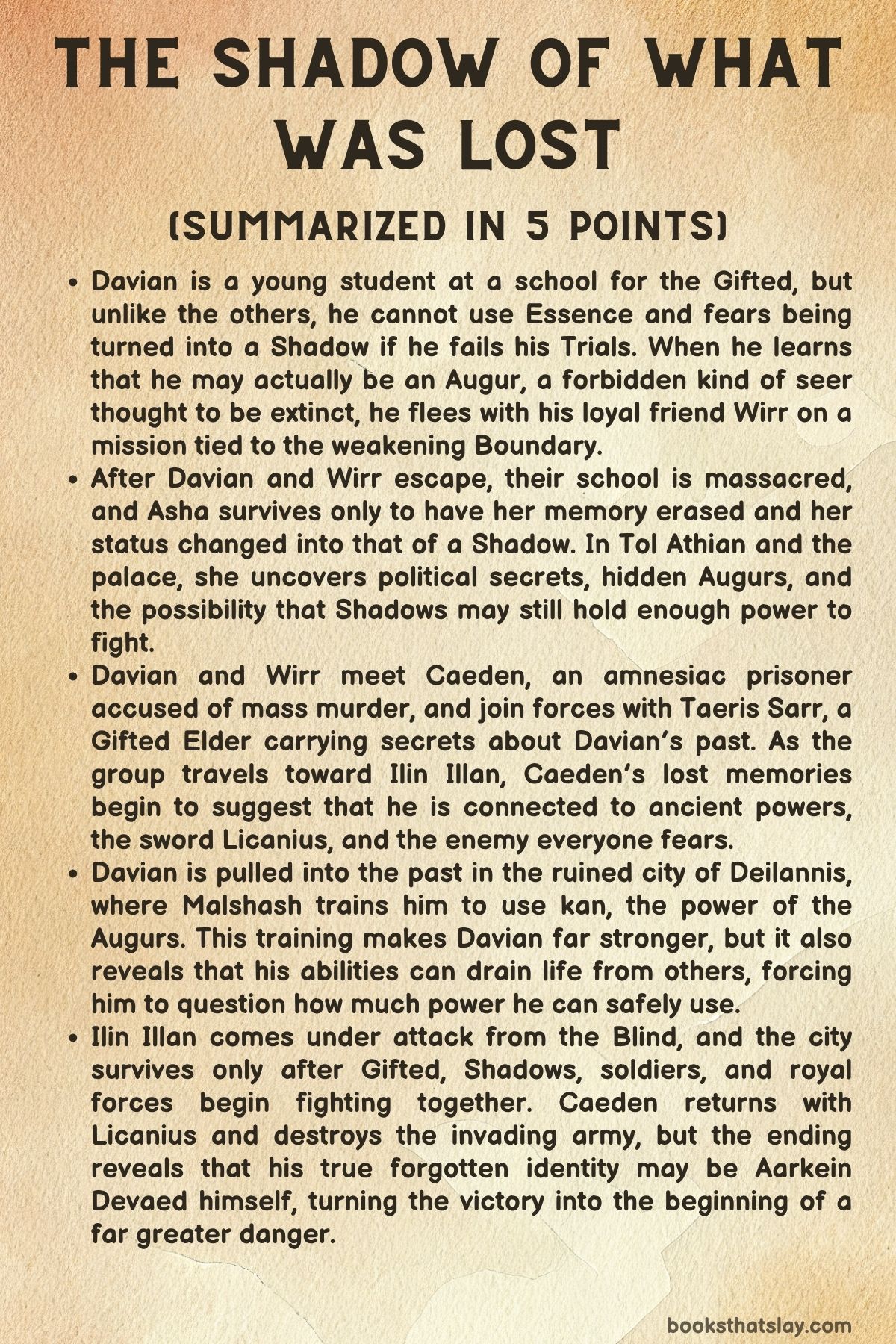
Characters
Davian
Davian is the emotional and moral center of The Shadow of What Was Lost, beginning as a vulnerable student who seems powerless in a society that judges him entirely by magical ability. His inability to wield Essence makes him anxious, ashamed, and afraid of becoming a Shadow, but his hidden Augur abilities reveal that his weakness is actually a misunderstood form of power.
Davian is loyal, thoughtful, and often burdened by guilt, especially when forced to kill or when he learns that others have suffered because of him. His journey is not simply about becoming stronger; it is about learning the danger of power without certainty.
His ability to Read minds and detect lies gives him access to truth, but truth does not always make decisions easier. After his time with Malshash, Davian becomes far more capable, yet also more frightening, because he can draw Essence from living things.
This makes him a character caught between compassion and danger. He wants to protect his friends and do what is right, but the book repeatedly shows that good intentions can still lead to harm when power outruns understanding.
Wirr
Wirr, later revealed as Prince Torin Wirrander Andras, is one of the most important figures in the book because he connects the world of the oppressed Gifted with the political power of Andarra’s royal family. At first, he appears to be Davian’s charming, loyal, and capable friend, someone who balances fear with humor and steadiness.
His hidden royal identity changes the reader’s understanding of him, but it does not erase the sincerity of his friendship. Wirr’s time at Caladel teaches him what it means to be treated as an equal rather than as a prince, and that experience shapes his desire to change the Tenets.
He carries deep guilt after learning that the massacre may have been tied to his identity, and his grief gives him a more serious sense of responsibility. His relationship with Elocien is complicated by love, secrecy, and manipulation, yet his final promise to his father shows his maturity.
Wirr becomes a leader not because of bloodline alone, but because he understands both the cruelty of unchecked power and the cruelty of fear-based control.
Asha
Asha is one of the strongest examples of resilience in the book. She begins as a Gifted student whose life is destroyed when her school is massacred and her memory is erased.
By being turned into a Shadow, she loses her recognized place in society, but she gains a position outside the Tenets and outside ordinary expectations. This makes her both vulnerable and powerful in ways others fail to understand.
Asha’s arc is built around reclaiming truth, agency, and value after others try to define her as broken or powerless. She refuses to accept the mistreatment of Shadows, confronts Ilseth’s lies, works with Elocien’s secret Augurs, and eventually discovers that Shadows can still use Vessels.
Her courage is practical rather than showy: she negotiates, spies, remembers, tests, and acts when others hesitate. Her feelings for Davian add tenderness to her story, but they never reduce her role to romance.
Asha becomes a political and moral force, proving that those discarded by institutions may become essential to survival.
Caeden
Caeden is the most mysterious and morally unstable figure in The Shadow of What Was Lost. For much of the story, he appears as an amnesiac young man accused of a massacre he cannot remember.
His lack of memory creates sympathy, because he seems frightened by his own possible guilt and repeatedly chooses to protect his companions. Yet the fragments of his past suggest that he is far older and more dangerous than he seems.
The names Tal’kamar and Aarkein Devaed pull him toward an identity connected to ancient destruction, betrayal, and immense power. What makes Caeden compelling is the tension between who he was, who he has forgotten, and who he is trying to become.
His bond with Karaliene and his loyalty to the group show a genuine desire for goodness, but his recovered memories reveal murder, deception, and a deliberate attempt to erase guilt. By the end, Caeden is both savior and threat.
He saves Ilin Illan with Licanius, yet the revelation of his true identity forces the reader to question whether redemption is possible without full honesty about the past.
Taeris Sarr
Taeris Sarr is a complicated mentor figure whose choices are shaped by guilt, secrecy, and long-term fear. He was believed to have been executed for killing Davian’s attackers, but the truth is far more painful: Davian himself caused the men’s deaths through uncontrolled power, and Taeris took the blame to protect him.
This sacrifice makes Taeris noble, but not simple. He withholds information, manipulates routes, and allows others to walk into danger because he believes larger threats justify difficult choices.
His decision to lead the group toward Deilannis, knowing it connects to prophecy and Nihim’s death, damages trust even if his intentions are defensive. Taeris understands that the Boundary’s failure could destroy Andarra, and this urgency makes him willing to accept risks others might reject.
His bond with Davian, both emotional and magical, adds another layer of pain, especially because Davian does not fully know how much Taeris has endured for him. Taeris is neither fully trustworthy nor selfish; he is a man who has carried too many secrets for too long.
Elocien Andras
Duke Elocien Andras appears at first to be a powerful reformer, the Northwarden who secretly supports the Gifted and protects hidden Augurs. His willingness to bring Asha into his confidence and his concern for Wirr suggest a man trying to undo earlier prejudice.
Yet the later revelation that Erran has been Controlling him for years changes his entire character. Elocien’s apparent transformation is not wholly his own, which raises disturbing questions about morality, identity, and consent.
Before Erran’s influence, Elocien was capable of brutal anti-Augur violence and might even have killed his own son after discovering Wirr was Gifted. Under Control, he becomes an ally of reform, but that goodness is partly imposed on him.
His death saving Wirr is still emotionally meaningful because, in that moment, the version of Elocien who loves his son acts with courage. However, his final panic also suggests the suppressed original self returning.
Elocien represents one of the book’s hardest moral questions: whether good actions remain good when the person performing them has been shaped by another will.
Karaliene Andras
Karaliene is a sharp, disciplined royal figure who combines political awareness with personal loyalty. Her first reaction to Wirr’s return shows both relief and anger, because she understands the danger his disappearance has caused.
She is cautious with Taeris and Caeden, and her suspicion is not unreasonable in a world filled with false identities, hidden motives, and political threats. Karaliene’s strength lies in her ability to act decisively without losing her capacity to reassess people.
Her relationship with Caeden shows this quality clearly. She begins by mistrusting him, then changes her view after he saves her life and speaks honestly about his fear of his past.
She is not naive; she remains aware that his missing memories may matter. Yet she recognizes the person standing before her as someone trying to choose a better path.
When the King becomes unstable and she is placed in a position of authority, Karaliene represents a steadier form of leadership than the fear-driven rule around her. She balances duty, intelligence, and emotional restraint.
Malshash
Malshash is a teacher, survivor, and warning all at once. As the Augur who trains Davian in the past, he gives Davian the tools needed to survive and return to his own time.
He explains kan, time, Reading, memory, and the danger of power with a depth no one else can offer. Yet Malshash is not merely a wise guide.
His own history is marked by trauma, rage, and catastrophic misuse of power. After his wife was murdered, he tried to reverse death itself and killed many innocent people in the process.
His daily shapeshifting into the forms of the dead shows both punishment and remembrance, as if he cannot escape the cost of what he did. Malshash’s guidance is valuable, but it is also compromised by his use of Influence on Davian.
He believes the end required it, but the act violates trust. His character shows that knowledge does not guarantee moral safety.
He understands power better than most, yet his life proves how grief can turn power into destruction.
Ilseth Tenvar
Ilseth Tenvar is one of the book’s key agents of betrayal. He appears first as an Elder who gives Davian urgent guidance and sends him on a mission to the Boundary, but his real purpose is far darker.
By manipulating Davian, erasing Asha’s memory, turning her into a Shadow, and lying to the Council, Ilseth shows how authority can hide corruption beneath procedure and concern. His actions are especially cruel because he exploits Davian’s fear and hope at the moment when Davian is most desperate.
He also understands the systems around him well enough to use them as cover. The massacre at Caladel, his false account of Asha’s despair, and his connection to Devaed’s servant reveal a man serving a hidden agenda while presenting himself as a protector of order.
Ilseth is not frightening because of raw power alone; he is frightening because he uses trust as a weapon. His downfall comes when Asha recovers her memory and confronts him, turning his own confidence against him.
Erran
Erran is one of the most morally challenging characters in the story. He is kind to Asha, protective of the secret Augurs, and committed to using visions to prevent disaster.
His warmth makes him seem trustworthy, and his friendship gives Asha a sense of belonging after her isolation as a Shadow. Yet his confession that he has been Controlling Elocien for years complicates everything.
Erran did it after suffering violence from Elocien and believing that the Duke would kill more Augurs if left unchanged. In practical terms, his Control may have saved lives and protected Wirr.
In moral terms, it is a severe violation of another person’s will. Erran embodies the book’s concern with whether harmful methods can be excused by protective goals.
He is not portrayed as cruel, but he is capable of making choices that cross deep ethical lines. His grief over Kol and his decision to flee show that he is still young, afraid, and overwhelmed by the consequences of survival.
Fessi
Fessi brings gentleness and emotional openness to the hidden Augurs’ world. Like Erran and Kol, she lives under constant fear because her existence would be condemned if discovered.
Her visions of death place a heavy burden on her, yet she still offers kindness to Asha and helps her understand the secret work being done around Elocien. Fessi’s role is quieter than many others, but she matters because she shows the human cost of prophecy.
The Augurs are not distant, all-knowing figures; they are young people forced to carry knowledge they cannot freely share. Fessi’s friendship with Asha helps both of them feel less alone.
She also shows a healthy concern for boundaries when she tells Erran not to Read Asha’s mind before Asha learns to protect herself. That moment reveals her respect for consent in contrast to the larger abuses of mental power elsewhere in the story.
By leaving after Kol’s death, Fessi chooses survival, not cowardice. She has already given much to a dangerous cause.
Kol
Kol is initially cold and hostile toward Asha, but his behavior is rooted in fear rather than simple cruelty. He has Seen Asha present at his death, and that knowledge poisons his ability to trust her.
Once Asha understands the pressure he carries, his guarded nature becomes easier to read. Kol’s later apology marks an important shift, showing that he is capable of honesty and growth even under the weight of prophecy.
His defense of Asha after her kidnapping reveals a fierce protective instinct, though it also shows his anger and impulsiveness. Like the other young Augurs, Kol is trapped by knowledge of possible futures and by the rule that they cannot openly share their visions with one another.
His death at Scyner’s hands gives his earlier vision a terrible fulfillment, but it also confirms his courage. Kol dies trying to protect others, and that final act changes him from a suspicious figure into one of the story’s quiet casualties of hidden war.
Aelric
Aelric first appears as a cocky young swordsman, but his arrogance hides discipline, guilt, and a painful past. His backstory explains why he takes swordplay and control so seriously: a childhood accident led to violence that killed his father and changed his life.
Being taken in by King Andras gave him status, but it also bound him to court expectations and duty. Aelric’s relationship with Wirr develops from suspicion to respect.
He recognizes Wirr’s identity and understands the difficulty of living between personal desire and royal responsibility. His warning about Dezia is not only protective sibling behavior; it reflects his belief that people in their position rarely get to choose freely.
Aelric’s value in the story lies in his gradual shift from a seemingly boastful fighter to a loyal, perceptive companion. He is brave in battle, but his deeper strength is his ability to recognize grief in others and respond with hard-earned empathy.
Dezia
Dezia is a perceptive and emotionally intelligent character whose presence draws out sides of Wirr that he usually keeps hidden. She understands the restrictions of court life and recognizes the loneliness that can come with duty.
Her bond with Wirr is built on shared confinement: both know what it means to have public expectations limit private feeling. Dezia does not simply function as a romantic possibility; she also becomes a mirror for Wirr’s conflict between who he wants to be and what his bloodline demands of him.
She is direct, brave, and observant, willing to speak privately with Wirr even when Aelric disapproves. Her role among the traveling party adds warmth and emotional tension, especially as Wirr approaches the life he tried to escape.
Dezia represents the personal cost of politics. In a world where titles, bloodlines, and duty shape every choice, her connection with Wirr shows how affection can exist even when the future makes it difficult to keep.
Breshada
Breshada is a Hunter whose brief but memorable presence complicates the reader’s understanding of enemies and allies. She saves Davian and Wirr from attackers, yet she does not do so out of affection or approval.
Her disgust toward them and her reference to repaying Tal’kamar’s debt suggest that she is tied to a much larger history than the boys understand. Breshada’s appearance shows that not every hostile figure is acting from the same motive and that old debts can shape present events in unexpected ways.
She is dangerous, skilled, and emotionally controlled, someone who can kill efficiently and then walk away with a warning. Her attitude toward the boys also reinforces how hated the Gifted are outside their own communities.
Breshada’s importance lies in the questions she raises. She seems to know more about Tal’kamar than most living people, and her actions imply that the struggle around Davian, Caeden, and Devaed began long before the central characters understood their roles.
Scyner and the Shadraehin
Scyner first presents himself as the Shadraehin, the leader of the Shadows, but later events reveal a more complicated structure of deception and resistance. As Scyner, he is manipulative and dangerous, using the suffering of Shadows as a path to power while hiding his own identity as an Augur.
His murder of Kol and threats against Asha expose his ruthlessness. The real Shadraehin, by contrast, is a woman who appears more strategic and politically aware.
She is not idealized; she is willing to keep the Vessels and refuses to promise loyalty to the Administration. Yet she also understands the danger facing Ilin Illan and agrees to rally Shadows to fight.
Together, Scyner and the real Shadraehin show the divided nature of resistance. Oppressed people may organize for justice, survival, revenge, or personal ambition, and outsiders often fail to distinguish between those motives.
Asha’s negotiations with the real Shadraehin show her growing political skill and her ability to work with imperfect allies.
Nihim
Nihim is a quiet but deeply significant figure whose faith and sacrifice shape the moral direction of the journey. Living as a Desrielite priest while secretly helping Taeris, he has spent years serving a dangerous cause with little recognition.
His conversations with Caeden about faith, free will, and identity give Caeden a framework for thinking about who he might become despite the darkness in his past. Nihim believes in meaning without pretending to have proof, and this makes his faith humble rather than rigid.
His death in Deilannis is not accidental; he has known for years that he would die there with someone important. This knowledge gives his final actions a calm sadness, but also a sense of chosen purpose.
He does not force his beliefs onto others. Instead, he offers comfort, clarity, and courage at moments when the others are uncertain.
Nihim represents the kind of sacrifice that does not seek glory but still changes the course of events.
Themes
Power and Moral Responsibility
Power in The Shadow of What Was Lost is never treated as simple strength. Essence, kan, Vessels, royal authority, prophecy, and Control all give characters the ability to shape the lives of others, but each form of power carries moral danger.
Davian’s growth makes this clear. His ability to Read minds can expose truth, yet it also risks violating privacy.
His ability to drain Essence can save others, yet it can also turn a living person to dust. Wirr’s royal blood gives him the chance to change the Tenets, but that same authority raises the question of whether any small group should have the right to bind others by magical law.
Erran’s Control of Elocien is perhaps the most uncomfortable example. It may have prevented murder and saved Wirr, but it was still a profound violation of will.
The book does not suggest that power is evil in itself. Instead, it shows that power becomes dangerous when people believe good intentions are enough to excuse any method.
True responsibility requires restraint, honesty, and the humility to question whether the cure may become another form of harm.
Identity, Memory, and the Possibility of Change
Caeden’s story places identity under intense pressure by asking whether a person without memory is still accountable for who they once were. As an amnesiac, he appears frightened, decent, and eager to protect his companions.
He wants to be judged by his current choices rather than by a past he cannot remember. Yet the return of fragments from that past makes the issue harder.
If he was Tal’kamar, and if he was also Aarkein Devaed, then his forgotten life includes acts of terrible violence and manipulation. His decision to enter the Waters of Renewal shows a desire to change, but it may also be an attempt to escape guilt without facing it.
Davian’s experience with Malshash also questions memory, since memories can be subjective, shielded, altered, or hidden. Asha’s erased memory shows how identity can be attacked by removing truth, while her recovery of that memory helps restore her agency.
The book suggests that change is possible, but not through forgetting alone. Real change requires knowledge, responsibility, and the courage to face what one has done.
Law, Fear, and Institutional Control
The Tenets are presented as laws created to prevent another age of Augur tyranny, but they also become tools of fear, humiliation, and control. The Gifted are treated as potential threats even when they are children, and the punishment of becoming a Shadow shows how law can turn cruelty into procedure.
Administrators can demand obedience, restrict movement, and enforce social hierarchy while claiming to protect ordinary people. The book is careful to show why the laws exist: the Augurs once abused power, and the Gifted helped enforce that abuse.
However, the response to that history becomes another injustice. Davian, Wirr, Asha, and others live in a society trapped between fear of the past and fear of freedom.
King Andras’s refusal to let the Gifted fight, even when the city is under attack, shows how prejudice can become suicidal when leaders care more about control than survival. Wirr’s amendment of the Tenets is therefore not just a magical change; it is a political and moral shift.
It recognizes that safety built on oppression eventually endangers everyone.
Fate, Free Will, and the Burden of Prophecy
The story constantly questions whether the future is fixed or whether choices can alter what is Seen. The Augurs’ visions once justified their authority, but when those visions failed, their entire system collapsed.
Malshash believes time may be a single line, with choices already made even if people experience them as decisions. Nihim, by contrast, accepts divine knowledge without surrendering his sense of personal choice.
This tension appears in nearly every major arc. Davian is told he may be part of a prophecy to defeat Devaed, yet he still has to choose what kind of person he will become.
Kol, Fessi, and Erran live under visions of their own deaths, which affects how they relate to others and whether they can hope. Caeden’s link to Licanius, whose name means fate, deepens the question further.
If he is destined to play a role in destruction or salvation, the value of his present choices becomes uncertain but not meaningless. The book’s treatment of fate is powerful because it does not give an easy answer.
It suggests that prophecy may guide, mislead, or trap people, but character is revealed in how they act under its weight.