The Bridesmaid by Cate Quinn Summary, Characters and Themes
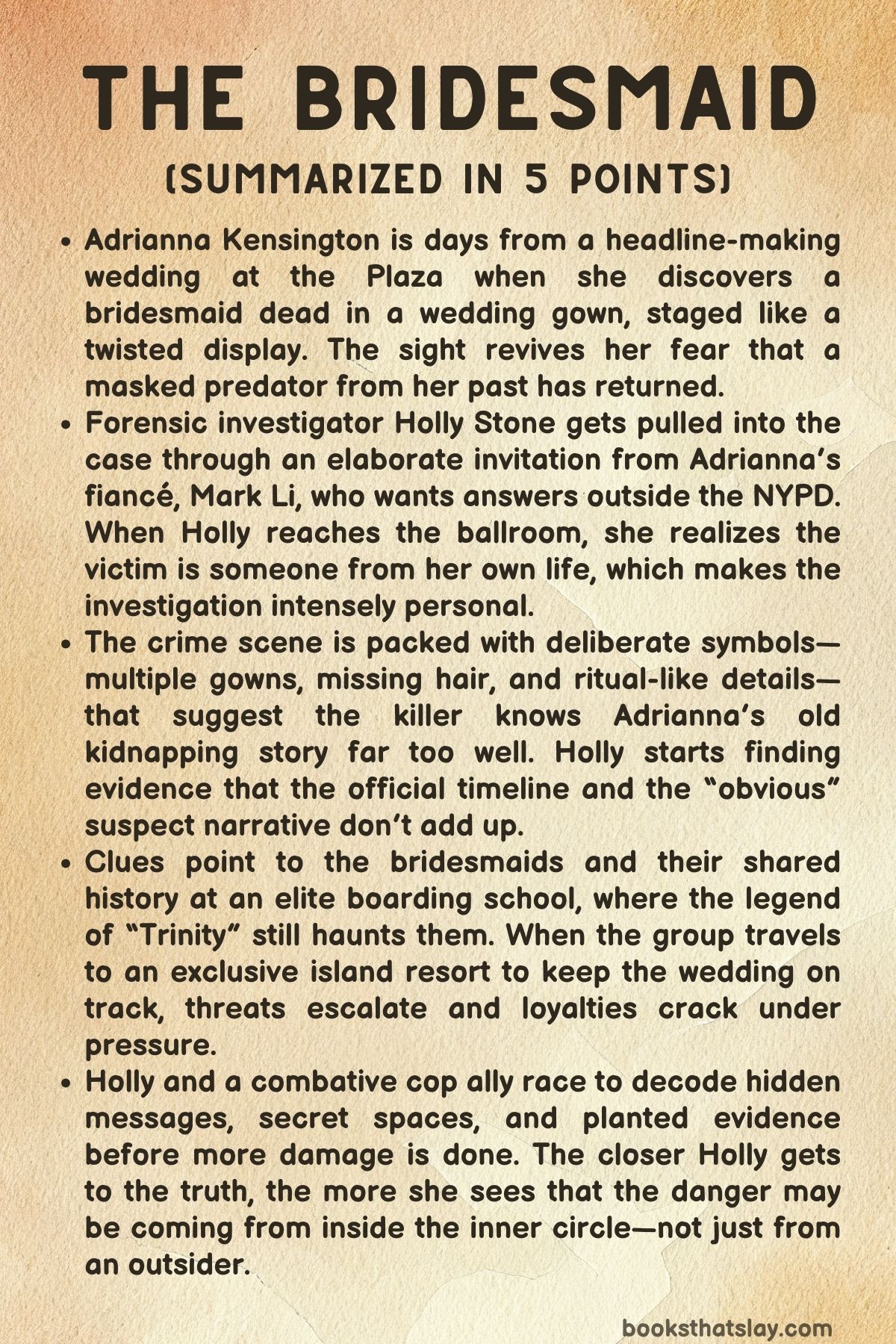
The Bridesmaid by Cate Quinn is a psychological crime thriller set amid the opulence of New York’s elite. When heiress Adrianna Kensington’s lavish wedding turns into a crime scene, the discovery of a bridesmaid’s body reopens a chilling past.
Forensic investigator Holly Stone, eccentric yet brilliant, is drawn into a tangled web of lies, power, and revenge that connects the Kensington family’s dark history to a string of murders. As hidden secrets unravel between a powerful dynasty, a haunted bride, and a relentless investigator, the line between victim and perpetrator blurs, leading to shocking revelations about loyalty, ambition, and survival.
Summary
At New York’s luxurious Plaza Hotel, Adrianna Kensington supervises her extravagant wedding preparations. The glamour collapses when she discovers a body in a wedding gown—her former bridesmaid, bloodied and hanging from the stage.
Horrified, Adrianna calls her father, Leopold Kensington, whispering, “He’s back,” referring to the stalker who once kidnapped her. Across town, forensic investigator Holly Stone examines a staged crime scene and soon receives an ornate, mechanical wedding invitation from Adrianna’s fiancé, tech millionaire Mark Li, summoning her to the Plaza.
At the hotel, Mark explains the murder’s connection to Adrianna’s past abduction. Holly realizes the case mirrors details from the kidnapping that were never made public.
When she inspects the crime scene, she’s stunned to recognize the victim—her former boss, Simone Walters. Overwhelmed by grief, Holly confronts Mark, who insists Simone was one of Adrianna’s bridesmaids and that only Holly can uncover the truth.
Meanwhile, Petra Morka, a supermodel bridesmaid, meets secretly with Leopold. Their affair exposes hidden ties between the family and the victim.
Petra hints Simone had discovered something dangerous about Adrianna’s kidnapping before she was killed. Back at the Plaza, Holly studies the crime scene—the arrangement of dresses, candles, and missing jewelry—suggesting ritualistic symbolism.
She suspects the murder carries a personal message meant for Adrianna.
Adrianna and her half-sister Georgia attempt to suppress news of the murder, fearing the resurfacing of her old trauma. Determined to keep her wedding intact, Adrianna insists the ceremony proceed.
When Holly reviews Simone’s final voicemail, it hints that Simone had uncovered the truth about the kidnapping and feared for her life. Examining the forensics, Holly notices inconsistencies—the body’s low temperature and injuries suggest it was moved from a colder place.
She concludes the killer acted with control and familiarity with the Kensingtons.
At the Plaza, tensions rise as detectives Ortiz and Fitzwilliam join the investigation. Holly identifies blood traces on a scaffold pole, likely the murder weapon, and finds a key engraved with her name, marked “1620.” The number corresponds to an elevator access key, one connected to the Plaza’s restricted service routes.
She deduces the body was transported via service containers used for wedding gowns.
When Holly tests the elevator, she encounters Georgia Kensington wearing Simone’s ring. Georgia mistakes Holly for a new bridesmaid hired by Mark.
To maintain cover, Fitzwilliam pretends Holly is Simone’s niece. Adrianna embraces the lie and invites Holly into her inner circle.
Soon, Holly finds a hidden letter from Simone urging her to “Unmask Trinity”—the secret name for Adrianna’s kidnapper, known only to police. Inside the envelope lies a Kensington family signet ring containing brown powder.
Analysis reveals it isn’t a drug but volcanic soil mixed with bone—evidence pointing to the exclusive island resort, Elysium, where the wedding will take place.
When the wedding party arrives at Elysium, the opulent setting turns menacing. A mutilated wedding cake bears the carved message “TRINITY IS COMING.” Panic ripples through the bridesmaids.
Silky, a fragile model and one of Adrianna’s former classmates, collapses after a Valium overdose. Georgia recounts that “Trinity” was once a school legend—a masked figure who stole “three best things” from girls at their elite boarding school, Kensington Manor.
Silky, haunted by past abuse, had once sued the school but lost. Soon after, she vanishes.
Searching her cabana, Holly and Fitzwilliam discover disturbing collages linking Adrianna’s kidnapping to the school’s buried scandals. They follow Silky’s trail to a restricted jungle zone and find her lifeless body in the tide.
Though police rule it an overdose, Holly suspects murder. The island’s calm fractures when someone carves another warning in the sand: “1, 2, 3, YOU’RE NEXT.
TRINITY.” Holly retrieves water-damaged court documents from Silky’s belongings, revealing testimonies of abuse and graffiti of a cloaked figure—identical to Adrianna’s kidnapper. Simone had been investigating these links before her death.
As chaos spreads, a leaked video shows Silky confessing to Simone’s murder, apparently under duress. Sponsors withdraw, and Mark Li orders Holly and Fitzwilliam off the island.
Before leaving, Holly examines Simone’s hidden clues and locates a secret panic room beneath the old Tower Suite, the site of Adrianna’s kidnapping. When she and Fitzwilliam investigate, someone shoves her down the stairs and locks her inside.
Trapped together, they uncover preserved bodies and police files exposing Petra as a suspect in Adrianna’s kidnapping. Petra arrives armed, confirming she pushed Holly earlier and burns the evidence.
After she leaves, Holly realizes the panic room connects to the Tower Suite itself, proving Adrianna’s kidnapping could have been self-orchestrated. She and Fitzwilliam escape to the beach just as Adrianna’s wedding begins.
At the ceremony, Holly confronts the Kensington family. She accuses Leopold of staging crimes and manipulating media narratives to protect his empire.
Then she turns to Adrianna, revealing the shocking truth: Adrianna had staged her own kidnapping years earlier for attention and control but accidentally trapped herself. The revelation ignites chaos.
Adrianna shoots Petra in panic; Leopold is wounded and flees with Holly as a hostage. In a final confession, Leopold admits to covering up deaths to protect his daughters and steps off the edge of the infinity pool, vanishing.
Adrianna later claims his death was accidental to preserve the family name. The aftermath exposes decades of corruption.
Elysium Island is sold to a rehab company, and mass graves linked to Kensington Manor are uncovered. The abusive school is shut down, Georgia takes over the family empire, and Adrianna disappears from public life.
Months later, Holly opens her own forensic practice with Fitzwilliam in New York. Adrianna secretly hires her to investigate her father’s disappearance—his body was never found.
The case closes with lingering uncertainty over whether Leopold Kensington is truly dead or has vanished to begin again, leaving the sins of his dynasty buried but not forgotten.
Characters
Adrianna Kensington
Adrianna Kensington, the wealthy heiress at the center of The Bridesmaid, embodies a blend of privilege, trauma, and obsession with control. On the surface, she appears as a perfectionist bride-to-be—meticulous about every detail of her wedding and desperate to maintain the image of elegance and composure expected from a Kensington.
Yet beneath that polished exterior lies deep psychological damage rooted in her staged kidnapping, a desperate act for validation and fame that spiraled into chaos. Adrianna’s identity is defined by performance; every action she takes, from managing the press to continuing her wedding despite murder and scandal, is meant to preserve her family’s public image.
Her relationship with her father, Leopold, is both dependent and manipulative—she mirrors his ruthlessness even as she craves his approval. When the truth surfaces—that she orchestrated her own kidnapping—Adrianna’s façade fractures completely.
Her descent into paranoia and violence, culminating in her shooting Petra, reveals a tragic figure undone by the illusions she built to protect herself.
Holly Stone
Holly Stone serves as the novel’s anchor of rationality within a world of wealth, deceit, and hysteria. A forensic investigator with a sharp mind and unconventional demeanor, Holly contrasts starkly with the opulence of the Kensington world.
Her analytical brilliance is matched by her moral integrity, as she relentlessly seeks truth even when it threatens her safety. Holly’s journey from detached professional to emotionally invested investigator mirrors her growing realization that justice is not just about science—it’s about courage and compassion.
Her personal connection to the victim, Simone Walters, complicates her objectivity and forces her to confront guilt and grief. By the story’s end, Holly becomes both detective and survivor, navigating lies, power, and psychological warfare to uncover the true nature of the crimes.
She represents the story’s conscience, exposing corruption and human frailty hidden behind glamour.
Leopold Kensington
Leopold Kensington, Adrianna’s father and a domineering nightclub magnate, personifies the corrupting force of wealth and power. A master manipulator, Leopold’s control over his family and empire is absolute; he uses money and intimidation to suppress truth and shape public narratives.
His love for Adrianna is possessive rather than paternal—rooted in pride and reputation rather than empathy. Throughout The Bridesmaid, Leopold’s actions suggest a man who believes morality is negotiable as long as his legacy remains untarnished.
His affair with Petra Morka and his orchestration of media cover-ups expose his moral decay. Yet in his final moments, when he confesses his crimes and seemingly takes his own life, a sliver of humanity surfaces—his recognition of the monstrous world he has created.
Leopold’s fall is symbolic of the implosion of the Kensington dynasty, a patriarch destroyed by his own lies.
Mark Li
Mark Li, Adrianna’s fiancé, is a study in restraint and ambiguity. A reserved technology entrepreneur, he appears detached from the chaos surrounding the Kensington family, yet his actions reveal both complicity and self-preservation.
Mark’s decision to hire Holly privately instead of relying on the NYPD demonstrates his mistrust of authority and his need for control. Though outwardly calm and logical, he is emotionally opaque, leaving readers to question his motives—whether love, fear, or ambition drives his loyalty to Adrianna.
As the narrative unfolds, Mark becomes an intermediary between truth and illusion, aiding Holly’s investigation while maintaining allegiance to the Kensington brand. He symbolizes the modern opportunist, using intellect and emotional detachment to navigate moral ambiguity without ever fully confronting it.
Petra Morka
Petra Morka, the glamorous supermodel and one of Adrianna’s bridesmaids, epitomizes the dangerous allure of beauty intertwined with secrets. Outwardly confident and worldly, Petra hides layers of guilt, resentment, and survival instinct.
Her affair with Leopold entangles her deeply in the Kensington family’s corruption, making her both participant and victim in their deceptions. Petra’s knowledge of Simone’s discoveries and her eventual attempt to destroy incriminating evidence reveal her desperation to protect herself, even as her conscience begins to surface.
Despite being vilified for much of the story, Petra’s later actions suggest she was manipulated and framed more than she was malicious. Her complex moral trajectory—from accomplice to tragic casualty—reflects the novel’s central theme: that those closest to power are often its first victims.
Georgia Kensington
Georgia, Adrianna’s half-sister, operates in the shadows of her more famous sibling. Pragmatic, sharp, and fiercely loyal to the family, Georgia often acts as the voice of reason amid emotional chaos.
Yet her loyalty is also rooted in fear—fear of her father’s dominance, of losing status, and of being overshadowed by Adrianna. As events unfold, Georgia becomes an unlikely heir to the Kensington empire, stepping into the leadership role after the family’s implosion.
Her transformation from subservient daughter to powerful executive underscores the generational shift from emotional dependence to cold pragmatism. Georgia’s calculated composure and adaptability make her the true survivor of the Kensington tragedy, embodying a quieter, more corporate version of the family’s ruthless legacy.
Simone Walters
Simone Walters, though deceased for much of the novel, exerts an immense posthumous influence on its events. A brilliant and ambitious celebrity attorney, Simone’s death is the catalyst for Holly’s investigation and the unraveling of the Kensington family’s secrets.
Her relationship with Holly adds emotional depth, revealing that beneath her fame and confidence lay vulnerability and regret. Simone’s investigation into Adrianna’s kidnapping and the abuses at Kensington Manor positions her as a whistleblower figure—someone who sought justice even at great personal risk.
Her murder, staged with ritualistic symbolism, transforms her into a martyr for truth in a world built on deception. Through Simone, The Bridesmaid highlights how power silences those who challenge it, yet also how truth endures through those determined to uncover it.
Silky
Silky’s story is one of tragedy and exploitation. Once a model and Adrianna’s bridesmaid, she is portrayed as fragile, unstable, and haunted by the trauma of her school years at Kensington Manor.
Her addiction and erratic behavior make her an easy scapegoat for the powerful figures around her. Yet beneath her instability lies a desperate pursuit of justice—her attempts to expose the school’s abuses and revive her lawsuit against it demonstrate remarkable courage.
Silky’s mysterious death, ruled as an overdose but implied to be murder, symbolizes how the system consumes the weak to protect the powerful. Her drawings, notes, and cryptic references to “Trinity” become the key to decoding the novel’s darkest truths, transforming her from a fallen figure to a posthumous truth-teller.
Fitzwilliam
Detective Fitzwilliam, initially a skeptic and occasional antagonist to Holly, evolves into her trusted ally. His sarcastic demeanor and procedural rigidity contrast Holly’s intuition-driven methods, creating a dynamic partnership rooted in tension and respect.
As the case grows darker, Fitzwilliam’s loyalty and courage surface, especially when he risks his life to protect Holly. His evolution from a bureaucratic officer to a man driven by conscience mirrors the novel’s broader commentary on institutional failure and personal morality.
By the end, Fitzwilliam’s partnership with Holly in her new forensic practice signifies rebirth—two individuals scarred by corruption but choosing to rebuild integrity together.
Themes
Trauma and the Haunting Power of the Past
The narrative of The Bridesmaid builds itself around the lingering influence of trauma—both personal and collective—and the ways in which it shapes identity, relationships, and perception of truth. Adrianna Kensington’s past kidnapping operates as the emotional nucleus of the story, an event that defines every decision she makes and every relationship she sustains.
Her obsession with perfectionism, control, and image stems from a desperate attempt to reclaim autonomy stolen during that traumatic episode. The wedding, outwardly a celebration of love, becomes a symbolic performance meant to conceal her inner fractures.
Her trauma distorts not only her self-image but also the morality of those around her—her father, Leopold, weaponizes it for family reputation and business interests, while the media exploits it for spectacle. Yet, the novel also expands this trauma beyond Adrianna, illustrating its infectious spread.
Holly Stone’s professional detachment as a forensic investigator conceals her emotional scars from past betrayals, and the bridesmaids each carry buried pain linked to their shared history at Kensington Manor School. The resurfacing of those memories transforms the investigation into an excavation of repressed cruelty.
Trauma here is not static—it mutates, resurfacing as paranoia, manipulation, and violence. Cate Quinn portrays memory as an unreliable but inescapable force, showing how denial of the past only strengthens its hold.
The ultimate revelation—that Adrianna staged her own kidnapping—collapses the boundary between victim and perpetrator, emphasizing that trauma, when unacknowledged, can transform into an instrument of destruction, perpetuating cycles of fear and deceit.
The Corruption of Wealth and Power
The Kensington family’s wealth operates as both shield and weapon, corrupting truth and morality in The Bridesmaid. From the moment Adrianna’s father suppresses media coverage of the murder, the narrative exposes how privilege manipulates justice, perception, and even human empathy.
Leopold’s empire thrives on image management, where every scandal must be spun, every crime contained. The Plaza Hotel—emblem of grandeur and control—becomes a stage for moral decay, its opulence masking grotesque violence and manipulation.
Money buys silence, loyalty, and even the illusion of innocence, transforming people into commodities within a controlled narrative. The bridesmaids themselves, chosen for their beauty, status, and secrets, embody the commodification of womanhood under patriarchal wealth.
Mark Li, the tech magnate fiancé, represents a newer form of power—cold, data-driven, and transactional—mirroring Leopold’s ruthless pragmatism but cloaked in modern sophistication. Through these characters, Quinn dissects the interplay between money and morality, revealing that the Kensingtons’ fortune cannot purchase integrity or redemption.
Instead, it isolates them within a moral vacuum where appearances replace truth. The novel suggests that immense wealth fosters an ecosystem of denial, where crimes are sanitized through PR strategies and guilt is buried under luxury.
Even the physical spaces—the penthouse, the private island resort—serve as gilded prisons, trapping characters within lies they can no longer sustain. Ultimately, the collapse of the Kensington empire underscores the emptiness of their privilege, suggesting that power, once divorced from conscience, consumes its possessors from within.
Female Identity, Image, and Exploitation
Throughout The Bridesmaid, the portrayal of women reflects the tension between societal expectations and personal authenticity. Adrianna’s life is constructed as a performance, each gesture choreographed to project flawlessness—bride, heiress, survivor.
Her femininity becomes spectacle, consumed by the public and manipulated by her father for brand preservation. The bridesmaids, too, are curated images—models, influencers, and public figures—chosen not for intimacy but for optics.
Their relationships are transactional, driven by competition and hidden resentments. Petra’s dual role as both mistress and scapegoat exposes how women are objectified and discarded in systems built by men like Leopold.
Silky’s mental collapse and eventual death further illustrate the psychological toll of constant scrutiny and exploitation. Quinn uses these interconnected female experiences to reveal a broader critique of how patriarchal and capitalist structures commodify womanhood.
Even Holly, the outsider investigator, is drawn into this web of performance, forced to masquerade as Simone’s niece and later as a bridesmaid to gain access to truth. Her gradual realization that truth and image are inseparable in this world underscores the fragility of female identity under constant surveillance.
By the novel’s end, the surviving women—Adrianna, Georgia, and Holly—embody different responses to exploitation: withdrawal, assimilation, and reinvention. Yet none emerge unscarred.
The story becomes a meditation on how power and media coerce women into roles that both elevate and destroy them, leaving authenticity as the ultimate casualty of survival.
Truth, Deception, and the Nature of Justice
Truth functions as an unstable currency in The Bridesmaid, constantly reshaped by motive, memory, and manipulation. The novel constructs a world where justice is not achieved through moral clarity but through the strategic control of narrative.
Holly’s forensic rationality stands in stark contrast to the Kensingtons’ obsession with perception. Her pursuit of factual truth is continuously obstructed by those who benefit from distortion—Leopold’s PR tactics, Adrianna’s psychological denial, and Mark’s calculated secrecy.
Each revelation seems to expose another layer of deceit, suggesting that in a society dominated by image, truth itself becomes performative. Simone’s murder investigation mirrors this tension: every clue uncovered by Holly reveals how truth has been weaponized, whether through fake evidence, misdirection, or silence bought by money.
The climactic discovery—that Adrianna engineered her own kidnapping—redefines the moral landscape of the novel, showing how even self-victimization can serve as a manipulative strategy. Justice, therefore, becomes elusive; the official outcomes—Leopold’s death, Petra’s downfall, Adrianna’s retreat—offer no moral resolution.
Quinn presents justice not as a system of law but as a fragile human endeavor distorted by fear, loyalty, and ego. The novel’s conclusion, with Adrianna hiring Holly to investigate her father’s “disappearance,” reinforces this ambiguity: truth may be uncovered, but never entirely believed.
The persistence of secrets, the blurred boundaries between guilt and innocence, and the manipulation of evidence all contribute to a haunting final suggestion—that justice in such a world is not about uncovering what happened, but about controlling who gets to tell the story.