The Bronze Horseman Summary, Characters and Themes
The Bronze Horseman by Paullina Simons is a sweeping historical romance set against the Siege of Leningrad during World War II. The book follows Tatiana Metanova, a young Russian woman whose ordinary life is shattered when Germany invades the Soviet Union, and Alexander Belov, a Red Army officer carrying a dangerous secret about his American past.
Their love grows under conditions of hunger, fear, duty, and family loyalty. The novel is about survival as much as romance, showing how war strips people down to their deepest needs while testing what they are willing to sacrifice for love.
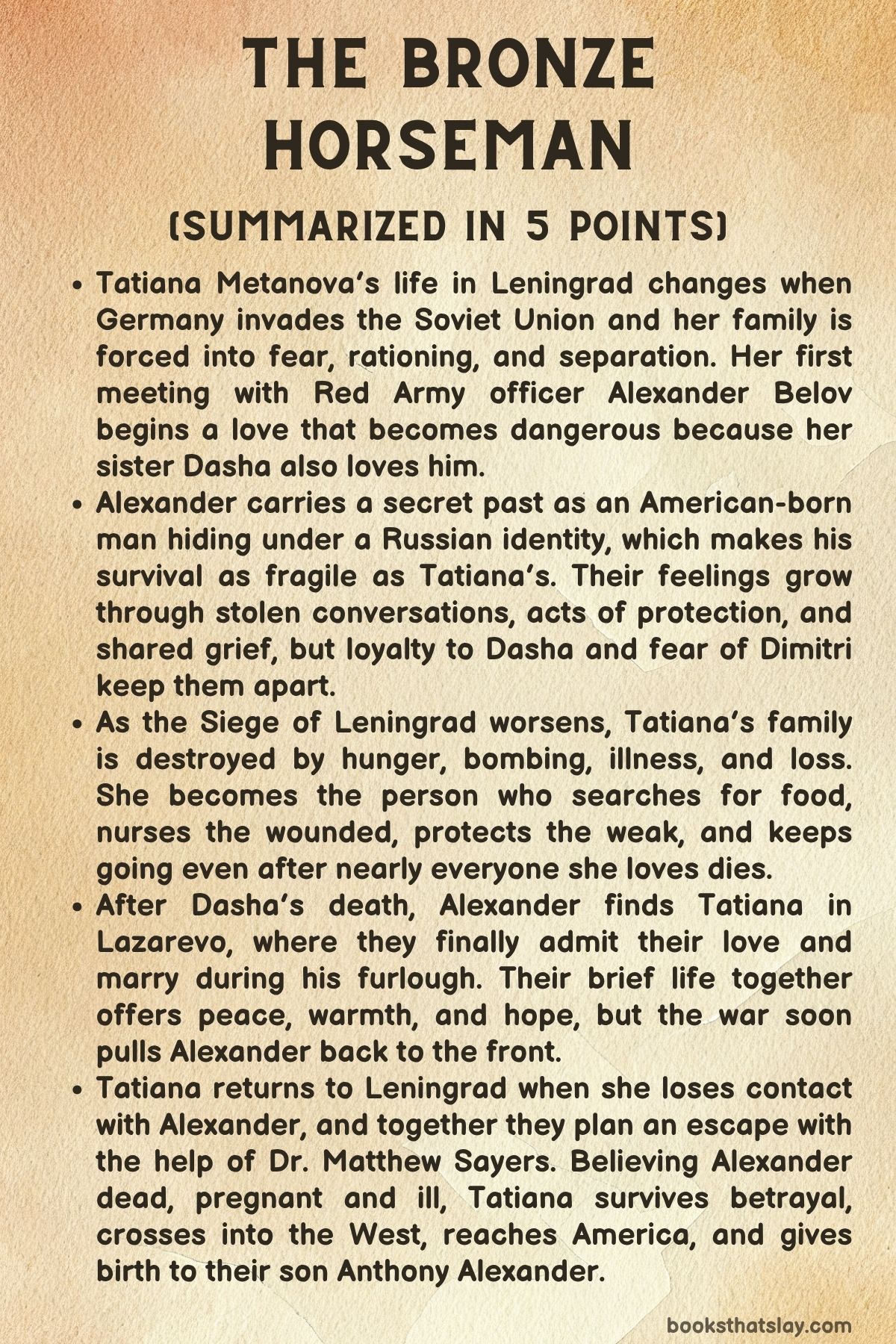
Summary
The Bronze Horseman begins in Leningrad in June 1941, just as seventeen-year-old Tatiana Metanova’s family hears the radio announcement that Germany has invaded the Soviet Union. Tatiana lives in a crowded apartment with her parents, Irina and Georgi, her grandparents, her twin brother Pasha, and her older sister Dasha.
The news immediately changes the mood of the household. Georgi decides that Pasha must be sent to a boys’ camp in Tolmachevo to keep him safe and away from military service, despite the family’s protests.
Tatiana is hurt by his departure but tries to believe what everyone tells her: that Pasha will return soon.
Soon after, Tatiana is sent out to find food for the family. The city is already anxious, and supplies are low.
At a bus stop, she meets a handsome young soldier named Alexander Belov. Their conversation begins lightly, with him teasing her about the ice cream she has bought, but the encounter quickly becomes important to both of them.
Alexander helps her buy food and brings her home, accompanied by his friend Dimitri Chernenko. Tatiana is struck by Alexander, but her excitement collapses when Dasha recognizes him.
Dasha and Alexander have known each other before, and Dasha clearly hopes to renew their relationship.
Tatiana’s feelings for Alexander grow quickly, but she tries to bury them because of Dasha. Alexander, however, continues seeking her out after work.
He encourages her to ask her father to bring Pasha home, warning that the situation around Tolmachevo may not be safe. Tatiana hesitates, trusting that her brother is protected.
During these meetings, Alexander reveals his greatest secret: he is not truly Russian by birth. He was born Anthony Barrington in Massachusetts to American Communist parents who moved to the Soviet Union.
When his parents became victims of the state, Alexander survived by hiding his identity and becoming Alexander Belov. Tatiana understands that this knowledge could destroy him if revealed.
Their bond deepens through shared walks, conversations about America, and quiet emotional trust. Alexander gives Tatiana books that belonged to his parents, including Pushkin’s The Bronze Horseman, which becomes precious to her.
Still, the relationship is trapped by Dasha’s love for Alexander and by Dimitri’s growing interest in Tatiana. Dimitri is forceful, jealous, and manipulative, and Alexander warns Tatiana that he is dangerous.
Tatiana tries to manage the situation alone, refusing to betray her sister even as Alexander tells her he loves her and wants them to be honest.
The war worsens, and Tatiana’s family receives no news of Pasha. Desperate to find him, Tatiana joins the People’s Volunteer Army and heads toward the area where his camp was located.
The camp has been attacked, and Alexander is told that Pasha is most likely dead. He goes after Tatiana and finds her injured beneath bodies and rubble.
He carries her to safety, and while she is treated, he tells her the terrible truth about Pasha. Their grief brings them closer, and they kiss for the first time.
Yet Tatiana is hurt when she learns Dasha asked Alexander to search for her, fearing he came only because of Dasha.
Tatiana spends time recovering in the hospital. Alexander visits her, though he worries about being seen.
One night, he comes to her drunk, emotionally shaken, and the two share an intimate encounter. The next day, he pulls away and calls it a mistake, leaving Tatiana devastated.
When she returns home, life is tense. Her grandparents have left, food is becoming scarcer, and Alexander continues appearing with Dasha as though nothing has changed.
Tatiana begins working as a nurse, hoping to help the war effort, but her family resents the decision. A violent argument with Georgi follows, and he strikes her.
Alexander tries to defend her, causing more anger in the household.
Alexander later explains to Tatiana why Dimitri has power over him. Dimitri’s father was connected to the prison where Alexander’s father was held, and Alexander once befriended Dimitri to get access to his father.
Since then, Dimitri has remained a threat, knowing enough about Alexander’s past to endanger him. Tatiana recognizes that Dimitri’s interest in her is partly a way to control Alexander.
When the family finally receives official news of Pasha’s death, grief settles over the Metanovs, and the war closes harder around them.
As the siege of Leningrad begins, hunger becomes the center of daily life. Rations shrink, bombing continues, and Georgi drinks more heavily.
Marina, Tatiana’s cousin, moves in, increasing the strain on the household. Tatiana works, queues for food, cooks, and tries to keep everyone alive, often giving more to others than she keeps for herself.
Alexander and Dimitri are sent away on military duties, and Dasha waits anxiously for Alexander’s return. When Dasha announces that she and Alexander are engaged, Tatiana is crushed.
Alexander later admits to Tatiana that he agreed partly to protect her from Dimitri, not because he truly wants to marry Dasha.
The siege grows brutal. Georgi dies when the hospital where Tatiana takes him is bombed.
Deda dies away from them. Water, heat, and sanitation disappear.
The family burns what they can for warmth, and Tatiana fights to save Alexander’s gifted books. Marina dies of scurvy, then Irina dies too.
Dasha and Tatiana are left almost alone, starving and sick. Alexander returns at intervals with food, oranges, and hope, telling them that America’s entry into the war may change the course of events.
Dasha eventually realizes that Tatiana and Alexander love each other after watching them together. Tatiana denies it, bound by her promise not to hurt her sister.
Alexander decides that Tatiana and Dasha must leave Leningrad. He gets them onto a truck and sends them across the Road of Life over frozen Lake Ladoga.
At the crossing, Tatiana meets Dimitri, who refuses to help Dasha because he believes she is dying. Dasha reaches medical care but dies soon after.
Tatiana, shattered and alone, rolls her sister’s body into the lake because the frozen ground makes burial impossible. She later reaches Lazarevo, where she begins a new life among elderly village women, recovering from illness and grief.
Months pass before Alexander finds Tatiana in Lazarevo. Their reunion is filled with relief, anger, love, and old hurt.
Tatiana tells him Dasha is dead, but she is cold at first because she remembers how he denied loving her when they parted. Alexander explains that he did not know Dasha had died and that Dimitri lied to him.
After a painful confrontation, they finally admit the full truth of their feelings. Their relationship becomes open between them at last.
They marry in Molotov on June 23, 1942, buy simple rings, and make a home in an old cabin near the river.
For a brief time, Tatiana and Alexander experience happiness away from the war. They swim, cook, practice English, read, make plans, and enjoy married life.
Alexander tells her more about his past, his medals, and the failed desertion plan he once had with Dimitri. Tatiana wants to follow him when his furlough ends, but Alexander insists she must stay safe.
Their farewell is painful, and after he leaves, they exchange letters. When Tatiana stops hearing from him, she leaves Lazarevo and returns to Leningrad to find him.
Back in Leningrad, Tatiana works again at the hospital and learns that Alexander has been injured. Dimitri finds her and forces himself into her space, frightening and angering her.
When Alexander hears that Tatiana is near the front, he comes to her, furious that she risked her life. Their argument turns into reunion, and they reaffirm their promises.
Later, Tatiana befriends an American doctor, Matthew Sayers, through the Red Cross.
During Operation Spark, Alexander is badly wounded while saving Sayers. Tatiana helps save Alexander’s life by donating blood.
As he recovers, they plan an escape with Sayers’s help. Tatiana has stolen a Finnish pilot’s uniform for Alexander, and Sayers agrees to help them cross into Finland and eventually reach America.
Tatiana then reveals she is pregnant. Alexander, terrified for her safety, suggests ending the pregnancy, but Tatiana refuses, seeing the child as part of their future.
Dimitri discovers the plan and demands to be included. Soon after, Alexander learns that the NKVD intends to interrogate him.
Knowing he may not escape, he secretly arranges with Sayers to save Tatiana without telling her the whole truth. Tatiana is told that Alexander has died in a bombing on the way to Volkhov.
Broken by the news, she still leaves with Sayers and Dimitri. At the border, Dimitri betrays them, violence erupts, and he is killed.
Sayers is fatally wounded, but Tatiana manages to get him to Helsinki before he dies. From there, she reaches Stockholm, secures papers, and crosses the ocean to New York.
Sick with tuberculosis and heavily pregnant, she arrives in America and gives birth to a son, Anthony Alexander, carrying Alexander’s name and memory into a new life.
Characters
Tatiana Metanova
Tatiana Metanova is the emotional center of the book, beginning as a young, sheltered girl in Leningrad and becoming a woman shaped by war, hunger, love, and loss. At seventeen, she is underestimated by nearly everyone around her.
Her family sees her as dreamy, impractical, and less useful than Pasha or Dasha, yet the story steadily proves that Tatiana possesses a rare strength. Her courage is not loud or performative.
It appears in the way she queues for food, nurses the wounded, feeds her family before herself, searches for Pasha, crosses the Road of Life with Dasha, and later finds the will to keep living after losing almost everyone. She often sacrifices herself to a dangerous degree, and this self-denial becomes both her greatest virtue and her deepest weakness.
Her love for Alexander gives her a sense of purpose beyond survival, but she also grows because of the choices she makes without him. By the end of the book, Tatiana has crossed borders, outwitted threats, endured bereavement, protected her unborn child, and reached America.
In The Bronze Horseman, she represents quiet endurance under extreme pressure, but she is not merely a symbol of innocence. She is stubborn, secretive, proud, and sometimes reckless, especially when love and loyalty pull her in different directions.
Alexander Belov
Alexander Belov, born Anthony Barrington, is one of the most conflicted figures in the book. To the world, he is a brave Red Army officer, respected for his discipline, courage, and battlefield heroism.
Beneath that identity, he is an American whose past could lead to arrest or execution if exposed. This hidden life explains much of his guarded nature.
Alexander has learned to survive by controlling what he says, hiding what he feels, and calculating danger before others see it. His love for Tatiana breaks through that control, making him both more alive and more vulnerable.
He is protective, passionate, and deeply loyal, but he can also be harsh, possessive, and driven by fear. His relationship with Dasha shows his sense of obligation, while his bond with Dimitri reveals the cost of past compromises.
Alexander’s courage is clear in battle, but his emotional courage is more uneven. He wants to save Tatiana, yet he sometimes tries to decide her future for her.
His identity as both Alexander and Anthony makes him a man split between two countries, two names, and two possible lives. His dream of America is not simply political freedom; it is the hope of being known fully without fear.
Dasha Metanova
Dasha Metanova is often placed in painful contrast with Tatiana. Older, more confident, and more socially experienced, she is used to occupying space in ways Tatiana does not.
Her attachment to Alexander creates the central emotional obstacle between the lovers, yet Dasha is not a simple rival. She is a woman trying to hold onto love during a war that has made every future uncertain.
Her desire to marry Alexander is tied to fear as much as romance; she knows soldiers die, and she wants something secure before death or separation takes it away. Dasha can be self-centered, dismissive of Tatiana, and blind to her sister’s suffering, especially when she teases or commands her.
At the same time, she stays in Leningrad partly because she does not want to abandon Tatiana. Her final confrontation with the truth about Tatiana and Alexander gives her a tragic dignity, because she senses what both of them deny.
Dasha’s death on the far side of Lake Ladoga is one of the story’s harshest losses. She dies as a victim of war, hunger, illness, and emotional betrayal, leaving Tatiana to carry grief mixed with guilt.
Dimitri Chernenko
Dimitri Chernenko is one of the most dangerous characters in the novel because his threat is personal, political, and psychological. At first, he appears as Alexander’s friend and fellow soldier, but his behavior soon reveals a need for control.
His interest in Tatiana is not built on real tenderness; it is possessive, entitled, and tied to his resentment of Alexander. Dimitri understands that he has power because he knows parts of Alexander’s hidden past.
This makes him a constant danger, especially in a state where suspicion can destroy lives. He pressures Tatiana physically and emotionally, misreads her fear as encouragement, and later reacts with bitterness when he realizes she will never belong to him.
His desire to flee to America with Alexander exposes another side of him: cowardice mixed with desperation. Dimitri wants freedom, but he wants it on his own terms and at other people’s expense.
His betrayal at the border completes the pattern that has defined him throughout the book. When he cannot control Alexander and Tatiana, he tries to ruin them.
His death is violent and chaotic, matching the damage he causes.
Pasha Metanov
Pasha Metanov is physically absent for much of the story, but his presence shapes the family’s emotional collapse. As Tatiana’s twin brother and Georgi’s only son, he carries a special value within the household.
Georgi’s decision to send him to the boys’ camp is meant to protect him, yet it becomes one of the family’s defining tragedies. Pasha’s presumed death creates guilt, anger, blame, and silence.
Tatiana is especially affected because her bond with him is intimate and lifelong. Her decision to join the People’s Volunteer Army and search for him shows how deeply she refuses to accept passive grief.
Pasha also exposes the unequal emotional structure of the Metanova family. Tatiana overhears her parents wishing she had been lost instead of him, a cruel moment that clarifies her loneliness within her own home.
Even after official news of his death arrives, Tatiana struggles to fully believe it because she never sees his body. Pasha becomes more than a lost sibling; he is the wound that begins the family’s disintegration.
Irina Metanova
Irina Metanova is a mother overwhelmed by fear, grief, hunger, and the collapse of ordinary life. She begins as part of a crowded but functioning family, but the invasion and Pasha’s disappearance break her emotional stability.
Her love for her children is real, yet it is unevenly expressed. She mourns Pasha with a bitterness that often falls on Tatiana, and she fails to recognize how much Tatiana is doing to keep the household alive.
Irina’s anger toward Alexander after Georgi’s confrontation also shows how grief can attach itself to convenient targets. As the siege worsens, Irina becomes part of the domestic suffering of Leningrad: sewing, rationing, waiting, weakening, and watching her family disappear piece by piece.
Her death marks the near-total collapse of Tatiana’s childhood home. Irina is not heroic in an obvious way, but she is human in her exhaustion.
The book presents her as a mother trapped in conditions too extreme for ordinary patience, fairness, or hope to survive intact.
Georgi Metanov
Georgi Metanov is a father whose authority fails under the pressure of war. His decision to send Pasha away is rooted in protection, but when it leads to tragedy, he cannot bear the guilt.
Instead of becoming a source of strength for the family, he turns increasingly to alcohol, anger, and denial. His grief hardens into cruelty, especially toward Tatiana, whom he undervalues and later physically strikes.
Yet Georgi is not portrayed as evil. He is a broken man who cannot survive the consequences of his own choice.
Tatiana’s anger toward him after Pasha’s death is understandable, but she also recognizes his pain and takes him to the hospital in an attempt to save him from himself. His death in the bombing of the hospital is bitterly ironic because the place meant to help him becomes the site of his end.
In the wider story, Georgi shows how war destroys not only bodies but also family roles, pride, and moral steadiness.
Deda
Deda is one of the figures Tatiana associates with goodness, wisdom, and moral clarity. Though he is not present through the entire book, his influence matters because Tatiana measures herself against him.
She wants to be good in the way she believes he is good, and this longing shapes many of her actions. Deda belongs to the older world that begins disappearing once the war starts.
His departure from Leningrad and later death remove another layer of family stability. For Tatiana, Deda represents memory, conscience, and the kind of steady kindness that becomes harder to find during the siege.
His loss is not as dramatically shown as some others, but it deepens Tatiana’s sense that the life she knew is being dismantled person by person. In a book full of hunger, violence, and fear, Deda’s importance lies in the quiet moral inheritance he leaves behind.
Babushka Maya
Babushka Maya, Tatiana’s other grandmother, becomes a painful example of how siege conditions force impossible moral situations onto families. She is elderly, sick, dependent, and consuming rations in a household where everyone is starving.
The family’s discussions about what to do with her are disturbing because they reveal how hunger changes the way people think about care, duty, and survival. No one wants to become cruel, but the siege makes even compassion feel like a cost.
Maya’s death is handled with grim practicality, as Tatiana reports it and the authorities come to remove the body. Her character matters because she shows the brutal reduction of human life under siege: a grandmother becomes a body to manage, a ration problem, a sorrow that cannot be properly honored.
Through her, The Bronze Horseman shows how war attacks the rituals of family love as much as life itself.
Marina
Marina, Tatiana’s cousin, enters the Metanova household as another displaced person of war. Her father is missing, her mother is ill, and she has nowhere secure to go.
Tatiana invites her in out of compassion, even though the family already lacks enough food. Marina’s presence increases tension in the apartment, especially as starvation worsens.
She can be careless, needy, and irritating to Tatiana, particularly when food disappears or when she comments on Alexander’s behavior. Yet Marina is also a victim of the same catastrophe as everyone else.
Her decline from illness and scurvy is one of the signs that the family has moved beyond hardship into physical ruin. When she dies, Tatiana is forced into another act of emotional suppression, placing her body outside because proper mourning has become impossible.
Marina’s role is important because she shows how war expands every household’s suffering, bringing the grief of relatives, neighbors, and friends into already fragile spaces.
Matthew Sayers
Matthew Sayers enters the book as an American doctor with the International Red Cross, and his role becomes crucial to both Tatiana and Alexander. He first connects with Tatiana through medical work, recognizing her skill and dedication.
Later, Alexander saves him during battle, and Sayers becomes bound to the couple by gratitude and moral responsibility. His willingness to help them escape is not only repayment; it also shows his recognition that they are trapped in a system that may destroy them despite their courage.
Sayers represents a bridge to the West, especially for Tatiana, who practices English with him and depends on his help to reach safety. His death after the border violence is another major loss, but he succeeds in helping Tatiana move toward freedom.
In the story’s moral structure, Sayers stands apart from characters who use knowledge as leverage. He knows dangerous truths, but he uses that knowledge to protect rather than control.
Colonel Stepanov
Colonel Stepanov is a military authority figure who often acts with more humanity than the system around him. He supports Alexander, recognizes his bravery, and helps him when possible.
His personal connection to Alexander deepens after Alexander tries to save Stepanov’s son Yuri, even though Yuri dies. Stepanov’s grief does not make him vindictive; instead, he becomes one of the few people in power who treats Alexander with loyalty and respect.
He assists with leave, delivers military honors, and later warns Alexander about NKVD suspicion. Yet his power has limits.
He can delay danger or soften it, but he cannot fully protect Alexander from the state. Stepanov’s character shows the difference between individual decency and institutional cruelty.
He is honorable, but he operates inside a world where honor cannot always save the innocent.
Themes
Love as Sacrifice and Survival
Love in The Bronze Horseman is not treated as an escape from war but as something that must exist inside fear, hunger, secrecy, and moral pressure. Tatiana and Alexander’s relationship begins with attraction, but it becomes meaningful because both are repeatedly asked to give up comfort, safety, pride, and certainty for each other.
Tatiana refuses to hurt Dasha, even when it costs her honesty and happiness. Alexander agrees to an engagement he does not truly want because he thinks it will protect Tatiana from Dimitri.
Later, their marriage in Lazarevo offers them a brief period of joy, but even that happiness is shadowed by Alexander’s return to the front. Their love is often expressed through practical acts: food brought during starvation, warnings about danger, blood donated in a hospital, escape plans made under threat, and promises to keep living.
The book does not make love simple or pure. It can lead to secrecy, jealousy, anger, and pain.
Yet it also becomes a force that keeps both characters from surrendering to despair. Love gives Tatiana the courage to cross borders and gives Alexander a reason to endure a life built on hidden identity.
Hunger, War, and the Breakdown of Ordinary Morality
The Siege of Leningrad changes the rules of daily life until ordinary morality becomes difficult to preserve. At first, the Metanovs think in familiar terms: family arguments, work, food shopping, romantic hopes, and military news.
As the blockade tightens, everything narrows to survival. Bread, water, warmth, and ration cards become more important than privacy, manners, or emotional fairness.
Tatiana’s family does not become cruel because they lack love; they become cruel because hunger strips away patience and generosity. Georgi drinks because he cannot live with grief.
Irina blames and withdraws because loss has exhausted her. Dasha weakens, Marina eats what she can, and Tatiana gives too much of herself until her body is nearly destroyed.
The deaths of relatives cannot be mourned properly because there is no strength, space, or time for ritual. Bodies are moved, reported, or left outside because survival demands action over ceremony.
The theme is powerful because it shows that war does not only kill through bombs and bullets. It also changes how people speak, eat, remember, love, and judge one another.
Identity, Secrecy, and the Danger of the State
Alexander’s hidden identity turns the political world of the book into a personal threat. Born Anthony Barrington in America, he must live as Alexander Belov in the Soviet Union after his parents are destroyed by the system they once believed in.
His life depends on concealment, and this secrecy affects every relationship he has. Tatiana’s knowledge of his past becomes an act of trust, while Dimitri’s knowledge becomes a weapon.
The state is present not only through armies and official announcements but through fear of exposure, interrogation, prison, and execution. Alexander can be a decorated soldier and still remain unsafe because heroism does not erase suspicion.
His medals prove his courage, but they cannot protect him from the danger attached to his birth and family history. This theme also affects Tatiana, especially once she becomes Alexander’s wife and carries his child.
Her connection to him places her at risk, forcing her to use false identity, language, documents, and quick thinking to survive. The book presents identity as both truth and danger: to be known fully is what Alexander wants most, yet being known by the wrong people could destroy him.
Female Endurance Under Extreme Pressure
Tatiana’s journey shows how endurance can look quiet from the outside while requiring extraordinary force within. She is not trained for power, command, or violence.
She begins as a young woman sent to buy food, teased by her sister, dismissed by her parents, and treated as childish by others. Yet when the world collapses, she becomes the person who keeps moving.
She searches for Pasha, works in hospitals, feeds her family, manages death, protects Dasha, survives illness, returns to the front, saves Alexander through blood donation, organizes an escape, crosses borders, and gives birth in a foreign country. Her strength is not flawless.
She lies, denies her own needs, risks her safety, and sometimes mistakes suffering for duty. Still, the story insists that endurance is not passive.
Tatiana acts constantly, even when she is starving, grieving, or afraid. Other women in the story also show different forms of endurance: Dasha clings to love while dying, Irina bears unbearable maternal grief, Marina seeks shelter after losing her own family, and the women in Lazarevo create a fragile domestic world from scarcity.
Through them, survival becomes a female labor of cooking, nursing, waiting, carrying, hiding, and continuing.