Orphan X Summary, Characters and Themes
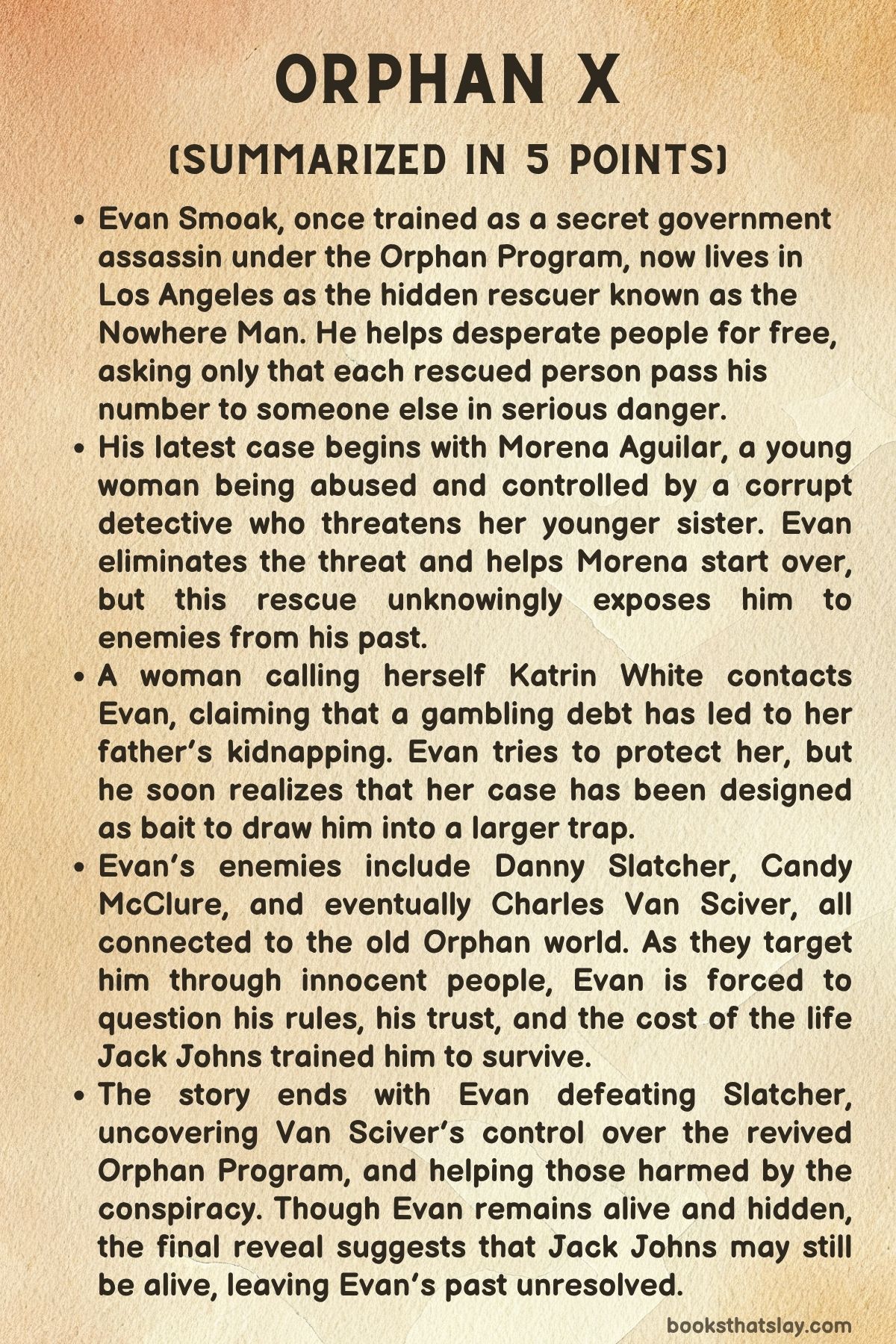
Orphan X is a fast, tense thriller by Gregg Hurwitz about Evan Smoak, a former government-trained assassin who has rebuilt himself as a hidden rescuer for people with nowhere else to turn. Known as the Nowhere Man, Evan lives by rules drilled into him since childhood, using his lethal skills without asking for money or fame.
The book mixes covert action with questions about identity, trauma, loyalty, and moral responsibility. Beneath the violence is a story about a man trained to be alone who slowly discovers how dangerous and necessary human connection can be.
Summary
Evan Smoak was taken from a harsh childhood in East Baltimore when he was only twelve. A man named Jack Johns brought him into a secret government program that turned abandoned children into deniable assassins.
Jack became his trainer, handler, and father figure. He promised never to lie to Evan, even though the truth he offered was often brutal.
Evan learned combat, surveillance, pain control, languages, weapons, and emotional discipline. He also learned a set of Commandments that governed survival, strategy, and ethics.
His official identity disappeared, and he became an operative known by the code name Orphan X.
Years later, Evan lives in Los Angeles under a quiet public cover as an importer of industrial cleaning supplies. His penthouse at Castle Heights looks ordinary, but it is really a concealed fortress with bullet-resistant protections, hidden surveillance, an armory, emergency systems, and a secure Vault.
He has left the government behind and now works as the Nowhere Man, helping desperate people for free. His only payment is that each person he saves must give his secret phone number to one other person in terrible need.
After returning from a mission in Las Vegas, Evan receives a call from Morena Aguilar, a frightened seventeen-year-old in East Los Angeles. She tells him that a corrupt police detective, Bill Chambers, has sexually exploited her and other girls and now plans to target her younger sister, Carmen.
Evan investigates Chambers, confirms the threat, and kills him before he can hurt Carmen. Afterward, Evan helps Morena and Carmen start over with money recovered from Morena’s biological father’s unclaimed assets.
The case seems clean, but it becomes the first step in a larger trap.
At Castle Heights, Evan’s controlled life is complicated by his neighbors. Mia Hall, a district attorney and widowed mother, lives below him with her adopted son, Peter.
Evan is drawn to Mia’s strength, honesty, and vulnerability, while Peter’s curiosity and innocence unsettle him. Evan is used to monitoring people as possible threats, not caring about them.
Yet meals, conversations, small acts of kindness, and Peter’s odd notes begin to make him feel connected to ordinary life.
Soon after Morena’s case, the RoamZone phone rings again. A woman calling herself Katrin White says she owes millions to a private gambling operation in Las Vegas and that the men she owes have kidnapped her father, Sam.
Evan is suspicious because the call comes too soon, but Morena appears to have referred her. He arranges a cautious meeting with Katrin, moving her from one public location to another to test for danger.
At a restaurant in Chinatown, Evan spots a sniper aiming from a nearby building. He saves Katrin from being shot and kills one attacker, but he realizes something is wrong: for the first time, he is reacting instead of controlling the situation.
Katrin tells Evan that her gambling debt led to her father’s abduction. Evan hides her in a motel and verifies parts of her story.
When he calls the kidnappers to negotiate, they allow Katrin to speak to her father briefly before apparently executing him over the phone. Evan believes his decision to intervene caused Sam’s death.
The failure breaks through his discipline, making the case personal. He remembers Jack’s death years earlier, when Evan tried to quit the Orphan Program after realizing his missions might not be as righteous as he had been told.
During that meeting, gunmen attacked, Jack was wounded, and Evan escaped with Jack’s bloodstained shirt, believing Jack had died protecting him.
The enemies hunting Evan are led in the field by Danny Slatcher, known as Orphan Zero, and assisted by Candy McClure, known as Orphan V. Slatcher is a highly skilled former Orphan with government connections, advanced surveillance equipment, and a group of violent contractors. Candy is a sadistic killer whose childhood taught her to reject victimhood by becoming cruel and controlling.
They use Katrin as bait, but Evan gradually learns the real target is not Katrin at all. It is him.
Evan hides Katrin in a safe house and continues to test her story. He discovers that Slatcher’s team can track him with an efficiency that rivals his own.
He searches a sniper site in Chinatown and realizes the bullets were never meant for Katrin. They were aimed at him.
When he contacts the enemy, he learns that someone connected to the old Orphan world knows exactly who he is.
Another caller, Guillermo “Memo” Vasquez, contacts Evan through Morena, claiming that drug dealers are threatening his daughter Isa. Evan suspects that either Memo or Katrin is false.
While he tries to verify Memo’s story, Slatcher’s team kidnaps Katrin from Evan’s loft. Evan later discovers that a tracking device was hidden inside his own detection tool, a brilliant move that exposed several of his safe locations.
Slatcher has outplayed him by turning his caution against him.
Evan’s private world continues to collide with ordinary life. Mia and Peter face threats from men connected to Mia’s work as a prosecutor, and Peter sends a balloon to Evan’s window asking for help.
Evan chooses to save them, even though he is waiting for Katrin’s tracking signal. He rappels into Peter’s bedroom, defeats the attackers, and protects Mia and her son.
But Mia confronts him after seeing what he can do. When she learns that he has investigated her private life, she feels betrayed.
For Evan, this is a new kind of pain: not physical damage, but the loss of trust.
Katrin’s implanted GPS signal eventually leads Evan to Slatcher’s temporary base in Calabasas. Slatcher is away, expecting Evan elsewhere, so Evan attacks the building.
He kills several armed men and fights Candy, who is destroyed by the acid she had prepared for others. Evan reaches Katrin and frees her, only to receive a call from Morena proving that Katrin helped create the Memo setup.
Katrin, forced by threats against her real daughter, stabs Evan with his own knife. Evan survives only because he turns at the last instant.
Badly wounded, Evan escapes, fights through more attackers, and drives himself home while nearly dying from blood loss. Mia finds his blood trail, cleans it to protect him, and later says goodbye for her and Peter’s safety.
Her parting kindness hurts Evan because it shows him what he cannot easily have. While recovering, Evan learns Katrin’s real name is Danika White.
Her cover story was built from pieces of truth: she is a gambler, but her supposed father-in-danger story was false. Slatcher’s team threatened her daughter Samantha to force her cooperation.
Evan also confirms that Memo’s danger is real. He finds Memo hospitalized and beaten, then rescues Isa from the drug dealers who took her.
Even while hunted, injured, and betrayed, he cannot ignore an innocent life.
Morena helps Evan set a trap for Slatcher in Las Vegas. Evan waits in a hotel room, gets Morena safely away, and fights Slatcher in a savage close-quarters battle that moves across balconies, a parking structure, and a solar-paneled overhang.
Slatcher is larger and brutally skilled, but Evan uses timing, pain control, and a damaged katana sheath to survive. The fight ends when Evan turns the sword blade and severs Slatcher’s fingers, causing him to fall to his death.
After Slatcher dies, Evan takes his advanced contact-lens communication device and discovers a link to someone higher up. Danika later calls Evan for help, saying the person above Slatcher is coming for her.
Evan refuses because she betrayed him, even though his own code tells him never to let an innocent die. Moments later, Charles Van Sciver, known as Orphan O, enters Evan’s loft and kills Danika.
Van Sciver reveals that he is Top Dog and now controls the Orphan Program, which was never truly dismantled. Its new purpose is to eliminate former Orphans until only one remains.
Evan remotely detonates an explosive hidden in the camera, leaving Van Sciver’s condition uncertain.
Evan quietly pays off Samantha’s student loans, giving Danika’s daughter the future her mother tried to protect. He also leaves gifts and small repairs for people at Castle Heights, including a DNA ancestry report for Peter.
Though Evan decides to step back from the Nowhere Man work for a while, he remains alert. The ending reveals that Jack Johns may still be alive, hiding in a remote cabin and training another boy.
The final note is one of survival, secrecy, and unfinished loss.
Characters
Evan Smoak
In Orphan X, Evan Smoak is built around contradiction. He is a professional killer who has turned himself into a rescuer, a man trained to avoid attachment who is quietly starved for connection, and a disciplined strategist whose strongest rule is moral rather than tactical.
His childhood made him vulnerable to recruitment, but Jack Johns shaped that vulnerability into focus, control, and ability. Evan’s life as the Nowhere Man gives him a way to repair the damage caused by his past, yet his rescue work also depends on secrecy, violence, and emotional distance.
His greatest conflict is not whether he can survive, because he usually can. It is whether he can remain human while living as a weapon.
His relationships with Mia, Peter, Morena, Memo, and Danika expose sides of him that training cannot fully contain. By the end of the book, Evan has been physically wounded, emotionally exposed, betrayed, and forced to question whether his rules are enough.
Jack Johns
Jack Johns is Evan’s handler, teacher, and surrogate father. He is hard, secretive, and sometimes cruel in method, but his cruelty is never careless.
Jack understands that the Orphan Program wants tools, not people, and he makes it his private mission to keep Evan from becoming only a tool. He teaches Evan pain control, discipline, fieldcraft, and suspicion, but he also teaches him to respect women, question orders, and protect innocence.
Jack’s influence explains why Evan becomes different from the other Orphans. While the program sees Evan as expendable, Jack sees him as a son.
His apparent death becomes the central wound in Evan’s life, and the bloodstained flannel shirt Evan keeps is less a memory object than a symbol of love, guilt, and unfinished truth. The later suggestion that Jack survived changes the emotional ground of the story, because it means Evan’s deepest loss may also be his greatest unresolved mystery.
Mia Hall
Mia Hall represents the ordinary world Evan watches from a distance but cannot easily enter. She is a district attorney, a widow, and a mother carrying grief, responsibility, fear, and daily exhaustion.
Her strength is not shown through physical force but through persistence: she raises Peter, handles threats from criminals, keeps working, and tries to maintain emotional honesty even when life has made that difficult. Mia’s attraction to Evan grows because she senses his steadiness and hidden kindness, but she also becomes the person most wounded by his habits of secrecy.
When she learns he has investigated her private life, she sees his protection as a violation of trust. Her decision to help him by cleaning the blood trail and then distance herself from him is deeply important.
It shows that she cares for him, but not at the cost of her son’s safety or her own dignity.
Peter Hall
Peter Hall is curious, funny, lonely, and more perceptive than adults expect. As Mia’s adopted son, he carries his own questions about belonging and identity, which quietly mirror Evan’s lack of known family roots.
Peter sees things other people miss, including Evan’s injuries, odd behavior, and concealed danger. His balloons, notes, awkward conversations, and fascination with Evan give the story a tender counterweight to the violence around it.
Peter also becomes a test of Evan’s moral development. Evan knows how to eliminate threats, but Peter requires patience, gentleness, and careful guidance.
When Peter misunderstands Evan’s advice about confronting a bully, the book shows how dangerous Evan’s worldview can be when translated into a child’s life. Yet Peter also helps Evan imagine a “next time,” a future in which change is possible.
Morena Aguilar
Morena Aguilar is one of the most important victims Evan helps because her case begins the chain that exposes the larger conspiracy. She is young, frightened, exploited, and burdened with protecting her younger sister from the same abuse she has suffered.
Her fear is realistic, but she is not passive. By calling Evan, by trusting him enough to tell the truth, and later by trying to pass his number to another person, she takes action inside a life where powerful men have tried to erase her choices.
Morena’s branded arm reveals the cruelty of Bill Chambers’s control, while Carmen’s unmarked arm later becomes a sign that Evan’s intervention mattered. Morena also becomes a link between Evan’s mission and his enemies, because those enemies understand that his referral system can be manipulated.
Her survival depends on caution, courage, and her instinct to protect her sister.
Carmen Aguilar
Carmen Aguilar is a child whose innocence raises the stakes of Morena’s situation. She is not developed through long speeches or major decisions, but through what she represents: the future Chambers intends to destroy.
Her presence makes Morena’s fear sharper and Evan’s response more immediate. Carmen’s unbranded arm after Evan’s intervention is one of the clearest signs of rescue in the book.
She also shows quiet bravery when she helps Evan connect with Morena in Las Vegas, despite danger and confusion. Carmen matters because she gives the story a visible measure of what protection means.
Evan is not only avenging harm already done; he is preventing harm before it reaches another child.
Danika White / Katrin White
Danika White, using the name Katrin White, is one of the book’s most complex figures because she is both victim and betrayer. Her story is designed to fool Evan by mixing truth with lies.
She is a real gambler with real debts, but the kidnapped-father story is a manipulation created to draw Evan into danger. Her fear is genuine because Slatcher and his superiors threaten her daughter Samantha, and this authenticity makes her deception harder to detect.
Danika’s relationship with Evan is shaped by attraction, desperation, shame, and calculation. She allows herself to be used against him, but she is not simply malicious.
Her choices are driven by terror and maternal love, even when those choices endanger others. Her stabbing of Evan is a terrible betrayal, yet her later plea for help and her daughter’s financial rescue leave her as a tragic figure whose love for Samantha survives her moral collapse.
Samantha White
Samantha White never becomes central through direct action, but she is crucial to understanding Danika. She is the pressure point used by powerful people to control her mother.
Samantha’s anger toward Danika reveals a painful family history of gambling, abandonment, and emotional exhaustion. To her, her mother’s problems have likely been a repeated source of fear and humiliation.
Yet Samantha also becomes the recipient of Danika’s final sacrifice. Evan’s decision to pay off her loans and create an education fund gives Samantha a future free from the debts and dangers surrounding her mother.
Through Samantha, the book shows how violence and coercion can reach beyond immediate victims into families, education, and long-term opportunity.
Sam White
Sam White exists mainly as part of Danika’s false story, but the idea of him carries real emotional force while Evan believes he has been killed. The apparent execution of Sam becomes the moment Evan thinks he has failed an innocent man, and that failure cracks his emotional control.
Later, the truth that Sam is alive exposes how carefully Slatcher’s team studied Evan’s conscience. They did not need to kill Sam; they only needed Evan to believe they had.
Sam’s role therefore matters less as an independent character and more as a weaponized illusion. He becomes proof that Evan’s compassion can be used against him when an enemy understands his code.
Danny Slatcher / Orphan Zero
Danny Slatcher is Evan’s dark professional mirror. He has comparable training, ruthless patience, and the ability to think several moves ahead.
His danger comes not only from strength or marksmanship but from tradecraft. Planting a tracker inside Evan’s own detection device shows that he understands how Evan thinks and can exploit his habits.
Slatcher admires skill, but he has no moral center like Evan’s. He uses hired killers, threats against families, false deaths, and emotional manipulation without hesitation.
As Orphan Zero, he represents what an Orphan can become when training is not balanced by humanity. His final fight with Evan is significant because it is not a simple contest between good and evil; it is a contest between two products of the same system, one who protects innocence and one who treats people as disposable material.
Candy McClure / Orphan V
Candy McClure is cruel, theatrical, and terrifying because she has turned her own history of abuse into a philosophy of domination. She refuses to be powerless, but instead of rejecting cruelty, she adopts it and sharpens it.
Her work as an assassin is marked by humiliation, control, and a pleasure in making victims afraid. She is also highly capable, not merely decorative or secondary to Slatcher.
Her identity as Orphan V places her within the same broad world of trained operatives, but her methods are more sadistic and personal. Candy’s death by the acid she prepared for others is fitting because it turns her chosen instrument back on her.
She is a warning about survival without mercy: pain may create strength, but it can also create a person who spreads harm rather than ending it.
Charles Van Sciver / Orphan O
Charles Van Sciver is the book’s hidden architect and the clearest embodiment of institutional corruption. His role reframes Orphan X from a story about one rescue mission into a wider conflict involving the surviving Orphans and the government machinery that made them.
Van Sciver is intelligent, cold, and ambitious. He lacks Evan’s emotional conflict and seems to view killing as both profession and hierarchy.
His past connection to Evan at Pride House gives their conflict personal history, even though Van Sciver claims the hunt is not personal. He now controls the system that once controlled both of them, and his goal of making Orphans eliminate one another reveals a bleak worldview: survival is the only purpose left.
His inability to answer Evan’s question about what comes after being the last survivor exposes his emptiness.
Tommy Stojack
Tommy Stojack is one of Evan’s few trusted contacts, though even their trust is limited by the rules of their world. As an armorer, Tommy provides weapons, repairs, modifications, and practical knowledge that Evan needs to keep functioning.
His missing finger, guarded manner, and professional caution make him feel like someone who has survived by understanding danger rather than pretending it is not there. Tommy’s value is not only technical.
He helps verify Danika’s identity and gives Evan information that changes the direction of the case. His relationship with Evan shows a rare form of friendship built on competence and boundaries.
They do not need emotional confession to understand each other. Their trust comes from consistency, discretion, and knowing exactly how dangerous their lives are.
Guillermo “Memo” Vasquez
Memo Vasquez is first presented as a possible fraud, but he becomes one of the story’s clearest examples of genuine need. He is a struggling father trying to protect his daughter Isa after criminals force him into a drug-related situation.
Evan’s suspicion toward Memo shows both the strength and weakness of his methods. Testing stories keeps him alive, but distrust can delay compassion.
Memo’s fear of deportation adds another layer to his helplessness, because he is trapped between criminal violence and institutional vulnerability. Evan’s later apology to Memo is meaningful because Evan rarely admits failure in simple human terms.
By arranging Memo’s immigration approval and rescuing Isa, Evan repairs at least one part of the damage caused by his misjudgment.
Isa Vasquez
Isa Vasquez is one of the most vulnerable characters in the book. Her kidnapping by drug dealers reveals the cruelty of people who use children as leverage.
Her Down syndrome is not treated as her whole identity; rather, it intensifies the reader’s awareness of how defenseless she is inside a violent adult world. The detail of her giving the mattress to her teddy bear shows innocence, imagination, and tenderness in a place built around fear.
Evan’s quiet rescue of Isa is one of his purest acts because he works silently to avoid frightening her. She sees him as almost superhero-like, but the book keeps the scene grounded in care rather than spectacle.
Isa reminds Evan, and the reader, why the Tenth Commandment matters.
Bill Chambers
Bill Chambers is a corrupt detective whose authority makes his crimes especially vile. He uses the power of his badge, access to databases, and fear of law enforcement to control vulnerable girls and women.
His abuse of Morena and his plan to target Carmen make him an early example of institutional power turned predatory. Chambers is not complex in the same way Evan or Danika is; his function in the book is to show what happens when public trust is converted into private violence.
Evan’s killing of Chambers is not only punishment but prevention. Through Chambers, the story establishes the kind of person the Nowhere Man exists to stop: someone protected by systems that should have protected his victims.
Ida Rosenbaum
Ida Rosenbaum is a small but memorable part of Evan’s Castle Heights life. Her insistence that Evan attend homeowners’ meetings and her casual physical intrusions contrast sharply with the deadly seriousness of his hidden world.
She treats him not as a trained operative but as an unreliable neighbor who should participate in building matters. That ordinary pressure is important because it reminds Evan that civilian life has its own rules, obligations, and social expectations.
Ida’s presence creates moments of humor and discomfort, but she also helps show how isolated Evan is. He can handle assassins, surveillance teams, and corrupt officials, yet a determined elderly neighbor can still unsettle his carefully managed routine.
Johnny Middleton
Johnny Middleton begins as an irritating neighbor who tries to involve Evan in martial arts and later becomes someone Evan must guide through the consequences of violence. Johnny’s problem with the brothers of a man he injured gives Evan a chance to display restraint rather than lethal force.
Evan could easily destroy the attackers, but instead he uses defensive moves and then makes Johnny apologize and take responsibility. Johnny’s role shows the difference between knowing how to fight and knowing when violence is morally justified.
He also reveals Evan’s hidden capacity as a teacher. Evan does not merely rescue Johnny from harm; he forces him to understand accountability.
Hugh Walters
Hugh Walters, the homeowners’ association president, represents the mild absurdity of normal life pressing against Evan’s covert existence. His fines, rules, and casual observations feel trivial beside assassins and government conspiracies, yet they also matter because they pull Evan into the rhythms of a community.
Hugh notices things, including Mia’s fear, and his comments sometimes push Evan toward action. He is not a heroic figure, but he functions as part of the social environment Evan cannot fully escape.
Hugh’s ordinary concerns make Evan’s double life more striking. The same man who manages secret weapons and encrypted networks must also answer to building complaints and missed meetings.
Joey Delarosa
Joey Delarosa is Evan’s neighbor across the street and an example of how Evan constantly studies his surroundings. Evan knows Joey is a domestic abuser and watches him as part of his environmental awareness.
Joey also becomes useful because Evan hides a bridge phone in his apartment, using the space as part of his defensive network. Candy’s later intrusion into Joey’s apartment shows how Evan’s preparations extend into the lives of people around him, often without their knowledge.
Joey is morally unpleasant, but he is also a reminder that Evan’s world is not divided only between official enemies and innocents. Some people nearby are dangerous in smaller, uglier ways.
Melinda Truong
Melinda Truong is a specialist who helps Evan verify documents and identities. Her vintage poster restoration business gives her a legitimate surface while her forgery expertise places her in Evan’s shadow network.
Melinda’s role is brief but important because her confirmation that Danika’s passport is authentic strengthens Evan’s uncertainty. She proves that Danika is not a simple invented identity, which allows the trap to work longer.
Melinda represents the kind of expert Evan relies on: someone outside ordinary systems, discreet, skilled, and useful at exactly the right moment. Her presence also expands the world of the book, showing that Evan’s survival depends on more than weapons and combat.
Themes
Identity, Secrecy, and Reinvention
In Orphan X, identity is treated as something both constructed and stolen. Evan’s original name is erased when Jack gives him a new last name, and the Orphan Program turns him into a code, a weapon, and a deniable asset.
Later, Evan builds another self as an ordinary Los Angeles resident, but even that identity is a cover maintained through lies, surveillance, and emotional distance. Danika’s false identity as Katrin adds a darker version of the same idea.
Her cover works because it uses pieces of truth, proving that identity can be manipulated most effectively when it is not entirely false. Evan’s life as the Nowhere Man is his attempt to choose who he is after the government has already defined him.
Yet the book keeps asking whether reinvention is enough when the past remains active. Evan can change his name, home, phone, habits, and mission, but he cannot fully escape the program that made him.
Identity becomes less about documents and more about repeated choices: who he protects, what he refuses to become, and what parts of himself he allows others to see.
Training, Morality, and the Fight to Stay Human
Evan’s training gives him extraordinary control over pain, fear, movement, memory, and violence, but the book is more interested in what that training costs. The Orphan Program is designed to create operatives who can kill without hesitation and disappear without consequence.
Jack’s private rebellion is that he teaches Evan not only how to survive but how to question orders and protect innocents. That difference separates Evan from Slatcher, Candy, and Van Sciver.
They have skill, discipline, and lethal ability, but they lack Evan’s moral resistance. The Commandments are not just tactical rules; they are Evan’s replacement for family, religion, and law.
Still, the story tests whether rules can handle real human pain. Evan’s failure with Danika, his guilt over Sam’s supposed death, and his hesitation when Mia and Peter need him all show that morality is harder than efficiency.
The book argues that staying human is not a feeling Evan naturally keeps. It is work.
He must choose it repeatedly, especially when violence would be easier, cleaner, and safer for him personally.
Trust, Vulnerability, and Human Connection
Evan’s greatest weakness is also his greatest hope: his need for connection. His training teaches him that solitude protects him, and much of his life supports that belief.
His home is fortified, his phone is untraceable, his contacts are limited, and his routines are designed to prevent emotional dependence. Yet the story keeps placing him near people who need more than technical rescue.
Mia wants honesty. Peter wants guidance.
Morena needs reassurance. Memo deserves belief.
Even Danika, though she betrays him, exposes the danger of deciding too quickly that another person is only a threat or a tool. Evan’s relationship with Mia is especially important because it shows the limits of protection without trust.
He believes surveillance keeps her safe, but to Mia it means he has taken private knowledge without permission. Her rejection teaches him that intimacy cannot be built the same way he builds security systems.
The small final choice to leave Peter’s handprint on the refrigerator matters because it shows Evan allowing another person’s mark to remain in his controlled space. That is a quiet but real change.
Power, Exploitation, and the Duty to Protect
The book repeatedly shows powerful people using vulnerable people as leverage. Chambers uses his badge to exploit girls.
Slatcher uses Danika’s daughter to control Danika. Drug dealers use Isa to control Memo.
The Orphan Program uses abandoned children to create disposable killers. These situations differ in scale, but they share the same pattern: someone with force, information, money, or authority turns another person’s helplessness into a tool.
Evan’s mission as the Nowhere Man is a direct answer to that pattern. He acts outside the law because the law is sometimes absent, corrupted, or too slow for the people being harmed.
Yet the book does not make that answer simple. Evan’s protection can save lives, but it can also bring danger closer, as seen with Danika, Morena, Mia, and Peter.
The duty to protect therefore requires more than strength. It requires judgment, humility, and the ability to admit mistakes.
Evan is most admirable when he protects without needing praise, such as rescuing Isa quietly or funding Samantha’s future anonymously. The theme ends on the idea that power becomes moral only when it is used to reduce fear rather than create it.